INTRODUCTION
There has been considerable study of the effects of genetic selection upon fibre production and fibre attributes in all continents where fibre-bearing sheep, goats and camelids are kept. The attributes of fleeces from these animals have been manipulated for generations by subjective and objective selection pressure. The impacts on fibre production and fibre attributes of the major environmental effects such as nutrition and disease management have also been documented. Less well known are the impacts of the time and frequency of fibre harvesting on fibre quality and production.
Most fibre-bearing small ruminants have their fibre harvested once per year and for many alpacas in South America their fleeces are harvested only every second or third year (Calle-Escobar Reference Calle-Escobar1984). Traditionally mohair was harvested annually (Riley Reference Riley1832; Schreiner Reference Schreiner1898), as is still the practice in Turkey, Lesotho, Kazakstan, Argentina and Arizona. The practice of shearing twice annually was known at least in 1872 (Wilson Reference Wilson1873). In Texas, up until 1900, annual shearing of Angora goats was practiced by 0·67 of the producers who responded to a survey (Black Reference Black1900) with 0·33 shearing twice annually. For Angora goats in South Africa, Texas and Australia the current mohair harvesting practice is to shear twice per year. Very long mohair is produced for speciality markets by shearing only once every 3 years (Hunter Reference Hunter1993).
The impact of the frequency of shearing (fibre harvest) on fibre production and fibre attributes has been studied in a limited number of wool-bearing sheep breeds, for example strong wool Merino (McGuirk et al. Reference McGuirk, Paynter and Dun1966), Romney (Bigham Reference Bigham1974) and the carpet wool Elliottdale (Reid & Sides Reference Reid and Sides1984). The first two studies suggest frequency of shearing increases wool production, while Reid & Sides (Reference Reid and Sides1984) found no effect. There is limited information on the impact of shearing frequency on objective fibre attributes. No study has been found on the effects of shearing frequency on mohair production or mohair attributes. In addition, in many environments adverse weather (e.g. cold or heat stress) or changes in pastoral conditions (e.g. limited grazing, seed and dust contamination) limit the practical options available for managers to manipulate the frequency of fibre harvesting.
The present work examines the impact of frequency of shearing, and how this impact differs with genotype, on mohair production and fibre attributes of modern Angora goats that have been subject to extensive fleece selection in South Africa and Texas.
MATERIALS AND METHODS
Location and environmental conditions
Animals were grazed on annual temperate pastures near Melbourne, Victoria, Australia (37°40′S, 144°53′E, altitude 135 m). Shelter was available in the form of covered and enclosed shedding that was always accessible and could accommodate all goats. Daily rainfall records were available from an official Meteorology station located 2·5 km to the west of the site.
Animals
Angora castrated male goats (wethers) born in September 2002 to known sires were grazed together as a flock and shorn every 6 months (February and August 2003, February 2004). One month after the February 2004 shearing, the goats were transported to the site and grazed as a flock until February 2006. Detailed records of birth weight, birth type, live weight gain, fleece growth and fleece quality were available for the first three fleeces produced from each goat.
Design
There were four or eight individual goat replicates of 21 treatments arranged as a seven shearing treatments by three genetic strains factorial.
The shearing treatments were:
• Three different 6-month shearing intervals, each with different months of shearing: February–August, April–October and June–December;
• Two 12-month shearing intervals with different months of shearing: August–August and September–September;
• One 3-month shearing interval (Often treatment) and
• One 7-month winter shearing interval, February–September.
Genetic strain was based on sire line as follows:
• South African: Sires of 1·0 South African bloodline;
• Texan: Sires of 1·0 Texan bloodline; and
• Mixed: Sires of approximately 0·5 South African and 0·5 Texan bloodlines.
The replicates were allotted as follows: from each block of eight animals with similar initial live weight and of the same genetic strain, two were randomly allocated to the Often treatment and one was randomly allocated to each of the other treatments using random number generators. Each shearing treatment had three South African, four Texan and five mixed strain goats giving a total of 12 goats per shearing treatment except for the Often treatment which had 24 goats. The total number of goats was 96.
Management
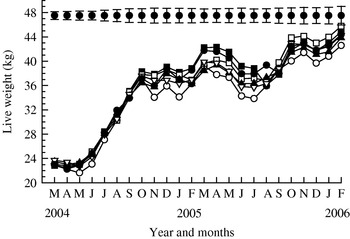
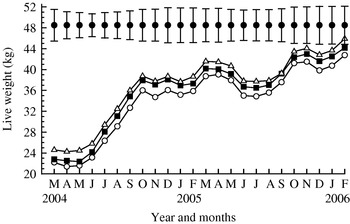
Goats were grazed as one flock, at near the recommended stocking rate of 10 dry sheep equivalents/ha on 10 ha of improved annual pasture divided into six paddocks. Goats were moved between paddocks every week or more frequently to match feed requirements. During the first year, pastoral conditions were affected by drought, and supplementary feeding of whole barley grain (average 150 g/goat/day) following Australian practice (McGregor Reference McGregor2005) was provided from mid-May to early September to maintain live weight (see Fig. 1). The pasture was composed of the following species: annual rye grass (Lolium rigidum), subterranean clover (Trifolium subterraneum), brome grass (Bromus mollis), silver grass (Vulpia spp.), barley grass (Hordeum leporinum), cape weed (Cryptostemma calendula), with a number of other grasses and weeds making a minor contribution. A mineralized stock block was always available (Ridley AgriProducts Pty. Ltd.) with the following content: minimum content Ca 49 g/kg; P 10 g/kg; S 20 g/kg; Cu 600 mg/kg; Co 60 mg/kg; I 60 mg/kg; Zn 1000 mg/kg; Fe+2 1100 mg/kg; Se 5 mg/kg; based on NaCl 0·75–0·85.
Mean live weight of Angora goats born in August 2002, for different shearing treatments over time. Live weight includes any fleece present at the time of weighing. Treatment s.e.d. is provided following analyses without covariates, but including shearing treatment. Error bars represent ±s.e.d. Symbols for shearing treatments: ○ April–October; ■ August–August; □ February–August; ▲ February–September; △ Often (four times per year); • September–September.

Goats were given a full crutching (removal of fibre from britch and belly areas) and wigging (removal of fibre from face and top knot) 3 months prior to any full shearing or every 3 months for the treatments shorn annually. As the goats in the Often treatment were shorn every 3 months they were not crutched or wigged. Goats were also vaccinated with Coopers Animal Health Tasvax 5 in 1 (Schering-Plough Pty. Ltd., New South Wales) to protect against five Clostridia spp. and ‘drenched’ with an effective anthelmintic to control gastro-intestinal parasites. All goats were weighed to the nearest 0·2 kg every month and 1 day prior to any shearing. At each weighing body condition score was also recorded (McGregor Reference McGregor1983, Reference McGregor1992, Reference McGregor2005). All goats were then fasted overnight prior to any shearing or crutching. Goats were returned to pasture together following shearing.
Mohair evaluation
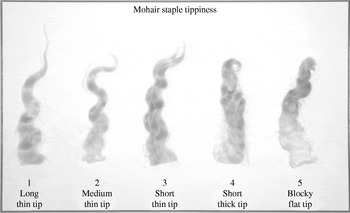
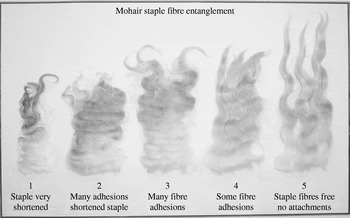
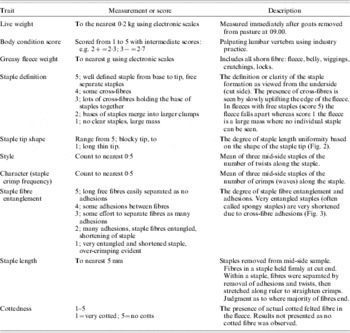
At crutching and shearing, fleeces, pieces, bellies and locks and samples were weighed to the nearest 1 g. Mid-side samples were taken at shearing, identified and stored in a plastic bag. A range of objective and subjective evaluations were completed on the mid-side sample prior to testing the sample (Table 1, Figs 2 and 3). Three staples from the mid-side sample were assessed for attributes in the following order: staple definition, staple tip shape, style, character, staple fibre entanglement and staple length. The assessed length was not the longest fibres in the staple tip but was subjectively determined with the aim of measuring to the point where most of the fibres were present before any significant narrowing of the staple near the tip, as per industry selling broker practice. Following laboratory evaluation, the mid-side samples were tested for clean washing yield, mean fibre diameter, fibre diameter variation, fibre curvature and medullated fibre content (using the OFDA100) following international wool testing standard methods (IWTO-19, IWTO-47, IWTO-57). Clean fleece weight was determined as: total greasy fleece weight including weight of crutchings (kg)×clean washing yield (as a proportion).
Examples of different mohair staple tip shape scores showing the variation in the appearance of the staple.

Examples of different mohair staple fibre entanglement scores showing the variation in the appearance of the staple.

Table of traits assessed during the shearing experiment

Statistical analysis
Fleece-free live weights were determined for each goat by subtracting the greasy fleece weight from the recorded live weight assuming that fleece growth rate followed the pattern exhibited by the Often shorn treatment. In other words, if the mohair growth rate was low in winter for the Often treatment then a similar proportion of the total annual greasy fleece growth was approximated as applying in other shearing treatments. Fleece-free live weights are more reliable for analysis as they overcome the differences in live weight resulting from different shearing frequencies where, for example, a 4 kg fleece is removed once a year compared with harvesting a 1 kg fleece every 3 months.
For most variates the values analysed were the sum of the values determined during the period of analysis, e.g. greasy fleece weights, staple length, character and style. For some variates the average measurement was determined by averaging the values determined during the time period, e.g. fleece-free live weight and body condition score. For fibre diameter attributes the weighted average was determined, e.g. the value at any one shearing was multiplied by the clean fleece weight and the sum of these was divided by the sum of clean fleece weights for the period under analysis. The October 2004 shearing was delayed by 3 weeks because of wet weather conditions. Measurements that were sums of values obtained as individual shearings were adjusted by the extra growth over the period of October 2004–November 2004 based on measurements for the Often shearing treatment. This was done by using the proportion of the November 2004 measurements for the Often shearing treatment calculated as the number of days that the October 2004 shearing was delayed divided by the number of days between the August 2004 shearing and November 2004 shearing of the Often treatment. This adjustment is regarded as valid as during this time period all treatments exhibited the same rapid live weight change (Fig. 1) in response to the excellent nutritional conditions while grazing rapidly growing spring pastures.
Measurements were analysed over the period of spring 2004 shearing to spring 2005 shearing, excluding the June–December shearing treatment. During this period, the frequency of shearing of each treatment being evaluated corresponded with actual number of shearings over the period, which simplifies interpretation. While the whole 2-year period was also examined, measurements over that period necessarily included shorter shearing intervals (edge effects) at the start and finish. This complicates interpretation because the shearing treatment being evaluated (e.g. annual shearing) is somewhat different to the shearing treatment being observed (e.g. annual shearing plus two half-yearly intervals at beginning and end of the 2-year period), and thus the 2-year period analyses are not presented.
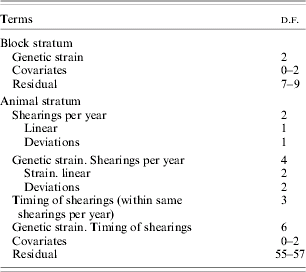
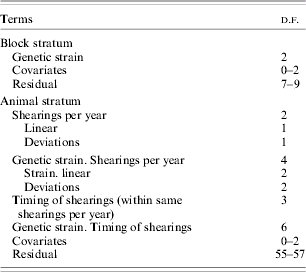
Measurements relating to the period spring 2004 shearing to spring 2005 shearing were analysed using analyses of variance (Payne Reference Payne2005) of the form presented in Table 2. Covariates were selected from measurements taken prior to the allocation of animals to this experiment, according to whether they substantially reduced the residual variation in the animal stratum. Inference is restricted to responses to different shearing regimes, and to differences between genetic strain in these responses, because some of the covariates differ between strains. Thus main strain effects are confounded with covariates. This non-standard analysis provides an exceptionally high level of precision for the effects of number of shearings per year because of the ‘hidden replication’ (Mead et al. Reference Mead, Curnow and Hasted1993) of the factorial and nesting structure (hidden replication=24, 36 and 24 for 1, 2 and 4 shearings per year), the use of response curves for number of shearings per year, and the control of between animal variation from using pre-treatment covariates. The analysis also achieves the highest level of cause and effect inference for number of shearings per year by maintaining all traditional experimental design principles. Standard errors of difference are provided as s.e.d.
Analysis of variance terms and degrees of freedom (d.f.) for measurements relating to the 1-year period from spring 2004 to spring 2005. The analysis excludes the June–December shearing treatment
RESULTS
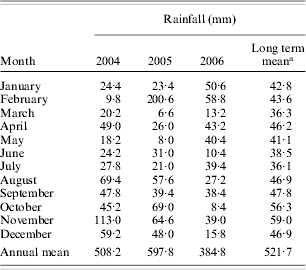
The rainfall over the spring 2004 to spring 2005 period was approximately 600 mm (Table 3). In February 2005, 167 mm of rain fell over a 30 h period. This type of rainfall event occasionally occurs during late summer in southern Australia. The goats were unaffected by this heavy rainfall as they had sufficient shelter to remain dry.
Monthly rainfall and long term mean monthly rainfall recorded at the Melbourne International Airport, 2·5 km west of the experimental site (37°40′S, 144°51′E) during the period of the experiment
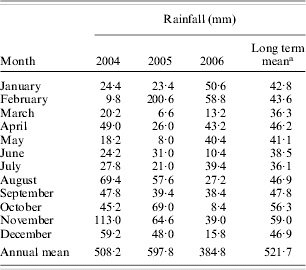
a For the period from 1970 until the end of 2006.
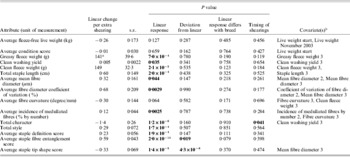
Substantial increase in live weight occurred during the spring of 2004, but changes in live weight were much less after this time (Figs 1 and 4). No effect of shearing treatment was detected on average fleece-free live weight or average body condition score (Tables 4 and 5).
Mean live weight of three genetic strains of Angora goats born in August 2002. Live weight includes any fleece present at the time of weighing. The s.e.d. is provided following analyses without covariates, but including June–December shearing treatment. Error bars represent ±s.e.d. Symbols for genetic strains: ○ South African; ■ Mixed; △ Texan.

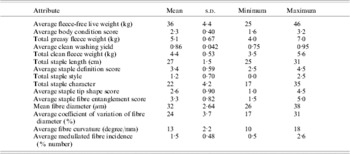
Mean, standard deviation and range in average fleece-free live weight and measured attributes of mohair. Data obtained from all 48 goats in treatments shorn every 6 months (including the June/December shearing treatment) for the 12-month period to spring 2005

The linear changes in attribute measurements for each extra shearing over a 1-year period between spring 2004 and spring 2005 following adjustment for covariates. Covariate(s) which were used are shown along with P values for (i) a linear response to number of shearings per year, (ii) any additional response to shearings per year (deviations from linear), (iii) differences in the linear response with breed and (iv) the effect of different shearing timings within same number of shearings per year. Bold P values indicate significance at less than 0·05
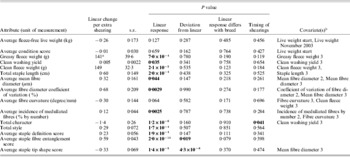
a This implies that greasy fleece weight decreases by 141 g by replacing biennial shearing (two shearings per year) with annual shearing (one shearing per year). Greasy fleece weight increases by 2×141=282 g by replacing biennial shearing with shearing four times per year.
b A 2 following the abbreviation refers to measurements taken at 12 months of age shearing, a 3 refers to 18 months of age shearing.
There was substantial variation between goats in average live weight and in mohair attributes (Table 4). The average annual greasy mohair production was 5·08 kg, and the average clean fleece production was 4·37 kg. These Angora goats produced an annual clean fleece equivalent to 0·122 of their mean fleece-free live weight (4·37 kg/35·6 kg). This fibre growth was equal to 0·34 g/kg/day.
Frequency of shearing effects on mohair production
Increasing the frequency of shearing affected 13 assessed attributes of mohair (Table 5). Increasing the frequency of shearing resulted in linear changes in most fleece attributes with deviations from linear changes detected for staple fibre entanglement and fibre tip scores. Total clean fleece weight increased by about 150 g for each extra shearing in the 1-year period and this was associated with a 6 mm increase in staple length and 0·32 μm increase in mean fibre diameter.
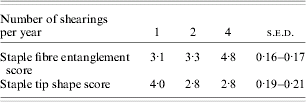
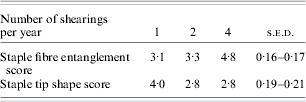
Staple tip shape score was typically score 4 (short thick tip) at one shearing per year and typically less than score 3 (short thin tip) at two and four shearings per year (Table 6). Staple fibre entanglement score was typically score 3 (many fibre adhesions) at one or two shearings per year, but typically score 5 (staple fibres free, no attachments) at four shearings per year (Table 6).
Effect of number of shearings per year on average staple entanglement score and average tip shape score from spring 2004 to spring 2005
Timing of shearing on annual production
There was no other evidence of a time of shearing effect, within those regimes that had the same number of shearings per year, on mohair attributes (Table 5). The one statistical significance for total character of P=0·041 is no more than would be expected by chance when examining a number of attributes.
Differences in shearing regime effects with genetic strain
There was no evidence that the effects due to number of shearings per year differed with breed (Table 5, all but one P value >0·1, range 0·079–0·910). There was a tendency for average staple fibre entanglement score to differ between genetic strain (P=0·079, Table 5). This occurred in Texan goats when frequency of shearing was one or two per year with an average score 2·7, compared with Mixed and South African strains which had average entanglement scores of 3·5, s.e.d. 0·26–0·30.
DISCUSSION
Frequency of shearing effects on mohair production
This experiment compared shearing frequencies ranging from one to four per year and a range of monthly shearing patterns. Each additional shearing resulted in an additional 149 g of clean mohair representing 0·034 of the annual clean mohair production (Table 5). This increase was associated with a 6 mm increase in staple length (+2·2%) and 0·32 μm increase in mean fibre diameter (+2·0% increase in cross-sectional area). The results imply that goats shorn four times per year grew an additional 10·2% of clean fibre compared with those shorn only once per year.
The present research documents the many advantages in fleece production and quality that arise from increasing frequency of shearing from once per year to two per year. These advantages increase further with shearing four times per year but the penalty of four shearings per year is the significantly reduced staple length of the harvested mohair making it impossible to achieve B length (100–120 mm) for sale lines. In South Africa, Texas and Australia, a frequency of shearing of two per year is general industry practice in order to provide fleeces with staple lengths of 120–150 mm. Presently the sale of overgrown mohair (>160 mm) is penalized with large discounts (McGregor & Butler Reference McGregor and Butler2004). B length fine mohair receives similar prices to the longer A length (120–160 mm) mohair (McGregor & Butler Reference McGregor and Butler2004). It may be possible to shear Angora goats with longer fleeces three times each year and still achieve B length mohair and thus avoid large market discounts for shorter C length (70–100 mm) mohair. Shearing three times per year may also enable producers to avoid crutching between shearings.
The reasons for increased fibre growth with increased frequency of shearing in small ruminants are poorly understood. The following factors are likely to be relevant:
1. Shearing stimulates a cold stress response, increasing the metabolic rate by up to 30% in sheep (Blaxter et al. Reference Blaxter, McCGraham and Wainman1959).
2. Shearing stimulates increased feed intake for about 5 months, as occurs with shorn Merino sheep (Farrell & Corbett Reference Farrell and Corbett1970; Birrell Reference Birrell1989).
3. With annually shorn animals there is more time for moulted fibres to be lost from the fleece (Stapleton Reference Stapleton1978; Schlink & Dollin Reference Schlink and Dollin1995), thus reducing weight of fibre harvested.
4. Fibre weathering losses. With Australian Merino sheep it is estimated that the quantity of fibre harvested is 4–7% less than that actually grown as a consequence of fibre weathering and abrasion losses (Wheeler et al. Reference Wheeler, Hedges and Mulcahy1977).
The effect of shearing more than once per year on fibre growth in Angora goats appears less than that reported with sheep. McGuirk et al. (Reference McGuirk, Paynter and Dun1966) found in strong wool Merino sheep that an extra winter or an extra summer shearing, i.e. two shearings per year, compared with an annual shearing resulted in an extra 10% of clean wool growth, associated with a 5·6–9·8% increase in staple length but no fibre diameter data is available. In New Zealand Romney sheep, Bigham (Reference Bigham1974) measured a 15, 18 and 23% increase in clean wool production of sheep shorn three, six and 12 times per year, respectively, compared with the control group shorn only once over an 11-month period. In Elliotdale carpet wool sheep, Reid & Sides (Reference Reid and Sides1984) reported no effect of frequency of shearing on wool production.
The response of the Angora goats to extra shearings in the current experiment was less than half of that reported by McGuirk et al. (Reference McGuirk, Paynter and Dun1966) and Bigham (Reference Bigham1974) for sheep. This may be related to the following effects:
1. The structure of the Angora goat fleece provides less protection against both cold and heat stress compared with the fleece of sheep (McGregor Reference McGregor1985). Thus Angora goats would expend proportionally more of their energy intake on maintenance and less on production compared with sheep, even with shearing once per year.
2. Angora goats may have a lower hourly rate of digestible organic matter intake (DR) compared with sheep. Higher DR is associated with higher rates of wool growth (Birrell Reference Birrell1992).
3. Angora goats may have a higher production of fibre per unit of body weight compared to Merino sheep. If this is so, the Angora goats may have a lower biological capacity to respond to additional shearing frequencies.
Thus restricted intake of energy and/or long periods of cold stress during the winter half year could exacerbate any seasonal depression in mohair growth.
Frequency of shearing effects on mohair quality attributes
The effects of frequency of shearing on objective and subjective fleece quality attributes reported here are new for any fleece bearing species as previous studies provided no (Reid & Sides Reference Reid and Sides1984) or only minimal information on quality traits (Bigham Reference Bigham1974) or used primarily subjective observations (McGuirk et al. Reference McGuirk, Paynter and Dun1966).
Entangled mohair
Entangled mohair is often downgraded during classing to an inferior style grade incurring a 20% price discount (McGregor Reference McGregor2002; McGregor & Butler Reference McGregor and Butler2004). In the present study, increasing the frequency of shearing above the current practice of twice per year was associated with a substantial reduction in entanglement score. This indicates that any delay in shearing, which is equivalent to reducing frequency of shearing, is likely to lead to increased staple entanglement scores. The results also indicated that Texan goats showed greater staple entanglement when the frequency of shearing was one or two per year and this is potentially important to mohair producers as it suggests that producers with Texan strain goats should not delay shearing and risk increasing staple entanglement and potential price discounts.
Staple tip shape score
The results show that on average, staple tips had a more blocky appearance with one shearing per year and a more tippy appearance with two or more shearings per year (Table 6). This result was not expected as there is uneven fibre growth between individual mohair fibres which, when extended over an entire year, was expected to result in more staples with a lower tip shape score than compared with mohair harvested from two shearings per year.
In Merino wool the blocky staple tips consist of wool wax, soil, suint and fragments of damaged wool caused by UV light, that together adhere the majority of the fibres in the tip in a sticky mass at an early stage following shearing (Goldsworthy & Lang Reference Goldsworthy and Lang1954). Mohair does not have these adhesions between fibres at the staple tip.
It is possible that more blocky staple tip shapes in the annual shearing treatments could arise from two other causes:
1. There is more time for moulted, loose and broken fibres to migrate out of the fleece and be lost in a similar manner to that described in Merino sheep (Schlink & Dollin Reference Schlink and Dollin1995). Thus the staple tip might look more even at the time of shearing.
2. There is more cumulative weathering damage to the staple tip and the ends of longer fibres have more time to break and be lost, leaving more uniformly blocky staple tips.
Both of these mechanisms would result in less harvested fleece and may in part explain why annually shorn fleeces were lighter. The first mechanism may also explain why the number of medullated fibres is lower compared with more frequent shearing treatments, as the medullated fibres have more time to migrate out of the fleece and be lost before the next shearing when the frequency of shearing is once per year, each spring.
Mohair character or mohair staple crimp frequency
The character trait measured in the present work is the actual count of mohair staple crimp frequency (Table 1). The present experiment showed that character or total staple crimp frequency was at a maximum when goats were shorn once per year and crimp frequency declined as frequency of shearing increased (Table 5).
The fibre curvature measurements may assist in the interpretation of the crimp character data. Fibre curvature is an objective measurement of wool staple crimp frequency (Brims Reference Brims1993). In the present work, fibre curvature is associated with staple crimp frequency. While frequency of shearing affects mohair crimp character score, there was only a tendency for frequency of shearing to be associated with fibre curvature and the absolute effect on fibre curvature was marginal (−0·3 degrees/mm, P=0·064). Thus while staple crimp character was affected by frequency of shearing, the actual physical impact on the curvature of individual mohair fibres was barely detectable.
To explain the present observations in mohair it is hypothesized that in the annual shearing treatment, the mohair fibres formed adhesions in the staple that were able to effectively fix the fibres and allow staple crimping to form. However, in the biannual shearing treatments there was less time between shearings to form effective adhesions, and so there was less time to form staple crimp. Clearly with four shearings per year there was even less time to form effective adhesions between fibres and so staple crimp frequency was still further reduced. These observations may also fit the explanation provided by Goldsworthy & Lang (Reference Goldsworthy and Lang1954) for the uniformity of crimping in some wool. Goldsworthy & Lang (Reference Goldsworthy and Lang1954) observed that if wool fibres were adhered at the tip and the skin they would form more uniform crimp patterns compared with wools without adhesions.
Timing of shearing on annual production
Period of measurement biases
When comparing regimes on a spring to spring basis there is the potential to create a period of measurement bias. This is because three shearing treatments were measured from August 2004 to August 2005, two shearing treatments were measured from September 2004 to September 2005 and one shearing treatment was measured from October 2004 to October 2005. However, no differences were found between shearing regimes that had the same number of shearings per year (Table 5). This implies that any biases due to period of measurement are likely to be small and are unlikely to have caused misinterpretation of the results. Normally during spring in southern Victoria, pastures are growing rapidly and have a high nutritional value (McGregor Reference McGregor1998). Live weight curves (Figs 1 and 4) indicate that similar rates of live weight gain were recorded during each spring (curves are parallel) implying that nutritional conditions were similar during the months of August–October 2004 as in August–October 2005.
CONCLUSION
Increased frequency of shearing increased mohair growth and changed 13 objective and subjective attributes of mohair fleeces. Managers of Angora goats should take note of the findings that goats which are shorn less frequently will grow less mohair that is more likely to be entangled in spring.
The Rural Industries Research and Development Corporation partly funded this project. Terry Couzens is thanked for assisting with animal management. John Hornweg is thanked for his dedicated shearing services. Mark Ferguson provided data collected on the animals prior to this project. Riverina Fleece Testing Services, Albury provided fleece testing services.