Introduction
Chemosynthesis-based ecosystems are most commonly found around hydrothermal vents and methane seeps in the deep sea. Most of the megafauna at these sites consist of highly specialized animals living in symbiosis with sulfur- and/or methane-oxidizing bacteria, which provide them with nutrients. At modern vents and seeps, these are mainly vestimentiferan tube worms, bathymodiolin mussels, and vesicomyid bivalves—all restricted to these environments. Mesozoic vents and seeps were also inhabited by animals endemic to such environments, although their taxonomic affinities were different. Common were rhynchonellide brachiopods of the Dimerelloidea, a group that disappeared from vents and seeps by the end of the Early Cretaceous (Campbell and Bottjer, 1995a, Reference Campbell and Bottjerb; Sandy, Reference Sandy2010; Peckmann et al., Reference Peckmann, Kiel, Sandy, Taylor and Goedert2011; Kiel et al., Reference Kiel, Glodny, Birgel, Bulot, Campbell, Gaillard, Graziano, Kaim, Lazăr and Sandy2014). Among mollusks, gastropods of the Abyssochrysoidea were common, including large-sized taxa (Goedert and Kaler, Reference Goedert and Kaler1996; Kaim et al., 2008, 2009, Reference Kaim, Jenkins, Tanabe and Kiel2014; Kiel et al., Reference Kiel, Campbell and Gaillard2010), and bivalves restricted to the seep environment included several genera of Lucinidae (Kiel, Reference Kiel2013) and the large kalenterid genus Caspiconcha Kelly in Kelly et al., Reference Kelly, Blanc, Price and Whitham2000.
Initially described from Greenland, Caspiconcha is now known from seep deposits from the Atlantic, Pacific, and Tethys Oceans and from both hemispheres (Kelly et al., Reference Kelly, Blanc, Price and Whitham2000; Kiel and Peckmann, Reference Kiel and Peckmann2008; Kiel et al., 2010, Reference Kiel, Birgel, Campbell, Crampton, Schiøler and Peckmann2013; Agirrezabala et al., Reference Agirrezabala, Kiel, Blumenberg, Schäfer and Reitner2013; Jenkins et al., Reference Jenkins, Kaim, Little, Iba, Tanabe and Campbell2013). Its shell morphology indicates the presence of a byssus, and when found in situ, it is usually oriented with the anterior part about 30° downward relative to the bedding plane, suggesting a semi-infaunal/epifaunal mode of life (Kelly et al., Reference Kelly, Blanc, Price and Whitham2000; Kiel and Peckmann, Reference Kiel and Peckmann2008). Its large size (exceeding 300 mm in length) and its abundance at many Early Cretaceous seep deposits suggest that Caspiconcha harbored chemotrophic bacteria in its gills, like the dominant bivalves at vents and seeps today (Kelly et al., Reference Kelly, Blanc, Price and Whitham2000; Jenkins et al., Reference Jenkins, Kaim, Little, Iba, Tanabe and Campbell2013). So far, there are three nominal species of Caspiconcha: the type species C. whithami Kelly in Kelly et al., Reference Kelly, Blanc, Price and Whitham2000 from the Barremian of Greenland; Caspiconcha major (Gabb, Reference Gabb1869) from Tithonian to Albian seep deposits in California (Jenkins et al., Reference Jenkins, Kaim, Little, Iba, Tanabe and Campbell2013); and Caspiconcha rubani Kiel, Campbell, and Gaillard, Reference Kiel, Campbell and Gaillard2010 from the Berriasian of the Crimea. Several other species have been left in open nomenclature pending more exhaustive taxonomic work and/or collecting effort. Here we formally describe four of these species and discuss the evolutionary history of Caspiconcha and other seep-related kalenterids/modiomorphids.
Geologic setting
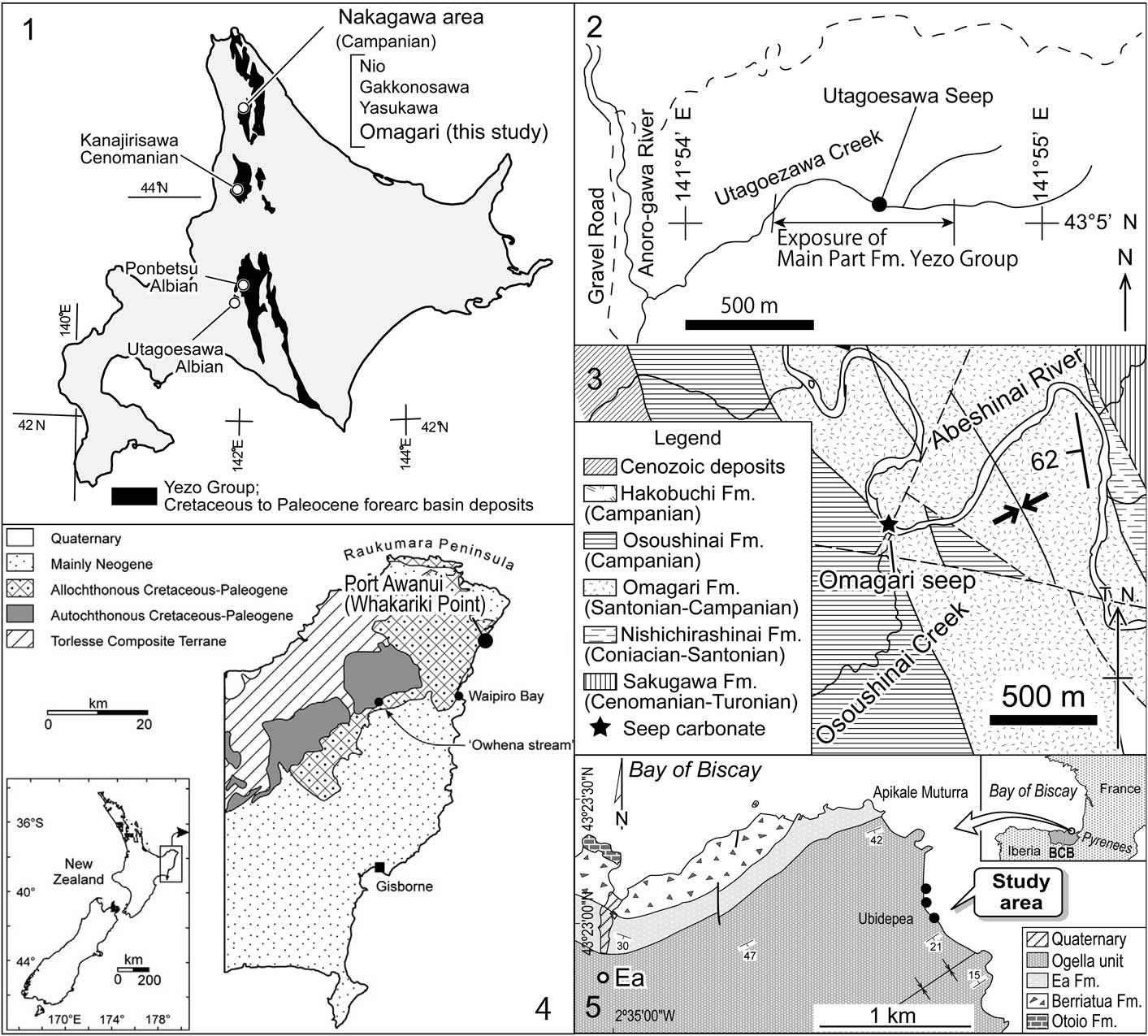
The material is from localities in Spain, New Zealand, and Japan that have been described elsewhere (Fig. 1). They are briefly outlined here, with references to more detailed reports.
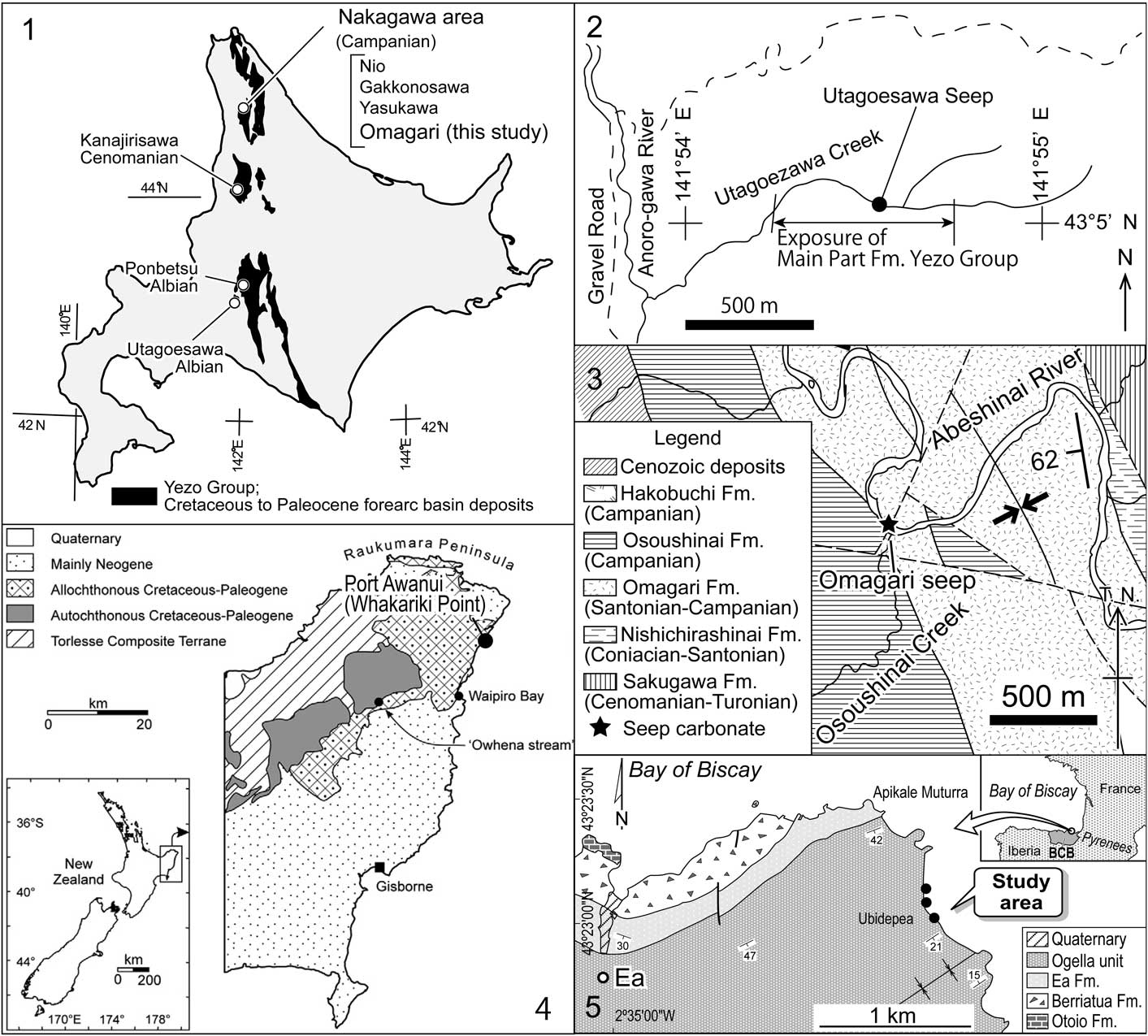
Maps showing the fossil localities of Caspiconcha described in the text. (1) Locality map of the Utagoesawa seep and the Omagari lens in Hokkaido, Japan. (2) Detailed map of the Utagoesawa Seep in Yubari City, Hokkaido, Japan. (3) Detailed map of the Omagari lens in Nakagawa area, Hokkaido, Japan. After Takahashi et al. (Reference Takahashi, Hirano and Sato2003). (4) Locality map of the Raukumara Peninsula, northern New Zealand. After Kiel et al. (Reference Kiel, Birgel, Campbell, Crampton, Schiøler and Peckmann2013). (5) Locality map of Ispaster, Spain. After Agirrezabala et al. (Reference Agirrezabala, Kiel, Blumenberg, Schäfer and Reitner2013).
Ispaster, Spain
More than 50 limestone bodies crop out on an intertidal platform composed mostly of turbidites along the coast of the Bay of Biscay in the Basque country, Spain, between the villages Ea and Ispaster. They were identified as ancient methane-seep deposits using stable carbon isotope, petrographic, and biomarker evidence, are of late Albian age, and belong to the Ogella unit of the Black Flysch Group (Agirrezabala et al., Reference Agirrezabala, Kiel, Blumenberg, Schäfer and Reitner2013). All investigated specimens described here as Caspiconcha basquensis n. sp. are from float boulders of seep limestone found along the beach at this section.
Utagoesawa, Japan
Large carbonate bodies crop out along the Utagoesawa Creek (also called Utagoshisawa Creek by local people) in Yubari City, central Hokkaido, Japan. The carbonate bodies are surrounded by late Albian (Early Cretaceous) muddy sediment of the Yezo Group. A detailed description of this locality is pending, but basic information was provided by Ogihara (Reference Ogihara2005) and Jenkins et al. (Reference Jenkins, Kaim, Little, Iba, Tanabe and Campbell2013). The petrography of the carbonate bodies includes typical seep textures (e.g., isopachous radiaxial carbonate cements and clotted fabrics), and those cements show a carbon isotope signature as low as −47‰ VPDB (Vienna Peedee belemnite), which clearly indicates seep origin.
Port Awanui, New Zealand
Limestone boulders eroded from the well-exposed, calcareous mudstone unit that forms the shore and is from within the undifferentiated Whangai–Wanstead formations float on the shore platform close to the headland of Whakariki Point at Port Awanui. Using stable carbon isotope, petrographic, and biomarker evidence, these limestone boulders were identified as ancient methane-seep deposits (Kiel et al., Reference Kiel, Birgel, Campbell, Crampton, Schiøler and Peckmann2013). Most specimens described here as Caspiconcha raukumaraensis n. sp. are from locality Awanui GS688 (New Zealand Fossil Record File number FRF Z15/f7485) and are dated as mid-Cenomanian. A single specimen is from the locality Awanui II (FRF Z15/f82) dated as late Albian to mid-Cenomanian (Kiel et al., Reference Kiel, Birgel, Campbell, Crampton, Schiøler and Peckmann2013).
Omagari seep site, Japan
A~10 m wide carbonate body is exposed as a small islet in the Abeshinai River near the mouth of its tributary, Osoushinai River, within strata of the Omagari Formation, Yezo Group, and dated as Campanian (Takahashi et al., 2003, Reference Takahashi, Hikida, Jenkins and Tanabe2007; Jenkins et al., Reference Jenkins, Kaim and Hikida2007). It was identified as an ancient methane-seep deposit using stable carbon isotope, petrographic, and biomarker evidence (Hikida et al., Reference Hikida, Suzuki, Togo and Ijiri2003; Ogihara, Reference Ogihara2005; Jenkins and Hikida, Reference Jenkins and Hikida2011). A single large bivalve from this deposit was previously identified as Calyptogena sp. (Hikida et al., Reference Hikida, Suzuki, Togo and Ijiri2003) and is here described as Caspiconcha lastsamurai n. sp.
Materials and methods
Most of the specimens described here were collected by the authors, and selected specimens were mechanically prepared. The comparative figured material of C. whithami Kelly in Kelly et al., Reference Kelly, Blanc, Price and Whitham2000 and C. major (Gabb, Reference Gabb1869) is housed at the Sedgwick Museum, University of Cambridge, UK (SMUC) and the California Academy of Science (CAS), respectively.
Repositories and institutional abbreviations
NMM, Nakagawa Museum of Natural History, Nakagawa Town, Hokkaido, Japan; NMNS, National Museum of Nature and Science, Tsukuba, Japan; NRM, Swedish Museum of Natural History, Department of Palaeobiology, Stockholm, Sweden; GNS, Geological and Nuclear Science, Lower Hutt, New Zealand; UMUT, University Museum, the University of Tokyo.
Systematic paleontology
Class Bivalvia Linnaeus, Reference Linnaeus1758
Subclass Autobranchia Grobben, Reference Grobben1894
Superorder Heteroconchia Gray, Reference Gray1854
Order Carditida Dall, Reference Dall1889
Superfamily Kalenteroidea Marwick, Reference Marwick1953
Family Kalenteridae Marwick, Reference Marwick1953
Remarks
Kalenterids were previously classified within the Pholadomyoida (e.g., Waller, Reference Waller1990; Fang and Morris, Reference Fang and Morris1997; Kelly et al., Reference Kelly, Blanc, Price and Whitham2000; Griffin and Pastorino, Reference Griffin and Pastorino2006), Palaeoheterodonta (Cox et al., Reference Cox1969; Hautmann, 2001, Reference Hautmann2008), or Carditida (e.g., Chavan, 1954, Reference Chavan1969; Newell, 1957, Reference Newell1969; Nevesskaja, Reference Nevesskaja2009). Here we follow the interpretation of Kaim and Schneider (Reference Kaim and Schneider2012) who placed the kalenterids among the Carditida based on the presence of complex cross-lamellar shell microstructure and the lack of a nacreous layer in two genera of kalenterids: Caspiconcha (Jenkins et al., Reference Jenkins, Kaim, Little, Iba, Tanabe and Campbell2013) and Myoconcha J. Sowerby, Reference Sowerby1824 (Kaim and Schneider, Reference Kaim and Schneider2012).
Genus Caspiconcha Kelly in Kelly et al., Reference Kelly, Blanc, Price and Whitham2000
Type species
Caspiconcha whithami Kelly in Kelly et al., Reference Kelly, Blanc, Price and Whitham2000; Early Cretaceous (late Barremian), NE Greenland.
Occurrence
Tithonian (Late Jurassic) to Campanian (Late Cretaceous). Barremian of Greenland, Tithonian to Albian of California, Hauterivian of Crimea and possibly Czech Republic, Albian of Basque Country, Spain, Albian–Cenomanian of New Zealand, and Albian and Campanian of Hokkaido, Japan.
Remarks
Due to its similarity to Myoconcha regarding the modioliform shape, deeply set anterior adductor muscle scars with myophoric buttress, and extreme reduction of the anterior side of the shell, Kelly et al. (Reference Kelly, Blanc, Price and Whitham2000) placed Caspiconcha among the Modiomorphidae, subfamily Myoconchidae. Later, Myoconchidae/Myoconchinae have been synonymized with Kalenteridae (Damborenea, Reference Damborenea2004; Bouchet et al., Reference Bouchet, Rocroi, Bieler, Carter and Coan2010; Jenkins et al., Reference Jenkins, Kaim, Little, Iba, Tanabe and Campbell2013), and subsequently Caspiconcha is here classified in Kalenteridae. Caspiconcha differs from Myoconcha by lacking external radial ornament and by possessing an edentulous hinge and a caspiconchiid process.
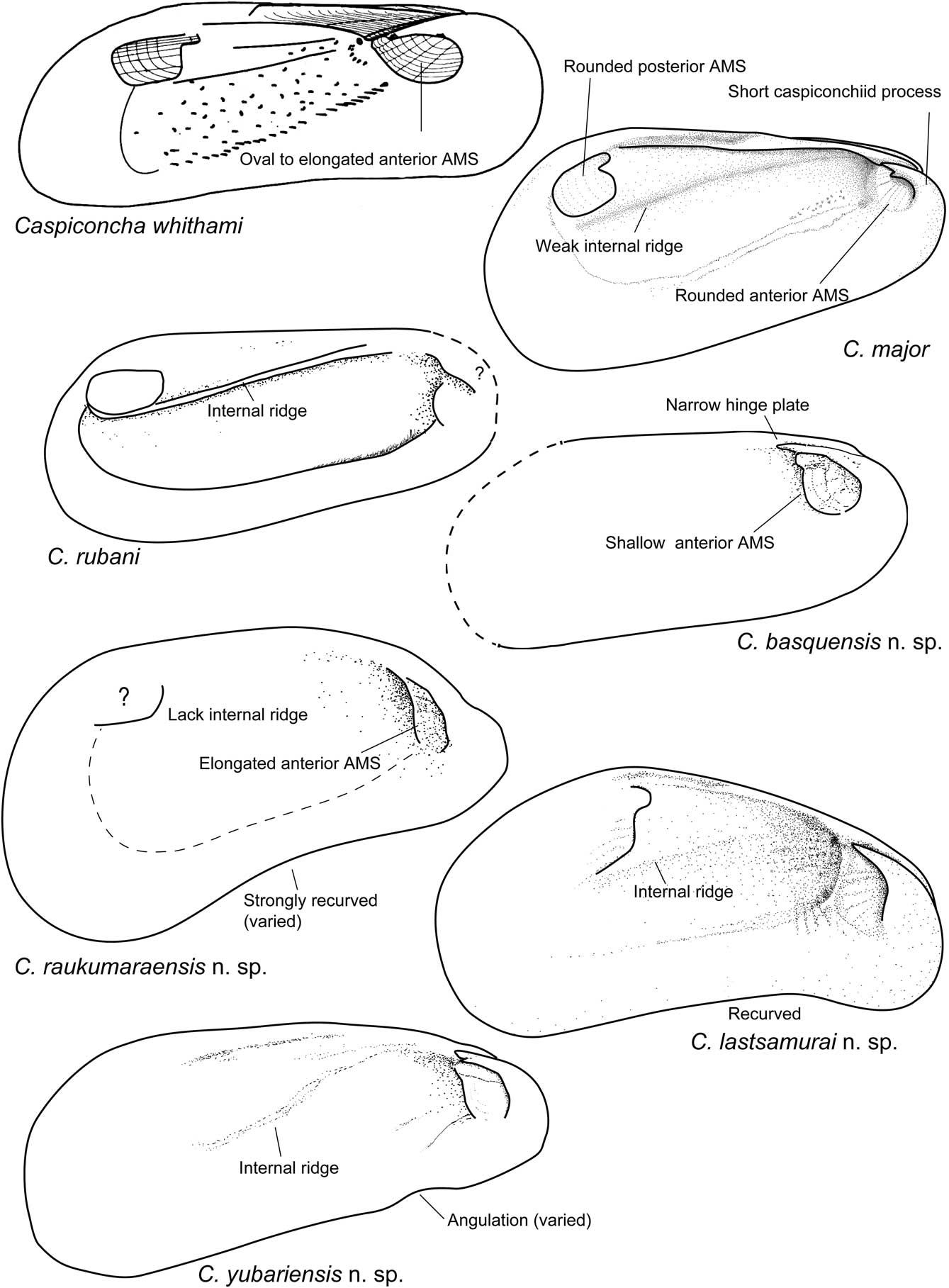
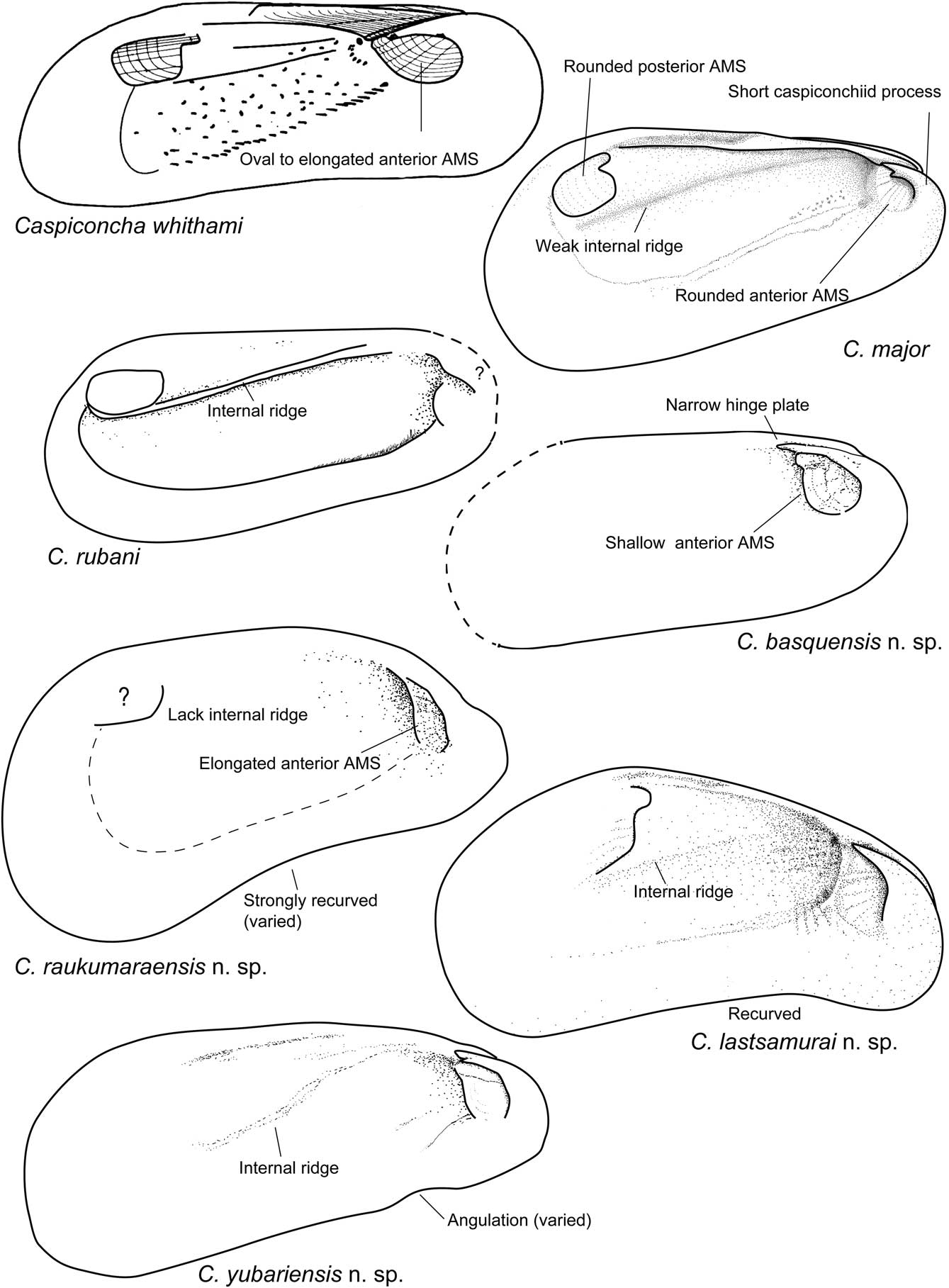
The nominal species are Caspiconcha whithami Kelly in Kelly et al., Reference Kelly, Blanc, Price and Whitham2000 from the Barremian of Greenland (Kelly et al., Reference Kelly, Blanc, Price and Whitham2000), C. rubani Kiel, Campbell, and Gaillard, Reference Kiel, Campbell and Gaillard2010 from the late Berriasian of the Crimean Peninsula (Kiel and Peckmann, Reference Kiel and Peckmann2008; Kiel et al., Reference Kiel, Campbell and Gaillard2010), C. major (Gabb, Reference Gabb1869) from Tithonian to Albian localities in the Great Valley Group in California (Stanton, Reference Stanton1895; Kiel et al., Reference Kiel, Amano and Jenkins2008; Jenkins et al., Reference Jenkins, Kaim, Little, Iba, Tanabe and Campbell2013), and the new species C. basquensis n. sp. from the late Albian of northern Spain, C. yubariensis n. sp. from the late Albian of Utagoesawa seep, central Hokkaido, Japan, C. raukumaraensis n. sp. from the late Albian to mid-Cenomanian of New Zealand, and C. lastsamurai n. sp. from the Campanian of the Omagari seep, northern Hokkaido. Illustrations with indication of selected key characters of all nominal species, including the four new species described herein, are in Figure 2. In addition, ‘Myoconcha aff. transatlantica’ from the Early Cretaceous (Hauterivian) of the Czech Carpathians (Ascher, Reference Ascher1906) is most likely a species of Caspiconcha (Kiel and Peckmann, Reference Kiel and Peckmann2008; Kaim, et al., Reference Kaim, Skupien and Jenkins2013). A specimen possibly belonging to Caspiconcha was found in a Santonian (Late Cretaceous) debris flow deposit in Amakusa, southwestern Japan (N. Kikuchi and Y. Kondo, Kochi University, personal communication, 2012): it reaches nearly 300 mm in length and has a broad, modioliform outline, but no internal shell features were observed.
Schematic illustrations of all nominal Caspiconcha species with indications of selected key characters. AMS=adductor muscle scar. After Kelly et al. (Reference Kelly, Blanc, Price and Whitham2000) and Kiel et al. (Reference Kiel, Campbell and Gaillard2010) for illustrations of C. whithami and C. rubani, respectively.
Caspiconcha basquensis new species
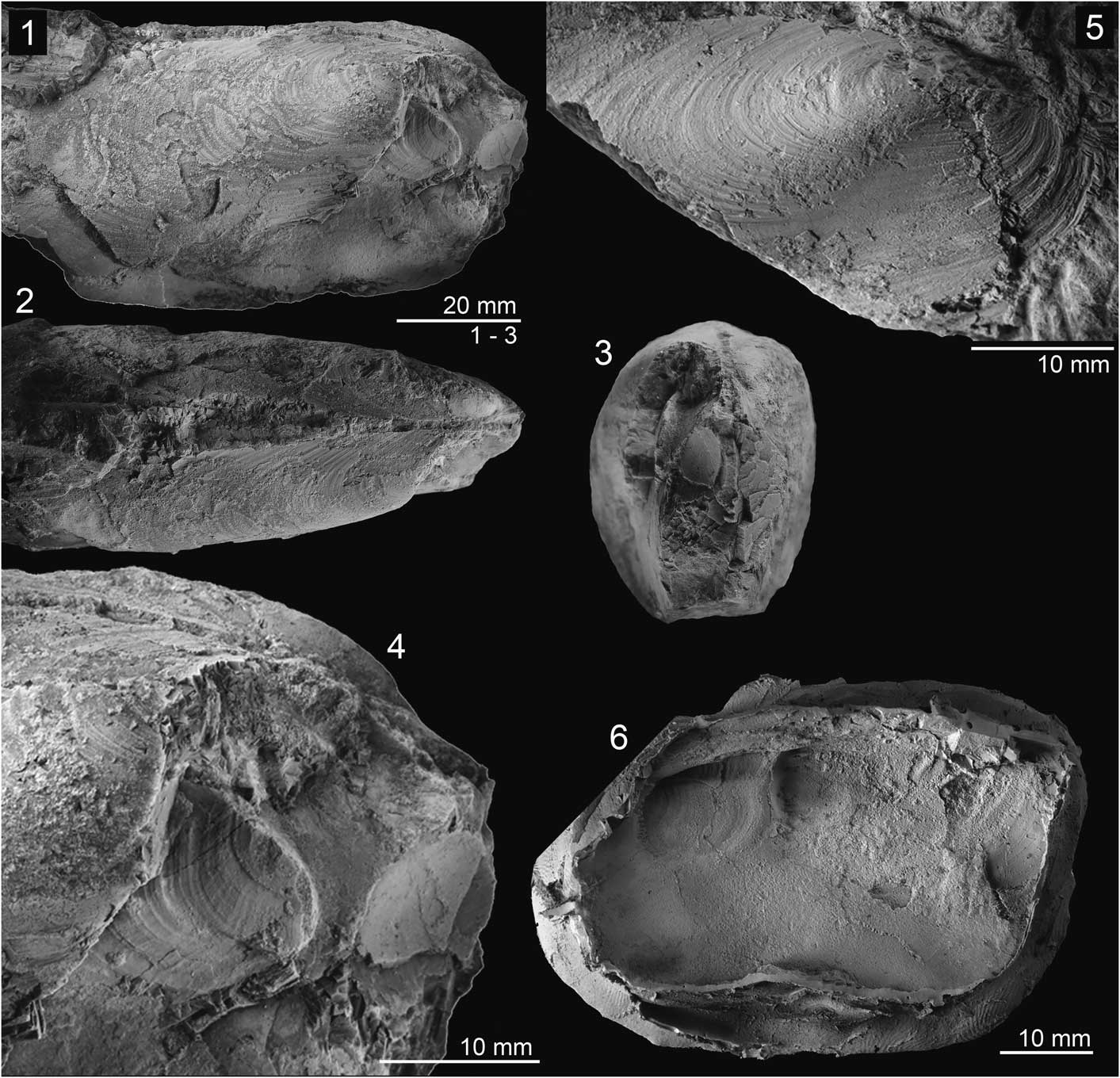
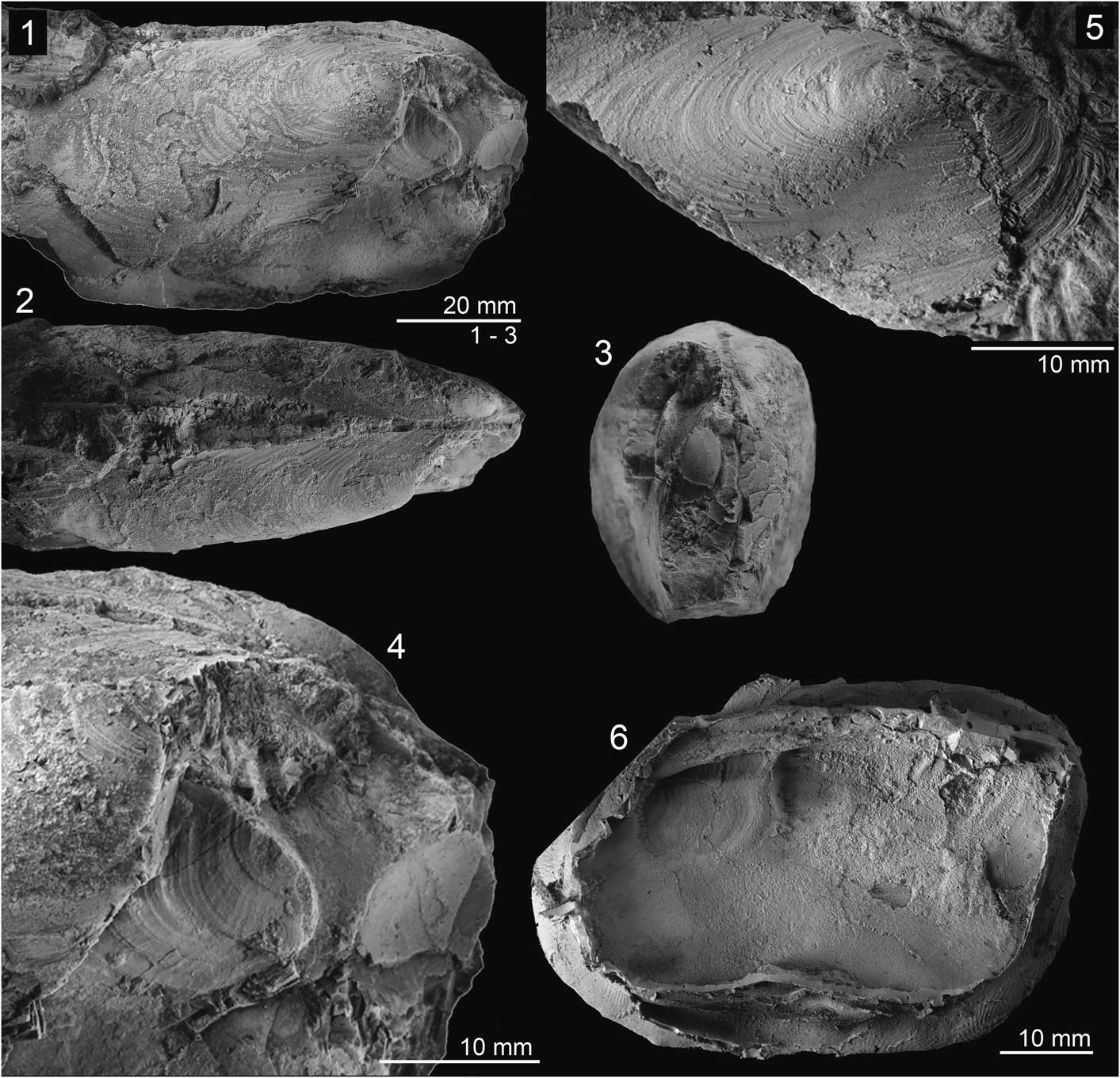
Caspiconcha basquensis new species from Albian seep carbonates exposed along the shoreline between the villages Ea and Ispaster, west of Lekaitio, Basque country, in northern Spain. (1–4) Holotype (NRM Mo 182801), specimen with partially preserved shell; anterior part of right valve broken away, showing mold of anterior adductor muscle scar; (1) right valve; (2) dorsal view; (3) anterior view; (4) close-up of anterior end. (5) Paratype (NRM Mo 182802), small specimen with well-preserved shell. (6) Paratype (NRM Mo 182803), rubber cast of anterior side of specimen, showing adductor and pedal retractor scars (from Agirrezabala et al., Reference Agirrezabala, Kiel, Blumenberg, Schäfer and Reitner2013).
2013 Caspiconcha sp. Reference Agirrezabala, Kiel, Blumenberg, Schäfer and ReitnerAgirrezabala et al., p. 102, fig. 16C, D.
Holotype
NRM Mo 182801.
Paratypes
NRM Mo 182802, 182803, and six unnumbered, fragmentary specimens.
Diagnosis
Modioliform shell with strong anteroposterior elongation; nearly straight dorsal and ventral margin, broad ridge from the umbo to the posteroventral margin; no triangular depression runs below the ridge; moderately deep-set anterior adductor muscle scar.
Occurrence
Seep carbonates in Ubidepea mudstone (informal subunit; late Albian), Ogalla unit, Black Flysch Group exposed along the shore between the villages Ea and Ispaster, west of Lekaitio, Basque country, northern Spain.
Description
Shells elongate modioliform, up to 210 mm long, dorsal and ventral sides nearly straight; umbo subterminal, prosogyrate, very low, pointed; inflation moderate, greatest along a broad ridge from the umbo to the posteroventral margin, no triangular depression below ridge; surface with fine, irregular growth increments. Interior of shell with broad ridge and several fine striations from umbo to posterior end. Anterior adductor muscle scar oval, anteroposteriorly elongated, moderately impressed, deepest at anterodorsal side; curved, commarginal growth increments pointing toward the posterior on entire scar, crossed by fine, perpendicular striations; pedal retractor scar elongate trapezoid, directly adjacent posterodorsally to anterior adductor scar, separated by indistinct ridge; pedal elevator muscle scar elongate oval with longitudinal striations, positioned posterior of pedal retractor scar, separated from it by strong ridge. Myophoric buttress indistinct; caspiconchiid process present; hinge plate narrow, edentulous.
Etymology
For the Basque country, Spain, where the type locality is located.
Remarks
Caspiconcha basquensis n. sp. is similar to the type species C. whithami in being straight and elongate and having an anteroposteriorly elongated oval anterior adductor muscle scar, but differs by having a narrow hinge plate and a more pointed anterior shell; C. whithami has a broad hinge plate and a broad anterior shell. The more pointed anterior side also distinguishes Caspiconcha basquensis from the similarly straight and elongate species C. rubani. Caspiconcha basquensis differs from all other known species of Caspiconcha by having a shallower anterior adductor muscle scar.
Caspiconcha yubariensis new species
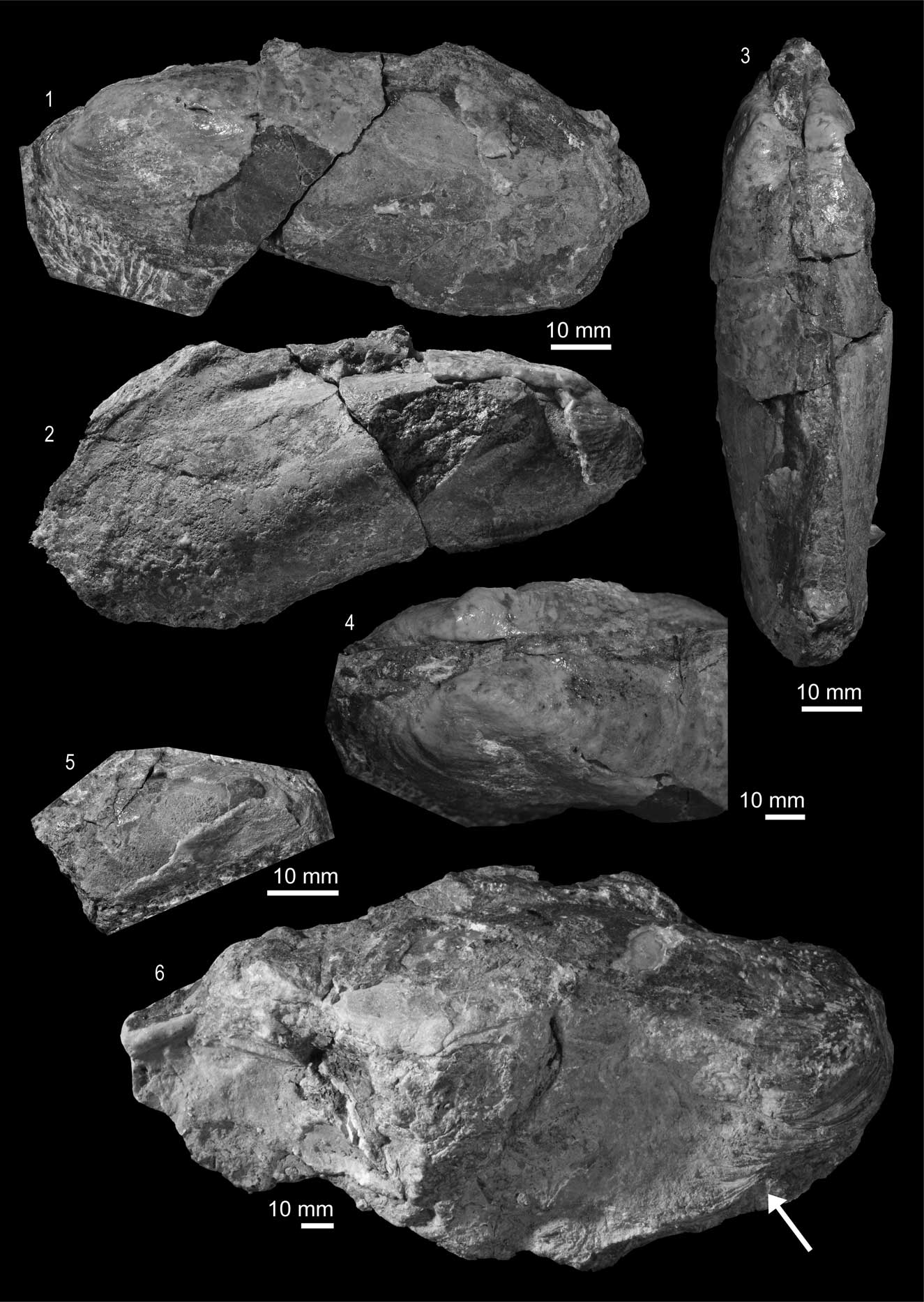
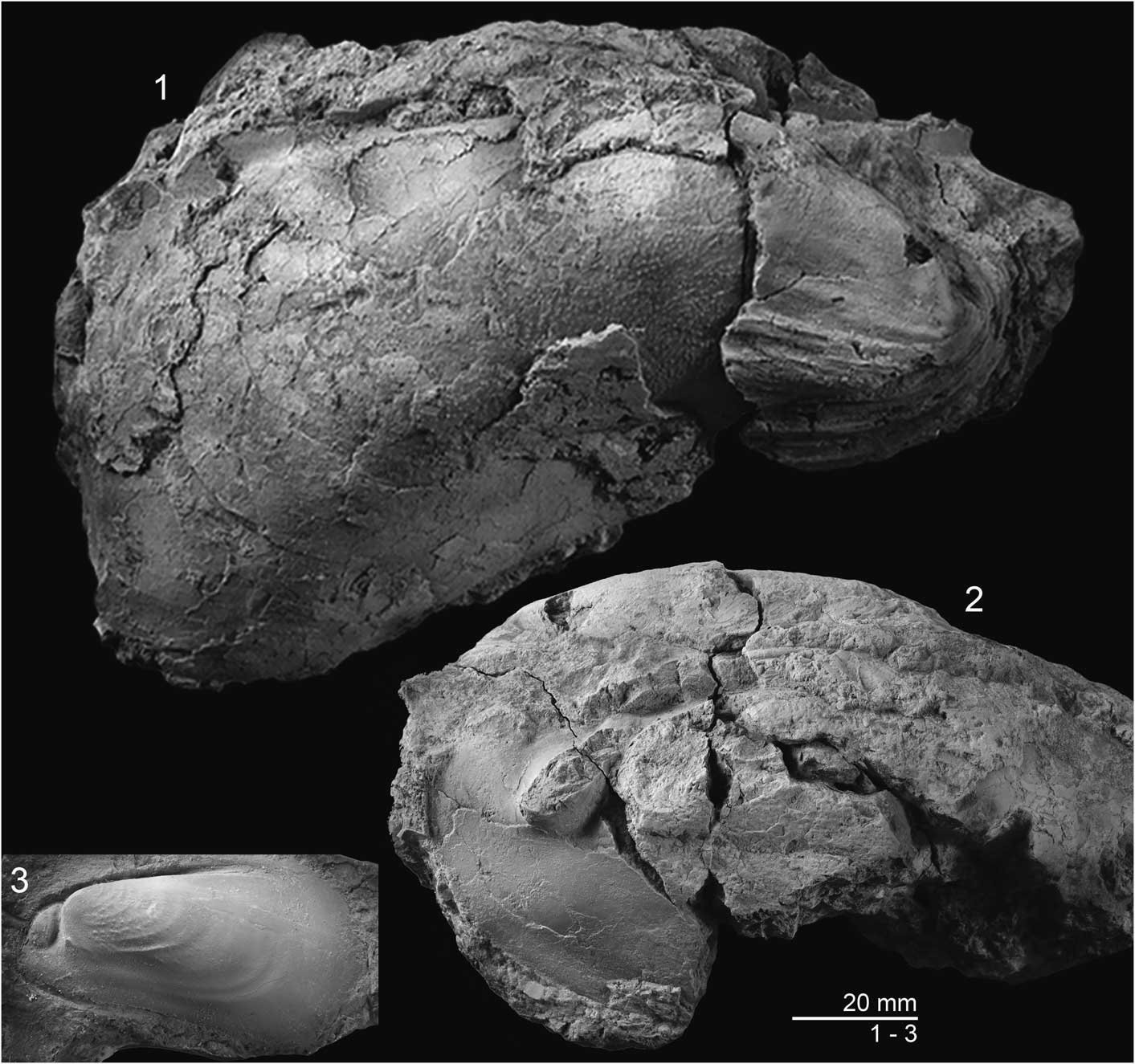
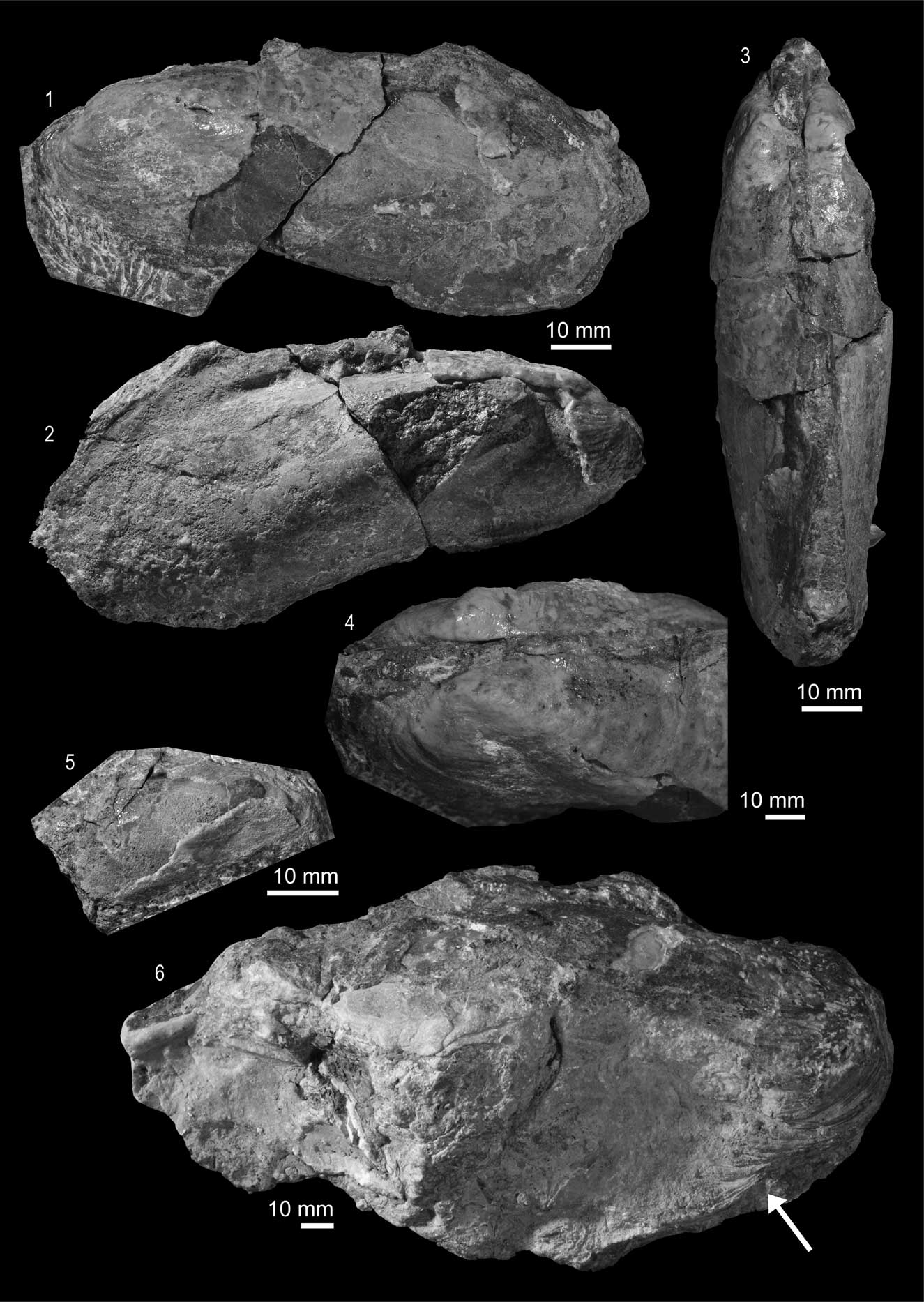
Caspiconcha yubariensis new species from late Albian seep carbonates in Utagoesawa Creek, northern Japan. (1–4) Holotype (NMNS PM27843), articulated specimen, most of shell of right valve peeled off, showing internal mold with myophoric buttress and partial anterior adductor muscle scar; (1) left valve; (2) right valve; (3) dorsal view; (4) oblique view, close-up of anterior part showing strong ridge and depression. (5) Paratype (NMNS PM27841), right valve of juvenile specimen. (6) Paratype (NMNS PM25523), right valve of articulated adult specimen, angulation in anteroventral area (arrow).
2013 Caspiconcha sp. Reference Jenkins, Kaim, Little, Iba, Tanabe and CampbellJenkins et al., p. 371, fig. 11.
Holotype
Best preserved specimen (NMNS PM27843).
Paratypes
NMNS PM25523-25525, 27837-27842.
Diagnosis
Shell modioliform to subtrapezoidal; strong ridge from the umbo to posteroventral margin, relatively narrow but clear depression runs below the ridge; varied angulation in anteroventral area especially in adult specimen; deep-set anterior muscle scar; strong internal ridge.
Occurrence
Utagoesawa seep site in late Albian (Early Cretaceous) deposit of ‘main part formation,’ Yezo Group exposed along the Utagoesawa Creek, Yubari City, Hokkaido, Japan.
Description
The shell large, up to 247 mm (NMNS PM25523); modioliform to subtrapezoidal, equivalve, strongly inequilateral, strong inflation in the dorsal part of the central flank running obliquely toward posterior part of the ventral margin, relatively well-developed triangular depression runs from the umbonal area widening toward the mid flank; dorsal margin slightly curved along its whole extent, posterior margin rounded, angulation of shell shape in anteroventral part, strength of angulation varies among species; umbones close to the anterior end, situated at, or slightly below, the hinge line; shell thick, especially in the anterior part; exterior ornament consists of commarginal growth lines, more pronounced on the shell anterior; shell interior generally smooth, large elongated anterior adductor muscle scar bordered posteriorly by a stout myophoric buttress, strong oblique ridge running from umbonal area toward posterodorsal area, probable posterior adductor muscle scar situated just above the oblique ridge in posterodorsal area; hinge stout with very long ligament groove.
Etymology
For Yubari City, from the type area of the species.
Remarks
Angulation of the shell shape in anteroventral part varies among observed specimens; for example, adult specimens of NMNS PM25523 (Fig. 4), 27837 and 27839 have strong angulation, although juvenile (paratype NMNS PM27841, Fig. 4) and young (holotype NMNS PM27843, Fig. 4) specimens have very weak angulation. Caspiconcha yubariensis n. sp. is similar to the type species C. whithami in general shell shape, but differs by having a much stronger ridge and a relatively narrow and strong depression from the umbonal area toward the posteroventral area. Caspiconcha yubariensis is also similar to C. raukumaraensis n. sp. in general shell shape, but C. raukumaraensis differs by its shallow myophoric buttress and the lack of internal ridge. Caspiconcha yubariensis differs from other known Caspiconcha species by having angular anteroventral margins.
Caspiconcha raukumaraensis new species
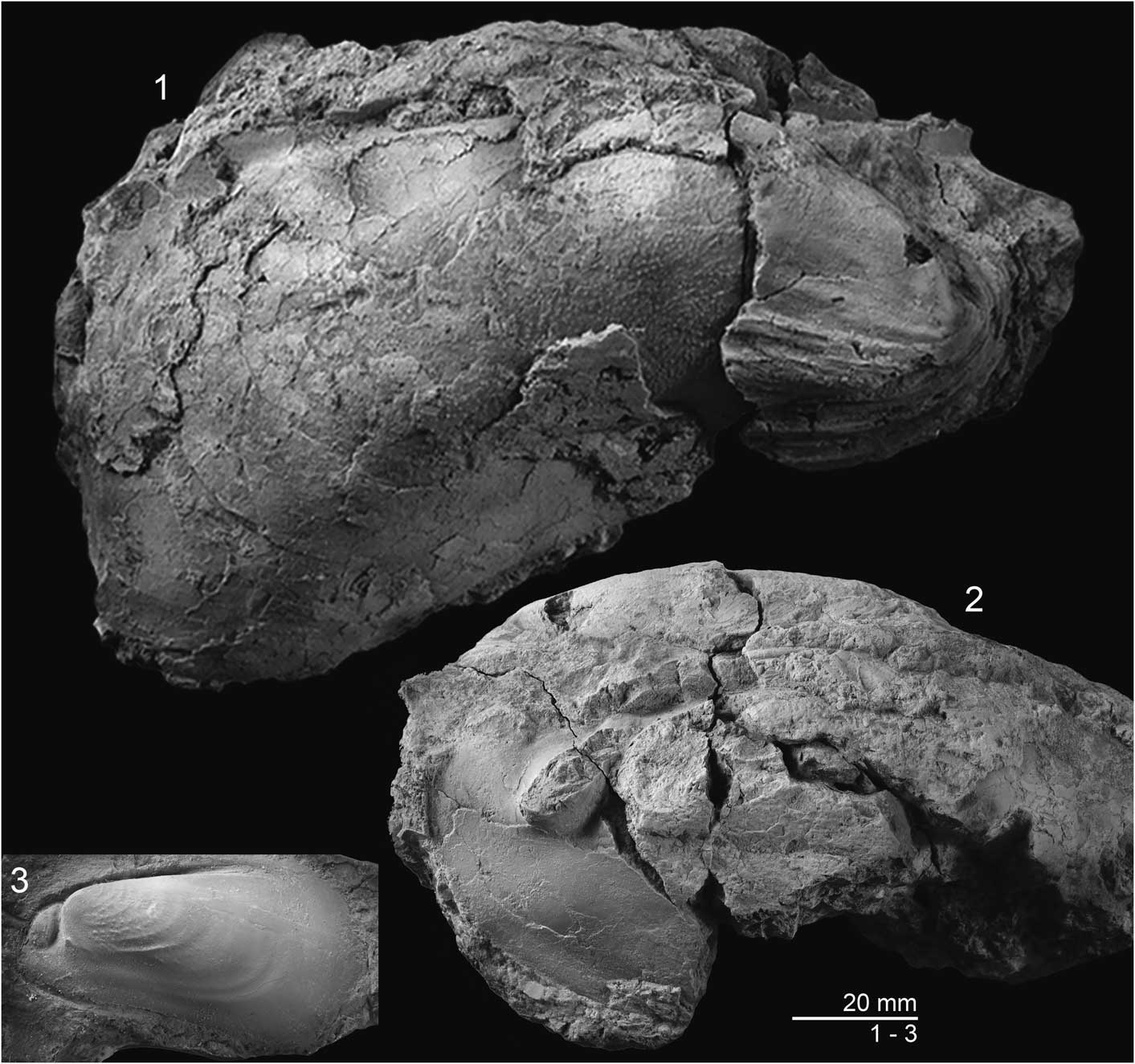
Caspiconcha raukumaraensis new species from Albian to Cenomanian seep carbonates at Port Awanui in New Zealand. (1, 2) Holotype (TM8832), semiarticulated specimen, right valve with partially preserved shell, internal mold of left valve showing anterior adductor muscle scar (fig. 1 from Kiel et al., Reference Kiel, Birgel, Campbell, Crampton, Schiøler and Peckmann2013). (3) Paratype (TM9255), internal mold of left valve.
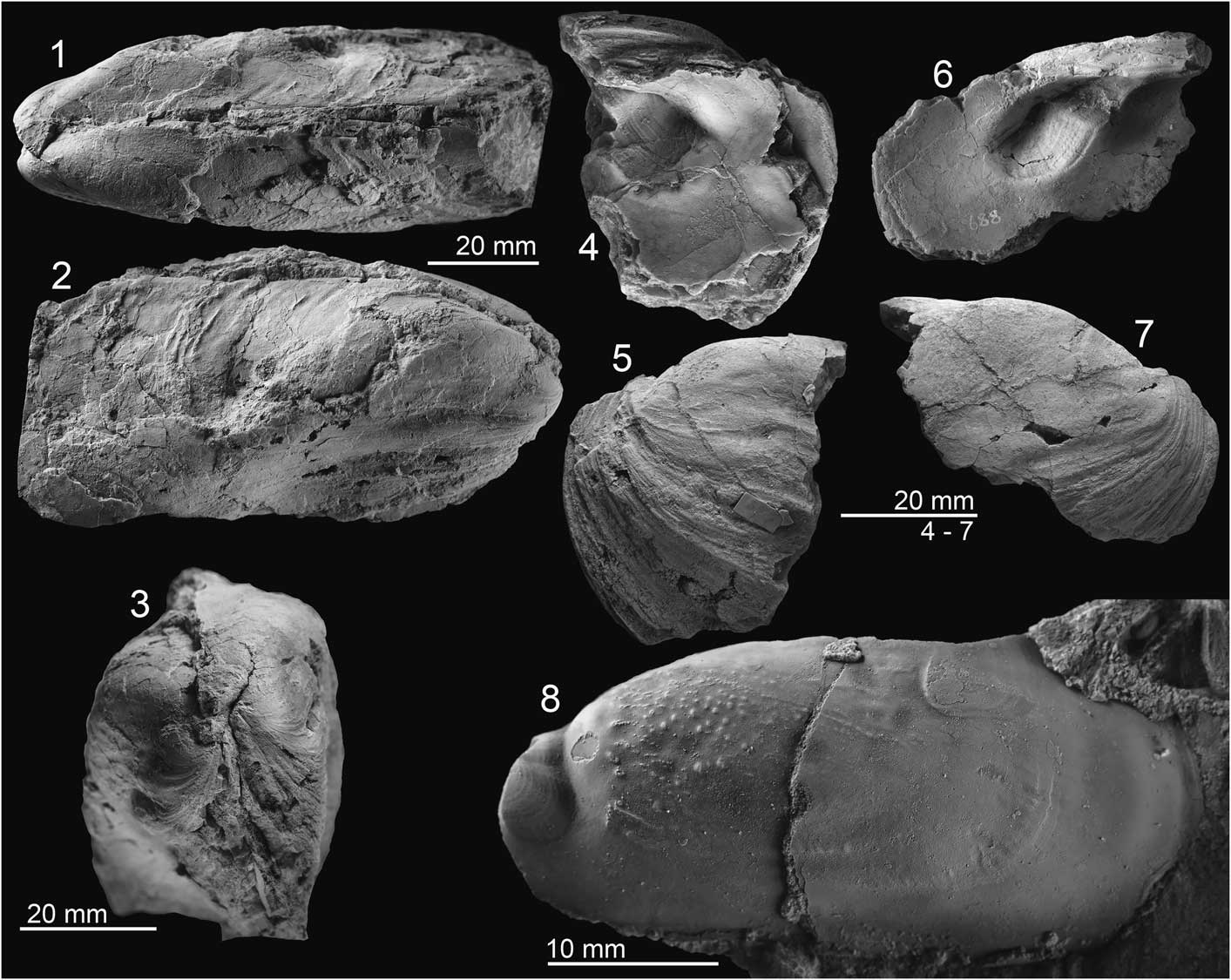
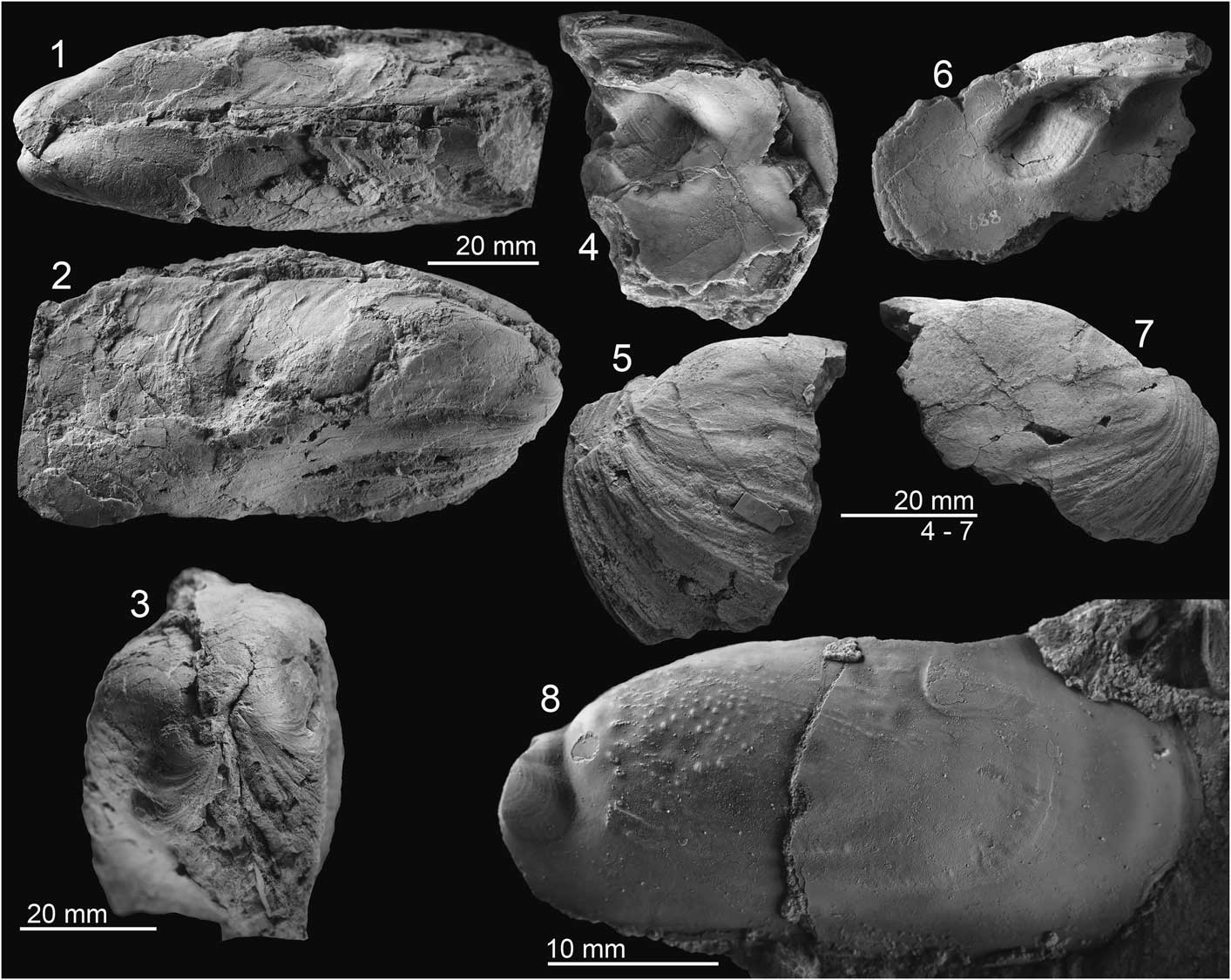
Caspiconcha raukumaraensis new species from Albian to Cenomanian seep carbonates in New Zealand. (1–3) Paratype (TM9256), articulated specimen; (1) view on dorsal side; (2) view on right valve; (3) view on anterior side. (4, 5) Anterior part of left valve (TM9257). (6, 7) Anterior part of right valve (TM9258) (fig. 6 from Kiel et al., Reference Kiel, Birgel, Campbell, Crampton, Schiøler and Peckmann2013). (8) internal mold of small specimen (TM9259).
2013 Caspiconcha sp. Reference Kiel, Birgel, Campbell, Crampton, Schiøler and PeckmannKiel et al., p. 26, fig. 13D, E.
Holotype
TM8832.
Paratypes
TM8831 (anterior portion of right valve; L=56.4 mm), TM9255 (anterior portion of left valve; L=36 mm), TM92556-9 (total: 14 specimens from GS668, one from Awanui II)
Diagnosis
Shells strongly recurved as adults, with broad triangular depression in mid flank; anterior adductor muscle scar subrectangular, anterodorsal side deeply impressed, and posteroventral side projected.
Occurrence
Seep carbonates in undifferentiated Whangai–Wanstead formations, mid-Cenomanian at Port Awanui, North Island, New Zealand (FRF locality number Z15/f7485).
Description
Shell recurved modioliform, up to 155 mm long; umbo subterminal, prosogyrate, very low; dorsal margin slightly to moderately curved with thick, external ligament; posterior margin broad, convex; ventral margin slightly concave; anterior margin short and blunt; shell inflated near umbo with curved, blunt ridge running toward the posteroventral margin, broad triangular depression below ridge; surface with rough, irregular growth increments.
Shell interior with numerous small pits above pallial line in posterior third of shell (mantle muscle scar area); faint, broad band running from umbo toward posterior end of shell; anterior adductor muscle scar subrectangular, slightly longer than high, ventral margin moderately convex, covered by commarginal growth increments, anterodorsal side deeply impressed; pedal retractor scar triangular, situated posterodorsal of adductor muscle scar and separated from it only by weak ridge. Myophoric buttress steep; caspiconchiid process present; hinge edentulous. Pallial line entire, indistinct, starting at posterior side of anterior adductor muscle scar, curved relative to ventral margin, posteriorly distant from shell margin, ending at posteroventral corner of posterior adductor muscle scar. Posterior adductor muscle scar weak, only known from a single small (42 mm long) specimen, elongate oval, parallel to posterodorsal shell margin, indistinct dorsally, ventrally with fine growth increments.
Etymology
For the Raukumara Peninsula in northeastern New Zealand.
Remarks
Caspiconcha raukumaraensis n. sp. is variable in shell shape, with nearly straight-sided specimens to recurved specimens. This variation may to some extent represent an ontogenetic change because all available small specimens are nearly straight-sided, while most, but not all, large specimens show curvature. At least in one specimen, the extreme concavity of the ventral margin appears to be due to an injury in this part of the shell. Two specimens of Caspiconcha raukumaraensis from the type locality are preserved in a way that the two shells are interlocking. This type of preservation has also been reported from Caspiconcha basquensis n. sp. (Agirrezabala et al., Reference Agirrezabala, Kiel, Blumenberg, Schäfer and Reitner2013).
Caspiconcha raukumaraensis differs from C. major mainly by its more rectangular anterior adductor muscle scar that is more elongate in an anterior–posterior direction. Unfortunately, the posterior adductor muscle scar of Caspiconcha raukumaraensis is known only from a single small specimen; therefore, these features cannot be compared with those other species. In addition, the Japanese Caspiconcha lastsamurai n. sp. reported herein differs from Caspiconcha raukumaraensis by having a larger, more rounded anterior adductor muscle scar. Caspiconcha basquensis n. sp. reaches larger sizes than Caspiconcha raukumaraensis, and all available specimens of Caspiconcha basquensis are very elongate and straight-sided.
Caspiconcha lastsamurai new species
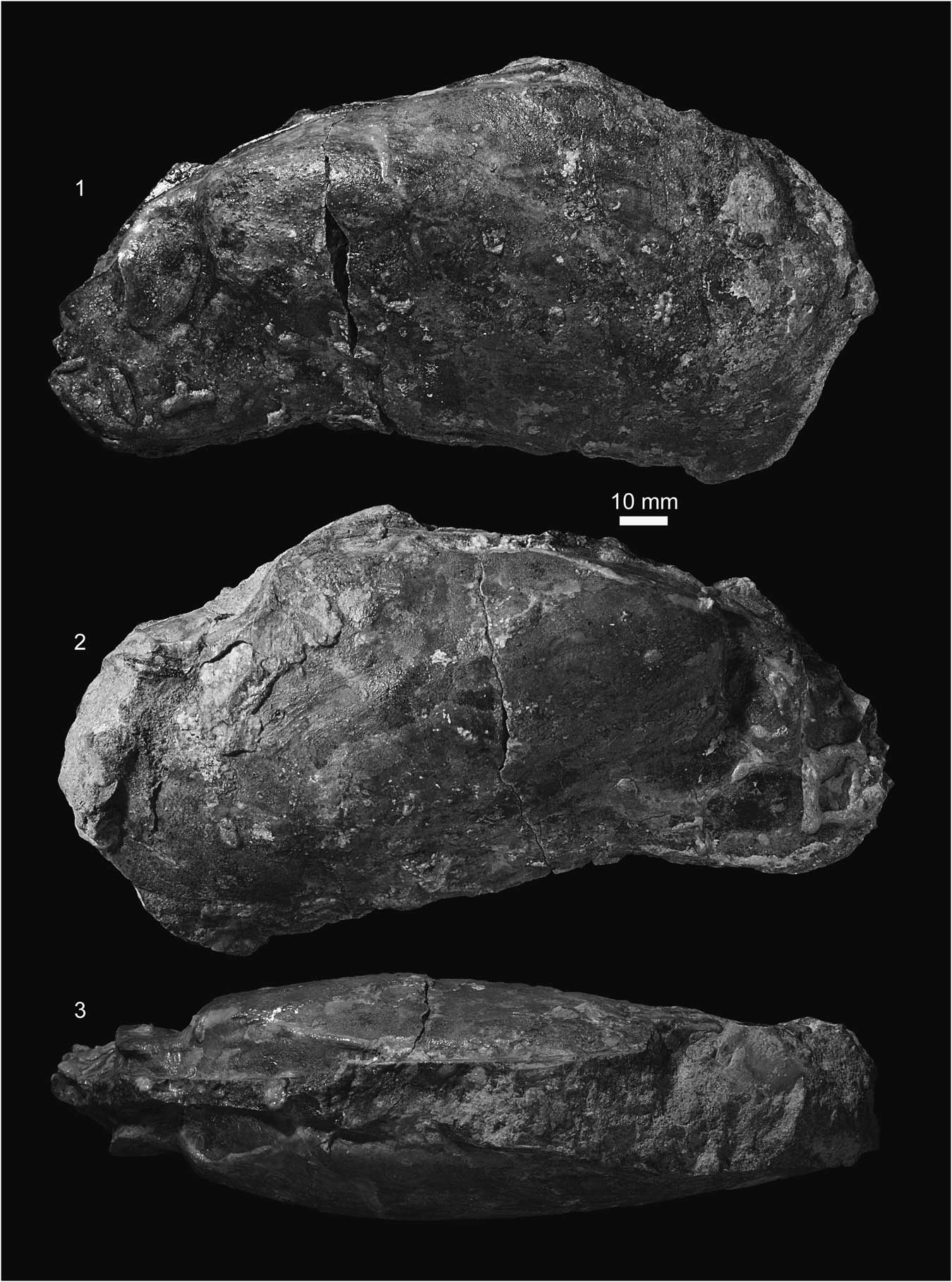
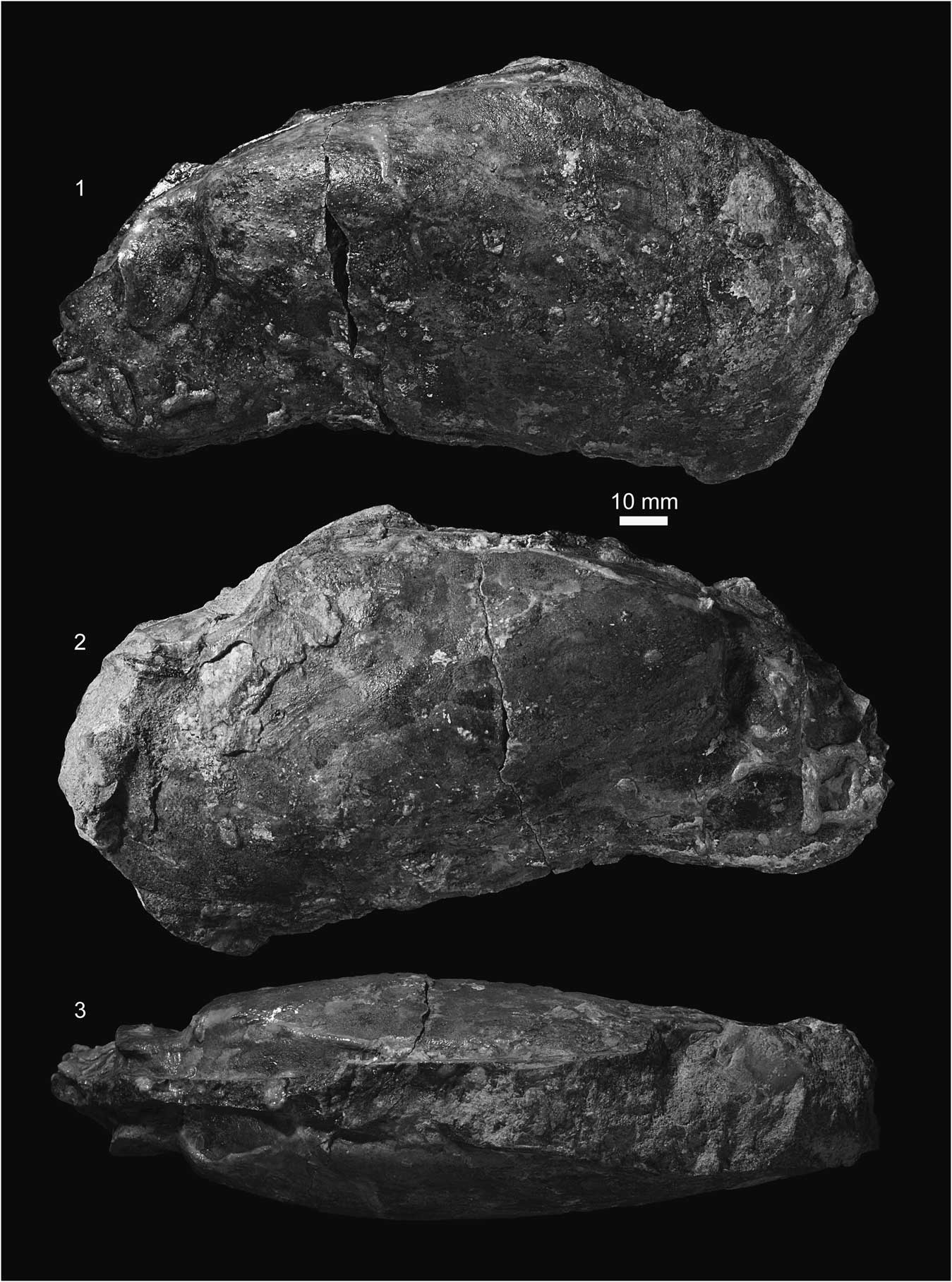
Caspiconcha lastsamurai new species from Campanian Omagari seep carbonate in northern Japan. (1–3) Holotype (NM-223), articulated specimen, almost no shell material remained; (1) left valve; (2) right valve; (3) dorsal view.
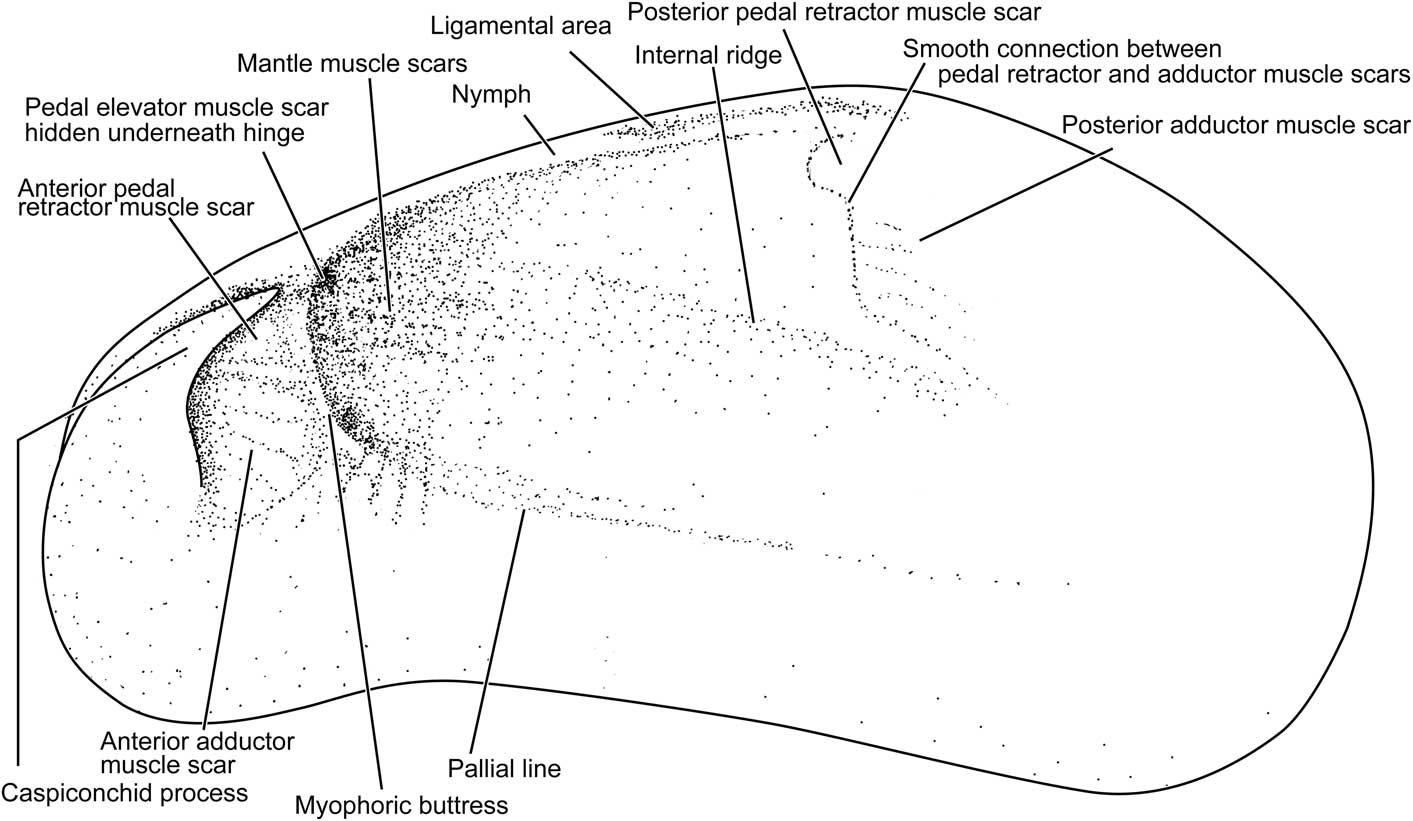
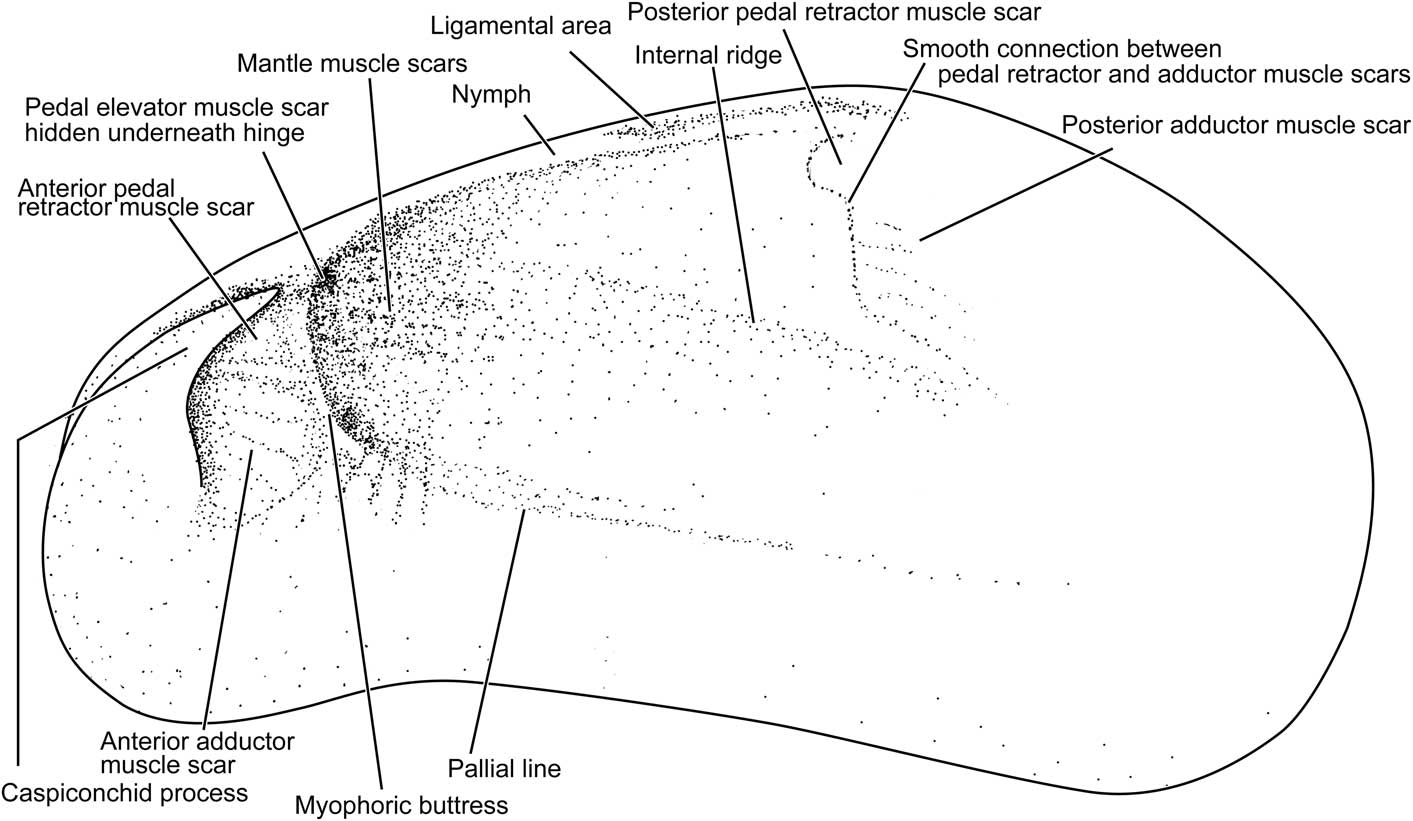
Schematic illustration of the right valve internal features of Caspiconcha lastsamurai new species from Omagari seep, northern Japan.
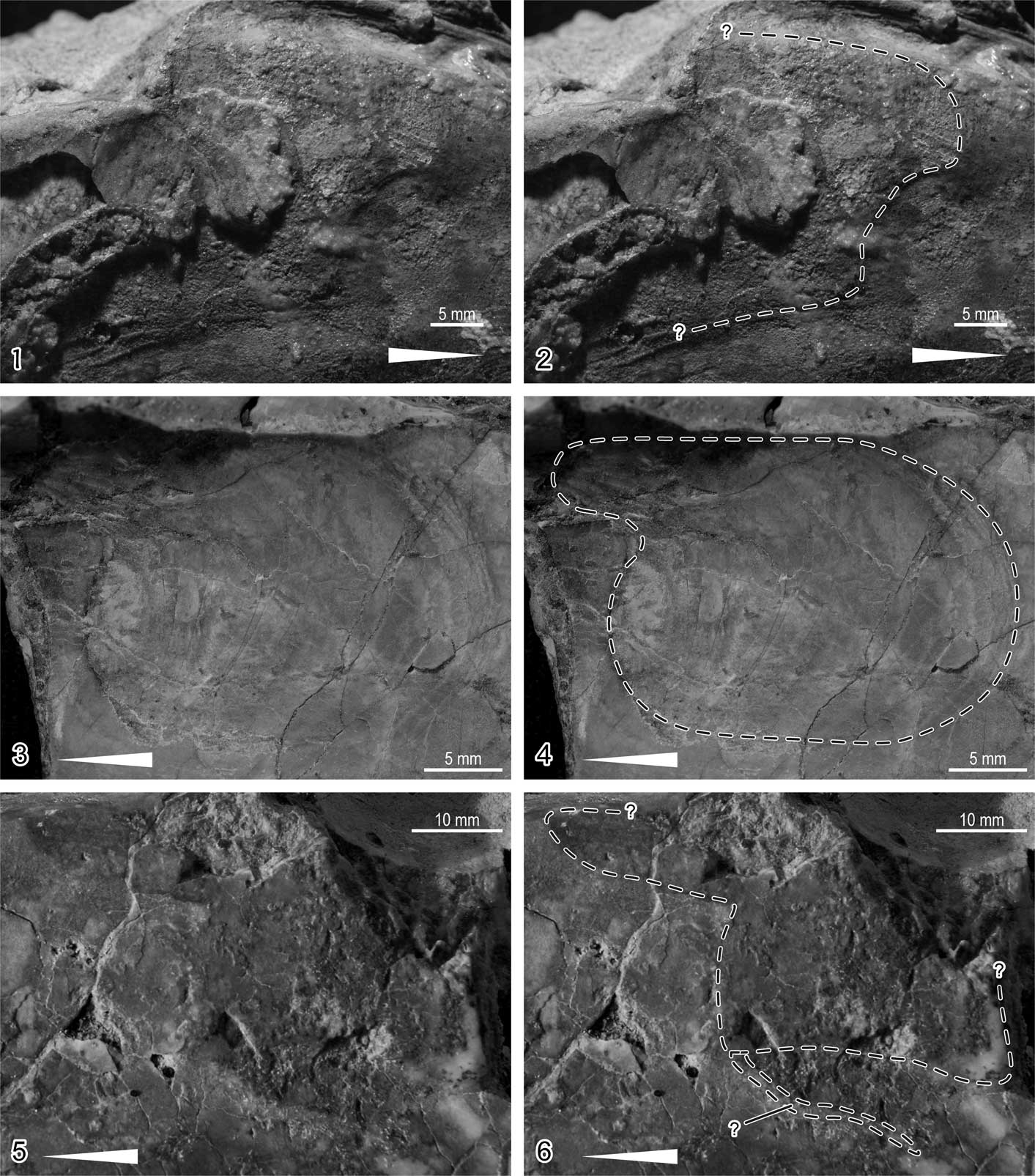
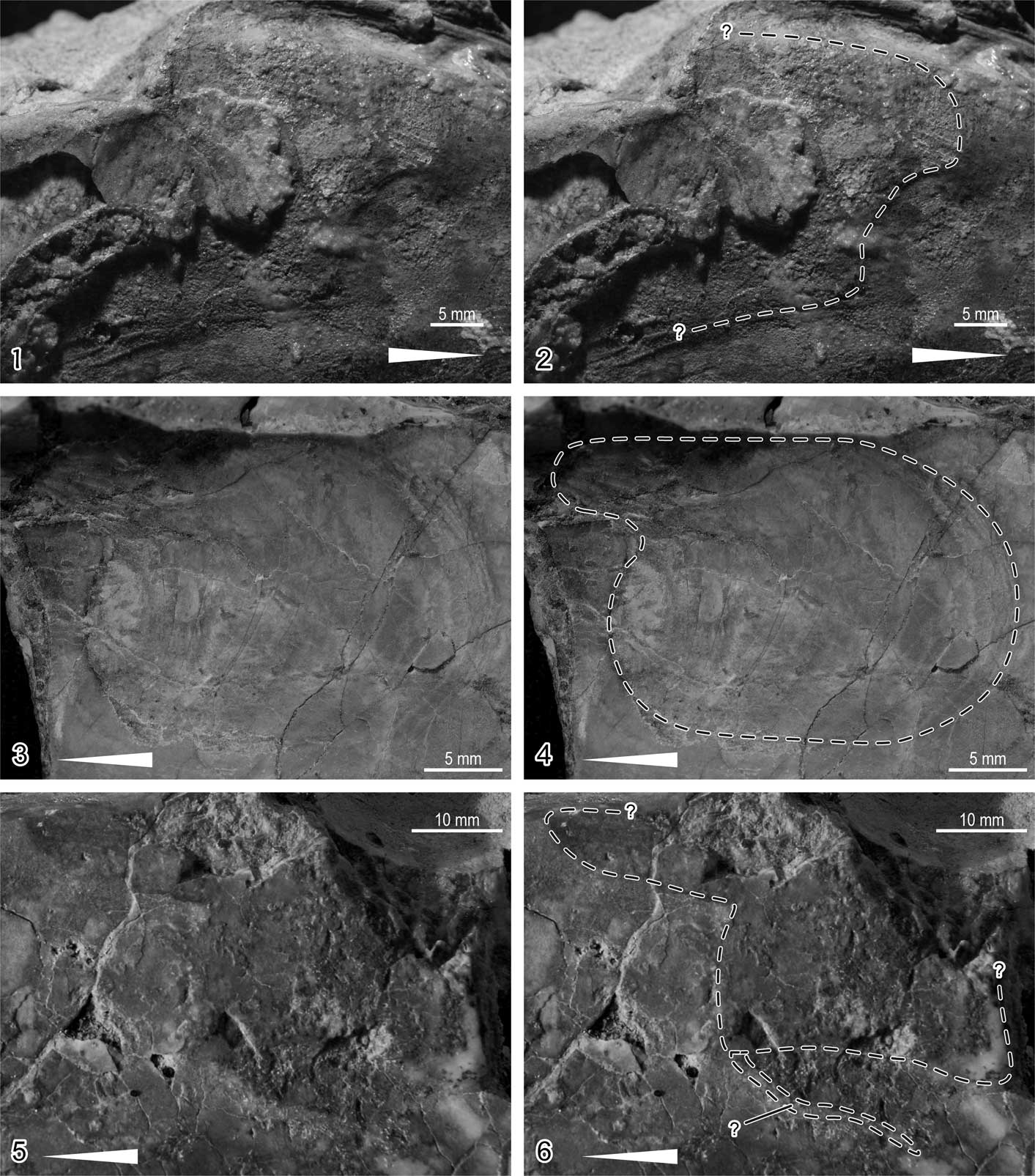
Photographs of posterior adductor muscle scars of some Caspiconcha species. (1, 2) C. lastsamurai new species from Omagari seep, northern Japan, mold of right valve. (3, 4) C. major (Gabb, Reference Gabb1869) CAS 72527−9, right valve. (5, 6) C. whithami Kelly in Kelley et al., 2000 CASP K9276 (SMUC number X30009), left valve. (1, 3, 5) Photographs only; (2, 4, 6) Photographs with explanatory drawing. Arrowheads indicate the shell anterior.
2003 Calyptogena sp. Reference Hikida, Suzuki, Togo and IjiriHikida et al., p. 337, fig. 9–3.
2007 Calyptogena sp. Reference Amano and KielAmano and Kiel, p. 228.
2008 Calyptogena sp. Reference Kiel and PeckmannKiel and Peckmann, p. 757.
2010 ‘Calyptogena’ sp. Reference Kiel, Campbell and GaillardKiel et al., p. 38.
2013 Caspiconcha sp.; Reference Jenkins, Kaim, Little, Iba, Tanabe and CampbellJenkins et al., p. 361, fig. 14.
2013 Caspiconcha sp.; Reference Kiel, Birgel, Campbell, Crampton, Schiøler and PeckmannKiel et al., p. 26, table 1.
Holotype
Internal mold of an articulated specimen (NMM-223); a cast of the type specimen is in the UMUT collection (UMUT MM 31127).
Diagnosis
Shell strongly recurved with nearly straight dorsal margins and moderately curved ventral margin; weak internal ridge running from anterior pedal elevator muscle scar toward ventral margin of the posterior adductor muscle scar; elongated anterior adductor muscle scar deeply set.
Occurrence
Omagari seep site, Omagari Formation, Yezo Group; Campanian, Upper Cretaceous exposed in Nakagawa Town, Hokkaido, Japan.
Description
The description as follows is based on the single type specimen (NMM-223). The specimen is an internal mold with valves in occlusion, having very little shell substance adhering. Thus, we could observe only the internal features of this species. Shell large, strongly recurved with moderately concaved ventral and nearly straight dorsal margins; equivalved, strongly inequilateral, moderately inflated in the anterior close to the umbones; dorsal margin straight in lateral profile for the full extent of the nymph and ligament area and then curved ventrally at the posterodorsal area; posterior margin well rounded; ventral margin moderately concave especially at one-third length from the anterior; anterior margin short and rounded; shell moderately inflated in dorsal aspect with wedge shape in both anterior and posterior margin, triangular depression running from the umbonal area widening toward the mid flank. Shell interior smooth apart from muscle scars, pallial line invisible; anterior adductor muscle scar elliptically rounded with pedal elevator muscle scars located dorsally; posterior adductor muscle scar is trapezoidal with dorsally located narrow posterior pedal retractor muscle scar projected anteriorly; connection between posterior pedal retractor muscle scar and posterior adductor muscle scar forms smoothly curved line (Figs. 7, 8); weak internal ridge running from anterior pedal elevator muscle scar toward ventral margin of the posterior adductor muscle scar; myophoric buttress moderately steep. Hinge area not perfectly preserved, apparently edentulous; caspiconchiid process present; nymph and ligament groove very long and straight.
Etymology
The species is the last known occurrence of the genus and it was found in Japan. We coined the species name after Hollywood motion picture ‘The Last Samurai,’ 2003 © Warner Brothers.
Remarks
Caspiconcha lastsamurai n. sp. was first reported as Calyptogena sp. based on its general shell shape (Hikida et al., Reference Hikida, Suzuki, Togo and Ijiri2003). This identification was subsequently questioned and instead affinities to Caspiconcha were suggested (Amano and Kiel, Reference Amano and Kiel2007; Kiel and Peckmann, Reference Kiel and Peckmann2008; Kiel et al., Reference Kiel, Campbell and Gaillard2010; Jenkins et al., Reference Jenkins, Kaim, Little, Iba, Tanabe and Campbell2013). Caspiconcha lastsamurai differs from other Caspiconcha species (i.e., C. whithami, C. rubani, C. basquensis, and C. major) in having a strongly recurved shell, trapezoidal posterior adductor muscle scar, and smoothly curved connection line between posterior pedal retractor muscle scar and the posterior adductor muscle scar (Fig. 9). Caspiconcha lastsamurai n. sp. differs from Caspiconcha raukumaraensis n. sp. from New Zealand (Kiel et al., Reference Kiel, Birgel, Campbell, Crampton, Schiøler and Peckmann2013) by having a less recurved shell shape and an almost straight dorsal margin. Caspiconcha lastsamurai differs from C. basquensis n. sp. from Spain (Agirrezabala et al., Reference Agirrezabala, Kiel, Blumenberg, Schäfer and Reitner2013) by its strongly curved shell and its deeper anterior adductor muscle scar.
Discussion
History of Caspiconcha
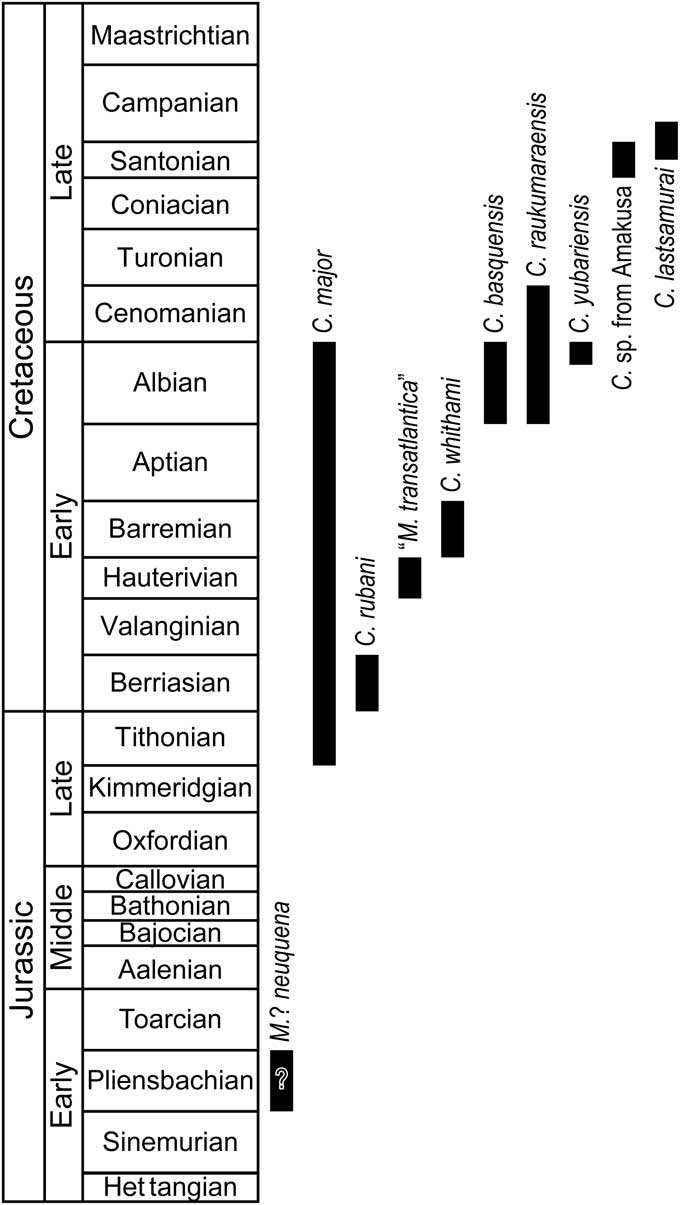
We demonstrate the currently known stratigraphic range of Caspiconcha from Tithonian to Campanian in Figure 10. The fossil record of Caspiconcha consists of seven nominal species and one uncertain species from Santonian (Upper Cretaceous) deposit of Amakusa area in Kyushu, Japan. Caspiconcha first appeared with C. major in the latest Jurassic (Tithonian) in the eastern Pacific, and shortly afterward the first Tethyan species, C. rubani, appeared in the earliest Cretaceous (Berriasian). Two further species appeared in the Barremian and Hauterivian. The diversity reached a peak in the Albian with four species distributed worldwide. Afterward, the genus seems to have declined in diversity and local abundance. The mid-Cenomanian seep site at Port Awanui, New Zealand, was the last seep deposit dominated by a species of Caspiconcha (C. raukumaraenis); the remaining Late Cretaceous records are single occurrences, including the youngest species, the Campanian C. lastsamurai. This fading abundance of Caspiconcha seems to be a real phenomenon rather than sampling bias because several well-investigated Late Cretaceous seep deposits exist and no additional specimens of Caspiconcha have been recovered up to now. Although Maastrichtian (Late Cretaceous) seeps are extremely rare at this moment, there is a newly found Campanian-Maastrichtian seep in Alaska (unpublished data, RGJ and AK, 2007) and there are Maastrichtian seeps in Antarctica (Little et al., Reference Little, Birgel, Boyce, Crame, Francis, Kiel, Peckmann, Pirrie, Rollinson and Witts2015). Why did this once successful bivalve genus slowly disappear from seep habitats during the Late Cretaceous? No obvious competitor for its ecologic niche appeared in that time. The epifaunal and semi-infaunal bivalves (i.e., bathymodiolin and vesicomyid bivalves) that dominate modern seep environments did not appear in the geologic record before the mid-Eocene (Amano and Kiel, Reference Amano and Kiel2007; Kiel and Amano, Reference Kiel and Amano2013). One possible reason could be the decrease in sulfide release at methane seeps after the mid-Cretaceous drop in marine sulfate concentrations; fewer sulfides would mean less food for the presumed sulfur-oxidizing symbionts of Caspiconcha (Kiel, Reference Kiel2015). An additional or alternative explanation is offered by Hryniewicz et al. (Reference Hryniewicz, Amano, Jenkins and Kiel2017b): the decline of Caspiconcha coincides with the appearance of large thyasirid bivalves at methane seeps. These infaunal bivalves could potentially have mined the available sulfide produced deep in the sediment so that very little sulfide reached the upper sediment layers that Caspiconcha was able to penetrate (Hryniewicz et al., Reference Hryniewicz, Amano, Jenkins and Kiel2017b).
Range chart of Caspiconcha species and relatives; note the highest diversity in the Albian.

History of seep-inhabiting kalenterids/modiomorphids
The apparent origin of Caspiconcha in the latest Jurassic should be treated cautiously because the fossil record of seep deposits before the late Jurassic is scarce (Campbell, Reference Campbell2006). A possible Early Jurassic species belonging to Caspiconcha is Myoconcha neuquena Leanza Reference Leanza1940 from the Early Jurassic of Argentina. Judging from the descriptions and figures of Leanza (Reference Leanza1940) and Griffin and Pastorino (Reference Griffin and Pastorino2006) and preliminary observations by RGJ and AK, M. neuquena possesses an edentulous hinge and a caspiconchiid process, suggesting affiliation to the genus Caspiconcha. However, we need further investigations to confirm its taxonomy. Several bivalves found at even older vent and seep deposits were considered as belonging to the modiomorphids and may thus be related to Caspiconcha as well. These include a species from a Late Triassic seep deposit in Oregon (Peckmann et al., Reference Peckmann, Kiel, Sandy, Taylor and Goedert2011), large modiomorphid bivalves from Late Triassic seeps in Turkey (Kiel et al., Reference Kiel, Krystyn, Demirtaş, Koşun and Peckmann2017), the large and elongate Ataviaconcha wendti Hryniewicz et al., Reference Hryniewicz, Jakubowicz, Belka, Dopieralska and Kaim2017a found in Devonian and Silurian seep deposits in Morocco (Aitken et al., Reference Aitken, Henderson, Collom and Johnston2002; Hryniewicz et al., Reference Hryniewicz, Jakubowicz, Belka, Dopieralska and Kaim2017a; Jakubowicz et al., Reference Jakubowicz, Hryniewicz and Belka2017), and Sibaya ivanovi Little et al., Reference Little, Maslennikov, Morris and Gubanov1999 from a Devonian vent locality in the Ural mountains, Russia (Little et al., Reference Little, Maslennikov, Morris and Gubanov1999). This recurrence of modiomorphid/kalenterid–like bivalves at vent and seep deposits from Silurian through Cretaceous time may imply either that modiomorphid/kalenterid bivalves have repeatedly colonized these environments through Earth’s history, or that Caspiconcha is the last member of a long-lived vent- and seep-inhabiting lineage among the kalenterids. Whatever the exact relationships among these bivalves are, it remains intriguing that the dimerelloid brachiopods colonized seep (and vent) environments throughout roughly the same time interval, and disappeared just slightly earlier, in the mid-Hauterivian (Early Cretaceous) (Kiel et al., Reference Kiel, Glodny, Birgel, Bulot, Campbell, Gaillard, Graziano, Kaim, Lazăr and Sandy2014). If Caspiconcha and its relatives were indeed chemosymbiotic (cf. Kelly et al., Reference Kelly, Blanc, Price and Whitham2000; Jenkins et al., Reference Jenkins, Kaim, Little, Iba, Tanabe and Campbell2013), the apparent long coexistence of dimerelloid brachiopods and chemosymbiotic bivalves contradicts the hypothesis that brachiopods were pushed out of the vent/seep environment by chemosymbiotic bivalves through competitive replacement (cf. Campbell and Bottjer, Reference Campbell and Bottjer1995b).
Implications for the modern chemosynthetic fauna
There was a considerable confusion about the origin of the vesicomyid bivalves because molecular age estimates indicated an early Cenozoic origin, although three vesicomyid species from Cretaceous sediments in Hokkaido, Japan, were known from the paleontological literature (e.g., Little and Vrijenhoek, Reference Little and Vrijenhoek2003; Kiel and Little, Reference Kiel and Little2006). The first to question the vesicomyid affinities of these species were Amano and Kiel (Reference Amano and Kiel2007), and two of the species were subsequently identified as members of different bivalve families: ‘Calyptogena’ sp. from the Albian Ponbetsu seep deposit (Kanie et al., Reference Kanie, Yoshikawa, Sakai and Takahashi1993) was described by Kiel et al. (Reference Kiel, Amano and Jenkins2008) as the solemyid Acharax mikasaensis Kiel, Amano, and Jenkins, Reference Kiel, Amano and Jenkins2008, and Vesicomya inflata Kanie and Nishida, Reference Kanie and Nishida2000 from large Cenomanian concretions in the Horokonai area (Kanie and Nishida, Reference Kanie and Nishida2000; Kanie et al., Reference Kanie, Nishida, Kuramochi and Kawashita2000) was redescribed as type species of the new lucinid genus Ezolucina Amano et al., Reference Amano, Jenkins, Kurihara and Kiel2008. The last of the three alleged Cretaceous vesicomyids, ‘Calyptogena’ sp. from the Omagari seep deposit (Hikida et al., Reference Hikida, Suzuki, Togo and Ijiri2003) is here described as Caspiconcha lastsamurai n. sp. Thus, all three Cretaceous ‘vesicomyids’ were clearly misidentified and the oldest confirmed fossil occurrence of the Vesicomyidae is Archivesica cf. A. tschudi (Olsson, Reference Olsson1931) from the Eocene of Washington State, USA (Amano and Kiel, Reference Amano and Kiel2007), although subsequent work suggested that it belongs to a different vesicomyid genus (Amano and Kiel, Reference Amano and Kiel2012; Amano et al., Reference Amano, Jenkins, Ohara and Kiel2014).
Conclusions
We formally described four new species of seep-restricted genus Caspiconcha from late Albian to early Campanian of Spain, New Zealand, and Japan. The augmented fossil record clearly shows that Caspiconcha reached its highest diversity and broadest distribution in the Albian, followed by a decrease in diversity, abundance, and geographic range. In the Late Cretaceous, only two species of Caspiconcha are known and are geographically restricted to the western Pacific (New Zealand and Japan). The New Zealand record marks the last abundant occurrence of Caspiconcha, and so far, only one species of Caspiconcha is known to have survived until the Campanian. With the identification of ‘Calyptogena’ sp. of Hikida et al. (Reference Hikida, Suzuki, Togo and Ijiri2003) as a new species of Caspiconcha, the alleged last Cretaceous record of the family Vesicomyidae has been dismissed.
Acknowledgments
We thank two anonymous referees and editors of the journal for their constructive and helpful comments. RGJ thanks Y. Miyajima (Kyoto University) and K. Sato for helping with fieldwork in Japan; RGJ and AK thank S. Kelly (CASP, University of Cambridge, UK) for access to Greenland Caspiconcha collection in Sedgwick Museum; and SK thanks L. Agirrezabala (Universidad del País Vasco, Spain) and J.S. Crampton (GNS Science, New Zealand) for making the fieldwork in Spain and New Zealand possible and enjoyable, and G. Hundertmark (Göttingen) for photography. The research of RGJ was supported by JSPS KAKENHI Grant Number 26287131, 26400500, and 16H05740 and Grant for Program to Disseminate Tenure Tracking System (JST); AK was supported by the research grant no. 2012/07/B/ST10/04189 from National Science Centre, Poland; and SK was supported by the Deutsche Forschungsgemeinschaft through grant Ki802/6-1.