Introduction
According to recent World Health Organization estimates, the prevalence of obesity in Europe is rising rapidly and is expected to include 150 million adults and 15 million children by 2010 (WHO, Reference Branca, Nikogosian and Lobstein2007). Not only related to an increased risk of metabolic and cardiovascular diseases and physical disabilities, obesity also is associated with a higher incidence of neuropsychiatric symptoms, including emotional distress (Dixon et al. Reference Dixon, Dixon and O'Brien2003; Evans et al. Reference Evans, Charney, Lewis, Golden, Gorman, Krishnan, Nemeroff, Bremner, Carney, Coyne, Delong, Frasure-Smith, Glassman, Gold, Grant, Gwyther, Ironson, Johnson, Kanner, Katon, Kaufmann, Keefe, Ketter, Laughren, Leserman, Lyketsos, McDonald, McEwen, Miller, Musselman, O'Connor, Petitto, Pollock, Robinson, Roose, Rowland, Sheline, Sheps, Simon, Spiegel, Stunkard, Sunderland, Tibbits and Valvo2005; Herva et al. Reference Herva, Laitinen, Miettunen, Veijola, Karvonen, Laksy and Joukamaa2006; Bean et al. Reference Bean, Stewart and Olbrisch2008). For example, the prevalence of depression in obese subjects, which is close to 30% (Evans et al. Reference Evans, Charney, Lewis, Golden, Gorman, Krishnan, Nemeroff, Bremner, Carney, Coyne, Delong, Frasure-Smith, Glassman, Gold, Grant, Gwyther, Ironson, Johnson, Kanner, Katon, Kaufmann, Keefe, Ketter, Laughren, Leserman, Lyketsos, McDonald, McEwen, Miller, Musselman, O'Connor, Petitto, Pollock, Robinson, Roose, Rowland, Sheline, Sheps, Simon, Spiegel, Stunkard, Sunderland, Tibbits and Valvo2005), is largely higher than that in the general population. Psychological characteristics related to obesity have been investigated in several studies (Charles, Reference Charles1987; Lykouras, Reference Lykouras2008). Personality traits including neuroticism, low self-esteem and low impulse control have been identified in obese subjects and were associated with unhealthy food choices (Gibson, Reference Gibson2006) and unsuccessful outcomes or increased complications of obesity medical treatment (Lykouras, Reference Lykouras2008; Canetti et al. Reference Canetti, Berry and Elizur2009). Neuroticism is a major personality trait which is associated with negative affect and characterized by a general tendency to negative emotions, including anxiety, anger, sadness and culpability. Neuroticism has been identified as a potent risk factor for lifetime mood and anxiety disorders (Roberts & Kendler, Reference Roberts and Kendler1999; Jylha & Isometsa, Reference Jylha and Isometsa2006; Kendler et al. Reference Kendler, Gatz, Gardner and Pedersen2006, Reference Kendler, Gardner, Gatz and Pedersen2007) and was found to be associated with eating behaviours, including higher cognitive dietary restraint, disinhibition and hunger, in overweight and obese women (Provencher et al. Reference Provencher, Begin, Gagnon-Girouard, Tremblay, Boivin and Lemieux2008). Neuroticism, together with reduced extraversion, was found to correlate with increased body mass index (BMI) in women, but not in men, in a British population-based study (Faith et al. Reference Faith, Flint, Fairburn, Goodwin and Allison2001).
While many psychological factors are important contributors, biological factors such as inflammatory molecules are also suggested to influence emotional distress in many populations affected by chronic medical conditions. Pro-inflammatory cytokines have been repeatedly linked to behavioural symptoms including mood disorders (Dantzer et al. Reference Dantzer, Wollman and Yirmiya1999; Capuron et al. Reference Capuron, Bluthe and Dantzer2001; Raison et al. Reference Raison, Capuron and Miller2006). We and others showed that treatment with cytokines (primarily interferon-α) in medically ill patients is responsible for the development of major depression in up to 45% of treated patients (Musselman et al. Reference Musselman, Lawson, Gumnick, Manatunga, Penna, Goodkin, Greiner, Nemeroff and Miller2001; Capuron et al. Reference Capuron, Gumnick, Musselman, Lawson, Reemsnyder, Nemeroff and Miller2002). In addition, we found in patients with the metabolic syndrome that low-grade systemic inflammation was one determinant of depressive symptoms in these patients independently of body weight (Capuron et al. Reference Capuron, Su, Miller, Bremner, Goldberg, Vogt, Maisano, Jones, Murrah and Vaccarino2008). Obesity is a chronic condition which also is associated with low-grade inflammatory processes, with increased circulating levels of acute-phase proteins [C-reactive protein (CRP) in particular] and pro-inflammatory cytokines [e.g. interleukin (IL)-6, IL-1, tumour necrosis factor-α] being augmented in both adult and younger obese subjects (Bastard et al. Reference Bastard, Jardel, Delattre, Hainque, Bruckert and Oberlin1999). Part of systemic inflammation originates from the adipose tissue in which macrophages accumulate and potently secrete inflammatory factors (Bastard et al. Reference Bastard, Jardel, Delattre, Hainque, Bruckert and Oberlin1999; Wellen & Hotamisligil, Reference Wellen and Hotamisligil2003; Clement et al. Reference Clement, Viguerie, Poitou, Carette, Pelloux, Curat, Sicard, Rome, Benis, Zucker, Vidal, Laville, Barsh, Basdevant, Stich, Cancello and Langin2004). Weight loss induced by very-low-calorie diets was shown to significantly improve the inflammatory profile of obese subjects (e.g. decreased pro-inflammatory factors and increased anti-inflammatory molecules) and regulate inflammation-related genes in white adipose tissue (Bastard et al. Reference Bastard, Jardel, Bruckert, Blondy, Capeau, Laville, Vidal and Hainque2000; Clement et al. Reference Clement, Viguerie, Poitou, Carette, Pelloux, Curat, Sicard, Rome, Benis, Zucker, Vidal, Laville, Barsh, Basdevant, Stich, Cancello and Langin2004). Accordingly, the improvement of the inflammatory profile in adipose tissue and decreased expression of chemoattractant genes were accompanied by a reduction of macrophages in the white adipose tissue of morbidly obese subjects after surgery-induced weight loss (Cancello et al. Reference Cancello, Henegar, Viguerie, Taleb, Poitou, Rouault, Coupaye, Pelloux, Hugol, Bouillot, Bouloumie, Barbatelli, Cinti, Svensson, Barsh, Zucker, Basdevant, Langin and Clement2005; Forsythe et al. Reference Forsythe, Wallace and Livingstone2008). Noteworthy, weight loss improves the emotional status of obese subjects (Wolfe & Terry, Reference Wolfe and Terry2006). Altogether, these data support the notion that chronic low-grade inflammation is a hallmark of obesity. Given the notorious effects of pro-inflammatory cytokines on behaviour and mood regulation (Dantzer et al. Reference Dantzer, Wollman and Yirmiya1999; Raison et al. Reference Raison, Capuron and Miller2006), obesity-related chronic low-grade inflammation may therefore participate in the emotional distress frequently observed in obese individuals.
The purpose of this study was to assess the relationship between adiposity, low-grade inflammation, eating behaviour and emotional status (through the measurement of major emotionality-related personality dimensions) in obese women and to investigate the effects of weight loss induced by gastric surgery on this relationship.
Method
Participants
A total of 101 obese women involved in a gastric surgery programme (Roux-en-Y bypass primarily) were prospectively recruited between 2006 and 2007 in the Department of Nutrition, Centre of Reference for Medical and Surgical Care of Obesity (CREMO), Hôtel-Dieu and Pitié-Salpêtrière hospitals (Paris, France). Patients met the criteria for obesity surgery, i.e. BMI ⩾40 kg/m2 or ⩾35 kg/m2, with at least one co-morbidity (hypertension, type 2 diabetes, dyslipidaemia, obstructive sleep apnoea syndrome, arthrosis). Pre-operative evaluation included medical history, physical, nutritional, metabolic, cardiopulmonary and psychological assessments. Each subject's weight was stable (i.e. variation of less than ±2 kg) for at least 3 months prior to surgery. Subjects did not demonstrate evidence of acute or chronic inflammatory disease, infectious disease, viral infection, cancer and/or known alcohol consumption (>20 g per day). For all patients, many clinical and biological parameters were assessed prior to gastric surgery (i.e. baseline). According to the criteria of fasting glycaemia over 7 mm or the use of an anti-diabetic drug, 27 subjects had type 2 diabetes. Of these, seven were not treated before surgery, 14 were treated with an oral antidiabetic drug and five with insulin. An oral glucose tolerance test was performed before surgery and confirmed that all patients in the non-diabetic group had glucose levels less than 11 mmol/l (200 mg/dl) in the 2 h following a 75 g oral glucose challenge.
Follow-up evaluation was performed at 1 year after surgery, a time point corresponding to significant weight loss. All patients included at study entry were seen at 1 year post-surgery. Nevertheless, a complete dataset was available in only 70 of them. Due to logistic reasons, the other patients had not received complete psychological assessments at follow-up. Among the 70 patients who were evaluated at follow-up, seven were treated with a selective serotonin reuptake inhibitor. This treatment was maintained throughout the study.
Written informed consent was obtained from each participant. The protocol of the study was approved by the Ethics Committees of the Hôtel-Dieu Hospital (Paris, France).
Psychological assessment
Before surgery (baseline) and at 1 year after surgery, participants underwent a psychological evaluation with a registered psychologist in order to assess emotional status and eating behaviour. Assessment included the French validated version of the revised Neuroticism–Extraversion–Openness personality inventory (NEO-PI-R) (Costa & McCrae, Reference Costa and McCrae1985; Rolland, Reference Rolland1998), a 240-item questionnaire which measures five major domains of personality, including neuroticism, extraversion, openness, agreeableness and conscientiousness, each of them being defined by six emotional facets. Only scores at neuroticism and extraversion were considered for data analysis, because of their previous reported relationship with obesity in women (Faith et al. Reference Faith, Flint, Fairburn, Goodwin and Allison2001). Neuroticism included the facets of anxiety, hostility, depression, self-consciousness, impulsiveness and vulnerability and extraversion included the facets of warmth, gregariousness, assertiveness, activity, excitement seeking and positive emotion. The NEO-PI-R is a well-validated instrument with available population norms. The French validation of the NEO-PI-R shows good psychometric properties with internal consistency reliabilities above 0.85 for the dimensions of neuroticism and extraversion (Costa & McCrae, Reference Costa, McCrae and Rolland1998). Changes in NEO-PI-R scores have been found to be associated with changes in symptom distress in patients with personality disorders (Wilberg et al. Reference Wilberg, Karterud, Pedersen, Urnes and Costa2009). In the same study, the dimension of neuroticism was found to be the most sensitive to changes due to its inherent state characteristics (Wilberg et al. Reference Wilberg, Karterud, Pedersen, Urnes and Costa2009). Eating behaviour was measured using the Three-Factor Eating Questionnaire (TFEQ; Karlsson et al. Reference Karlsson, Persson, Sjostrom and Sullivan2000), a 51-item questionnaire which assesses three dimensions of eating behaviour including cognitive restraint of eating (conscious restriction of food intake to control body weight), disinhibition (inability to resist emotional/social eating cues) and hunger (subjective feelings of hunger). The French validation of the TFEQ in obese subjects shows good psychometric properties with internal consistency reliabilities ranging from 0.74 to 0.79 for the three dimensions (Lluch, Reference Lluch1995). This questionnaire has been used in large populations of morbidly obese French subjects (Bellisle et al. Reference Bellisle, Clement, Le Barzic, Le Gall, Guy-Grand and Basdevant2004).
Biological measurements
Fasting venous blood samples were obtained at each time point. Plasma glucose and insulin were measured on a Modular Hitachi (Roche Diagnostics®) by the glucose oxidase method and on an IMMULITE 2000 (Siemens®) by solid-phase, enzyme-labelled chemiluminescent immunometric assay, respectively. The sensitivity of the insulin test is 2 μIU/ml; intra- and inter-assay coefficients of variation (CV) are below 7% for serum. The sensitivity of the glucose test is 0.11 mmol/l; intra- and inter-assay CV are below 2% for serum. Insulin sensitivity was evaluated by the Quantitative Insulin Sensitivity Check Index (QUICKI; Katz et al. Reference Katz, Nambi, Mather, Baron, Follmann, Sullivan and Quon2000). Serum samples were stored at −80°C until thawed for biological assays. Assays included the measurement of inflammatory markers and adipokines, including IL-6, high-sensitivity CRP (hsCRP), leptin and adiponectin. Serum leptin and adiponectin were determined using a radioimmunoassay kit from Linco Research (USA) according to the manufacturer's recommendations. The sensitivity was 0.5 ng/ml and 0.8 μg/ml for leptin and adiponectin, respectively. Intra- and inter-assay CV were below 4% and 9% for leptin and adiponectin, respectively. Serum levels of IL-6 were measured by a high-sensitivity enzyme-linked immunosorbent assay (ELISA) system (Quantikine HS; R&D System Europe Ltd, UK). The sensitivity of this assay was <0.04 pg/ml, with intra- and inter-assay CV below 8%. hsCRP was measured using an IMMAGE automatic immunoassay system (Beckman–Coulter, USA). The sensitivity was 0.02 mg/dl. Intra- and inter-assay CV were below 5% and 7.5%.
Statistical analysis
Raw values for inflammatory markers and adipokines were log-transformed because of non-normality. Relationships among adiposity-related measures and biological variables and between psychological scores at baseline were assessed using Bravais–Pearson correlations, controlling for age and diabetes status. Paired Student's t tests were performed to assess changes in BMI, biological variables and psychological scores between baseline and 1 year post-surgery. For each variable of interest, the relative difference (Δ/baseline) in values between the two time points was computed. Separate multivariate linear regression analyses entering physiological parameters in separate models were used to assess (1) the association of BMI, inflammatory/metabolic markers and behavioural scores at baseline adjusting for age and diabetes status and (2) the relationship of changes (relative difference) in the variables of interest between the two time points adjusting for age, diabetes status and variation in BMI. In addition, mediation analyses were performed using the method proposed by Baron & Kenny (Reference Baron and Kenny1986) to assess the differential contribution of inflammation and adiposity to psychological scores in obese participants. Briefly, based on this method, mediation is assumed if four steps are met: (1) the initial variable (e.g. adiposity) is significantly associated with the outcome (behavioural scores); (2) the initial variable is significantly correlated with the mediator (e.g. inflammation); (3) the mediator is significantly associated with the outcome, when controlling for the initial variable; and (4) the relationship between the initial variable and the outcome is reduced or no longer significant, when controlling for the mediator. The Sobel test was used to determine the significance of the mediation. Statistical analyses were performed with the SPSS software version 16 for Windows (SPSS Inc., USA). All probabilities were two-tailed with the level of significance set at p<0.05.
Results
Characteristics of study participants
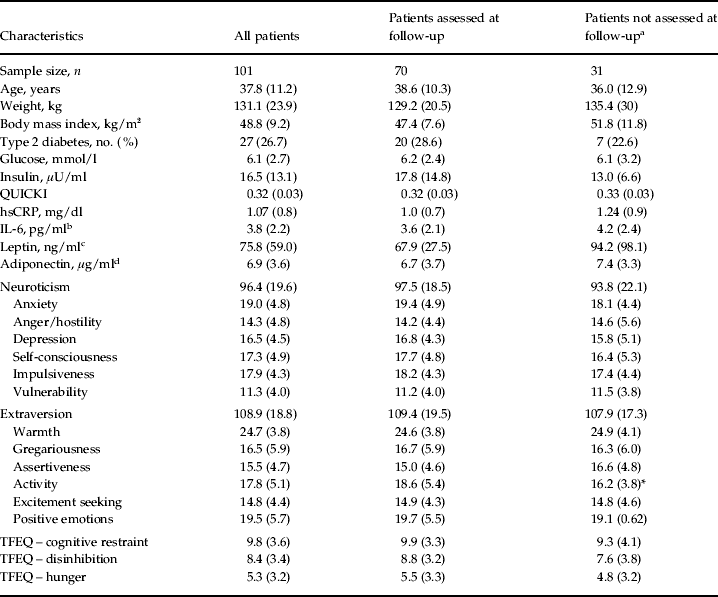
Characteristics of the morbidly obese women at baseline are shown in Table 1. As already mentioned and previously observed in this severely obese population, 26.7% of participants had type 2 diabetes at inclusion. Insulin, glucose and QUICKI values were also consistent with published data in obese subjects (Poitou et al. Reference Poitou, Coussieu, Rouault, Coupaye, Cancello, Bedel, Gouillon, Bouillot, Oppert, Basdevant and Clement2006, Reference Poitou, Divoux, Faty, Tordjman, Hugol, Aissat, Keophiphath, Henegar, Commans and Clement2009). For each dimension (i.e. neuroticism and extraversion) and subunit of the NEO-PI-R questionnaire, the mean score of the study population was comparable with the mean range of the normative population. Consistent with previous results in obese subjects, scores of cognitive restraint and disinhibition were elevated in the population under study (Hsu et al. Reference Hsu, Mulliken, McDonagh, Krupa Das, Rand, Fairburn, Rolls, McCrory, Saltzman, Shikora, Dwyer and Roberts2002; de Zwaan et al. Reference de Zwaan, Mitchell, Howell, Monson, Swan-Kremeier, Crosby and Seim2003; Bellisle et al. Reference Bellisle, Clement, Le Barzic, Le Gall, Guy-Grand and Basdevant2004). Overall, there was no significant systematic variation between the 70 patients who were evaluated at follow-up compared with the remaining participants, except for activity scores that were slightly higher in the first group.
Characteristics of patients at baseline

Values are given as mean (standard deviation).
QUICKI, Quantitative Insulin Sensitivity Check Index; hsCRP, high-sensitivity C-reactive protein; IL-6, interleukin-6; TFEQ, Three-Factor Eating Questionnaire.
a Due to logistic reasons, these patients had not received complete neuropsychiatric assessments at follow-up.
b IL-6 values were missing in ten patients.
c Leptin values were missing in four patients.
d Adiponectin values were missing in nine patients.
* Mean value was significantly different from that of patients assessed at follow-up (p<0.05, analysis of covariance, controlling for age).
Associations between clinical and biological markers at baseline and relationship with behavioural scores
At baseline, BMI correlated significantly with adipokines and inflammatory markers (respectively, leptin: R=0.67, p<0.001; adiponectin: R=0.22, p<0.05; IL-6: R=0.56, p<0.001; hsCRP: R=0.36, p<0.001). Serum concentrations of IL-6 were positively correlated with serum concentrations of leptin (R=0.51, p<0.001) and hsCRP (R=0.47, p<0.001). IL-6 levels were also correlated with insulin sensitivity, with greater IL-6 concentrations corresponding to decreased insulin sensitivity (QUICKI) (R=−0.22, p<0.05). In addition, baseline hsCRP concentrations were positively correlated with serum levels of glucose (R=0.20, p<0.05). Finally, baseline serum concentrations of adiponectin were inversely related to glucose and positively related to insulin sensitivity (QUICKI) (respectively, R=−0.48 and R=0.37, p<0.001), indicating that the lower the adiponectin levels, the higher the glucose levels and the poorer was insulin sensitivity. Regarding behavioural measures, baseline neuroticism scores on the NEO-PI-R were inversely related to extraversion scores (R=−0.42, p<0.001), as expected. Moreover, baseline neuroticism scores were significantly correlated with the dimensions of disinhibition and hunger of the TFEQ (R=0.36, p<0.001 and R=0.23, p<0.05), with higher neuroticism corresponding to increased disinhibition and hunger scores.
Separate multivariate linear regression analyses adjusting for age and diabetes status indicated that, at baseline, BMI predicted significantly serum concentrations of leptin (β=0.66, R 2=0.44, p<0.001), adiponectin (β=0.21, R 2=0.05, p<0.05) and the inflammatory markers IL-6 and hsCRP (β=0.55, R 2=0.31 and β=0.34, R 2=0.13; all p<0.001). No significant relationship was found for BMI and adipokines/inflammatory markers with baseline global NEO-PI-R neuroticism and extraversion total scores but with facets of these scores. BMI at baseline was significantly associated with the activity facet of extraversion (β=−0.33, R 2=0.10, p=0.001) and with the dimensions of hunger and disinhibition of the TFEQ (β=−0.29, R 2=0.09, p<0.001 and β=−0.28, R 2=0.08, p<0.01).
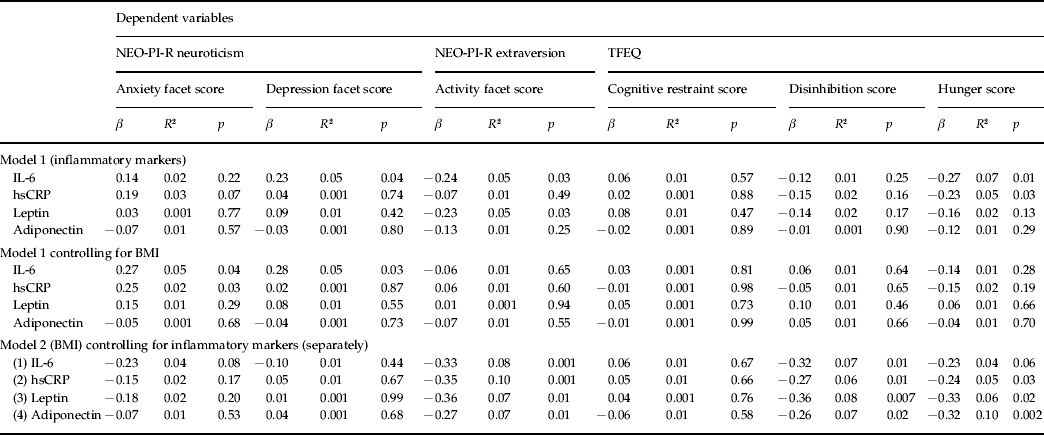
As shown in Table 2, baseline IL-6 levels were associated with the depression facet of neuroticism, with higher IL-6 concentrations being associated with higher scores of depression. Moreover, there was a significant relationship between IL-6 concentrations and the activity facet of extraversion, with higher IL-6 levels corresponding to lower activity. Similarly, baseline leptin levels were significantly related to the activity facet of extraversion, with greater leptin levels corresponding to lower activity scores. Finally, there was a trend for hsCRP concentrations to be positively associated with the anxiety facet of neuroticism. Interestingly, the association of IL-6 and hsCRP, respectively, with the facets of depression and anxiety of the dimension of neuroticism at baseline remained significant, and even became stronger, after adjusting for BMI. In addition, a relationship was found between baseline IL-6 concentrations and the total score of neuroticism and the facet of anxiety, when controlling for BMI. The Sobel test confirmed the contribution of IL-6 levels to the depression facet of neuroticism (Z=2.05, p<0.05) and the contribution, to a lesser extent, of both IL-6 and hsCRP levels to the facet of anxiety in obese participants (respectively, Z=1.93 and Z=1.89, p=0.05). The association of leptin and IL-6 with the activity facet of the dimension of extraversion at baseline did not remain significant after adjusting for BMI. The dimension of hunger of the TFEQ was negatively associated with concentrations of both IL-6 and hsCRP at baseline. However, this relationship did not remain significant after adjusting for BMI. When controlling for inflammation, the relationship found between BMI and the activity facet of extraversion remained highly significant. Similarly, the associations of BMI with the dimensions of hunger and disinhibition of the TFEQ remained generally significant when controlling for inflammatory markers. Nevertheless, when IL-6 was controlled for in the regression model, the relationship between BMI and hunger scores was significantly reduced. However, this effect was not robust enough to survive the Sobel test (Z=−1.07, p>0.05).
Association between adipokines/inflammatory markers and psychological variables at baselineFootnote a

NEO-PI-R, Revised Neuroticism–Extraversion–Openness personality inventory; TFEQ, Three-Factor Eating Questionnaire; IL-6, interleukin-6; hsCRP, high-sensitivity C-reactive protein; BMI, body mass index.
a All models were adjusted for age and diabetes status.
Effects of gastric surgery
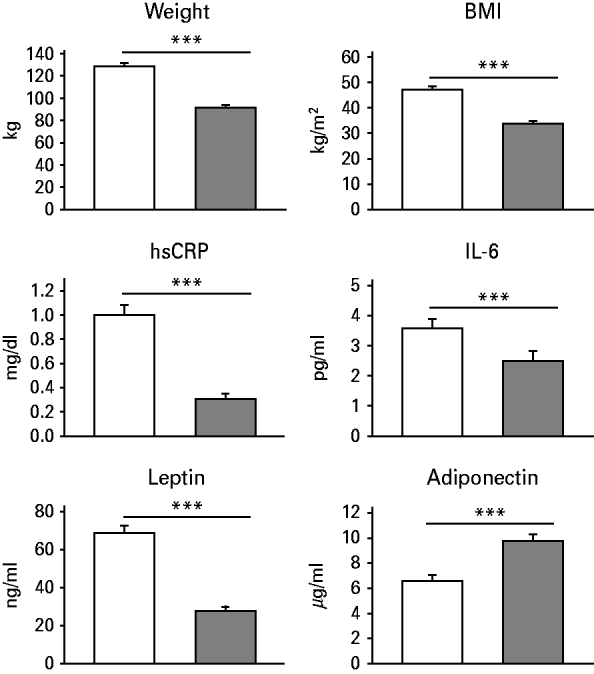
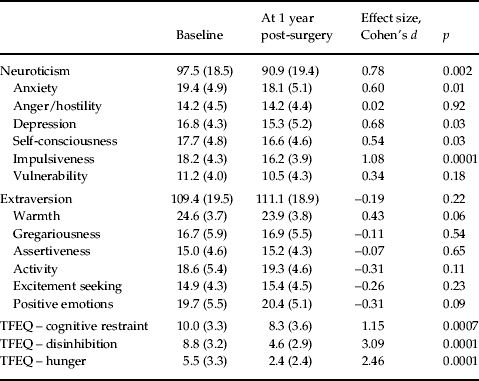
Fig. 1 shows the variations in adiposity and in adipokines and inflammatory markers between baseline and 1 year post-surgery. Variations in psychological scores between the same time points are shown in Table 3. In comparison with baseline, 1 year post-gastric surgery was associated with significant weight loss and decreased BMI (all p<0.001). On average, study participants had lost 37 (s.d.=15) kg, corresponding to a mean weight loss of 29%. Concentrations of inflammatory markers and adipokines were also significantly decreased after surgery in comparison with baseline (all p<0.001), as shown previously in a smaller group of subjects (Poitou et al. Reference Poitou, Coussieu, Rouault, Coupaye, Cancello, Bedel, Gouillon, Bouillot, Oppert, Basdevant and Clement2006). Neuroticism scores (especially on the facets of anxiety, depression, self-consciousness and impulsiveness) and TFEQ scores were significantly lower 1 year after surgery in comparison with baseline. On average, neuroticism scores were decreased in 64.3% of participants. There was no significant difference in extraversion scores at 1 year post-surgery compared with baseline.
Changes in adiposity and in adipokines and inflammatory markers between baseline (□) and 1 year post-surgery ( ) for: weight, body mass index (BMI), high-sensitivity C-reactive protein (hsCRP), interleukin-6 (IL-6), leptin, and adiponectin. Biological variables were log-transformed for statistical analyses. For hsCRP, data at 1 year were available in 65 patients; for IL-6, data at 1 year available in 58 patients; for leptin, data at 1 year were available in 61 patients; for adiponectin, data at 1 year were available in 65 patients. Values are means, with standard errors represented by vertical bars. *** Indicates that mean value was significantly different from that at baseline (p<0.001).

Changes in psychological scores between baseline and at 1 year post-gastric surgeryFootnote a

Values are given as mean (standard deviation).
TFEQ, Three-Factor Eating Questionnaire.
a Baseline and post-surgery psychological scores were available in 70 subjects. Effect sizes (Cohen's d) of 0.2, 0.5 and 0.8 represent, respectively, small, medium and large differences.
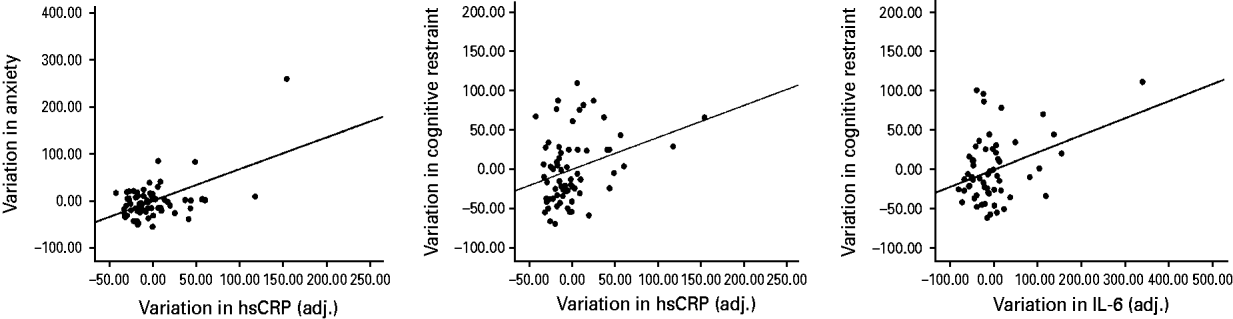
As expected, decreases in BMI and weight were significantly associated with decreases in concentrations of hsCRP (R=0.41 and R=0.41, p<0.001) and leptin (R=0.84 and R=0.86, p<0.001) and with increases in adiponectin levels (R=−0.27 and R=−0.26, p<0.05). In addition, hsCRP concentration decrease between baseline and 1 year post-surgery was significantly associated with decreases in IL-6 and leptin (R=0.32, p<0.05 and R=0.38, p<0.01). In the whole population under study, there was no significant linear relationship between changes measured in inflammatory markers and adipokines levels between baseline and 1 year post-surgery and variations in total neuroticism scores. Nevertheless, separate linear regression analyses performed on facets, adjusting for age, diabetes status and variation in BMI, revealed that decreases in hsCRP between the two time points were significantly associated with decreases in scores in the anxiety facet of neuroticism (β=0.60, R 2=0.30, p<0.001). In addition, decreases in hsCRP and IL-6 between baseline and 1 year post-surgery were significantly associated with decreases in cognitive restraint scores as assessed by the TFEQ (respectively, β=0.34, R 2=0.10, p<0.05 and β=0.36, R 2=0.13, p<0.01) (Fig. 2). Consistent with results obtained at baseline, the Sobel test confirmed the contribution of decreases in hsCRP levels between baseline and 1 year post-surgery to reductions in scores in the anxiety facet of neuroticism (Z=2.88, p<0.01) and also in scores of cognitive restraint (Z=2.09, p<0.05).
Relationship of variations in high-sensitivity C-reactive protein (hsCRP) and interleukin-6 (IL-6) levels between baseline and 1 year post-surgery with variations in the anxiety facet of neuroticism and the cognitive restraint dimension of the Three-Factor Eating Questionnaire (TFEQ). Variations depicted in graphs represent relative changes from baseline, i.e. (T2 – T1/T1)×100. Partial regressions were determined by separate linear regression analyses adjusting for age, diabetes status and variation in body mass index. (a) Association of variations in hsCRP with decreases in Neuroticism–Extraversion–Openness personality inventory (NEO-PI-R) anxiety scores (β=0.60, p<0.001). (b) Association of hsCRP variations with decreases in TFEQ cognitive restraint scores (β=0.34, p<0.05). (c) Association of IL-6 variations with decreases in TFEQ cognitive restraint scores (β=0.36, p<0.01). Similar results were obtained when excluding two potential outliers, as identified by Grubbs's test (hsCRP v. NEO-PI-R anxiety scores: β=0.63, p<0.001; hsCRP v. TFEQ cognitive restraint scores: β=0.32, p<0.05) except for the association of IL-6 v. TFEQ cognitive restraint scores that was decreased (β=0.16, p=0.22), consistent with data from the Sobel test.

Discussion
Results from this study indicate strong associations between adiposity, glucose homeostasis, inflammatory processes and some psychological characteristics in morbidly obese women. The relationships between BMI, glucose homeostasis and inflammatory markers reinforce the notion that that low-grade chronic inflammation is a fundamental characteristic of obesity (Bastard et al. Reference Bastard, Jardel, Delattre, Hainque, Bruckert and Oberlin1999, Reference Bastard, Jardel, Bruckert, Blondy, Capeau, Laville, Vidal and Hainque2000; Cancello & Clement, Reference Cancello and Clement2006; O'Rourke, Reference O'Rourke2009) and support the role of inflammation in glucose homeostasis and insulin resistance (Bastard et al. Reference Bastard, Maachi, Lagathu, Kim, Caron, Vidal, Capeau and Feve2006; Rabe et al. Reference Rabe, Lehrke, Parhofer and Broedl2008).
Separate regression analyses adjusting for diabetes status and age indicated that the facets of depression and anxiety in the dimension of neuroticism were associated with IL-6 and hsCRP, with higher levels of the inflammatory markers predicting higher anxiety and depression scores. These results were not attributable to adiposity, since they remained significant after adjusting for BMI. This contribution of both IL-6 and CRP levels to scores in the depression and anxiety facets were confirmed by mediation analyses. To our knowledge, this is the first report of an association of inflammation with personality characteristics in severely obese subjects. These findings are consistent with the role of inflammation in emotionality/affectivity, and more specifically in mood-related symptoms (Raison et al. Reference Raison, Capuron and Miller2006). Neuroticism, which is highly connected to negative affect, is well known for representing an important intrinsic vulnerability factor for lifetime depression (Roberts & Kendler, Reference Roberts and Kendler1999; Jylha & Isometsa, Reference Jylha and Isometsa2006; Kendler et al. Reference Kendler, Gatz, Gardner and Pedersen2006, Reference Kendler, Gardner, Gatz and Pedersen2007). The finding that inflammatory factors were related to neuroticism scores in the population under study, independently of BMI, suggests therefore that inflammation per se may contribute to an increased vulnerability to emotional distress and mood disorders by exacerbating neuroticism in obese individuals. This notion could explain, at least partially, the high prevalence of psychiatric co-morbidities (mood disorders in particular) in obesity. Nevertheless, the verification of this hypothesis needs further investigations, using notably more specific assessments of mood in addition to measures of neuroticism. It is noteworthy, however, that the relationship between the NEO PI-R neuroticism dimension and scores on well-established scales of depression (e.g. the Beck depression inventory) has already been documented in many studies. In addition to supporting the hypothesis of the involvement of inflammatory processes in the psychological status and emotional distress of obese individuals, these results may have additional important implications, since they suggest that personality traits may be influenced by metabolic and inflammatory factors. Although neuroticism is supposed to represent a stable characteristic of personality, recent data have shown that this dimension is highly sensitive to changes, suggesting its inherent state characteristics (Wilberg et al. Reference Wilberg, Karterud, Pedersen, Urnes and Costa2009). Our findings that neuroticism scores only (and not extraversion scores) were significantly modified after surgery-induced weight loss and modulated by metabolic and inflammatory markers are in line with these data. Altogether, these findings indicate that in addition to metabolic processes, inflammatory pathways may significantly contribute to the psychological alterations and emotional distress related to obesity. Even though our data did not show any evidence of significant changes in extraversion scores after surgery-induced weight loss, it is possible that this result is attributable to the assessment tool used in this study and that detection of subtle variations in specific facets of extraversion would require more sensitive measures.
The influence of chronic low-grade inflammation on emotional status in obesity may involve several mechanisms. Although pro-inflammatory cytokines are too large to freely pass through the blood–brain barrier, several relevant pathways by which peripheral cytokine signals can access the brain have been elucidated, including passage of cytokines through leaky regions in the blood–brain barrier, active transport and transmission of cytokine signals via afferent nerve fibers, such as the vagus nerve (Watkins et al. Reference Watkins, Goehler, Relton, Tartaglia, Silbert, Martin and Maier1995; Plotkin et al. Reference Plotkin, Banks and Kastin1996; Rivest et al. Reference Rivest, Lacroix, Vallieres, Nadeau, Zhang and Laflamme2000; Konsman et al. Reference Konsman, Parnet and Dantzer2002). Within the brain, pro-inflammatory cytokines can induce their own synthesis and are produced by activated microglia and neurons. The central effects of cytokines include the activation of the hypothalamic–pituitary–adrenal axis and corticotropin-releasing hormone system, the alteration of the metabolism of key monoamines (e.g. serotonin, dopamine, neuroepinephrine) and the activation of amino acid and monoamine degradation pathways, notably the indoleamine-2,3-dioxygenase and quinolinic acid pathway (Dantzer et al. Reference Dantzer, Wollman and Yirmiya1999; Capuron & Miller, Reference Capuron and Miller2004; Raison et al. Reference Raison, Capuron and Miller2006). All of these mechanisms are believed to play a role in the regulation of emotional states.
Consistent with previous results (Provencher et al. Reference Provencher, Begin, Gagnon-Girouard, Tremblay, Boivin and Lemieux2008), neuroticism scores were found to be associated with eating behaviour, notably with the dimensions of disinhibition and hunger. Accordingly, similar to the relationship found between neuroticism and inflammatory markers, IL-6 and hsCRP levels were associated with hunger scores in participants. Nevertheless, this association did not remain significant when BMI was controlled for in the analyses, suggesting that adiposity (and not inflammation specifically) was an important mediator of altered eating behaviour in obese subjects. This hypothesis is supported by results from multiple regressions and mediation analyses indicating that BMI is associated with the dimensions of hunger and disinhibition of the TFEQ, independently of levels of inflammation.
As mentioned above, surgery-induced weight loss was associated with significant decreases in neuroticism scores, notably in the dimensions of anxiety, depression, self-consciousness and impulsiveness, together with significant decreases in inflammation and changes in adipokine levels. As expected, the extent of surgery-induced decrease in adiposity was significantly correlated with the magnitude of variations in adipokines and inflammatory markers, consistent with the notion that fat is one major source of low-grade inflammation in obese subjects (Bastard et al. Reference Bastard, Jardel, Delattre, Hainque, Bruckert and Oberlin1999; Wellen & Hotamisligil, Reference Wellen and Hotamisligil2003; Clement et al. Reference Clement, Viguerie, Poitou, Carette, Pelloux, Curat, Sicard, Rome, Benis, Zucker, Vidal, Laville, Barsh, Basdevant, Stich, Cancello and Langin2004; Cancello et al. Reference Cancello, Henegar, Viguerie, Taleb, Poitou, Rouault, Coupaye, Pelloux, Hugol, Bouillot, Bouloumie, Barbatelli, Cinti, Svensson, Barsh, Zucker, Basdevant, Langin and Clement2005; Forsythe et al. Reference Forsythe, Wallace and Livingstone2008). Decreases in scores in the anxiety facet of neuroticism between baseline and 1 year post-surgery were found to be associated with decreases in hsCRP, a relationship that remained after adjusting for variations in adiposity. In addition, decreases in hsCRP and IL-6 levels were also associated with decreases in scores of cognitive restraint between baseline and 1 year post-surgery. Consistent with baseline results, mediation analyses confirmed the contribution of variations in hsCRP levels to decreases in scores of cognitive restraint and in the anxiety facet of neuroticism. These findings are in line with previous data showing the involvement of inflammatory factors in the pathophysiology of mood and cognitive symptoms in various clinical populations, including patients with the metabolic syndrome (Capuron et al. Reference Capuron, Su, Miller, Bremner, Goldberg, Vogt, Maisano, Jones, Murrah and Vaccarino2008), patients with cancer or viral infections (Capuron & Miller, Reference Capuron and Miller2004; Capuron et al. Reference Capuron, Pagnoni, Demetrashvili, Woolwine, Nemeroff, Berns and Miller2005) and patients with coronary heart disease (Bankier et al. Reference Bankier, Barajas, Martinez-Rumayor and Januzzi2008).
No significant association was found between decreases in depression scores and variations in inflammatory markers in the present study. This finding is surprising, given the well-documented effects of inflammation on the physiopathology of depressive symptomatology. This result may be related to several limitations of this study, including a lack of statistical power due to the limited number of participants evaluated during the entire study period, but also a possible insufficient sensitivity of the depression facet of neuroticism in the detection of subtle depressive variations. It may also be that inflammation-induced changes in the depression dimension are not as easily reversed as inflammation-induced changes in anxiety. Finally, this finding may also suggest that other mechanisms are involved in the context of obesity, especially in the situation of gastric surgery characterized by drastic weight loss and major physical transformations.
In conclusion, data from this study indicate a strong relationship between adiposity, inflammation and affectivity in obese subjects and reveal that decreases in adiposity due to gastric surgery are associated with significant decreases in adipokines and inflammatory markers, together with significant improvements in emotional status and eating behaviour. Although it is delicate to causally interpret this relationship and to exclude the additional participation of psychological processes, including change in body image and self-esteem, our findings indicate that inflammatory status may be an important mediator of emotional distress and psychological characteristics of obese individuals.
Acknowledgements
This work was supported by Assistance Publique Hôpitaux de Paris/Direction de la Recherche Clinique (CRC P050318) and PHRC (0207). We thank Dr Florence Marchelli, Madame Christine Baudoin and Madame Patricia Ancel for their involvement in patient recruitment, data collection and sampling at the Centre of Research on Human Nutrition (CRNH), Ile de France.
Declaration of Interest
None.