Introduction
It is unlikely that there is any procedure in medicine other than cardiopulmonary resuscitation (CPR) where the survival rate has plummeted over the last 40 years. In the initial publication from Johns Hopkins Hospital, by Kouwenhoven and colleagues, 70% (14/20) survived to discharge;Reference Kouwenhoven, Jude and Knickerbocker1 in subsequent publications from the same hospital, survival was 24% in 1961Reference Jude, Kouwenhoven and Knickerbocker2 and 13% in 1983.Reference Bedell, Delbanco, Cook and Epstein3 The reason of course is that while the initial report described CPR as ‘designed to resuscitate the victim of acute insult’,Reference Kouwenhoven, Jude and Knickerbocker1 CPR has evolved to become the default response for virtually any patient in whom cardiac or respiratory function ceases and no prior decision not to resuscitate has been made.
There have been positive developments in resuscitation of course, particularly in management of out-of-hospital cardiac arrests where innovations such as ready availability of automated defibrillators allowing rapid CPR have resulted in improved outcomes.Reference Eisenberg, Bergner and Hallstrom4 Nevertheless, in recognition that the outcome of CPR in hospital patients is often poor unless patients are selected carefully has prompted extensive debate regarding the appropriate use of this procedure. Concerns about the appropriateness and value of CPR are particularly relevant for older people and their doctors since many studies have suggested that outcomes are worse in older people.Reference Ebell, Becker, Barry and Hagen5 However, there has also been evidence that doctors and families may be prone to underestimate the quality of life and likelihood of benefit from CPR in older people and to make resuscitation decisions without considering the preferences of older people themselves.Reference Ebrahim6
In this review, we examine the evidence for the effectiveness of CPR in older people and the determinants of success or failure. The ethical issues regarding use or withholding CPR are also examined. Finally, some, necessarily personal, pragmatic advice is given regarding the approach to this difficult issue.
Survival to discharge following CPR
In-hospital CPR
The most commonly reported measure of ‘successful’ CPR is survival to discharge. While this measure allows comparisons between studies, it is not entirely satisfactory. For some people, survival even for a more limited period may be of value; for others, survival to discharge with significant neurological or cognitive impairment may not represent a satisfactory or desirable outcome.
Reported rates of survival to discharge after in-hospital CPR vary from 7 to 26%.Reference Schneider, Nelson and Brown7–Reference Warner and Sharma9 In the largest study to date, examining 14,720 resuscitation attempts from the American National Registry of Cardio Pulmonary Resuscitation (NRCPR), survival at 20 minutes after CPR was 44%, but only 17% of patients survived to discharge.Reference Peberdy, Kaye and Ornato10 In Ebell's 1998 meta-analysis of CPR outcomes, including 9838 patients from 49 research publications after 1980, survival to discharge was 13–15%, depending on the rigour with which CPR events were defined.Reference Ebell, Becker, Barry and Hagen5 Survival rates are influenced by a large number of factors, and these complicate interpretation of individual studies and of the role of single factors such as age. These include factors associated with the cardiac arrest, with the patient and with the institution where the arrest occurs.
With regard to the arrest itself, survival to discharge for ventricular fibrillation and pulseless ventricular tachycardia in the NRCPR study was 34 and 35%, respectively, but was only 10% for asystole and pulseless electrical activity.Reference Peberdy, Kaye and Ornato10 Those with a witnessed arrest do better than those whose arrest is non-witnessed; the former unsurprisingly are more likely to have a shockable arrhythmia. For the same reason, the longer the attempt at resuscitation, the less likely the patient is to survive to discharge.
It is also unsurprising that those with severe acute or multiple chronic illnesses will do worse. Thus in Ebell's meta-analysis, factors that predicted a failure to survive to discharge included: sepsis the day prior to the CPR event, serum creatinine >133 μmol/l, metastatic cancer, being African-American, dementia and dependent status.Reference Ebell, Becker, Barry and Hagen5 Conversely, those with acute myocardial ischaemia, who are often cared for in a monitored environment and discovered with a ventricular arrhythmia, have a relatively good prognosis.
Although there is little doubt that older people are less likely to survive to discharge after CPR, there are conflicting reports on whether or not advanced age, independent of severity of acute and chronic illness, is a determinant of outcome. Ehlenbach and colleagues used Medicare data from 1992 to 2005 to identify 433,985 people aged 65 years or more who underwent CPR in US hospitals; 18.3% (95% confidence interval (CI): 18.2 to 18.5) survived to discharge.Reference Ehlenbach, Barnato and Curtis11 Survival to discharge was 22.2% in the 65–69 year age group, gradually declining with advancing age to 12.2% in those aged 90 years or more. Older age remained a predictor of a poor outcome even after adjusting for sex, race, co-morbidity and admission from residential or nursing care units.
Several studies have shown that selected groups of older people may do very well after CPR.Reference Di Bari, Chiarlone and Fumagalli12–Reference Tunstall-Pedoe, Bailey, Chamberlain, Marsden, Ward and Zideman14 For example, an Italian study of 245 patients (mean age 70 years), many with acute myocardial infarction, who received CPR in a geriatric department equipped with an intensive care unit, reported survival to discharge in 47%.Reference Di Bari, Chiarlone and Fumagalli12 Although survival was lower in those aged 70 years or more (39%) than those aged less than 70 (53%), age was not an independent predictor after adjusting for the mechanism and causes of cardiac arrest. Hospital systems may also affect survival after CPR. In particular, the finding that hospitals with more extensive monitoring of patients have lower variations in survival according to the time of day that the arrest occurs, supports the importance of variations in the quality of care provided.Reference Peberdy, Ornato and Larkin15, Reference Jones-Crawford, Parish, Smith and Dane16 Larger hospitals have a slightly lower survival rate than smaller hospitals, while there is no difference between teaching and non-teaching hospitals. The reduced survival of those referred from residential care units and the abysmal survival when CPR is performed in such units are consistent findings in the literature.Reference Finucane, Boyer and Bulmash17, Reference Kane and Burns18
Out-of-hospital CPR
The most important factors determining outcomes after out-of-hospital CPR are the speed with which bystander CPR and particularly defibrillation are started and whether or not the arrest has a cardiac aetiology, in which case outcomes are better. Individual patient characteristics are of lesser significance.Reference Hollenberg, Herlitz and Lindqvist19
Results regarding the importance of advanced age as a predictor of outcome from out-of-hospital CPR have been conflicting. It is clear, however, that certain groups of older people can do very well. In a study of out-of-hospital arrests attended by emergency staff in Houston, Texas, 22% of 367 elderly cardiac arrest victims were successfully resuscitated and 24 patients (7%) survived.Reference Bonnin, Pepe and Clark20 However, of the 119 older patients (32% of all elderly patients) who presented with ventricular fibrillation or tachycardia, 48 patients (40%) were resuscitated and 17 patients (14%) survived. Indeed, survival rates for younger and older ventricular fibrillation/tachycardia patients were not significantly different.
Conversely, resuscitation outcomes are very poor in older people where the presenting rhythm is not shockable, there is no bystander CPR and the ambulance is slow to arrive. For example, in the study by Herlitz et al., there were no survivors among those over 80 years, with an unwitnessed arrest at home and an interval of 8 minutes or more before the ambulance arrived.Reference Herlitz, Engdahl and Svensson21
Other outcomes after CPR
In the NRCPR study, 84% of patients had come from home prior to their cardiac arrest.Reference Peberdy, Kaye and Ornato10 Among those who survived to discharge, only 51% returned home. The remainder went to other hospitals, to rehabilitation units, or to nursing homes. Two per cent were discharged to hospice care. In Ebell's meta-analysis, only five studies reported discharge information; of these, 73 of 93 patients (78%) returned home on discharge.Reference Ebell, Becker, Barry and Hagen5
The neurological status and overall functional performance of survivors in the NRCPR study was assessed using the same five-point scale for each (1 = good performance to 5 = brain death).Reference Peberdy, Kaye and Ornato10 Before CPR, 68% of those who survived CPR had been in category 1 with regard to neurological status; at discharge 59% were in category 1; thus 86% of category 1 patients remained at this level and 14% had a decline in neurological status. With regard to functional performance, 49% of survivors were category 1 before CPR and 37% after CPR; thus 25% had a decline in overall function.
In one of the largest and most detailed single-centre studies, investigators followed up 89% of 101 patients who survived to discharge following CPR in the Academic Medical Center in Amsterdam.Reference de Vos, de Haes, Koster and de Haan22 Most survivors were independent in daily activities (75%), 17% were cognitively impaired, and 16% had depressive symptoms. Multivariate regression analysis showed only two pre-arrest predictors of poor quality of life or cognitive impairment after CPR: age 70 years or older and non-cardiac reason for admission.
Patients with prolonged (>24 hours) coma after CPR are more likely to die or have significant neurological deficits; absence of pupil or corneal reflexes or of motor response other than extensor response at 3 days is a particularly poor feature.Reference Young23 However, an analysis of data from two randomized, double-blind studies (Brain Resuscitation Clinical Trial I and II) of 774 patients who were initially comatose after successful resuscitation from cardiac arrest (both in- and out-of-hospital) found that while the 6-month mortality was 94% for the oldest group (>80 years) compared with 68% for the youngest group (≤45 years), age was not an independent predictor of poor neurological outcome after adjusting for prolonged arrest time.Reference Rogove, Safar and Sutton-Tyrrell24 Overall, 27% of this population recovered good neurological function.
Gross neurological function may not be an adequate outcome measure. In a study of survivors of out-of-hospital cardiac arrests in the Lothian region of Scotland, 35 of 37 patients who were still alive and resident in the region (mean age 66 years) underwent detailed cognitive testing. Although none had obvious neurological damage, 37% had moderate or severe impairment of verbal and spatial memory. Severity of impairment of memory correlated significantly with measures of duration of cardiac arrest but not with age or other potential confounders.Reference Grubb, O'Carroll, Cobbe, Sirel and Fox25
Ethics and CPR: background
The often poor results when CPR is performed as an automatic response to death in hospital have promoted widespread professional and even public concern about the appropriate use of this intervention. Policies regarding written do-not-resuscitate (DNR) orders (it has been suggested that do-not-attempt-resuscitation (DNAR) orders would be more accurateReference Hadorn26) have long been commonplace in the United States and are increasingly common in European and other countries.Reference Edgren27, Reference Bedell, Pelle, Maher and Cleary28 This, in turn, has led to debate about the extent to which discussion of such orders with patients themselves is required and when it may be appropriate for doctors to make a unilateral decision on this matter.
A quick summary of the evolution of this debate in Britain is informative about the difficulties. When written DNR orders became usual in the USA in the early 1980s, an editorial in the BMJ noted dismissively: ‘In Britain, such decisions are based on clinical judgement and mutual trust . . . rather than abstract principles and printed policy statements’. Reference Bayliss29 However, following complaints regarding doctors making unilateral decisions about resuscitation, the Health Service Commissioner and Chief Medical Officer recommended that all hospitals should have written policies regarding CPR and DNR policy, and patients or their families should be informed and consulted about any decisions.30, Reference Calman31 This approach was endorsed jointly by the British Medical Association, the Resuscitation Council (UK), and the Royal College of Nursing in 1993.32 However, in 2000, Age Concern England publicised over 50 case histories of unilateral DNR orders,Reference Mendick and Dillon33 and an editorial by Ebrahim called for legislation to eliminate the ageism underlying the failure to consult people.Reference Ebrahim6 On the other hand, in 2001, Soper, a general practitioner, recounted the sad story of an older patient who arrested at home and where paramedics commenced CPR over the objections of her daughter who said: ‘I told them that she wouldn't have wanted them to try and revive her, but they asked if I had that in writing’.Reference Soper34
Controversy and debate has continued about how best to approach CPR decision-making and, most recently, about whether existing guidelines are a help or a hindrance to providing high-quality and ethical care to groups such as hospice patients or those in residential care.35
Ethical principles: the primacy of autonomy?
In their highly influential book Principles of Biomedical Ethics, Beauchamp and Childress suggested respect for autonomy, beneficence, non-maleficence and justice as cardinal principles in biomedical ethics.Reference Beauchamp and Childress36 It is a parody, albeit with some element of truth, to see developments and controversies in medical ethics in recent decades as a battle between respect for autonomy (over-simplified as ‘what does the patient want’) and beneficence (over-simplified as ‘what does the doctor think is in the patient's best interests’ or as paternalism). In that regard, and from a North American viewpoint, Schneider has noted that we live in the ‘time of the triumph of autonomy in bioethics’.Reference Schneider37
Few would dispute that medical practice has changed, and needed to change, from an era where medical paternalism (albeit, almost by definition, well-intentioned) was dominant to one where the goals and preferences of patients were emphasized. However, the idea that patient autonomy is the ultimate goal of medical practice has been increasingly challenged of late. In the most recent edition of their textbook, Beauchamp and Childress themselves noted that ‘to assign priority to one of these factors [principles] as the key ingredient is a dubious project, as is the attempt to dispense with ethical theory all together’. Reference Beauchamp and Childress36 Instead, they noted: ‘in moral reasoning we often blend appeals to principles, rules, rights, virtues, analogies, paradigms, parables, and interpretations’. Others have attacked the emphasis on the ‘four principles’: for example, Cowley described them as ‘fatuous jargon’Reference Cowley38 while Harris bemoaned the development of ‘cookbook ethics’.Reference Harris39
It is a generally accepted principle that the preferences of competent patients regarding their own care should be respected whenever possible. People have an absolute right to say ‘no’ to proposed interventions. However, it does not follow that people can demand interventions regardless of their effectiveness or availability. Nevertheless, respect for autonomy would seem to require that important decisions are not made secretly and that patient's goals and preferences are taken into account.
Eliciting patients’ CPR preferences
A 2003 review of 45 papers examining the views of older patients regarding resuscitation concluded that the majority of patients were comfortable with discussions about CPR and wished to be involved in discussions and decisions about resuscitation.Reference Frank, Heyland and Chen40 Patients reported getting much of their knowledge about CPR from television and, consistent with the exaggerated success rate noted in television depictions of CPR, overestimated the likely benefits of CPR.Reference Diem, Lantos and Tulsky41 The majority of in-patients wanted CPR in their current health. A significant minority (over a third in North American studies) wanted CPR under any circumstances, but most rated significant physical and mental disability as important reasons for declining CPR in the future.
Patient preferences may vary significantly with time. Fried et al. followed 189 people over 60 years with advanced cancer, heart failure or chronic obstructive pulmonary disease.Reference Fried, O'Leary and Van Ness42 Participants were interviewed every 4 months over 2 years and asked about their willingness to undergo high burden therapy that might increase their chance of avoiding death but increase the risk of physical or cognitive impairment. Overall, 49% of patients showed inconsistent trajectories in preferences with time and this could not be fully explained by variation in patients’ health status. Patients’ views can also change because of education about the real outcomes of CPR, and this can considerably modify preference.Reference Murphy, Burrows and Santilli43
Despite patients’ preference that CPR discussions should occur, these often do not occur, even with patients who are most likely to need CPR. A number of barriers have been identified. Fidler et al., in a prospective cohort of 374 patients, attempted to establish whether acutely unwell patients wished to participate in discussions about resuscitation.Reference Fidler, Thompson and Freeman44 Patients were approached in the emergency department and given an information leaflet on the study; after 24 hours they were asked if they wanted to participate. Only 74 patients agreed to discuss cardiopulmonary resuscitation and accept information about it; 189 could not be approached for practical reasons and 111 declined. Cognitive and sensory difficulties do create genuine difficulties in communicating with older people, although these can sometimes be surmounted by simplification, repetition and use of aides.Reference O'Keeffe45
Doctors may fear causing distress by explicit discussions of end-of-life issues. While such distress is rare in studies reporting hypothetical discussions, the risk has been 6–11% in studies reporting ‘real-life’ discussions.Reference O'Keeffe45, Reference Sayers, Schofield and Aziz46 While better communication training for doctors and incremental provision of information might improve matters, it can be argued that distress when faced with discussing one's possible death is an unavoidable side-effect of increased autonomy. It is inarguable, however, that it is very difficult in practice, and may be counter to all the humane instincts of the doctor, to discuss CPR with distressed acutely ill patients. As Finucane and Harper put it: ‘To hold vulnerable patients . . . in the glare of autonomy, carefully explaining their bleak prognosis and insisting lawyer-like on a decision . . . seems barbaric to many’. Reference Finucane and Harper47
Futility: an ethical trump-card?
In general, doctors don't feel any obligation to offer or to discuss futile treatment to patients. Hence ‘futility’ is often offered as a reason for not discussing resuscitation with patients. However, there is great difficulty in defining what is meant by futility. As Trugg and colleagues put it: ‘Many clinicians view futility the way one judge viewed pornography: they may not be able to define it, but they know it when they see it’.Reference Trugg, Brett and Frader48 While some degree of subjectivity is indeed inevitable, ‘futility’ is too often a fancy term to dress up judgements that rely more on values and biases than on evidence.Reference Curtis, Park, Krone and Pearlman49
Whether or not a treatment is futile always depends on the goal of treatment.Reference Sokol50 It is helpful to distinguish between different types of futility judgement:
1 Physiological futility: the intervention cannot physiologically achieve the desired effect. An example would be the use of CPR in someone with rupture.
2 Quantitative futility: the proposed intervention is very highly unlikely to achieve the desired effect.
3 Qualitative futility: the proposed intervention, if successful, will probably produce such a poor outcome that it is better not to attempt it.
Physiological futility is the most objective type of futility judgement and is uncontroversial although rarely helpful. Qualitative futility is the most subjective and least satisfactory use of the term: there is evidence that doctors consistently and significantly underestimate the quality of life of patients such as those with disabilities.Reference Ouslander, Tymchuk and Rahbar51–Reference Sprangers and Aaronson53
Usually when doctors mention futility, they mean quantitative futility. However, quantitative thresholds for futility are arbitrary, and good data are lacking for most conditions. Pre-arrest scoring systems, such as the ‘pre-arrest morbidity index’ (PAM)Reference George, Folk, Crecelius and Campbell54 and the ‘prognosis after resuscitation score’ (PAR)Reference O'Keeffe and Ebell55 have been developed in an attempt to improve prediction of outcomes following CPR. However, these have not performed well in independent studies and are, in any event, of little use in deciding how an individual patient will do.Reference Bowker and Stewart56
Two examples will demonstrate some of the difficulties in this area. Many studies in the USA have shown reduced survival in black patients compared with patients of other races after in-hospital (and out-of-hospital) arrest.Reference Peberdy, Kaye and Ornato10, Reference Ehlenbach, Barnato and Curtis11 The reasons are complex, and racial differences in the burden of cardiac and other co-morbidity and in the quality of hospital care and the higher proportion of black patients undergoing CPR, even when a poor outcome seems likely, may be contributing factors. Whatever the reason, and however robust a finding this may be, it would not be acceptable to decide that someone should not receive CPR because of their race. Another example is that of patients with cancer. In older series, such patients did very poorly after CPR and CPR in those with metastatic disease was labelled as ‘futile’. However, a recent meta-analysis concluded that since 1990, 6.7% of cancer patients (9.1% if localized cancer, 7.8% if metastatic cancer) survived CPR to discharge.Reference Reisfield, Wallace and Munsell57
CPR in residential care: a special case?
As Finucane and colleagues have noted, when a patient in a nursing home is found pulseless, one can decide either they have died peacefully, often after long illness, in their own residence or that a cardiac arrest has occurred in a setting with nursing and medical expertise.Reference Finucane and Harper47 Reports of CPR outcomes from long-stay units in the United States, where resuscitation services in this setting are generally well developed, show very poor outcomes both initially and in the long term.Reference Finucane, Boyer and Bulmash17, Reference Kane and Burns18 This can be explained by the characteristic frailty of residents. Also, cardiac arrests in long-stay units are often unwitnessed; hence asystole is often the presenting rhythm disturbance. Performing or witnessing CPR on someone they have often known for a long time may be traumatic for staff and for other residents in long-stay units. Conroy and colleagues have argued that provision of CPR training in long-stay units diverts staff time and scarce resources from more important elements of care, for limited benefit, and they suggested that not all units should offer CPR.Reference Conroy, Luxton, Dingwall, Harwood and Gladman58
A number of arguments can be made against this view.Reference O'Brien and O'Keeffe59 While it is possible to predict that residents of long-stay units, as a group, will do badly with CPR, it is not possible to make that prediction with great confidence for individual residents. The population of most long-stay units is highly heterogeneous. While many are very frail, others, for example those admitted because of housing needs or fear of falling or for short-term respite, may be relatively fit and healthy. Refusing CPR on the grounds of age or of location alone, without considering individual circumstances, is discriminatory and may contravene equality legislation. Resident preferences must also be considered. While some would choose to forego aggressive resuscitative measures if asked, others, having considered the alternative, might prefer to have a chance of surviving, however small, in the event of a cardiac arrest. The cost issue can also be overstated. Relatively cheap, automated external defibrillators are now widely distributed in public places and can be used by lay people without any elaborate or costly training.Reference Woollard60
Striking a balance in CPR decision-making
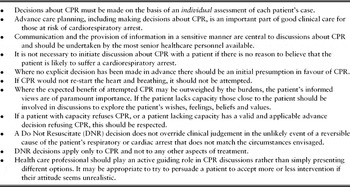
It is important, when making CPR decisions, to strike a balance between ensuring patient participation whenever possible but without offering illusory choices where CPR is very unlikely to succeed. Important principles when making CPR decisions are summarized in Table 1. A number of points warrant additional discussion.
General principles of CPR decision-making

(Adapted from references 35 and 45).
For many patients, the likelihood of cardiorespiratory arrest is small. It would be impractical, and unnecessarily burdensome for all, to discuss end-of-life issues with all such patients; instead, the presumption in favour of CPR should operate in the unlikely event of an arrest. Some patients may give an indication, whether explicit or not, that they would welcome discussion of end-of-life care, and the issue should be broached with such people.
At the other extreme, there are those who are so unwell that death seems inevitable within a short time. In most cases, a sensitive but open discussion of end-of-life care will be possible. However, this does not necessarily require explicit discussion of CPR or an ‘offer’ of CPR if a clinical decision has been made that CPR would be unsuccessful.Reference O'Keeffe45 As the BMA/RC/RCN guidelines state:35
‘Although patients should be helped to understand the severity of their condition, whether they should be informed explicitly of a clinical decision not to attempt CPR will depend on the individual circumstances. . .[For] those who know that they are approaching the end of their life, information about interventions that would not be clinically successful will be unnecessarily burdensome and of little or no value’.
Even in such cases, individual circumstances must always be considered. It would be as wrong not to discuss CPR with the patient who shows a keen interest in or has strong views about their medical care as it would be cruel to have the same discussion with the dying patient with anxiety or depression or who resists discussion of medical matters.
There are many patients for whom discussion of CPR is required, including those with acute severe illness, those with recurrent hospital admissions due to chronic progressive illness and those with severe chronic disease impacting on the patient's reported quality of life. Discussion of CPR includes education about what is involved and the best estimate of the success rate for the individual patient, with explanation of the limitations of such predictions.
The approach to communication with patients is of critical importance. Although there are enormous individual variations, there is a well-recognized discrepancy between the amount of information patients want (which is often large) and the degree to which they want to make medical decisions for themselves (which is often small).Reference Vick and Scott61–Reference Wilkinson, Khanji, Cotter, Dunne and O'Keeffe63 Thus patients who want to receive information about their condition are not always willing to use that information to make the final decision about their treatment.
This is well illustrated by an American study of over 3000 people with CPR preferences identified in studies of critically ill (SUPPORT study) and older (HELP) hospital patients.Reference Puchalski, Zhong and Jacobs64 Only 25% would actually want their stated resuscitation preferences followed if they were to lose decision-making capacity, while 75% would prefer that their family and physician make resuscitation decisions for them. Franz Ingelfinger noted the importance of physicians providing active guidance rather than leaving difficult decisions to patients:Reference Ingelfinger65
‘I do not want to be in the position of a shopper at the Casbah . . . A physician who merely spreads an array of vendibles in front of his patient and then says “Go ahead, choose, it's your life” is guilty of shirking his duty. . . ’
The 2007 revision of the British Medical Association (BMA), the Resuscitation Council (UK) and the Royal College of Nursing (RCN) 2001 guidelines are, in the view of the authors, the most helpful yet in negotiating the difficulties surrounding this area.35 These guidelines share many similarities with those suggested by one of us (SO'K) in 2001.Reference O'Keeffe45 However, CPR decisions are never easy, and no guidelines will ever substitute for careful consideration of the individual patient and his or her circumstances.
Conflicts of interest
The authors declared no conflicts of interest.