Introduction
Multiple sclerosis (MS) is a chronic neurological disease that causes demyelination of the central nervous system white matter and cerebral atrophy, resulting in motor, cognitive, and neuropsychiatric symptoms. Cognitive impairment occurs in 43 to 70% of individuals with MS (for review, see Chiaravalloti & DeLuca, Reference Chiaravalloti and DeLuca2008), with learning and memory impairment among the most common deficits. Memory dysfunction negatively impacts employment and functional status, thereby reducing activities in, and quality of, everyday life. As such, accurate evaluation of memory functioning is essential for proper treatment planning, as well as documentation of disability. A comprehensive approach to memory assessment includes objective cognitive assessment with formal instruments (i.e., memory tests), as well as subjective reports by patients regarding memory capacity outside of the testing environment. Although subjective reports provide important insights into how memory problems impact daily life, they often conflict with the results of formal testing.
Within the MS literature, patients’ self-reported memory functioning for the most part has been shown to be essentially unrelated to performance on memory tasks. Subjective memory complaints were not significantly related to short term memory, or visual or verbal learning and memory in a sample of early phase MS patients (Landro, Sletvold, & Celius, Reference Landro, Sletvold and Celius2000). Self-report memory failed to correlate significantly with performance on tasks of verbal learning and memory, story recall, and visual spatial memory (Randolph, Arnett, & Freske, Reference Randolph, Arnett and Freske2004; Randolph, Arnett, & Higginson, Reference Randolph, Arnett and Higginson2001). Similarly, no significant relationships were found between self-reported memory and working memory and verbal memory, as well as processing speed, flexibility and problem solving, and response inhibition (Bruce, Bruce, Hancock, & Lynch, Reference Bruce, Bruce, Hancock and Lynch2010).
Much of the literature has attributed subjective—objective discrepancies to patient error (e.g., lack of awareness, poor insight). Patients may interpret other cognitive deficits, such as inattention or executive dysfunction, as memory problems (Bruce et al., Reference Bruce, Bruce, Hancock and Lynch2010; Randolph et al., Reference Randolph, Arnett and Higginson2001, Reference Randolph, Arnett and Freske2004). Non-cognitive factors, such as neurological and physical function (Hoogervorst et al., Reference Hoogervorst, van Winsen, Eikelenboom, Kalkers, Uitdehaag and Polman2001), neuropsychiatric (Carone, Benedict, Munschauer, Fishman, & Weinstock-Guttman, Reference Carone, Benedict, Munschauer, Fishman and Weinstock-Guttman2005), and fatigue (Marrie, Chelune, Miller, & Cohen, Reference Marrie, Chelune, Miller and Cohen2005), may be experienced as impaired memory. More commonly, still, patients perceive cognitive impairments when psychological factors (e.g., depression, anxiety) are the underlying issue (Bruce et al., Reference Bruce, Bruce, Hancock and Lynch2010; Goverover, Chiaravalotti, & DeLuca, Reference Goverover, Chiaravalotti and DeLuca2005; Landro et al., Reference Landro, Sletvold and Celius2000; Maor, Olmer, & Mozes, Reference Maor, Olmer and Mozes2001; Marrie et al., Reference Marrie, Chelune, Miller and Cohen2005; Randolph et al., Reference Randolph, Arnett and Freske2004). The heterogeneity of factors cited as attributing to inaccurate subjectivity may give the impression that subjective report serves as a non-specific gauge of impairment or distress.
The emphasis on subject-related explanations of the objective-subjective discrepancy relies on the tacit assumption that objective measures of memory are valid proxies of real world learning and memory requirements. Whereas most studies operationalize memory as total learning across several trials or delayed recall following multiple learning opportunities, learning and memory in naturalistic settings typically requires acquisition of information following a single learning trial. For instance, one often has a single opportunity to encode a new acquaintance's name or the message of a television news story. Thus, single-trial learning may better replicate peoples’ day-to-day experience of learning and memory and may therefore correlate more strongly with patients’ self-reported memory functioning. In contrast, multiple-exposure learning variables may be better suited to learning and memory performance in school or work environments.
The goal of the current study was to explore the relationships between self-reported memory functioning and one-trial learning relative to aggregated learning across trials and subsequent delayed recall. It was hypothesized that initial-trial learning would be significantly associated with subjective memory experience, whereas the relationship with aggregate learning and delayed recall would not.
Method
Participants
The study sample consisted of 16 men and 48 women, aged 47.7 ± 9.3 years with 15.7 ± 2.4 years of education. Mean time since diagnosis was 14.0 ± 9.3 years, and MS course included relapsing-remitting (47), primary progressive (2), secondary progressive (13), and progressive-relapsing (1); the MS course for 1 individual was unknown. Ambulation Index (Hauser et al., Reference Hauser, Dawson, Lehrich, Beal, Kevy, Propper and Weiner1983) scores, available for 60 of the 64 subjects, revealed mild gait impairment (mean, 3.3 ± 2.5) in this sample. This study was approved by the Institutional Review Board at Kessler Foundation Research Center, and all participants provided informed consent before enrollment.
Recruitment
Persons aged 18–55 years diagnosed with MS (McDonald et al., Reference McDonald, Compston, Edan, Goodkin, Hartung, Lublin and Wolinsky2001) were recruited from local MS clinics, the New Jersey Metro Chapter of the National MS Society, and from the community, to participate in a study investigating memory retraining in MS. Subjects were excluded if they had an exacerbation in the past 4 weeks, were currently taking corticosteroid medication, or had a history of serious psychiatric diagnosis (schizophrenia or bipolar disorder), substance abuse, diagnosed learning disability, or neurological condition other than MS. Although individuals with a serious history of depression were excluded, given the high prevalence of depression among MS patients, individuals with current depressive symptomatology were not excluded, rather, their depressive symptomatology was assessed and considered in the analysis.
Materials and Procedures
Subjective memory functioning was assessed with the Memory Functioning Questionnaire (Gilewski, Zelinski, & Schaie, Reference Gilewski, Zelinski and Schaie1990), which asks individuals to rate how often they encounter difficulty recalling different types of information. The dependent variable used in these analyses was the Total MFQ score, which has a possible range of 64 (lowest rating of one's memory faculties) to 448 (highest rating). Objective learning and memory were assessed with the California Verbal Learning Test-II (CVLT-II; Delis, Kramer, Kaplan, & Ober, Reference Delis, Kramer, Kaplan and Ober2000), the Open Trial-Selective Reminding Test (OT-SRT; Chiaravalloti, Balzano, Moore, & DeLuca, Reference Chiaravalloti, Balzano, Moore and DeLuca2009), and Prose Memory (PM; Williams, Reference Williams1991) from the Memory Assessment Scales. The CVLT-II is a list-learning task with five learning trials, immediate and delayed recall trials, and a recognition trial. The OT-SRT is a list-learning task, which requires subjects to learn a list of 10 words over a maximum of 15 trials. On trials 2 through 15, subjects are reminded of words that were missed on the preceding trial and are then asked to recall the entire word list. List learning is discontinued when a subject meets the criterion of perfect recall on two consecutive trials, with full credit (i.e., 10) awarded for all learning trials after the criterion is met (Sumowski, Wylie, Chiaravalloti, & DeLuca, Reference Sumowski, Wylie, Chiaravalloti and DeLuca2010). Delayed recall of the OT-SRT list is also assessed. The PM is a 60-word story that is presented for immediate free recall and recognition, as well as delayed free recall and recognition. Depressive symptomatology was quantified with the Chicago Multiscale Depression Inventory (CMDI; Nyenhuis et al., Reference Nyenhuis, Luchetta, Yamamoto, Terrien, Bernardin, Rao and Garron1998).
The relationships between self-reported memory functioning (MFQ total score) and objective memory functioning (CVLT-II, OT-SRT, and PM scores) were explored using Pearson product-moment correlations. Subsequently, the relationship between self-reported memory functioning and depression was explored using Pearson product-moment correlations. The relationship between self-reported memory (MFQ total score) and objective memory measures (i.e., CVLT-II, OT-SRT, and PM scores) was then subjected to partial correlation analysis to determine the unique variance after accounting for the relationship with depression.
Results
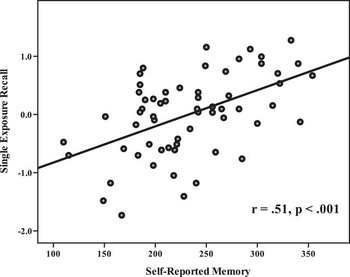
Due to the high number of statistical analyses conducted and to control for Type 1 error, significance was concluded at p < .01 and a trend was deemed present at p < .05. Significant positive correlations were found between self-reported memory functioning on the MFQ and recall during Trial 1 of the OT-SRT (r = .42; p = .001) and Trial 1 of the CVLT-II (r = .39; p = .002), and a trend toward significance was found between self-reported memory functioning and Immediate Recall of the PM (r = .28; p = .028). In contrast, no significant relationship was found between MFQ scores and recall performance on CVLT-II learning Trials 2, 3, 4, or 5, Total Recall across Trials 1–5, Short Delay Free Recall, or Long Delay Free Recall (all p values > .05). No significant relationship was found between MFQ scores and performance on OT-SRT individual Trials 2 through 15, Trials to Criterion, or 30 Minute Recall (all p values > .05). No significant relationship was found between MFQ scores and PM Delayed Recall (p > .05). Taken together, self-reported memory functioning was only related to performance on persons’ first attempt at recalling word lists (i.e., CVLT-II, OT-SRT) and prose passages (i.e., PM). To obtain a common metric value of first-trial learning, sample-based Z-scores were created for each of the immediate recall trials (OT-SRT Trial 1, CVLT-II Trial 1, PM Immediate Recall), and then were averaged into a composite Z-score representing immediate recall following single exposure to stimulus information. As shown in Figure 1, self-reported memory (MFQ) was strongly related to immediate recall (r = .51; p < .001). We then performed a similar procedure for delayed recall performance across the three tasks; however, self-reported memory (MFQ) was not reliably related to delayed recall performance (r = .23; p = .08). Taken together, self-reported memory appears most strongly linked to immediate recall performance.
Single exposure recall is a composite of the immediate recall trials on the Open-Trial Selective Reminding Test (OT-SRT), California Verbal Learning Test-II (CVLT-II), and Prose Memory (PM), created by averaging sample-based Z-scores for each of these measures. The self-reported memory is the Total MFQ score.

Depressive symptomatology on the CMDI was minimal (total T, mean, 55.2 ± 12.8; range, 38.0–89.7), with elevations due mostly to vegetative symptoms (vegetative T, mean, 58.4 ± 13.4; range, 35.7–95.9), consistent with MS. An inverse trend toward significance was observed in the relationship between self-reported memory functioning on the MFQ and depressive symptomatology as quantified on the CMDI (r = −.29; p = .023), such that greater depressive symptomatology was associated with poorer subjective memory reports. However, when mood was controlled through partial correlation, the correlations between self-reported memory functioning on the MFQ and recall during Trial 1 of the OT-SRT (r = .40; p = .002) and Trial 1 of the CVLT-II (r = .34; p = .009) remained significant and positive. The relationship between self-reported memory functioning on the MFQ and Immediate Recall of the PM weakened slightly, but nonetheless showed a trend toward significance (r = .24; p = .062). In summary, although mood may be related to subjective memory, it does not account for the relationship between subjective and objective memory.
Discussion
The current results revealed a significant association between self-reported memory functioning and initial-trial performances on objective memory measures. In contrast, self-reported memory functioning was essentially unrelated to total learning across trials and delayed recall performance. Findings suggest that the first-trial recall may best reflect subjective memory experience, perhaps because single-trial learning more closely replicates the single-exposure interactions characteristic of real life (e.g., conversations).
Previous research examining the relationship between subjective and objective memory in MS patients has overwhelmingly relied on aggregated learning measures (e.g., CVLT-II Total Learning) and delayed recall performance following aggregated learning (e.g., CVLT-II LDFR; Bruce et al., Reference Bruce, Bruce, Hancock and Lynch2010; Carone et al., Reference Carone, Benedict, Munschauer, Fishman and Weinstock-Guttman2005; Landro et al., Reference Landro, Sletvold and Celius2000; Randolph et al., Reference Randolph, Arnett and Higginson2001, Reference Randolph, Arnett and Freske2004). Although one of these studies found self-report cognitive impairment was related to delayed recall (Carone et al., Reference Carone, Benedict, Munschauer, Fishman and Weinstock-Guttman2005), the others found no relationship between patient self-report and objective performance on aggregated learning and delayed recall scores. The current study mirrors existing non-significant findings in this regard; however, when initial-trial learning is considered independently, a significant subjective—objective relationship is revealed. Marrie and colleagues’ (Reference Marrie, Chelune, Miller and Cohen2005) found that individuals with mildly impaired immediate memory perceived themselves as impaired, whereas individuals with considerable impairment reported being cognitively intact. While the relationship described speaks more to the issue of awareness, germane to the current discussion is that subjective memory was related to immediate memory performance, but not whatsoever to auditory recognition, delayed recall, or working memory.
Although the association between self-reported memory and initial-trial learning may be explained by a priori similarities between single-trial learning (e.g., CVLT-II Trial 1) and the memory requirements of everyday events, the reason for the degrading association between self-reported and objective memory functioning across additional learning opportunities (e.g., CVLT-II Trials 2–5, CVLT-II Total Learning, etc.) is less clear. It is possible that the repeated exposures provided in our learning assessment measures are conceptually different from spontaneous exposure to information in real life. Indeed, it has been shown that retrieval practice improves learning (Sumowski, Chiaravalloti, & DeLuca, Reference Sumowski, Chiaravalloti and DeLuca2010) and repeated exposure to information boosts memory (Chiaravalloti et al., Reference Chiaravalloti, Balzano, Moore and DeLuca2009).
Given that researchers have demonstrated associations among psychological factors and memory complaints in MS patients (e.g., Bruce et al., Reference Bruce, Bruce, Hancock and Lynch2010; Goverover et al., Reference Goverover, Chiaravalotti and DeLuca2005; Landro et al., Reference Landro, Sletvold and Celius2000; Maor et al., Reference Maor, Olmer and Mozes2001; Marrie et al., Reference Marrie, Chelune, Miller and Cohen2005; Randolph et al., Reference Randolph, Arnett and Freske2004), the relationship between depression and memory variables in the current study was a concern. Although a greater degree of depressive symptomatology was associated with poorer subjective memory reports, after controlling for depression, the significant relationship between self-reported memory and first-trial recall did not appreciably change. It is of note that item endorsement on depression inventories may actually be a proxy for MS disease severity, particularly as many of the items assess symptoms of physical discomfort and fatigue.
There are several clinical implications from the current research. Most neuropsychological tests, designed to assess a particular domain (e.g., memory), provide multiple data points pertaining to various facets of that domain (e.g., acquisition, retrieval). Therefore, selection of the appropriate variable (e.g., first-trial recall) to represent a particular construct (e.g., real-life memory experience as evidenced through self-report) is as important as selection of the assessment instrument itself. Second, documenting a concordance between self-report and objective findings indicates intact self-awareness, which is a positive prognostic indicator for rehabilitation outcome. Finally, the present findings may serve to inform future research, either cognitive behavioral or pharmacological, about ecologically valid variables for memory functioning in MS. While objective assessment measures are effective in detecting learning and memory deficits, what neuropsychologists identify as learning and memory problems is different from what individuals report as learning and memory problems. The current research suggests that aggregate learning or delayed recall scores that have benefitted from multiple exposures do not best reflect subjective memory impairment, rather, first-trial recall does.
Limitations of the current study include elevated education level of participants, limited inclusion of older subjects, and failure to assess visual learning and memory. Study of the relationship between self-report memory and various objective memory measures (e.g., single-trial acquisition, total learning, delayed recall) has been relatively limited in terms of the measures used and the populations studied. To broaden generalizability of the current findings, future studies should investigate initial-trial performance in individuals with MS on objective memory tasks other those used in the current study. Additionally, research may extend existing work in MS and traumatic brain injury (e.g., Bradley, Teichner, Crum, & Golden, Reference Bradley, Teichner, Crum and Golden2000) to other neurological populations. Finally, study of the impact of initial-trial impairment on activities of daily living and return to employment may help to develop specific rehabilitation approaches that address improvement of initial acquisition in these settings.
In summary, these findings suggest that individuals with MS are able to provide accurate and valid subjective assessment of their memory functioning and that subjective memory reports have good clinical utility in memory assessment. Corroboration of self-report on objective testing may depend on comparison to initial-trial recall variables, which appears to most accurately reflect a person's day-to-day experiences.
Acknowledgments
This research was supported by a research grant (R01 HD045798) from the NIH and a fellowship training grant (H133P090009) from the NIDRR. The authors have no conflicts of interest to report. The contents of this article were developed under a grant from the Department of Education, NIDRR grant number H133P090009. However, those contents do not necessarily represent the policy of the Department of Education, and you should not assume endorsement by the Federal Government.