Introduction
In the middle of the night of July 6, 2013, the town of Lac-Mégantic (Eastern Townships, Quebec, Canada) had faced one of the worst railway disasters in Canadian history. An unmanned train with 72 tank cars full of crude oil derailed in the community’s downtown area, setting off a series of explosions and igniting a major fire. The catastrophe resulted in 47 deaths, along with the destruction of several private residences, apartments, and commercial establishments. This disaster also triggered an environmental spill involving large amounts of crude oil. Many families were forced to leave their homes for several weeks, a number of which have not yet returned due to soil contamination. Coupled with the human suffering and the environmental degradation, the Lac-Mégantic derailment also caused social and economic consequences. Many citizens lost their jobs (temporarily or permanently) and various local businesses closed for months before relocating elsewhere.Reference Généreux, Petit and Maltais1 , Reference Généreux and Maltais2
Disasters like the Lac-Mégantic train derailment affect people and communities by causing extensive human and material losses. As a result, public health organizations have to intervene and help citizens and communities to cope in the aftermath of disasters. However, public health concerns about disasters have traditionally focused on the acute consequences of disasters (mostly physical health consequences) and on emergency response operations.Reference Galea3 There now is a large body of evidence suggesting that the population burden of mental health problems in the aftermath of disasters also warrants public health attention.Reference Galea, Nandi and Vlahov4 – Reference Warsini, West, Ed, Mills and Usher8 A long-term monitoring of psychosocial consequences after disasters is imperative to tailor interventions aiming at supporting citizens, communities, and inter-sectoral partners (eg, municipalities, schools, and community organizations), and promoting resilience and recovery processes.
Large-scale traumatic events result in various adverse psychosocial outcomes. Posttraumatic stress disorder (PTSD) is by far the most common studied in this context.Reference Goldmann and Galea5 One review of the literature estimates the prevalence of PTSD between 30%-40% among direct victims, 10%-20% among rescue workers, and 5%-10% in the wider community.Reference Neria, Nandi and Galea9 Despite the high prevalence of PTSD after a disaster, more research is needed to evaluate a broader range of psychosocial outcomes, such as anxiety or mood disorders, as well as substance use and misuse, which have all been shown to be increased in the aftermath of disasters.Reference Goldmann and Galea5 Such studies are likely to represent a more accurate picture of post-disaster burden than does consideration of a single disorder (ie, PTSD). Long-term monitoring should not only rely on disorders diagnosed in clinical settings, but also on community-level self-reported symptoms. Indeed, health-care-seeking behaviors may vary greatly from one person to another. Access to mental health care may also vary from one place to another and over time. For example, only six percent of persons affected by the Hurricane Katrina (2005) received mental health services within six months after this event.Reference McFarlane, Van Hooff, Goodhew, Neria, Galea and Norris10 Diagnoses of physicians may also be biased towards PTSD or other stress-related disorders among exposed patients, not reflecting the real community psychological portrait. Thus, treatment-seeking samples only may introduce biases and limit external validity.Reference Goldmann and Galea5 In addition to the difficulty of having a representative sample, researchers face other challenges when studying mental health impacts of collective traumas. Most studies to date have been cross-sectional, short-term, with small sample sizes, did not have data prior to the disaster, and did not use unaffected communities as control groups. Furthermore, evidence suggests that post-disaster mental health problems reach their peak in the year following the disaster, and then improve, but many studies reported a persistence of symptoms for months and even years, hence the need of a long-term monitoring of such consequences.Reference Arnberg, Gudmundsdóttir and Butwicka11 – Reference Priebe, Marchi, Bini, Flego, Costa and Galeazzi14
The magnitude of the exposure to a disaster is a key determinant of negative psychosocial outcomes in the aftermath of disasters.Reference Neria, Olfson and Gameroff6 , Reference Fan, Prescott, Zhao, Gotway and Galea15 – Reference Neria, DiGrande and Adams17 A wide range of potential types of exposure has been studied, including physical injury, immediate risk to life, property destruction, and fatalities. Current evidence also suggests a dose-response relationship between increasing level of exposure and risk of PTSD and other psychosocial outcomes.Reference Goldmann and Galea5
Many types of disasters exist, and these are classified as human-made (eg, terrorist attack), technological (eg, train derailment), or natural (eg, earthquake, hurricane, or wildfire). Few studies have focused on technological disasters, even though they have been found to be associated with greater negative psychosocial outcomes than natural or human-made disasters.Reference Galea, Nandi and Vlahov4 In a recent systematic review of the literature, 65 studies on PTSD from 40 technological disasters were extracted.Reference Neria, Nandi and Galea9 Only three used a random or a systematic sample and had sample size larger than 500. Among these studies were the Chernobyl nuclear reactor accident (1986; n = 1,617; assessment at 6.5 years); Reference Havenaar, Rumyantzeva and van den Brink18 the Exxon Valdez oil spill (1989; n = 593; assessment at one year);Reference Palinkas, Petterson, Russell and Downs19 and the chemical factory explosions in Toulouse (2001; n = 1,477; assessment at nine months).Reference Godeau, Vignes and Navarro20
To tackle these limitations, and in response to the health and social needs of citizens of Lac-Mégantic and in surrounding areas, the Eastern Townships Public Health Department has implemented a physical and mental health surveillance system, largely based on repeated cross-sectional population-based surveys. Using data from these surveys, the objectives of this study were to: (1) assess adverse psychosocial outcomes one and two years after the tragedy, and (2) examine distributions of these outcomes over time.
Methods
Setting
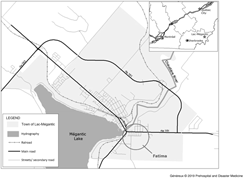
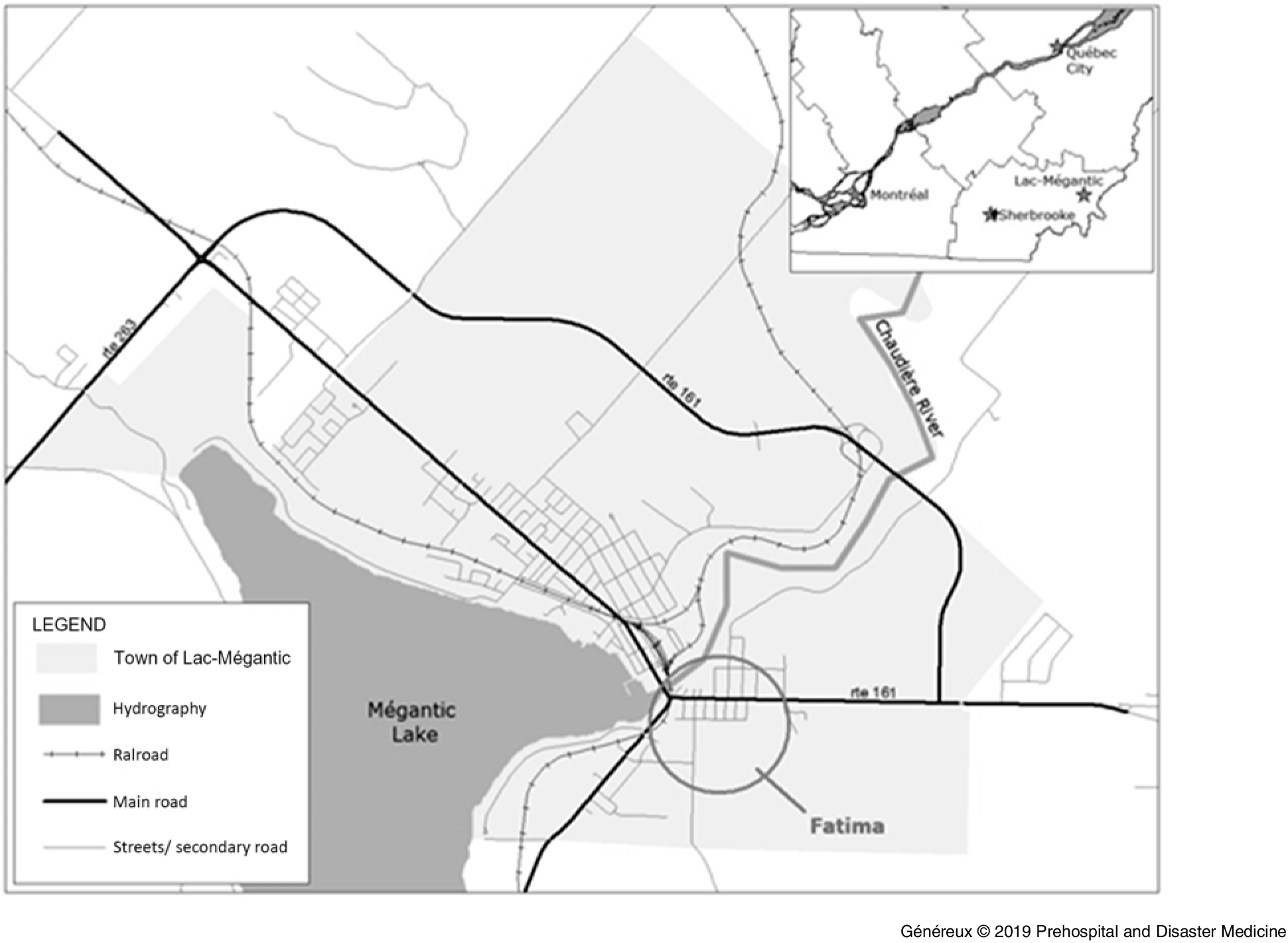
The Eastern Townships includes a mix of urban, semi-urban, and rural areas.21 It is located in the southeastern part of the province of Quebec (Canada), just beside the New England States in the US. Its population is around 500,000 with one-third living in the main city named Sherbrooke (Quebec’s sixth largest city).22 The town of Lac-Mégantic has a population of around 6,000 citizens.22 It is the seat of the Granit area (population of 20,000 residents), which is one out of the nine administrative areas in the Eastern Townships. Lac-Mégantic is located on the shores of the Mégantic Lake. Its historic center, heart of the city’s downtown, is located at the mouth of the Chaudière River. Since the Eastern Townships region is geographically spread (more than 10,000 square kilometers), areas other than the Granit area are quite remote from Lac-Mégantic (Figure 1). Lac-Mégantic setting facilitates the monitoring of after-effects of a disaster, given that the town is “isolated” and that most of the train crash impacts were contained to this local community. It also makes the population sampling easier than in natural disasters that tend to include a more widespread area of exposure.Reference Fergusson and Boden23 Indeed, one can assume that basically everybody belonging to this close-knit community was impacted to some extent by the traumatic event.
Map of Lac-Mégantic, Quebec, Canada.
Recruitment Procedures and Samples used in this Study
Data used in this study were drawn from two successive waves (2014 and 2015) of the Eastern Townships Population Health Survey (ETPHS), a repeated cross-sectional study representative of adults living in the Eastern Townships. For both waves, respondents had to complete a telephone or a web-based questionnaire lasting approximately 30 minutes (in French or in English). A specialized and independent firm collected the data. The first wave (2014) had been designed to monitor the health and social needs of the entire Eastern Townships population. The random sampling was stratified according to the nine administrative areas, with minimally 800 participants in each area. This allowed secondary analyses to be carried out on the negative psychological consequences of the train derailment on the affected community (ie, the Granit area), one year after the event. The questionnaire was built in collaboration with multiple researchers of the Eastern Townships region and covered various physical and mental health outcomes not specific to the tragedy. Several items of the questionnaire judged highly relevant afterwards (eg, psychological distress, depressive episode, and anxiolytic use) were included in these secondary analyses. The second ETPHS wave (2015) was specifically designed to study the consequences of the Lac-Mégantic tragedy. The questionnaire included both questions from the first wave, allowing comparison over time, and a new set of questions (eg, posttraumatic stress reactions). The ethics committee of the Eastern Townships Integrated University Centre for Health and Social Services approved separately both waves of this study.
The 2014 Sample—The 2014 wave of the ETPHS was conducted during Summer 2014 among a large sample of adults (n = 8,737). Its over-arching goal was to estimate the prevalence of main public health issues at the local level, with a good precision, in order to tailor interventions according to local needs. Based on a random digit-dial procedure including cellular phones, respondents were randomly selected according to age and sex in order to reach a sufficient number of participants in each administrative area of Eastern Townships.Reference Levasseur, Roy, Michallet, St-Hilaire, Maltais and Généreux24 People aged less than 18 years old or living in a collective household were excluded. The response rate was 47.9%, with a final sample of 811 citizens living in the Granit area, of which 240 (29.5%) lived in the city of Lac-Mégantic. A sample size of 800 respondents was judged adequate to estimate with a good precision the prevalence of outcomes assessed.
The 2015 Sample—The 2015 wave of the ETPHS was conducted in Fall 2015 among a random sample of 1,600 adults (response rate 48.4%), of which one-half lived in the Granit area (n = 800, including 251 in Lac-Mégantic). The other-half was scattered elsewhere in the Eastern Townships. Since this second wave was specifically intended to study the Lac-Mégantic tragedy’s long-term consequences, the sample size required in areas other than the Granit area was smaller than that of the first wave (n = 800 and n = 7,926, respectively).
Variables
The data collection tool (ie, the survey) was designed to limit bias. Most survey questions were validated in previous studies. Moreover, survey questions were pre-tested with a test group before conducting the actual survey.Reference Stratton25 Several adverse psychosocial outcomes (all dichotomous) were examined in this study, most of them (n = 11) being measured in both waves and some (n = 6) in 2015 only.
Outcomes Measured in Both Waves—Perceived daily stress was captured with the question: “Thinking about the amount of stress in your life, would you say that most days are not at all, not very, a bit, quite a bit, or extremely stressful?” and was categorized as “most of the days stressful” if respondents answered being a bit, quite a bit, or extremely stressful on most days. The main source of stress (work, financial concerns, family, not enough time, personal problems, or other) was also assessed and categorized as financial concerns (versus other sources). The sense of security in its neighborhood was captured with this question: “In general, how secure do you feel in your neighborhood?” Possible answers were completely secure, somewhat secure, not very secure, and not at all secure. The variable was categorized as “not very” or “not at all secure” (versus others). Excessive drinking was defined as having at least five drinks of alcohol on one occasion, at least once a week over the past 12 months. Anxiety and depressive signs were also examined. Psychological distress was assessed with the six-item Kessler scale asking how often in the past month people felt nervous, hopeless, restless, so depressed that nothing could cheer you up, that everything was an effort, or worthless. Answers were coded as: none of the time (0), a little of the time (1), some of the time (2), most of the time (3), and all of the time (4). Scores of the six questions were then summed, yielding a minimum score of zero and a maximum score of 24. A score of seven or more was suggestive of psychological distress. This measure had been used in large population-based surveys and presents good content and face validity.Reference Kessler, Barker and Colpe26 Depressive episode was assessed by asking participants if they either: “felt sad, blue, or depressed” or “lost interest in most things like hobbies, work, or activities that usually give you pleasure” for two weeks or more in a row during the past 12 months. Participants were asked to report any anxiety (eg, phobia, obsessive-compulsive disorder, or panic disorder) or mood-related disorder (eg, depression, bipolar disorder, mania, or dysthymia) diagnosed by a health professional. Participants also had to report if they had consulted a social worker or a psychologist and if a health professional had suggested or discussed stress management in the past year. Finally, the use of anxiolytics prescribed by a physician (ie, “sedatives or tranquilizers which contain diazepam, lorazepam, alprazolam, or clonazepam”) were considered.
Outcomes Measured in the Second Wave Only—In addition to excessive drinking, respondents were asked if their alcohol use had increased, remained the same, or decreased in the last two years. Gambling habits were defined as having played or gambled money on video lottery terminals, horse racing, card games, casinos, or lotteries during the past year. Presence or absence of PTSD signs were assessed using the Horowitz’s Impact of Event Scale (IES), which helps to detect intrusive (eg, nightmares) or avoidance (eg, keeping away from anything that reminds one of the event) reactions after a stressful event.Reference Horowitz, Wilner and Alvarez27 , Reference Sundin and Horowitz28 Using this measure, participants were asked how a list of 15 comments made by people who have been through stressful events (eg, “Images of it or thoughts on it woke me up or kept me awake;” or “I stayed away from anything reminding me of it”) applied to them in the last seven days regarding the Lac-Mégantic train derailment. Answers (never = 0; rarely = 1; sometimes = 3; or often = 5) were used to compute a composite score ranging from zero to 75 with scores between 26 and 43, and scores higher than 43, suggestive of moderate and severe posttraumatic stress symptoms (PSS), respectively.Reference Ticehurst, Webster and Carr29 The alpha coefficient of this instrument was 0.82 and the test-re-test fidelity coefficient was 0.89.Reference Horowitz, Wilner and Alvarez27 This tool had already been used in other studies and surveys and showed good validity.Reference Alexander and Klein30 , Reference Maltais, Lachance and Brassard31 Finally, having received sleep advice from a health professional or having used antidepressants prescribed by a physician in the last 12 months were also added to the 2015 questionnaire.
Exposure to the Tragedy—In both waves of the ETPHS, two measures of the exposure to the tragedy were computed (ie, residential location and exposure intensity). Residential location was measured using the six-digit postal code of each participant and categorized as living in: (a) Lac-Mégantic, (b) elsewhere in the Granit area, or (c) elsewhere in Eastern Townships. The measure reflecting the intensity of exposure was only computed for people living in the Granit area. Nine dichotomous questions assessing three types of losses were asked to each participant in this area: human losses (ie, loss of a loved one, fear for one’s life or that of a loved one, or suffering injuries); material losses (ie, home damage, permanent or temporary relocation, or job loss); and subjective losses (ie, perception that the event was stressful, that something important was lost, that something important was interrupted, or that harm will potentially occur in the future). Intensely exposed participants correspond to those having reported all three types of losses, whereas those with a moderate and a low exposure reported one or two types of losses, or no loss, respectively.
Sociodemographic Characteristics—Various sociodemographic characteristics were assessed: gender (male/female); age (18-39, 40-64, 65 years and over); educational attainment (high school, college, or university); annual household income (< $30,000; $30,000-$79,000; or $80,000 or more); occupation (full-time/part-time job or other); and living arrangement (living alone or other).
Statistical Analysis
For both waves of the ETPHS, participant characteristics were described using proportions for (a) the Granit area, and (b) elsewhere in the Eastern Townships (with the exception of the type of losses and the exposure intensity which were only assessed in the Granit area). Frequency of psychosocial outcomes were examined as a function of both measures of exposure to the tragedy (ie, residential location and exposure intensity). Chi-square tests were used to identify significant differences across exposure groups. Moreover, student t-tests were used to assess time trends between 2014 and 2015, for each psychosocial outcome and level of exposure (α = 0.05). All data were weighted for age and sex. Analyses were carried out using IBM SPSS V24 software (IBM Corp.; Armonk, New York USA).
Results
Participant Characteristics
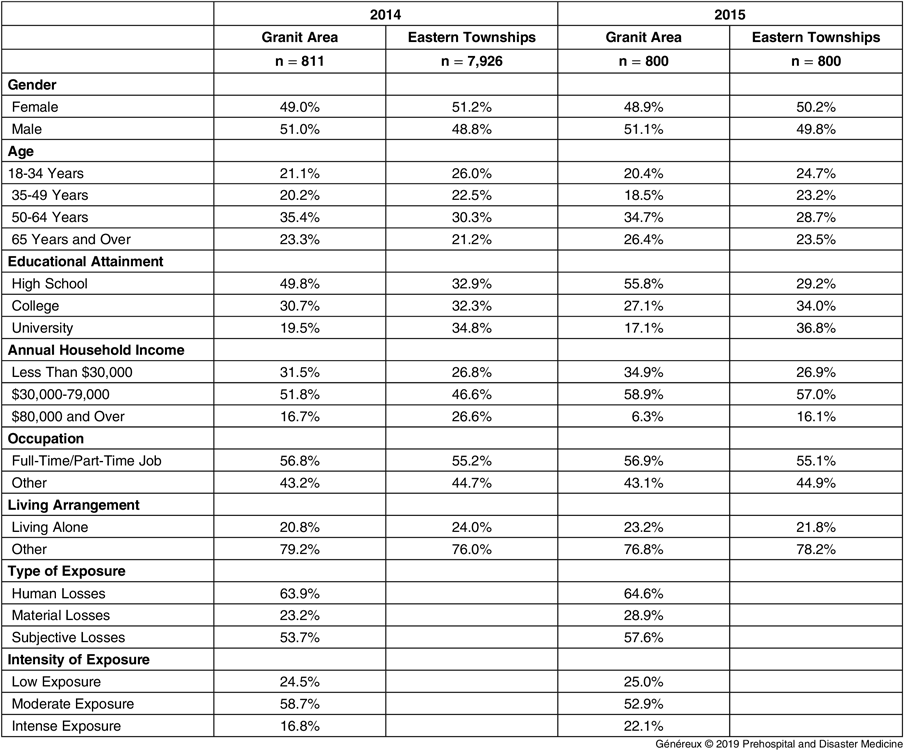
Participant characteristics are described in Table 1. In the Granit area, and elsewhere in Eastern Townships, samples were similar with respect to sociodemographic characteristics for both waves of the study. The sex and age distribution were similar to that of the general population, according to 2016 Census data. However, the proportion of deprived people (eg, living alone or low educational attainment) was slightly higher among survey participants (results not shown). Human losses were the most common type of loss following the tragedy, with almost two-thirds of the Granit area citizens experiencing such type of loss. Furthermore, about one-in-six adults in this area (ie, 16.8% in 2014) reported having been intensely exposed to the disaster.
Sociodemographic Characteristics and Exposure to the Lac-Mégantic Train Derailment One and Two Years After the Tragedy

Adverse Psychosocial Outcomes as a Function of Residential Location
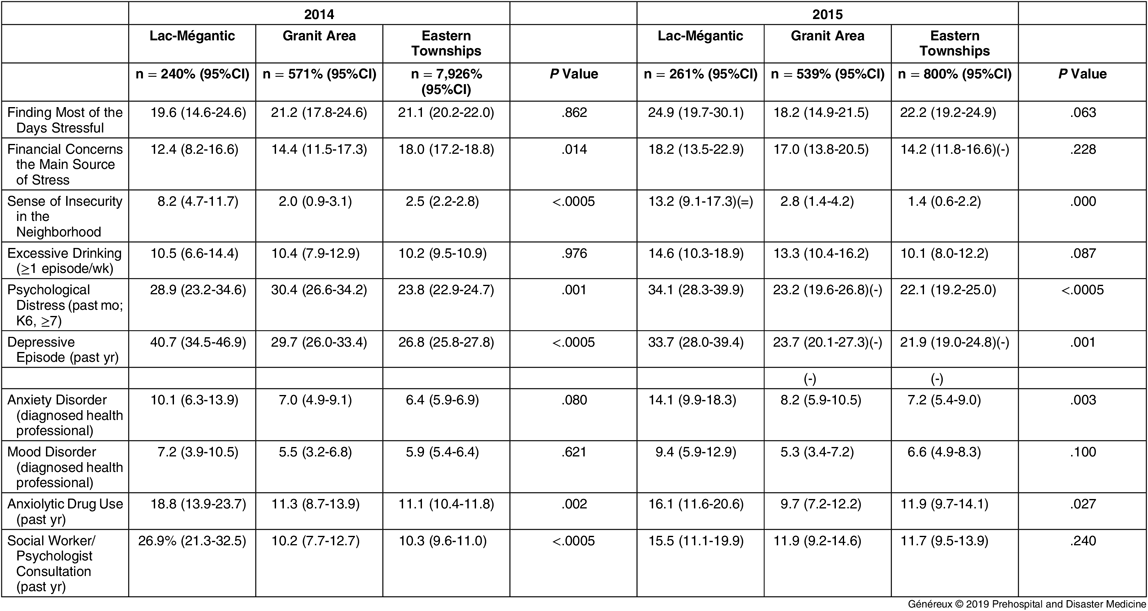
Significant differences were found in psychosocial outcomes as a function of residential location for both waves of the ETPHS (Table 2). Significant time trends from 2014 to 2015 were also observed. As for example, in the city of Lac-Mégantic, the sense of insecurity in neighborhood had been on the rise, going from 8.2% in 2014 to 13.2% in 2015. Furthermore, and despite the high proportion of citizens affected by the tragedy in Lac-Mégantic in 2015, visits to psychologists and social workers decreased by one-half since 2014. Only 15.5% of people in Mégantic used such services in 2015, as compared with 26.9% in 2014.
Adverse Psychosocial Outcomes One and Two Years After the Lac-Mégantic Train Derailment as a Function of Residential Location

Note: (+) = Significant increase from 2014 to 2015; (-) = Significant decrease from 2014 to 2015.
Adverse Psychosocial Outcomes as a Function of Exposure Intensity
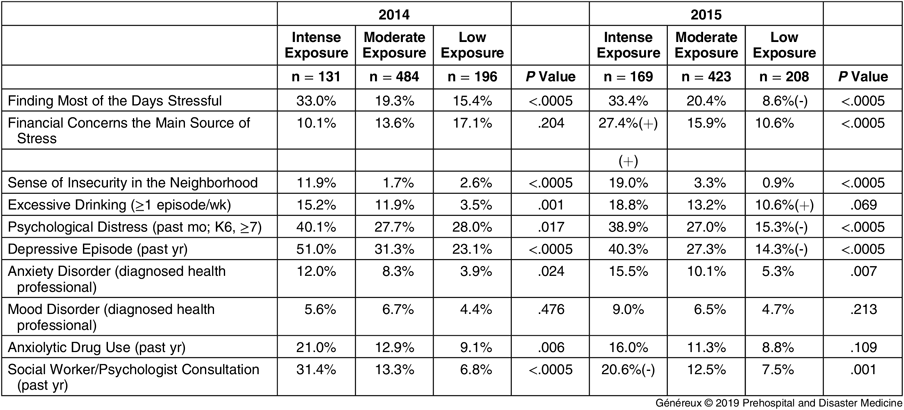
Steep differences were observed in the proportions of adverse psychosocial outcomes according to the intensity of exposure to the Lac-Mégantic tragedy (Table 3). In 2014, adults reporting an intense exposure were four-times more likely to report excessive drinking as compared to those with a low exposure (15.2% versus 3.5%; P = .001). Similar gradients were observed for various psychosocial outcomes, both one year and two years after the train derailment (ie, finding most of the days stressful, sense of insecurity in neighborhood, psychological distress, depressive episode, anxiety disorder, social worker or psychologist consultation, and anxiolytic drug use). Besides those gradients as function of exposure intensity, some significant time trends from year one to year two post-disaster were also observed (Table 3). Financial concerns as the main source of stress increased over time among adults most affected in terms of disaster-related losses. If the use of psychosocial services decreased among intensely exposed adults between 2014 and 2015, the remaining psychosocial outcomes did not show any statistically significant improvement, or deterioration, among these adults.
Adverse Psychosocial Outcomes One and Two Years After the Lac-Mégantic Train Derailment as a Function of Intensity of the Exposure (Granit Area Only)

Note: (+) = Significant increase from 2014 to 2015; (-) = Significant decrease from 2014 to 2015.
Adverse Psychosocial Outcomes Assessed in 2015 Only as a Function of Both Exposure Measures
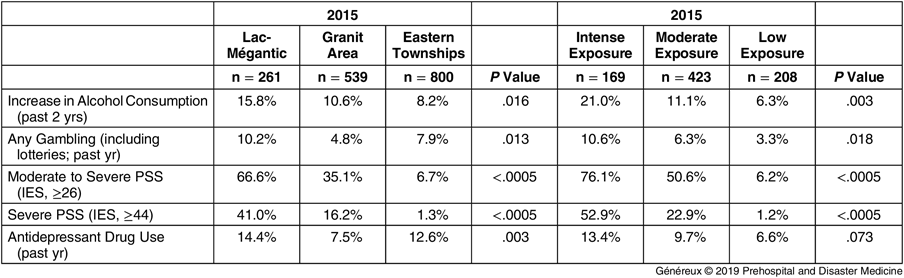
Some adverse psychosocial outcomes were examined in 2015 only (Table 4). Findings from the 2015 wave notably revealed that two-thirds (66.6%) of the Lac-Mégantic citizens and three-quarters (76.1%) of those intensely exposed still showed moderate to severe signs of PSS two years after the disaster. Posttraumatic stress signs were also observed in other municipalities of the Granit area and in moderately exposed adults, but on a much lower scale (35.1% and 50.6%, respectively). Particularly deep gradients were observed in the distribution of adverse psychosocial outcomes according to exposure intensity. For instance, an increase in alcohol consumption over the past two years was reported by one-fifth of adults in the intensely exposed group, a proportion three-times as high as in the low exposed group (21.0% versus 6.3%; P = .003). Similarly, gambling habits were more frequently reported in intensely exposed adults, as compared with those who did not suffer any loss (10.6% versus 3.3%; P = .018).
Adverse Psychosocial Outcomes Measured in the Second Wave of the ETPHS (2015, Granit Area Only) as a Function of Both Measures of Exposure to the Tragedy

Abbreviations: IES, Impact of Event Scale; PSS, posttraumatic stress symptoms.
Discussion
In the aftermath of the Lac-Mégantic train derailment tragedy, the Public Health Department has been involved in the monitoring of various psychosocial outcomes one and two years after the disaster. The 2014 wave of the ETPHS suggested major psychosocial impacts for different categories of people, either based on their residential location (ie, Lac-Mégantic, Granit area, or Eastern Townships) or on the disaster-related losses. The 2015 wave of this study revealed very little improvement, and even deterioration in specific outcomes since 2014, with a sense of distress affecting a significant part of the general population, both direct and indirect victims. One of the most striking finding regards the PSS. In 2015, two-thirds of the local population in the city Lac-Mégantic reported at least moderate PSS, no matter the level of exposure to the tragedy. Unexpectedly, and despite persisting and even increasing psychosocial needs, the use of social services has significantly declined between 2014 and 2015.
These observations are consistent with existing literature on psychosocial impacts of disasters. Given the wide range of stressors faced by a community in the aftermath of a disaster, various outcomes must be examined. The PSS may be a direct consequence of being exposed to a tragic incident such as this, whereas depression, anxiety, and substance abuse may be more driven by exposure to secondary stressors.Reference Tracy, Norris and Galea32 Furthermore, depressive and anxiety symptoms may persist over time and may also arise several months or years after a traumatic event, especially with the accumulation of losses and disruptive events.Reference Goldmann and Galea5 It is also recognized that such symptoms are usually increased in man-made disasters as compared with natural disasters.Reference Norris, Friedan, Watson, Byrne, Diaz and Kaniasty33 Finally, the presence of secondary stressors has been shown to increase the risk of mental health disorders after a catastrophe.Reference Lock, Rubin, Murray, Rogers, Amlôt and Williams34 In Lac-Mégantic, many secondary stressors may have increased the sense of distress of individuals and its duration, namely the long process for decontamination and reconstruction of the downtown area, the claim regarding compensation (class action), and the resumption of downtown train circulation.Reference Généreux and Maltais2
Very high levels of PSS were observed in Lac-Mégantic two years after the train crash. Using the same measure as the one in this study (ie, IES), other researchers found mean scores of 25.0 and 25.3 in a community impacted by the Deepwater Horizon Oil Spill (2010; South Mobile County in Alabama) a few months and one year after the event, respectively.Reference Gill, Ritchie, Picou, Langhinrichsen-Rohling, Long and Shenesey35 These data are much lower than those estimated in Lac-Mégantic in 2015, with mean scores reaching 40.0 and 35.5 among direct victims (ie, intensely exposed individuals) and the wider community, respectively (data not shown). The magnitude of the psychosocial impacts observed in Lac-Mégantic could be due to several factors, including: the small size of the community (where most people knew one or more victims); the large-scale disaster that had disrupted the daily lives for many months; the multifaceted consequences for the personal, family, social, and professional lives of individuals; and the collective grief.
Besides such persistent psychosocial outcomes, a sharp decline in help-seeking behaviors has been observed in Lac-Mégantic over time, with a reduction by nearly one-half in visits to psychologists and social workers from year one to year two following the train crash. This paradox is not unique to Lac-Mégantic.Reference Osofky, Palinkas and Galloway36 An increase in frequency and severity of mental health symptoms along with a decrease in utilization of services has also been highlighted after Hurricane Katrina.Reference Wang, Gruber and Powers37 This phenomenon may be explained by the fact that most victims were doing well before disaster struck, a disaster that completely changed their live and their community. Such people might not be inclined to seek support and assistance in a formal clinical setting in the aftermath of a disaster; they may not even recognize their psychological needs.
In the face of such a situation, the Public Health Department has to ensure the positive development of health and well-being of the Granit citizens in the years to come.Reference Généreux, Petit, Roy, Maltais and O’sullivan38 Findings from this study suggest the need for better access to and an adaptation of social services, together with additional and long-term psychosocial resources. In order to support recovery and resilience processes of individuals and the community, these psychosocial resources should be brought closer to the community and work hand-in-hand with community organizations. By capitalizing on the community’s assets, and by fostering citizen engagement, one can expect more encouraging trends in future years.Reference O’sullivan, Kuziemsky, Corneil, Lemyre and Franco39
Strengths and Limitations
The major strength of this study was the large and representative population-based sample. Furthermore, it contains a unique set of psychosocial outcomes and exposure measures which allowed a better understanding of the long-term impacts of a large-scale disaster and the key role of disaster-related losses, using real-life rather than clinic-based data. However, this study has some limitations which have to be pointed out. It was based on self-reported measures. This increased the likelihood of social desirability or recall biases. Furthermore, because the ETPHS was cross-sectional, it is not possible to infer about causality of results. Since only adults were surveyed, it is difficult, and certainly not recommended, to extrapolate the findings to children and adolescents.Reference Kar40
Conclusion
Everyone, including the public and the decision makers, should be aware of long-term impacts of primary and secondary stress factors on the health and well-being of a community affected by a catastrophe, whether it is a terrorist attack, a technological incident, or a natural disaster. The Lac-Mégantic community has suffered, and still does, emphasizing the importance of public health efforts in monitoring long-term impacts and supporting the community over time. The community’s healing process, which is critical to health and well-being, will span several years, calling for sustained effort from everyone and requiring a flexible and collaborative approach.
Conflicts of interest
The authors have no conflict of interest associated with this research.