Specifically, we analyze the extent to which family structure, defined
by marriage and parenthood, influences the authority attainment of Whites,
Blacks, and Latinos of both sexes. We conceptualize job authority as a
form of legitimate power that serves as a central mechanism by which
workplace inequalities along the lines of race, gender, and the
intersection of race and gender are maintained (Elliott
and Smith, 2004; McGuire and Reskin,
1993; Smith 2002; Tomaskovic-Devey 1993). Job authority is a highly
coveted workplace resource that is positively associated with income,
status, and intrinsic rewards (Wright et al.,
1995). We are particularly interested in the kind of authority that
allows incumbents to supervise the work of other employees, to influence
the rate of pay received by other employees, and/or to hire and fire
subordinates. We frame our analyses around several basic questions. Does
having a spouse and/or children in the home correlate with access to
higher levels of workplace authority? How do race, ethnicity, and gender
intersect to shape this correlation? And, finally, to what extent does the
race and sex composition of the job setting influence this intersection?
Below we review relevant literature and advance testable hypotheses before
discussing our data and results.
BACKGROUND AND HYPOTHESES
Gender and Job-Family Trade-offs
Prior research has portrayed women's labor market experiences as
a balancing act between the conflicting demands of child care and
household responsibilities, on the one hand, and individual career
pursuits, on the other hand (Estes and Glass,
1996; Hinze 2000; Hochschild 1997; Mennino and
Brayfield, 2002; Parasuraman and Greenhaus,
1997; Reskin and Padavic, 1994; Schor 1991; Seron and Ferris,
1995). This understanding is reflected not only in feminist
scholarship on gendered divisions of labor but also in neoclassic economic
models that statistically control for marital status and children in the
household under the presumption that women often choose to
“self-select” out of more demanding jobs to care for their
husbands and children. The underlying argument is that traditional
cultural expectations regarding the household division of labor encourages
many women to prefer jobs that allow them easy entry and flexible exit
from the labor market, which in turn channels them disproportionately into
jobs with low pay and few opportunities for advancement into positions of
authority. Men, by contrast, are not culturally expected to balance family
and employment demands and, therefore, remain freer to invest in their
human capital and to work longer hours, which in turn help to maximize
earnings and opportunities for advancement into positions of
authority.
Collectively these lines of research suggest the following baseline
hypotheses:
Hypothesis 1: marriage and parenthood will correlate
negatively with women's access to higher levels of workplace
authority, regardless of race and ethnicity.
Hypothesis 2: marriage and parenthood will have no, or a
positive, correlation with men's access to higher levels of workplace
authority, regardless of race and ethnicity.
To date, empirical research has lent support to these expectations,
generally showing that marriage and parenthood tend to be more beneficial
to men's employment outcomes than women's employment outcomes,
all else equal. This pattern has been documented in empirical assessments
of the gender gap in labor market participation (Spain
and Bianchi, 1996; Tienda and Stier,
1996), earnings (Korenman and Neumark,
1991; LeLouarn et al., 1984; Pfeffer and Ross, 1982), managerial careers (Schneer and Reitman, 1993), job autonomy (Adler 1993), and job authority (D'Amico 1986; Hill
1980; Wolf and Fligstein, 1979a, 1979b). Somewhat surprisingly, however, recent
research has also begun to show that women, particularly women of color,
might now benefit from marriage in pursuit of better employment
opportunities, especially in seeking positions with higher levels of
workplace authority and pay.
For example, a 1997 study by the research organization Catalyst shows
that married women were more likely to hold executive, administrative,
managerial, and professional positions than non-married women and that the
vast majority of Black women managers in their sample were, in fact,
married. This pattern is echoed in Farley and Allen's (1987) analysis of 1980 Census data, which revealed
stark differences in the relationship between marital status and labor
market outcomes for Black and White women. Specifically, they found that
married Black women earned 20% more than married White women, but
non-married Black women earned far less than non-married White women.
Similar studies show that Black women who have attained positions of
workplace authority tend to be married, often with children. Hayes (1997), for example, found that more than half of a
sample of twenty high-level Black women executives was married and/or
mothers. Similarly, a recent report by Korn/Ferry (1998) revealed that 68% of Black women executives were
married, and 62% of these women had children.
In short, traditional assumptions about job-family tradeoffs may be
more relevant for understanding gender inequalities among Whites than
Blacks, particularly with respect to accessing higher positions of
workplace authority and pay. Evidence and expectations for Latinas are
more difficult to come by, but what little we know seems to point to a
“marital bonus” for them as well. According to Corcoran et al.
(1999, p. 117), married Puerto Rican women are
more likely to be employed than their single counterparts, and they also
“earned 20 percent ($1.73) more per hour than employed single
(Puerto Rican) women and 33 percent ($2.56) more per hour than employed
single (Puerto Rican) mothers.” The same earnings pattern was
observed among Mexican women but, in contrast to married Puerto Rican
women, married Mexican women were less likely than their married
counterparts to be employed in 1990 (Corcoran et al., 1999, p. 131).
This body of literature suggests that race and ethnicity
“interact” with family structure to produce different job
outcomes for White women and women of color in similar family situations.
We operationalize this expectation via the following hypothesis:
Hypothesis 3: marriage and parenthood will correlate
positively with minority women's access to higher levels of workplace
authority but negatively with White women's access to higher levels
of workplace authority.
Race, Gender, and Workplace Stereotypes
In addition to cultural expectations surrounding household divisions
of labor, the association between family structure and authority
attainment is also likely to be influenced by group-specific stereotypes
held by employers and coworkers. To date, however, relevant studies have
largely been mute on this issue, making it difficult to develop informed
expectations. Part of this shortcoming arises from the fact that most
research on racial stereotypes in the workplace has tended to focus
exclusively on men, and most research on gender stereotypes has ignored
racial and ethnic variations. Still, the issue remains salient,
particularly in light of recent and more direct studies of employers'
perceptions of Black women, which show a strong link between images of
race and family structure and its implications for employee
evaluation.
In one of these studies, Browne and Kennelly (1999) adapted Kirschenman and Neckerman's (1991) interview strategy to encourage Atlanta
employers to talk about race and gender using their own frameworks. They
found not only that employers differentiated between men and women
employees but also that they differentiated between Black and White women
employees specifically. In short, employers tend to stereotype White women
as mothers, but they tend to stereotype Black women specifically as
single mothers, who often bring problems related to child-care
responsibilities into the workplace. One of the authors' overriding
points is that, “employers are apt to focus upon this status as the
defining characteristic of Black women, regardless of its accuracy”
(Browne and Kennelly, 1999, p. 321). This point
is important because it suggests that even married and/or childless
Black women will still be viewed through the lens of “single
motherhood,” and that this lens devalues employers' perceptions
of job performance and potential for advancement (see also Kennelly 1999).
In a similar study of employer perceptions in four large metropolitan
areas, Moss and Tilly (2001) reached similar
conclusions, showing that employers often invoke images of Black women as
“single mothers” to explain why their work habits differ from
those of Whites generally and Black men specifically. Their study also
provided insights into employer stereotypes about Latino workers. In
short, employers tend to see Latino men as “proud” or
“macho” and to see Latina women as “submissive”
and “hard-working,” often with a strong commitment to their
family. As one employer told them, “… I've noticed that
Hispanic women spend more time dealing with personal issues. Their
children and their families and stuff like that, and consequently
don't get as much production” (Moss and Tilly, 2001, p. 128).
While still emergent, this literature indicates that employers'
perceptions, which affect opportunities for promotion and advancement,
reflect a complex intersection of race, ethnicity, gender, and family
structure, and that the latter is much more important for assessing
women's workplace identities than men's. Prior research,
however, also suggests that such stereotyping tends to be stronger among
outgroup members than ingroup members, whose frequent contact diminishes
reliance on the crude screening tools of stereotyping. Indeed, all the
employers in Browne and Kennelly's (1999)
study, and the majority of those in Moss and Tilly's (2001) study, were White men. It is quite likely that
such stereotypes are less prevalent among Black women and Latinas, and
this fact might impact how family structure influences access to workplace
authority in settings consisting largely of ingroup members.
Again, lacking an established theoretical framework in this area, we
advance a final hypothesis that attempts to address these issues with
respect to workplace authority. This hypothesis builds from two lines of
thought. First, we suspect that marriage and non-parenthood might be
beneficial to minority women, particularly Black women, in authority
attainment processes because it helps them to “play against”
negative employer stereotypes of group members as single mothers
and/or “overly” committed parents. Second, we suspect that
this benefit of “playing against stereotype” is stronger in
outgroup settings, particularly under White men superiors, than in ingroup
settings, because people are generally more likely to rely on stereotypes
to evaluate outgroup members than ingroup members. In formal terms, this
hypothesis can be expressed as follows:
Hypothesis 4: marriage and non-parenthood will correlate more
positively with minority women's access to higher levels of workplace
authority in outgroup settings than in ingroup settings.
Again, the general idea is that a married Black woman can signal that
she is different from “most” Black women (and thus more
capable) by being married. Similarly, Latinas without kids can signal that
they are more career-oriented than “most” Latina women (again,
more capable) by foregoing, or at least delaying, this stereotypical role.
And finally, this “signaling” is likely to be more meaningful
in outgroup settings than ingroup settings.
DATA AND MEASUREMENT
Data for our study come from the Multi-City Survey of Urban Inequality
(MCSUI), which is a multistage, stratified, area-probability sample of
White and minority respondents in Atlanta, Boston, and Los Angeles
conducted between 1992 and 1994, which was a time of local and national
economic expansion. Surveys were administered face-to-face and lasted
approximately two hours, with the ethnicity of respondents and
interviewers matched to minimize well-known race-of-interviewer effects
(see Johnson et al., 1994). The MCSUI also
includes data from Detroit, which we omit because of a lack of information
on key labor market variables (e.g., level of workplace power).
For our analyses, we select only civilian labor force participants
between the ages of twenty-one and sixty-four who were not self-employed
and who reported having an immediate superior. The latter restriction is
imposed to facilitate the examination of how the race and gender of
superiors influences access to authority and its connections with family
structure. This restriction reduces the original sample by 9%, but we
believe this reduction is justified on two accounts. First, supplemental
analyses (not shown) indicate that excluded respondents tended, on
average, to exhibit the same odds of power attainment as respondents in
our sample. So there is no systematic bias introduced. Second, such
mid-level positions comprise the overwhelming majority of workplace power
positions in the United States and represent jobs where competition for
legitimate authority among individuals of different races, ethnicities,
and sexes is likely to be most common. The upshot is simply that our
results cannot be generalized to the top-most rung of organizational
power. Below we discuss our measurement of key variables, starting with
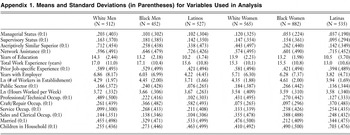
the dependent variable: organizational power, or authority. All variables
are listed in Appendix 1 with subsample means and standard deviations.
Workplace Power
Employed respondents in the MCSUI were asked three closed-ended
questions commonly used in survey research on workplace power:
[a] Do you supervise another employee who is directly
responsible to you? [b] Do you influence or set the rate of pay
received by others? [c] Do you have the authority to hire or
fire others? We use responses to these questions to classify employees
into one of three hierarchical levels:
We combine questions [b] and [c] to construct a
single indicator of managerial status for several reasons: first, all
respondents who answered “yes” to [b] or
[c] also answered “yes” to [a]; second,
the correlation between [b] and [c] in our pooled
sample is quite high (rφ = .543; p < .0001), with 70%
of respondents answering “yes” to [b] also answering
“yes” to [c]; and third, [b] and
[c] are conceptually similar in that they connote control over
organizational resources, as well as people.
Family Structure
After preliminary analyses with different specifications of family
structure, we settled on two simple indicators: currently married
(yes/no) and presence of children eighteen years old or younger in
the household (yes/no). We settled on this measurement strategy
for several reasons. First, we found that subdividing single workers into
singles who were cohabiting with romantic partners and singles who were
not cohabiting with romantic partners yielded no significant differences
in our analyses. Second, our subdivision of parenthood by age of youngest
child in the household (no children [reference category]; less
than six years old; seven to twelve years old; thirteen to eighteen years
old) yielded no consistent and significant results across our analyses.
Finally, interaction terms between marital status (married/single) and
parental status (yes/no) yielded no significant differences for any of
our analyses. For these reasons, we simplify our operationalization of
family structure to these two dummy indicators and report more detailed
findings from supplemental analyses when appropriate.
Extended Household
Because prior research suggests that household structure might also
influence women and minorities' relationship to the labor market, we
include a dummy indicator for whether there is another non-spousal
adult living in the household. The general expectation is that an
additional adult in the household might relieve some of the domestic
responsibilities that traditionally befall wives and mothers, thereby
rendering marital status and motherhood either less salient, or possibly
an asset, to women's access to organizational authority. We settled
on this simple, uni-dimensional indicator of extended households after
exploratory analyses revealed no consistent and significant differences
with respect to whether these non-spousal adults were family or non-family
members.
Human Capital Controls
To control statistically for other factors associated with workplace
power attainment, we include four indicators of human capital in our
regression analyses. We measure education as the total number of
years of formal schooling. We also include three indicators of labor force
experience. We control for total work experience as defined by
the number of years that a respondent has been formally employed since
first leaving full-time school. We decided to use total work experience
over “age” because the two variables are highly correlated and
because total work experience more accurately captures interrupted work
histories. For example, a man and woman may be of the same age but have
vastly different work histories. We measure prior job-specific
experience as a simple dummy indicator (yes/no) based on the
question, “Did you have any previous experience in this type of job,
excluding schooling, before you were hired?” Finally, we measure
organizational tenure as the number of years that the respondent
reports being employed with his or her respective employer.
Job Context Controls
In our regression analyses, we also include several job-relevant
factors identified in prior research as being important covariates of
workplace power. One such factor is establishment size, which
reflects the vertical and horizontal complexity of the organization in
question and the number of power positions likely to be available to
respective employees. We operationalize this factor as the natural log of
the number of employees that the respondent reports working at his or her
establishment. We also include a dummy indicator for public
sector (0 = private sector; 1 = public sector) because prior research
indicates that the relative disadvantage that women and minorities face in
climbing workplace power hierarchies tends to be lower in public than
private settings, owing to more egalitarian hiring practices and
bureaucratic protocols for advancement in the former (Fernandez 1975; Reskin and Ross,
1992; Wilson 1997).
Another factor related to workplace power is time spent at work. We
operationalize this variable as the natural log of the average number of
hours worked per week. We log this variable to compress higher
values because work hours that extend beyond normal full-time status are
more likely to be the result of being a manager than a determinant of
becoming a manager.
We also include a four-category indicator of occupational
location because men and women continue to be highly segregated
within and between broad occupational niches. This indicator is based on
1990 Census Occupation Codes and includes the following categories: (1)
professional and technical occupations, which include officially titled
managers and supervisors; (2) craft and repair occupations; (3) service
occupations; and (4) clerical and sales occupations (reference category).
While occupational controls can be endogenous in some models of authority
attainment, they are not so in our models because of their broad
categorization and the fact that most workplace power is achieved outside
explicitly titled “manager” and “supervisor”
occupations.
To investigate the demographic contexts in which marriage and/or
parenthood influence authority attainment, we use two dummy indicators.
The first is set to 1 if the respondent works under an ascriptively
similar superior and 0 if the respondent works under an ascriptively
dissimilar superior. This indicator is based on three nested questions in
the MCSUI: “Do you have an immediate supervisor on your job to whom
you are directly responsible?” “What is your immediate
supervisor's race or ethnic origin?” And, “Is your
immediate supervisor a man or a woman?”
The second dummy indicator refers to working alongside, rather than
under, ascriptively similar coworkers on the job. We constructed this
indicator from two sources of information. First, we identified the racial
majority, if one existed, of coworkers from the MCSUI question,
“What is the race and ethnicity of most of the employees doing the
kind of work you do at the place where you work?” Next, lacking
similar information about the sex composition of coworkers, we used
metro-level data from the 1990 5% Public Use Micro Samples (PUMS) to
identify the locally dominant sex for each of the roughly 500 detailed
Census Occupation Codes in each metro area. We then appended this
information to the MCSUI and created an indicator that takes a value of 1
if a respondent works with mostly coethnic coworkers in an occupation
that, locally, consists of mostly workers of the same sex; otherwise, the
indicator takes a value of 0. We now turn to analyses of these
variables.
RESULTS
To evaluate the relationship among family status, authority
attainment, and ascriptive identity, we begin by examining basic
descriptive statistics for these variables for our sample of active
workers. These statistics appear in Table 1 and
reveal several preliminary patterns. First, marriage is increasingly
common at higher levels of organizational authority. Specifically, results
show that although married workers comprise only about a third of all
laborers without power, they comprise 40 percent of all supervisors, and
half of all managers. Second, the opposite is true of parenthood, although
to a lesser extent; instead of rising with organizational power,
parenthood steadily decreases from 46% of laborers to 43% of supervisors
to 40% of managers. These patterns suggest that of the two major
dimensions of family structure—marriage and
parenthood—marriage is more strongly linked to authority chances
than parenthood, and this link is positive for workers in general.
Marital and Parental Status by Level of Authority and by Ethnicity and
Gender
With respect to race, ethnicity, and gender, results indicate that
Black women workers are least likely to be married (21%), followed by
Black men workers (33%) and Latina workers (34%). Subdividing these
statistics further by parenthood shows that Latinas are the group most
likely to be single mothers (44%), in part because they are the most
likely to be parents (71%). Black women are the next closest group in both
respects, with 51% being parents and 39% being specifically
single parents. While, on the one hand, these rankings conform to
stereotypes about women of color as single mothers, they also challenge
them in a couple key respects. First, they show that although Latinas are
more likely to be married than Black women, they are also more likely to
be single mothers, given their exceptionally high fertility rates. Past
surveys on gender, ethnicity, and employer stereotyping have missed this
point, as have employers they interview, who still tend to stereotype
Black women as single mothers and Latinas as members of strong,
traditional nuclear families. Second, although rates of single motherhood
are high for Latinas and Black women, relative to other groups, the
majorities of these workers are not, in fact, single mothers. So to the
extent that employers apply this stereotype to members generally, it does
not accurately reflect their experience statistically, as prior research
has pointed out for Black women (Browne and Kennelly,
1999; Kennelly 1999) but not for Latinas,
until now.
One reason for the apparent “marriage bonus” for workers
as a whole might be that marriage provides individuals with more resources
at home, which facilitate pursuit of more demanding supervisory and
managerial positions at work. Another way to accrue such resources is to
have a non-spousal adult living in the household. This possibility
suggests that such extended households would also correlate positively,
like marriage, with authority attainment. Results, however, indicate that
they do not. Simple descriptive statistics show that having a non-spousal
adult in the household, whether through cohabitation with a romantic
partner, extended family, or other non-family member, is less common among
managers (24%) and supervisors (25%) than among laborers without power
(29%). These findings suggest that the benefits of marriage in accessing
workplace authority has less to do with having another adult living in the
household than it does with procuring the cultural and material advantages
of marriage in particular.
These findings encourage us to consider how family structure,
especially marriage, correlates with authority attainment within
respective ethnic and gender groups. To examine this issue more
thoroughly, we use multinomial regression to assess the links between
family status and authority attainment while statistically controlling for
other factors known to determine success in the labor market, namely
education, work experience, and job context. In these analyses, we make
two sorts of comparisons: (1) the influence of marriage and parenthood on
holding supervisory positions compared with laborer positions (the first
step up the metaphorical authority ladder); and (2) the influence of these
same factors on holding managerial positions compared with supervisory
positions (the second step up the metaphorical ladder). We expect
coefficients for marriage and parenthood will become increasingly large
and statistically significant as we move from comparison (1) to comparison
(2), thus reflecting an increasing salience of these factors with movement
up the power hierarchy in American workplaces. Table
2 reports the results of this regression analysis, first for the
full sample of workers and next for each group respectively.
Multinomial Regression Coefficients Predicting Successive Levels of
Authority, Controlling for Human Capital and Job Context, by
Group
Results for the pooled analysis indicate that even after statistically
controlling for education, skills, and job context, marriage still
correlates positively with higher positions of workplace power.
Specifically, the anti-log of .456 indicates that, on average, married
workers are 1.6 times more likely than single workers to hold managerial
jobs compared with supervisory jobs, all else equal. By contrast, there is
no significant difference between parents and non-parents in making this
transition, or in making the transition from laborer to supervisor. As
noted in our data discussion above, we also estimated this model and all
remaining models with interaction terms for marital and parental statuses
to test if single parenthood was more detrimental for authority attainment
than single non-parenthood. Results indicated no significant difference
between the two groups. The main factor appears to be marital status, not
its intersection with parenthood, net of other factors. Also, because
younger children may place more constraints on job mobility than older
children, we replaced our simple parenthood variable (yes/no) with a
variable indicating the age of the youngest child in the household (no
children [reference category]; less than six years old; seven to
twelve years old; or thirteen to eighteen years old). Again, we found no
statistically significant results for this variable.
To determine for whom the “marriage bonus” is most
salient, we re-estimated the same multinomial model separately for each
group. Interestingly, results show that the “marriage bonus”
is limited strictly to women of color. Specifically, the anti-log of .771
indicates that, all else equal, married Black women are 2.2 times more
likely than single Black counterparts to hold managerial jobs, compared
with supervisory jobs. This finding is consistent with other research on
labor force participation and earnings, which shows that Black women
generally benefit from marriage, relative to their single counterparts
(Catalyst 1997; Farley and
Allen, 1987). For Latinas, the same pattern holds, but even more
strongly. The anti-log of 1.217 indicates that married Latinas are 3.4
times more likely than single counterparts to hold managerial positions
compared with supervisory positions. Among men, by contrast, there is no
significant effect of family structure on authority attainment, and among
White women the effect is negative. The anti-log of −.642 indicates
that married White women are only half as likely as single White women to
hold supervisory, compared with laborer, positions. This finding is
consistent with the argument advanced in some studies that single women
can devote themselves more to the demands of (managerial) work than their
married counterparts (Hennig and Jardim, 1977).
The fact that men, regardless of race and ethnicity, do not tend to
receive a marital bonus in access to authority counters the traditional
1950s image of the married male executive and reflects the increasing
diversity of today's workforce, not only in ethnic and racial terms
but also with respect to family status (Schneer and
Reitman, 1993).
Together these findings point to several initial conclusions. First,
members of groups least likely to be married—Black and Latina
women—are precisely those most likely to benefit from this status as
they move up workplace power hierarchies. The opposite, however, is true
for White women. This finding suggests that employment tradeoffs that many
married women face vary by race and ethnicity. Moreover, results of
supplementary interaction analyses (not shown) indicate that this
“marital bonus” and its corollary, “single
penalty,” are statistically indistinguishable for parents and
non-parents. In other words, net of education, work experience, and job
context, single women of color without children are no more likely to gain
access to managerial positions than single women of color with children.
Finally, the presence of non-spousal adults in the household exhibits no
statistically significant effect on authority chances at any level for any
group.
The finding that women of color benefit from marriage as they move
into managerial positions suggests that marriage brings to them more
positive work-related resources than it takes away via employment-family
trade-offs. One way this “bonus” might work is by providing
them with more help around the household. For example, prior research
indicates that spouses tend to share housework more equitably when both
spouses work in professional and/or managerial occupations and earn
similar salaries (Brayfield 1992; Carlisle 1994; Presser
1994). Moreover, the pooling of resources among married couples can
increase the opportunity to hire others to cover household chores in the
face of family-tradeoffs often associated with managerial work (Carlisle 1994; Mennino and
Brayfield, 2002; Risman and Johnson-Sumerford,
1998). Another possibility, however, is that marriage allows women
of color, particularly Black women, to play against racially specific
stereotypes of single motherhood, that is, to distinguish themselves
positively from others they ascriptively resemble. The fact that
non-spousal adults in the household do not offer the same
“bonus” that husbands appear to do lends some support to this
possibility, as does the finding that marriage does not provide the same
“bonus” among White women, who do not suffer from the same
single (mother) stereotype.
Although we do not have data to examine these issues directly, we can
test the “playing-against-stereotype” hypothesis indirectly
under the following assumption: “outsiders” are more likely to
hold and act upon group stereotypes than ingroup members. As Browne and
Kennelly (1999, p. 320) note, this idea is
consistent with relevant theories of statistical discrimination, social
closure, Black feminism, and stereotyping, which all contend that
individuals tend to stereotype dissimilar others more often and more
negatively than they stereotype ingroup members (see Bobo and Johnson,
2000, p. 103 for an exception).1
Bobo and Johnson (2000, p. 103) found evidence that Blacks rate
themselves less favorably than Whites, Asians, and Latinos on the
propensity to be on welfare and to have involvement with drugs and
gangs.
To the extent that this assumption holds true, we might
reasonably expect women of color to experience a greater marital
“bonus” in work settings where they are employed under White
men and/or alongside mostly dissimilar coworkers than when they are
employed under and/or alongside similar others. To investigate this
possibility, we first re-estimated our group-specific models separately
for workers employed under White men and for workers employed under
similar others. Results of these analyses appear in
Table 3a for men and in
Table
3b for women.
Men's Multinomial Regression Coefficients Predicting Successive
Levels of Authority, Controlling for Human Capital and Job Context, by
Group and Supervisor's Ethnicity and Gender
Women's Multinomial Regression Coefficients Predicting Successive
Levels of Authority, Controlling for Human Capital and Job Context, by
Group and Supervisor's Ethnicity and Gender
Affirming results in Tables 1 and 2, results in Table 3a
indicate no statistically significant effect of family structure on
men's authority outcomes, regardless of the ascriptive
characteristics of their immediate superiors. Results in Table 3b, however, indicate a variety of patterns for
women. For White women, although none of the marriage coefficients is
statistically significant, their signs shift frequently, indicating no
clear pattern of association with authority attainment, regardless of whom
they work under. These results indicate that the marriage
“penalty” that White women tend to face, net of other factors,
is highly variable, suggesting that it might be more a function of
individual and family trade-offs than employer stereotyping.
By contrast, results for Black women differ. In both types of work
settings—under White male superiors and under Black female
superiors—there is a strong, positive correlation between marriage
and access to managerial authority, with little comparative effect on
access to supervisory authority. The fact that the relevant coefficients
from these two settings are so close in size and direction (1.312 under
White men and 1.438 under Black women) suggests that “playing
against stereotype” may be equally important for accessing
managerial authority in each setting. This possibility could arise for
several, potentially overlapping reasons.
First, Black women superiors who oversee managerial positions may not
exercise complete control over the promotion and/or hiring for
positions they immediately oversee; instead, this control may, in fact,
lie with a “dissimilar other” in the human resources
department or a “dissimilar other” further up the
organizational chain of command. Second, it could be that women and
minorities are not as immune to negative stereotypes of ingroup members as
commonly assumed. In fact, recent research on managers of color indicates
that they, like White men, often find fault with their own ethnic group.
Moss and Tilly (2001, p. 131) explain that this
occurs in part from the influence of dominant White attitudes and from
attempts by managers of color “to distance themselves
psychologically from their co-ethnics.” Finally, it could also be
that Black women who rise to positions of power, as indicated by holding
authority over managerial positions, make significant family-tradeoffs
that they do not wish to see other group members repeat.
This latter possibility might help to explain why Black mothers,
regardless of marital status, fare more poorly in attaining managerial
positions under Black women superiors than they do under White men
superiors. Specifically, the anti-log of −1.886 indicates that,
under self-similar superiors, Black mothers are only 0.2 times as likely
as Black women without kids to achieve managerial status, compared with
supervisory status. Under White men, on the other hand, the managerial
attainment of Black mothers and Black women without kids is statistically
indistinguishable (.025, non-significant at the 0.1-level).
For Latinas the lack of group members overseeing positions of
workplace authority complicates analysis (as well as Latinas' chances
of attaining such positions). However, for those working under White men
superiors we do see a strong positive effect of marriage on access to
supervisory and managerial positions. Although there are insufficient
cases to establish the statistical significance of these patterns, the
magnitude of respective coefficients does increase with movement up the
authority hierarchy, from .583 for the laborer-supervisor comparison to
1.283 for the supervisor-manager comparison. To probe these patterns
further, we re-estimated the model for Latinas working under coethnics
versus non-coethnics generally. Results (not shown) indicated that
marriage had a much stronger, positive effect on Latinas working under
other coethnics than it did under non-coethnics. For example, results
indicated that under coethnic superiors, married Latinas are an
astonishing thirty-four times more likely to hold managerial positions
than single Latinas, all else equal. Under non-coethnics, commonly White
women, the effects are much smaller by comparison. These findings suggest
that while marriage might help Latinas “play against
stereotype” under White superiors, it plays a much stronger role in
determining success under ethnically similar (and often male) superiors,
who appear to place an extremely strong emphasis on traditional norms of
“women as wives” and men as authority figures.
To determine further the impact that normative role expectations play
in the authority attainment process, in our final analysis, we stratified
our sample by the ethnic and gender composition of coworkers, rather than
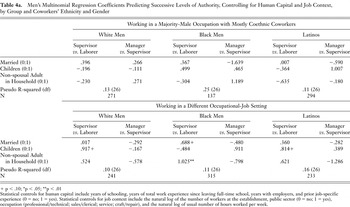
superiors. Results for men appear in Table 4a,
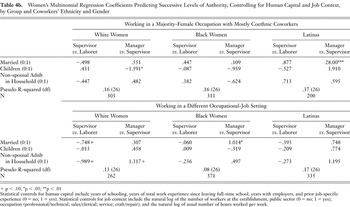
and results for women appear in Table 4b. Most
of the “action” appears in our results for women. Thus, for
the sake of parsimony and continuity we focus only on Table 4b.
Men's Multinomial Regression Coefficients Predicting Successive
Levels of Authority, Controlling for Human Capital and Job Context, by
Group and Coworkers' Ethnicity and Gender
Women's Multinomial Regression Coefficients Predicting Successive
Levels of Authority, Controlling for Human Capital and Job Context, by
Group and Coworkers' Ethnicity and Gender
Here, again, results indicate an extremely strong, positive effect of
marriage on access to managerial positions among Latinas, especially in
jobs where they comprise the majority. Effectively, the coefficient of
28.0 indicates that Latinas almost never hold managerial positions in
predominantly “Latina” jobs unless they are married. For Black
women, by contrast, the marriage “bonus” is stronger and
statistically significant in outgroup settings, that is, in jobs where
they do not comprise the majority, than in ingroup settings where they do
comprise the majority. Specifically, results indicate that in
predominantly “outgroup” jobs, married Black women are
(e1.014) 2.8 times more likely than single Black women to hold
managerial positions, compared with supervisory positions. Interestingly,
the negative effect of parenthood among Black women evident in Table 3b is much smaller and statistically
non-significant in Table 4b. However, to the
extent that parenthood negatively affects Black women, it does so more in
jobs dominated by “similar others” than in jobs dominated by
“dissimilar others.” This pattern shows that to the extent
that there is a negative effect of parenthood among Black women, it is
stronger when they work among mostly other Black women than when they work
in outgroup settings. The same, interestingly, is true among White
mothers, who experience the largest barrier to managerial positions
(relative to their non-parental counterparts) when working mostly among
their own kind. Specifically, results indicate that, in predominantly
“White female” jobs, White mothers are only 0.2 times as
likely as White women who have no children to hold managerial positions,
compared with supervisory positions. The same effect is absent in
predominantly “outgroup” jobs.