Introduction
Population ageing is unprecedented globally1 and is particularly marked in Europe, where the median age is already the highest in the world.2 The increasing population of older people is a fulfilment of an ancient human desire for longevity, but it brings new demands to improve older people's health, independence, activity, social and economic participation by adding ‘quality’ to their extended lives, because a good life does not merely mean a long life.Reference Dragomirecká, Bartonová, Eisemann, Kalfoss, Kilian, Martiny, von Steinbüchel and Schmidt3, Reference Bowling4
Quality of life (QoL) is a multidimensional concept related to both a person's positive and negative perception of various aspects of life including physical, psychological, social and spiritual components.5 It can be described as the dynamic interaction between the external conditions of the individual's life and the internal perception of those conditions.Reference Larson, Franzen-Dahlin, Billing, von Arbin, Murray and Wredling6 The World Health Organisation (WHO) defined QoL as: ‘an individual's perception of their position in life in the context of the culture and value systems in which they live and in relation to their goals, expectations, standards and concerns’ (p. 1403).5 However, there is no unified measurement of QoL, with some asserting that subjective indicators or objective measures can be used to assess QoL, while others have argued that QoL should be studied using a holistic approach.Reference Shek and Lee7
This review examines the empirical literature regarding the measurement and related factors of the QoL of older people in China in the context of the notable demographic transition. There were approximately 177 million Chinese residents aged 60 years and above in 2010, accounting for 13.3% of China's total population,8 which is nearly three times that of the population of the UK.9 It will have taken China just 27 years to double the proportion of older people from 7.0% to 14.0% at an annual growth rate of 3.3%, compared with about 45 years to achieve the same increase in some developed countries.10 It is expected that China's elderly population will reach 248 million (17.2%) in 2020 and 400 million (30.0%) in 2050.Reference Cao, Xiang and Dong11 The ageing of the population in China, coupled with the ‘one child’ policy, poses a significant social challenge that is relevant also in a global context and especially to Western industrialized countries where ageing has also become a top health policy issue. There will be twice as many people aged 60 years and above than children in China in 2050. At the same time, children are increasingly relocating with their employment, leaving older people at home.Reference Kalfoss, Low and Molzahn12, Reference Lowenstein, Katz, Prilutzky, Mehlhausen-Hassoen, Daatland and Herlofson13 Thus understanding the QoL of older people and its related factors in China, and the potential for cross-cultural applications, may enable a global understanding of QoL and related phenomena to better inform health and social care support,Reference Shek, Chan and Lee14 while minimizing health care costs and maintaining economic productivity.Reference Kalfoss, Low and Molzahn12
Methods
The following electronic databases were searched to identify all published research studies focusing on QoL of older people in China and its related factors: Web of Science, PsycINFO, MEDLINE, PubMed, CINAHL, China Academic Journal and VIP Database for Chinese Technical Periodicals. There was no restriction on publication year or research design. The key subject terms and related words used were as follows: ‘older people’ OR ‘elderly’ OR ‘ageing’ OR ‘aged’ AND ‘quality of life’ AND ‘Chinese’ OR ‘China’ OR ‘Hong Kong’ OR ‘Taiwan’ OR ‘Macau’.
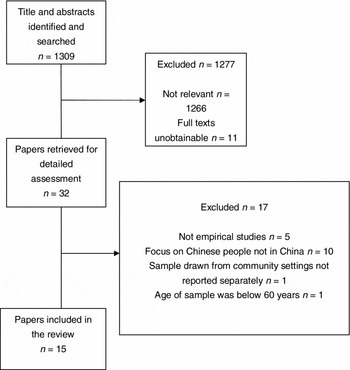
The search identified 1309 papers. After reviewing the titles and abstracts, 1266 papers were deemed not relevant (did not report the QoL of older people in community settings). Eleven papers merited further review but full texts were unobtainable. The remaining 32 papers were retrieved and assessed for eligibility using the following criteria: primary empirical studies; the age of older people was at least 60 years old; written either in English or in Chinese. Exclusion was based on the following criteria: not empirical studies; focusing on Chinese people who were not resident in China; the sample drawn from community settings was not reported separately; the sample age was below 60 years.
Eleven papers in English and four papers in Chinese were included in the review. The study selection process is set out in Figure 1.
Flow chart of study selection process

An overview of selected papers
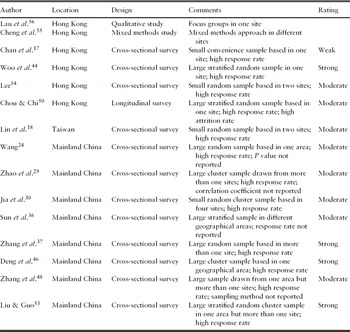
Eight studies were conducted in mainland China, six in Hong Kong, and the remaining one in Taiwan. Thirteen studies adopted a quantitative approach: twelve cross-sectional surveys and one longitudinal survey; one qualitative study, and one mixed methods study. All studies were published post-1998. Table 1 summarizes the 15 selected studies, together with a rating of the quality of 13 quantitative studies using the Strobe Checklist,Reference Altman, Egger, Gotzsche, Pocock, Vandenbroucke and von Elm15 with six being strong quality, six being moderate quality and one being weak quality.
Summary of included studies regarding quality of life of older people in China

Measurements of QoL of older people in China
Eight measurement tools of QoL were used across the 13 quantitative studies. The brief version of World Health Organization Quality of Life (WHOQOL-BREF),16 which is one of the most widely used scales of QoL in health and health care, was used in two studies.Reference Chan, Chien, Thompson, Chou and Lam17, Reference Lin, Yen and Fetzer18 It comprises 26 items, rated on a five-point Likert scale, distributed across four domains: physical health, psychological well-being, social relationship and environment, with a higher score indicating a better QoL. The WHOQOL-BREF has been tested in 23 countries with good to excellent psychometric qualities and was identified as a high-quality instrument in almost all languages.Reference Skevington, Sartorius and Amir19
Adapted from the original version, the Taiwanese version of the WHOQOL-BREFReference Yao, Chung, Yu and Wang20 comprises 28 items, with two additional cultural-specific items, ‘being respected/accepted’ and ‘eating/food’ added to the social relationship and the environment domains, respectively. Good reliability and validity of the scale has been reported in some studies.Reference Yao, Chung, Yu and Wang20, Reference Hwang, Liang, Chiu and Lin21 Similar to the Taiwanese version, the Hong Kong Chinese version of the WHOQOL-BREF (HK-WHOQOL-BREF) comprises the same 28 items, except that ‘eating’ and ‘being respected’ are both categorized within the psychological domain.Reference Leung, Wong, Tay, Chu and Ng22 It has good reliability and validity with Cronbach's α coefficients from 0.67 to 0.79 and test-retest reliability from 0.64 to 0.90 for application among older people in Hong Kong.Reference Chan, Chiu, Chien, Thompson and Lam23
One studyReference Wang24 used the Quality Survey Scales for Elderly PopulationReference Yu, Yang and He25 to assess older people's QoL. The scale was developed by the Chinese Medical Association and reported good reliability and validity in some studies.Reference Sun, Jiang, Xu, Huang, Zeng and Zhong26, Reference Zhang, Li, Fan and Huang27 Using a three-point Likert scale, it addresses 11 aspects of QoL: perceived health status, living habits, functional ability, relations with family members, living conditions, financial status, psychological status, nutritional status, social interactions, physical fitness and life satisfaction, to yield a score range of 11 to 33, with a higher score indicating a better QoL.
Instead of measuring the global context of QoL, the Short Form 36 (SF-36)Reference Ware and Grandeket28 is a well-established standard health-related QoL instrument used in two studies.Reference Zhao, Xu, Jin and Huang29, Reference Jia, Feng, Hu and Wang30 It contains 36 items measuring eight concepts, with a higher score indicating a better QoL: physical functioning (PF), role limitation due to physical health (RP), bodily pain (BP), general health perceptions (GH), vitality (VT), social functioning (SF), role limitations due to emotional problems (RE) and mental health (MH). The SF-36 Chinese versionReference Li, Wang and Shen31 has been verified as suitable within the Chinese cultureReference Zhang, Shao, Wang, Long, Zhang and Li32, Reference Li and Mao33 with satisfactory internal consistency reliability and 2 weeks test-retest reliability.
Another scale used to assess health-related QoL is the European Quality of Life-5 Dimensions (EQ-5D),34, 35 which was utilized in two studies.Reference Sun, Lucas, Meng and Zhang36, Reference Zhang, Zhang and Li37 It comprises two parts: the EQ-5D descriptive system and the EQ visual analogue scale (EQ VAS), with a good reliability and validity in European populations.Reference Vanagt, Essink-Bot, Krabbe and Bonsel38, Reference Zeng, Ching and Loke39 The EQ-5D descriptive system comprises five dimensions: mobility, self-care, usual activities, pain/discomfort and anxiety/depression, with each dimension using a three-point Likert item of ‘no problems’ (level 1), ‘some problems’ (level 2) and ‘extreme problems’ (level 3). A health state profile is defined by combining one level from each dimension. For example, state ‘11223’ indicates no problem with mobility and self-care, some problems with performing usual activities, moderate pain or discomfort, and extreme anxiety or depression. An individual's health state can also be converted into a single summary index by applying a scoring algorithm. The EQ VAS is a 20-cm vertical analogue scale representing perceived overall health status, with the endpoints labelled ‘best imaginable health state’ and ‘worst imaginable health state’. The EQ-5D results can be presented using the health state profile, the index value or the EQ VAS score. The Chinese EQ-5D has reported satisfactory validity in some studies.Reference Zhao, Yue, Yang, Wang, Wu and Li40, Reference Wang, Kindig and Mullahy41
In addition to reflecting objective indicators, some measurements reflect subjective well-being as the micro-indicator of QoL. The Philadelphia Geriatric Morale Scale (PGMS)Reference Lawton42 is one in general use and comprises three domains: agitation, attitude towards own ageing, and lonely dissatisfaction. The score is calculated by the sum of total item scores, with a higher score indicating a better subjective QoL. Different valid versions with different items have been developed, such as the 15-item Hong Kong Chinese version of PGMS,Reference Wong, Woo, Hui and Ho43 which was used in the study of Woo et al.,Reference Woo, Ho and Wong44 and the 23-item Chinese version of PGMS,Reference Fan, Wang, Wang and Ma45 which was used in the study of Deng et al.Reference Deng, Hu, Wu, Dong and Wu46
The Index of Well Being (IWB) scaleReference Campbell, Converse and Rodgers47 is another measurement assessing people's subjective well-being, and was used in the study of Zhang et al.Reference Zhang, Huang, Ye and Zeng48 The scale comprises nine items with two components: index of general affect (IGA; eight items) and life satisfaction questionnaire (ISQ; one item). The items in IGA were added together and then divided by eight. The score of ISQ was multiplied by 1.1, and added to the average score of IGA to create a single score, with a higher score indicating a better QoL. The Chinese version of IWB,Reference Fan, Wang, Wang and Ma49 with an internal consistent correlation of IGA of 0.89, test-retest reliability of 0.43, and a criterion-related validity compared with ISQ of 0.55, is easy to understand and suitable for older people to complete.
Chou and ChiReference Chou and Chi50 used the Life Satisfaction Index-A Form (LSI-A)Reference Neurgarten, Havighurst and Tobin51 to assess life satisfaction as the indicator of QoL. The scale comprises 18 items, rated on a two-point scale from 0 to 1 measuring different components, including positive self-concept, congruence between desired and achieved goals, resolution and fortitude, and mood tone, with a higher score indicating a higher level of life satisfaction. The Chinese LSI-A has been validated with reported Cronbach's α coefficients of 0.81 and 0.84.Reference Chou and Chi50 A short modified version of 13 items rated on a three-point scale from 0 to 2 of the LSI-A, namely LSI-Z,Reference Wood, Wylie and Sheafor52 with a reliability of 0.79 was used to investigate QoL of older people in Liu and Guo's study.Reference Liu and Guo53
Instead of validated QoL instruments, LeeReference Lee54 used a single item to measure the QoL of 109 older people living alone in Hong Kong: ‘I am happy much of the time’, with responses from ‘strongly agree’ to ‘strong disagree’.
Related factors of QoL of older people in China
Health status
Health status is the most frequently reported factor relating to QoL of older people. Cheng et al.Reference Cheng, Chan and Phillips55 used a mixed methods approach to identify the determinants of QoL of older people in Hong Kong. Five focus groups (n = 52 older people) were used to generate 99 statements relating to QoL. A questionnaire comprising these statements was then administered to 1616 older people and factor analysis was used to explore the important factors of QoL. Finally, eight focus groups (n = 62 older people) confirmed the factors, with health as the primary concern related to QoL. Similarly, Lau et al.'s focus group participants rated good health as the most important for a good life.Reference Lau, Chi and Mckenna56 A high QoL was achievable if they had fewer diseases, less pain, and the ability to perform activities of daily living and normal life roles.
In addition, self-perceived health status has been broadly used in quantitative studies as a reliable, sensitive and easily obtained measurement of the general state of health.Reference Ocampo57 Participants in five studies were asked to rate their health status from very poor to excellent.Reference Lin, Yen and Fetzer18, Reference Woo, Ho and Wong44, Reference Zhang, Huang, Ye and Zeng48, Reference Chou and Chi50, Reference Lee54 QoL was found to be significantly related to reported health status, with those with good health reporting a better QoL. Furthermore, reported perception of health status was identified to be an important factor in multivariate analysesReference Lin, Yen and Fetzer18, Reference Woo, Ho and Wong44 and directly influenced older people's QoL according to the result of pathway analysis.Reference Zhang, Huang, Ye and Zeng48
Additionally, three aspects of health status, physical health, mental health, and functional ability, were measured in the majority of selected studies.
Physical health
Five studies used the presence of chronic disease or symptoms such as fatigue, chest pain and constipation as the indicator of physical health.Reference Jia, Feng, Hu and Wang30, Reference Zhang, Zhang and Li37, Reference Woo, Ho and Wong44, Reference Chou and Chi50, Reference Liu and Guo53 The results of bivariate analyses showed that there were significant differences in QoL between older people with or without chronic disease or symptoms. Moreover, having diseases was independently related to poor QoL in multivariate analyses.
Three studies used the number of chronic diseases to assess physical health and found that it was negatively correlated with QoLReference Chan, Chien, Thompson, Chou and Lam17, Reference Lin, Yen and Fetzer18, Reference Lee54 with older people with more chronic diseases reporting poorer QoL.
Additionally, Lee used the number of days in hospital and confined to bed for most of the days in the previous 3 months to investigate the relationship between health status and QoL.Reference Lee54 Lee found that staying in hospital and in bed for fewer days were both significant variables correlated with better QoL, with the number of days in hospital emerging as an independent factor.
Mental health
Mental ill-health is increasing and accounts for 27% of the total disease burden in developed countries and 15% of that in developing countries.58 Depression is one of the most common disabling mental illnesses among older people and was measured in six studiesReference Chan, Chien, Thompson, Chou and Lam17, Reference Lin, Yen and Fetzer18, Reference Woo, Ho and Wong44, Reference Chou and Chi50, Reference Liu and Guo53, Reference Lee54 using three different tools: the Center for Epidemiological Studies Depression scale (CES-D),Reference Radloff59 the 15-item Geriatric Depression Scale (GDS)Reference Sheikh and Yesavage60 and the 30-item GDS.Reference Yesavage, Brink, Rose, Lum, Huang, Adey and Leirer61 All six studies reported that depression had a negative relationship with QoL and was a predominant factor contributing to poor QoL. In the longitudinal study, depression was further identified to be a predictive factor of women's QoL, with older women with depression being more likely to report a poor QoL after 3 years,Reference Chou and Chi50 because depression induced people to report their health in a more negative light and consequently limited their QoL.Reference Chan, Chien, Thompson, Chou and Lam17
Another important mental health problem is cognitive status, which was measured in two studiesReference Chan, Chien, Thompson, Chou and Lam17, Reference Deng, Hu, Wu, Dong and Wu46 using the Mini-Mental State Examination (MMSE)Reference Folstein, Folstein and McHugh62 and was found to have a statistically significant positive correlation with QoL. Cognitive status was also identified as one of the important influencing factors of QoL in the study of Deng et al.Reference Deng, Hu, Wu, Dong and Wu46 Thus older people with a good cognitive function reported a good QoL.
Functional ability
Old age is generally accompanied by frailty, being prone to illness and the experience of physical discomfort, which may prevent people conducting tasks in their daily lives independently,Reference Lau, Chi and Mckenna56 thus an assessment of older people's functional ability can reflect their health status. Four studiesReference Chan, Chien, Thompson, Chou and Lam17, Reference Woo, Ho and Wong44, Reference Deng, Hu, Wu, Dong and Wu46, Reference Chou and Chi50 measured the effect of functional ability upon QoL using the following instruments: the Barthel Index,Reference Mahoney and Barthel63 the 15-item Modified Barthel Index (MBI),Reference Woo, Ho, Lau, Yuen, Chiu, Lee and Chi64 the Instrumental Activities of Daily Living (IADL) scale,Reference Lawton and Brody65 the ADL scaleReference Zhang, Elena and He66 and a researcher-developed composite scale. Three of the four studies focused on two major functional domains: basic activities of daily living (BADL) and more complicated IADL, and the remaining oneReference Woo, Ho and Wong44 focused solely on BADL. Results showed that functional ability was bivariately associated with QoL, with older people with limitations in BADL or IADL reporting a poorer QoL. Moreover, the ability to perform BADL was identified as an independently related factor of QoL in one study.Reference Chan, Chien, Thompson, Chou and Lam17 Thus being able to take care of oneself and being functionally independentReference Chan, Chien, Thompson, Chou and Lam17 were reflected in a good QoL.
Psychological well-being
The importance of psychological well-being to QoL was highlighted in the study of Lau et al.Reference Lau, Chi and Mckenna56 Psychological well-being was also addressed in four quantitative studies using two components: life satisfaction and self-esteem.Reference Zhao, Xu, Jin and Huang29, Reference Woo, Ho and Wong44, Reference Chou and Chi50, Reference Lee54 Life satisfaction was measured by the LSI-A,Reference Neurgarten, Havighurst and Tobin51 the LSI-ZReference Wood, Wylie and Sheafor52 or a single question using a five-point Likert scale yielding a positive correlation with QoL. Moreover, three of these four studies using multivariate analyses revealed that older people who were satisfied with their life were more likely to have a good QoL.Reference Woo, Ho and Wong44, Reference Chou and Chi50, Reference Lee54 Additionally, a causal relationship between life satisfaction and QoL was reported by Chou and Chi,Reference Chou and Chi50 with baseline life satisfaction being a predictor of 3-year-later life satisfaction in both older males and females.
One studyReference Lee54 focused on older people's self-esteem using the Rosenberg Self-Esteem Scale.Reference Rosenberg67 The bivariate analysis demonstrated that maintaining a good self-esteem was correlated with a good QoL. Furthermore, self-esteem was one of the strongest related factors of QoL in multivariate analysis.
Social well-being
The majority of the reviewed studies examined the association between QoL and the following social well-being aspects: social support, loneliness and living arrangements.
Social support
In two non-quantitative studies, most participants identified social support as an important component of their QoLReference Cheng, Chan and Phillips55, Reference Lau, Chi and Mckenna56 and valued interpersonal relations and engagement in social interactions which made them livelier and happier. Seven quantitative studies18,36,44,46,48,50,53 investigated the impact of social support upon QoL using the following instruments: Social Support Scale,Reference Liu68 Family APGAR,Reference Smilkstein69 Social Support Rate Scale (SSRS),Reference Xiao, Wang, Wang and Ma70 Lubben Social Network ScaleReference Lubben71 and some researcher-developed questionnaires. Social support was assessed under two categories: quantity and quality of support.
All seven studies addressed the quantity of social support, including social network size, frequency of social interaction, and support level derived from social networks. The results showed that the quantity of social support was statistically associated with QoL and was an independent factor in multivariate regression models. Older people who had a smaller social support network, received less support and did not have contact with other people regularly, reported a poorer QoL.
The quality of social support refers to older people's subjective satisfaction with their received support. Two studies found that the quality of social support was an important factor related to QoL,Reference Deng, Hu, Wu, Dong and Wu46, Reference Chou and Chi50 with satisfaction with social support playing a vital role in promoting the QoL.
Loneliness
One studyReference Liu and Guo53 used the University of California Los Angeles (UCLA) Loneliness ScaleReference Russell72 to measure loneliness to investigate its relationship with QoL. The stepwise regression analysis indicated that loneliness was significantly related to QoL and was the second strongest variable for ‘empty-nest’ older people (i.e. older people living alone or living with a spouse only), explaining 13.2% of the total variance. It seemed that older people with a higher level of loneliness were more likely to report a poorer QoL.
Living arrangements
Living arrangements were divided into different categories in five studies: ‘empty-nest’ and ‘non-empty-nest’, ‘living alone’ and ‘not living alone’ or ‘living alone’, ‘living with a spouse’ and ‘living inter-generationally’.Reference Lin, Yen and Fetzer18, Reference Wang24, Reference Zhao, Xu, Jin and Huang29, Reference Sun, Lucas, Meng and Zhang36, Reference Liu and Guo53 The results showed an association between living arrangements and QoL. Living arrangements were further identified as the strongest related factor of all the variables, explaining 62.3% of the total variance.Reference Liu and Guo53 Compared with other types of living arrangements, older people living alone reported the poorest QoL.
Housing
Housing was identified as an important factor that contributed to QoL in two qualitative studies conducted in Hong Kong.Reference Cheng, Chan and Phillips55, Reference Lau, Chi and Mckenna56 ‘Having a comfortable residence’ ‘with essential facilities’ gave older people a feeling of satisfaction. In addition, residential satisfaction was positively correlated with QoL in Lee's study,Reference Lee54 with older people who were satisfied with their physical living environment reporting a good QoL.
Socio-demographic factors
There appeared to be a consistent relationship between QoL and socio-demographic factors across the majority of the reviewed studies.
Age
Increasing age was found to be negatively related to QoL.29,30,36,37,44,48,50,54 Older people have a progressive, generalized impairment of function, with ageing resulting in a loss of adaptive response to stress and a growing risk of age-associated diseases, which may induce a poorer QoL.Reference Ren73
Gender
In three studies, there was a gender difference, with males reporting a better QoL than females.Reference Jia, Feng, Hu and Wang30, Reference Sun, Lucas, Meng and Zhang36, Reference Woo, Ho and Wong44 Moreover, Zhang et al. found that gender influenced QoL indirectly via health status, financial status and education.Reference Zhang, Huang, Ye and Zeng48
Marital status
A poor QoL was found among those currently of unmarried status, i.e. never married, widowed, divorced or separated.Reference Jia, Feng, Hu and Wang30, Reference Woo, Ho and Wong44, Reference Chou and Chi50, Reference Liu and Guo53 Older people who are not currently married may experience a feeling of loss of intimacy and a high level of loneliness, which have a negative impact upon psychological well-being.
Financial status
Money was ranked the second most important QoL component by participants in the study by Lau et al. due to its necessity for survival needs.Reference Lau, Chi and Mckenna56 Similar results were reported in four studies using monthly/yearly income as the indicator of financial status,Reference Zhao, Xu, Jin and Huang29, Reference Jia, Feng, Hu and Wang30, Reference Sun, Lucas, Meng and Zhang36, Reference Zhang, Huang, Ye and Zeng48 with older people having a higher income reporting a better QoL. Furthermore, high income was a significant independent factor that directly influenced QoL.
In addition, three studies used the subjective indicator of self-perceived financial status to assess older people's financial situation.Reference Woo, Ho and Wong44, Reference Chou and Chi50, Reference Lee54 This indicator is somewhat more important than actual income as it reflects people's satisfaction with their financial situation. Older people who reported that they had enough money on which to live perceived a better QoL than those who expressed financial strain in their daily lives. Self-perceived financial status was further identified as the strongest predictor of 3-year-later QoL.Reference Chou and Chi50
Employment
Previous employment and current employment were found contribute to QoL prediction in one study.Reference Lin, Yen and Fetzer18 Older people who did not work before or did not continue to work after retirement may have a relatively impaired financial situation with less social interaction, which can negatively affect their QoL.
Educational level
Seven studies measured educational level in an attempt to understand its relationship with QoL18,29,30,36,37,48,50 and reported that educational level was an important related factor. It indirectly influenced QoL through income and health and was identified as the most significant variable contributing to QoLReference Zhang, Huang, Ye and Zeng48 with those older people possessing a higher educational attainment reporting a better QoL.
Discussion
QoL is popular as an endpoint in the evaluation of public policy and spans a wide range of disciplines, with no widely accepted single definition or measurement instrument.Reference Brown, Bowling and Flynn74 A variety of measurements of QoL including macro-indicators, such as WHOQOL-BREF and Quality Survey Scales for Elderly Population, and micro-indicators, such as SF-36, EQ-5D, PGMS, IWB and LSI, have been used. However, as QoL has a multifaceted nature, the suitability of using a micro-indicator as the proxy of QoL is worth considering. In addition, only oneReference Yu, Yang and He25 of the eight measurement tools was designed specifically for older people. Ageing and increased frailty can affect several areas of lifeReference Larson, Franzen-Dahlin, Billing, von Arbin, Murray and Wredling6 and therefore whether the instruments developed for all populations are adequately sensitive among older people is contestable.
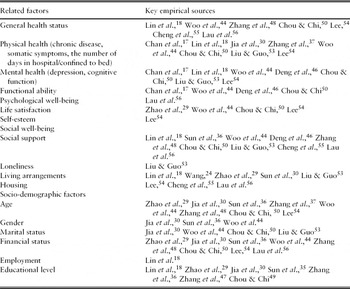
A number of factors related to the QoL of older people in China were identified across the studies (see Table 2), which included health status, psychological well-being, social well-being, housing and socio-demographic factors. Different studies used different variables to indicate health status, such as self-perceived health, the presence of chronic disease, the number of chronic diseases, depression, cognitive function and functional ability. Regardless of the indicator used, health status was a major factor related to QoL, perhaps reflecting that good health allows older people to maintain social contact with the outside world, participate in preferred activities, and engage in social activities,Reference Lee54 which gives meaning to their lives and consequently improves their QoL.
Related factors of quality of life of older people in China

Psychological well-being, which was indicated by life satisfaction and self-esteem in five studies, was related to QoL and echoes the findings of other studies.Reference Iwarsson and Isacsson75, Reference Leung, Wu, Lue and Tang76 Expressing a good psychological well-being significantly contributed to a good QoL, as people's lives and actions are influenced by their mental out-look, attitudes and personality characteristics.Reference Gabriel and Bowling77
Three aspects reflecting social well-being, such as social support, loneliness and living arrangements, were important to older people's QoL. Social support refers to the social resources that individuals perceive to be available or are actually provided to them by non-professionals in the context of both formal support groups and informal helping relationships.Reference Wong, Yoo and Stewart78 It is a key environmental factor enhancing older people's health, participation and security, and can reduce loneliness and depression,Reference Yeh and Lo79, Reference Chalise, Kai and Saito80 and was identified as a significant factor related to QoL, with those older people receiving a large amount of support and/or with broader networks and frequent social interactions, and therefore a better quality of support being more likely to report a better QoL.
Loneliness is a common and serious problem for older people reflecting reduced social contact and network size, due to the deaths of family members and peers, loss of social roles, and limited mobility.Reference Pinquart and Sorensen81 It is associated with both negative physical and psychological health outcomes, leading to ill health and poor prognosis in older people.Reference Chalise, Kai and Saito80, Reference Lauder, Sharkey and Mummery82 Thus older people with a higher level of loneliness are more likely to report a poorer QoL.
Living arrangements refers to the size and structure of their household, which reflects familial interaction and availability of support from family members.Reference Bongaartis and Zimmer83 The Chinese culture emphasizes collectivism and filial piety, and it is very common for older people to co-reside with their children and rely on them as a major source of support. However, with the changes in lifestyle and family values, improvements in living conditions, increasing family nuclearization and rising younger people migration, living arrangements are changing. Thus understanding of the effects of living arrangements upon the QoL of older people in China is particularly important in the Chinese context. The results indicate that older people living alone are an ‘at risk’ group regarding a good life quality because they may lack financial and social support, companionship, and care from family members, which may induce a lower QoL.Reference Sun, Lucas, Meng and Zhang36
Residential status was found to be important to a good life quality in three reviewed studies. As Perez said, ‘home is more than a symbol of QoL at all ages. It is the place to cover one of our basic needs, namely, accommodation. It can have certain benefits for one's physical health and psychological welfare.’ (p. 174).Reference Perez, Fernandez-Mayoralas, Rivera and Abuin84 The sense of security in having adequate housing and the feeling of coping well with environmental stress play a key role in maintaining older people's QoL.Reference Lee54
A range of socio-demographic factors including age, gender, marital status, financial status, employment and educational level have a considerable impact on QoL. Age, gender and marital status were considered to be related to QoL interactively. Thus the higher life expectancy of women meant that a higher proportion of them experienced a change in marital status with increasing age and were more likely to report a poor QoL.
Financial status not only represents a basic ‘guarantee of life’ but also enables people to participate in society and enjoy themselves.Reference Zhang, Huang, Ye and Zeng48 Poor financial status can exert strong negative effects on older people, impair their confidence in life, deepen their negative experiences and eventually lead to a poor QoL.Reference Zhang, Huang, Ye and Zeng48 This was reported in eight studies where income and self-perceived financial status were used as the indicator of financial status.
Regarding employment and educational level, a better QoL was found in older people who had been employed, continued to work after retirement and those who had a higher educational attainment. These two factors have been used in many studies as proxy measures for socioeconomic status or social class.Reference Lin, Yen and Fetzer18, Reference Tseng and Wang85 In addition, it is thought that older people with a higher educational attainment may have more knowledge about health care and better control over their lives, which consequently lead to a better life.Reference Tseng and Wang85
Conclusions
A variety of QoL measurements were used, but their applicability to older people needs further research. Despite the variation in measurement tools, data collection methods or study designs, some consistent findings relating to the QoL of older people in China emerged across the studies. Health status, psychological well-being, social well-being, housing and socio-demographic factors appear to be important related factors of QoL, with those with better physical and mental health, a higher level of functional ability and satisfaction with their life reporting a higher QoL. Furthermore, those living alone, having a higher level of loneliness, receiving less social support and living in poorer quality accommodation appear to be more vulnerable to a poorer QoL. Additionally, older women who were currently of unmarried status, with a poorer financial situation and of a lower educational level and not employed were more likely to report a poor QoL. These related factors are generally similar to those found in studies conducted in developed countries and may be accounted for by the effect of industrialization that has occurred in both developed and developing societies.Reference Lau, Chi and Mckenna56
Further studies are needed to explore whether more factors, especially culturally specific factors, may be related to the QoL of older people. This evidence would not only facilitate health care providers to develop effective and personalized interventions to enhance older people's QoL but may also help inform the development of support provision in Western developed countries by highlighting the importance of the cultural context of the ageing experience.
Conflicts of interest
The authors have no conflicts of interest to declare.
Acknowledgements
Yu Chen thanks the China Scholarship Council, King's College London and Fudan University for supporting her study at King's College London.