INTRODUCTION
Currently eight species are recognized in the scorpaeniform genus Satyrichthys, widely distributed in deep waters of the temperate and tropical Indian and Pacific Oceans (Miller, Reference Miller1974; Heemstra, Reference Heemstra1982; Richards, Reference Richards, Fischer and Bianchi1984, Reference Richards, Carpenter and Niem1999; Kawai, Reference Kawai2013; Pogoreutz et al., Reference Pogoreutz, Vitecek and Ahnelt2013). Three of these species are documented exclusively from the Indian Ocean (S. kikingeri Pogoreutz et al., Reference Pogoreutz, Vitecek and Ahnelt2013) or for both oceans (S. laticeps (Schlegel, 1852) and S. milleri Kawai, Reference Kawai2013), the latter only from the easternmost Indian Ocean (Andaman Sea). The other five species are known from the Pacific Ocean (Kawai, Reference Kawai2013; Pogoreutz et al., Reference Pogoreutz, Vitecek and Ahnelt2013). Satyrichthys kikingeri and S. laticeps are the only species occurring in the Indian Ocean west of Sri Lanka (Kawai, Reference Kawai2013).
Before the description of S. kikingeri only four specimens of the genus, not determined to the species level, were reported from the Maldives (Anderson et al., Reference Anderson, Waheed, Rasheed and Arif1992; Pogoreutz et al., Reference Pogoreutz, Vitecek and Ahnelt2013). [Satyrichthys investigatoris (Alcock, 1898), recorded by Adam et al. (Reference Adam, Merrett and Anderson1998), is now placed in the genus Scalicus (Kawai, Reference Kawai2013).] Two of these specimens were deposited at the Bernice Pauahi Bishop Museum (BPBM) at Honolulu (Hawaii) (Adam et al., Reference Adam, Merrett and Anderson1998). The aims of this paper are to identify these two individuals of Satyrichthys spp. to species level and to highlight the importance of these records for the sampling area.
MATERIALS AND METHODS
The Maldives archipelago is located in the tropical Indian Ocean, south-west of India. It stretches north–south from about 7°N to about 0.5°S (Anderson et al., Reference Anderson, Adam and Goes2011). Between the double-chain of atolls in the central Maldives, depths range between 200 and 500 m, while outside the atolls, the reef slopes drop to abyssal depths (Anderson et al., Reference Anderson, Adam and Goes2011).
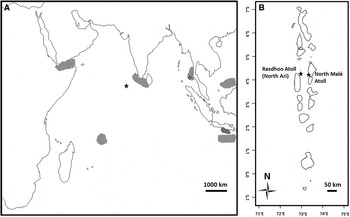
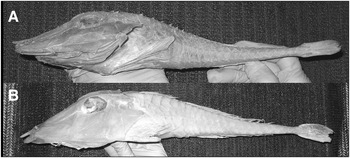
In 1991, four specimens determined as Satyrichthys sp. were sampled with bottom long-lines from a depth of 180 m at ‘Site 2’ during the VA ‘Farumas’ Reef Fish Survey off Giraavaru Island located at North Malé Atoll, Maldives (Anderson et al., Reference Anderson, Waheed, Rasheed and Arif1992; Adam et al., Reference Adam, Merrett and Anderson1998; Figure 1). The largest and the smallest of these specimens were preserved in 50% isopropanol and deposited at the BPBM at Honolulu (Hawaii) (Adam et al., Reference Adam, Merrett and Anderson1998) (Figure 2).
Distribution of Satyrichthys spp. in the Indian Ocean (A), and collection sites of Satyrichthys specimens in the Maldives archipelago (Rasdhoo Atoll: S. kikingeri, holotype, NMW 96546, for details see Pogoreutz et al. (Reference Pogoreutz, Vitecek and Ahnelt2013); North Malé Atoll, ‘Site 2’ of the VA ‘Farumas’ Reef Fish Survey, collected from a depth of 180 m in 1999: S. laticeps, BPBM 34965, SL 278.25 mm; S. cf. kikingeri, BPBM 41160, SL 413.65 mm; for details see Anderson et al. (Reference Anderson, Waheed, Rasheed and Arif1992) and Adam et al. (Reference Adam, Merrett and Anderson1998)) (B). Ruled and checked areas mark the distribution of S. laticeps and S. milleri, respectively, based on information on collection sites of museum specimens examined by Miller (Reference Miller1974) and Kawai (Reference Kawai2013). Collection sites of the holotype of S. kikingeri (Pogoreutz et al., Reference Pogoreutz, Vitecek and Ahnelt2013) and the two specimens discussed in the present publication are marked with asterisks. (B) Adapted from Pogoreutz et al. (Reference Pogoreutz, Vitecek and Ahnelt2013). SL, standard length.

Lateral views of two peristediids collected from a depth of 180 m at ‘Site 2’ during the VA ‘Farumas’ Reef Fish Survey off North Malé Atoll, Maldives, and deposited at Bernice Pauahi Bishop Museum at Honolulu, Hawaii (Anderson et al., Reference Anderson, Waheed, Rasheed and Arif1992; Adam et al., Reference Adam, Merrett and Anderson1998): (A) Satyrichthys laticeps (BPBM 34965, SL 278.25 mm), a first record for the Maldives archipelago; (B) Satyrichthys cf. kikingeri (BPBM 41160, SL 413.65 mm), a second record for this species. SL, standard length.

All morphometric measurements were made twice with an electronic caliper to the nearest 0.1 mm. Data for each specimen are presented as mean percentage of respective standard length (% SL). Morphometrics and meristics follow Pogoreutz et al. (Reference Pogoreutz, Vitecek and Ahnelt2013). Both specimens were characterized as Satyrichthys in the combination of the following characters: (1) no teeth in both oral jaws; (2) lateral margin of the head smooth; (3) the posterior bony plates of both lower lateral series separated by the ventral row; (4) only the posterior lip barbels are branched; and (5) less than 20 soft rays in dorsal and anal fins (Kawai, Reference Kawai2013). The sex of both specimens is unknown. Specimens were identified to species level based on: (1) size of frontal spine; (2) size of post-temporal spine; (3) size of parietal bones; (4) shape, spacing and number of gill rakers; (5) number and location of lip and chin barbels; (6) length, branching and number of flagellae of posteriormost lip barbel; and (7) presence of forward directed spines on bony plates in the upper lateral row of the caudal peduncle.
RESULTS
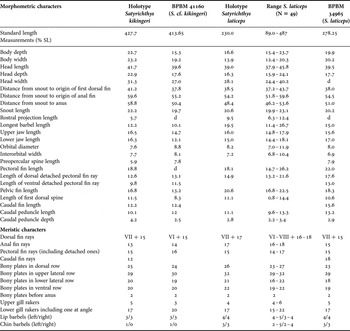
The smaller specimen (BPBM 34965, SL 278.25 mm) is determined as S. laticeps in the combination of the following characters: (1) frontal with a distinct supraorbital spine; (2) post-temporal ends in a conspicuous, well-developed spine; (3) parietal bones unequal in size on midline; (4) gill rakers elongate, slender and closely spaced; (5) four lip and three chin barbels on the left and right side; (6) posteriormost lip barbel long and branched, bearing 8/8 flagellae on the anterior and posterior side respectively; and (7) bony plates in the upper lateral row to the caudal peduncle with forward directed spines. Measurements (in mm) and count data are within the range given by Kawai (Reference Kawai2013) (Table 1).
Comparison of measurements and counts among specimens of Satyrichthys kikingeri, S. laticeps and deposited Satyrichthys spp. specimens caught during the VA ‘Farumas’ Reef Fish Survey off North Malé Atoll, Maldives, in 1991. Holotype counts and measurements of S. kikingeri are taken from Pogoreutz et al. (Reference Pogoreutz, Vitecek and Ahnelt2013). Counts and measurements of holotype and other specimens of S. laticeps are taken from Kawai (Reference Kawai2013). %SL, percentage of standard length; d, damaged; N, sample size.

The larger specimen (BPBM 41160, SL 413.65 mm) is determined as S. kikingeri in the combination of the following characters: (1) frontal with small supraorbital spine; (2) post-temporal ends in a weak spine; (3) parietal bones unequal in size on midline; (4) gill rakers short, rounded and widely spaced; (5) three lip barbels on each side and one chin barbel on the left side (vs none on the right side); (6) posteriormost lip barbel long and branched, bearing 8/8 flagellae on the anterior and posterior side respectively; and (7) bony plates in the upper lateral row of the caudal peduncle with forward directed spines. Measurements (in mm) and count data of specimen are provided in comparison to holotype (Pogoreutz et al., Reference Pogoreutz, Vitecek and Ahnelt2013) (Table 1).
DISCUSSION
The number of lip barbels, which is an important diagnostic feature for the genus Satyrichthys (Kawai, Reference Kawai2008), allows separation of species within this genus into two groups: those with 2 barbels, and those with 3 or 4 barbels on the lip of the lower jaw (Kawai, Reference Kawai2013). To date only species with three or more lip barbels are known from the Indian Ocean: S. kikingeri (3 barbels); S. laticeps (4 barbels); and S. milleri (4 barbels). From these three species, S. laticeps and S. kikingeri appear to be closely related but differ in the combination of meristic and morphometric characters, discussed in detail in Pogoreutz et al. (Reference Pogoreutz, Vitecek and Ahnelt2013).
The two Satyrichthys specimens sampled in 1991 off North Malé Atoll were identified as S. laticeps and S. cf. kikingeri based on morphometric and meristic characters. Satyrichthys laticeps represents the first record of this species for the Republic of the Maldives. The second specimen of S. cf. kikingeri shows minor meristic and some morphometric differences compared with the larger type specimen. However, the majority of count data are close or identical to those of the holotype (Pogoreutz et al., Reference Pogoreutz, Vitecek and Ahnelt2013). As demonstrated by Kawai (Reference Kawai2013) for S. laticeps, the range of body proportions in Satyrichthys species is obviously wide. These few differences may possibly be size or sex dependent. Therefore, until the variability of this species is better understood, we treat this specimen as S. cf. kikingeri.
All species of Satyrichthys are deep-water inhabitants of little commercial value. Therefore, distribution of most species is insufficiently documented (Richards, Reference Richards, Fischer and Bianchi1984, Reference Richards, Carpenter and Niem1999; Kawai, Reference Kawai2008, Reference Kawai2013). Satyrichthys laticeps is the only species known to occur in the entire Indo-Pacific range of the genus (Kawai, Reference Kawai2013). Nevertheless, records of S. laticeps (mostly of synonyms) from the western (Saya de Malha Bank), northern (Arabian Sea) and eastern (Sri Lanka) Indian Ocean indicate a patchy distribution (Kawai, Reference Kawai2013). The present record from the Maldives complements data on the range of this species, suggesting a distribution in suitable habitats across the whole Indian Ocean. Still, the question arises how a benthic deep-water form such as S. laticeps managed to cross the distance from the Asian mainland to Maldivian waters. We assume larval dispersal, as in many other marine teleosts, to be of great importance for this group. Unfortunately, pelagic larval duration (PLD) and dispersal potential of peristediids is poorly known, and what little is known remains still vague, e.g. Bottari et al. (Reference Bottari, Dimech, Nardone, Rinelli and Ragonese2010) mention a PLD for the African armoured sea-robin Peristedion cataphractum (L. 1758) of a ‘few months’. However, ocean currents are commonly known as powerful agents of passive fish larval dispersal (Cowen & Sponaugle, Reference Cowen and Sponaugle2009). As the Maldives archipelago is subject to currents changing seasonally with the monsoons (Anderson et al., Reference Anderson, Adam and Goes2011), there might be a potential highway for peristediid larval dispersal.
Even though Satyrichthys sp. sometimes can be found dead washed upon beaches (Adam et al., Reference Adam, Merrett and Anderson1998), or floating on the sea surface in the Maldives (Pogoreutz et al., Reference Pogoreutz, Vitecek and Ahnelt2013), there were no published records of this genus for the Maldives archipelago until recently (Kawai, Reference Kawai2013; Pogoreutz et al., Reference Pogoreutz, Vitecek and Ahnelt2013). This is surprising, considering the depth range of 200–500 m of the sea floor between atolls (Anderson et al., Reference Anderson, Adam and Goes2011), and therefore availability of potentially suitable habitat. To date, there are two species of Satyrichthys recorded from this area, S. kikingeri (Pogoreutz et al., Reference Pogoreutz, Vitecek and Ahnelt2013) and S. laticeps (present study). Despite the current taxonomic efforts (Kawai, Reference Kawai2013; Pogoreutz et al., Reference Pogoreutz, Vitecek and Ahnelt2013), the exact range of this genus remains unknown. However, Satyrichthys larvae might use ocean currents as highways for dispersal, be more widely distributed than previously acknowledged, and exhibit a higher diversity in the Maldives archipelago than previously thought.
ACKNOWLEDGEMENTS
We thank R.L. Pyle, A. Suzumoto and L. O'Hara (Bernice Pauahi Bishop Museum at Honolulu, Hawaii) for graciously providing photographs and loan of the specimens, and E. Mikschi, H. Wellendorf and A. Palandacic (Natural History Museum of Vienna) for their kind support and hospitality during our visits. This research received no specific grant from any funding agency, commercial or not-for-profit sectors.