INTRODUCTION
Using parents' implicit knowledge as the basis for scientific and clinical assessment of children's early language abilities has become a frequently used technique. In particular the American instrument the MacArthur-Bates Communicative Development Inventories (CDI), which was developed in 1993 (Fenson et al., Reference Fenson, Dale, Reznick, Thal, Bates, Hartung, Pethick and Reilly1993; see also Fenson, Marchman, Thal, Dale, Reznick & Bates, Reference Fenson, Marchman, Thal, Dale, Reznick and Bates2007) is a very useful method of assessing young children's gestures, comprehension and production of early words as well as early grammatical development. Moreover, validity and reliability studies have proved the method to be valid (for an overview, see Fenson et al., Reference Fenson, Marchman, Thal, Dale, Reznick and Bates2007). The CDI instrument is based on questionnaires which tap into parents' knowledge about their children's language by asking specific questions, for example concerning the child's vocabulary. The instrument consists of two reports: CDI: Words and Gestures, originally designed for children from age 0 ; 8 to 1 ; 4, and CDI: Words and Sentences, originally designed for age 1 ; 4 to 2 ; 6.
This paper presents a CDI cross-sectional study of Danish children's early language acquisition in the age range of 0 ; 8 to 3 ; 0, and is the first systematic large-scale investigation of Danish children's language development. The CDI approach was chosen as it allows for large and representative samples of language data (aggregated across time and different social situations), necessary for establishing age-based norms. This study is based on the Danish adaptation of the American CDI instrument.
The main purpose of this paper is to provide an outline of the study and present some main results related to the development of early gestures, comprehension and production of words and grammatical skills, thereby drawing a first portrait of Danish children's early language skills (see also Bleses, Vach, Wehberg, Faber & Madsen, Reference Bleses, Vach, Wehberg, Faber and Madsen2007). In a cross-linguistic study (Bleses et al., submitted), the trajectory of Danish children's early lexical development, as indexed by the CDI parental reports, relative to other languages, is described, by comparing the Danish study to all comparable CDI studies. For other studies based on the Danish CDI adaptation, see Lauritzen, Jørgensen, Olsen, Straarup & Michaelsen (Reference Lauritzen, Jørgensen, Olsen, Straarup and Michaelsen2005) and Wehberg, Vach, Bleses, Thomsen, Madsen & Basbøll (2007, 2008).
What is – linguistically speaking – the task of Danish children when faced with acquiring their own mother tongue? In brief, the Danish language is characterised by being a Germanic language with semi-restricted word order (verb second), obligatory subject (except for imperatives), grammatical gender and a somewhat more complex inflectional morphology than English. Danish is very closely related, genetically as well as typologically, to the other Scandinavian languages. Danish, however, is very different with respect to the sound structure, due to the combination of a complicated segmental phonology of weak vowel reduction (today represented by non obligatory but pervasive schwa reductions, in particular schwa assimilation; cf.Brink & Lund, Reference Brink and Lund1975; Brink, Lund, Heger & Normann Jørgensen, Reference Brink, Lund, Heger and Normann Jørgensen1991; Grønnum, Reference Grønnum1982; Grønnum & Basbøll, Reference Grønnum and Basbøll2001) and vocalisations of underlying obstruents (e.g. Basbøll, Reference Basbøll1972, Reference Basbøll1980, Reference Basbøll2005; Rischel, Reference Rischel and Benediktsson1970, Reference Rischel, Galberg Jacobsen, Bleses, Madsen and Thomsen2003) with the result that obstruents in indistinct position correspond to approximants or semi-vowels finally and before neutral vowel phonemes. The combination of these processes (in addition to weak prosodic cues) causes an indistinct syllable structure consisting of monotonous vocalic stretches. Segmental and prosodic cues, documented in the literature as playing an important role in the early segmentation of words (cf. e.g. Jusczyk, Reference Jusczyk1997) are therefore weakly signalled or even non-existent in Danish (see Bleses & Basbøll, Reference Bleses, Basbøll, Schmidt, Mikkelsen, Post, Simonsen and Fruensgaard2004). The acquisitional implications of the role of the sound structure for Danish children are discussed in more details in Bleses et al. (submitted).
In the remaining parts of this paper we are offering at first a methodological description of the Danish CDI study as well as assessments of the validity of the Danish CDI. Analyses of the early gestures, comprehension and production of words and early grammar (complexity) in Danish children from 0 ; 8 to 3 ; 0 are thereafter presented.
METHOD
The Danish adaptation of the MacArthur-Bates Communicative Development Inventories
The American CDI reports CDI: Words and Gestures and CDI: Words and Sentences (Fenson et al., Reference Fenson, Marchman, Thal, Dale, Reznick and Bates2007) were adapted to Danish in two stages (cf.Andersen, Vach, Wehberg & Bleses, Reference Andersen, Vach, Wehberg and Bleses2006). For reasons of comparability, the aims of the Danish adaptation of the CDI parental reports were to be as close as possible to the original American instrument and to provide a well-suited Danish instrument to measure early language development in Danish children. In correspondence with this, the Danish version consists of two CDI reports; the CDI: Words and Gestures form, which is named CDI: Ord og Gestikulation, and the CDI: Words and Sentences form, which is named CDI: Ord og Sætninger, and the division in parts and subsections is – with one exception – identical to the American CDI (see Table 1). The Danish CDI is constructed such that the entire word list of CDI: Words and Gestures is included in the word list of CDI: Words and Sentences.
Categories and numbers of items in the vocabulary lists of CDI: Words and Gestures and CDI: Words and Sentences in the Danish CDI compared with the American CDI

* ‘Outside things’ and ‘Places to go’ together comprise one category in the American CDI: Words and Gestures.
In a first step, a one-to-one translation was performed. After a raw translation, single items were discussed and checked for inclusion or substitution, taking into account some linguistic and cultural factors and the frequency in different corpora (e.g. the Danish corpus in CHILDES, see Plunkett, Reference Plunkett1993). A pilot study based on a first preliminary version of the CDI: Words and Gestures (CDI: Ord og Gestikulation) was also performed.
Adjustments were primarily made in the vocabulary lists in both reports as well as in the sentence and grammar sections. In the following, we will discuss the main adjustments.
The vocabulary lists in CDI: Words and Gestures and CDI: Words and Sentences. The major reason for making adjustments to the vocabulary lists in the Danish adaptation is to take into account the differences between American and Danish cultures. Such cultural adjustments were mainly made in relation to food items, clothing and small household items by adding frequent Danish items and removing American English items infrequent in Danish. Due to the more elaborated lexicalised family relations in the Danish language, the category ‘People’ has additional words for paternal uncle (farbror) and maternal uncle (morbror), and differential words for aunt, grandfather and grandmother as well.
Linguistically motivated differences, in particular in relation to adverbs and pronouns, can also be found in the vocabulary list, e.g. adverbs can be inflected (dynamic vs. static inflection: ind vs. inde ‘in’) and some can be compared, and pronouns are inflected in both number and gender (for other details see Andersen et al., Reference Andersen, Vach, Wehberg and Bleses2006).
As can be seen in Table 1, which compares the word lists in the two Danish CDI reports to the American forms, the number of semantic categories and the number of words within each category show up as comparable overall.
Sentences and grammar
The grammar section of the CDI: Words and Sentences form is modified in the Danish CDI compared to the American CDI, mainly in order to accommodate the more complex inflectional morphology in Danish. Reflecting the differences between Danish and American English morphology, more items and additional morphological inflectional forms have been added in the Danish version for both nouns and verbs, and a higher number of possibilities for overgeneralisations have been included as well. Consequently, this subscale includes 62 items in the Danish version where the American CDI has only 45 items.
Sampling of the Danish CDI study
The children were selected randomly from the Danish population register (CPR-registeret) in two phases. In the first phase, 13,800 children from 0 ; 8 to 2 ; 6 were selected randomly (from all over Denmark) based on the following criteria: Danish citizenship and born in Denmark and exact age of 0 ; 8, 0 ; 9, 0 ; 10 […] or 2 ; 6 in the first week of June 2002. For each combination of age and gender, 600 children were sampled. A small questionnaire was mailed to the families, and the 6,736 families who returned the questionnaire and thereby agreed to participate, were checked with respect to the following criteria: monolingual Danish children living with both parents and having no reported speech, hearing or other serious (chronic) health problems (note that the occurrence of otitis media followed by tympanotomy tube or premature birth at a gestational age of 32 weeks or later did not lead to exclusion). On this basis, 876 children were excluded. The remaining 5,860 parents received a CDI report and a supplementary questionnaire. Of these, 4,707 families returned the CDI report and the questionnaire, resulting in a response rate of 80% in the second part of data collection and an overall response rate of 34%.
After removing some CDI forms which were incompletely or obviously incorrectly filled, data was typed into an electronic database and crosschecked again against the original forms. All criteria were checked again, now also using information found in various comment fields, and finally we could include 4,400 children in the final dataset (0 ; 8–1 ; 3: 1,537 children ; 1 ; 6–2 ; 6: 2,863 children). No systematic drop-out analyses were conducted, but one reason for the somewhat low response rate, as indicated by some parents, may have been that at least two other (longitudinal) unrelated population based studies involving mothers and babies were carried out at the same time in Denmark.
In the second phase, a further sampling was made – following an identical procedure to the first sampling, but collecting reports from children in different age ranges (CDI: Words and Gestures from children aged 1 ; 4–1 ; 8 and CDI: Words and Sentences from children aged 2 ; 7–3 ; 0). In this second phase, 5,964 families received a small questionnaire. Of these, 2,556 returned the questionnaire, resulting in a response rate of 43%. From these, 178 were excluded on the basis of the exclusion criteria mentioned above. Subsequently, 2,378 received a CDI report and a supplementary questionnaire and 1,854 returned the CDI report and the questionnaire, resulting in a response rate of 78% for the last part of the data collection and an overall response rate of 31% (cf. above). After the final checks the second phase could add 1,712 children to the population (1 ; 4–1 ; 8: 861 children; 2 ; 7–3 ; 0: 851 children).
Demographic characteristics of the population
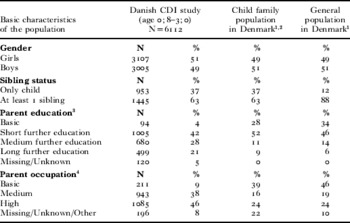
The final sample comprises the two cohorts, amounting to a total of 6,112 children. The distribution of demographic characteristics (gender, sibling status, parent education and parent occupation) in the sample is tabulated in Table 2. For comparison, the distribution of the demographic characteristics in the Danish child family population and in the general population in Denmark are given.
Demographic characteristics of the population in the Danish CDI study

1 This information is based on the national institution Statistics Denmark.
2 All children at age 1;0–3;0 in Denmark and their parents, respectively.
3 Highest education of mother/father; categorized according to a classification system established by Statistics Denmark, which follows international guidelines.
4 Highest occupation of mother/father; categorized according to a classification system established by Statistics Denmark, which is based upon the international standard ISCO.
The sample is balanced with respect to gender (51% girls and 49% boys). Concerning sibling status, 37% of the children are first-borns with no siblings, which is in accordance with the distribution in Danish children at this age. The educational and occupational level of the parents in the data set is higher than the national average. Very few parents (only 4%) in the Danish CDI study have only a basic education (primary school, preschool education, preparatory education, etc.), in comparison to 28% of Danish child families and 34% of the Danish population in general. Conversely, 21% of the parents in the CDI study have advanced university education (e.g. master's degrees, PhDs, etc.), in contrast to only 9% in child families and 6% in the general population. A similar pattern can be observed in relation to parent occupation. This displays a skewed representation in the direction of educated, middle-class families being over-represented, which is a frequent observation in CDI studies in general (see Fenson et al., Reference Fenson, Marchman, Thal, Dale, Reznick and Bates2007). At age 0 ; 8, 35% of the children are in daycare and at age 1 ; 0 this figure reaches 85% of all children in our study population. This distribution of daycare in the Danish CDI study is quite similar to that of the child family population in Denmark in general, reflecting that the vast majority of Danish children are socialised in an institutionalised culture. Most children in the CDI study actually spend between 35 and 45 hours per week in daycare.
Validity of the Danish CDI
The validity of the Danish CDI reports CDI: Words and Gestures and CDI: Words and Sentences has been investigated in different ways (Bleses et al., 2007). Here we will report the findings from three different validity investigations which consider the validity of the lexical items in the Danish CDI reports specifically, as this is a major component in both CDI reports. Moreover, the internal consistency of three different scales in the two CDI reports will be investigated.
The primary goal of the first investigation was to explore whether the words listed in the vocabulary section of the two CDI reports are to a sufficient degree representative of the vocabulary typically used by Danish children aged 0 ; 8 to 3 ; 0. For this purpose, we conducted analyses of a subsample of a longitudinal spontaneous speech corpus, the Odense Twin Corpus, which comprises spontaneous speech samples from six twin families (12 children). Recordings of approximately one hour have been made monthly from ages 0 ; 9 to 5 ; 0 (with some variation across families) and they primarily cover dinner-table conversations and free-play sessions. For our investigation, all words produced by four children (representing two twin pairs) from age 1 ; 1 to 2 ; 6 were identified. The children's words were subsequently compared to the words in the vocabulary lists of the two CDI reports (proper names and unintelligible words were excluded from the analyses). As no more than 20 different word types and 110 tokens (including interjections and sound words) were produced by the four children in the age range corresponding to the scope of CDI: Words and Gestures, we have chosen to focus on the words produced in the age range 1 ; 4 to 2 ; 6, corresponding to the scope of CDI: Words and Sentences. The result is shown in Table 3.
Comparison between spontaneously produced words by four Danish children and the vocabulary list in CDI: Words and Sentences

The children produced 11,704 word tokens in total. The 11,704 tokens consisted of 691 different word types and 54% of these could be found in the CDI. Removing infrequently used types increases the rate substantially (see Table 3), such that we can conclude that 73% of all not infrequently used types (and 91% of all not infrequently used word tokens) can be found in the CDI. We registered 50 words (781 tokens), produced by the four children at least five times, which were not included in the CDI vocabulary list; mainly nouns, interjections, sound words and some function words. The top five – accounting for 321 word tokens – consist of the following words: (1) hov ‘uh-oh’, ‘oops’; (2) lige ‘just’; (3) åh ‘oh’; (4) at lave ‘do’, ‘make’; and (5) at ‘to'. The interjection hov (143 tokens) clearly should have been included in the CDI word list as it appears to be a highly frequent word in the very early lexicon of Danish children.
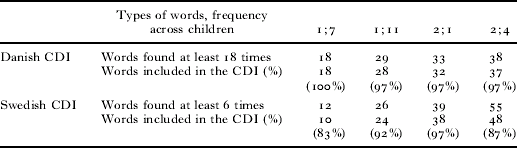
The result of a second investigation with a similar aim can be seen in Table 4. Here we used the vocabulary obtained by looking at all the sentences reported by the parents in their response to the question about the three longest sentences the child had produced. Again we can observe that 75% of all not infrequently produced types (and 91% of all not infrequently used word tokens) are included in the Danish CDI. A corresponding analysis has also been performed for the Swedish CDI (see Berglund & Eriksson, Reference Berglund and Eriksson2000) and applying the same criteria in our material actually gives somewhat higher, but still highly comparable, rates, as shown in Table 5.
Comparison between words found in the three longest sentences of each child and the vocabulary list in CDI: Words and Sentences

Comparison between words found in the three longest sentences of each child and the CDI vocabulary lists in the Danish and Swedish CDI'sFootnote 1
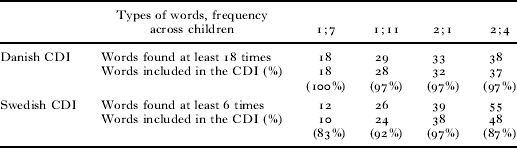
1 The Danish data set is more than three times larger than the Swedish data set which means that a token frequency of 6 in the Swedish data is roughly equivalent to a token frequency of 18 in the Danish data.
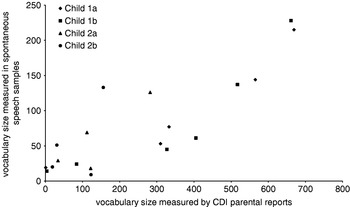
Finally, in the third investigation, the aim was to investigate whether the lexical development established in the CDI study is similar to the development observed in spontaneous speech. We correlated the (cumulative) number of word types produced spontaneously by the same four children as included above with vocabulary size as measured by CDI reports which the parents filled out for some of the months. As Figure 1 indicates, there is a high correlation between the developmental pattern, as indexed by the CDI, and vocabulary development, as indexed by spontaneous speech data.
Correlation of vocabulary size measured in spontaneous speech samples with vocabulary size measured by CDI parental reports.

The reliability of the Danish CDI reports was evaluated based on the internal consistency of scores for three scales in CDI: Words and Gestures (word comprehension, word production, gestures) and one scale in CDI: Words and Sentences (word production). Calculations of Cronbach's alpha yielded a coefficient of 0·98 for word comprehension, 0·97 for word production and 0·91 for gestures in CDI: Words and Gestures. For word production in CDI: Words and Sentences, the value was 0·99. These alpha values – which demonstrate high internal consistency – are similar to those reported in several CDI studies (e.g. Berglund & Eriksson, Reference Berglund and Eriksson2000; Fenson et al., Reference Fenson, Marchman, Thal, Dale, Reznick and Bates2007; Maital, Dromi, Sagi & Bornstein, Reference Maital, Dromi, Sagi and Bornstein2000).
In summary, the investigations of the validity and reliability of the Danish CDI instrument suggest that: (a) most common words and a substantial part of the less common words used spontaneously by Danish children are included in the vocabulary lists; (b) the vocabulary development of Danish children as measured by the CDI seems to correlate adequately with the growth of word types in spontaneous speech as measured in four Danish children's spontaneous speech productions; and (c) values of internal consistency of different scales of the Danish CDI were found to be satisfactory. We therefore conclude that the Danish adaptation of the American CDI has been adjusted linguistically and culturally in appropriate ways which makes it suitable for tapping into Danish children's language acquisition.
Statistical methods
We present the results on the age-dependent distribution of the different scores by percentiles (10%, 25%, 50%, 75%, 90%) where the medians are shown separately for girls and boys. Each score is further subjected to a 2-way ANOVA with age and sex as categorical factors.
Results
In this section we will present selected results from CDI: Words and Gestures (word comprehension, word production and gestures) and CDI: Words and Sentences (word production and complexity).
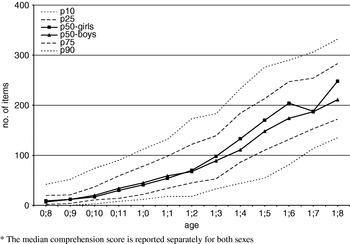
Figure 2 presents selected percentiles of the distribution of the comprehension score in Danish children from age 0 ; 8 to 1 ; 8. The comprehension score corresponds to the number of words in the CDI form CDI: Words and Gestures which the parents have marked that their child ‘understands’ or ‘understands and says’.
Percentiles of comprehension score by age (CDI: Words and Gestures).*

We can see the expected developmental trend from age 0 ; 8 to 1 ; 8. The Danish children have a median comprehension score which increases in size from 7 words at age 0 ; 8 to 232·5 words at age 1 ; 8. Up until age 1 ; 2 no apparent gender-specific differences can be noted and the scores are very similar. From that age onwards a different pattern emerges in the sense that girls are faster than boys at all time points (at age 1 ; 7, however, only by one word). The ANOVA analysis revealed a main effect of age (F(12, 2398)=270·9, p<0·0001) and sex (F(2, 2398)=7·0, p=0·0081) as well as an interaction (F(12, 2398)=1·82, p=0·0407).
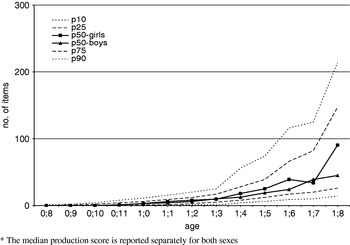
Figure 3 gives the corresponding percentiles of the distribution of the production score in Danish children from age 0 ; 8 to 1 ; 8. The production score is the number of words for which the parents have marked ‘understands and says’ in the CDI form CDI: Words and Gestures.
Percentiles of production score by age (CDI: Words and Gestures).*

The Danish children show a developmental trend, having an overall median production score which boosts from 0 at age 0 ; 8 to 70·5 words at age 1 ; 8. There is a floor effect for word production in the Danish data until 1 ; 0, where the median score is 3. Both boys and girls showed an improvement in number of produced words, but from age 1 ; 4 onwards we can observe that girls get an advantage over boys (except for age 1 ; 7) culminating at age 1 ; 8 in a difference of the median values of 46 words. The ANOVA analysis yielded a main effect of age (F(12, 2398)=136·0, p<0·0001) and sex (F(2, 2398)=12·9, p=0·0003) as well as an interaction (F(12, 2398)=12·91, p<0·0003).
Comparing the productive to the comprehensive vocabulary in the Danish children in this age range, we find an expected asymmetry: at all time points the Danish children comprehend far more words than they are capable of producing (at age 1 ; 8 the median scores yield a difference of 164 words).
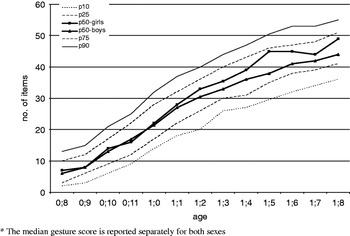
Figure 4 presents selected percentiles of the distribution of the gesture scores in Danish children from age 0 ; 8 to 1 ; 8. The gesture score is the total number of gestures which the parents have marked either ‘sometimes’ or ‘often’ (Part II A) or ‘yes’ (Part II B–E) in the CDI form CDI: Words and Gestures.
Percentiles of gesture score by age (CDI: Words and Gestures).

A monotonic increase in the percentiles across the age groups can be observed in the Danish children. The median score at 0 ; 8 is 6 gestures; by 1 ; 0 the score is doubled to 22 gestures; and finally, at 1 ; 8, a total of 43 gestures are used by the median Danish child. From age 1 ; 0 the median scores for girls are somewhat higher. The ANOVA analysis revealed a main effect of age (F(12, 2384)=579·3, p<0·0001) and sex (F(2, 2384)=47·8, p<0·0001) as well as an interaction (F(12, 2384)=3·86, p<0·0001).
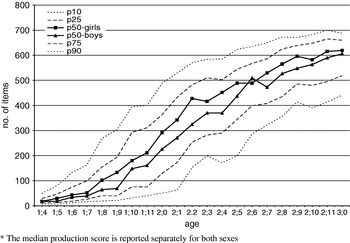
Selected percentiles of the distribution of the word production score in Danish children from age 1 ; 4 to 3 ; 0 are shown in Figure 5. The word production score is the number of words for which the parents have marked ‘says’ in the CDI form CDI: Words and Sentences.
Percentiles of production score by age (CDI: Words and Sentences).*

The Danish children show a clear developmental trend with an increase from 17 words at age 1 ; 4 to 619 words at age 3 ; 0. Girls are consistently faster than boys in producing words. With only one exception (age 2 ; 6) girls score higher than boys from age 1 ; 5 to 3 ; 0. However, the magnitude of difference in mean number of words is at some time points rather small (e.g. 1 ; 5–1 ; 7 and 2 ; 10–3 ; 0). Results from an ANOVA analysis confirmed a main effect of age (F(20, 3714)=401·2, p<0·0001) and sex (F(2, 3714)=85·5, p<0·0001) as well as an interaction (F(20, 3714)=401·2, p<0·0001).
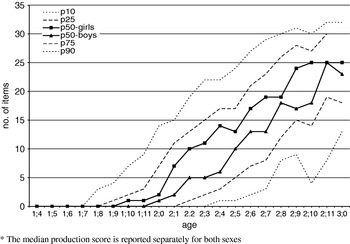
Selected percentiles of the distribution of the complexity score in Danish children from age 1 ; 4 to 3 ; 0 are shown in Figure 6. The complexity score is the total number of items for which the parents have marked that their child was able to produce the more complex form of 33 pairs of constructions in the complexity part of the CDI form CDI: Words and Sentences.
Percentiles of complexity score by age (CDI: Words and Sentences).*

We can observe a clear developmental trend in the Danish children from age 1 ; 7 onwards with a rather steep increase in particular from age 2 ; 0 (2 complex items) to 3 ; 0 (24 complex items). An even more pronounced sex difference emerges from Figure 6 in such a way that girls score higher than boys, in particular at the younger age levels (2 ; 2–2 ; 6) where the average number of complex forms is higher by a factor of two. The ANOVA analysis yielded a main effect of age (F(12, 3714)=281·8, p<0·0001) and sex (F(2, 3714)=107·0, p<0·0001) and an interaction (F(12, 3714)=4·0, p<0·0001).
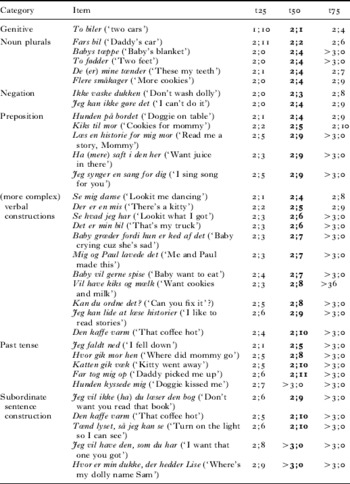
The sentence pairs vary in complexity across the 33 pairs and encompass different types of grammatical markers like inflectional endings (such as noun plurals, past tense forms), negations, prepositions, more complex verb construction and subordinate sentence constructions. In Table 6 below we show the time points where 25%, 50% and 75% of the children have started to use the more complex form for each item of the complexity part. The items are sorted by linguistic category and the time point where 50% have started within each of these categories in order to obtain an impression of what kind of linguistic complexity Danish children acquire first. In most of the complex forms of the pair of constructions more than one linguistic complexity has been added. By ‘category’ we mean the main type of linguistic complexity which the sentence indicates that the child has acquired. The time points are based on fitting a logistic quadratic model to the growth curve for each item.
The time points where 25%, 50% and 75% of the children has started to use the more complex form for each item of the complexity part

Table 6 implies that simple inflectional endings for genitive and plural are among the first to emerge (50% of the children master all such forms from age 2 ; 1 to age 2 ; 4), whereas past tense forms emerge only in some children so early (one item is mastered by 25% of the children at age 2 ; 1), but in the majority much later (for all past tense items the median is 2 ; 5 or later). The only weak past tense form represented (hunden kyssede mig ‘the dog kissed me’) are not produced by 50% of the children within the time frame of this study. The children start using prepositions early – 50% of the children produce two of the corresponding items at age 2 ; 4 or 2 ; 5 respectively – and at the age of 2 ; 9 all the prepositions included in the complexity scale are used by at least half of the children. More complex verbal constructions can be observed from age 2 ; 4. Subordinated sentence constructions, however, only begin to appear rather late. None of the items are mastered by more than 50% of the children at age 2 ; 9.
CONCLUSION
The first objective of this paper was to present a cross-sectional CDI study of Danish children's early language development in the age range from 0 ; 8 to 3 ; 0. The study is based on a large representative sample comprising more than 6,000 children, and is the first empirical study to document the inter-individual variability and to establish normative growth curves in Danish children's early language development. This paper presented selected results from CDI: Words and Gestures (word comprehension, word production and gestures) and CDI: Words and Sentences (word production and complexity). The paper described both general trends and variability in Danish children's language development from age 0 ; 8 to 3 ; 0 and showed that the Danish CDI instrument is sensitive to language development in Danish children. The variability of the children on different measures of language acquisition also confirms that the Danish CDI is capable of measuring individual differences among children. Small but consistent and statistically significant differences between girls and boys were registered within all the language dimensions measured in this study, showing a slight advantage to the girls. Validation studies indicated that the vocabulary inventory of the Danish CDI is representative of the early vocabulary of Danish children and that vocabulary development, as indexed by the CDI, correlates with the lexical development as documented in spontaneous speech in four Danish children. The trajectories of Danish children's lexical development are similar to those observed in many other studies for other languages; a systematic comparison is given in Bleses et al. (submitted). By categorising the items of the complexity section we can also depict the sequence of Danish children's first steps into grammar.