Beyond Delegation
Most governance is indirect and carried out through intermediaries. Governors do not govern targets directly, but bring in third parties to increase efficiency, effectiveness or legitimacy. Sometimes these third parties are ‘internal’ to the governor, as in the case of government bureaucracies, but often they are ‘external’, operating at some distance from the governor. Many states, for example, rely on professional associations for much of their environmental, health and safety regulation; they turn to private contractors to provide public services in utilities, education, or military and intelligence affairs; and they conduct parts of their foreign policy through international organizations such as the EU or NATO. International organizations in turn engage non-governmental organizations (NGOs) to implement development projects or monitor state compliance with international commitments. And NGO-operated certification schemes outsource verification to independent auditors.
It has become common to treat indirect governance as a process of delegation to be analyzed through principal-agent theory (the P-A approach). We agree that much indirect governance can be understood in this way. State delegation to private military contractors is illustrative: states (as principals) grant firms (as agents) the authority to act on their behalf, and states reserve the right to revoke this authority in cases of ineffectiveness or misconduct. Thus, in principle at least, states retain hard control over their military agents.
Yet not all indirect governance can be properly understood as P-A delegation. Governors do not always have hard control over their agents. Often they lack the authority or power to grant or rescind third parties’ authority (at acceptable cost), and rely instead on soft inducements to mobilize intermediaries and keep them in line. Consider, for example, the mixture of moral suasion, political leadership and material support by which the United States tried to manage notoriously independent allies such as Hamid Karzai of Afghanistan or Nouri al-Maliki of Iraq. Such soft, indirect governance cannot properly be understood through P-A theory; it requires its own form of analysis.
In a recent book,Footnote 1 we develop Orchestrator-Intermediary theory (O-I theory) to analyze soft, indirect forms of governance. Here we introduce O-I theory and contrast it with P-A theory. We highlight the commonalities and differences between orchestration and delegation, and discuss the governor’s calculus of choice between them. In conclusion, we briefly discuss the relative advantages of orchestration.
Two Logics of Indirect Governance
Delegation and orchestration both describe indirect modes of governance in which a governor brings in one or more third parties to govern a target by proxy (Figure 1). P-A and O-I theories broadly agree on why governors enlist third parties, but offer different accounts of how they do so.
Modes of indirect governance

Benefits of Indirect Governance
Why do governors engage in indirect governance? Under P-A theory, principals delegate governance tasks if, and to the extent that, agents can perform those tasks more effectively, efficiently or legitimately than the principals themselves.Footnote 2 O-I theory assumes that orchestrators work through intermediaries for essentially the same reasons.Footnote 3 Under both theories, the main benefits of indirect governance are functional: governors enhance their own governance capacity by tapping into the capabilities of third parties. Governors rely on third parties to perform well-known governance functions. These include:
-
∙ Expertise: Governors draw on the know-how of specialized actors to improve their governance efficiency and effectiveness. For instance, governments delegate technical regulation to independent regulatory agencies.Footnote 4
-
∙ Agenda setting: Governors bring in third parties to facilitate their internal collective decision making through agenda setting and mediation. The European Commission’s right of initiative is an important example.Footnote 5
-
∙ Credible commitment: Governors employ third parties as external commitment devices to enhance policy credibility. This has arguably been a major driver of the rise of independent central banks since the 1980s.Footnote 6
-
∙ Access to targets: Governors engage third parties to gain access to policy targets. The Global Environment Facility relies on the ‘on-the-ground capacity’ of independent ‘implementing agencies’ to manage climate adaptation programs in developing countries.Footnote 7
-
∙ Monitoring: Governors use independent and expert third parties as monitors. For example, the government of Texas has installed webcams along the Mexican border and enlists private internet users to screen illegal activity.Footnote 8 And the parties to the Nuclear Non-Proliferation Treaty charge the International Atomic Energy Agency (IAEA) with verifying compliance.
-
∙ Adjudication: Governors empower third parties to settle disputes and interpret rules. Notable examples include constitutional courts, the World Trade Organization Appellate Body and the private Internet Corporation for Assigned Names and Numbers (ICANN) review panel.Footnote 9
-
∙ Legitimacy: Governors enlist third parties to increase the acceptability of their policies. States are more likely to accept assistance from an independent financial institution such as the International Monetary Fund or World Bank than from a former colonial power or regional hegemon.Footnote 10
Modes of Indirect Governance
How do governors engage in indirect governance? P-A and O-I theories embody two fundamentally different relationships between governors and the third parties they enlist.
Delegation
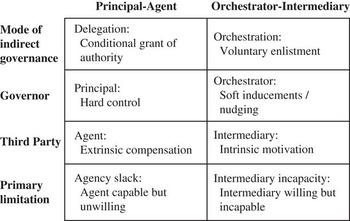
The focus of P-A theory is delegation, defined as ‘a conditional grant of authority from a principal to an agent that empowers the latter to act on behalf of the former’.Footnote 11 Delegation starts with an implicit or explicit contract whereby the principal empowers the agent to perform a set of pre-defined governance tasks toward pre-defined ends. The principal compensates the agent for its efforts, monitors the agent’s performance, and punishes an agent that is caught slacking or shirking. Delegation is thus fundamentally hierarchical. The principal ‘must be able to both grant authority and rescind it’.Footnote 12 This ability gives the principal hard control over the agent.
In practice, however, the principal’s hard control is often compromised by information asymmetries that allow the agent to shirk or slack unobserved and/or by the high costs of replacing the agent. If the agent performs crucial tasks that the principal can neither perform unilaterally nor reassign to other equally capable agents, the principal may be reluctant to discard the agent even if it is known to be slacking. The threat to rescind the agent’s authority loses credibility, and the principal must revert to alternative means of managing the agent.Footnote 13
Orchestration
The focus of O-I theory is orchestration, defined as the mobilization of an intermediary by an orchestrator on a voluntary basis in pursuit of a joint governance goal.Footnote 14 Because the orchestrator cannot command the intermediary’s co-operation, orchestration begins with a search for an ‘affine’ third partyFootnote 15 that sufficiently identifies with the orchestrator’s governance goals to voluntarily serve as intermediary. Once identified, the orchestrator enlists the intermediary through material and ideational support. Support strengthens the intermediary, while providing the orchestrator modest leverage over its actions. Material support strengthens the intermediary’s operational capacities; ideational support – such as guidance, formal approval or political endorsement – enhances the intermediary’s effectiveness and legitimacy vis-à-vis targets. By conditioning its support, and by assuming ideational leadership over the intermediary’s problem definitions and policy priorities, the orchestrator can nudge the intermediary toward governance goals that are compatible with its own goals.
Orchestration thus simultaneously empowers intermediaries and provides the orchestrator soft influence over them. But there are limits to what an orchestrator can do. If third parties remain unconvinced by the orchestrator’s overtures, or if intermediaries depart from the orchestrator’s goals, the orchestrator cannot coerce changes of attitude. In contrast to the hierarchy of P-A, then, O-I theory highlights a more horizontal relationship of mutual dependence between orchestrator and intermediary.
Orchestration and delegation are conceptually distinct, but often overlap in practice. Delegation blends into orchestration when principals find it difficult to credibly threaten to rescind their agents’ authority. Business firms, for example, often refrain from legally enforcing contracts in order to maintain business relationships.Footnote 16 And where central banks enjoy strong independence from government oversight, governments must rely on suasion rather than commands to influence monetary policy. Conversely, orchestration blends into delegation as orchestrators gain stronger control over their intermediaries. For example, when neo-corporatist peak associations owe some of their authority to the government, the government has harder means by which to control them than their formally private status would suggest.Footnote 17 In practice, then, the difference between delegation and orchestration becomes more a continuum than a sharp distinction.
In addition, governors often mix elements of delegation and orchestration. For example, they may empower agents by formal acts of delegation, but then rely on soft means of orchestration to support and steer their actions. The ‘trusteeship’ exercised by independent central banks and constitutional courts reflects this mixture of hard control ex ante and soft nudging ex post. Footnote 18 By contrast, British indirect colonial rule in Sierra Leone began with the enlistment and support of traditional local power holders for British governance purposes, but ended with the suppression of those who refused to support those purposes: here the British employed soft inducements ex ante and hard control ex post. Footnote 19
Costs of Indirect Governance
Indirect governance is a pure benefit when the governor can employ third parties that are both perfectly capable of performing the required tasks and perfectly share the governor’s goals. Real-world third parties, however, often possess only imperfect capabilities for the desired tasks and/or have goals that diverge from those of the governor. While P-A and O-I theory agree that such imperfections introduce friction and cost, they weigh these problems differently.
P-A theory focuses on goal divergence (‘agency slack’) as its central limitation.Footnote 20 The assumption is that principals select agents according to their governance capabilities with little regard to agents’ governance goals. Principals can do so because they have hard means to keep agents with divergent goals in check. The principal writes a contract that creates incentives for the agent to pursue the principal’s governance goals. The stronger the incentives the contract creates, and the more closely the principal monitors the agent’s behavior through its own efforts – via (‘police patrols’) or third-party whistle blowers (‘fire alarms’)Footnote 21 – the lower the risk of agency slack.Footnote 22 Yet contracts are never fully incentive-compatible, and monitoring is typically costly and imperfect. Thus some scope for agency slack is unavoidable. The only way to stop slacking completely is by rescinding the agent’s authority.
The contracting-out of public services to private companies is illustrative.Footnote 23 Starting in the 1980s, many municipalities began to negotiate contracts with private firms to manage services such as water supplies. These contracts stipulated, among other things, the price and quality of water and the maintenance of infrastructure. Nevertheless, many suppliers persistently under-invested in maintenance, putting quality at risk. As agency slack eroded the benefits of delegation, many municipalities that had privatized such services took them in-house again in the 1990s and 2000s.
O-I theory, in contrast, focuses on capability deficits as the primary limitation of orchestration. The assumption is that the orchestrator must select intermediaries based on their governance goals, and therefore may have to compromise on their capabilities. Given its lack of hard control, the orchestrator depends on intermediaries that are intrinsically motivated to work in concert with the orchestrator. This shifts the information problem from one of monitoring an agent’s performance to one of selecting an intermediary with similar goals in the first place. Yet compatible motivations do not imply adequate capabilities. Often the orchestrator must work with intermediaries that are partly or completely incapable of performing the required tasks. The orchestrator will try to improve intermediary performance through appropriate forms of support, but these measures can fail.
Consider the example of ethnic reconciliation in post-war Kosovo.Footnote 24 International donors including the Soros Foundation and the Swiss Agency for Development and Co-operation have orchestrated local intermediaries to reach out to Kosovar citizens. The intermediaries most willing to work with international donors are multi-ethnic, multi-lingual NGOs run by women, young intellectuals and others untainted by ethnic hatred. Unfortunately these NGOs are largely incapable of effective political action in an ethnically divided society. Precisely because of their multi-ethnic, multi-lingual composition, and their refusal to take sides, they are despised on all sides of the ethnic divide. The foreign donors can do little to help the NGOs increase their legitimacy: the only (partially) effective way to do so – encouraging the NGOs to take sides in the conflict – would undercut their shared goal of ethnic reconciliation.
Moreover, even where orchestrator support enhances the intermediary’s capabilities, that capability increase may unwittingly undermine the intermediary’s willingness to be orchestrated. Consider the European banking industry. Following the creation of the Single Market in 1992, EU member states nudged their domestic banks into creating national banking champions to deter foreign takeovers. Governments supported domestic bank consolidations, limited domestic competition and supported banks’ outward expansion. But success in increasing the size and international presence of domestic banks lowered their dependence on home markets, and hence their loyalty to national political authorities. During the debates on a European banking union in the early 2010s, many large European banks deserted their erstwhile national benefactors and lobbied for the Europeanization of banking oversight.Footnote 25 Figure 2 summarizes the key differences between the P-A and O-I theories of indirect governance.
P-A and O-I theories compared

The Choice Between Delegation and Orchestration
When will governors engage in delegation? When will they prefer orchestration? The choice depends on three bundles of factors: the identity and interests of the governor, the availability of third parties and the governance functions to be performed.
Governors
The choice between delegation and orchestration depends on the internal attributes of the governor. First, some governors have a stronger preference for hard control than others. Authoritarian regimes are generally more loath to cede control to third parties than are liberal democracies. Where autocratic rulers cannot achieve their governance goals directly or through closely held agents, they are more likely to sacrifice those goals than to relax control. Democratic governments, by contrast, are constitutionally constrained to deliver policy benefits to the public, and are hence more likely to orchestrate, even where that implies a loss of control over governance processes and outcomes.Footnote 26
Secondly, some governors have a greater capacity for hard control than others. National governments with extensive lawmaking authority and enforcement powers are typically better able to engage in delegation than are intergovernmental organizations operating under restrictive treaty mandates, with limited financial and administrative resources and tight member state oversight.Footnote 27 Weak governments often have little alternative to orchestration. Formally, they may still frame governance arrangements as contractual P-A delegation; in practice, however, these arrangements more closely resemble orchestration, as the government is unable to enforce the contract.
Thirdly, some governors are more constrained by veto players than others. Democratic governments and intergovernmental organizations operate under much tighter checks and balances than do autocratic regimes or NGOs. This biases them toward orchestration, because delegations of authority attract veto player attention and often require ex ante approval. This approval may not be forthcoming, as illustrated by the difficulty the US executive has in gaining Senate approval of international treaties (for example, the UN Arms Trade Treaty). Orchestration is less conspicuous, often remaining ‘under the radar’ (or out of the reach) of potential veto players, at least until the process is underway. This makes it more difficult for veto players to intervene. For example, even though some member states sought to maintain a sovereign monopoly on reporting infectious disease outbreaks, the rise of the internet allowed the World Health Organization to orchestrate new networks to disseminate outbreak information. By the time states became aware of these initiatives, their success in dealing with the SARS epidemic led states to ratify them.Footnote 28
Fourthly, the choice between delegation and orchestration depends on whether the governor wants to claim political credit for indirect governance or deny responsibility for it. Credit claiming is easier if the third party is a closely held agent rather than a largely independent intermediary. This favors delegation. Blame avoidance, by contrast, is facilitated if the governor can deny close association with the third party. This favors orchestration. Thus the separatists in eastern Ukraine are useful for the Russian government only insofar as Moscow ‘is not believed to be remote-controlling’ them.Footnote 29 Formally delegating the task of destabilizing Ukraine would defeat the purpose.
Finally, issue saliency matters. If a governor perceives a governance goal as highly salient, she is more likely to insist on hard control, and hence more willing to pay the extra costs of delegation (that is, the costs of empowering, compensating, monitoring and disciplining agents). If a governance goal has lesser salience, a governor can spare the costs of delegation and opt for orchestration. Relying on voluntary collaborators is almost always cheaper than employing paid agents.
Third Parties
The choice between delegation and orchestration also depends on the supply of appropriate third parties.Footnote 30 If supply is abundant, both modes of indirect governance are viable. Delegation is viable because governors can credibly threaten to replace slacking agents with others. The cost of rescinding existing agents’ authority is low; hard control is effective. Orchestration is viable because the large pool of potential intermediaries enhances the prospects of finding one that is both willing and able to advance the orchestrator’s governance goals. Soft inducements are sufficient to ensure effective co-operation. Conversely, when the supply of third parties is limited, the viability of both delegation and orchestration is impaired.
Limited availability of third parties especially erodes the viability of delegation, making orchestration the de facto mode of indirect governance. Intuitively, this is because the lack of alternative agents increases the principal’s dependence on existing agents, undermining the inherent hierarchy of the delegation relationship. Unless the principal can bring the delegated function in-house at reasonable cost, the threat to rescind the agent’s authority loses credibility. The best the principal can do, then, is to try to nudge the agent toward the desired behavior through soft ideational and material inducements. In short, it must orchestrate what formally remains a delegation arrangement.
Consider governments and defense contractors. While delays, cost overruns and underperformance are common in weapons development, governments rarely terminate defense contracts, because they fear both the fiscal loss and the public embarrassment of shifting suppliers, especially to foreign ones.Footnote 31 In short, because the contestability of agents is low, a relationship that remains formally structured as a P-A delegation, for better or worse, operates in practice as O-I orchestration.
All of this depends, however, on information conditions. If agents cannot be properly monitored, then delegation will not work. If agent type cannot be evaluated, then orchestration will not work.
Governance Functions
Finally, the choice between delegation and orchestration is shaped by the governance functions to be performed. Some governance tasks are better performed through delegation, others through orchestration.
Orchestration is prone to failure when governance tasks require intermediaries to run high risks of significant losses on behalf of the orchestrator. Intermediaries often lack incentives to accept such tasks voluntarily. Delegation is then the superior mode of governance, because it enables the governor to incentivize agents through compensation and hard threats. For example, one major problem of the condottieri (military contractor) system in Renaissance Italy was the inability of their notional political masters to force them to engage in a battle that potentially threatened their livelihood and their lives (or to prevent the condottieri from switching to the winning side during battle): ‘The state wanted quick and inexpensive victories; the condottieri wanted to make their living and save their skins’.Footnote 32 Likewise, the blind spot of early modern systems of tax collection by unpaid local notables was the taxation of these notables themselves – that blind spot reduced tax revenues both directly and indirectly, by undermining perceptions of tax justice and increasing resistance among taxpayers.Footnote 33 The solution to these problems was to delegate territorial defense and revenue collection to paid state agents operating under hard bureaucratic controls. Even today, orchestration is virtually absent in tax administration, and the utilization of private military contractors is largely limited to foreign operations.
Delegation is prone to failure when third parties’ capability to perform a task depends on their relative independence. For instance, when governors aim to tap into the expertise, legitimacy or commitment potential of third parties, they must cede hard control over them:Footnote 34 central banks can increase the credibility of low-inflation targets only if governments cannot easily overrule their policy decisions or rescind their independence; on-site inspections by IAEA staff are acceptable only if the IAEA is not perceived as a tightly controlled agent of any particular state or political interest; independent regulatory agencies improve the quality of regulation only if their regulatory decisions are not distorted by political considerations. Similarly, if governors want to draw on the creativity of third parties, they must give them leeway. For instance, the administrators of Wikipedia tout an ‘ignore all rules’ principle to ensure voluntary contributors complete freedom from creativity-constraining controls.Footnote 35 Finally, tasks outside the formal authority of the governor usually require a high degree of third-party independence. If an intergovernmental organization wishes to act outside its treaty mandate, or a national government wants to meddle in the domestic politics of another state, orchestration is the mode of choice: orchestration not only avoids the political difficulties of obtaining formal approval (see our discussion of veto players above), it also decreases suspicion and resistance among policy targets.
Is Orchestration Desirable?
The domain of application of the P-A theory of delegation is more restricted than is generally acknowledged. Far from providing a general model of indirect governance, it theorizes an important but specific case, in which a governor can both grant and rescind third-party authority at low cost. In many cases, however, granting and/or rescinding authority is costly, impossible or undesirable. In these cases, governors must turn to a different indirect approach: managing third parties through soft inducements. The O-I theory of orchestration sheds light on this widespread and important mode of indirect governance. The prevalence of orchestration does not, however, imply its normative desirability. In conclusion, then, we briefly discuss some problems of effectiveness and legitimacy.
Effectiveness
Orchestration’s dependence on voluntary enlistment makes it vulnerable to intermediary incapacity: the available intermediaries may be willing to advance the orchestrator’s governance goals, but incapable of making any useful contribution. Here orchestration decays into a strategy of ‘whitewashing’ (or ‘bluewashing’ in cases of UN orchestration), feigning governance activity where effectively there is none. In addition, orchestration is vulnerable to changes in intermediary preferences: intermediaries that lose interest in or commitment to the orchestrator’s governance goals may simply defect from the orchestration relationship, thus undermining its effectiveness. They can either defect openly or limit their efforts to symbolic gestures. In these cases, orchestration decays into multi-actor handholding with little practical value. Whatever its flaws, however, unless delegation is a viable alternative, the correct counterfactual for assessing orchestration is the absence of governance. Where that is the standard, even fairly ineffective orchestration may still be the most effective governance mode available.
Legitimacy
The essentially voluntary nature of orchestration raises difficult issues of legitimacy. Some scholars think of legitimacy primarily in terms of electoral accountability: all governance actors must be, directly or indirectly, accountable to voters in order to be legitimate.Footnote 36 Delegation is compatible with this view because it ensures that the agents exercising authority at the end of an indirect governance chain are ultimately controlled by an (elected) principal. This ensures electoral accountability by proxy. Orchestration, in contrast, cuts the chain of electoral accountability because the orchestrator lacks hard control over intermediaries. Ultimately, intermediaries exercise their authority in an (externally) uncontrolled and unaccountable way. This potentially allows governors to use orchestration to pursue goals outside their mandate. Yet the electoral accountability provided by delegation is often fictitious, especially when chains of delegation are long.Footnote 37 The real difference in accountability between orchestration and delegation is smaller than the conceptual difference suggests.
Other scholars focus on institutional and political restrictions on governance actors as the main source of legitimacy:Footnote 38 no actor should be in a position to exercise authority unconstrained. From this perspective, orchestration appears more appealing, because it creates webs of mutual dependence, reducing the likelihood of unilateral and extreme action. Finally, some scholars focus on collective deliberation and learning as the main source of legitimacy: the exercise of authority should be subject to open and reasoned debate.Footnote 39 This perspective also casts a favorable light on orchestration. The symmetry and essential voluntariness of the orchestration relationship favors reason giving and respectful hearing.
In sum, the attractiveness of orchestration depends on both circumstances and perspectives. Governance actors that lack the ability to delegate, or lack strong monitoring and enforcement capacities, will turn to orchestration to achieve their goals (if suitable intermediaries are available). Whether orchestration is more generally desirable depends on broader considerations that we have only briefly touched on here. Whatever the normative assessment, however, orchestration is an important mode of governance that cannot simply be subsumed under delegation, but demands its own form of analysis.