I. INTRODUCTION
Copper cladding aluminum (CCA) is an electrical conductor that consists of an inner aluminum core and an outer copper cladding. CCA is considered to have low density, low cost, excellent electrical conductivity, and joint performance. Reference Gibson1,Reference Perrard2 Consequently, CCA is widely used in communication, electrical power, construction, transportation, metallurgy, and chemical industries. In the earliest applications, CCA composite wire with a diameter ranging from 0.13 to 8.3 mm were successfully used in the field of signal transmission (ASTM B566-04a). The CCA composite wire is often produced by overlay welding, Reference Yamaguchi, Takayama and Hiderita3 co-rolling, Reference Dion4 or hydrostatic extrusion. Reference Rhee, Han, Park and Kim5,Reference Yoon, Jeong, Lim, Na and Kim6 Recently, the CCA composite flat bar has generated much attention due to its significant prospects in large current transmission. However, the CCA composite flat bar cannot be produced by overlay welding technology or co-rolling technology. Therefore, Xie et al. has developed an innovative technology for producing the CCA composite flat bar based on continuous casting and rolling. CCA rods with round or rectangular cross section are first produced by continuous casting, next they are rolled and drawn, and then finally the CCA flat bars are improved by annealing. This technology has made the cost of manufacturing the CCA flat bar low which allows for large scale production in the industry. Reference Xie, Liu and Huang7
Annealing is a critical production process to obtain a good combination of mechanical and electrical properties of the CCA flat bar. Unlike the single metal material, annealing of CCA flat bar will face a challenge that copper and aluminum require different recrystallization temperatures, thus higher annealing temperatures and longer holding times are needed to make sure the copper and aluminum completely recrystallize. However, the copper and aluminum atoms adjacent to the interface diffuse to the opposite sides driven by the concentration gradient. Diffusion for longer time promotes the generation of thicker intermetallic compounds which are detrimental to the interfacial bonding property. Some previous researchers found that the interfacial fracture mode transferred from ductile to brittle when the intermetallic compound layer at the interface was thicker than 2 μm. Reference Abbasi, Karimi Taheri and Salehi8–Reference Peng, Wuhrer, Heness and Yeung10 Abbasi, Reference Abbasi, Karimi Taheri and Salehi8 Lee, Reference Lee, Bang and Jung11 and Braunovic et al. Reference Braunovic and Alexandrov12 revealed that a thicker layer of intermetallic compounds caused a higher electrical resistivity across the interface. Therefore, understanding how to control the interfacial structure evolution of the CCA flat bar during annealing is an important issue that many researchers have been focusing on.
For bimetal composites or joints such as Al/Cu, Reference Braunovic and Aleksandrov13 Au/Al, Reference Bertolino, Garay, Anselmi-Tamburini and Munir14 Ag/Zn, Reference Friedman, Garay, Anselmi-Tamburini and Munir15 and Al/Ni Reference Liu, Chen and Chen16 systems, it was found that applying the current vertical to the interface direction during annealing promoted the growth of intermetallic layers. For the Sn/Ag, Reference Chen and Chen17 Sn/Cu, Reference Chen and Wang18 and Sn/Ni Reference Chen and Chen19,Reference Chen, Chen and Liu20 systems, whether the current promoted or inhibited the interfacial reaction depended on the relationship of the current direction and the diffusion direction of Sn atoms. These two studies inspired the study of whether applying a current parallel to the interface during annealing would have a regulatory effect on the interfacial structure. Besides the effect of the current, the stress gradient also has an effect on the diffusion. Local stress gradient will be generated in the Al and Cu lattices during inter-diffusion, because of the difference of atomic sizes between Al and Cu. However, the stress gradient effect is strongly correlated to the sizes of the samples, and it is higher for thinner film or wire and more sensitive for interstitial atoms. Reference Beke, Szabó, Erdélyi and Opposits21,Reference Hug and Bellido22 Since the size of the CCA flat bar is much larger than the diffusion distance and both of the Al(Cu) and Cu(Al) solution are substitutional, the stress gradient effect is slight in CCA flat bar.
In this present work, the CCA flat bar fabricated by continuous casting and subsequent rolling technology was selected as the research object. By applying longitudinal alternating current (LAC) along the CCA flat bar during isothermal annealing, the effects of LAC on the Cu/Al interface morphology, bonding property, and growth rate of interfacial compound layers were investigated. The results indicate that LAC can influence the diffusion behavior and inhibit the growth of interfacial compound layers significantly. It is proposed that the annealing method assisted by LAC could be an innovative method to control the thickness of the interfacial layers and bonding property of the CCA flat bar.
II. EXPERIMENTAL METHOD
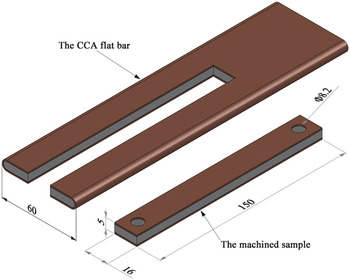
CCA rods with the section dimension of 50 × 30 × 3 × R4 mm (width × thickness × cladding thickness × round corner radius) were produced by horizontal core-filling continuous casting Reference Wu, Liu, Xie, Wang and Dong23 and then were rolled with multiple passes at room temperature to obtain the CCA flat bars with the width of 60.0 mm and thickness of 5.0 mm. Reference Wu, Liu and Xie24 As shown in Fig. 1, samples for annealing with a width of 16.0 mm, thickness of 5.0 mm, and length of 150.0 mm were cut from the CCA flat bars along the rolling direction. Two holes with a diameter of 8.2 mm were drilled at each end of the samples to connect to the electric cable connector.
Schematic diagram of the sample machined from the CCA flat bar (unit: mm).

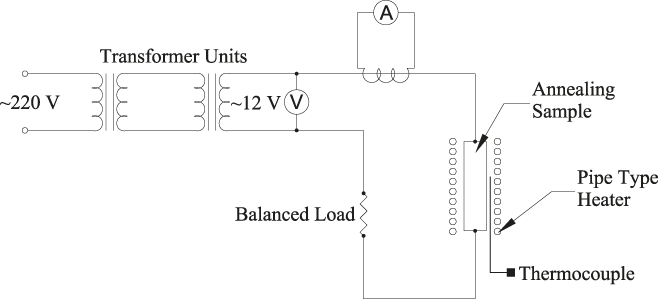
Annealing experiments on the CCA samples with and without the current were performed in air. The principle diagram of the LAC-aided annealing experiment is shown in Fig. 2. The input voltage of the alternating current with a Chinese industrial frequency of 50 Hz was transformed from 220 to 12 V through a continuous regulating transformer, a large power step-down transformer, as well as some other transformer units. The CCA samples for annealing were heated through a pipe type heater which has a temperature control accuracy ±1 K. The power supplies for the transformer units and pipe type heater were independent. A large power resistance was selected as the balanced load, which controlled the total power of the electric circuit. The direction of the current applied on the samples was parallel to the rolling direction, so it is defined as LAC. The current intensity range of 50–220 A is corresponding to the current density range of 0.625–2.75 A/mm2. For comparison, the same pipe type heater was used in annealing experiments without assistant LAC. Our previous study revealed that the recrystallizations of the aluminum core and copper cladding were not complete below 673 K. Reference Wu, Liu and Xie25 Thus, in this work the annealing temperature range were selected as 673–773 K, and the range of holding time was 0.25–2 h. After the annealing, the samples were cooled by natural air.
Principle diagram of the annealing with assistant current.

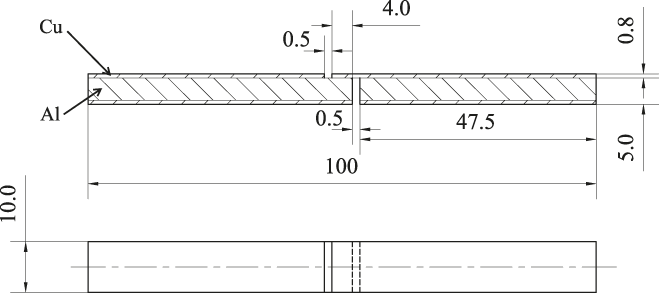
The ZEISS EVO 18 scanning electron microscope (SEM; Carl Zeiss Microscope GmbH, Jena, Germany) was used to observe the microstructure of the interface and the BRUKER QUANTAX energy dispersive spectrometer (EDS; Bruker Nano GmbH, Berlin, Germany) was used to analyze the chemical composition around the interface. Shear tensile test was used to evaluate the interfacial bonding strength of the CCA flat bar, and the sizes of the specimen were shown in Fig. 3. The shear tensile test was conducted on a 10 kN universal material testing machine. The clamping chuck of the machine was set to move at 0.5 mm/min. Three samples at each condition were tested and the average value of the properties was taken as the final results.
Shear tensile test specimen of the CCA flat bar (unit: mm).

III. RESULTS AND DISCUSSION
A. The interface morphology of the CCA flat bar before annealing
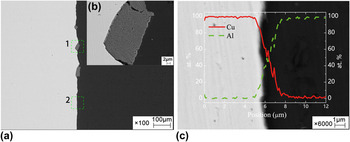
Figure 4 shows the SEM backscattered electron images of the interface morphology of the as-rolled CCA flat bar before annealing. The overall interface is shown in Fig. 4(a), the residual as-cast interface structure is shown in Fig. 4(b), and the new interface formed during rolling is shown in Fig. 4(c). In previous works, the as-cast interface structure, Reference Su, Liu, Huang, Liu and Xie26 the evolution of interface during rolling, Reference Wu, Liu and Xie27 and the effect of annealing temperature on the interface structure were characterized and investigated. Reference Wu, Liu and Xie25 The as-cast interfacial layers were broken by the serious compression stress and longitudinal extension in rolling process and became fragments or blocks distributed discontinuously along the interface after rolling. The microanalysis indicates that these blocks have the same morphology and structure as the as-cast interface, in which the intermetallic layers near the copper are CuAl2 and Cu9Al4 phases and the lamellar structure is Al–CuAl2 eutectic structure. Figure 4(c) presents the new interface generated in the rolling process which appears flat and does not seem to have a diffusion layer or intermetallic phase. Since the new interface is the primary concern of the overall interfacial structure, the influence of applying the LAC during annealing on this part of the interface will be mainly discussed in the next sections.
The interface morphology of the rolled CCA flat bar before annealing: (a) overall morphology, (b) enlarged view of No. 1 zone shows the residual as-cast interface structure, (c) enlarged view of No. 2 zone shows the new interface generated during the rolling and the EDS line scanning analysis.

B. Effect of the LAC density on the interface morphology
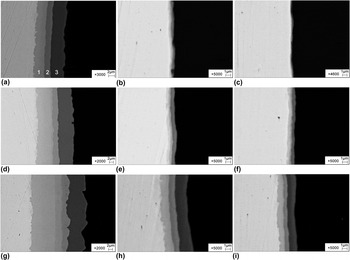
When the CCA flat bar is annealed at high temperatures, inter-diffusion takes place at the interface. This process promotes the generation of new phases, especially at the new interface generated during rolling. Figure 5 shows the effect of applying LAC with a density of 0.625–2.75 A/mm2 on the interface morphology when annealing at a temperature of 673–773 for 1 h. It is clear that the interface becomes thinner as the LAC density increases at the same annealing temperature. This indicates that the LAC inhibits the growth of interfacial layers. As shown in Figs. 5(a), 5(d), and 5(g), when annealing above 673 K without the assistant current, it is easy to distinguish 3 layers that exist between the copper and aluminum. The thicknesses of the interfacial layers annealed at 673 K, 723 K, and 773 K are approximately 10 μm, 18 μm, and 25 μm, respectively.
Effect of LAC density on the morphology of the new interface generated during rolling: (a)–(c) 0, 1.25 and 2.75 A/mm2 at 673 K; (d)–(f) 0, 1.25 and 2.75 A/mm2 at 723 K; (g)–(i) 0, 1.25 and 2.75 A/mm2 at 773 K.

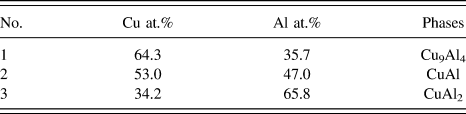
According to the results given in Table I of the EDS analysis of the interface layers in Fig. 5(a), it is reasonable to infer that the corresponding 3 layers are respectively Cu9Al4, CuAl, and CuAl2 phases based on the Cu/Al phase diagram Reference Massalski28 and relevant research results. Reference Su, Liu, Huang, Liu and Xie26,Reference Drozdov, Gur, Atzmon and Kaplan29 When annealing at 673 K for 1 h with a LAC density of 1.25 A/mm2, the interfacial layers are still continuous [Fig. 5(b)] and have a much thinner thickness compared with those annealed without current [Fig. 5(a)]. Furthermore, when the LAC density is increased to 2.75 A/mm2, discontinuous interfacial layers are observed, as shown in Fig. 5(c).
The EDS analysis of the interfacial layers in Fig. 5(a).

When the annealing temperature is increased to 723 K and to 773 K, the thickness of the interfacial layers decreases with increasing LAC density. Although the LAC has the ability of inhibiting the growth of interfacial phases, the continuous layers still grow even when the LAC density is as high as 2.75 A/mm2. At 723 K and 773 K, two and three layers can be easily observed respectively in Figs. 5(f) and 5(i). It can be concluded from above results that the LAC can inhibit the growth of interfacial phases to a limited extent. The LAC cannot inhibit the growth completely at higher temperatures due to the more active inter-diffusion behavior.
C. Effect of LAC during annealing on the interfacial bonding strength
Our previous study revealed that the full recrystallization of both the copper cladding and aluminum core occurred when annealing at 673 K for 1 h without current. Reference Wu, Liu and Xie24,Reference Wu, Liu and Xie25 This process improved electrical conductivity and elongation of the CCA flat bar remarkably. However, the interfacial bonding strength of the CCA flat bar after annealing was reduced when compared to the as-rolled sample. From Fig. 5, the CCA flat bar has interfacial layers less than 1 μm thick when annealing at 673 K for 1 h with the current density of 1.25–2.75 A/mm2. To investigate the effect of the LAC on the interfacial bonding strength, comparative experiments of annealing with and without LAC were designed. These results are presented in Table II.
Interfacial property of the CCA flat bar at different states.

From the results in Table II, the interfacial bonding strength of the CCA flat bar improve from 26.3 MPa, when annealing without the LAC, to 44.8 MPa, when annealing with a 1.25 A/mm2 LAC density. By comparing the thicknesses of the interface at different annealing conditions (Fig. 5), the results indicate that the increase of the bonding strength resulted from the reduction of the thickness of the interfacial layers caused by the inhibition of the brittle interfacial intermetallic compounds. The above results prove the relationship between the interfacial layers thickness and the bonding strength, and agree with the results in specific articles. Reference Abbasi, Karimi Taheri and Salehi8–Reference Peng, Wuhrer, Heness and Yeung10 Therefore, the LAC-aided annealing is an efficient process to enhance the bonding strength of the CCA flat bar.
D. Effect of the LAC on growth of interfacial layers
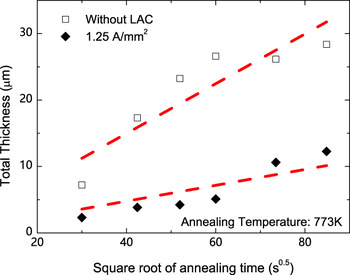
The effect of the LAC during annealing on the growth of interfacial layers with holding time is illustrated in Fig. 6. Many researches on the Cu/Al diffusion system indicated the linear relationship between the interfacial layers thickness and the square root of time, in different types of samples. Reference Chen and Hwang30–Reference Guo, Liu, Jin, Shi and Qiao32 In this present work, by fitting of the scattered experimental data, it can be seen from Fig. 6 that the total interfacial layers thickness also grows linearly with the square root of time, when the CCA flat bars are annealed at 773 K for 0.25–2 h both with and without LAC. This indicates that LAC didn’t change the mechanism of the interface reaction, but the slope of the fitting line is much gentler for the condition of LAC-aided annealing.
Effect of LAC on growth of interfacial layers.

From the fitting plot in Fig. 6, the relation between holding time and total interfacial layers thickness can be presented by:
 $$\omega = \sqrt K \sqrt t \quad ,$$
where, ω is the total thickness, t is the holding time, and K is the growth rate constant. It is found that the growth rate constants for annealing samples with and without LAC are K 1 = 1.43 × 10⁻¹⁴ m2/s and K 2 = 1.40 × 10⁻¹³ m2/s, respectively. The ratio K 1/K 2 is 0.102 (10.2%), which indicates that LAC can reduce the growth rate of interfacial compound layers by 89.8%.
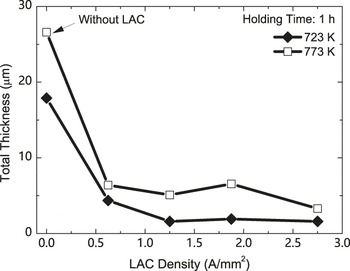
The effect of the LAC density on the total thickness of the interfacial layers when annealing at 723 and 773 K for 1 h is shown in Fig. 7. If the LAC density exceeds 0.625 A/mm2, the inhibition effect of the assistant LAC is very remarkable based on the sharp reduction of the total thickness curves at the initial stage in Fig. 7. When the LAC with a density of 0.625 A/mm2 was applied, the total thickness of the interfacial layers is reduced by 75.6% at 723 K and 76.0% at 773 K, compared with those of the annealing without LAC. However, the interfacial layers thickness changes gently in the LAC density range of 1.25–2.75 A/mm2. Thus, at the temperature range of 723–773 K for holding 1 h, the density of 1.25 A/mm2 of the LAC is sufficient to inhibit the growth of the interfacial layers effectively.
Effect of LAC density on the total thickness of the interfacial layers at 723 and 773 K.

E. The mechanism of the effect of LAC on interface growth
When the CCA flat bar is isothermally annealed, the growth of the interfacial compounds at the new interface generated during rolling is controlled by the diffusion of Cu and Al atoms, both in matrix metals and intermetallic phases. Reference Tanaka and Kajihara33–Reference Kajihara35 Fundamentally, the effect of LAC on the morphology and thickness of the interfacial layers depends on the effect of LAC on the diffusion behavior.
If electric current is passed through metals, the flux equation for component i can be written as Eq. (2) Reference Shewmon36 :
 $${J_i} = - {{{D_i}{C_i}} \over {RT}}\left( {{{RT\partial \ln {C_i}} \over {\partial x}} + Fz_i^ * E} \right)\quad ,$$
 $$E = {{{j_{\rm{e}}}} \over \sigma }\quad ,$$
where J
i
is the diffusion flux of component i, D
i
is the diffusion coefficient, C
i
is the concentration of component i, R is the universal gas constant, T is the thermodynamic temperature, F is the Faraday’s constant,
 $z_i^ *$
is the effective charge, and E is the electric field, which can be calculated through current density j
e and electric conductivity σ as shown in Eq. (3).
Firstly, the effect of current on the diffusion flux can be analyzed from the term
 $Fz_i^ * E = Fz_i^ * {{{j_{\rm{e}}}} \over \sigma }$
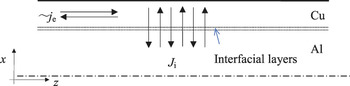
on the right side of Eq. (2). As shown in Fig. 8 the direction of current is identical with the rolling direction of the CCA flat bar, i.e., z direction in Fig. 8. However, the Cu and Al atoms diffuse along the x direction, which controls the growth of interfacial compound layers. Thus, the contribution of current density vector j
e to the diffusion flux vector J
i
in the x direction is nearly zero. Equation (2) can be written into Eq. (4) in the x direction.
 $${J_i} = - {D_i}{{\partial {C_i}} \over {\partial x}}\quad .$$
Sketch diagram of current direction and diffusing direction in LAC-aided annealing: j e, current density vector; J i , diffusion flux vector.

The Kirkendall effect of the Cu/Al couple revealed that its diffusion behavior is dominated by the vacancy mechanism. Reference Funamizu and Watanabe37,Reference Liu and Cui38 According to the vacancy diffusion mechanism, the diffusion is dependent on vacancy concentration and the required energy barrier for atom transition. The vacancy concentration in cold-worked metals is supersaturated, which is not an equilibrium state. Thus, the vacancies tend to transfer to the “vacancy sink” to reduce the vacancy concentration, driven by the reduction of system free energy. Reference Fischer, Svoboda, Appel and Kozeschnik39 The vacancy sink includes the dislocation jog, noncoherent phase interface, grain boundary, et al. The annihilation rate of vacancies under LAC can be described by Eqs. (5) and (6) Reference Onodera and Hirano40,Reference Onodera and Hirano41 :
 $$- {{{\rm{d}}N_{\rm{V}}^e} \over {{\rm{d}}t}} = \gamma \cdot N_{\rm{V}}^e + {{{J_{\rm{V}}}} \over d}\quad ,$$
 $${J_{\rm{V}}} = N_{\rm{V}}^e \cdot D_{\rm{V}}^0\left| {e \cdot {Z^ * }} \right|{{\rho \cdot {j_{\rm{e}}}} \over {kT}}\quad ,$$
where
 $N_{\rm{V}}^e$
is the vacancy concentration, t is the holding time, γ is the rate constant of vacancy annihilation without LAC, J
V is the vacancy flux caused by current, d is the grain size along current direction,
 $D_{\rm{V}}^0$
is the diffusion constant of vacancy at the temperature of T, e is the elementary charge,
 ${Z^*}$
is the effective electric charge count of vacancy, ρ is the electrical resistivity, and k is the Boltzmann constant. The second term on the right side of Eq. (5) denotes the effect of current.
Combining Eq. (6) with Eq. (5), obtains Eq. (7):
 $$- {{{\rm{d}}N_{\rm{V}}^e} \over {{\rm{d}}t}} = \gamma \left( {1 + {{D_{\rm{V}}^0 \cdot \left| {e \cdot {Z^ * }} \right|\rho \cdot {j_{\rm{e}}}} \over {\gamma \cdot d \cdot k \cdot T}}} \right)N_{\rm{V}}^e\quad .$$
It can be deduced from Eq. (7) that the current can accelerate the annihilation of vacancy. The annihilation rate of vacancy is proportional to materials parameters such as
 $D_{\rm{V}}^0$
,
 ${Z^*}$
, and current density j
e, and inversely proportional to other factors like grain size d.
Supposing that the vacancy concentration in cold-worked metals is
 $N_{\rm{V}}^0$
as the initial condition of Eq. (7), it can be solved:
 $$N_{\rm{V}}^e = N_{\rm{V}}^0\exp \left( { - {\gamma ^e}t} \right)\quad ,$$
where γ e is defined as:
 $${\gamma ^e} = \gamma \left( {1 + {{D_{\rm{V}}^0\left| {e{Z^ * }} \right|\rho {j_{\rm{e}}}} \over {\gamma dkT}}} \right)\quad .$$
Prior to annealing, the CCA flat bars were cold rolled with a total reduction of 83%. During this process a large number of lattice defects such as vacancies and dislocations were generated in the copper cladding and aluminum core. The vacancy concentration
 $N_{\rm{V}}^0$
was higher than the equilibrium concentration. It is indicated by Eq. (8) that the vacancy concentration
 $N_{\rm{V}}^e$
declines exponentially with the increase of holding time influenced by the LAC. The vacancy concentration will decline more rapidly with a higher LAC density. When the vacancy concentration was reduced by LAC, the exchange positions for Al or Cu atoms was decreased, thus the diffusion flux could be reduced. That is the reason why the LAC slows down the growth rate of interfacial compounds.
In addition, the opposite results between this present work and previous research in Refs. Reference Lee, Bang and Jung11–Reference Braunovic and Aleksandrov13 can be explained. The primary reason is because of the relationship between current transmitting direction and the diffusion direction. If these two directions are vertical with each other, like the experimental conditions for this present work, the predominant effect of the current is to accelerate vacancy annihilation, and reduce the diffusion flux. Otherwise, if these two directions are parallel with each other, the predominant effect of the current is to enhance the diffusion flux through the term
 $Fz_i^ * E = Fz_i^ * {{{j_{\rm{e}}}} \over \sigma }$
on the right side of Eq. (2).
IV. CONCLUSIONS
-
(1) LAC-aided annealing is an efficient method to inhibit the growth of interfacial layers and improve the bonding strength of the CCA flat bar, and it can be used as a novel annealing method to control the interface structure and bonding property.
-
(2) For the same annealing temperature and holding time, when LAC density is higher than 0.625 A/mm2, the total interfacial thickness of the CCA flat bar is decreased by more than 75% compared with those without LAC. When increasing the current density in the range of 1.25–2.75 A/mm2, the inhibition effect of LAC is insignificant.
-
(3) When annealing at 673 K for 1 h with a LAC density of 1.25 A/mm2, the interfacial bonding strength improves from 26.3 to 44.8 MPa, compared with the annealing without LAC.
-
(4) The LAC promotes the vacancy annihilation in component metals, decreases the vacancy concentration, and causes the reduction of the diffusion flux, which can be responsible for the mechanism of LAC inhibiting growth of intermetallic compounds at the interface.
ACKNOWLEDGMENTS
The investigation was financially supported by National High-tech R&D Program (863 Program) (No. 2013AA030706) and Beijing Municipal Science and Technology Project (No. Z141100004214003) of China.