

This special issue is dedicated to understanding exchanges in personal and family networks and their likely consequences for key demographic dimensions. The idea of linking family networks and such dimensions stems from scientific exchanges developed between two economists, one philosopher, and two sociologists during my prepandemic stay at the IMéRA Institute for Advanced Study in the Spring semester of 2019. In the wonderful context of IMéRA, Dr Ramses Abul Naga, Claire Bidart, Raouf Boucekkine, Pierre Livet, and I had several meaningful occasions to share ideas and hypotheses that envision the potential of a configurational approach of exchange issues in personal and family networks. These ideas were in direct connection with empirical work that several colleagues and I have been conducting for several years in the NCCR Lives, a large long-term research project on vulnerability in a life course perspective funded by the Swiss National Science Foundation. The NCCR Lives has endeavored to create new theoretical and empirical ways of understanding resilience factors for individuals facing stressful social contexts [Spini et al. (Reference Spini, Bernardi and Oris2017)]. Therefore, I was thrilled to be invited by Dr de la Croix to be guest editor of a special issue of the Journal of Demographic Economics on exchanges in family and personal configurations beyond the household. Obviously, the papers included in this special issue have been written and revised during the height of the pandemic without ever touching on this highly pressing issue. However, some of the results presented here have some relevance for understanding the relational resilience factors that individuals have employed to face the current collective hardships, as well as those likely to come.
The configurational studies of this special issue trace complex patterns of exchanges existing among family members and beyond households. They focus on the functional connections among spouses, children, siblings, and other relatives living in a variety of households. The main goal of this special issue is to reveal how some key decisions and exchanges occurring in family dyads, such as the marital and parent–child dyads, are embedded within a larger set of family and interpersonal exchanges that constitute configurations of their own. Configurations were originally defined as “structures of mutually oriented and dependent people” [Elias (Reference Elias1994), p. 214]. Workplaces, churches, and associations; but also families and friendship groups are configurations in which individuals are functionally interconnected, whether directly or indirectly. Individuals are interdependent in a configuration because each one fulfils some of the others' needs for social recognition, emotional proximity, financial and practical resources, or other socially defined needs [Widmer et al. (Reference Widmer, Giudici, Le Goff and Pollien2009), Widmer (Reference Widmer2016, reedition)]. As such, configurations must deal with power issues: Resources are scarce in configurations, and the individuals embedded in them, while cooperating, also compete. This mixture of cooperation and competition creates collective developments which are beyond any individual's control. Therefore, the pattern of exchanges that characterize any configuration is largely unintended and has unexpected consequences [Widmer (Reference Widmer2021)]. Such consequences, in turn, shape the cooperation and exchanges (as well as conflicts) that occur in each of the constituting dyads of the configuration.
On the basis of this theoretical stance, the configurational perspective on families posits that the exchanges between partners, parents and children, or siblings, are better understood when they are referred to their relational context [Widmer et al. (Reference Widmer, Giudici, Le Goff and Pollien2009)]. This perspective holds that central family dyads are shaped by the larger networks of exchanges with relatives, friends, and others in which they are embedded. On the other hand, it posits that these configurations of exchanges depend to a significant extent on what happens in those central dyads [Widmer et al. (Reference Widmer, Giudici, Le Goff and Pollien2009)].
Based on this set of assumptions, the papers of this special issue focus on the structures of exchanges that unfold in family and personal networks, and promote the use of social network methods [Wasserman and Faust (Reference Wasserman and Faust1994), Hanneman and Riddle (Reference Hanneman and Riddle2005)], especially those developed to tackle family networks [Widmer et al. (Reference Widmer, Aeby and Sapin2013)]. The papers consider a variety of critical issues, such as fertility decisions, reproductive health or reciprocity in dyads. Their common ground relates to an understanding of individual decisions and dyadic exchanges as embedded in larger configurations of ties.
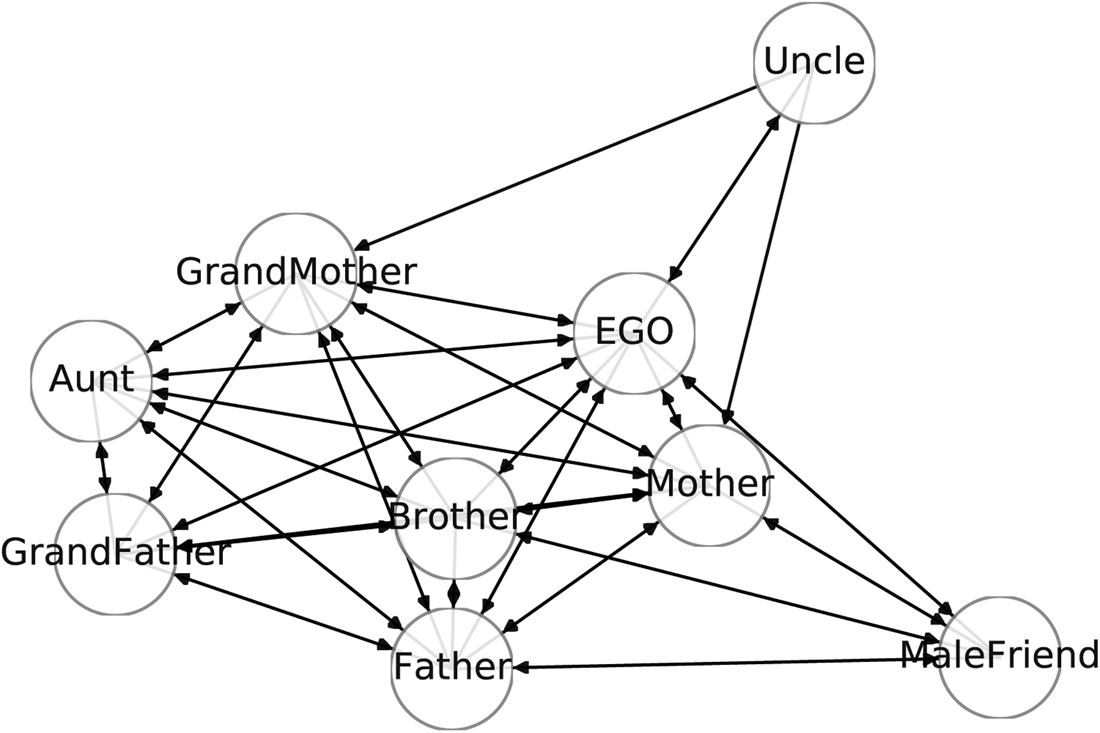
The configurational perspective is not yet broadly implemented in empirical research on families, which still largely focus on specific dyads when dealing with such topics as the exchanges of goods, services, and financial assets among family members. Existing research places a particularly strong emphasis on parent–child and spousal exchanges. This special issue aims to exemplify research outcomes that stem from empirically considering larger configurations of ties to understand exchanges that unfold in specific family dyads, and personal decisions. Consider the family network in Figure 1 based on data from the MOSAiCH 2013 survey [Ernst Staehli et al. (Reference Ernst Staehli, Joye, Sapin, Pollien, Dümmler and Kessler2014)]. Sociological research has made a critical distinction between instrumental and expressive exchanges and support: Whereas expressive exchanges refer to emotional support and expression of positive emotions, instrumental exchanges refer to transfers of financial or practical resources that help families adjust to economic pressures from their context [Parsons and Bales (Reference Parsons and Bales1955)]. Arcs refer to instrumental support provided by family network members in cases of need. In Figure 1, arrows point to the person from whom such support originates.
Instrumental exchanges within a family network showing bonding social capital.

The case featured in Figure 1 shows a configuration in which the respondent as a focal individual (often referred to as “ego” in personal network research) is embedded in a dense set of instrumental exchanges among their network members. The interest for density has a long history in social network research [Scott (Reference Scott2017)]. Its operationalization is straightforward, as it is measured by the ratio of the activated ties in a network (in this case, ties providing instrumental support) over the total of possible ties depending on the network's size. The denser a network is, the greater share of its dyads have activated their relationships. Density as a concept underlies a variety of mechanisms that have been of critical importance in sociology since Durkheim's contribution more than a century ago (1895, reedition 2005). Density enhances expectations, claims, obligations, and trust among members of a configuration because of the increase of the collective nature of normative control [Coleman (Reference Coleman1988)]. If any family or personal network member fails to conform to the group's expectations at one point, then they are likely to see several other configuration members jointly react against the situation. Dense family or personal networks also facilitate communication by multiplying the number of information channels and reducing the number of intermediaries between any two configuration members [Widmer (Reference Widmer2006)]. In dense family configurations, support has a collective nature, as several individuals are likely to coordinate their efforts when providing support. Finally, as already stressed by Durkheim (Reference Durkheim1895, reedition 2005), density is related with shared memories and shared identities within the family: “where collective sentiments are strong, it is because the force with which they affect each individual conscience is echoed in all the others, and reciprocally” (ibid, p. 159). For these reasons, density was used as a critical indicator of family bonding-based social capital; i.e., the resources associated with increasing internal cohesion of the family as a configuration [Widmer (Reference Widmer2006, Reference Widmer2016, reedition)]. Coleman (Reference Coleman1988) described bonding social capital as a relational resource by which the accumulation of trust and normative constraints make interactions more predictable and secure. Papers included in this special issue stress the importance of the density of exchanges for the activation of intergenerational transfers (Baeriswill et al., this issue), reciprocity in dyadic exchanges (Aeby and Gauthier, this issue) and prenatal health care (Cisse et al., this issue).
In all those cases, the fact that dyadic exchanges are embedded in a dense configuration of ties proved to have positive consequences for individuals. To cite Baeriswill et al., based on a VLV study on the elderly in Switzerland, “highly dense exchanges of practical help within family configurations encourage older men to support their family members financially, regardless of the frequency of the provided support (at least rarely or at least sometimes). In turn, older men's financial support may also foster the mobilization of supportive ties within family configurations”.
There is indeed a duality between dyadic exchanges and the network dynamics of exchanges that diffuse within family and personal configurations. This duality reveals their collective nature. Similar results were found by Aeby and Gauthier, whose research on middle adulthood in Switzerland revealed that “emotionally dense structures that provide bonding social capital proved to be associated with giving care and reciprocity overall”. Aeby and Gauthier stress that an expressively dense network generates a protective but also controlling environment that helps enforce norms of instrumental reciprocity in specific dyads. Cisse et al. similarly revealed the critical importance of density for accessing prenatal health care in the national context of Mali, a country marked by widespread poverty.
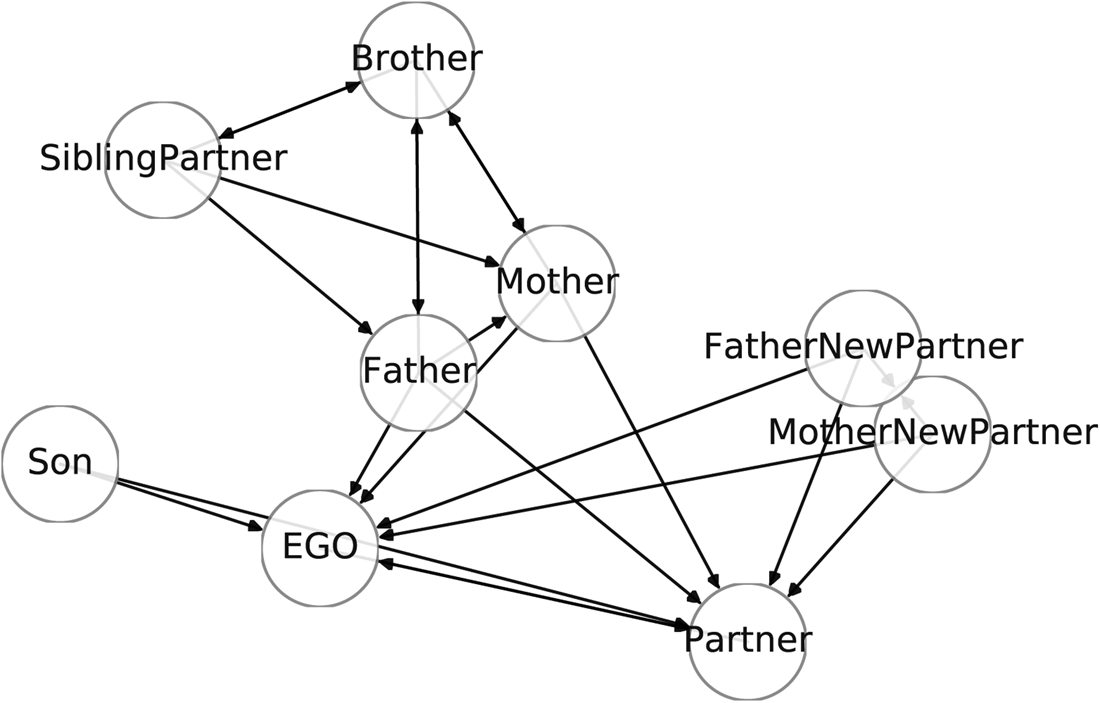
Alternatively, a second case study from the MOSAiCH dataset, presented in Figure 2, features a focal individual who has about as many exchanges with her alters as the focal individual in Figure 1, whereas the exchanges among her alters are less numerous. This makes the focal individual a central node in a family network with some “holes”—that is, areas with disconnections among individuals, conducive of bridging social capital [Burt (Reference Burt, Guillén, Collins, England and Meyer2001)]. In that regard, a critical dimension of personal or family networks is related with their centralization [Wasserman and Faust (Reference Wasserman and Faust1994)]. A network is said to be centralized if the extent to which connections are distributed across the network members is highly unequal; that is, one or two individuals have many more ties, direct or indirect, than others [Freeman (Reference Freeman1978)]. Individuals with more central positions in their networks are more likely to have decisional power and influence and be able to innovate thanks to such resources [Ibarra and Andrews (Reference Ibarra and Andrews1993), Scott (Reference Scott2017)]. Fewer connections between subgroups of a family or personal network create holes in the structure, which provide focal individuals with opportunities to mediate the flow of information between their family members as brokers. In other words, focal individuals can bridge gaps, and hence control the projects that bring them together.
Instrumental exchanges within a family network showing bridging social capital.

In personal networks such as those described in this special issue, respondents are generally more central in their own networks than other members, confirming the bridging potential that individuals develop in their personal networks [Cornwell (Reference Cornwell2011)]. The literature indeed often refers to personal networks as ego-centered or egocentric networks. However, the extent to which focal individuals are central in their own family or personal networks is highly unequal. Some are indeed at the center of a star, while others occupy peripheral positions as their networks feature another person (for instance, their spouse) as the holder of the central position [Widmer (Reference Widmer2016, reedition)].
As we shall see, the importance of focal individuals' centrality proved to be less decisive than density in the papers included in this special issue. This result calls into question the importance of bridging social capital developed in family and personal networks; i.e., the ability of individuals to create and sustain relationships across a variety of social groups and cleavages [Burt (Reference Burt, Guillén, Collins, England and Meyer2001), Widmer (Reference Widmer2006), Cornwell (Reference Cornwell2011)]. However, when one goes beyond the predicaments associated with bridging social capital in the literature, some significant results stand out: the centrality of older adults in help exchanges was positively linked to giving instrumental support to family members in Baeriswill et al.'s paper. In line with the literature, women appear to be more central in terms of degree centrality than men in providing practical support, suggesting that their care role for specific others is indeed in close relationship with their central position in exchange networks. By contrast, women's role as practical support receivers rather than providers was similar to that of men, which can be interpreted in the light of the imbalanced positions of women and men in support exchanges: women are strongly enticed to help by their structural position in family networks, but this same position does not provide them with any particular advantage in terms of practical support received. In Aeby and Gauthier's study on middle adulthood, giving financial support also occurred less frequently in centralized personal networks. Interestingly, there was a negative association between respondents' centrality in emotional support networks and the financial support they provided to network members. In Cisse et al.'s contribution, as in Aeby and Gauthier's research, centrality proved to be negatively correlated with access to prenatal care. All such evidence, stemming from diverse age groups and national contexts, suggests that density and bonding social capital have greater functional importance in personal and family networks than centrality and bridging social capital. However, it is certainly too early to claim that these observations have general validity.
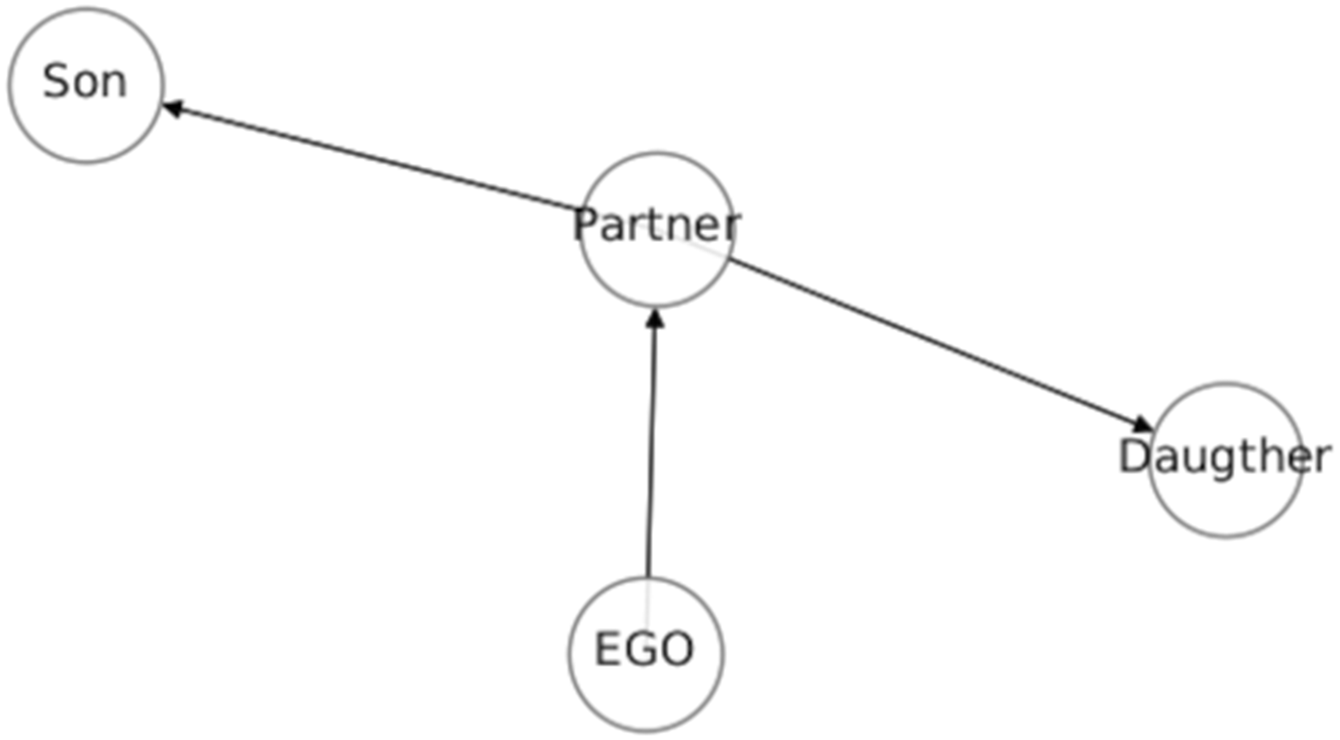
There are also individuals whose networks are neither dense nor centralized around themselves. In other words, such individuals develop neither bridging nor bonding social capital in their family or personal networks, as featured in Figure 3. In that case, the focal individual (ego) only had a few significant family members coming from his nuclear family. Dyadic exchanges were not embedded in a dense set of ties, and the focal individual did not hold a central position in their own network, rather depending on the focal's partner's personal connections. Such situations feature focal individuals who lack interaction not only with others, but also among the few others that they are connected with. In that respect, the amount and diversity of relationships that they can mobilize in times of need are limited, jeopardizing their chances to overcome stressful life course events or transitions by way of activating their personal and family ties [Spini et al. (Reference Spini, Bernardi and Oris2017)]. The studies presented in this special issue reveal that such cases, far from being marginally represented, constitute a very large share of samples, which stresses the limitations that many individuals face in constituting and sustaining their family and personal networks. Indeed, bonding and bridging social capital are not automatically developed in personal and family networks, as they are conditioned by a series of factors associated with the life courses of individuals and the social contexts in which they are embedded [Widmer (Reference Widmer2016, reedition)].
Instrumental exchanges within a family network showing no social capital.

A third critical dimension raised by this special issue relates with the composition of configurations, in other words, whom respondents consider as significant members of their family or personal networks. At the time being, most research still focuses on the composition of households to define significant family groups [Widmer (Reference Widmer2016, reedition)]. This focus on the household has its roots on the assumption that significant family contexts are nuclear by definition—i.e., constituted by coresident parents and their dependent children [Parsons and Bales (Reference Parsons and Bales1955)] and that solidarity ties beyond that unit, whether with relatives or with friends and neighbors, have neither breadth nor consequences. This assumption has been contradicted by a large series of studies which revealed that active family and personal ties exist well beyond households [Bengtson (Reference Bengtson2001), Furstenberg (Reference Furstenberg2020), de Bel and Widmer (Reference de Bel and Widmer2021)]. Therefore, it is important to closely consider the family status, gender, age, occupation, and place of residence of alters mentioned as significant family or personal network members by focal individuals. A family network constituted mostly by siblings, parents, and grandparents has different consequences for a variety of issues than one constituted by friends or in-laws for several reasons. First, the composition of networks proved, as we shall see in the papers of this special issue, to impact outcomes in itself: large family networks with members coming from the partner's side as well as the respondent's side proved to be associated with greater fertility. Based on their study on young adults in Ouagadougou, Bougma et al. stress that:
“the network's economic resources are positively associated with women's demand for children: demand for additional children is higher for women with at least one public employee in their network than for those without, taking into account the types of networks and the characteristics of the woman and her household”.
Similarly, middle-aged individuals in Switzerland with personal networks which include a mixture of relatives and friends were more likely to experience reciprocity of exchanges in dyads than people whose networks focused on the nuclear family (Aeby and Gauthier, this issue). Likewise, individuals whose networks focused on the family of origin performed more poorly in terms of prenatal care in Mali than those with networks constituted by neighbors and friends (Cisse et al., this issue). These results concur that the composition of personal and family networks is in itself an important factor for many life decisions and exchanges, with more diverse and open networks in compositional terms being more favorable to individual outcomes. We therefore find some empirical confirmation of the importance of bridging social capital in family and personal networks—not in terms of relational structures, but in relation with the diversity of alters present. It is also noteworthy that the composition of networks has direct consequences for density and centrality, which in turn impact dyadic exchanges and life decisions. Overall, networks focused on blood relatives have much greater density, whereas heterogeneous networks generate greater centrality for focal individuals.
Overall, the contributions to this special issue produce quite convergent results for key structural dimensions of personal and family networks. The relational structures of networks (such as density and centrality), as well as their compositional features (such as the statuses of network members), seem to matter a great deal for dyadic exchanges and individual decisions. This confirms the potential value of developing additional empirical studies in the configurational perspective. In that regard, the concept of social capital and its bridging and bonding structures might be complemented by other sensitizing concepts in the near future. The reserve perspective on relations [Cullati et al. (Reference Cullati, Kliegel and Widmer2018)] is one interesting candidate for accounting for network effects in a life course perspective. Lately, research has emphasized the importance of resource cumulation for understanding vulnerability and resilience [Spini et al. (Reference Spini, Bernardi and Oris2017)]. Following up, the reserve perspective on resources [Cullati et al. (Reference Cullati, Kliegel and Widmer2018)] focuses on understanding time processes associated with social capital and vulnerability. One first dimension concerns the immediacy or non-immediacy of the use of social interactions. Relational reserves have been defined as resources accumulated for future use in life or for transfers to other generations, as kin availability depends on past decisions and investments regarding nuptiality, fertility, or migration made not only by focal individuals but also by their siblings, partners, parents, grandparents, uncles and aunts, in-laws, children, etc. [De Vos, and Palloni (Reference De Vos and Palloni1989), Widmer (Reference Widmer2016, reedition)]. As such, the cumulation of family reserves takes place over several generations and their use is often postponed, whereas the constitution of social capital is considered more personal and its use is meant to be immediate, like an investment which is expected to provide swift and tangible returns. Accordingly, a second dimension made salient by the reserve perspective on relationships as resources is that they are the consequences of long-term processes of accumulation that deserve researchers' full consideration. A related critical dimension of such accumulation is that reserves can either be actively created by individuals' agentic behaviors or passively received from alternative sources, such as intergenerational inheritance. The reserve perspective on relationships is likely to be better adjusted than the social capital research tradition to situations in which the long-term protective function of social interactions for individuals and groups facing social stress is more important than their short-term contribution to individual growth. The importance of density in the contributions to this special issue decisively points to this protective function of family and personal networks in demanding contexts or life situations.
Acknowledgements
Work on this special issue was supported by a 2019 scholarship by IméRA—Institut d'études avancées, Exploratoire Méditerranéen de l'Interdisciplinarité of Aix-Marseille University (https://imera.univ-amu.fr/en), and by the Swiss National Centre of Competence in Research project LIVES—Overcoming Vulnerability: Life Course Perspectives (https://www.centre-lives.ch/en), which is funded by the Swiss. National Science Foundation (grant number 51NF40-160590).