INTRODUCTION
Gastrointestinal nematode (GIN) infection is a major concern in small ruminant production systems worldwide. The blood-feeding nematode Haemonchus contortus is especially harmful because it causes anaemia and can lead to the death of host animals (Miller et al. Reference Miller, Bahirathan, Lemarie, Hembry, Kearney and Barras1998). Lactating ruminants infected with GIN have reduced milk production (Suarez et al. Reference Suarez, Cristel and Busetti2009). However, the extent of the reduction in milk production due to the GIN burden varies and is dependent on animal breed and the level of resistance that the individual animal has against GIN (Alberti et al. Reference Alberti, Zanzani, Ferrari, Bruni and Manfredi2012, Reference Alberti, Zanzani, Gazzonis, Zanatta, Bruni, Villa, Rizza and Manfredi2014).
Anthelmintic treatment (AT), a common practice for controlling GIN infections in ruminant production systems (Waller Reference Waller2004; Tsiboukis et al. Reference Tsiboukis, Sazakli, Jelastopulu and Leotsinidis2013) helps to sustain milk production (Gross et al. Reference Gross, Ryan and Ploeger1999; Cringoli et al. Reference Cringoli, Veneziano, Jackson, Vercruysse, Greer, Fedele, Mezzino and Rinaldi2008). However, the extent of these beneficial effects differs between breeds and has mostly been studied in dairy sheep (Cringoli et al. Reference Cringoli, Rinaldi, Veneziano, Mezzino, Vercruysse and Jackson2009). For non-dairy sheep, milk is the predominant source of nutrition supporting offspring in the early stages of life (Melaku et al. Reference Melaku, Bogale, Chanie, Fentahun and Berhanu2013; Zanzani et al. Reference Zanzani, Gazzonis, Di Cerbo, Varady and Manfredi2014). Thus, the effect of AT on milk production in non-dairy sheep is important, and has potential impacts on offspring growth.
The Small Tailed Han (STH) is a dual-purpose meat and wool sheep breed well-known for high lamb growth rates in China (Chu et al. Reference Chu, Wang, Wang, Li and Fu2003), and the Ujumqin (UJU) is a sheep breed indigenous to China that produces high quality meat (Ren et al. Reference Ren, Li, Su, Xu, Wei, Zhang, Li, Liu and Du2011). Both breeds are susceptible to GIN infections, as reported previously (Zhong et al. Reference Zhong, Li, Sun and Zhou2014). However, there is limited literature on the effects of GIN infections and AT on milk production in these two non-dairy sheep breeds. In addition, the effect of milk production on lamb growth in these breeds is unknown. Therefore, the objectives of the current study were to investigate the effects of AT administered before lambing on: (1) feed intake, feed digestion and milk production in STH and UJU ewes, and (2) the growth rate of lambs consuming milk from these ewes.
MATERIALS AND METHODS
The use of the animals and the experimental procedure were approved by the Animal Care Committee at the Institute of Geography and Agroecology, the Chinese Academy of Sciences in Jilin, China (Grant No. 20120208).
Experimental design and animal management
The experiment was conducted between December 2013 and March 2014, and comprised three periods: natural GIN infection period, AT period and measurement period.
All experimental ewes were reared under the same conditions at a farm located in Jilin, China (44°33′N, 123°31′E, 145 m a.s.l.). The study used a 2 × 2 factorial design with sheep breed and AT as experimental factors, resulting in a total of four treatment groups. Twenty STH ewes aged 2 ± 0·1 (mean ± s.d.) years (second pregnancy) with an initial body weight (BW) of 58 ± 3·1 kg were stratified by BW and the number of lambs borne, which was determined by pregnancy scan 30 days prior to lambing. The ewes were randomly allocated to one of two groups: one group (n = 10) received AT (AT-STH), whereas the other group did not (n = 10; NonAT-STH). Similarly, 20 UJU ewes aged 2 ± 0·1 years (second pregnancy) with an initial BW of 50 ± 2·8 kg were divided into two groups: one received AT (AT-UJU) and another group did not (NonAT-UJU). All ewes were impregnated using oestrous synchronization and artificial insemination between 1 and 20 October 2013. All ewes were naturally infected with GIN by grazing on pasture from 09.00 to 16.00 h. Ewes selected for inclusion in the current study had similar faecal egg counts (FECs) ranging from 3000 to 4000 eggs/g of faeces. The GIN species that infected the ewes were determined to be 0·75 ± 0·030 Haemonchus contortus, 0·15 ± 0·030 Trichostrongylus colubriformis, 0·07 ± 0·030 Ostertagia circumcincta, and some other species of nematodes detected by light microscopy (Bausch & Lomb, Scientific Optical Products Div., Rochester, NY, USA). Species identification of the worm burden composition was determined from post-slaughtering three sheep per group according to the parasitological method described by Foreyt (Reference Foreyt1997).
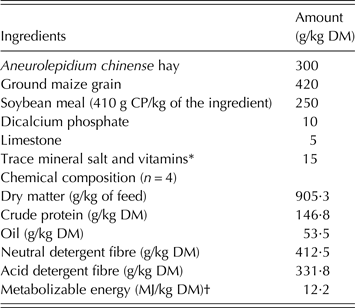
Due to low pasture growth rate during winter in Northern China, all ewes were reared from conception in a semi-grazing system. Forage in the paddock included Chlozis virgata, Aneurolepidium chinense and Suaeda glauca. The ewes were then moved into pens and individually fed a total mixed ration (TMR) ad libitum for the remainder of the day. The TMR (Table 1) was formulated according to NRC (2007) to fulfil the nutrient requirements of pregnant sheep.
Ingredients and chemical composition of experimental Total Mixed Ration (TMR)

* Mineral and vitamin supplements were purchased from Continental Grain Corp. (Beijing, China) and contained (per kg) 24 000 IU vitamin A, 4800 IU vitamin E, 120 mg Fe, 24 mg Cu and 75 g NaCl.
† Metabolizable energy was calculated according to NRC (2007).
To balance the number of lambs in the STH groups, the ewes were ultrasonically scanned 30 days before lambing and randomly allocated into two groups, with seven of the ten STH ewes in each group pregnant with twin lambs. The scan showed that all UJU ewes were carrying a single lamb; thus, the UJU ewes were stratified by BW only and then randomly allocated to two groups.
Both breeds of ewes in the AT groups (n = 10 ewes of each breed) were administered an anthelmintic treatment consisting of moxidectin injected subcutaneously (0·8 mg/kg BW; Anhui Eastmark International Trading Co., Ltd, Anhui, China) and an albendazole tablet (80% pure, 21·6–25·0 mg/kg BW; Inner Mongolia Huatian Pharmaceutical Co. Ltd., Inner Mongolia, China) 30 days before the expected lambing date. Both drugs are licensed for use in sheep and goats in China. All ewes had a history of deworming and the doses were given according to the results of pre-tests on other ewes bearing similar GIN burdens. After the AT, FECs were checked weekly to examine the efficacy of the drugs. Ewes in the NonAT groups were untreated but were subjected to the same handling procedure as those in the AT groups.
The measurement period started on lambing day and continued for 28 days. Lambing occurred between 15 and 22 March 2014. After lambing, each ewe was kept in an individual metabolic cage (120 cm long × 145 cm wide × 140 cm high) with free access to fresh water and fed TMR ad libitum at 06.00, 12.00 and 18.00 h. At each feeding time, 1 kg of TMR was supplied to each ewe and the amount of feed supplied was enough to ensure at least 5% refusals according to feed intake record in the AT period. Feed refusals were removed and recorded daily to calculate dry matter intake (DMI). Except on days 7, 14, 21 and 28 of the measurement period, lambs were put into individual ewes’ cages to suckle at 07.00, 09.00, 11.00, 13.00, 15.00, 17.00, 19.00, 21.00, 24.00 and 05.00 h until they stopped sucking by themselves. A cover prevented the lambs from accessing ewes’ feed.
Sampling and analytical procedures
All ewes and lambs were weighed immediately after lambing and also before the morning feed on days 7, 14, 21 and 28 of the measurement period. The average daily body weight gain (ADG) was calculated by a regression of body weight over a period of 28 days. Faecal samples were collected directly from the rectum of each ewe on days 0, 7, 14, 21 and 28 of the measurement period and processed immediately to determine FECs using the McMaster technique reported by Stafford et al. (Reference Stafford, West and Pomroy1994), with the results expressed as eggs per gram (EPG) of faeces.
Total faeces were collected from each ewe for 5 consecutive days on days 20–24 of the measurement period. Faeces were weighed, acidified with 30 ml of 10% sulphuric acid per kg of faeces, and pooled for an individual ewe. A 100-g subsample of pooled faeces was stored at −20 °C until further analysis.
At the end of the experiment, sub-samples of the diets and faeces were dried at 105 °C for 24 h to determine dry matter (DM) content, and another sub-sample was dried at 65 °C for 48 h, ground through a 1-mm screen (Wiley mill, Arthur H. Thomas Co., Philadelphia, PA, USA) and stored at 4 °C for later chemical analysis. The contents of oil (method no. 920·39; AOAC1995), ash (method no. 942·05 AOAC 1995) and nitrogen (method no. 988·05 AOAC 1995) in the diets and faeces were analysed using a Kjel-Foss Automatic 1030 analyser (Foss, Beijing, China). The crude protein (CP) content was calculated as × 6·25 the N content. The concentrations of neutral detergent fibre (NDF) and acid detergent fibre (ADF) were determined by the method of Van Soest et al. (Reference Van Soest, Robertson and Lewis1991), using heat-stable amylase and sodium sulphite, and expressed exclusive of residual ash.
Before milking ewes, the udder was washed using warm (30–40 °C) water containing a mild disinfectant (50 mg/l chlorine sanitizer) for about 2 min to stimulate milk let-down and then dried using paper towels. Thereafter, fore-stripping was performed to check for mastitis. Each ewe was individually milked by an automatic vacuum pump single bucket milking machine (HL-JN01, Hailian Packaging Equipment Co., Ltd, Beijing, China) twice a day at 06.00 and 18.00 h on days 7, 14, 21 and 28. On the milking days, lambs were not allowed to suckle for the whole day but were fed milk obtained from the measuring buckets after quantifying milk yield.
Statistical analysis
The data regarding the apparent digestibility of feed nutrients and ADG of lambs were analysed using a two-way ANOVA with model terms of treatment, sheep breed and treatment × breed interaction. Milk yield was analysed with a repeated measurements model in which measurements obtained from the same ewe at different sampling times were treated as repeated measures. The model consists of treatment, sheep breed, sampling time and treatment × breed, treatment × time, breed × time and treatment × breed × time interaction as fixed effects, animal as a random effect, and a correlation matrix with heterogeneity variance across time. Differences among predicted means from the above model were determined using multiple comparisons with a P-value adjusted by the ‘Benjamini-Hochberg (BH)’ method (Benjamini & Hochberg Reference Benjamini and Hochberg1995). The FECs from ewes were log-transformed (ln (EPG + 1)) prior to statistical analysis and analysed using a linear mixed model with fixed effects of treatment, sheep breed, sampling time and their interactions, random effect of animal and heterogeneous variance cross the treatment group. On the other hand, a random coefficient regression model was applied to analyse the body weight of the individual lamb change over time by fitting linear models with sampling time as the x-variate and animal as a random effect. The analyses were done by the R packages ‘nlme’, ‘lme4’ and ‘predictmeans’ in R 3·2·2 (R Core Team 2015). Statistical significance was declared when P < 0·05.
RESULTS
Dry matter intake, body weight and digestibility
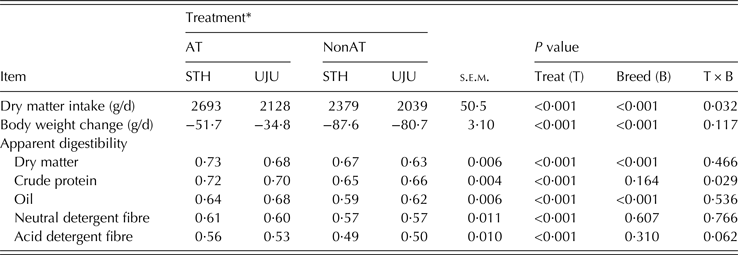
Breed and AT treatment significantly interacted for DMI (P = 0·032) and AT treatment increased DMI to a greater extent in STH ewes than in UJU ewes (Table 2). All ewes lost weight after lambing, but the weight loss in the AT groups was significantly lower than those in the NonAT groups (P < 0·001), and STH ewes lost more weight than UJU ewes (P < 0·001). Breed and AT treatment significantly interacted for the apparent digestibility of CP (P = 0·029) and tended to interact for the apparent digestibility of ADF (P = 0·062). The apparent digestibility of DM, NDF and oil (P < 0·001) in both breeds increased with AT treatment, but STH ewes had higher apparent DM digestibility than UJU ewes (P < 0·001).
Effects of anthelmintic treatment on body weight change, dry matter intake and apparent digestibility in Small Tailed Han and Ujumqin ewes

* Treatments: AT, anthelmintic treatment; NonAT, non-anthelmintic treatment; STH, Small Tailed Han; UJU, Ujumqin.
Milk production and faecal egg counts
Breed and AT had limited interaction with sampling days, despite sampling days having significant effects on milk yield and FECs (Table 3). Anthelmintic treatment in ewes significantly increased milk yield (P < 0·001) but reduced FECs (P < 0·001; Table 3). Breed had significant effects on milk yield and FECs, and STH had higher milk yield and FECs than UJU (P < 0·05).
Effects of anthelmintic treatment on daily milk yield and faecal egg counts in Small Tailed Han and Ujumqin ewes

* Treatments: AT, anthelmintic treatment; NonAT, non-anthelmintic treatment; STH, Small Tailed Han; UJU, Ujumqin.
Lamb growth rate and birthweight
There was a significant effect on lamb ADG across treatments, breeds and weighing dates (P = 0·018; Fig. 1). Overall, the ADG of lambs in the AT groups was higher than that in the NonAT groups and the effect of AT treatment on ADG increased with the age of the lamb. This trend was more pronounced for STH lambs than UJU lambs. In addition, mean birthweight of lambs born from AT ewes was higher than those born from NonAT ewes (4·26, 4·31, 3·41 and 4·03 kg for AT-UJU, AT-STH, NonAT-UJU and NonAT-UJU lambs, respectively; P = 0·023).
The regression effects of anthelmintic treatment in Small Tailed Han (STH) and Ujumqin (UJU) ewes on the growth rates of their lambs from birth (n = 10 UJU lambs and n = 17 STH lambs).

DISCUSSION
Ruminant parasitic nematodes are commonly controlled by AT (Roeber et al. Reference Roeber, Jex and Gasser2013), despite widespread problems of successive anthelmintic resistance in nematode populations having appeared (Kaplan Reference Kaplan2004; Wolstenholme et al. Reference Wolstenholme, Fairweather, Prichard, von Samson-Himmelstjerna and Sangster2004). The strong efficacy of moxidectin and albendazole against GIN in sheep has been well documented (Uriarte et al. Reference Uriarte, Gracia and Almeria1994; Melaku et al. Reference Melaku, Bogale, Chanie, Fentahun and Berhanu2013) and it is one of the primary reasons why sheep producers worldwide use this combination for GIN control. A previous study showed these two drugs were effective to control GIN in dairy sheep (Veneziano et al. Reference Veneziano, Santaniello, Schioppi, Morgoglione, Rufrano and Cringoli2006), while the present results indicated that using the combination of moxidectin and albendazole shortly before lambing was feasible for controlling GIN infections in non-dairy STH and UJU sheep.
Fthenakis et al. (Reference Fthenakis, Papadopoulos and Himonas2005) reported that AT with albendazole and moxidectin during the last month of pregnancy contributes to an increased birthweight in lambs of AT ewes. In addition to the effect on birthweight of lambs, the current study found that the lambs from AT ewes had higher growth rates than lambs from NonAT ewes. Because milk was the only feed source consumed by the lambs, the higher growth rate of lambs from ewes receiving AT might be attributed to these ewes producing more milk for their lambs to consume than NonAT ewes. Therefore, using AT to control GIN infections benefits both the lactation performance of ewes and the growth of their lambs.
Gastrointestinal nematode infections can depress feed intake, digestibility and growth rate by damaging the gastrointestinal tract. It has been well documented that Haemonchus contortus infection in sheep causes anaemia (Pathak et al. Reference Pathak, Dutta, Banerjee, Pattanaik and Sharma2013) and Trichostrongylus infection may also decrease appetite in sheep (Taylor et al. Reference Taylor, Coop and Wall2007). In agreement with those findings, the present results indicated that AT increased DMI and apparent digestibility in STH and UJU ewes. The differences observed in DMI and digestion between the breeds in the present study may result from the fact that STH ewes are multiparous, averaging 1·7 offspring per lambing, whereas UJU ewes generally produce only one offspring per lambing. More lambs suckling triggers their mothers to eat more and digest the feed more efficiently to provide extra nutrients for their lambs (Araujo et al. Reference Araujo, Pires, Susin, Mendes, Rodrigues, Packer and Eastridge2008).
Gastrointestinal nematode infections in dairy sheep and goats can influence milk yield negatively (Hoste & Chartier Reference Hoste and Chartier1998; Faizal et al. Reference Faizal, Rajapaksha and Rajapakse2002; Cruz-Rojo et al. Reference Cruz-Rojo, Martínez-Valladares, Álvarez-Sánchez and Rojo-Vázquez2012; Alberti et al. Reference Alberti, Zanzani, Gazzonis, Zanatta, Bruni, Villa, Rizza and Manfredi2014). The use of AT to increase milk yield has been studied extensively. For example, AT in dairy goats increased milk production by 12% (Rinaldi et al. Reference Rinaldi, Veneziano and Cringoli2007) and albendazole treatment in dairy Lacaune ewes before and after lambing increased milk production by 19% (Fthenakis et al. Reference Fthenakis, Papadopoulos and Himonas2005). In addition, Cringoli et al. (Reference Cringoli, Veneziano, Jackson, Vercruysse, Greer, Fedele, Mezzino and Rinaldi2008) reported that milk production in dairy sheep naturally infected with GIN increased by 44% when GIN were removed using a combination of moxidectin and netobimin during the peri-parturition period and midway through the lactation period. In the current study, milk yield of both these non-dairy ewe breeds increased (34% for STH and 14% for UJU) after pre-lambing AT. The higher milk yield from AT ewes may be a reflection of the higher feed intake compared with NonAT ewes. Moreover, STH ewes produced more milk than UJU ewes regardless of AT. This was probably due to STH ewes having more offspring than UJU ewes. The considerable variation noted in milk yield between the two sheep breeds in the present study is consistent with the results and conclusions from previous studies (Thomas et al. Reference Thomas, Berger and McKusick2001; Allah et al. Reference Allah, Abass and Allam2011; Ayadi et al. Reference Ayadi, Matar, Aljumaah, Alshaikh and Abouheif2014). Thus, the current findings together with previous results indicate that milk yield may vary with different breeds and anthelmintic regimens, but the effects of AT are all consistent and positive.
CONCLUSION
Effective AT in non-dairy ewes before lambing benefited subsequent lactation performance in ewes and growth rate in lambs from this short-duration study (28 days). Anthelmintic-treated ewes had lower FECs, and higher DMI, digestibility and milk production. However, the extent of these positive effects differed in STH and UJU ewes, partly due to the number of offspring that each breed had and also the difference in their feed intake. Future long-term studies are needed to validate the use of AT to improve lactation performance of ewes and growth rate of lambs.
This work was financially supported by the Excellent Young Scientists Foundation of the Northeast Institute of Geography and Agroecology at the Chinese Academy of Sciences in Changchun, China (Grant No. DLSYQ12008), the Science and Technology Development Project of Jilin Province (Grant No. 20140101025JC) and the Youth Innovation Promotion Association of the Chinese Academy of Sciences (2015184). We acknowledge the support of the AGMARDT Postdoctoral Fellowship to author Dr Long Cheng (Lincoln University, New Zealand). We appreciate Dr Andy Greer and Prof Grant Edwards (Lincoln University, New Zealand) for providing valuable comments on the manuscript.