1. Introduction
I have taught blending inheritance to students in courses on genetics and evolution, and they have simulated its consequences—on programmable calculators (from 1976) and computers (since the mid 1980's). With inheritance of acquired characters, (the other major embarrassment of Darwin's theory—Olby 1966, Wallace Reference Wallace1968)Footnote 1 it is swept under the rug in Whiggish presentations of evolutionary genetics. But blending inheritance is a powerful tool for understanding key consequences of Mendelian genetics and guiding new theory construction for evolutionary processes with non-Mendelian inheritance. I focus on the latter here: you can simulate and explore the former with software (Schank and Wimsatt Reference Schank and Wimsatt1993) described in Wimsatt and Schank Reference Wimsatt and Schank1993.
Blending inheritance was commonly accepted by hybridists of the eighteenth and nineteenth centuries. Darwin was no exception. It apparently worked well for most hybrid traits.Footnote 2 Exceptions which retrospectively suggested Mendelian segregation seemed just quirky. So Fleeming Jenkin's crisply engineered critiques of blending in his searching review of the fourth edition of the Origin in 1867 was a bombshell that left lasting impressions. R. A. Fisher began his Reference Fisher1930 classic, The Genetical Theory of Natural Selection, with a discussion derived from Jenkin's analysis. To Fisher, Jenkin's arguments showed that Mendel was needed to make the world safe for Darwinism: blending inheritance (with panmixia) in large populations would halve the variance in each generation. Evolutionary processes feeding on that variance must (by Fisher's own “fundamental theorem of natural selection”) either grind to a halt or produce or conserve variance by other means. Since the equilibrium variance in the population would be only twice that produced per generation, either new variance is produced at a rapid rate or evolution proceeds slowly indeed (Fisher Reference Fisher1930; Wallace Reference Wallace1968; Wimsatt Reference Wimsatt and Nickles1980, Reference Wimsatt1981). This problem is blamed for Darwin's increasing dalliance with the inheritance of acquired characteristics, as a source of new variation. Thankfully, Mendelism appeared to do away with blending inheritance. Or did it?
Reading Fleeming Jenkin for class, I noticed in 1975 that the “migrant pool” assumption that colleague Mike Wade criticized in models of group selection was a kind of blending inheritance at the group level.Footnote 3 All groups as “parents” contributing migrants to a pool from which all “offspring” groups would be drawn led to even faster blending for group inheritance than Fisher showed for bi-parental organisms (Wade Reference Wade1978; Wimsatt Reference Wimsatt and Nickles1980), and made it far too easy to dismiss group selection. It ignored local population structure implied by having populations found new groups near them. In 1981 I generalized this constraint (roughly: do not blend beyond necessity) to identify “segregation analogues” retarding loss of variance at higher levels of population structure. (In an open system with new variance constantly produced and consumed, a lowered rate of loss proportionately increases equilibrium variance. See equations in Wimsatt Reference Wimsatt and Nickles1980, Reference Wimsatt1981 derived by Wade and myself.) These constructions suggested that (and why) current theory still tends to underestimate how important population structure is for evolution.
Informal discussions of cultural inheritance sometimes treat it as “blending.”Footnote 4 It cannot be, at least not commonly: rich complex and diverse cultural variations are transmitted in highly conserved fashion across generations in ways inconsistent with this claim. How? I first illustrate the effects of blending inheritance in an idealized system. This “false” model then allows us to explore the nature of the constraints on uncontrolled mixing for cultural inheritance and evolution.
2. Basic Description of the Model
Imagine a physical analogue for a model population with “blending” inheritance—an indefinitely large population of water-filled beakers. The population has beakers of either clear (W) or red-colored (R) water in relative frequencies p and q (q = 1 − p). Mating involves thorough mixing of water from pairs of beakers chosen at random and redistributed equally between them, producing offspring for the next generation. This continues until all beakers are mated. The population of offspring beakers then becomes the parent population, and the process is repeated. There is no mortality, differential reproduction, or change in population size, hence no selection, so all changes are due just to the modes of inheritance and mating rule. With pairs of beakers, mating is biparental. Since any two beakers can mate, sex doesn't matter, or the two sexes are equally frequent. With random choice of beakers, “panmixia“ is assumed, so there is no assortative mating or population structure. Then the frequency of any type of mating is simply the product of the frequencies of the two types involved.Footnote 5 To mark blending or Mendelian systems below, I will use R and W for blending factors, and A and B for Mendelian ones.
3. A Binomial Distribution Model of Blending Inheritance
Consider the binomial expansion for (p + q)m:

Cancellations in exponents, numerators, and denominators reduce the penultimate term to mp 1q m−1, symmetric with the second term—save for interchanged exponents for p and q. So also for other symmetrically located terms.
This expansion has:
m + 1 terms.
The coefficients of p and q in these terms (“binomial coefficients,” denoted by C(m, 0), C(m, 1), … , C(m, k), … , C(m, m). Assuming m ≥ k, C(m, k) is the number of different collections of k objects one can get from m objects (drawing k at a time with replacement before the next draw).Footnote 6
For modeling blending inheritance, suppose that p + q = 1, so (p + q)m = 1m = 1.
Let p be the proportion of red beakers and q be the proportion of white beakers in the original population. Since any beaker is either red or white—initially—then p + q = 1.
Claim: If we start with pure red and pure white beakers in any proportion, the behavior of this population with blending inheritance is given by the binomial distribution for (p + q) m where m = 2G, where G is the generation number (0 at the start).Footnote 7
The following correspondences then hold between the binomial and the imagined case of blending inheritance:
There are 2G + 1 types in the Gth generation.
The powers of p and q give relative proportions of R and W in the type corresponding to that term. Thus the fourth term in generation 3 contains p 5q 3, corresponding to type R 5W 3.
Evaluation of a term gives the frequency of its type. Thus, for p = q = 0.5, the fourth term in the expansion for G = 3 has the form C(8, 3)p 5q 3, and gives the frequency of type R 5W 3 (proportions .625R and .375W), which is 56[1/28] = 0.2187.
Types in the G-th generation are spaced at intervals of 1/ 2G of the total in composition.
The sum of all proportions of all types for any generation is 1.
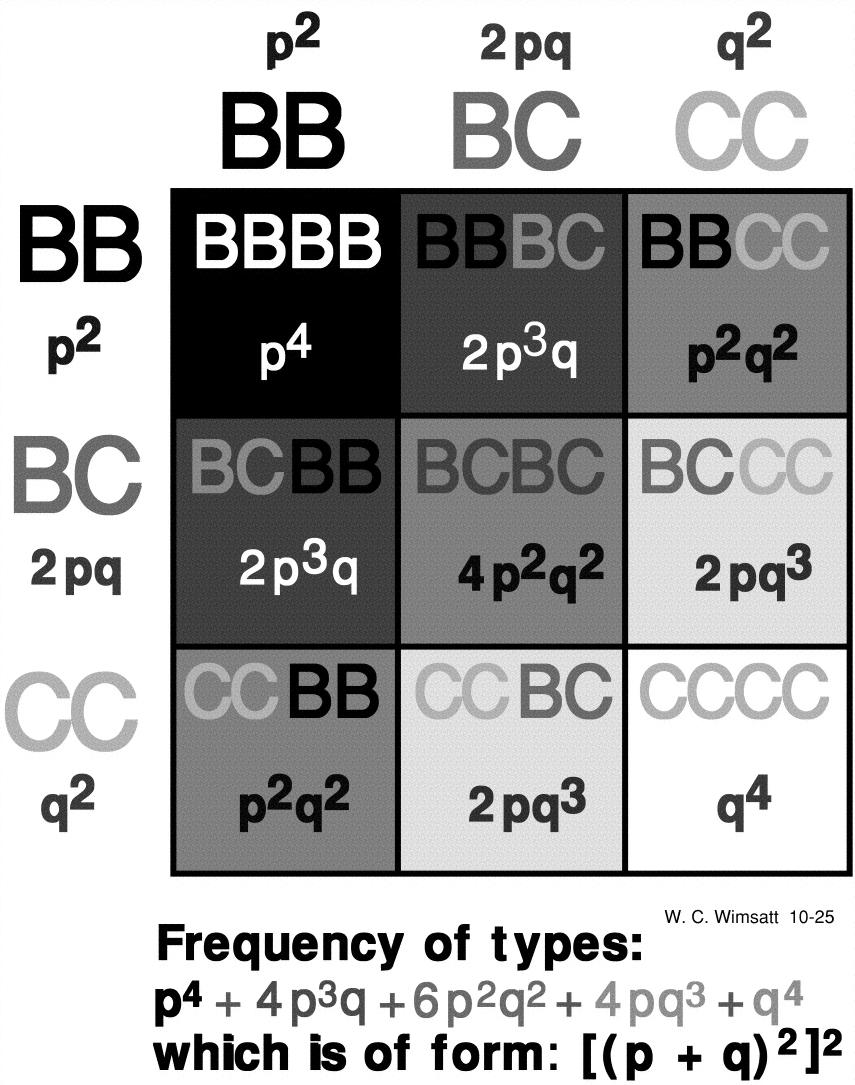
Figure 1 depicts the second generation of a blending inheritance process. (The first generation is just like that for Mendelian inheritance, even producing Hardy-Weinberg proportions of types!) We return to this surprising fact below.
Blending Inheritance in a Panmictic Population: second generation from initial frequencies of p and q of pure types Band Cin starting population. These produce types BB, BC, and CC in the first generation, which do not segregate but breed true, unlike the corresponding Mendelian types.

In successive generations of a blending process, new types appear between neighboring types. The first generation produces 3 types, RR, RW, and WW as input types for matings in the second generation. The 3 × 3 square (a “Punnett square” for blending inheritance) has the 3 possible types for each parent in their respective frequencies of p2, 2pq, and q2, yielding 5 offspring types. (In the Punnett square of offspring, these are the squares in the diagonal rising to the right, and its 4 “parallels,” two on each side and each having its characteristic powers of p and q.) Each identically hued square in a parallel gives one exclusive way in which that proportion of R and W can arise from the types of the preceding generation. These exhaust all possibilities: adding their frequencies gives proportions in the next generation, which breeds to form a 5 × 5 array with 9 diagonals, etc. The Punnett squares define the combinatorial possibility space for genotypes assembled from those input arrays of parental contributions.
The binomial distribution for a generation thus contains all necessary information on the number, composition, and relative frequencies of types produced in that generation from a blending inheritance process with initial proportions p and q of R and W beakers. In successive generations you square the distribution of types produced in the last generation. Starting with a distribution (p + q) of types in the 0th generation, we get (p + q)2types in the 1st generation, ((p + q)2)2 = (p + q)4 types in the 2nd generation, (((p + q)2)2)2 = (p + q)8 types in the 3rd generation, and so on. This is why m in the G-th generation = 2G.
Unlike Mendelian inheritance, blending inheritance is absolutely “true breeding”: like parents produce only like offspring. Mendelian inheritance does this if parents are identical homozygotes, but blending inheritance is broader still: if parents differ, (not covered by Mendelian true-breeding) blending produces a new shade which is the average of parental shades. So the number of types increased as 2G + 1, roughly doubling each generation.
The corresponding Mendelian process with frequencies p and q of genotypes AA and BB mating at random would produce proportions p 2AA + 2pqAB + q 2BB of the 2 original (homozygous) genotypes, and a new heterozygous genotype, AB. Each genotype passes on only one of its two factors, each with equal probability. This produces a 2 × 2 table for the combination of factors—the outcomes of matings between any two genotypes. The array of these tables multiplied by the frequencies of those matings describes the population process.
Mendelian segregation is so named for the fact that breeding two identical (single-factor) heterozygotes, AB × AB, reproduces them (on average) only half of the time, and AA and BB in equal frequency the rest, giving the classic Mendelian ratio of expectations, 1AA:2AB:1BB. This cross increases the number of types represented from 1 to 3—increasing the variance in the population. At equilibrium, these increases are exactly balanced by crosses of AA and BB to produce AB's. So the proportions of homozygotes and heterozygotes are preserved generation after generation, as p 2AA + 2pqAB + q 2BB. Thus, so is the variance—one reason why evolutionists like the Hardy-Weinberg equilibrium principle. Variance conserved is variance usable by selection.
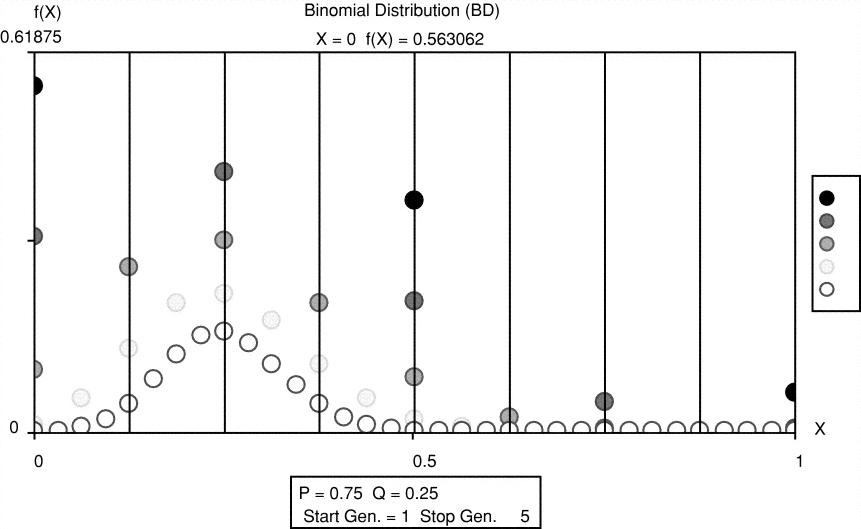
What of the other crosses? AA × AA and BB × BB will obviously produce nothing new on either system. With Mendelian inheritance the 2 × 2 tables for an AA × AB, or AB × BB cross shows no new types or changed proportions either, so they do not disturb the equilibrium. But blending inheritance would produce new types in these last crosses: all offspring of RR × RW are identically R3W1, and offspring of RW × WW are R1W3. There can't be an equilibrium of types because new mixed types with successively finer gradations between them are constantly being created. There is an asymptotic equilibrium in the limit: variance goes to zero as the distribution gets peakier about the mean, but because evolution requires variance for selection to work, this equilibrium would not delight any evolutionist. Figure 2 depicts types and their relative frequencies in a blending process from generations 1–5 with starting frequencies of p = .75, q = .25. We see a doubling of types (3, 5, 9, 17, 33,…), with decreasing frequencies of each (they must sum to 1), and the asymptotic clustering of the distribution closer and closer to the mean.
Frequency of types under blending inheritance in generations 1–5. Generation 1 in black, with each later generation adding intermediate types in lighter shades. Frequencies of each type declines, but summed contribution in intervals about mean (of q = .25) increases monotonically, producing successively “clumpier” distributions with halved variances. Output from program in Schank and Wimsatt 1993.

4. Blending and Population Structure as Exo-genetics.
So Mendelian inheritance conserves variance and blending inheritance dissipates it? Not quite so simple! Both blending and Mendelian inheritance produced the same distribution of types in the first generation, with reduced variance. Why no difference here? In any population with two or moreFootnote 8 different Mendelian homozygotic types, the variance is halved in the first generation as we go to Hardy-Weinberg proportions through the production of heterozygotes. In this maximally mixed state, every genotype occurs with a frequency equal to the product of frequencies of its constituents. It is an equilibrium because it is an entropic maximum (Wimsatt Reference Wimsatt1981). This maximally mixed state is an entropic minimum of variance for the constraints determining the architecture of the genome. This feature of Mendelian blending is also recognized in Wahlund’ s Principle: combining differentiated sub-populations into a single large panmictic population will always result in a loss of variance.
Now things look a little different! Particulate genes prevent the infinite divisibility of qualities suggested by blending inheritance, thus leading to an equilibrium variance greater than zero. This is internal or endo-geneticnon-blending, and all that traditional discussions recognize. But there is also mixing external to the organism: With panmixia, or population-wide random mating, any organism's chance of mating with any other genotype is proportional to its frequency in the population. This is the strongest possible form of blending of population or exo-genetic structure.Footnote 9 A total denial of effects of group structure at any level on probability of mating, it “idealizes” groups out of existence. This is why the “migrant pool assumption” is so detrimental to group selection. Models using it had (surprisingly?) succeeded in showing that under conditions with no groups, group selection is not a significant evolutionary force.
The single-locus case with panmixia yielding H-W equilibrium in one generation is the fastest possible loss of variance through mixing processes. (Most structures yield asymptotic approaches to H-W equilibrium.) It thus can provide a reference standard for all other cases. Any structural factor causing a slower loss of variance is a “segregation analogue” for those effects. In equations for the rate of approach to Hardy-Weinberg equilibrium, one can identify factors retarding the rate below this maximum (Wimsatt Reference Wimsatt1981, p. 163, table 3). Asymptotic approach to multi-locus H-W equilibrium is attributable to other endo-genetic segregation analogues, in particular linkage (commmonly recognized), and (less commonly recognized) diploid gametic organization (Wimsatt Reference Wimsatt1981, Reference Wimsatt2002). Sex-linkage and overlapping generations also slow the approach to H-W equilibrium. That's four factors acting as “segregation analogues” already in classical theory, kinds of structure which slow mixing.
Wade and I derived an equation for rate of loss of variance in group selection that exhibits two further exo-genetic structural parameters (Wimsatt Reference Wimsatt1981). These are the ratio of 1-generation migration distance to species range and to the mean distance between groups. (The first is a “mean-free-path” like parameter of diffusion, and the second is a measure of how many parental groups might be involved in parenting each new group.) Greater values of either yield more extreme exo-genetic blending.
We commonly regard endo-genetic factors as parts of genetic architecture. But exo-genetic factors, commonly lumped under “population structure,” are equally so: they both affect genotype frequencies produced by matings and they are equally efficacious for outcomes in population genetic models. Population structure is not an add-on. Panmixia is not a benign assumption. Assuming it when absent is as serious an error as assuming that endo-genetic structure is blending when it is particulate. And we are constantly reminded how serious that is! (Fisher Reference Fisher1930).
5. Blending and Cultural Inheritance
There are two main ways Darwin could have avoided the consequences of blending inheritance: selection and assortative mating. Jenkin (Reference Jenkin1867) considered both but incorrectly dismissed them as implausible. They can be effective for both biological and cultural evolution. Selection against hybrids keeps distinct lineages pure (or purer if selection is not absolute). It secures genetic isolation of distinct species and can select for behavioral isolation in incipient species. It works also for cultural evolution if those who partially assimilate are discriminated against by parent populations or otherwise disadvantaged. Such selection can be mediated in many ways by diverse cultural mechanisms. It is worth further discussion elsewhere.
I focus here on exploiting parallels with “segregation analogues” to elaborate a cultural exo-genetics. Jenkin noted correctly that strict mating segregation—mating like with like—prevents blending, but thought it improbable or rare—not too observant of his own society!Footnote 10 Above I used the Hardy-Weinberg equation as a reference standard for detecting structure in the hereditary system by looking for factors which retarded the rate of loss of variance below that defined for 1-locus panmixia. Analysis of blending inheritance draws attention to production and dissipation of variance. How do cultures resist blending homogeneity? We can talk of mixing of populations, but blending of traits is more problematic: the absence or problematic character of a genotype-phenotype distinction for culture, and the many “non-quantitative” cultural traits for which we don't know what “blending” means. Still other problems are raised by the fact that cultural heredity is a multi-channel system with complex modes of inter-channel modulation, whereas biological inheritance is treated as a single channel (and Weismannian, permitting no direct modulation other than through selection.)Footnote 11
Cultural inheritance is more plausibly a multi-channel system, with different characteristics for each channel and complex interactions and potential cross-talk between them. How do we handle different languages? Must language, picture, dance, and other lineages of practice for transmission of culture be commensurate, and if so, how? It is not clear how one defines blending or its absence for such a system—or any system without quantitative characters. But we could still recognize loss of variation and use information-theoretic measures for diversity (Shannon and Weaver Reference Shannon and Weaver1949). But before we worry about this, it makes sense to delineate the important structures special to culture which further constrain inheritance patterns, preventing mixing or blending, however defined, and allowing for richer and more multi-dimensional cultural differentiation. Two of the most striking features (Wimsatt Reference Wimsatt1999) of our cultural inheritance systems are:
1. Unlike biological inheritance, our cultural genotype is not acquired in a bolus at the beginning, but over time as we develop, learn, and age. This both makes multiple hereditary channels more likely and significant modulations of our access inevitable, as we age, change capabilities, and roles. Modulations of access provide potential segregation analogues, and multiple hereditary channels can interact epistatically and asymmetrically, producing other interactions which can provide qualitatively new (and non-blending) complexities.
2. Virtually all complex abilities and cultural structures show strong sequential dependencies in their acquisition. You must walk before you can dance because the latter is a modulation of the former, and you must learn arithmetic, algebra, and geometry in order to learn the calculus, because the latter requires skills, procedures, and concepts derived from all of the former. (This rich structure of dependencies is nowhere utilized by “meme” theories, which is one of their gravest shortcomings.)
These dependencies have consequences. Thus, (1) cultural elements acquired earlier may actively bias reception of later ones, providing intra-individual sources of selection. Evolutionists and creationists not only learn and believe different things, but acquire different filters affecting passive and active knowledge acquisition, normative behavior, and methodological criteria for evaluation. (2) For acquisition of complex and sequentially dependent knowledge or skills, adjustments in education, social roles, production, and management responsibilities produce life trajectories with many commonalities across cultures and across roles within cultures. (3) These sequential dependencies significantly affect movement of individuals, knowledge, and skills within the culture, and produce differentiated “micro-cultures” of knowledge and practice which recruit and maintain themselves and interact with other micro-cultures (institutions). (4) These micro-cultures in turn provide important structures facilitating the acqusition of complex sequentially dependent skills. (5) Different selectivities for different aspects of culture, together with our increasing interactions with different reference groups in our different roles (condo meetings, classes, “soccer-parents,” department meetings, computer OS users, professional meetings, interest-group mailing lists, etc.) produces a richly structured overlapping fabric of “weak ties” cross-cutting these institutions, and usable for other purposes. All of these produce structures that can generate or maintain boundaries or channels of communication within culture on a number of size scales.
In the simplest population genetic models, migration into a new population leads naturally to mating. This focuses attention on the consequences of spatial structure on mating processes, but is far too simple. All kinds of other things connected with social standing affect probability of mating for primates and indeed for all sorts of animals. Spatial structuring affects mixing of traits both for culture and for biology, but for culture a host of other culturally structuring properties modulate transmission and exchange of cultural elements. This points to an important difference between biological and cultural inheritance: For biology, if you mate for one property, you mate for them all. An adequate theory of cultural change must deal with the different overlapping connectivities induced by our different connections and our different filters. Cultural promiscuities operate in a much higher-dimensional space. If biological reproduction were like cultural congress, it would be kinky indeed.
6. Conclusion: False Models as Means to Truer Theories
Scientific models are often as useful for the false assumptions they make as for what truths they might embody. One often designs a false model deliberately for use as a template to compare with data when one is interested not in how well it fits the data, but in the form of the residuals—where it does not fit, how and why (Wimsatt Reference Wimsatt, Nitecki and Hoffman1987). This can be a powerful tool in the construction of new theory. Darwin's “blending” model of inheritance is profoundly false, but it illuminates strengths and characteristics of the accepted Mendelian theory, and an insufficient understanding of it has lead to incorrect moves (or “missed warnings”) in newer theoretical developments: the treatment of group selection and population structure. But it may prove even more useful for organizing a theory of cultural evolution (Wimsatt Reference Wimsatt1999, Reference Wimsatt and Oyama2001). There is no internal “memetics” for culture, so questions of endo-genetic blending do not arise for cultural traits, but exo-genetics or population structure, important but underappreciated in the biological case, remain as a critical element for any evolutionary theory. For culture, exo-genetics operates in a space of many more dimensions for rich interaction—dimensions yet to be exploited for theory. Generalization of some of the concerns from Darwin's incorrect theory have provided useful tools and templates to use in starting to think about how culture is generated and structured within the context of an evolutionary theory of cultural change.
I thank Michael Wade and my students in BioSci 147 for 30 years of insights on the consequences of blending inheritance.