Introduction
Cowpea, Vigna unguiculata (L.) Walp. (Fabaceae) cultivated in tropical Africa, constitutes a major source of protein in the human diet (Diouf, Reference Diouf2011). Cowpea is the third most important crop in Botswana after maize, Zea mays L., and grain sorghum, Sorghum bicolor (L.) Moench (both Poaceae). It is eaten in the form of dry seeds, green pods, green seeds and tender green leaves, and also utilized for fodder under a wide range of conditions. Cowpea is capable of fixing atmospheric nitrogen through its association with rhizobium in root nodules (Caswell, Reference Caswell1984), which is sufficient enough to meet the plant's nitrogen requirements (Pule-Meulenberg and Dakora, Reference Pule-Meulenberg and Dakora2009).
Cowpea yields at traditional farming systems are low, ranging from 50 to 350 kg/ha (Jackai and Daoust, Reference Jackai and Daoust1986). It is drought-tolerant and adapts well to the drier regions where other food crops do not perform well (Singh, Reference Singh1987). The major biological constraint to cowpea production is severe infestation and damage by various pests in the field and during storage (Jackai and Daoust, Reference Jackai and Daoust1986). The yield losses due to field pests range from 20 to 100% (Youdeowei, Reference Youdeowei1989; Obopile, Reference Obopile2006). Every part of the cowpea plant has one or another pest that cause substantial damage (Jackai and Daoust, Reference Jackai and Daoust1986), especially to flowers and pods.
The cowpea aphid Aphis craccivora Koch (Hemiptera: Aphididae) is considered as an important field pest of cowpea in Africa, Asia and Latin America (Singh and Jackai, Reference Singh and Jackai1985). Heavy infestation results in stunted plants, abscission of pods and shrivelled seed (Ofuya, Reference Ofuya1997), with a yield loss of up to 50% in Botswana (Obopile, Reference Obopile2006). Effective chemical control measures are seldom used by low-input farmers in the tropics (Hill, Reference Hill1983; Jackai and Daoust, Reference Jackai and Daoust1986), and there is concern over the effect on the environment as well as workers' safety (Ofuya, Reference Ofuya1997).
Concerted efforts are needed to develop effective and environmentally sound measures to reduce yield losses caused by the cowpea aphid. The use of resistant varieties offers an advantage to farmers. In the current study, the demographic parameters of the cowpea aphid reared on Botswana cowpea landraces were assessed using the survival, fecundity, mortality, intrinsic rate of natural increase, pre-reproductive period and relative growth rate of A. craccivora to measure its performances on different landraces. Our prediction was that cowpea landraces resistant to the cowpea aphid would have a significant effect on demographic parameters of the aphid.
Materials and methods
Plants
The cowpea landraces used were B621-B, B383, B013-F and B339 with the susceptible variety Blackeye included as a check. The National Plant Genetic Resource Centre located in the Department of Agricultural Research at Gaborone, Botswana provided the landraces used in this study. Blackeye is a local variety that is widely grown by farmers and was provided by the Botswana Department of Agricultural Research. One plant representing each landrace, including Blackeye, was sown in a polythene plastic pot (9 cm in diameter, 8 cm deep) containing soil composed of four parts of river sand, two top soil layers and one compost based on the volume of the plant pot. Each landrace, including the variety Blackeye, was replicated five times giving five plants per variety and a total of 25 experimental plants. The plants were assessed during the seedling stages. The experiment was laid out in a completely randomized design. No fertilizer was applied to the pots. The experiment was carried out from 18 March 2011 to 5 April 2011, giving a total of 18 days.
Aphid colony
The experiment was conducted in a greenhouse. Plants were artificially infested with A. craccivora at the seedling stage. The aphid colony used for this study was obtained from a greenhouse colony reared from the progeny of a single virginoparous apterous female collected from cowpea plants at the Botswana College of Agriculture gardens in Sebele, Gaborone, Botswana. The aphids were collected from an uncrowded colony to prevent a reduction in fecundity induced by crowding during the nymphal stages (Maelzer, Reference Maelzer1977). The colony was maintained on Blackeye plants in the greenhouse inside insect-proof cages at a temperature of 25 ± 5°C and a photoperiod of about 12 h light-12 h dark. The aphids were continuously transferred to new plants until the commencement of the experiment to avoid overcrowding.
Experimental conditions
At the commencement of the experiment, the aphids were inspected to check for neonates (24-h-old nymphs). After 24 h, more than 25 nymphs were found, enough to infest all the 25 experimental cowpea plants. Using a camel-hair brush, cohorts of 25 first-instar nymphs were individually placed on individual cowpea plants, resulting in five nymphs per landrace/cultivar. Each plant was covered with an insect-proof cage to prevent aphids from escaping or moving from one plant to the other and also to eliminate the insect's natural enemies.
Life table parameters
Aphid survival and reproductive capacity among the landraces/cultivars was compared by calculating the mean age-specific fecundity (m x) and age-specific survival (l x) of A. craccivora. Survival estimates were based on live aphids found during the daily counting of nymphs on each landrace/cultivar. The mean fecundity (M d) (Wyatt and White, Reference Wyatt and White1977) was recorded as the number of offspring that females produce in a period equivalent to the time from birth to the onset of reproduction (pre-reproductive period). The reproductive expectation (Σl xm x) was calculated during a time period equivalent to the pre-reproductive period (Diaz and Fereres, Reference Diaz and Fereres2005). Mortality, expressed as mortality rate (q x), was calculated as:
 $$\begin{eqnarray} q _{ x } = d _{ x }/ n _{ x }, \end{eqnarray}$$
where x is the age interval (days); d x is the number dying during the age interval x to x+1; and n x is the number of survivors at the start of the age interval x (Wyatt and White, Reference Wyatt and White1977). Longevity (number of days from nymph to adult death) was also recorded for all the varieties tested.
The intrinsic rate of natural increase (r m) was calculated as:
 $$\begin{eqnarray} r _{m} = c (log_{e}\, M _{d})/ d , \end{eqnarray}$$
where c is the constant 0.738 for aphids and mites (Wyatt and White, Reference Wyatt and White1977); M d is the number of nymphs produced in a reproductive period; and d is the pre-reproductive period in days (Holopainen and Kainulainen, Reference Holopainen and Kainulainen2004). The mean relative growth rate (MRGR) for aphids was also calculated as (Dixon, Reference Dixon1985):
 $$\begin{eqnarray} MRGR = (0.86\hairsp log_{e}\, M _{d})/ d . \end{eqnarray}$$
Statistical analysis
Analysis of data was performed using PROC MIXED in SAS (SAS Institute, 2003). Landrace/cultivar was considered as fixed and replication assumed to be a random effect. Multiple comparisons were made on least-squares means of the fixed effects using the PDIFF option of the LSMEANS statement (SAS Institute, 2003).
Results
Fecundity and survival rate
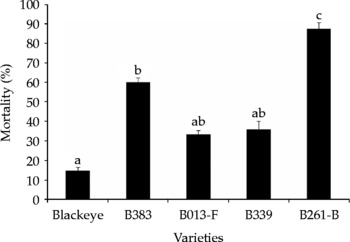
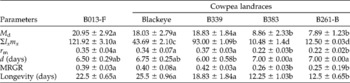
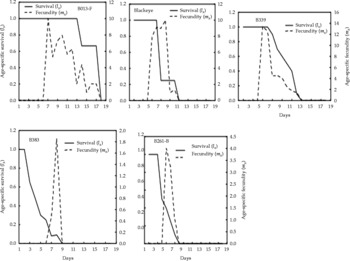
Mortality (q x) varied significantly among the landraces including Blackeye (F (4,15) = 22.26; P < 0.0001). The highest mortality occurred on the landrace B261-B while the lowest was observed on the landrace B013-F followed by B339 at the vegetative stage (Fig. 1). Significant differences were recorded among the four landraces and Blackeye for the survival (F (4,15) = 14.11; P = 0.0012), fecundity (F (4,15) = 18.61; P < 0.0001) and pre-reproductive period (F (4,15) = 13.91; P = 0.0041) of A. craccivora (Table 1). The landrace B013-F showed the highest adult aphid survival rate followed by B339 and Blackeye (Fig. 2). The lowest survival rate was recorded on B261-B and B383. Aphid longevity was significantly reduced on the landraces B261-B and B383 (F (4,15) = 32.28; P < 0.0001) compared with the others (Table 1).
Mortality rate (q x) of the aphids on Blackeye and the four cowpea landraces

Population and life table parameters of apterous adult aphids on the four cowpea landraces and Blackeye

M d, effective fecundity; Σl xm x, sum of the product of age-specific survival (l x) and age-specific fecundity (m x); r m, intrinsic natural rate of increase; d, pre-reproductive period; MRGR, mean relative growth rate.
Means ± SE within rows followed by the same letter do not differ significantly according to Fisher's protected least significant difference (α = 0.05).
Age-specific fecundity (m x) and survival (l x) of Aphis craccivora reared on the five cowpea varieties

Life table parameters
Landrace/cultivar affected population growth parameters of the aphids (Table 1). The reproductive expectation (Σl xm x) of the aphids differed significantly between the landraces/cultivars (F (4,15) = 12.65; P = 0.0043), being significantly higher on B013-F compared with the other landraces. Landraces B383 and B261-B showed the lowest reproduction expectation (Table 1). The intrinsic rate of natural increase (r m) differed significantly between the landraces (F (4,15) = 11.90; P = 0.0001). Significantly higher r m values were observed on Blackeye, B013-F and B339 compared with B261-B and B383 (Table 1).
Landrace/cultivar also had a significant effect on the mean reproductive growth rate (F (4,15) = 14.71; P < 0.0001) of A. craccivora. Landraces B261-B and B383 had significantly lower MRGR values compared with landraces B013-F, B339 and Blackeye, which showed no significant differences between each other (Table 1). Also, there were significant differences in the pre-reproductive period among the landraces/cultivars (F (4,15) = 13.91; P < 0.0001; Table 1). The longest pre-reproductive period was recorded on the landraces B383 and B261-B, followed by Blackeye and B013-F. The lowest pre-reproductive period was recorded on B339.
Discussion
Demographic parameters of A. craccivora were significantly influenced by the landraces/cultivars in our study. Significant reductions were found in fecundity, survival, reproductive expectation, intrinsic rate of natural increase (r m), MRGR and longevity on the landraces B261-B and B383. Conversely, there was a significant increase in the mortality of cowpea aphids on the landraces B261-B and B383 as well in the duration of the pre-reproductive period. The variation in the demographic parameters of cowpea aphid suggests that there may be some naturally occurring resistance in the landraces that negatively affects the reproductive performance of aphids (Jackai et al., Reference Jackai, Goudou, Asiwe and Tayo2001).
A reduction in the fecundity and survival of cowpea aphid on the landraces B261-B and B383 indicates that they have a negative impact on the survival and reproductive capacity of the aphid. r m was significantly reduced on the landraces B261-B and B383, indicating a negative impact on the growth rate of A. craccivora. Life table parameters have been used to measure aphid performance on different host plants (Laamari et al., Reference Laamari, Khelfa and Cœur d'Acier2008; Obopile and Ositile, Reference Obopile and Ositile2010).
The higher r m values on B013-F and B339 indicate that cowpea aphid had a greater potential to reproduce on these than on the other tested landraces. Adult aphids were able to reproduce on all the landraces and the susceptible Blackeye cultivar, yet their reproduction began on different days causing a varied length of the pre-reproductive period among the landraces. Time from birth to first reproduction (d) may be related to the level of plant resistance or susceptibility, because a high level of plant resistance is known to increase d compared with a susceptible variety (Kennedy and Abou-Ghadir, Reference Kennedy and Abou-Ghadir1979).
The MRGR was found to vary with cowpea landraces. It is a good predictor of the reproductive rate of aphids (Holopainen and Kainulainen, Reference Holopainen and Kainulainen2004). A reduction in aphid MRGR on the landraces B383 and B261-B reflected a lower reproductive rate that is associated with low food quality (Holopainen and Kossi, Reference Holopainen and Kossi1998). Aphids probably grew faster on susceptible landraces because of high nutrition compared with B383 and B261-B. Aphids reared on the latter two landraces showed the shortest life spans and high mortality while those on the former two landraces the highest longevity.
In conclusion, our study shows that cowpea landraces B383 and B261-B negatively affect various life table and population parameters of A. craccivora, indicating some inherent level of aphid resistance. This merits to be studied further to determine the morphological and biochemical characteristics that contribute to the observed resistance.