Introduction
Importation of blood to support tsetse feeding in Africa is costly and marred by delays, quarantine restrictions and other logistic problems (IAEA, 2000), necessitating local sourcing of diet for laboratory-reared tsetse colonies on the continent. However, the livestock industry in Africa is challenged by tropical diseases that are absent in the West from where the laboratory rearing of tsetse was developed. Homidium bromide, a trypanocide used for treatment of bovine trypanosomiasis (Dolan et al., Reference Dolan, Okech, Alushula, Mutugi, Stevenson, Sayer and Njogu1990), is a violative drug residue in animal tissues resulting from disease control (Mdachi and Murilla, Reference Mdachi and Murilla1993) likely to be encountered in tsetse diet. Homidium bromide has broad-spectrum anti-microbial activity (R. E. Mdachi, unpublished data; http://www.laprovet.fr.trypanosomes.html). In tsetse, this trypanocide could exert beneficial effects by eliminating entomopathogenic microbes (Kaaya and Okech, Reference Kaaya and Okech1990) or adverse influence by suppressing beneficial endosymbionts (Kaaya et al., Reference Kaaya, Darji and Otieno1987; Aksoy et al., Reference Aksoy, Maudlin, Dale, Robinson and O'Neill2001). To institute proper blood diet collection protocols in disease-plagued areas, it is necessary to evaluate its effect on laboratory tsetse flies. We investigated the effect of homidium bromide on survival of colonized Glossina morsitans morsitans Westwood (Diptera: Glossinidae).
Materials and methods
Donor animals
Animal handling protocols were approved by the Institutional Animal Care and Use Committee of the Kenya Trypanosomiasis Research Centre of the Kenya Agricultural Research Institute (KARI-TRC). Six boran steers were acquired from a KARI-TRC herd. They were acclimatized for a week and maintained on a ration of quality hay supplemented with proteins and mineral salts and water provided ad libitum. Four steers received homidium bromide (Ethidium®, Laprovet, Tours Cedex, France) (2.5 % w/v) solution by intramuscular injection on the hind leg at the recommended dose of 1.0 mg/kg body weight. Two steers received an equivalent volume of 0.9% physiological saline and served as the control animals. Physiological saline has the same salinity as circulation blood and is recommended as a post-bleeding treatment against animal exsanguination. In this study, it was meant to eliminate possible effect of animal response to intramuscular injection during homidium bromide administration.
Blood was aseptically collected by jugular venipuncture according to the method described by Feldmann (Reference Feldmann and Ochieng’-Odero1994b) at 15–30 min post-homidium administration, defibrinated, dispensed into 30 ml aliquots, screened for bacterial contamination and stored at − 20°C until required. Each batch of defibrinated blood from individual steers was first measured individually and then pooled together according to their respective groups (i.e. homidium- or saline-administered) before aliquoting. Blood from homidium- and saline-administered steers was referred to as treated and control diets, respectively. Two 10 ml blood samples were collected by jugular venipuncture from individual steers prior to commencement of diet collection at 15 min post-homidium administration and immediately after the diet collection. Serum was prepared and stored as described by Murilla et al. (Reference Murilla, Eisler, Peregrine, Ndung'u and Holmes1999).
Experimental design
Four hundred female and 200 male teneral G. m. morsitans flies from the International Livestock Research Institute were maintained as described by Kaaya et al. (Reference Kaaya, Darji and Otieno1987), divided into four groups and allowed to feed for 10 min daily for 5 days a week through a silicone membrane (Reference Feldmann and Ochieng’-OderoFeldmann, 1994b). The four groups were:
Group I: 220 females fed on treated diet for 10 weeks and thereafter on control diet.
Group II: 187 females maintained as in Group I but fed exclusively on control diet and served as controls for Group I flies.
Group III: 100 males maintained as in Group I.
Group IV: 99 males maintained as in Group II and served as controls for Group III flies.
Mortality rates of the flies were monitored as described by Feldmann (Reference Feldmann and Ochieng’-Odero1994a) and their survival recorded for 163 days. The performance of flies fed on control and treated diets was compared. It was not necessary to replicate this experiment since the sample size used was adequate for statistical power and the data were collected under controlled laboratory conditions.
Homidium-enzyme-linked immunosorbent assay
Serum samples from 15–30 min post-administration blood were diluted 300-fold and analysed using competitive homidium-enzyme-linked immunosorbent assay (Murilla et al., Reference Murilla, Eisler, Peregrine, Ndung'u and Holmes1999). Average drug concentrations of the two analytical samples of each animal were calculated and each was used to determine the homidium levels of blood diet from each animal. Total homidium in the pooled blood diet was divided by the total volume of pooled blood diet to calculate the homidium level.
Data analysis
The Kaplan–Meier method was used for determination of survival distribution functions of the fly groups. Rank statistics for testing homogeneity of survival curves were used to determine the effect of treatment on early (during early phase of colony life) and larger (during late phase of colony life) survival times.
Results
Homidium levels in tsetse blood diet
The serum homidium levels attained in the homidium-administered steers at 15–30 min post-homidium administration ranged between 173.51 and 342.62 ng/ml with a mean of 262.85 ng/ml (SE ± 37.25). The pooled treated diet had a final concentration of 266.15 ng homidium/ml blood.
Survival of female flies
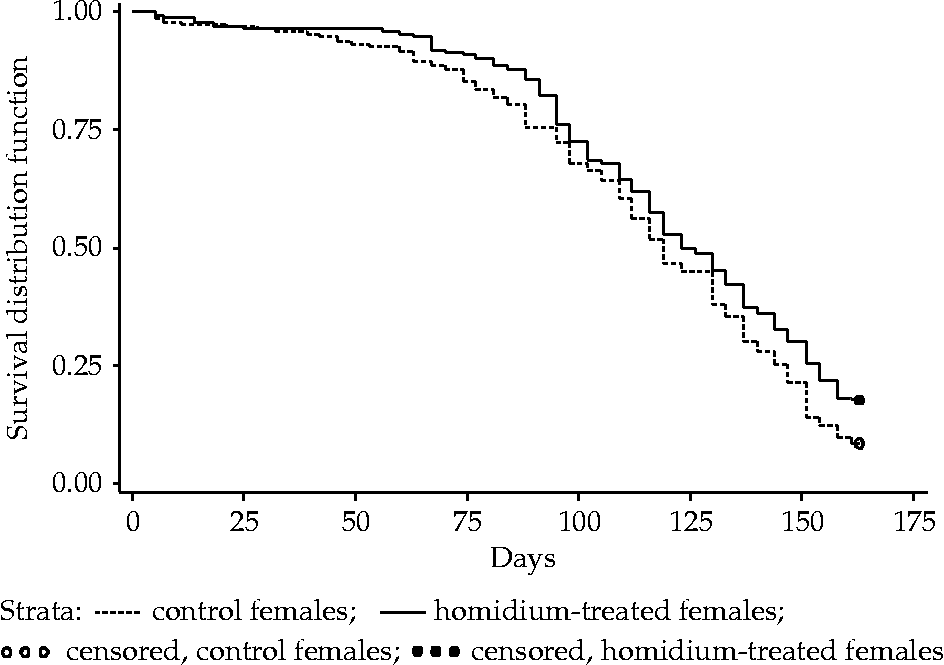
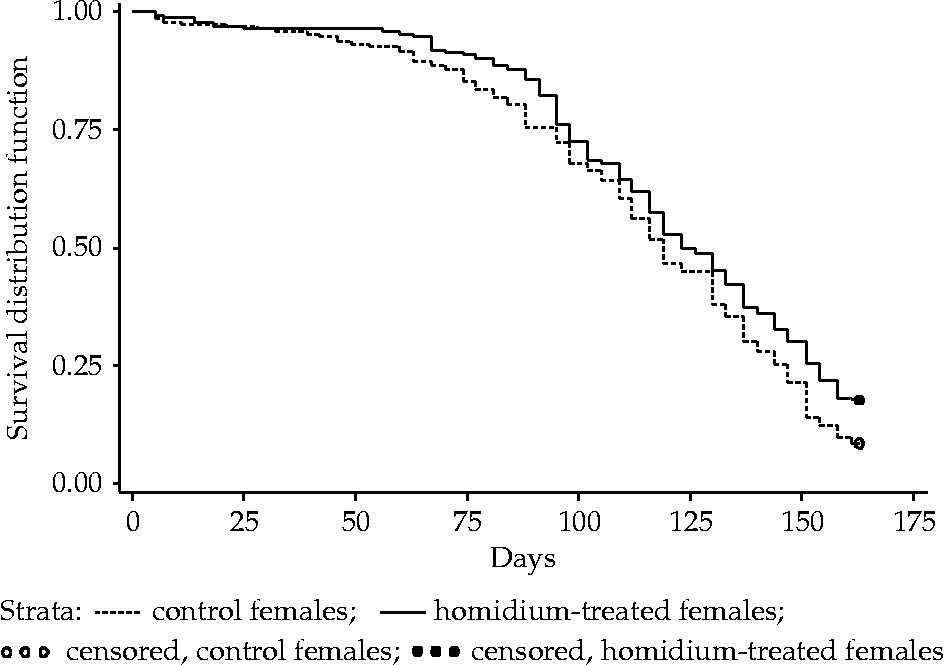
Figure 1 shows the survival distribution functions for the homidium-treated (Group I) and control (Group II) female flies. From about day 37, the controls experienced more deaths compared with the treated females. The P-values associated with tests of homogeneity were 0.01 (Log-Rank), 0.04 (Wilcoxon) and 0.12 Likelihood ratio (LR). Since the P-value of the Log-Rank test was significant (P < 0.05) and less than that of the Wilcoxon test, the two groups differed primarily at larger survival times with significantly (P < 0.05) longer survival times in the treated colony compared with the controls.
Survival distribution functions of female flies
Survival of male flies
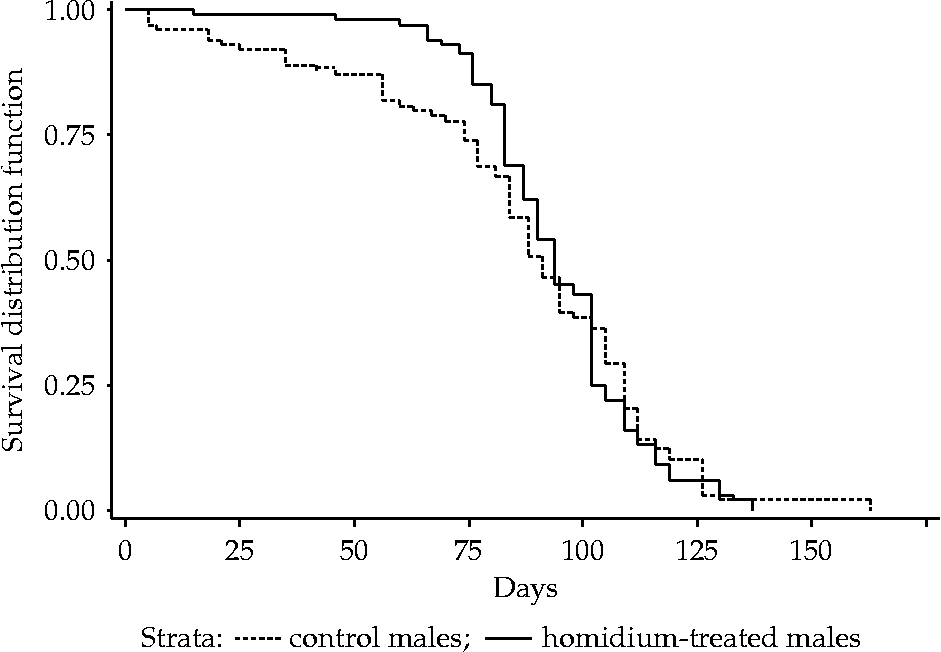
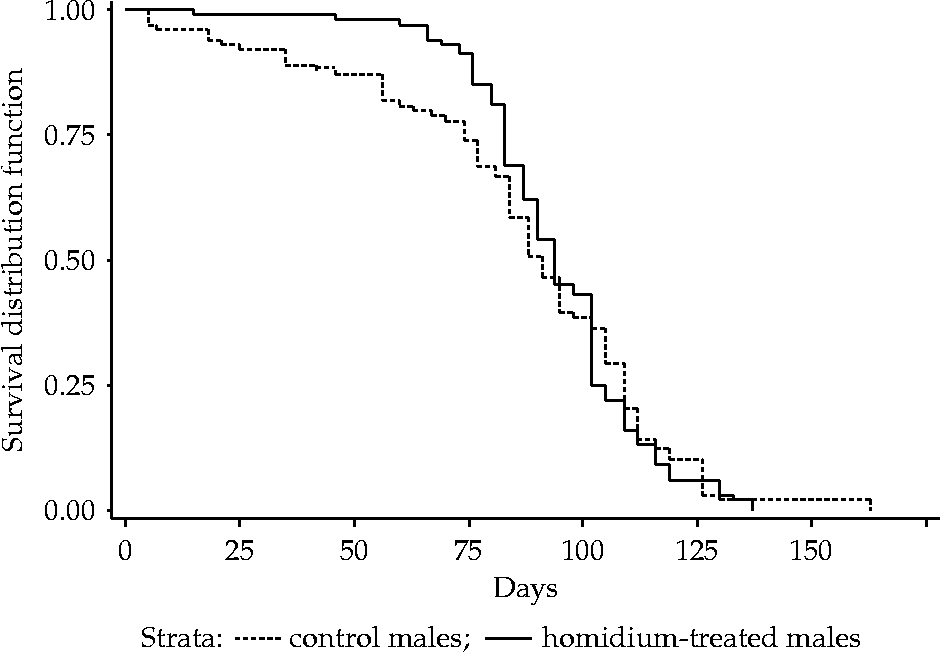
The survival distribution functions for the homidium-treated (Group III) and control (Group IV) male flies are shown in Fig. 2. From day 8 to day 100, the controls experienced more deaths than the treated males, while from day 100 onwards, the reverse was observed. The P-values associated with tests of homogeneity were 0.99 (Log-Rank), 0.37 (Wilcoxon) and 0.55 (LR). Since the P-value of the Wilcoxon test was less than that of the Log-Rank test, the two groups differed primarily at early survival times with longer early survival times in the treated colony compared with the controls.
Survival distribution functions of male flies
Discussion
There has been a search for a decontaminant that can clear bacteria from diet used for laboratory rearing of tsetse yet with no effect on female fertility (IAEA, 2000). This study shows that oral administration of homidium improved survival of tsetse flies. This finding is similar to that reported by Okoth et al. (Reference Okoth, Tinega, Mukiria and Murilla2005) in Glossina pallidipes Austen treated with Samorin®, a trypanocidal drug with a close chemical structure to that of homidium bromide. Homidium has anti-microbial activity (Gutteridge and Coombs, Reference Gutteridge and Coombs1977) and could eliminate tsetse pathogenic bacteria (Kaaya and Okech, Reference Kaaya and Okech1990) or microbes that compete with their hosts for proline for energy production (Maudlin, Reference Maudlin1991). Indeed, infections, especially those caused by entomopathogenic bacteria (Kaaya and Darji, Reference Kaaya and Darji1989) are known to significantly reduce the survival of tsetse flies (Maudlin et al., Reference Maudlin, Welburn and Milligan1998). Some Wolbachia infections are known to induce life-shortening effects on their arthropod hosts, an effect that can be reversed if treated with antibiotics (Aksoy et al., Reference Aksoy, Maudlin, Dale, Robinson and O'Neill2001). In this study, homidium bromide is likely to have protected the flies from harmful entomophagous microbes. Although it is not clear why homidium improved survival much later in life of females compared with males, this effect is important and beneficial in tsetse rearing since maximal pupal production and progressive growth of a tsetse colony depends on overall female survival (Wetzel and Luger, Reference Wetzel and Luger1978). Results of this study indicate that homidium bromide is a promising and affordable candidate for blood decontamination, especially for tsetse rearing laboratories with no ready access to irradiation facilities.
Further, isometamidium treatment regime, which does not totally prevent sterile release male tsetse from transmitting trypanosomes during sterile insect technique campaigns (Bouyer, Reference Bouyer2008), could be complemented with homidium for effective chemoprophylaxis. Though homidium bromide is a suspected mutagen, it is still used extensively as a trypanocide in Africa (Dolan et al., Reference Dolan, Okech, Alushula, Mutugi, Stevenson, Sayer and Njogu1990). It could be used with appropriate precautionary measures for routine tsetse rearing operations as a diet additive for feeding laboratory tsetse colonies. However, further studies need to be conducted to determine the mechanism by which homidium bromide improves survival in G. m. morsitans, and whether spiking of the blood diet with the drug will have the same effect on G. m. morsitans and the other tsetse species.