





Introduction
The Fontan procedure, which bypasses the heart by redirecting systemic venous blood flow directly to the pulmonary arteries, has markedly improved the survival of patients with single ventricle physiology. Nevertheless, long-term morbidities—including heart failure, dysrhythmia, pacemaker dependency, thromboembolic events, and the need for surgical reinterventions—remain common. Reference Dennis, Zannino and du Plessis1
The bifurcated Y-graft Fontan modification was described in 2002 to mitigate complications associated with Fontan physiology created with traditional extracardiac and lateral tunnel techniques. Reference Trusty, Restrepo, Kanter, Yoganathan, Fogel and Slesnick2,Reference Marsden, Bernstein and Reddy3 Computational fluid dynamics modelling estimated that the Y-graft reduced inferior and superior vena cava pressures, provided more balanced hepatic flow distribution, and reduced inefficient blood flow collision as patients aged. Reference Marsden, Bernstein and Reddy3,Reference Haggerty, Kanter and Restrepo4 Since higher vena cava pressures are associated with worse long-term Fontan outcomes, these lower pressures were considered potentially beneficial. Balanced hepatic flow was hypothesised to evenly distribute a lung-protective hepatic factor to the pulmonary vasculature. Reference Marsden, Bernstein and Reddy3 Based on these theoretical benefits, the Y-graft Fontan modification was adopted clinically in selected patients beginning in 2010. Reference Slesnick, Parks and Sallee5
Previous literature evaluating the Y-graft primarily relies on computational fluid dynamics models, with a relative paucity of clinical outcome data and no direct comparison of outcomes between the Y-graft and traditional extracardiac or lateral tunnel Fontan techniques. This paper aims to compare the mid-term outcomes between patients who underwent a Y-graft versus an extracardiac or lateral tunnel Fontan.
Materials and methods
This retrospective cohort study evaluated patients aged 0–18 years who underwent Fontan operations (extracardiac, lateral tunnel, or Y-graft) at a single institution from 2010 to 2023. Fenestration and type of Fontan were performed based on surgical and care team discretion, and subsequent fenestration closure was performed as indicated based on cardiologists’ discretion. Outcomes were assessed from the index encounter (the first outpatient cardiology visit occurring at least one year after Fontan completion) through the final encounter (the last outpatient cardiology visit in 2023). Y-graft patients were age-matched 1:2 to extracardiac and lateral tunnel cohorts.
The primary outcome was a composite of death, stroke, advanced heart failure referral, or cardiac intervention (including balloon valvuloplasty, stenting, coiling, or fenestration closure). Secondary outcomes assessed cardiac interventions alone and surgical revision alone. Additional baseline characteristics collected included age at index encounter, estimated age at Fontan, time from index to last encounter, time from Fontan to index encounter, sex (male, female), race (non-Hispanic White, non-Hispanic Black, Hispanic, and other), ventricular morphology (left, right, ambiguous), heterotaxy, a combination of protein-losing enteropathy and plastic bronchitis, cyanosis (defined as <93% SpO2) at index encounter, and arrhythmias at index and last encounters. The age at Fontan and time from Fontan to index encounter for all groups were based on the year of the Fontan. Statistical analyses were conducted using R version 4.3.1. Descriptive analyses included frequencies of patient characteristics and outcomes stratified by Fontan type (extracardiac, lateral tunnel, Y-graft). Bivariate associations between Fontan type and patient characteristics and outcomes were assessed using two-sided chi-square tests (χ²) for categorical variables and one-way analysis of variance (ANOVA) for continuous variables.
Results
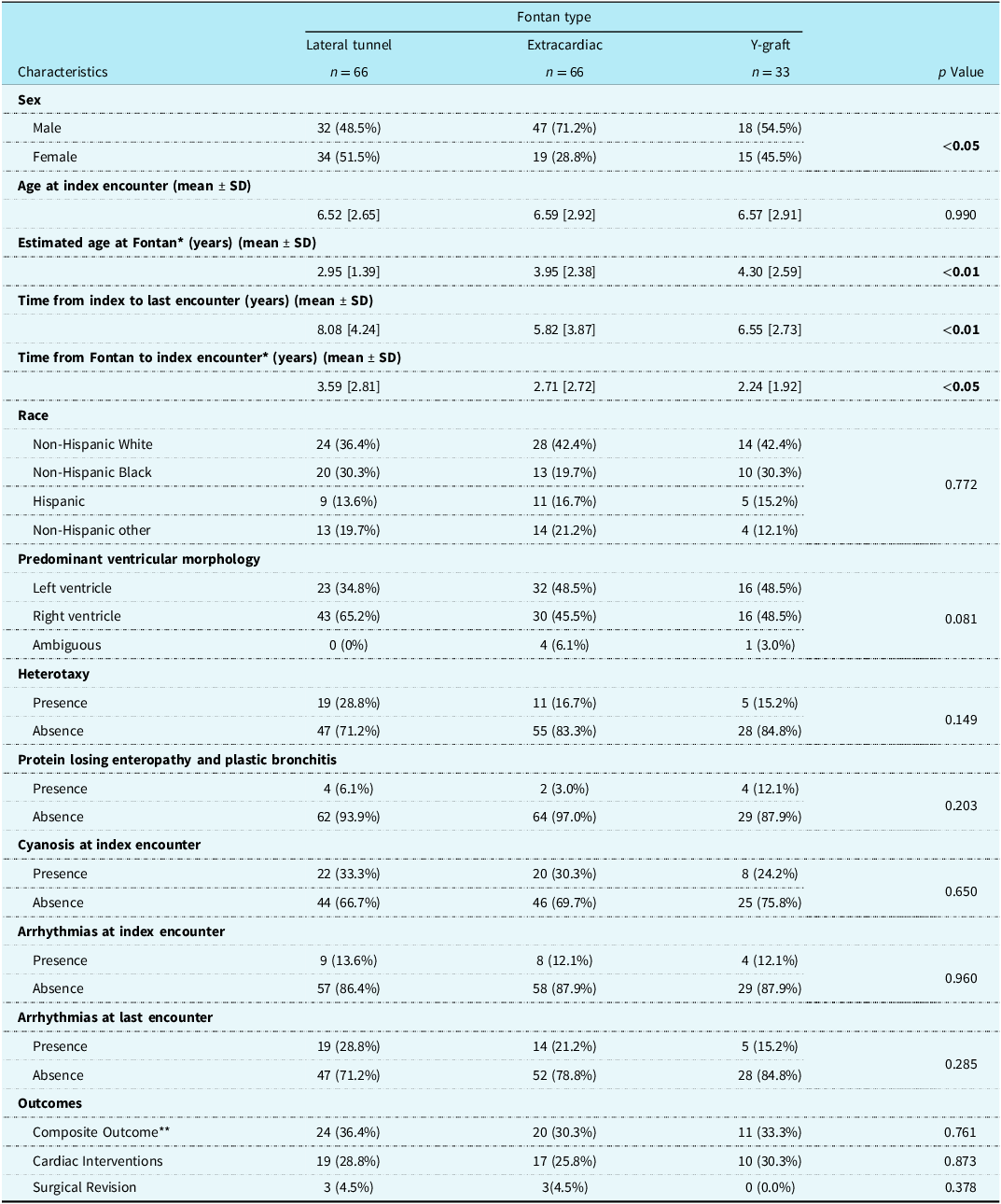
A total of 165 patients with Fontan physiology [lateral tunnel (n = 66), extracardiac (n = 66), and Y-graft (n = 33)] were analysed, with outcomes in Table 1. The mean age was similar among groups at the time of index encounter (lateral tunnel: 6.52 ± 2.65 years; extracardiac: 6.59 ± 2.92 years; Y-graft: 6.57 ± 2.91 years; p = 0.990). The extracardiac group had a higher proportion of males (71.2%) compared to the lateral tunnel (48.5%) and Y-graft (54.5%), p < 0.05. No significant differences were observed for race, dominant ventricle, or presence of heterotaxy. There were no significant differences in development of protein-losing enteropathy and plastic bronchitis (combined), cyanosis, or arrhythmias. The estimated age at the time of Fontan was different among the groups (lateral tunnel: 2.95 ± 1.39, extracardiac: 3.95 ± 2.38, Y-graft: 4.30 ± 2.59; p < 0.01). Follow-up time was significantly longer for lateral tunnel patients (8.08 ± 4.24 years) compared to those with extracardiac (5.82 ± 3.87 years) or Y-graft (6.55 ± 2.73 years; p < 0.01). The time from Fontan operation to index encounter also significantly differed between groups (lateral tunnel: 3.59 ± 2.81, extracardiac: 2.71 ± 2.72, Y-graft: 2.24 ± 1.92; p < 0.05). Composite outcome rates did not differ significantly between the lateral tunnel (36.4%), extracardiac (30.3%), and Y-graft (33.3%) cohorts (p = 0.761). Similarly, rates of cardiac intervention alone (lateral tunnel: 28.8%, extracardiac: 25.8%, Y-graft: 30.3%; p = 0.873) and surgical revision alone (lateral tunnel: 4.5%, extracardiac: 4.5%, Y-graft: 0%; p = 0.378) did not differ significantly among the cohorts.
Patient characteristics of Y-graft and age-matched extracardiac and lateral tunnel Fontan patients aged 0–18 years

Table 1. Long description
A table comparing characteristics of patients with different types of Fontan surgery. The table has 16 rows and 6 columns. The columns are labeled Fontan type, Lateral tunnel, Extracardiac, Y-graft, and p-Value. The rows are labeled with various characteristics such as sex, age at index encounter, estimated age at Fontan, time from index to last encounter, time from Fontan to index encounter, race, predominant ventricular morphology, heterotaxy, protein losing enteropathy and plastic bronchitis, cyanosis at index encounter, arrhythmias at index encounter, arrhythmias at last encounter, and outcomes. Each row provides data for the three Fontan types and a p-value indicating the significance of the differences. For example, the sex row shows the number and percentage of males and females in each Fontan type group. The age at index encounter row shows the mean age and standard deviation for each group. The estimated age at Fontan row shows the mean age and standard deviation at the time of Fontan surgery for each group. The table also includes p-values to indicate the statistical significance of the differences between the groups for each characteristic.
* Age at Fontan and time from Fontan to index encounter are estimates because only the year of Fontan surgery was available.
** Composite outcome includes cardiac interventions (balloon angioplasty, stenting, coiling, or fenestration), advanced heart failure referral, stroke, and death.
Categorical variables were analysed using the chi-square test of independence, and continuous variables were analysed using one-way ANOVA.
Bold font style represents statistically significant differences.
Discussion
This study aimed to provide a comparative analysis of mid-term outcomes between the Y-graft Fontan and the traditional extracardiac and lateral tunnel techniques. Patient demographics between the Y-graft, extracardiac, and lateral tunnel cohorts were similar at the time of index encounter. There were no significant differences observed in mean age, race, dominant ventricle, or presence of heterotaxy. The larger proportion of males in the extracardiac cohort may be due to hypoplastic left heart syndrome being more common in males and the extracardiac technique being more commonly implemented in hypoplastic left heart syndrome. Reference McBride, Marengo, Canfield, Langlois, Fixler and Belmont6,Reference Azakie, McCrindle and Van Arsdell7 Notably, the development of protein-losing enteropathy and plastic bronchitis, both signs of Fontan failure, did not differ by Fontan type. Reference Mackie, Veldtman, Thorup, Hjortdal and Dori8 Similarly, there was no significant difference in the rate of development of arrhythmias, a common complication of Fontan operations. Cyanosis at index encounter was used as a surrogate for either surgical or physiologic (e.g., veno-venous collaterals) fenestration, and no significant difference in cyanosis was found across the three different Fontan types. The availability of longer follow-up for the lateral tunnel cohort is consistent with the predominance of the lateral tunnel procedure prior to the extracardiac one. The difference in time from Fontan operation to first follow-up visit and estimated age at Fontan likely also reflects surgical-era bias. Reference Backer, Deal, Kaushal, Russell, Tsao and Mavroudis9
Over 25% of Fontan patients experienced adverse outcomes at midterm follow-up. Given the young age of the study population, this is a remarkably high rate of reintervention. The lack of a significant difference in the rate of development of the composite outcome between the Y-graft, extracardiac, and lateral tunnel cohorts suggests that, in the midterm, there is no significant advantage provided by the Y-graft Fontan in reducing adverse clinical outcomes.
Despite theoretical haemodynamic benefits, Y-graft patients experienced rates of cardiac intervention, advanced heart failure referral, stroke, and death that were similar to those in the lateral tunnel and extracardiac cohorts. This lack of observed clinical benefit may reflect inherent limitations of computational fluid dynamics modelling. Specifically, computational fluid dynamics modelling relies on assumptions such as rigid vascular walls and static pulmonary flow with changes in cardiac output. Reference Haggerty, Kanter and Restrepo4 Additionally, computational fluid dynamics modelling does not account for the growth of the patient over time. These simplifications do not accurately replicate the complexity or compliance of Fontan circulation or, thus, the differential loading conditions of Fontan circulation, which has known implications in the failure of the Fontan. Reference Egbe, Connolly and Miranda10
Prior clinical reports on the Y-graft modification demonstrate severe potential complications of the Y-graft Fontan physiology. In a cohort of 45 Y-graft patients, 40 developed stenosis in the baffle or branch pulmonary artery. Reference Slesnick, Parks and Sallee5 Figure 1 demonstrates 2 representative cases of Y-graft Fontan stenosis. Reference Trusty, Restrepo, Kanter, Yoganathan, Fogel and Slesnick2
2 representative cases of y-graft stenosis are shown here. Y5 shows unbalanced pulmonary flow with pulmonary artery stenosis on the high-flow side, and Y6 shows balanced pulmonary flow with Y-graft stenosis. Percent of hepatic flow to the left pulmonary artery is 81% and 1%, respectively.

As existing clinical literature on the Y-graft Fontan is limited, with prior work primarily relying on computational fluid dynamics modelling, our study is an important contribution to the literature on the performance of the Y-graft procedure in a paediatric population at least one year from their Fontan operation.
Limitations of the study include the small patient population and differential follow-up with possible availability of longer follow-up in the lateral tunnel population. Although the cohorts were age-matched at the time of the index encounter, the Fontan types were introduced in different surgical eras, which would theoretically favour the more recent Y-graft. Only the year of the Fontan operation was available in the dataset, so age at Fontan was estimated based on the date of birth and year of the Fontan. Pre-Fontan haemodynamic data were not available to be matched or statistically controlled in the analysis. Inconsistencies in chart abstraction were minimised with intra-rater reliability methods.
Conclusion
While the Y-graft Fontan demonstrates promising flow characteristics in computational fluid dynamics models, clinical data do not show a mid-term outcome advantage over traditional extracardiac or lateral tunnel techniques. Similar adverse event rates among these cohorts suggest that mathematical modelling cannot account for the full spectrum of physiologic abnormalities present in Fontan circulation. These findings warrant consideration of the feasibility of continuing the Y-graft Fontan, though long-term outcome analyses are needed to fully characterise the physiologic consequences of the Y-graft Fontan.
Acknowledgements
We thank Dr Tim Slesnick for providing the images used in this report.
Financial support
This research received no specific financial support from any funding agency, commercial, or not-for-profit sectors.
Competing interests
None.


 Open access

