INTRODUCTION
The Mediterranean Amphipoda fauna has a high richness, with more than 452 recorded species (Bellan-Santini et al., Reference Bellan-Santini, Karaman, Ledoyer, Myers, Ruffo and Vader1998), and has been widely studied; however, the knowledge of this order is not uniform throughout the entire Mediterranean. In this way, knowledge of the ecology and taxonomy of amphipod species on the Mediterranean coast of the Iberian Peninsula is still fragmentary (Jimeno & Turón, Reference Jimeno and Turón1995; Bellan-Santini et al., Reference Bellan-Santini, Karaman, Ledoyer, Myers, Ruffo and Vader1998) and the central east coast has been studied relatively infrequently (Marti, Reference Marti1989).
According to Jimeno (Reference Jimeno1993), there are 368 known species along the coast of the Iberian Peninsula, of which only 146 are reported from the Mediterranean side. Works on amphipods from this area have been mainly carried out on the Catalan coast (Castany et al., Reference Castany, Gallifa and Perez1982; Bibiloni, Reference Bibiloni1983; Carbonell, Reference Carbonell1984; Jimeno, Reference Jimeno1993; San Vicente & Sorbe, Reference San Vicente and Sorbe1999; Munilla & San Vicente, Reference Munilla and San Vicente2005; Cartes et al., Reference Cartes, Papiol, Palanques, Guillén and Demestre2007, Reference Cartes, Ligas, De Biasi, Pacciardi and Sartor2009; Delgado et al., Reference Delgado, Guerao and Ribera2009) and the Andalucia coast (Conradi et al., Reference Conradi, López-Gónzalez and Bellan-Santini1995; Conradi & López-González, Reference Conradi and López-Gónzalez1999; Sánchez-Moyano et al., Reference Sánchez-Moyano, García-Asencio and García-Gómez2007; Gonzalez et al., Reference González, Guerra-García, Maestre, Ruiz-Tabares, Espinosa, Gordillo, Sánchez-Moyano and García-Gómez2008; Guerra-García et al., Reference Guerra-García, Cabezas, Baeza-Rojano, Espinosa and García-Gómez2009a, Reference Guerra-García, Sánchez and Rosb; Izquierdo & Guerra-García, Reference Izquierdo and Guerra-García2010; Guerra-García & Izquierdo, Reference Guerra-García and Izquierdo2010). Other studies have been produced in the Balearic Islands (Cartes et al., Reference Cartes, Jaume and Madurell2003; Ortiz & Jimeno, Reference Ortiz and Jimeno2003) and indeed, on the Iberian Peninsula east coast (Marti, Reference Marti1989; Sánchez-Jerez et al., Reference Sanchez-Jerez, Barberá-Cebrián and Ramos-Esplá1999; Vázquez-Luis et al., Reference Vázquez-Luis, Sanchez-Jerez and Bayle-Sempere2008, Reference Vázquez-Luis, Sanchez-Jerez and Bayle-Sempere2009), where this study was carried out (Figure 1); however, more studies on the distribution of amphipods are still required in order to increase the knowledge of species distribution and amphipod diversity of this area.
(A) Locations from the literature about amphipods checked from the Spanish Mediterranean coast: ♦, Carbonell (Reference Carbonell1984); ▴, Bibiloni (Reference Bibiloni1983); ◊, Marti (Reference Marti1989);  , Jimeno (Reference Jimeno1993), Jimeno & Turón (Reference Jimeno and Turón1995);
 , Sánchez-Jerez et al. (Reference Sanchez-Jerez, Barberá-Cebrián and Ramos-Esplá1999, Reference Sanchez-Jerez, Barberá-Cebrián and Ramos-Esplá2000); ■, Conradi et al. (Reference Conradi, López-Gónzalez and Bellan-Santini1995), Conradi & López-González (Reference Conradi and López-Gónzalez1999), Sánchez-Moyano et al. (Reference Sánchez-Moyano, García-Asencio and García-Gómez2007), Guerra-García et al. (Reference Guerra-García, Cabezas, Baeza-Rojano, Espinosa and García-Gómez2009a); ○, San Vicente & Sorbe (Reference San Vicente and Sorbe1999); Munilla & San Vicente (Reference Munilla and San Vicente2005);
 , Guerra-García et al. (Reference Guerra-García, Sánchez and Ros2009b), Guerra-García & Izquierdo (Reference Guerra-García and Izquierdo2010), Izquierdo & Guerra-García (Reference Izquierdo and Guerra-García2010); •, Cartes & Sorbe (Reference Cartes and Sorbe1993, Reference Cartes and Sorbe1999), Cartes et al. (Reference Cartes, Jaume and Madurell2003);▽, Cartes et al. (Reference Cartes, Papiol, Palanques, Guillén and Demestre2007, Reference Cartes, Ligas, De Biasi, Pacciardi and Sartor2009), Delgado et al., Reference Delgado, Guerao and Ribera2009;
 , Ortiz & Jimeno, Reference Ortiz and Jimeno2003; □, Vázquez-Luis et al. (Reference Vázquez-Luis, Sanchez-Jerez and Bayle-Sempere2008, Reference Vázquez-Luis, Sanchez-Jerez and Bayle-Sempere2009); △, Gonzalez et al. (Reference González, Guerra-García, Maestre, Ruiz-Tabares, Espinosa, Gordillo, Sánchez-Moyano and García-Gómez2008); (B) locations from this study: 1, Vinaroz; 2, Benicarló; 3, Peñíscola; 4, Alcossebre; 5, Torreblanca; 6, Canet d'en Berenguer; 7, Puebla de Farnals; 8, Gandia; 9, Oliva; 10, Javea.

One of the communities more frequent in shallow soft-bottom non-vegetated areas from the western Mediterranean is the medium-to-fine sand community of Spisula subtruncata (Cardell et al., Reference Cardell, Sardà and Romero1999). This community tends to colonize exposed or semi-exposed sublittoral habitats, from the beach environment to 30 m depth (Sardá et al., Reference Sardá, Pinedo and Martin1996, Reference Sardá, Pinedo, Grémare and Taboada2000; Cardell et al., Reference Cardell, Sardà and Romero1999). Although this community generally contains low numbers of individuals and low values of biomass, a high abundance and diversity of amphipods had been reported (Bakalem et al., Reference Bakalem, Ruellet and Dauvin2009).
The main objective of this paper was to report the status of the knowledge of the amphipod species inhabiting this widely distributed community on the eastern Spanish Mediterranean coast and to analyse changes in species composition among sampled locations.
MATERIALS AND METHODS
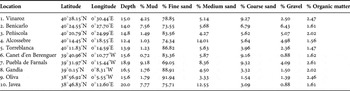
A total of 40 stations from ten different locations along approximatley 250 km of south-west coast of the Balearic Basin (Comunidad Valenciana, Iberian Peninsula east coast) were sampled (Figure 1). All locations were characterized by homogeneous fine-sand sediment (median sediment included between 0.125 µm and 0.25 µm) with a depth-range from 12.4 to 20 m (Table 1). For each location, four sites were sampled, keeping a constant depth in each location. All samples were collected in July during five consecutive years (2004 to 2008). Four Van Veen grab samples (400 cm2) were obtained at each site. Three samples were sieved through a 0.5-mm screen, fixed in 10% formalin and preserved in 70% ethanol for the study of the amphipod assemblage. The other sample was used to characterize the sediment (granulometric analysis and organic content). Grain size analysis was assessed by standard sieve fractionation (Holme & McIntyre, Reference Holme and McIntyre1984). Organic content of dry sediment was estimated as the loss of weight after ashing.
Locations, geographical coordinates, depth (m) and physical characteristics of sediment of the stations of each location.

Amphipods were identified using the key of Mediterranean amphipod fauna established by Bellan-Santini et al. (Reference Bellan-Santini, Karaman, Krapp-Schickel, Ledoyer, Myers, Ruffo and Schiecke1982, Reference Bellan-Santini, Diviacco, Krapp-Schickel, Myers and Ruffo1989, Reference Bellan-Santini, Karaman, Krapp-Schickel, Ledoyer and Ruffo1993, Reference Bellan-Santini, Karaman, Ledoyer, Myers, Ruffo and Vader1998), except for the genus Bathyporeia, which was identified using d'Udekem d'Acoz & Vader (Reference Udekem d'Acoz and Vader2005). The taxonomy was validated using the ERMS referential for amphipod introduced by Bellan-Santini & Costello (Reference Bellan-Santini, Costello, Costello, Emblow and White2001) (http://www.marbef.org/data/erms.php, consulted on 25 May 2010). New records for the Mediterranean Spanish coast were checked using published available literature (Figure 1).
Non-parametric multivariate techniques were used to compare species composition among locations. All multivariate analyses were performed using the PRIMER v. 6 statistical package (Clarke & Warwick, Reference Clarke and Warwick1994). Triangular similarity matrices were calculated through the Bray–Curtis similarity coefficient using abundance values that were previously square root transformed. Locations were classified into groups according to the cluster analysis of Bray–Curtis similarity coefficients. Similarities percentage analyses (SIMPER) of abundances were used to determine the species with higher percentage contribution in dissimilarity between groups.
The BEST procedure was used to determine the parameter (granulometry, organic matter %, depth and latitude) most correlated with species composition changes between sampled stations. Spearman correlation between similarity matrices of samples based on the abundances of benthic community and parameters was determined. Canonical correspondence analysis (CCA) was used to identify the relationships among the spatial distribution patterns of amphipods and environmental gradients. The CCA was conducted using the software CANOCO. The output is displayed as biplot, in which the plotted points for stations can be related to environmental gradients that are represented as arrows. The strength of the correlation of an environmental variable is reflected in the length of the arrow, and its association is reflected in the acuteness of the angle with the axis. Thus, the relationships among stations and environmental variables can be displayed on one plot.
RESULTS AND DISCUSSION
Taxonomic composition
A total of 55 species, belonging to 38 genera and 22 families, were identified. Among them, five species were first reported from the Mediterranean Spanish coast, 14 species were recorded for the second time and this study confirms their presence along the Spanish Mediterranean coast. A new species of Medicorophium, M. longisetosum sp. nov. (Myers et al., Reference Myers, de-la-Ossa-Carretero and Dauvin2010) was also described from this collection.
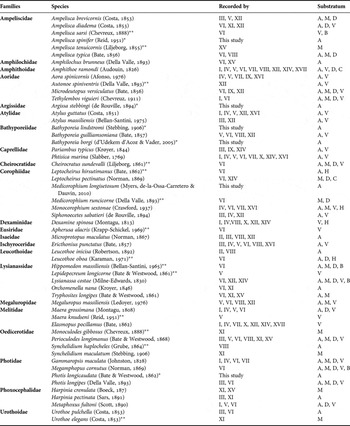
The species list is reported in Table 2, indicating when each species was previously cited and the bottom type where it was found. Some details on the new and second species records are given.
Amphipods species identified during present study. Asterisks indicate new records (*) and second records (**) for Spanish Mediterranean Coast. Literature and substratum where each species was found are indicated.

References: I, Carbonell (Reference Carbonell1984); II, Bibiloni (Reference Bibiloni1983); III, Marti (Reference Marti1989); IV, Jimeno (Reference Jimeno1993); V, Sánchez-Jerez et al. (Reference Sanchez-Jerez, Barberá-Cebrián and Ramos-Esplá1999, Reference Sanchez-Jerez, Barberá-Cebrián and Ramos-Esplá2000); VI, Conradi et al. (Reference Conradi, López-Gónzalez and Bellan-Santini1995), Conradi & López-González (Reference Conradi and López-Gónzalez1999); VII, Ruffo & Krapp-Shickel, personal communication in Jimeno (Reference Jimeno1993) or Conradi & López-González (Reference Conradi and López-Gónzalez1999); VIII, San Vicente & Sorbe (Reference San Vicente and Sorbe1999), Munilla & San Vicente (Reference Munilla and San Vicente2005); IX, Sánchez-Moyano et al. (Reference Sánchez-Moyano, García-Asencio and García-Gómez2007); X, Guerra-García et al. (Reference Guerra-García, Cabezas, Baeza-Rojano, Espinosa and García-Gómez2009a, Reference Guerra-García, Sánchez and Rosb); XI, Cartes & Sorbe (Reference Cartes and Sorbe1993, Reference Cartes and Sorbe1999), Cartes et al. (Reference Cartes, Jaume and Madurell2003); XII, Vázquez-Luis et al. (Reference Vázquez-Luis, Sanchez-Jerez and Bayle-Sempere2008, Reference Vázquez-Luis, Sanchez-Jerez and Bayle-Sempere2009); XIII, Gonzalez et al. (Reference González, Guerra-García, Maestre, Ruiz-Tabares, Espinosa, Gordillo, Sánchez-Moyano and García-Gómez2008); XIV, Ortiz & Jimeno (Reference Ortiz and Jimeno2003); XV, Cartes et al. (Reference Cartes, Papiol, Palanques, Guillén and Demestre2007, Reference Cartes, Ligas, De Biasi, Pacciardi and Sartor2009); XVI, Delgado et al. (Reference Delgado, Guerao and Ribera2009); XVII, Izquierdo & Guerra-García (Reference Izquierdo and Guerra-García2010). Substratum: A, sands; M, mud or clayey bottom; D, detrital bottom; H, hard bottom; V, among algae or seaweeds; B, among Bugula neritina and C. coraligene.
This species is common on fine-sand shallow water (10–108 m depth) of the eastern Atlantic Ocean from the western part of the Channel, where it can form abundant populations, to the African coast of Senegal, and in the Mediterranean Sea where it was present in the Marseilles Gulf and in the Adriatic Sea (Bellan-Santini et al., Reference Bellan-Santini, Karaman, Krapp-Schickel, Ledoyer, Myers, Ruffo and Schiecke1982; Bellan-Santini & Dauvin, Reference Bellan-Santini and Dauvin1988). It was also present along the Algerian coast in the Bou Ismail and Algiers Bays and the Bejaia Gulf from 13 to 120 m on diverse types of sediment from mud to coarse sand (Bakalem & Dauvin, Reference Bakalem and Dauvin1995). Ampelisca sarsi was also recorded at 383 m from the Portugal coast (Marques & Bellan Santini, Reference Marques and Bellan-Santini1993). From the Spanish Mediterranean coast, A. sarsi was previously reported as a first record by Conradi & López-Gonzalez (Reference Conradi and López-Gónzalez1999) among Bugula neritina and Mesophillum in Algeciras Bay (Andalucían coast). This species has been recorded from Vinaroz to Puebla de Farnals and always in low abundances. A total of 64 individuals have been collected from 12.4 to 15.6 m.
Ampelisca spinifer Reid, 1951
It was observed in the eastern Atlantic Ocean from Ireland to the Liberia coast, and in the Mediterranean in the Marseilles Gulf, the Tyrrhenian Sea and the coast of Israel (Bellan-Santini et al., Reference Bellan-Santini, Karaman, Krapp-Schickel, Ledoyer, Myers, Ruffo and Schiecke1982; Bellan-Santini & Dauvin, Reference Bellan-Santini and Dauvin1988). It was also recorded in Bou Ismail Bay in mud and muddy-gravel between 25 and 100 m depth (Bakalem & Dauvin, Reference Bakalem and Dauvin1995). Ampelisca spinifer was not previously reported from the Spanish Mediterranean coast. A total of 37 specimens have been recorded in Vinaroz, Benicarlo, Peñíscola, Puebla de Farnals, Oliva and Javea, from 14 to 20 m in fine-sand bottom. Its ecology was previously established between 15 to 182 m depth on several types of sediment, from muddy to coarse sand but always in sediments with a large amount of mud (Bellan-Santini et al., Reference Bellan-Santini, Karaman, Krapp-Schickel, Ledoyer, Myers, Ruffo and Schiecke1982; Bellan-Santini & Dauvin, Reference Bellan-Santini and Dauvin1988; Marques & Bellan Santini, Reference Marques and Bellan-Santini1993).
Ampelisca tenuicornis Liljeborg, 1855
It was observed in the eastern Atlantic Ocean from northern Norway to the Senegal coast, from 0 to 510 m depth; where it can form abundant populations in shallow muddy fine sand community (Bellan-Santini & Dauvin, Reference Bellan-Santini and Dauvin1988). Ampelisca tenuicornis was previously reported from the Mediterranean Spanish coast at the continental shelf of Ebro Delta (western Mediterranean) by Cartes et al. (Reference Cartes, Papiol, Palanques, Guillén and Demestre2007, Reference Cartes, Ligas, De Biasi, Pacciardi and Sartor2009). We have found a total of 1084 individuals from all studied locations (from 12.4 to 20 m), obtaining the highest abundances (956 ind/m2) in Gandia during the year 2004. This species was found in sandy and muddy bottom in shallow waters in the eastern and western part of the Mediterranean Sea including the Algerian coast (Bellan-Santini et al., Reference Bellan-Santini, Karaman, Krapp-Schickel, Ledoyer, Myers, Ruffo and Schiecke1982; Bakalem & Dauvin, Reference Bakalem and Dauvin1995).
Despite being previously established as Mediterranean endemic (Bellan-Santini et al., Reference Bellan-Santini, Karaman, Krapp-Schickel, Ledoyer, Myers, Ruffo and Schiecke1982), Autonoe spiniventris has since been observed by Martínez & Aderraga (Reference Martínez and Aderraga2001) on the Atlantic coast (San Sebastian, Spain). This species is common in the Bou Ismail and Algiers Bays between 15 and 100 m depth from sand to muddy coarse sand (Bakalem & Dauvin, Reference Bakalem and Dauvin1995). It was reported from the Spanish Mediterranean coast among Posidonia oceanica, and Cymodocea nodosa from the Alicante coast (Vazquez-Luis et al., Reference Vázquez-Luis, Sanchez-Jerez and Bayle-Sempere2009). Its depth-range was established (Bellan-Santini et al., Reference Bellan-Santini, Karaman, Ledoyer, Myers, Ruffo and Vader1998) from 2 to 100 m in well-sorted sand bottoms and among photophilic algae. We have collected 5825 specimens from 12.4 to 20.0 m. It has been found in all locations, being especially abundant in northern locations (from Vinaroz to Torreblanca) and Canet d'en Berenguer, with a maximum density of 2125 ind/m2 at Vinaroz in 2006.
This cosmopolitan species was previously recorded in the Atlantic Ocean, Indian Ocean and Japan Sea. In the Mediterranean Sea, it has been found from 11 to 370 m in various sediment types (Bellan-Santini et al., Reference Bellan-Santini, Karaman, Krapp-Schickel, Ledoyer, Myers, Ruffo and Schiecke1982, Reference Bellan-Santini, Karaman, Ledoyer, Myers, Ruffo and Vader1998; Grimes et al., Reference Grimes, Dauvin and Ruellet2009). From the Atlantic Iberian coast, Argissa stebbingi was previously reported in the Bay of Biscay (Bachelet et al., Reference Bachelet, Dauvin and Sorbe2003) and as the synonym A. hamatipes in Portugal (Marques & Bellan-Santini, Reference Marques and Bellan-Santini1993) and San Sebastian coast (Martínez & Aderraga, Reference Martínez and Aderraga2001). Eleven individuals of this first record for the Mediterranean Spanish coast have been found from 13.9 to 16.5 m water depth, in Vinaroz, Peñíscola, Torreblanca and Gandia.
It was described by d'Udekem d'Acoz & Vader (Reference Udekem d'Acoz and Vader2005) from specimens of the Tyrrhenian and Adriatic Seas, reporting that Bathyporeia nana Toulmond, 1966 specimens recorded previously in the Mediterranean Sea are actually B. borgi. Bathyporeia nana was found in the western basin of the Mediterranean Sea (Bellan-Santini et al., Reference Bellan-Santini, Diviacco, Krapp-Schickel, Myers and Ruffo1989) in sandy beaches from the intertidal zone to about 10 m depth. Recently, B. borgi was reported on muddy-sand at a depth of 10 m from the Algerian coast (Grimes et al., Reference Grimes, Dauvin and Ruellet2009). We have found 338 specimens along all locations from 12.4 to 20 m.
Bathyporeia lindstromi Stebbing, 1906
This endemic Mediterranean species was known on sandy bottoms, in 20 to 30 m from Italy (Tyrrhenian Sea), Sardinia, Malta and the Israeli coast (Bellan-Santini et al., Reference Bellan-Santini, Diviacco, Krapp-Schickel, Myers and Ruffo1989, Reference Bellan-Santini, Karaman, Ledoyer, Myers, Ruffo and Vader1998; d'Udekem d'Acoz & Vader, Reference Udekem d'Acoz and Vader2005), and it has since been found on fine sand at a depth of 5 m from the Algerian coast (Grimes et al., Reference Grimes, Dauvin and Ruellet2009). We have collected two individuals in Oliva and Javea at a water depth of 15.6 and 20 m.
This species was widely distributed in the Mediterrranean Sea, the Atlantic Ocean, the Black Sea and the Arctic Ocean from 8 to 157 m, being characteristically on sandy bottoms with loose-lying algae (Bellan-Santini et al., Reference Bellan-Santini, Karaman, Krapp-Schickel, Ledoyer, Myers, Ruffo and Schiecke1982, Reference Bellan-Santini, Karaman, Ledoyer, Myers, Ruffo and Vader1998; Marques & Bellan-Santini, Reference Marques and Bellan-Santini1993). It was also found on Posidonia meadows and various sediment types in the Bou Ismail Bay and Annaba Gulf from 8 to 90 m depth (Bakalem & Dauvin, Reference Bakalem and Dauvin1995). On the Spanish Mediterranean coast, it was recorded for the first time by Conradi & López-Gonzalez (Reference Conradi and López-Gónzalez1999) in sand, mud and detrital bottoms as well as among Halopteris scorparia from the Andalusian coast in 5 to 30 m water depth. We have collected 28 individuals from Vinaroz, Benicarlo and Peñíscola in 14 to 15 m.
It was observed along the north-eastern Atlantic Ocean and Mediterranean Sea from 7 to 350 m (Bakalem & Dauvin, Reference Bakalem and Dauvin1995; Bellan-Santini et al., Reference Bellan-Santini, Karaman, Ledoyer, Myers, Ruffo and Vader1998). Its ecology was established as detritic and mud coastal bottoms and bathyal muds (Bellan-Santini et al., Reference Bellan-Santini, Karaman, Krapp-Schickel, Ledoyer, Myers, Ruffo and Schiecke1982, Reference Bellan-Santini, Karaman, Ledoyer, Myers, Ruffo and Vader1998) as well as gravelly and coarse sand (Marques & Bellan-Santini, Reference Marques and Bellan-Santini1993). Leptocheirus hirsutimanus was first recorded from the Mediterranean Spanish coast by Conradi & López-Gonzalez (Reference Conradi and López-Gónzalez1999) in medium sand, biodetrital and hard bottoms from the Andalucían coast. We have found 26 individuals in Puebla de Farnals at 18.9 m water depth.
Medicorophium runcicorne Della Valle, 1893
This species has only been reported from the Mediterranean and Black Seas in mud and mobile substrates and among algae from 15 to 105 m (Bellan-Santini et al., Reference Bellan-Santini, Karaman, Krapp-Schickel, Ledoyer, Myers, Ruffo and Schiecke1982, Reference Bellan-Santini, Karaman, Ledoyer, Myers, Ruffo and Vader1998; Bakalem & Dauvin, Reference Bakalem and Dauvin1995). Medicorophium runcicorne was recorded for the first time from the Spanish coast by Conradi & López-Gonzalez (Reference Conradi and López-Gónzalez1999) in biodetrital, mud and clayey bottoms from the Andalucían coast. A total of 1304 individuals have been collected. It has been reported in all locations from 12.4 to 20 m water depth, obtaining the highest abundances in the locations of Gandia and Oliva (325 ind/m2).
Medicorophium longisetosum Myers, de-la-Ossa-Carretero & Dauvin, Reference Myers, de-la-Ossa-Carretero and Dauvin2010
A total of 365 specimens were collected from all locations with a depth-range of 12.4 to 20 m. Numbers of specimens collected in the ten sampling sites varied from 211 individuals at Vinaroz to one specimen at Javea. The presence of this new species, which is habitual and relatively abundant, is the best example of the necessity for more taxonomic studies in this area. It was fully described in Myers et al. (Reference Myers, de-la-Ossa-Carretero and Dauvin2010).
This Mediterranean endemic species was established inhabiting among seagrasses (Zostera) and fine and coarse sand bottoms from 3 to 25 m (Bellan-Santini et al., Reference Bellan-Santini, Karaman, Krapp-Schickel, Ledoyer, Myers, Ruffo and Schiecke1982, Reference Bellan-Santini, Karaman, Ledoyer, Myers, Ruffo and Vader1998). It was recorded for the first time in the Spanish Mediterranean coast by Conradi & López-Gonzalez (Reference Conradi and López-Gónzalez1999) among Halopteris escorparia. We have found 12 individuals in the locations of Alcossebre, Torreblanca and Oliva from 12.4 to 15.6 m in fine-sand bottoms.
This species was previously established as a Mediterranean endemic and its ecology was established in muddy bottoms from 14 to 400 m (Bellan-Santini et al., Reference Bellan-Santini, Diviacco, Krapp-Schickel, Myers and Ruffo1989, Reference Bellan-Santini, Karaman, Ledoyer, Myers, Ruffo and Vader1998), however, it was also reported from the Portuguese coast (Marques & Bellan-Santini, Reference Marques and Bellan-Santini1993) on gravelly and coarse sand bottoms from 52 to 97 m water depth. It was recorded in the Oran Gulf at a depth of 80 m on sandy mud and in the Oran Harbour on mud with shells (Grimes et al., Reference Grimes, Dauvin and Ruellet2009). Leucothoe oboa was first recorded from the Spanish Mediterranean coast by Conradi & López-Gonzalez (Reference Conradi and López-Gónzalez1999) in hard and sand biodetrital bottoms. We have found it in sandy bottoms with specimens of Leucothoe inicisa. We have collected a total of 213 individuals from 12.4 to 20 m water depth. It has been found in all locations though always in low abundances (40 ind/m2).
This Mediterranean endemic species was distributed on sandy and muddy bottoms from 4 to 350 m (Bellan-Santini et al., Reference Bellan-Santini, Diviacco, Krapp-Schickel, Myers and Ruffo1989, Reference Bellan-Santini, Karaman, Ledoyer, Myers, Ruffo and Vader1998). It was also recorded from Bou Ismail Bay (10–88 m) from sand to muddy gravel (Bakalem & Dauvin, Reference Bakalem and Dauvin1995). Hippomedon massiliensis was only recorded from the Spanish coast by Conradi & López-Gonzalez (Reference Conradi and López-Gónzalez1999) in sand, mud and detrital bottoms as well as among Bugula neritina. We have collected 228 individuals from 12.4 to 20 m depth, distributed in all locations but always in low densities (up to 40 ind/m2).
Lepidepecreum longicorne Bate & Westwood, 1861
This species was observed in the north-eastern Atlantic Ocean and Mediterranean Sea at depths ranging from 0 to 360 m (Bellan-Santini et al., Reference Bellan-Santini, Diviacco, Krapp-Schickel, Myers and Ruffo1989, Reference Bellan-Santini, Karaman, Ledoyer, Myers, Ruffo and Vader1998; Bakalem & Dauvin, Reference Bakalem and Dauvin1995). Its ecology is established in gravels and sand bottoms as well as abyssal and bathyal muds. Lepidepecreum longicorne was observed on the Spanish Mediterranean coast among Posidonia oceanica meadows along the Alicante coast and the Iberian coast, it was also previously recorded in Portugal (Marques & Bellan-Santini, Reference Marques and Bellan-Santini1993). We have found 46 specimens in northern locations (Vinaroz to Alcossebre), from 12.5 to 15 m water depth.
It is distributed in the Atlantic Ocean (West Africa) and the Mediterranean Sea (Bellan-Santini et al., Reference Bellan-Santini, Karaman, Krapp-Schickel, Ledoyer, Myers, Ruffo and Schiecke1982). It was common in Bou Ismail Bay on mud and sandy-muddy gravel between 45 to 100 m depth (Bakalem & Dauvin, Reference Bakalem and Dauvin1995). Its ecology was established in mud, muddy sands, coarse sands, fine gravel and detritic bottoms with a depth range from 10 to 68 m (Bellan-Santini et al., Reference Bellan-Santini, Karaman, Krapp-Schickel, Ledoyer, Myers, Ruffo and Schiecke1982, Reference Bellan-Santini, Karaman, Ledoyer, Myers, Ruffo and Vader1998). Maera knudseni was previously observed in Posidonia oceanica meadows along the Alicante coast (Sanchez-Jerez et al., Reference Sanchez-Jerez, Barberá-Cebrián and Ramos-Esplá2000). We have found 18 individuals only in Puebla de Farnals at 18.9 m water depth.
This species was previously observed in the north-eastern Atlantic Ocean and Mediterranean Sea in soft bottoms from 10 to 360 m water depth (Bellan-Santini et al., Reference Bellan-Santini, Karaman, Krapp-Schickel, Ledoyer and Ruffo1993, Reference Bellan-Santini, Karaman, Ledoyer, Myers, Ruffo and Vader1998). It was reported in the Bejaia Gulf and Bou Ismail Bay on various sediment types ranging from mud to coarse sand and at depths from 24 to 86 m (Grimes et al., Reference Grimes, Dauvin and Ruellet2009). Monoculodes gibbosus was previously reported on the muddy bottoms of the deep slope in front of Barcelona (western Mediterranean) from 593 to 598 m water depth (Cartes & Sorbe, Reference Cartes and Sorbe1999). We have found 14 individuals from Vinaroz, Benicarlo, Peñíscola, Puebla de Farnals and Oliva in 14 to 15.6 m.
Synchelidium haplocheles Grube, 1864
It is known from the Mediterranean Sea, Atlantic Ocean and Indo-Pacific Ocean (Bellan-Santini et al., Reference Bellan-Santini, Karaman, Krapp-Schickel, Ledoyer and Ruffo1993, Reference Bellan-Santini, Karaman, Ledoyer, Myers, Ruffo and Vader1998; Bakalem & Dauvin, Reference Bakalem and Dauvin1995), living from 3 to 100 m water depth on well sorted sand and coastal terrigenous mud bottoms. Synchelidium haplocheles was previously recorded on beaches from the Catalonian coast (Munilla & San Vicente Reference Munilla and San Vicente2005). We have found 90 specimens at depths from 12.4 to 15.6 m in northern locations, Puebla de Farnals and Gandia.
This cosmopolitan species was observed in the Atlantic Ocean (from Norway to West Africa), the Indian Ocean and the Mediterranean Sea. Its ecology was established from infralittoral, among algae and Posidonia meadows, to bathyal (400 m), among mud and detritic bottoms (Bellan-Santini et al., Reference Bellan-Santini, Diviacco, Krapp-Schickel, Myers and Ruffo1989, Reference Bellan-Santini, Karaman, Ledoyer, Myers, Ruffo and Vader1998; Bakalem & Dauvin, Reference Bakalem and Dauvin1995). Although it was previously recorded from the Atlantic Iberian coast (Marques & Bellan-Santini, Reference Marques and Bellan-Santini1993; Matínez & Adarraga, 2001), Photis longicaudata was not previously reported from the Spanish Mediterranean coast. Two specimens have been collected in Torreblanca at a depth of 13.9 m.
This species was observed in the Atlantic Ocean, Indian Ocean and Mediterranean Sea (western, Tyrrhenian, Adriatic, Israel and North Africa) associated with fine sediments distributed from 2 to 644 m (Bellan-Santini et al., Reference Bellan-Santini, Diviacco, Krapp-Schickel, Myers and Ruffo1989, Reference Bellan-Santini, Karaman, Ledoyer, Myers, Ruffo and Vader1998; Bakalem & Dauvin, Reference Bakalem and Dauvin1995). Urothoe elegans was previously reported on the muddy bottoms of the deep slope in front of Barcelona (western Mediterranean) (Cartes & Sorbe, Reference Cartes and Sorbe1993, Reference Cartes and Sorbe1999). We have found 143 individuals, in locations at Canet d'en Berenguer, Puebla de Farnals and Javea, from 15.6 to 20 m water depth.
Species distribution among locations
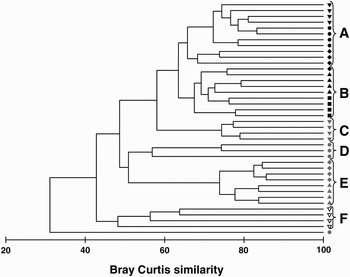
Cluster analyses based on species composition showed a segregation of stations according to the north–south axis (Figure 2). In this way, locations from north of the studied area (Groups A and B) obtained similarities among them higher than 60% and location 10 (Group F), which is sited south of studied area, showed more dissimilarity than other locations.
CLUSTER analysis based on amphipod assemblage of stations (ind/m2), indicating each location (▾, 1; •, 2; ♦, 3; ▴, 4; ■, 5;  , 6; , 7; , 8; , 9; △, 10) and groups established (A, B, C, D, E and F).

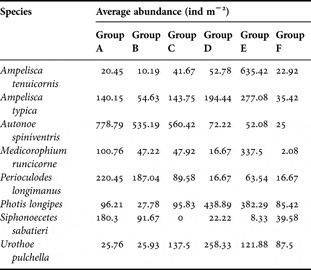
Changes among these locations were due to a decrease in abundance of species such as Autonoe spiniventris, Perioculodes longimanus or Siphonoecetes sabatieri from north to south. Whereas, other species abundance increased in locations 8 and 9, such as Ampelisca typica, Ampelisca tenuicornis or Medicorophium runcicorne, or from locations 6 to 9 Urothoe pulchella, or from locations 7 to 9 Photis longipes (Table 3).
Mean abundance of species contributing more in dissimilarities among groups established in CLUSTER analysis.

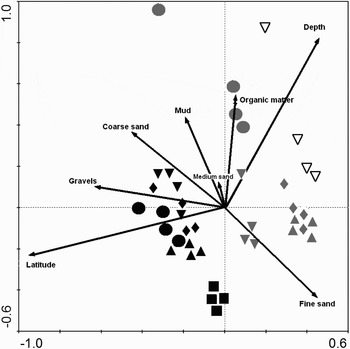
The influence of geographical situations of each location in amphipod assemblage was reflected in BEST and CCA results. Latitude together with depth obtained the highest Spearman correlation (Rho: 0.609 and 0.606) with changes in species composition. The CCA showed that both parameters were related since the southern locations are slightly deeper than northern ones (Figure 3; Table 1). Both latitude and depth highly influence benthic communities and were related to other abiotic parameters such as hydrodynamic conditions, temperature, dissolved oxygen, granulometry and organic content. For instance, temperature, influenced by latitude and depth, affect most biological processes and act on growth rates, maturation or reproduction cycle. Despite the fact that species contributing to differences among locations displayed a wide bathymetric distribution, some of them could be less adapted to hydrodynamic processes than others (Bellan-Santini et al., Reference Bellan-Santini, Karaman, Ledoyer, Myers, Ruffo and Vader1998). The fine sand communities, such as the study area, are always influenced by high hydrodynamism which can remove the surface layer (Cardell et al., Reference Cardell, Sardà and Romero1999), in such a way that local changes could change species abundances according to their capacity to shelter.
Results of canonical correspondence analysis (CCA) biplots. Points correspond to samples from locations: ▾, 1; •, 2; ♦, 3; ▴, 4; ■, 5; , 6; , 7; , 8; , 9; △, 10. Arrows indicate environmental variables. CCA axis I and CCA axis II had eigenvalues of 0.184 and 0.142, respectively.

Other parameters such as mud percentage or organic matter showed a weak correlation (Rho: 0.291 and 0.208), whereas percentages of other granulometric sizes showed the lowest correlations (Rho < 0.2) with amphipod species composition. Changes in these parameters were related to species differences among close locations. Despite the fact that sediments in the area were homogeneous and low changes in granulometry among locations were registered, grain size and organic content are factors that may be related to food availability and the ability to burrow (Oakden, Reference Oakden1984; Marques & Bellan-Santini, Reference Marques and Bellan-Santini1993); as a result light changes in sediment from close areas could produce changes in species composition.
BIOGEOGRAPHICAL CONSIDERATIONS
The present study recorded a total of 55 total species, but for a limited length of Spanish coast (250 km) and only for sandy bottoms. Among these species, 30 have a north-eastern Atlantic distribution and 17 have a wide distribution in Atlantic and Indo-Pacific or Arctic Oceans (Bakalem & Dauvin, Reference Bakalem and Dauvin1995; Bellan-Santini et al., Reference Bellan-Santini, Karaman, Ledoyer, Myers, Ruffo and Vader1998; Grimes et al., Reference Grimes, Dauvin and Ruellet2009). Meanwhile, only eight species were considered Mediterranean endemics. Among these endemics, six are reported as first or second records on the Spanish Mediterranean coast; and among the north-eastern Atlantic species Autonoe spiniventris and Leucothoe oboa are known only along the Iberian coast (Marques & Bellan-Santini, Reference Marques and Bellan-Santini1993; Martínez & Aderraga, Reference Martínez and Aderraga2001). Among the 20 species recorded for the first or second time on the Mediterranean coast, only two species Apherusa alacris and the new species Medicorophium longisetosum were absent along the Algerian coast (Bakalem & Dauvin, Reference Bakalem and Dauvin1995; Grimes et al., Reference Grimes, Dauvin and Ruellet2009), and four species, namely the two same species for Algeria, plus the two Bathyporeia species, B. borgi and B. lindstromi, were absent from the French Mediterranean coast. This shows a good resemblance of the continental shelf amphipod fauna at the scale of the western part of the Mediterranean Sea.
A total of six species (>10% of the recorded species) was new for the Spanish coast, and among them a new species was described (Myers et al., Reference Myers, de-la-Ossa-Carretero and Dauvin2010). This proves the need to significantly increase the prospection of the amphipods from the Mediterranean Spanish coast. To give some comparative numbers, the French Mediterranean continental shelf accounts for 250 Gammaridea (Dauvin & Bellan-Santini, Reference Dauvin and Bellan-Santini2002). Nevertheless records depended on the sampling efforts among the regions, respectively 240 in the ‘Provence-Alpes Côte d'Azur’ region which included the Marseilles Gulf where numerous studies were made mainly through the expertise of Denise Bellan-Santini, 100 for the ‘Languedoc–Roussillon’ region at the frontiers with Spain, and only 78 species around Corsica (Dauvin & Bellan-Santini, Reference Dauvin and Bellan-Santini2002). Recent works on Algerian amphipods, including three orders, i.e. Caprellidea, Gammaridea and Hyperiidea (Bakalem & Dauvin, Reference Bakalem and Dauvin1995; Grimes et al., 2005), revealed that the fauna accounts for 298 species of the 451 species recorded in the mid-1990s for the whole Mediterranean fauna. Using these records, we expected that the total amphipod marine fauna (Caprellidea, Gammaridea and Hyperiidea) of the Mediterranean coast of Spain should include between 250 and 300 species. A first inventory of all species collected in this area should be completed from published works particularly those of J.M. Guerra-Garcia on caprellids (Guerra-García et al., Reference Guerra-García, Sánchez-Moyano and García-Gómez2000, Reference Guerra-García, Sánchez-Moyano and García-Gómez2001a,Reference Guerra-García, Sánchez-Moyano and García-Gómezb, Reference Guerra-García, Sánchez-Moyano and García-Gómez2002, Reference Guerra-García, Cabezas, Baeza-Rojano, Espinosa and García-Gómez2009a,Reference Guerra-García, Sánchez and Rosb). Moreover, the higher percentage of endemics among first or second records indicates the need for more sampling studies in order to increase distribution knowledge of Amphipoda species from the Spanish Mediterranean coast.
ACKNOWLEDGEMENTS
This research would not have been possible without help from many people. We gratefully acknowledge the staff of the Department of Marine Sciences and Applied Biology and of the Station Marine de Wimereux. We also thank Dr Alan Myers for his inestimable collaboration with the species M. longisetosum sp. nov. I would like to especially thank Angel Climent Ballester's for her invaluable help. We also acknowledge the contributions of the two anonymous referees on the first version of the manuscript. We gratefully acknowledge CONSOMAR S.A. and Entitat de Sanejament d'Aigües for the financial contribution. We are also grateful to the University of Alicante for awarding a predoctorate grant to J.A.O.C. for a stay in Station Marine de Wimereux (France) and to this host institution for the admission.