

I. Introduction
Today’s global order is marked by a proliferation of mostly issue-area specific multilateral institutions. As a consequence of the resulting institutional density, more and more often the regulatory scopes of multilateral institutions partially overlap with one another. There are, thus, not only separate issue-area specific regimes, but also ‘regime complexes’ (e.g. Alter and Meunier Reference Alter and Meunier2009). As there is usually no superior authority to coordinate among the specific regimes of a complex, their regulatory overlap can be exploited by states (and non-state actors) to pursue their interests. They may use one multilateral institution to challenge another such institution and thus engage in contested multilateralism (CM) (Morse and Keohane Reference Morse and Keohane2014). The literature has highlighted two dominant strategies in this regard: regime-shifting that occurs when a coalition of actors moves the regulation of an issue from the original institution to an existing competing institution that better reflects their interests; and competitive regime-creation that occurs when a dissatisfied coalition of actors creates a new institution alongside the original institution to promote regulations that better reflect their interests.
In this article, we discuss the consequences of CM for the constitutionalisation of multilateral institutions. In general, global constitutionalisation refers to processes by which the international legal order comes to embrace principles of constitutionalism such as human rights, democracy, and the rule of law (Milewicz Reference Milewicz2009; Klabbers, Peters and Ulfstein Reference Klabbers, Peters and Ulfstein2009; Wiener et al. Reference Wiener, Lang, Tully, Maduro and Kumm2012). As pillars of the international legal order, multilateral institutions may exercise authority in ways that reflect these principles to a greater or lesser extent. We therefore define the constitutionalisation of specific multilateral institutions as the degree to which their exercise of authority is legally constrained in terms of democratic participation and judicial accountability. These features, we hold, represent the institutional expression of constitutionalist principles in delineated political orders (see Kreuder-Sonnen and Zangl Reference Kreuder-Sonnen and Zangl2015 for more details).
While the literature often highlights CM’s harmful consequences for global constitutionalism (e.g. Benvenisti and Downs Reference Benvenisti and Downs2007), we claim that its consequences for the constitutionalisation of multilateral institutions can be negative but also positive. In doing so, we shed light on two ‘blind spots’ in the concept of contested multilateralism that we expect to be particularly relevant for its consequences for the constitutionalisation of international institutions. First, we argue in section II that CM is not always driven by actors’ dissatisfaction with the policies of multilateral institutions, but can also stem from their dissatisfaction with the legal structure of an institution’s political order, i.e. its polity. We conceptualise this polity-driven CM as opposed to the common policy-driven CM and hold that the co-existence of constitutionalised and non-constitutionalised institutions in the contemporary global order is a frequent trigger of this type of CM. Second, we argue in section III that CM is not always state-led (or institution-led), but can also be society-led. Importantly, we claim that this neglected differentiation between state- and society-led CM is decisive for its consequences for the constitutionalisation of multilateral institutions. CM is likely to have negative consequences when the member states of a constitutionalised institution engage in top-down CM to enhance their freedom to wield discretionary authority; but it is likely to have positive consequences when society actors engage in bottom-up CM to reduce states’ freedom to wield discretionary authority provided by a non-constitutionalised institution. In section IV we then illustrate the empirical plausibility of our claims in two cases involving top-down contestation of the European Economic and Monetary Union (EMU) and bottom-up contestation of the World Health Organization (WHO).Footnote 1 In section V we summarise our claims and reflect upon the normative implications of polity-driven contested multilateralism.
II. Conceptualising polity-driven contested multilateralism
The fragmented character of the global order enables both state and non-state actors to challenge an existing multilateral institution by shifting issues to an alternative multilateral institution (Morse and Keohane Reference Morse and Keohane2014: 385–7). While Morse and Keohane (Reference Morse and Keohane2014: 386) point out that this contested multilateralism can be employed to promote both ‘policy and institutional change’, their empirical illustrations – in line with the majority of contributions in the literature – focus on instances of CM where the source of dissatisfaction with an existing institution is its substantive norms or decisions. This policy-driven contested multilateralism implies that state or non-state actors employ an alternative multilateral institution in order to challenge the policies of an established multilateral institution. For example, in 1992 Norway, Greenland and Iceland created the North Atlantic Marine Mammal Commission (NAMMCO) as an alternative multilateral institution to deal with whaling issues, because they were dissatisfied with the continuation of the whaling moratorium enacted by the International Whaling Commission (IWC). By contrast, a second type of CM has so far largely been neglected: polity-driven contested multilateralism. Here, the source of dissatisfaction is structural aspects of an institution’s political order. It thus implies that state or non-state actors draw on an alternative multilateral institution with the aim of challenging the polity of an established multilateral institution. The UK initiative for the creation of the European Free Trade Association (EFTA) in 1960 as an intergovernmental alternative to the European Economic Community (EEC) with its supranational institutions may serve as an example.
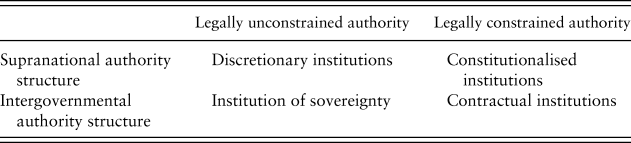
This latter type of CM appears to have important consequences for the constitutionalisation of multilateral institutions, because state and non-state actors that are dissatisfied with the constitutional quality of an existing multilateral institution may employ a less (or more) constitutionalised institution in order to undermine (improve) its level of constitutionalisation. To study associated strategies of CM, we distinguish four different types of multilateral institutions (Kreuder-Sonnen and Zangl Reference Kreuder-Sonnen and Zangl2015). The typology rests on two fundamental distinctions: Firstly, we ask whether political authority relations in multilateral institutions are structured in an intergovernmental or supranational fashion, i.e. whether states retain full sovereignty or whether sovereignty is pooled and/or delegated within the institution (Hooghe and Marks Reference Hooghe and Marks2015). Secondly, we ask whether or not political authority in multilateral institutions is constrained by law, i.e. whether the institution grants basically unlimited discretion to authority-holders or whether authority is legally constrained through democratic and judicial processes.
Four types of multilateral institutions

Crossing the two distinctions – supranational versus intergovernmental authority and legally constrained versus legally unconstrained authority – we arrive at a typology of four multilateral institutional arrangements (see Table 1).Footnote 2 Manifestations of each of these types can be found in co-existing sub-orders of the European Union (see Dawson Reference Dawson2015) which we use for illustrative purposes here:
• Institution of sovereignty: The institution of sovereignty implies that state governments constitute each other as sovereign actors who may exercise authority without any international legal constraints. Except for acknowledging their sovereign counterparts’ authority, states may wield authority with almost unlimited discretion. Any legal constraints on states authority are not international, but domestic constraints which may (or may not) be subject to democratic and/or judicial accountability. Even within today’s EU we can still find areas such as armament in which EU members are barely constrained by European law.
• Contractual institutions: In contractual institutions state governments constitute each other as sovereign authorities while at the same time constraining their authority by mutual agreement. Retaining sovereignty implies that states are not committed to any international agreement without their (continuous) consent. It also implies that they have full discretion over the content of international agreements which – at best – can be subject to domestic – but not international – democratic and/or judicial accountability. At least in areas such as foreign policy in which the intergovernmental method of policymaking applies, today’s EU can be understood as a contractual institution. In these areas, Member States have not pooled or delegated authority on the EU level, but engage in decision-making by consensus. While merely subject to domestic accountability mechanisms of national parliaments and national courts, these agreements still constrain the discretion states usually enjoy with regard to their foreign policy (Dawson Reference Dawson2015).
• Constitutionalised Institutions: In constitutionalised multilateral institutions, states have pooled or delegated parts of their sovereignty to a supranational organisation and established legal constraints on the wielding of supranational authority. The authority of constitutionalised institutions is subject to democratic and judicial accountability on the supranational level. The EU provides an example in the area of the Common Market in which the community method of policymaking applies. Member States have both pooled (Council) and delegated (Commission) authority on the EU level and the wielding of this supranational authority is subject to the democratic and judicial accountability of the European Parliament (which acts as a co-legislator) and the European Court of Justice (which acts as a constitutional court) (Schimmelfennig and Rittberger Reference Schimmelfennig and Rittberger2006).
• Discretionary institutions: Multilateral institutions enjoying pooled or delegated authority that is not legally constrained through democratic or judicial accountability mechanisms can be seen as discretionary – or even authoritarian – institutions. Discretionary supranational institutions may wield authority with almost unlimited discretion (Kreuder-Sonnen and Zangl Reference Kreuder-Sonnen and Zangl2015). The EU is illustrative, at least in areas such as the excessive imbalances procedure (EIP) which gives the Commission discretionary authority vis-à-vis countries with high budgetary deficits (Scharpf Reference Scharpf, Streeck and Schäfer2013). With hardly any legal constraints, the Commission may issue ‘recommendations’ which become binding unless rejected by a qualified majority in the Council. As the European Parliament and the European Court of Justice are virtually excluded from this procedure, the Commission’s powers are also free from democratic and/or judicial accountability (Joerges and Weimer Reference Joerges, Weimer, de Búrca, Kilpatrick and Scott2013).
The four types point to the co-existence of fundamentally different multilateral institutions in today’s global order (Kreuder-Sonnen and Zangl Reference Kreuder-Sonnen and Zangl2015). This co-existence allows state and non-state actors to employ strategies of contested multilateralism to cater the constitutionalisation of multilateral institutions to their liking.
III. Consequences for the constitutionalisation of multilateral institutions
We hold that the respective CM strategies can have both negative and positive consequences for the constitutionalisation of multilateral institutions. To arrive at this insight, we suggest a second adaptation and extension of the conceptual framework of contested multilateralism. In its formulation by Morse and Keohane, CM can be either state-led or institution-led. Regarding the latter, we agree that supranational organisations can play a discrete role in the deployment of CM strategies, yet we doubt that it is actually those multilateral institutions themselves which shift ‘the focus of [their] activity to a challenging institution with different rules and practices’ (Morse and Keohane Reference Morse and Keohane2014: 388). In fact, we argue that the actors who do the shifting are either states or society actors who engage in multilateral contestation from the top down (states) or from the bottom up (society actors).Footnote 3 Importantly, we claim that they do so for systematically diverging reasons with opposed consequences for the constitutionalisation of the institution in question.
When CM is polity-driven and the source of dissatisfaction is the absence or existence of legal constraints in a (non-)constitutionalised institution, we suggest that CM strategies employed top-down by states are likely to have negative consequences for the constitutionalisation of multilateral institutions, while the consequences of CM strategies employed bottom-up by society actors are likely to be positive. The general reason for this is that state actors and society actors typically assume different roles in multilateral institutions. While state actors (and supranational bodies) are usually in the role of authority-holders, society actors (and weak states) assume the role of addressees of this authority. These diverging social roles have – as we suppose – an impact on their respective support for constitutionalised or discretionary institutions: Authority-holders have nothing to fear from unconstrained authority. Sometimes they even have a lot to gain from discretionary authority as it improves their ability to realise their interests – be they self- or other-regarding – in the way they deem appropriate. Addressees of authority, by contrast, can hardly ever gain from unconstrained authority. As they depend on the democratic and judicial accountability mechanisms of constitutionalised institutions to be protected against an exercise of authority that is arbitrary or autocratic, addressees of authority have a lot to gain from legal constraints on authority.Footnote 4
Starting from these general predispositions of authority-holders and the addressees of authority, we construct top-down and bottom-up CM as two ideal-types with diverging consequences for the constitutionalisation of multilateral institutions.
Top-down polity-contestation
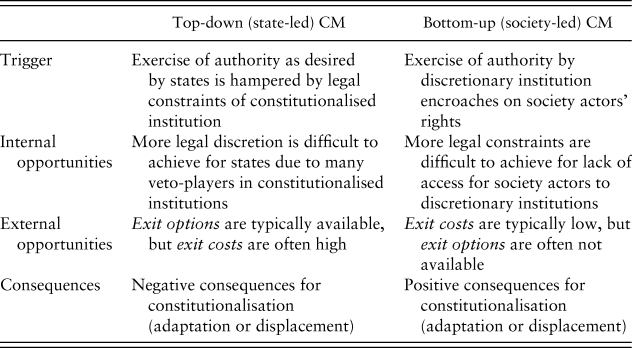
Top-down contested multilateralism implies that the member states of an international institution – and not society actors – engage in strategies of contestation. The trigger for this type of CM is often states’ dissatisfaction with the legal constraints on the authority of constitutionalised institutions. In fact, we hypothesise that the more constitutionalised a multilateral institution, the stronger the incentives for states to shift to or create an alternative institution, because it potentially undermines their ability to exercise authority the way they deem appropriate. Even if states accept the constitutionalisation of a multilateral institution in principle, they may still be dissatisfied with the resulting legal constraints regarding specific issues, specific actors, or specific situations (see also Morse and Keohane Reference Morse and Keohane2014: 390). Particularly in crisis situations, they may have a strong incentive to break free from the legal constraints of constitutionalised institutions.
In top-down CM, states opt for regime-shifting or competitive regime-creation, because the legal constraints of a constitutionalised institution typically imply sharp limitations to their internal opportunities for change. For the more constitutionalised a multilateral institution, the greater the institutional hurdles for change towards more legal discretion. Constitutionalised institutions are generally based on quasi-constitutional treaties detailing the procedures for ‘constitutional amendment’ which regularly require supermajorities and thus complicate formal change from within. In addition, constitutionalised institutions exhibit a comparatively high degree of judicialisation, which makes informal adaptations difficult to achieve or at least to sustain. Hence, strategies of top-down CM can become the only viable option for states to expand the discretion of a multilateral institution.
In top-down CM, the typical configuration of states’ external opportunities for shifting to or creating alternative multilateral institutions is characterised by a broad availability of exit options, but rather high exit costs. While exit options are generally available because states face no formal barriers to access or create alternative multilateral institutions, exit costs are rather high because states that are committed to a multilateral institution risk their reputation as a reliable partner among fellow members when shifting to or creating a competitive institution. Therefore, while states usually have exit options available, their readiness to use them for top-down strategies of contested multilateralism is often tempered by comparatively high exit costs.
Yet, if exit costs are not prohibitively high, states that are dissatisfied with the legal constraints of a constitutionalised institution will typically shift to or create a multilateral institution with more legal discretion. Therefore, the consequences for constitutionalisation of top-down CM are typically negative: either the original institution lowers its level of constitutionalisation to correspond to demands of dissatisfied states for the sake of reintegration (adaptation); or the original institution is more permanently sidelined and the issue dealt with in a discretionary institution (displacement) – thus lowering the aggregate level of constitutionalisation.
The contestation of the World Bank’s International Bank for Reconstruction and Development (IBRD) through the competitive creation of the Asian Infrastructure Investment Bank (AIIB) in 2016 provides an example. A coalition of emerging powers led by China had been dissatisfied with the institutional structures of the World Bank. Among other things, that dissatisfaction arose from the Bank’s legal constraints on lending for large-scale infrastructure projects and the respective accountability mechanism of the so-called Inspection Panel.Footnote 5 For years, this coalition pushed for internal reforms of the World Bank. Yet the coalition of established states that had promoted the legal constraints on lending and the accountability mechanism of the Inspection Panel resisted any substantial change (Vestergaard and Wade Reference Vestergaard and Wade2013). As a consequence, a coalition of emerging powers first launched the New Development Bank and later the AIIB as alternative institutions. Both institutions lend money for infrastructural projects with hardly any legal constraints and no accountability mechanisms comparable to the Inspection Panel. As a consequence, the level of constitutionalisation in the World Bank is already being questioned by those who fear a competitive disadvantage for the Bank’s lending operations (Heupel Reference Heupel, Heupel and Zürn2016).
In sum, we hold that top-down CM typically occurs if states are dissatisfied with the legal constraints of a constitutionalised institution that offers limited internal opportunities for change towards more legal discretion. If exit costs are not prohibitively high, they use the external opportunities of shifting to or creating more discretionary multilateral institutions. This, then, has negative consequences for the constitutionalisation of the respective institutions (see Table 2).
Ideal-types of top-down and bottom-up contested multilateralism

Bottom-up polity-contestation
Bottom-up contested multilateralism implies that society actors – instead of states – engage in strategies of multilateral contestation. The trigger for this type of CM is often society actors’ dissatisfaction with the unconstrained exercise of authority by a discretionary institution. In fact, we hypothesise that the more discretionary a multilateral institution, the more likely it is that society actors try to constrain its authority. In particular, if the institution’s exercise of discretionary authority infringes on society actors’ rights, we expect these actors to have a strong incentive to push for the constitutionalisation of the respective institution.
In bottom-up CM, society actors opt for regime-shifting or competitive regime-creation because the authority structures of a discretionary institution typically impose sharp limitations to their internal opportunities for change. For the more discretionary a multilateral institution, the greater the institutional hurdles for society actors to push for more legal constraints within the institution. Discretionary institutions usually provide access only to (member) states; as opposed to their constitutionalised counterparts, they neither facilitate participation of society actors nor provide them with judicial avenues to be heard. There are, thus, no institutionalised mechanisms through which society actors could claim their rights. Hence, as internal opportunities are limited in discretionary institutions, strategies of CM are usually the more promising option for society actors to press for legal constraints on the institutions’ authority.
In bottom-up CM, external opportunities to employ strategies of multilateral contestation are usually limited by the availability of exit options, but at the same time facilitated by relatively low exit costs. There are two limitations on society actors’ exit options: First, society actors often lack access to alternative multilateral institutions to which they could shift in order to push the original institution towards more constitutionalisation. Second, for lack of political authority, society actors cannot easily create international institutions which are comparable to the original institution created by states. If, however, exit options are available because a more constitutionalised institution is accessible, society actors have to be much less concerned with the kind of exit costs which may prevent state actors from engaging in CM. As society actors are usually not members of international institutions and thus cannot lose their reputation as cooperation partners in international institutions, shifting to or creating an alternative institution hardly produces any exit costs for them. Thus, bottom-up CM depends much less on exit costs, but much more on exit options than top-down contestation.
If exit options are available, society actors that are dissatisfied with the legally unconstrained exercise of authority by a discretionary institution will typically shift to or create a multilateral institution with more legal constraints. Therefore, the consequences for constitutionalisation of bottom-up CM are typically positive. Either the original institution reacts to the external challenge by accommodating its concerns (adaptation), or it is likely to lose social legitimacy which undermines its authority (displacement).
The contestation of the United Nations Security Council (UNSC)’s regime of targeted sanctions against terror suspects may serve as an example. By establishing a blacklist for terror suspects that obliged all states to freeze the bank accounts of the listed individuals without providing them with any form of legal remedy, the UNSC infringed on basic due process rights of the targeted persons. Affected individuals, supported by a transnational coalition of civil-society actors, were dissatisfied with the Council’s unconstrained exercise of authority. Yet, as the discretionary character of the UNSC did not grant them access, they were precluded from internally claiming their rights let alone advocating more legal constraints on the Council’s authority. They had to turn to more constitutionalised institutions to which they had access: the Council of Europe (CoE), the UN Human Rights Committee (HRC), and, most importantly, the European Court of Justice (ECJ). While the former two publicly criticised the Council’s practice, it was the latter with its famous Kadi rulings that brought the desired effect. The ECJ found the EU regulation implementing the UNSC resolution to violate the plaintiff’s right to a fair process and thus made the implementation of the UNSC resolution in the EU conditional on the introduction of legal remedies for the listed individuals. In response, the Council felt compelled to institutionalise effective complaint procedures, increasing its level of constitutionalisation (Heupel Reference Heupel2013).
In sum, we claim that discretionary institutions drive society actors to employ bottom-up CM, especially when they violate their rights. As discretionary institutions generally provide little internal opportunities for them to change the institution towards more legal constraints, society actors are likely to draw on the external opportunities provided by alternative institutions. If adequate exit options are available, they are likely to employ a constitutionalised institution in order to constrain the authority of a discretionary institution. Therefore, bottom-up polity-contestation is expected to have positive consequences for constitutionalisation of the respective institution (see Table 2).
IV. Two illustrative cases
The above prominent cases of polity-driven CM merely illustrate the plausibility of bottom-up and top-down CM as ideal types. In the following we demonstrate that the patterns of top-down and bottom-up CM can also be observed in less prominent cases. First, we look at the top-down contestation of the European Economic and Monetary Union (EMU) through the creation of the European Stability Mechanism (ESM); and second, we study the bottom-up contestation of the WHO’s emergency governance through the Parliamentary Assembly of the CoE.
Top-down polity-contestation of the EMU
Since its inception in the early 1990s, the EMU imposed legal constraints on the exercise of authority by both states and supranational organs. While fiscal and economic policymaking remained an exclusive competence of the Member States, they nevertheless constrained their authority by agreeing on certain regulative parameters for their policies (e.g. the Stability and Growth Pact) which were even backed by delegated monitoring and enforcement powers for the Commission. Monetary policy, on the other hand, became an integrated Union competence, but also faced strong legal constraints provided in EU primary law. For example, in order to tackle the moral hazard problem of non-optimal currency areas, Article 125(1) TFEU (the so-called no-bailout clause) prohibits the assumption of or liability for government commitments across Member States or by the Union. Moreover, any supranational acts of authority were subject to judicial review by the ECJ, which also protected the economic and social rights of individuals or private entities in the EU.
In the early days of the euro crisis, many EU Member State governments became dissatisfied with these legal constraints as the exigencies of the apparent emergency situation seemed to suggest measures incompatible with the existing EMU’s legal order. Many Member States saw the solution in fiscal transfers to deficit countries coupled with strict fiscal conditionalities to be supranationally implemented and supervised (e.g. Gocaj and Meunier Reference Gocaj and Meunier2013). Given the perceived urgency of the matter, however, internal institutional adaptation proved impossible. For one thing, an informal change of the Treaties was dismissed for fear of the ECJ and especially the German Constitutional Court denouncing such an approach as illegal. On the other hand, a formal Treaty revision was deemed too lengthy and seemed unlikely to be successful in light of the high constitutional hurdles for Treaty amendment (e.g. national referenda). In this situation, euro area Member States more or less collectively decided to establish an alternative multilateral institution, the ESM, with much fewer legal constraints on authority, outside the EU’s legal framework.Footnote 6
The ESM gives euro area Member States the possibility to provide emergency credits to financially distressed members of the common currency and thus to circumvent the no-bailout clause (Tomkin Reference Tomkin2013). It also enables them to delegate authority to the so-called Troika consisting of the European Commission, the European Central Bank (ECB), and the International Monetary Fund (IMF) to impose strict fiscal conditionalities on recipient states and thus to demand and supervise reforms in issue areas such as health care, education and labour law, which have enormous distributional effects. Not only are those states thus factually stripped of their fiscal sovereignty and budgetary autonomy guaranteed under EU law (Dawson and de Witte Reference Dawson and de Witte2013: 825), the Troika’s operations also interfere with economic and social rights of individuals and entities in countries receiving ESM credits (Fischer-Lescano Reference Fischer-Lescano2014). Since the ESM operates outside the EU’s legal system, the Troika is not subject to judicial review by the ECJ and affected individuals try in vain to claim their rights in front of the Court (Kilpatrick Reference Kilpatrick2015: 348–52). Hence, the ESM establishes a discretionary regime competing with the constitutionalised EMU which has lost most of its relevance since the establishment of the ESM. Formally, the EMU’s legal order has so far remained unaltered, but the factual shift of both euro area Member States and the European institutions to the discretionary alternative forum underlines the fact that this case of top-down polity-contestation had substantively negative effects on the constitutionalisation of the whole institutional complex.
Bottom-up polity-contestation of the WHO
In the wake of the SARS crisis of 2003, the WHO has been delegated a considerable amount of supranational authority by member states to deal with Public Health Emergencies of International Concern (PHEIC). As provided in the International Health Regulations (IHR 2005), the WHO Director-General may, in consultation with an Emergency Committee of health experts, determine that a spreading disease or another public health event constitutes a PHEIC and then issue temporary emergency recommendations to be followed by the member states concerned (see generally Fidler Reference Fidler2005). While legally limited in the contours of the types of measures it may adopt and the procedures to follow, the WHO’s emergency regime was still established as broadly discretionary – with hardly any ‘check’ on its authority, let alone a possibility for judicial review or democratic accountability (Hanrieder and Kreuder-Sonnen Reference Hanrieder and Kreuder-Sonnen2014). This was underscored by the WHO’s handling of the 2009–10 H1N1 swine influenza (the ‘swine flu’) where it put the new institutional framework into practice for the first time. The Director-General convened the Emergency Committee and drew on its advice to declare the swine flu a PHEIC, but also to declare it an influenza pandemic, which triggered worldwide pandemic preparedness plans and led especially wealthy states to pay billions of euros to purchase and stockpile vaccines and antiviral medication – much of which eventually proved unnecessary and remained unused. The organisation’s decision-making process was highly intransparent. Not only did the Emergency Committee operate in complete secrecy with the names of the experts being released only after the PHEIC had been declared over in 2010, the WHO also autonomously changed the definition of a pandemic to fit the characteristics of the swine flu (Doshi Reference Doshi2011). In light of the close ties of many WHO advisers to the pharmaceutical industry, this led to allegations of conflicts of interest and corporate regulatory capture (Cohen and Carter Reference Cohen and Carter2010).
Protest against this discretionary exercise of authority arose in particular in the European public health community, including the editors of the influential British Medical Journal (Godlee Reference Godlee2010), critical investigative journalists, and parliamentarians specialising in health policy. Yet these society actors lacked access to the WHO which is why their demands for a thorough investigation into the allegations and the introduction of better accountability structures in the organisation where not channelled internally. This was also due to the fact that most member state governments had little interest in elucidating the WHO’s crisis politics for fear of being drawn into a scandal of inappropriate governance, which also shielded the organisation from public pressure (Deshman Reference Deshman2011: 1108–10). This is why parliamentarians eventually shifted to an alternative multilateral institution with more democratic representation, i.e. the Parliamentary Assembly of the Council of Europe, where they could launch a public investigation into the WHO’s handling of the H1N1 influenza (see Deshman Reference Deshman2011). After some months of research and after summoning the Director-General and other high-ranking WHO officials for questioning before the investigating commission, the CoE Assembly published its Report entitled ‘The handling of the H1N1 pandemic – more transparency needed’, in which it notes and admonishes grave shortcomings in terms of transparency and accountability in the WHO’s crisis governance.Footnote 7
According to Deshman (Reference Deshman2011), the CoE thus emerged as a ‘horizontal check’ on the otherwise unconstrained WHO. This bottom-up multilateral polity-contestation also had positive, albeit modest, effects on the WHO’s level of constitutionalisation (see Hanrieder and Kreuder-Sonnen Reference Hanrieder and Kreuder-Sonnen2014: 342–3). The CoE report threatened to undermine the WHO’s credibility and thus its legitimacy as an expert authority. As a reaction, the WHO established its own Review Committee to assess the functioning of the IHR during the first PHEIC which would eventually, of course, whitewash the organisation in terms of the suspicions about undue corporate influence, but – critically – also recommend procedural improvements to increase transparency and accountability.Footnote 8 These recommendations were endorsed by the World Health Assembly in 2012 and led to some effective procedural adaptations regarding conflicts of interest and the openness of the work of the Emergency Committee.
V. Conclusion
The ambition of this article was to show a) that strategies of contested multilateralism do affect the constitutional qualities of multilateral institutions, especially when contestation is polity-driven, not policy-driven, b) that this form of contested multilateralism does have both positive and negative consequences for the constitutionalisation of international institutions, and c) that positive consequences are likely to emanate from society actors dissatisfied with the discretionary exercise of authority by an existing multilateral institution (bottom-up), whereas negative consequences are likely to emanate from states that are dissatisfied with the legal constraints of an existing constitutionalised multilateral institution (top-down).
To be sure, the status of our argument is analytical, not normative. We make claims about the consequences of top-down and bottom-up CM for the constitutionalisation of multilateral institutions. But we do not make a conclusive statement about the normative (un-)desirability of either type of CM. While changes in an institution’s constitutional quality can be considered an important criterion for the normative assessment of CM, it is merely one. Any normative assessment of these CM strategies depends on the concrete balancing of various such criteria. In fact, one may argue that the top-down contestation of the EMU may have had negative consequences for its constitutionalisation but was still normatively justified to help the financially distressed Member States and safeguard the common currency as a whole. Similarly, one may argue that the top-down contestation of the WHO may have had positive effects on its constitutionalisation but was still normatively undesirable because it undermined the WHO’s readiness to proactively address subsequent global health threats. While we personally disagree on both accounts, we accept that such a balancing of different normative standards is necessary to adequately assess top-down and bottom-up CM.
Acknowledgements
Earlier versions of this article were presented at the colloquium of the WZB’s Center for Global Constitutionalism in April 2016 and at the Workshop ‘Power Transitions and Institutional Change’ in Freising in June 2016. We thank the participants in these forums for their valuable comments and criticism.