





Teacher–pupil relationships (TPR) are the ongoing interpersonal interactions between teachers and pupils, often understood within attachment-informed frameworks and characterised by relational qualities such as closeness (e.g. warmth, trust and open communication), support (e.g. responsiveness and mindfulness to a pupil’s emotional and academic needs) and conflict (e.g. tension, friction, and negative interactions), with problematic TPRs typically reflecting low closeness and support alongside higher levels of conflict. These relationships can shape children’s social, emotional, behavioural and academic outcomes. Reference McGrath and Van Bergen1,Reference Miller-Lewis, Sawyer, Searle, Mittinty, Sawyer and Lynch2 Supportive TPRs, which are characterised by high levels of support and closeness and low levels of conflict, are associated with prosocial behaviour and academic engagement, whereas problematic TPRs have been linked to poorer educational, health and occupational outcomes. Reference Longobardi, Settanni, Lin and Fabris3,Reference Pianta, Hamre, Allen, Christenson, Reschly and Wylie4 Vulnerable students, particularly those with neurodevelopmental conditions and/or those with psychiatric disorders or difficult home environments such as poor family functioning or parental mental health issues, may be disproportionately affected and face increased risks of exclusion and adverse education trajectories. Reference McGrath, Lim, Plana-Ripoll, Holtz, Agerbo and Momen5,Reference Parker, Tejerina-Arreal, Henley, Goodman, Logan and Ford6 Despite this, few large-scale epidemiological studies have directly examined associations between problematic TPRs and poor child mental health outcomes. One exception is a secondary analysis of the 2004 Mental Health of Children and Young People (MHCYP) survey and its 3 year follow-up. This study found that parent-reported problematic TPRs predicted significantly higher odds of any psychiatric disorder (adjusted odds ratio (AOR) = 1.93; 95% CI: 1.07–3.51) and conduct disorder (AOR = 3.00; 95% CI: 1.37–6.58) at 3-year follow-up. Reference lain Lang, Marlow, Goodman, Meltzer and Ford7 However, concurrent differences between parent and child perceptions of TPR have rarely been examined in large-scale epidemiological studies, despite the importance of considering such differences given the subjective nature of relational experiences. Reference Collishaw, Goodman, Ford, Rabe-Hesketh and Pickles8 With schools increasingly viewed as places for early intervention and support in mental health conditions, and given the urgent need to improve children’s mental health in the post-COVID era, Reference Margaretha, Azzopardi, Fisher and Sawyer9 there is a clear need to re-examine the role of TPR in relation to child mental health outcomes.
Study aims and hypotheses
This secondary analysis of the 2017 MHCYP survey investigated the cross-sectional associations between problematic TPRs and DSM-5-classified disorders, examined both as a composite outcome (‘any DSM-5 psychiatric disorder’, a composite general term that included neurodevelopmental conditions within the 2017 MHCYP survey) and by diagnostic category, including neurodevelopmental conditions (autism and attention-deficit hyperactivity disorder (ADHD)), conduct disorders/disruptive behaviour disorders (CDDBDs) and emotional disorders. Secondary outcomes included school exclusion, poor family functioning and parental mental health. The latter two were included to enable contextual comparison with other key correlates of child psychopathology. Reference lain Lang, Marlow, Goodman, Meltzer and Ford7 Specifically, four hypotheses were tested: hypothesis 1, that problematic TPRs would be associated with greater prevalence of psychiatric disorder and poorer mental health; hypothesis 2, that associations would be stronger for ADHD, CDDBDs and autism, which often affect school function to a greater extent than emotional disorders; hypothesis 3, that associations would differ depending on whether TPRs were reported by parents or children; and hypothesis 4, that recognition by teachers of mental health difficulties would moderate these associations.
Method
Sample
The MHCYP surveys are nationally representative studies commissioned by NHS Digital to track trends in child and adolescent mental health and provide the most comprehensive source of such data in the UK. This study drew on the MHCYP 2017 survey of individuals aged 2–19 years in England, which has been described in detail elsewhere. Reference Ford, Vizard, Sadler, McManus, Goodman and Merad10 Using the National Health Service register, children and young people were selected from a stratified probability sample of approximately 6.3% postcode sectors and further stratified on the basis of factors associated with psychiatric disorders, including housing tenure, employment status and socioeconomic activity. The survey included 9117 participants. Data collection involved face-to-face interviews with parents and children, using self-completion for more sensitive topics and questionnaires mailed to teachers if the family agreed. Reference Ford, Vizard, Sadler, McManus, Goodman and Merad10,Reference Vizard, Sadler, Ford, Merad, Brodie and Forbes11 Our analyses focused on 6634 children and young people, aged 5–16 years with at least one report on TPR quality (Supplementary Fig. 1, available at https://doi.org/10.1192/bjo.2026.12091). Eighty-four participants (approximately 1% of the sample) were excluded owing to missing data on TPR quality; this was a negligible proportion and was unlikely to have biased the findings. Our analytic sample remained broadly representative of the population of interest with respect to key characteristics, including gender, ethnicity, home ownership and school exclusion, as indicated by comparisons with census data (2021–2024; Supplementary Table 1). Analyses were stratified into two groups, roughly corresponding to primary-school-aged children (5–10 years; n = 3553) and secondary-school-aged children (11–16 years; n = 3081). All statistical analyses were conducted in RStudio version 2024.04.7 for macOS (Posit Software, PBC, Boston, Massachusetts, USA; https://www.posit.co) and incorporated survey weights developed by the original survey team to adjust for design effects and non-response bias. Reference Vizard, Sadler, Ford, Merad, Brodie and Forbes11 These weights were calibrated on the basis of age, gender and region to ensure that the data were further representative of children aged 2–19 years living in England. This study involved secondary analysis of an existing data-set.
Measures
TPR quality was assessed through parent reports for all children and through self-reports for children aged 11–16 years. Parents and children were asked: ‘Over the last year, has (s/he/you) had one or more teachers that (s/he/you) found very difficult to work with?’ Affirmative responses were followed by: ‘Did your child’s/your difficult relationship with this/these teacher(s) upset or distress your child/you?’ Responses of ‘quite a lot’ or ‘a great deal’ indicated a problematic TPR; ‘no’ or ‘a little’ or ‘no’ to the first question indicated a lack of a problematic TPR.
Mental health
The presence of DSM-5 psychiatric disorders (a composite general term that included neurodevelopmental conditions used within the MHCYP 2017 data-set for analytical purposes) within the original survey was assessed using the Development and Well-Being Assessment (DAWBA), Reference Goodman, Ford, Richards, Gatward and Meltzer12 a multi-informant standardised diagnostic assessment with parallel versions for parents, children aged 11 years and above, and teachers. The DAWBA combines highly structured questions with semi-structured information in which problems are reported; responses were reviewed by a small team of clinical raters to assign diagnoses according to DSM-5 criteria, with a reconciliation system available when two clinical raters differed with respect to diagnosis. In addition, a senior rater rerated all cases identified with each mental health condition to ensure consistent application of diagnostic criteria. Consistent with previous work on the MHCYP survey series, Reference Parker, Tejerina-Arreal, Henley, Goodman, Logan and Ford6 disorders were classified hierarchically to ensure mutually exclusive categories: autism; ADHD, excluding autism; disruptive behaviour disorders, excluding ADHD and autism; and emotional disorders, excluding autism, ADHD and disruptive behaviour disorders.
All informants also completed the Strengths and Difficulties Questionnaire (SDQ) Reference Goodman13 a validated behavioural screening instrument used to assess psychopathology. The SDQ includes five subscales that assess emotions, behaviours, attention, peer relationships and prosocial behaviour. The scores from the first four subscales are added to provide a total difficulty score, with higher scores indicating greater distress. Teacher recognition of mental health difficulties was assessed using the first item on the SDQ ‘Impact Supplement’ in a subset of participants who agreed to have their teacher contacted. This is a bespoke item included within the broader SDQ framework. It asks: ‘Overall, do you think this child has difficulties in one or more of the following areas: Emotions, concentration, behaviour or getting on with other people?’. Responses of ‘no’ or ‘minor’ were broadly classified as ‘no teacher-perceived mental health difficulties’, whereas responses of ‘definite’ or ‘severe’ were classified as ‘teacher-recognised mental health difficulties’. School exclusion was recorded on the basis of parent report (yes/no).
Covariates
Our analysis was adjusted for other characteristics selected owing to their established relationships with psychiatric disorders and TPR quality. Reference Davis, Vizard, Forbes, Pearce, VÉ. and Merad14–Reference Costa, Langher and Pirchio16 These included special educational needs (SEN) status (no, 0; yes, 1), age (continuous 5–16 years), gender (male, 0; female, 1), ethnicity (‘White’, 1; ‘Black’, 2; ‘Asian’, 3; ‘Mixed, Other’, 4) and parent-reported child general health (broadly categorised as bad (1) if reported as ‘fair/bad/very bad’ and normal (0) if ‘very good/good’). Socioeconomic indicators included housing tenure (owned, 0; rented, 1); receipt of income support benefit (no, 0; yes, 1); and receipt of Employment and Support Allowance (no, 0; yes, 1); and the educational qualification level of the parent who completed the interview (diploma or degree, 0; lower than diploma or degree, 1). Family factors included family functioning measured using the McMaster General Functioning Scale, with a cut-off of 2.0 to differentiate between normal and poor family functioning. Reference Epstein, Baldwin and Bishop17,Reference Miller, Epstein, Bishop and Keitner18 Parental mental health was assessed using the 12-item General Health Questionnaire, with a score of 4 or more considered to indicate poor parental mental health. Reference Goldberg and Williams19 In addition to serving as covariates, poor family functioning and parental mental health were modelled as secondary outcomes in separate, parallel analyses, as they can act as both potential covariates ands comparative benchmarks of child mental health difficulties, consistent with previous research. Reference lain Lang, Marlow, Goodman, Meltzer and Ford7
Missing data
Missing data were addressed using multiple imputation by chained equations in R (mice version 3.16.0), Reference Buuren and Groothuis-Oudshoorn20 using the multiple-imputation-then-deletion approach. In this approach, outcomes are imputed to stabilise the imputation of predictors, but imputed outcome values (and subsequently rows) are subsequently excluded from the analyses. Reference Austin, White, Lee and van Buuren21,Reference Harel, Mitchell, Perkins, Cole, Tchetgen Tchetgen and Sun22 This strategy mitigates bias when missingness may depend on unobserved or outcome-related variables, conditions that approach a missing-not-at-random mechanism, by improving the accuracy of predictor imputation. Twenty imputed data-sets were generated, each with ten iterations; this resulted in stable parameter estimates without unnecessary computational burden, consistent with recommendations by Stuart et al. Reference Stuart, Azur, Frangakis and Leaf23 All estimates were pooled across imputed data-sets using Rubin’s rules. Reference Rubin24
Analysis
Descriptive analyses were performed to examine the distribution of key variables across children aged 5–10 years and those aged 11–16 years. Weighted percentages and means are reported for psychiatric disorders, SDQ scores, family and socioeconomic characteristics, and exposure to problematic TPRs. The primary analysis focused on parent-reported TPR. We constructed bivariable and multivariable regression models to examine associations between problematic TPR and psychiatric disorders, to test hypotheses 1 and 2, adjusting for gender, SEN, age, ethnicity, socioeconomic status (housing and receipt of income support or Employment and Support Allowance), parental mental health, child’s general health, parental educational qualifications and family functioning. False discovery rate corrections (Benjamini–Hochberg) were applied to adjust for multiple testing.
Complete-case analyses were conducted as a sensitivity analysis (Supplementary Tables 2–7). For each complete-case regression model, a post hoc power analysis was performed using the ‘pwr’ R package. Reference Champely25 We did not compute post hoc power estimates for the multiply imputed models, as such calculations are generally regarded as uninformative in this context. Reference Heinsberg and Weeks26
Agreement
To test hypothesis 3, we repeated the primary analysis using child-reported TPR (n = 3010) and compared the results with the parent-reported TPR findings within the same age group. We calculated weighted kappa (κ w) coefficients to assess the level of agreement between parent-reported and child-reported TPR and interpreted these according to established guidelines. Reference Landis and Koch27
Moderation
A moderation analysis to test hypothesis 4 was conducted within a subset of the primary sample that included teacher data without imputation (n = 3597), examining whether teacher recognition influenced the association between problematic TPR and psychiatric disorders. These analyses were stratified by teacher recognition status, and a model comparison approach was used to assess the significance of the moderation effect. This involved comparing a full interaction model (including the TPR–teacher recognition interaction term) with a nested model without this interaction, controlling for relevant covariates. Model fit was compared using a likelihood ratio (chi-squared) test. Reference Huang, Sang and Chao28
Ethics
MHCYP received ethical clearance from the West London and the GTAC Research Ethics Committee. The Cambridge Department of Psychiatry secured approval to access the MHCYP data through the UK Data Access Request Service (reference DARS-NIC-424336-T7K7T). No additional ethical approval was required for this secondary analysis.
Results
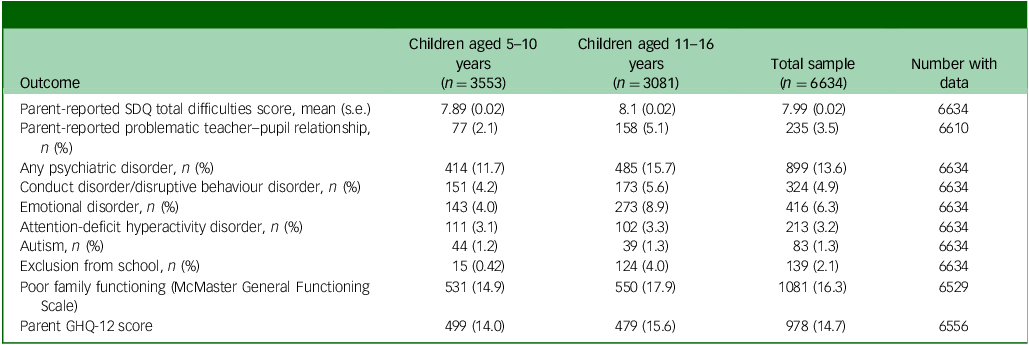
As shown in Table 1, in our total sample (n = 6634), 3.5% (n = 235) of children reported having a problematic TPR, and 13.6% (n = 899) of children were reported to have a DSM-5 psychiatric disorder. These children had markedly more adverse sociodemographic and mental health profiles compared with their peers, including significantly higher rates of SEN (5–10 years: χ 2(1) = 113.24, P < 0.001; 11–16 years: χ 2(1) = 72.77, P < 0.001) (Supplementary Tables 8 and 9).
Distribution of measures and outcomes from the Mental Health of Children and Young People 2017 survey sample, adjusted for survey design

Table 1 Long description
The table presents data on mental health outcomes and sociodemographic profiles for children aged 5-10 years and 11-16 years. It includes columns for different age groups, total sample, and the number with data. The rows list various outcomes such as parent-reported SDQ total difficulties score, problematic teacher-pupil relationship, psychiatric disorder, conduct disorder, emotional disorder, attention-deficit hyperactivity disorder, autism, exclusion from school, poor family functioning, and parent GHQ-12 score. Each row provides specific values for each category. The table aims to highlight the distribution of these measures and outcomes in the specified age groups.
SDQ, Strengths and Difficulties Questionnaire; GHQ-12, 12-item General Health Questionnaire.
Psychiatric disorders and mental health
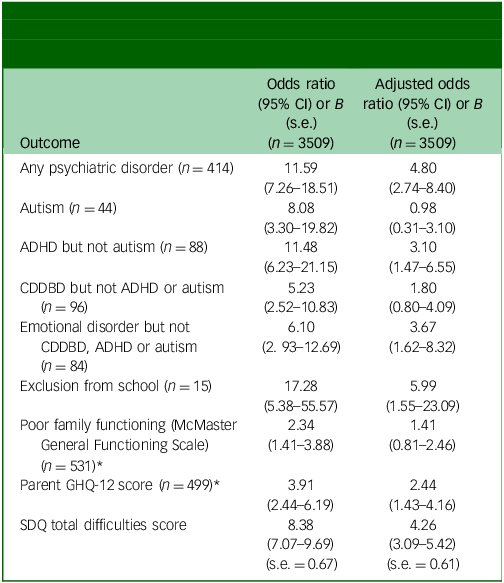
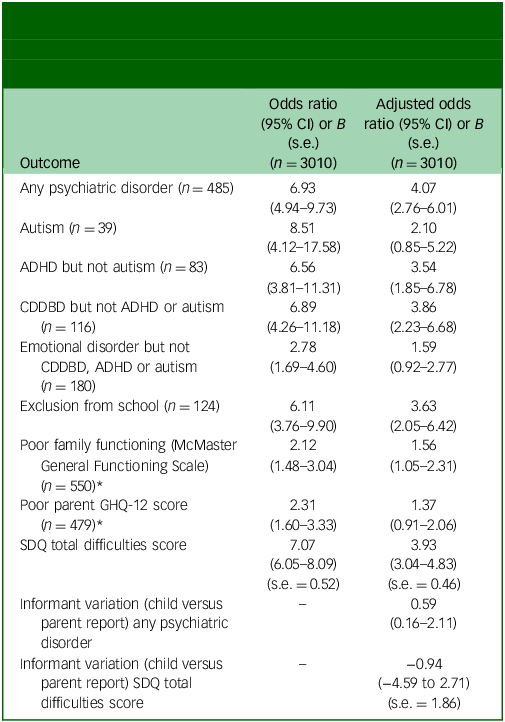
Regarding hypotheses 1 and 2, problematic TPRs were associated with higher prevalence of any psychiatric disorder (5–10 years: AOR = 4.80, 95% CI: 2.74–8.40; 11–16 years: AOR = 4.07, 95% CI: 2.76–6.01) and poor mental health (Tables 2 and 3); this association varied with type of disorder but not entirely as predicted. Among 5- to 10-year-olds, problematic TPRs were associated with higher odds of ADHD (AOR = 3.10, 95% CI: 1.47–6.55) and emotional disorders (AOR = 3.67, 95% CI: 1.62–8.32) but not with those of CDDBDs (AOR = 1.80, 95% CI: 0.80–4.09) or autism (AOR = 0.98, 95% CI: 0.31–3.10). Among 11- to 16-year-olds, parent-reported TPRs were associated with ADHD (AOR = 3.54, 95% CI: 1.85–6.78) and CDDBDs (AOR = 3.86, 95% CI: 2.23–6.68), whereas associations with emotional disorders (AOR = 1.59, 95% CI: 0.92–2.77) and autism (AOR = 2.10, 95% CI: 0.85–5.22) were weaker and not statistically significant. Problematic TPRs were also associated with higher SDQ total difficulties scores across both age groups (5–10 years: B = 4.26, s.e. = 0.61; 11–16 years: B = 3.93, s.e. = 0.46). Problematic TPRs were strongly associated with school exclusion in both age groups (5–10 years: AOR = 5.99, 95% CI: 1.55–23.09; 11–16 years: AOR = 3.63, 95% CI: 2.05–6.42). With respect to secondary outcomes, associations with poor parental mental health and family functioning were weaker and inconsistent, reaching significance only in older children for family functioning (AOR = 1.56, 95% CI: 1.05–2.31) and in younger children for parental mental health (AOR = 2.44, 95% CI: 1.43–4.16).
Bivariate (unadjusted) and multivariate (adjusted) analyses of psychosocial outcomes associated with problematic TPRs in children aged 5–10 years (n = 3509; problematic TPR n = 77)

Table 2 Long description
A table with 11 rows and 3 columns comparing psychosocial outcomes associated with problematic TPRs in children aged 5–10 years. The columns are labeled ‘Outcome’, ‘Odds ratio (95% CI or B (s.e.)) (n = 3509)’, and ‘Adjusted odds ratio (95% CI or B (s.e.)) (n = 3509)’. The table includes data on various outcomes such as any psychiatric disorder, autism, ADHD, CDDBD, emotional disorder, exclusion from school, poor family functioning, parent GHQ-12 score, and SDQ total difficulties score. Each row provides specific odds ratios and adjusted odds ratios for these outcomes.
TPR, teacher–pupil relationship; ADHD, attention-deficit hyperactivity disorder; CDDBD, conduct disorder/disruptive behaviour disorder; GHQ-12, 12-item General Health Questionnaire; SDQ, Strengths and Difficulties Questionnaire.
Multivariable models were adjusted for: SEN status, age, gender, ethnicity, parent-reported child general health, housing tenure, receipt of income support benefit, receipt of Employment and Support Allowance, parental educational qualification, family functioning (McMaster General Functioning Scale) and parental mental health (GHQ-12).
*In separate, parallel models, family functioning and parental mental health were instead modelled as secondary outcomes, adjusted for the same set of covariates (excluding each other).
Bivariate (unadjusted), multivariable (adjusted) and moderation analyses of psychosocial outcomes associated with problematic TPRs in children aged 11–16 (n = 3010; problematic TPR n: 158–159)

Table 3 Long description
The table presents data on the odds ratios and adjusted odds ratios of various psychiatric disorders and psychosocial outcomes in children with problematic TPRs. It includes three main columns: Outcome, Odds ratio (95% CI or B (s.e.)), and Adjusted odds ratio (95% CI or B (s.e.)). The table has 12 rows, each representing a different outcome or disorder. Row 1: Any psychiatric disorder, Odds ratio 6.93 (4.94-9.73), Adjusted odds ratio 4.07 (2.76-6.01). Row 2: Autism, Odds ratio 8.51 (4.12-17.58), Adjusted odds ratio 2.10 (0.85-5.22). Row 3: ADHD but not autism, Odds ratio 6.56 (3.81-11.31), Adjusted odds ratio 3.54 (1.85-6.78). Row 4: CDDBD but not ADHD or autism, Odds ratio 6.89 (4.26-11.18), Adjusted odds ratio 3.86 (2.23-6.68). Row 5: Emotional disorder but not CDDBD, ADHD or autism, Odds ratio 2.78 (1.69-4.60), Adjusted odds ratio 1.59 (0.92-2.77). Row 6: Exclusion from school, Odds ratio 6.11 (3.76-9.90), Adjusted odds ratio 3.63 (2.05-6.42). Row 7: Poor family functioning (McMaster General Functioning Scale), Odds ratio 2.12 (1.48-3.04), Adjusted odds ratio 1.56 (1.05-2.31). Row 8: Poor parent GHQ-12 score, Odds ratio 2.31 (1.60-3.33), Adjusted odds ratio 1.37 (0.91-2.06). Row 9: SDQ total difficulties score, Odds ratio 7.07 (6.05-8.09), Adjusted odds ratio 3.93 (3.04-4.83). Row 10: Informant variation (child versus parent report) any psychiatric disorder, Odds ratio not provided, Adjusted odds ratio 0.59 (0.16-2.11). Row 11: Informant variation (child versus parent report) SDQ total difficulties score, Odds ratio not provided, Adjusted odds ratio -0.94 (-4.59 to 2.71).
TPR, teacher–pupil relationship; ADHD, attention-deficit hyperactivity disorder; CDDBD, conduct disorder/disruptive behaviour disorder; GHQ-12, 12-item General Health Questionnaire; SDQ, Strengths and Difficulties Questionnaire.
Multivariable models were adjusted for: SEN status, age, gender, ethnicity, parent-reported child general health, housing tenure, receipt of income support benefit, receipt of Employment and Support Allowance, parental educational qualification, family functioning (McMaster General Functioning Scale) and parental mental health (GHQ-12).
*In separate, parallel models, family functioning and parental mental health were instead modelled as secondary outcomes, adjusted for the same set of covariates (excluding each other).
Consistent with the results of the broader regression models (Supplementary Tables 10 and 11), the risk of psychiatric disorder risk elevated among children with poorer general health, parental mental health difficulties and family dysfunction, with SEN showing the strongest associations (AORs ∼5), as expected given their overlap with psychiatric conditions. Reference Severyn, Chatburn, Norman, Newlove-Delgado, Saxton and Bjornstad29 Similarly, higher SDQ total difficulties scores were predicted by both problematic TPRs and these broader child and family vulnerabilities.
Child report
Agreement between parent and child reports was low (κ w = 0.16, 95% CI: 0.08–0.24; Supplementary Table 12). Despite this, similar patterns of association were observed for overall psychiatric disorder for child-reported TPRs (AOR = 3.17, 95% CI: 1.80–5.59; Supplementary Table 13) and SDQ total difficulties scores (B = 3.26, s.e. = 0.70). Stronger associations were noted for CDDBDs (AOR = 3.54, 95% CI: 1.45–8.66), whereas estimates for autism (AOR = 3.66, 95% CI: 0.37–36.08), ADHD (AOR = 0.94, 95% CI: 0.17–5.22) and emotional disorders (AOR = 2.01, 95% CI: 0.94–4.31) were imprecise and not statistically significant. Informant effects were small and non-significant across diagnostic categories (Table 3), indicating that the strength of associations between problematic TPRs and psychosocial outcomes was largely consistent between child- and parent-reported data.
Moderation
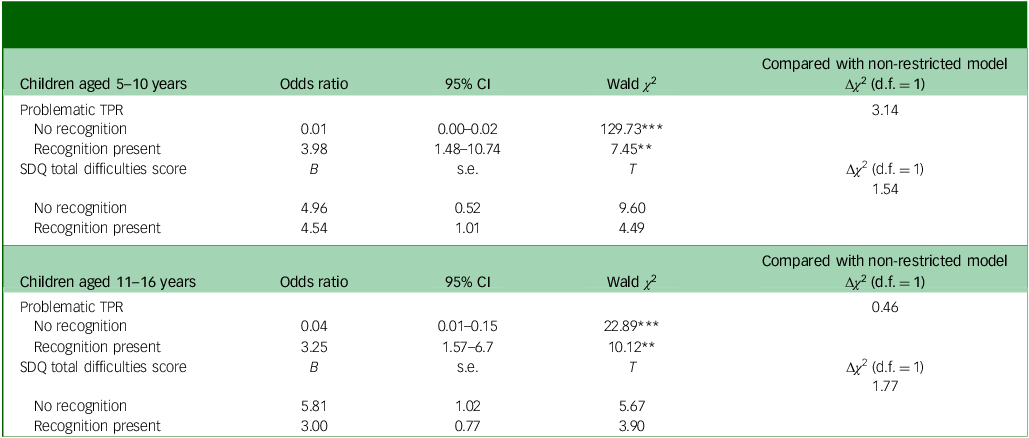
As shown in Table 4, we found no evidence of moderation between TPRs and SDQ scores in younger children (5–10 years; Δχ 2(1) = 1.54, P = 0.214), whereas psychiatric disorder models in this group were unstable owing to small cell sizes. Similarly, no significant moderation effects were found in older children (11–16 years) for either psychiatric disorders (Δχ 2(1) = 0.46, P = 0.499) or SDQ scores (Δχ 2(1) = 1.77, P = 0.183).
Moderation analysis of effect of teacher recognition on the association between problematic TPRs and psychosocial outcomes in the teacher-contact subgroup (n = 3597; 5- to 10-year-olds: n = 2042; 11- to 16-year-olds: n = 1534)

Table 4 Long description
A table comparing the effect of teacher recognition on problematic TPRs and psychosocial outcomes in children aged 5-10 and 11-16 years. The table has 10 rows and 6 columns. Column headers are: Path/group, Odds ratio, 95% CI, Wald chi-squared, and Compared with non-restricted model. Row labels include Problematic TPR and SDQ total difficulties score, with subcategories for No recognition and Recognition present. For children aged 5-10 years, the odds ratios for No recognition and Recognition present under Problematic TPR are 0.01 and 3.98, respectively. The Wald chi-squared values are 129.73 and 7.45, respectively. For SDQ total difficulties score, the odds ratios for No recognition and Recognition present are 4.96 and 4.54, respectively. For children aged 11-16 years, the odds ratios for No recognition and Recognition present under Problematic TPR are 0.04 and 3.25, respectively. The Wald chi-squared values are 22.89 and 10.12, respectively. For SDQ total difficulties score, the odds ratios for No recognition and Recognition present are 5.81 and 3.00, respectively.
TPR, teacher–pupil relationship; SDQ, Strengths and Difficulties Questionnaire.
*p < 0.05, **p < 0.01, ***p < 0.001.
Discussion
This study examined cross-sectional associations between problematic TPRs and both psychiatric disorder and poor mental health among a nationally representative sample of children aged 5–16 years in England. The findings demonstrated a consistent cross-sectional association between problematic TPRs and both psychiatric disorder and poor mental health, regardless of whether the TPR was reported by a parent or a child, despite low levels of agreement between these informants. Contrary to expectations, associations were not consistently stronger for disorders that impinged more on the classroom compared with emotional disorders, and teacher recognition did not moderate these associations.
Specifically, problematic TPRs were significantly associated with both psychiatric disorders and poor mental health in children aged 5–10 and 11–16 years, consistent with existing literature. Reference Miller-Lewis, Sawyer, Searle, Mittinty, Sawyer and Lynch2,Reference Parker, Tejerina-Arreal, Henley, Goodman, Logan and Ford6,Reference lain Lang, Marlow, Goodman, Meltzer and Ford7 With many childcare professionals advocating greater utilisation of the school environment to support child and adolescent mental health, Reference Fazel, Hoagwood, Stephan and Ford30 these findings emphasise the importance of considering TPR, particularly when pursuing the government’s goals outlined in the policy document Transforming Children and Young People’s Mental Health Provision: A Green Paper 31 in developing a comprehensive whole-school approach to mental health support. To effectively meet the mental health needs of students, government policy makers and educators should focus on fostering positive TPR quality through implementation of new and existing targeted interventions, such as those from the Education Endowment Foundation (https://educationendowmentfoundation.org.uk/), including social and emotional learning sessions and small-group teaching that aims to improve emotional regulation and peer relationships. Our observed association between parental mental health and TPR quality in younger children further underscores the importance of family-inclusive services within our schools.
Notably, problematic TPRs were significantly associated with school exclusion in both age groups, an alarming finding given rising UK exclusion rates and the known harms of exclusion to educational and social outcomes. 32 Therefore, our findings support calls to adequately support and improve behavioural management approaches for this vulnerable group. Reference Obsuth, Madia, Murray, Thompson and Daniels33
Hypothesis 2 was not supported: emotional disorders, CDDBDs and autism did not show consistent associations across age groups. These findings require cautious interpretation and replication in larger samples. The consistent ADHD findings were in line with the literature, Reference Moore, Russell, Arnell and Ford34 which reports more conflictual and less supportive TPR in children with ADHD, probably reflecting challenges related to attentional and behavioural regulation; these findings thus underscore the continued need to promote better relational support for this group. The lack of a significant association for CDDBDs in younger children may have been due to a small sample or the varying severity of the antisocial behaviour that individuals with conduct disorder can exhibit at different ages. Our findings in relation to autism are difficult to reconcile with recent pupil-reported experiences that highlight ‘being misunderstood’ by teachers as a major school-related difficulty. 35 In addition, the observation of an association between problematic TPRs and emotional disorders in younger children but not in adolescents may reflect developmental differences in the salience of teacher relationships, as younger children may rely more heavily on teachers as key sources of emotional support. By contrast, adolescents may derive greater support from peer relationships or be less influenced by any single teacher relationship. This finding is nevertheless concerning, as current behavioural guidance remains disproportionately focused on disruptive behaviours, with limited attention to the relational challenges posed by depressive and/or anxiety symptoms. 36 Our findings suggest that support strategies should adopt a broader relational approach to address both disruptive and withdrawn behaviours to prevent further marginalisation of emotionally vulnerable students. Such approaches may include promoting active monitoring of quieter students to maintain engagement and establishing consistent classroom routines regarding behaviour early in the academic year. 37
Associations remained significant regardless of teacher recognition across both age groups; this suggests that recognition alone may be insufficient to improve TPR quality, consistent with evidence that teachers can identify pupils experiencing difficulty but often struggle to judge the severity of that difficulty. Reference Mathews, Newlove-Delgado, Finning, Boyle, Hayes and Johnston38 These findings support evidence that enhanced teacher training in relationship-building and behaviour management may be particularly effective for pupils with psychiatric disorders and/or neurodevelopmental conditions. Reference Ford, Hayes, Byford, Edwards, Fletcher and Logan39–Reference Aldabbagh, Glazebrook, Sayal and Daley41 Given the absence of a moderating effect, future research should evaluate how existing teacher programmes are translated into meaningful support and ensure that pupils feel acknowledged and appropriate adjustments are made. 42 This is particularly pressing given that some pupils report distrust in schools as safe spaces to discuss their mental health. Reference Spall, Singh Grewal, Musanu, Wilkinson and Farrant43
Modest variation was observed between parent- and child-reported TPRs. Informant agreement was low, with most problematic TPRs reported by children not identified by parents. Our findings are consistent with the literature and could be influenced by context-specific differences, meaning that relational difficulties might be experienced or recognised differently at home and school. They might also be affected by informant-specific perspectives and reporting biases, as parents and children may have different insights into children’s experiences and may interpret or report challenges differently. Furthermore, discrepancies can occur because some relational issues are subtle or internalised, making them less apparent to external observers. Reference Collishaw, Goodman, Ford, Rabe-Hesketh and Pickles8 Nonetheless, parents identified more cases overall, possibly reflecting different thresholds of concern compared with their children. Significant associations between problematic TPRs and psychiatric disorder were observed regardless of the informant; however no statistically significant variation between informant types was found. These findings suggest that informant perspective does not influence the presence of the association itself. The absence of teacher-reported data limited triangulation and should be rectified in future work.
Methodological considerations
This study used a large, nationally representative probability sample from the 2017 MHCYP survey, enhancing its generalisability to the UK population. The composite ‘psychiatric disorders’ (which included neurodevelopmental conditions within the survey) and mental health were assessed using validated instruments. Inclusion of both parent- and child-reported TPR quality provided a unique contribution, as child perspectives are seldom captured in population-level research. In this study, we also adjusted for a broad set of sociodemographic, socioeconomic and family-level covariates, enabling a contextualised interpretation of TPR effects relative to established outcomes such as parental mental health and family functioning. Reference lain Lang, Marlow, Goodman, Meltzer and Ford7
Several limitations were inherent in this study. First, its cross-sectional design precluded causal inference. Although problematic TPRs were associated with a range of adverse outcomes, it remains unclear whether relational difficulties contribute to mental health problems or vice versa; longitudinal studies are needed to disentangle these pathways. School-level clustering could not be accounted for, as school identifiers were not available in the data-set. This may have influenced the precision of the estimated associations; however, recruitment was not school-based, and analyses of 2 previous surveys found that approximately half of the children in the sample were the only participant attending their school, with a maximum of 19 pupils recruited from any single school. Reference Ford and Goodman44
Although binary measurements offered a pragmatic approach within the constraints of the data-set, they did not enable us to capture the full complexity of TPR dynamics, which include aspects such as emotional support, conflict and or mutual respect. Decisions to group ‘minor’ teacher-perceived difficulties with ‘no’ difficulties and ‘fair’ child health with ‘bad/poor’ health were made to create dichotomous variables that meaningfully distinguished the presence versus absence of significant concern and significant health problems. As these were not ordinal variables with clear anchors, we were concerned that finer gradations might not have been meaningful or reliable. We also adopted this approach to ensure consistency with previous work. Reference Parker, Tejerina-Arreal, Henley, Goodman, Logan and Ford6 Regarding the DAWBA, some degree of misclassification was unavoidable, as no diagnostic tool is perfect. The DAWBA reduces this risk by collecting data from multiple informants and combining structured questions, semi-structured probes and clinician assessments; this improves its accuracy and makes it better suited to use in clinical practice than comparable instruments. Reference Angold, Erkanli, Copeland, Goodman, Fisher and Costello45
Several models, particularly those examining autism, were underpowered owing to low prevalence in our sample; this reduced the reliability of the corresponding estimates. These findings should be interpreted as exploratory and require replication in larger samples. All variables were based on self or parent report, which may have introduced shared-method variance and bias. The reliance on parent-reported outcomes may have inflated associations observed in parent-reported TPR models.
Although the problem of missing data was addressed using multiple imputation, the analysis was constrained by computational limitations within the secure research environment. As a result, auxiliary variable selection was restricted to the primary study variables (covariates and outcomes) rather than a broader set of auxiliary variables that might otherwise have improved the imputation model. Nonetheless, the complete-case analysis found in the supplementary material produced comparable results, supporting the robustness of our findings.
Implications for policy and practice
The findings of this study underscore the importance of TPR in any behavioural and mental health policy, as well as the need for research into the efficacy of existing behavioural management techniques, as recommended by Aldabbagh et al. Reference Aldabbagh, Glazebrook, Sayal and Daley41 Post-COVID behavioural strategies encouraged in UK schools, which include targeted one-to-one interventions such as structured discussions with pupils, as well as small-group support through settings such as pupil support units, 36 have not yet been evaluated in terms of their impact on relational dynamics. This presents a critical gap, particularly given rising behavioural concerns Reference Doan, Burniston, Smiley and Liu46 and the protective role of supportive TPRs for pupils with psychiatric disorders and/or neurodevelopmental conditions. Reference McGrath and Van Bergen1
Current Department for Education guidance on behaviour management risks inconsistent application, especially in relation to pupils with SEN, many of whom will have co-occurring psychiatric conditions Reference Severyn, Chatburn, Norman, Newlove-Delgado, Saxton and Bjornstad29 For example, the instruction that ‘a teacher should not assume’ that SEN underlie behaviour lacks operational clarity and may lead to inequitable responses. Likewise, ‘Behaviour Hubs’, now active across over 600 schools, 47 may be considered unfriendly to vulnerable pupils, raising concerns about unintended relational harm. These tensions are particularly concerning considering evidence that emotionally based school avoidance is becoming more prevalent. Reference Lester and Michelson48 Now is the time to revisit exclusion practices; clarify behavioural guidance; and provide teachers with better training in classroom management, relationship-based approaches such as the establish–maintain–restore model, and simple evidence-informed strategies such as behaviour-specific praise. 37 The findings of this study highlight the value of prioritising TPR quality in whole-school mental health strategies. Interventions should target both teacher development and broader systemic support structures to foster positive relational climates.
In addition, future evaluations of behavioural policy should incorporate teacher-, parent-, and pupil-reported relational data to assess impact on TPRs, as without such attention to relational context, strategies risk undermining mental health aims. Future research should employ longitudinal designs, incorporate teacher perspectives and ensure sufficient power to explore diagnostic subgroups more precisely.
Supplementary material
The supplementary material is available online at https://doi.org/10.1192/bjo.2026.12091
Data availability
The data that support the findings of this study are available from NatCen Social Research through the UK Data Service under Special Licence Access (study number 8467). Access to the data-set requires approval from the UK Data Service owing to confidentiality restrictions. 49 The analytic code for this study is not publicly available, as analyses were conducted within the University of Cambridge’s secure research environment. However, the corresponding author, M.S., will review requests and make an effort to provide the code, subject to data security and institutional restrictions.
Acknowledgements
Some sections of this work were adapted from M.S.’s master’s thesis, ‘A cross-sectional analysis assessing the association between problematic teacher-pupil relationships and psychiatric disorder, as reported by parents and children’, which is not publicly available or published online. Reference Severyn, Ford and White50 This study was preregistered on the Open Science Framework.
Author contributions
M.S. conceived the study, conducted the data analysis, interpreted the findings and drafted the manuscript. S.R.W. provided statistical supervision, contributed to data interpretation and critically revised the manuscript for important intellectual content. T.J.F. contributed to the conception and design of the study, provided guidance on interpretation, and critically reviewed and approved the final manuscript.
Funding
This research received no specific grant from any funding agency in the public, commercial or not-for-profit sectors.
Declaration of interest
T.J.F.’s research group receives funding for research methods consultancy from Place2Be, a third-sector organisation that provides mental health training and interventions in schools.


 Open access


eLetters
No eLetters have been published for this article.