Informing emergency medicine providers of the local resistance patterns for uropathogens may optimize empiric treatment of urinary tract infection. Recent emergency department–based studies have demonstrated that urinary isolates of Escherichia coli are often resistant to trimethoprim-sulfamethoxazole (TMP-SMX).Reference Filiatrault 1 , Reference Moffett, Frazee, Stein, Navab, Maselli, Takhar and Gonzales 2 Low rates of resistance to nitrofurantoin have been reported for common uropathogens.Reference Kassakian and Mermel 3 , Reference Auer, Wojna and Hell 4 We evaluated changes in the antibiotic prescribing patterns for patients discharged from the emergency department after distribution of antibiotic resistance data specific to our emergency department patient population.
A quasi-experimental study design was used with retrospective chart review for all patients discharged from our emergency department with a diagnosis of urinary tract infection from October 1, 2014, to March 31, 2015. The primary outcome was to compare the prescribing patterns for uncomplicated urinary tract infection at baseline (October 1, 2014, through November 30, 2014) and after education regarding local uropathogen resistance (February 1, 2015, through March 31, 2015). Prescribing patterns were evaluated for all patients that received a prescription for suspected urinary tract infection at 3 sites in Providence, Rhode Island: Rhode Island Hospital, The Miriam Hospital, and Hasbro Children’s Hospital. All sites are staffed by the same group of emergency medicine providers and together account for >200,000 patient visits per year.
Baseline antibiotic resistance was collected for each urine culture that grew >100,000 CFU/mL of a single microorganism. E. coli was identified in approximately 80% of urine cultures and therefore was chosen as the primary organism of interest for this intervention when isolated as a single pathogen. If patients with such urine culture results presented to the emergency department more than once, only the initial visit was used for the primary analysis. Urine isolates of E. coli had a lower likelihood of resistance to nitrofurantoin (5%) compared to fluoroquinolones or TMP-SMX (14% and 29%, respectively, P<.001) but not cefazolin (8%, P=.2). Antibiotic resistance data for E. coli were sent to all providers by email on December 3, 2014, and were posted in emergency department clinical treatment areas. The message included a recommendation to consider nitrofurantoin in the absence of contraindications due to low rate of resistance. Updated information was sent February 2, 2015, and March 23, 2015. The final update included further clarification of the use of nitrofurantoin in elderly patients; nitrofurantoin should only be used for short-term treatment of uncomplicated UTIs.
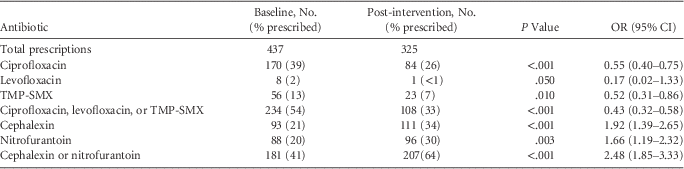
A total of 1,140 patients were discharged from the emergency department with a diagnosis of uncomplicated UTI and were prescribed antibiotics. There were fewer prescriptions for TMP-SMX (13% vs 7%, P=.01) and ciprofloxacin (39% vs 26%, P<.001) and more prescriptions for nitrofurantoin (20% vs 30%, P=.003) and cephalexin (21% vs 34%, P<.001) at the end of the study period (Table 1).
Empiric Antibiotic Prescriptions for Uncomplicated Urinary Tract Infections

NOTE. OR, odds ratio; CI, confidence interval; TMP-SMX, trimethoprim-sulfamethoxazole.
A total of 651 urine cultures were sent during the periods of comparison. There were 117 (18%) cultures with no growth and 217 (33%) with multiple organisms suggestive of contamination. E. coli was isolated in 267 of the 317 (84%) cultures with a single organism. During the first 2 months of the study, 11 of 144 patients (7.6%) with a urine culture positive for E. coli were prescribed antibiotics that were not effective against the isolated organism. Of these patients, 10 were prescribed ciprofloxacin and 1 patient was prescribed TMP-SMX. In the final 2 months of the study, 5 of 123 patients (4.1%) were prescribed ineffective antibiotics. Of these, 4 patients were prescribed ciprofloxacin and 1 patient was prescribed cephalexin. The reduction in prescribing ineffective antibiotics did not reach statistical significance (OR, 0.51; 95% CI, 0.17–1.52).
Information on urinary pathogen resistance patterns changed the prescribing practice of emergency medicine providers. Focusing empiric treatment on antibiotics with the lowest likelihood of resistance may decrease the likelihood that patients receive ineffective antibiotics, even though the subset of patients that had urine culture data available in this study was of inadequate size to show a statistically significant change.
Prior investigation demonstrated that only 57% of the elderly patients treated for UTI in the emergency department had a positive urine culture and that overtreatment of infections with broad-spectrum antibiotics is common in the emergency department.Reference Gordon, Waxman, Ragsdale and Mermel 5 , Reference Shapiro, Hicks, Pavia and Hersh 6 Some degree of overdiagnosis remains because 18% of the patients treated for suspected UTI with culture results available had no organism isolated. Initiating treatment with a narrow-spectrum antibiotic, such as nitrofurantoin, in patients with uncomplicated UTI may be the safest alternative.
Despite education on the appropriate use of nitrofurantoin, 2 patients diagnosed with pyelonephritis in the last 2 months of the study period were prescribed nitrofurantoin. Future antibiotic stewardship efforts will focus on prevention of such unintended consequences.
This retrospective chart review had several limitations. We were not able to evaluate whether changes in prescribing patterns resulted in decreased treatment failures. The patients selected for the primary analysis were discharged with a diagnosis of uncomplicated UTI and therefore were suspected to be stable, but patient condition on discharge or additional outside medical care was not evaluated. The patients in the pre-intervention group were slightly older (47.6 vs 43.7 years; P=.02). Patient’s prior resistance patterns, if available, and allergies were also likely to impact prescribers’ selection of empiric antibiotics for suspected UTI. Further prospective analysis is required.
Our data suggest that increased awareness of local resistance patterns and dissemination of this data to providers has important implications for antimicrobial stewardship at other hospitals.
ACKNOWLEDGMENTS
Financial support: No financial support was provided relevant to this article.
Potential conflicts of interest: All authors report no conflicts of interest relevant to this article.