1. INTRODUCTION
The interaction of high-intensity femtosecond laser pulses with plasmas is an important area of fundamental research and scientific applications, such as biomedical, particle acceleration (Tajima & Dawson, Reference Tajima and Dawson1979; Faure et al., Reference Faure, Glinec, Pukhov, Kiselev, Gordienko, Lefebvre and Malka2004), X-ray lasers (Burnett & Corkum, Reference Burnett and Corkum1989; Amendt et al., Reference Amendt, Eder and Wilks1991; Lemoff et a l., Reference Lemoff, Yin, Gordan, Barty and Harris1995), and high harmonic generation (Lin et al., Reference Lin, Chen and Kieffer2002). The interaction of intense laser pulse with plasma gives rise to a variety of nonlinear process (Drake et al., Reference Drake, Lee, Nishikawa and Tsintsadze1976; Pukhov et al., Reference Pukhov, Sheng and Meyer-Ter-vehn1999; Gattass & Mazur, Reference Gattass and Mazur2008) such as self-compression (Wilks et al., Reference Wilks, Kruer, Tabak and Langdon1992; Shibu et al., Reference Shibu, Parashar and Pandey1998; Sholokhov et al., Reference Sholokhov, Pukhov and Kostyukov2003; Karle & Spatschek, Reference Karle and Spatschek2008), self-focusing/filamentation (Akhmanov et al., Reference Akhmanov, Sukhorukov and Khokhlov1968; Sodha et al., Reference Sodha, Ghatak and Tripathi1976a , Reference Sodha, Tripathi and Ghatak b ), the growth of various parametric instabilities (Kruer, Reference Kruer1976), plasma wave excitation (Hora, Reference Hora1975) and so on. The nonlinear processes also cause the pulse compression. Therefore, the compression of the laser beam is the most powerful approach to boost the intensity and reduce the pulse duration that is, resulting in short laser pulses. In the generation of the ultra-short and ultra-intense laser pulse, significant progress has been built by chirped-pulse-amplification, where the laser pulse is stretched, amplified, and recompressed by passing through a pair of the parallel diffraction grating. This method, limited by the finite bandwidth of amplifier was used in laser (Mourou et al., Reference Mourou, Barty and Perry1998).
For ultra-high laser intensity pulse may not be further compressed because its bandwidth is minimum at same frequency spectrum. As the time bandwidth product as smallest as achievable to because its time-bandwidth product is as minimum as possible. Therefore the compression of the laser pulse is possible simply by increasing bandwidth that compresses the laser pulse in the time domain. Due to the presence of nonlinearity the new frequency component can be generated. Hence, the nonlinearity plays a significant role in self-compression processes. Being nonlinear behavior of plasma medium has an additional advantage over diffraction gratings and nonlinear crystals. Due to ionize state of plasma it can sustain high-power laser pulse as compared with diffraction gratings because of their limitation of medium breakdown.
Ross et al. (Reference Ross, Matousek, Towrie, Langley and Collier1997) have shown a new strategy to generate ultra-short and ultra-high intensity pulse by using an optical parametric amplifier. Shvets et al. (Reference Shibu, Parashar and Pandey1998) have numerically examined the initial ultra-short laser pulse that can be superradiantly amplified by counter propagating low-intensity pump in plasma and their results reveal that the intensity of short pulses can be amplified to hundred times the initial pulse intensity, with pump depletion as high as 40%. Shibu et al. (Reference Shibu, Parashar and Pandey1998) have shown the possibility of compression of the laser pulse, and the short laser pulse in a plasma combined with relativistic nonlinearity. The pulse compressed due to non-uniform refractive index rising over the speed of the electron can be relativistic due to relativistic mass variation. Shorokhov et al. (Reference Shorokhov, Pukhov and Kostyukov2003) have shown the self-compression of a 30 fs long laser pulse compression up to 5 fs laser pulse in plasma. Pukhov (Reference Pukhov2002) have discussed some important aspects of laser–matter interaction at a relativistic intensity (1018 watt/cm−2) and have discussed the possibility of generating short pulse laser by using plasma medium. Karle & Spatschek (Reference Karle and Spatschek2008) have examined the self-compression and pule-focusing of the pulse in a plasma-vacuum system. Bet on the applicable parameters, plasma-vacuum systems have been schemed for pulse compression, such a system can be used as a replacement for hallow-fibers to compress a pulse. Sharma et al. (Reference Sharma, Borhanian and Kourakis2009) have investigated the self-compression of the Gaussian laser pulse. The simultaneous effect of group velocity dispersion and collisional nonlinearity affect the laser pulse compression as well as focusing. Sharma and Kourakis (Reference Sharma and Kourakis2010) have examined self-compression of Gaussian laser in an inhomogeneous density plasma having relativistic nonlinearity. Their numerical results have shown that the compression of the pulse and localization of intensity could be improved due to inhomogeneity in the plasma. A hundred femtosecond pulse can be compressed to more than 10 times in a non-uniform plasma. Bokaei and Niknam (Reference Bokaei and Niknam2014) have reported the spatiotemporal evolution of laser pulse propagating in weakly relativistic regime having relativistic and ponderomotive nonlinearities, near the critical density plasma. They have observed the existence of a turning point temperature for each of the initial pulse intensity to which the self-compression is highly sensitive. The results reveal that below this temperature the self-compression is considerably improved and weaken above it. Olumi and Maraghechi (Reference Olumi and Maraghechi2014) have investigated the self- compression of the intense short laser pulse in magnetized plasma having relativistic nonlinearity. They have also shown the effect of chirping on laser pulse in magnetized plasma. The compression of the pulse can be enhanced with the negative chirped, while positive chirp decompresses the laser pulse. Liang et al. (Reference Liang, Sang, Wan, Lv and Xie2015) have studied the compression of the relativistic laser pulse in magnetized plasma. They have observed the compression of left-and right-handed circularly polarized laser pulse.
Ample literature on the beating of two co-propagating laser beams is also present like Bharuthram and Parashar (Reference Bharuthram and Parashar1999) have shown the cross-focusing of two co-propagating laser beams in plasma. Purohit et al. (Reference Purohit, Pandey and Sharma2003) have studied the cross-focusing of two laser beams on the growth of laser ripple inside the plasma combined with ponderomotive nonlinearity. They have also found that the change in second beam intensity will change the growth of laser ripple. Sodha et al. (Reference Sodha, Mishra and Agarwal2007) have investigated the self-focusing of original electromagnetic (EM) beam and cross-focusing of various coaxial beams in a fully ionized collisional magnetized plasma. They have also seen that the ionic thermal conduction was affected by self-focusing/cross-focusing of the laser beam. Sharma and Chauhan (Reference Sharma and Chauhan2008) have reported extended paraxial model of cross-focusing of two laser beam in plasma. They have also observed the effect of axial and off-axial laser beams. Singh and Gupta (Reference Singh and Gupta2015) have investigated beat wave excitation of electron plasma wave due to the cross-focusing of two coaxial laser beams in plasma. Their Numerical results have shown that the consequence of laser with plasma parameters on cross-focusing can further affect the power of electrostatic plasma wave.
The self-compression of laser pulse in plasma have been studied by earlier workers (Ross et al., Reference Ross, Matousek, Towrie, Langley and Collier1997; Shibu et al., Reference Shibu, Parashar and Pandey1998; Shvets et al., Reference Shvets, Fisch, Pukhov and Meyer-Ter-vehn1998; Pukhov, Reference Pukhov2002; Shorokhov et al., Reference Shorokhov, Pukhov and Kostyukov2003; Karle & Spatschek, Reference Karle and Spatschek2008; Sharma et al., Reference Sharma, Borhanian and Kourakis2009; Sharma & Kourakis, Reference Sharma and Kourakis2010; Bokaei & Niknam, Reference Bokaei and Niknam2014; Olumi & Maraghechi, Reference Olumi and Maraghechi2014; Liang et al., Reference Liang, Sang, Wan, Lv and Xie2015). But, till now the propagation regimes of co-propagating laser beams in temporal domain inside the plasma, through critical and divider curve has not been studied, in the presence of relativistic nonlinearity. Therefore, the self-compression characteristic of both laser beams has been focused in this study. This study can find applications in laser-induced-fusion because the dynamics of the laser pulse is important in case of laser-induced fusion.
In this work, the semi-analytical method (eikonal) has been used to solve the coupled nonlinear Schrodinger equation. This paper is organized in the following manner. In Section 2 we have derived the model equation for two co-propagating laser beam. The propagation characteristic of two laser beams in relativistic plasma is defined by the critical value of beam power and pulse width through critical and divider curve in Section 3. The result and discussion are explained in Section 4, and results are summarized in concluding Section 5.
2. ANALYTICAL FORMULATION IN RELATIVISTIC PLASMA
We have considered two coaxially laser beams having same frequencies that are propagating along z-direction. The electric fields of both laser beams is given by,
 $$\vec E_{1,2} (z,t) = A_{1,2} (z,t)\exp \{ i(k_{1,2} z - { {\rm \omega}} _{1,2} t)\hat x\} $$
where A
1,2 is called amplitude of both laser beams,
 $k_{1,2} = \left( {{ {\rm \omega}} _{1,2} /c\sqrt {{ {\rm \varepsilon}} _{01,02}}} \right)$
is known as propagation vector, ω1,2 represent the angular frequency of both laser, and ε01,02 is called dielectric constant. The wave equations for two laser beams can be written as,
 $$\nabla ^2 \vec E_{1,2} - \displaystyle{1 \over {c^2}} \displaystyle{{\partial ^2 \vec E_{1,2}} \over {\partial t^2}} = \displaystyle{{4{ {\rm \pi}}} \over {c^2}} \displaystyle{{\partial \vec J_{1,2}} \over {\partial t}}$$
where
 $\vec J_{1,2} $
is the current density
 $$\vec J_{1,2} = - N_{}^{} {_{\rm e}} e\vec v_{1,2} $$
where
 $\vec v_{1,2} = ({\rm i}{\rm. e}.\;\vec E_{1,2} /m{ {\rm \omega}} _{1,2} { {\rm \gamma}} )$
is called oscillatory velocities of electrons imparted by laser fields, N
e represents the modified electron density. Now we have solved Eqs. (1) and (2) and replaced it with new dimensionless variables T = (t − z/v
g1,2)ω
p
and Z = (ω
p
/c)z, we get,
 $$2ik_{1,2} \displaystyle{{\partial A_{1,2}} \over {\partial Z}} + \displaystyle{{{ {\rm \omega}} _p} \over c}{ {\rm \beta}} _{1,2} \displaystyle{{\partial ^2 A_{1,2}} \over {\partial T^2}} = \displaystyle{{{ {\rm \omega}} _p} \over c}\left( {\displaystyle{1 \over { {\rm \gamma}}} - 1} \right)A_{1,2} $$
where
 $${ {\rm \beta}} _{1,2} = \left( {\displaystyle{1 \over {{ {\rm \varepsilon}} _{01,02}}} - 1} \right) = \displaystyle{{{ {\rm \omega}} _p^2} \over {{ {\rm \omega}} _{1,2}^2}} { {\rm \varepsilon}} _{01,02}^{ - 1} $$
We have again normalized the above equation and rewrite the propagation vector in new form, K 1,2 = k 1,2 (c/ω p ) then we have,
 $$2iK_{1,2} \displaystyle{{\partial A_{1,2}} \over {\partial Z}} + { {\rm \beta}} _{1,2} \displaystyle{{\partial A_{1,2}} \over {\partial T^2}} = \left( {\displaystyle{1 \over { {\rm \gamma}}} - 1} \right)A_{1,2} $$
Equation (6) is known as the coupled nonlinear Schrodinger equation (NLSE) in which the second term is called dispersion broadening and the effect of nonlinearity is arising because of variation in relativistic mass of electron, which is represented on the right-hand side of the equation.
We have considered paraxial approach proposed by Sodha et al. (Reference Sodha, Ghatak and Tripathi1976a ), which may anticipate the solution of Eq. (6) given as,
 $$A_{1,2} (Z,T) = A_{01,02} (Z,T)\exp \left\{ {iK_{1,2} S_{1,2} (Z,T)} \right\}$$
Where A 01,02 and S 1,2 are known as the amplitude of two beams and eikonals. Using Eqs. (6) and (7), we have found the real and imaginary parts of Eq. (6) as,
 $$\eqalign{2\left( {\displaystyle{{\partial S_{1,2}} \over {\partial Z}}} \right) + { {\rm \beta}} _{1,2} \left( {\displaystyle{{\partial S_{1,2}} \over {\partial T}}} \right)^2 & = - \left( {\displaystyle{1 \over { {\rm \gamma}}} - 1} \right)\displaystyle{1 \over {K_{1,2}^2}} \cr & \quad + \displaystyle{{{ {\rm \beta}} _{1,2}} \over {K_{1,2}^2 A}}_{01,02} \left( {\displaystyle{{\partial ^2 A_{01,02}} \over {\partial T^2}}} \right)}$$
and
 $$\displaystyle{{\partial A_{01,02}^2} \over {\partial Z^2}} + { {\rm \beta}} _{1,2} \left( {\displaystyle{{\partial S_{1,2}} \over {\partial T}}} \right)\left( {\displaystyle{{\partial A_{01,02}^2} \over {\partial T^2}}} \right) + { {\rm \beta}} _{1,2} \displaystyle{{\partial ^2 S_{1,2}} \over {\partial T^2}} = 0.$$
Now the solution of Eqs. (8) and (9) can be written as
 $$A_{01}^2 = \displaystyle{{E_{01}^2} \over {g_1}} \exp \left( { - \displaystyle{{T^2} \over {{ {\rm \tau}} _{01}^2 g_1^2}}} \right),$$
 $$A_{02}^2 = \displaystyle{{E_{02}^2} \over {g_2}} \exp \left( { - \displaystyle{{T^2} \over {{ {\rm \tau}} _{02}^2 g_2^2}}} \right) $$
where τ01 and τ02 are normalized pulse widths of both the laser beams.
 $$S_{1,2} = \displaystyle{{T^2} \over 2}{ {\rm \alpha}} _{1,2} (Z)$$
where
 $${ {\rm \alpha}} _{1,2} (Z) = \displaystyle{1 \over {{ {\rm \beta}} _{1,2} {\rm g}_{1,2}}} \displaystyle{{\partial g_{1,2}} \over {\partial Z}}$$
where g 1,2 (Z) is temporal pulse width parameter, the evolution of this parameter determines the pulse dynamic of two laser beams. Now using Eqs. (10)–(13) in Eq. (9) and collecting the term of (T 2) we get,
 $$\displaystyle{{\partial ^2 g_{1,2}} \over {\partial Z^2}} = \displaystyle{{{ {\rm \beta}} _{1,2}^2} \over {K_{1,2}^2 { {\rm \tau}} _{01,02}^4 g_{01,02}^3}} - \left( {\displaystyle{{{ {\rm \beta}} _{1,2} {\rm g}_{1,2}} \over {K_{1,2}^2}}} \right)\left( {\displaystyle{1 \over { {\rm \gamma}}} - 1} \right)$$
Now we have expanded ((1/γ) − 1) and collecting the term of T 2 we get,
 $$\eqalign{\displaystyle{{\partial ^2 g_{1,2}} \over {\partial Z^2}} & = \displaystyle{{{ {\rm \beta}} _{1,2}^2} \over {K_{1,2}^2 { {\rm \tau}} _{01,02}^4 g_{01,02}^3}} - \displaystyle{1 \over 2}\left( {\displaystyle{{{ {\rm \beta}} _{1,2} g_{1,2}} \over {K_{1,2}^2}}} \right)\left( {\displaystyle{{{ {\rm \alpha}} _1 E_{01}^2} \over {{ {\rm \tau}} _{{\rm 01}}^{\rm 2} g_1^3}} + \displaystyle{{{ {\rm \alpha}} _2 E_{02}^2} \over {{ {\rm \tau}} _{02}^2 g_2^3}}} \right)\cr & \quad \times \left( {\left( {1 + \displaystyle{{{ {\rm \alpha}} _1 {\rm \vert} E_{{\rm 01}} {\rm \vert} ^{\rm 2}} \over {g_1^2}} + \displaystyle{{{ {\rm \alpha}} _2 {\rm \vert} E_{{\rm 02}} {\rm \vert} ^{\rm 2}} \over {g_2^2}}} \right)^{ - 3/2}} \right)}$$
This is coupled NLSE for pulse width parameters (g 1,2) of both beams. The first term on right-hand side indicates the dispersion broadening. The second term is responsible for pulse compression of the laser beam, which is relativistic nonlinearity. The compression processes can be ensured, when the magnitude of the second term of Eq. (15) becomes larger than the first one.
Now the effective dielectric constant of plasma in the case of relativistic nonlinearity is defined by Sodha et al. (Reference Sodha, Ghatak and Tripathi1976a ) as,
 $${ {\rm \varepsilon}} _{1,2} = { {\rm \varepsilon}} _{01,02} + { {\rm \phi}} _{1,2} (E_1 E_1^*, E_2 E_2^* )$$
where
 $$\eqalign{ & {{\rm \phi}} _{1,2} (E_1 E_1^*, E_2 E_2^* ) = \displaystyle{{{ {\rm \omega}} _p^2} \over {{ {\rm \omega}} _{1,2}^2}} \left( {\displaystyle{{{ {\rm \gamma}} - 1} \over { {\rm \gamma}}}} \right), \cr & \quad {{\rm \varepsilon}} _{01,02} = \left( {1 - \displaystyle{{{ {\rm \omega}} _p^2} \over {{ {\rm \omega}} _{1,2}^2}}} \right)\; {\rm and}\;\Omega _{1,2} = \left( {\displaystyle{{{ {\rm \omega}} _p} \over {{ {\rm \omega}} _{1,2}}}} \right) } $$
The relativistic Lorentz factor for two laser beams can be written as,
 $${ {\rm \gamma}} = \left( {1 + \displaystyle{{{ {\rm \alpha}} _1 {\rm \vert} E_{{\rm 01}} {\rm \vert} ^{\rm 2}} \over {g_1}} \exp \left( { - \displaystyle{{T^2} \over {{ {\rm \tau}} _{01}^2 g_1^2}}} \right) + \displaystyle{{{ {\rm \alpha}} _2 {\rm \vert} E_{{\rm 02}} {\rm \vert}} \over {g_2}} ^{\rm 2} \exp \left( { - \displaystyle{{T^2} \over {{ {\rm \tau}} _{02}^2 g_2^2}}} \right)} \right)^{1/2} $$
where
 $${ {\rm \alpha}} _1 = \left( {\displaystyle{{e^2} \over {{\rm m}_{\rm 1}^{\rm 2} { {\rm \omega}} _1^2 c^2}}} \right)\;{\rm and}\;{ {\rm \alpha}} _2 = \left( {\displaystyle{{e^2} \over {{\rm m}_{\rm 2}^{\rm 2} { {\rm \omega}} _2^2 c^2}}} \right)$$
Now, using Eqs. (16) and (17) we get,
 $$\eqalign{&{\rm \varepsilon}_{1,2} = 1 - \Omega_{1,2}^2 \left(1 + \displaystyle{{{\rm \alpha}_{1}E_{01}^2} \over{g_1}} \exp \left({-\displaystyle{{T^2} \over {{\rm \tau}_{01}^{2}g_{1}^{2}}}}\right)\right. \cr & \quad \left. + \displaystyle{{{\rm \alpha}_{2}E_{02}^{2}} \over {g_2}} \exp \left({ - \displaystyle{{T^2} \over {{\rm \tau}_{02}^{2}g_{2}^{2}}}}\right)\right)^{- 1/2}}$$
By using Taylor's series expansion we can expand the value of effective dielectric constant as,
 $${ {\rm \varepsilon}} _{1,2} = { {\rm \varepsilon}} _{1,2} (T) + \left( {\displaystyle{{\partial { {\rm \varepsilon}} _{1,2}} \over {\partial T^2}}} \right)_{T^2 = 0} (T^2 ) + \ldots $$
 $${ {\rm \varepsilon}} _{01,02} (g_{1,2} ) = 1 - \Omega _{1,2}^2 \left( {1 + \displaystyle{{{ {\rm \alpha}} _1 E_{01}^2} \over {g_1}} + \displaystyle{{{ {\rm \alpha}} _2 E_{02}^2} \over {g_2}}} \right)^{ - 1/2} $$
 $$\eqalign{& {\rm \varepsilon }_{1,2}(T,g_{1,2}) = \displaystyle{{\Omega _{1,2}^2 } \over 2}\left( {1 + \displaystyle{{{\rm \alpha }_1E_{01}^2 } \over {g_1}} + \displaystyle{{{\rm \alpha }_2E_{02}^2 } \over {g_2}}} \right)^{\!\!\! - 3/2} \cr & \times \left( {\displaystyle{{{\rm \alpha }_1E_{01}^2 } \over {g_1}}\left( { - \displaystyle{1 \over {{\rm \tau }_{01}^2 g_1^2 }}} \right) + \displaystyle{{{\rm \alpha }_2E_{02}^2 } \over {g_2}}\left( { - \displaystyle{1 \over {{\rm \tau }_{02}^2 g_2^2 }}} \right)} \! \right) \times T^2} $$
3. CRITICAL AND DIVIDER CURVES
We have assumed g
1 = g
2 and
 $P_{01} = { {\rm \alpha}} _1 E_{01}^2 /g_1 $
, and
 $P_{02} = { {\rm \alpha}} _2 E_{02}^2 /g_2 $
are dimensionless quantities, where P
01 and P
02 represent the power of both laser beams. The quantities τ01 and τ02 are known as normalized pulse width of both laser beams, g
1 and g
2 are the pulse width parameters. If ∂2
g
1,2/∂Z
2 = 0, then Eq. (15) becomes,
 $${ {\rm \tau}} _{01}^2 g_1^2 = \left( {\displaystyle{{2{ {\rm \beta}} _1} \over {(P_{01} + P_{02} )}}\left( {1 + P_{01} + P_{02}} \right)^{3/2}} \right)$$
So, at (Z = 0) and (g 1 = g 2 = 1), Eq. (22) can be rewritten as
 $${ {\rm \tau}} _{01} = \left( {\displaystyle{{2{ {\rm \beta}} _{01}} \over {(P_{01} + P_{02} )}}\left( {1 + P_{01} + P_{02}} \right)^{3/2}} \right)^{1/2} $$
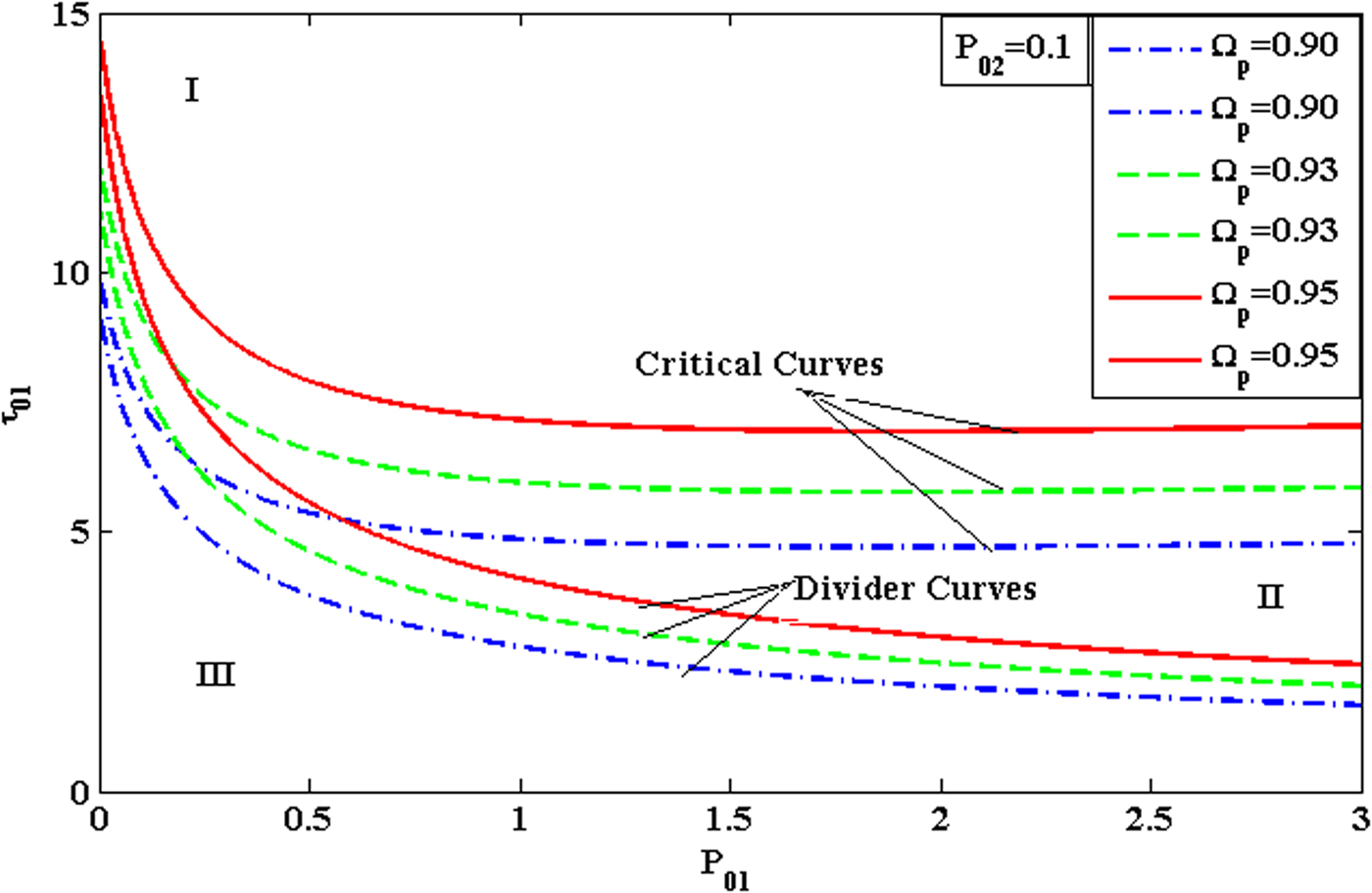
The value of α1, α2, and β1 are given in Eqs. (15) and (5), respectively. Equation (23) is called critical curve for two laser beams (by keeping second beam power constant P 02 = 0.1) at different plasma frequencies, which express the relation between dimensionless pulse width τ01 and dimensionless beam power P 01. If the initial power P 01 and of the pulse width τ01 of laser beams lies on the critical curve then we have ∂2 g 1,2/∂Z 2 = 0 and for the case of the point (τ01, P 01) lies above or below the critical curve then we have the value of ∂2 g 1,2/∂Z 2 positive (∂2 g 1,2/∂Z 2 >0) or negative (∂2 g 1,2/∂Z 2 <0), respectively. When τ01, P 01 lies on the critical curve then the value of ∂g 1,2/∂Z is zero and g 1 = g 2 = 1 under such condition, the value of pulse width parameters remains unchanged during propagation. However if the τ01, P 01 lies above the critical curve then ∂g 1,2/∂Z start decreasing to its initial value zero and g 1 and g 2 fall below unity as the beam propagates through the plasma leading to self-compression of the beams. Under such a condition the point τ01, P 01 moves along a downward direction thereby meeting on the critical curve leading to ∂2 g 1,2/∂Z 2 = 0. This indicates that this point τ01, P 01 is a point of inflection of g 1,2 versus Z graph.
Therefore, beyond this point the value of ∂g 1,2/∂Z starts increasing and reaches a minimum value of zero that is, g 1,2 acquires a minimum value, which signifies oscillatory compression of the laser pulse, so that the pulse width parameters oscillate between unity and minimum value. However, if the initial point τ01, P 01 lies below the critical curve, as the beam propagates, the point (τ01, P 01) moving towards the upward direction may touch the critical curve.
3.1. Divider curve
We have concluded the condition for oscillatory compression and the point (τ01, P 01) meeting on a critical curve and therefore, the vanishing of ∂2 g 1,2/∂Z 2 = 0 at that point for the direction propagation of g 1 and g 2 versus Z graph. Now from Eq. (20) we have,
 $$\left( {1 - { {\rm \varepsilon}} _{01,02} (g_{1,2} )} \right)^3 = \displaystyle{{\Omega _{1,2} ^6} \over {\left( {1 + P_{01} + P_{02}} \right)^{3/2}}} $$
Using the above Eq. (24) in Eq. (23) requires,
 $$\left( {1 - { {\rm \varepsilon}} _{01,02} (g_{1,2} )} \right)^3 = \displaystyle{{2\Omega _{1,2}^2} \over {(P_{01} + P_{02} )(1 - \Omega _{1,2}^2 )}}$$
Equation (25) yields a real positive value of g 1, we can obtain from Eq. (20):
 $$g_1 = \left( {\displaystyle{{\left( {1 - { {\rm \varepsilon}} _{01,02} (g_{1,2} )} \right)^2 \left( {P_{01} + P_{02}} \right)} \over {\Omega _{1,2}^4 - \left( {1 - { {\rm \varepsilon}} _{01,02} (g_{1,2} )} \right)^2}}} \right)$$
For the real positive value of g 1, Eq. (26) requires,
 $$\Omega _{1,2}^4 \gt (1 - { {\rm \varepsilon}} _{01,02} (g_{1,2} ))^2 $$
So that
 $$({ {\rm \varepsilon}} _{01,02} (g_{1,2} )) \lt (1 - \Omega _{1,2}^2 )$$
and
 $$\displaystyle{1 \over {({ {\rm \varepsilon}} _{01,02} (g_{1,2} ))}} \gt \displaystyle{1 \over {(\Omega _{1,2}^2 - 1)}}$$
Therefore from Eq. (25) we get,
 $${ {\rm \tau}} _{01}^2 \gt \displaystyle{{2\Omega _{1,2}^2} \over {(P_{01} + P_{02} )(1 - \Omega _{1,2}^2 )}}$$
Now, replacing the inequality sign by equality sign one can get,
 $${ {\rm \tau}} _{01}^2 = \displaystyle{{2\Omega _{1,2}^2} \over {(P_{01} + P_{02} )(1 - \Omega _{1,2}^2 )}}$$
Equation (28) is the expression of divider curve, which divides the positive quadrant of the critical curve into two parts and the two curves divided the quadrant into three regions I, II, and III, which signifies the steady broadening, oscillatory broadening, and oscillatory compression of the laser pulse, respectively. The oscillatory broadening can be observed, if the point (τ01, P 01) lies between the critical curve and divider curve and the initial propagating beams may meet on the critical curve to give the point of inflection. If the (τ01, P 01) lies below the divider curve, the original propagating laser beams are not able to reach on the critical curve, in that case, the beams will experience steady broadening. Thus, the two curves are divided into three regions I, II, and III such that, if the initial point (τ01, P 01) lies:
Region I: Above the critical curves: The beams go oscillatory compression with pulse width parameters oscillates between the initial value and a minimum.
Region II: Between the critical curve and divider curve: The beams undergo oscillatory broadening and pulse width parameters varying between initial values to a maximum value.
Region III: Below the divider curve: Beams steadily broaden.
4. RESULTS AND DISCUSSION
The semi-analytical results characterized the co-propagation of two Gaussian laser beams in plasma with relativistic nonlinearity. For a laser pulse with an initial power larger than critical power, Eq. (15) can be solved by numerical simulation with appropriate initial boundary condition (g 1 = g 2 = 1 and dg 1,2/dZ = 0, at Z = 0), and the following laser parameters: The wavelength of both laser beams are λ1 = λ2 = 1064 nm, laser frequencies are ω1 = ω2 = 1.77 × 10¹⁵ rad s−1.
In order to study characteristic of two laser beams in plasma, we have plotted the critical and divider curve between normalized pulse width τ01 and normalized beam power P 01 and keeping second laser power is constant at P 02 = 0.1 for different value of plasma frequencies Ω1,2 = 0.90, 0.93 and 0.95. The space between critical and divider curve is divided into three regions I, II, and III, these regions represent the oscillatory compression, oscillatory broadening, and steady broadening of both the laser beams in g 1 and g 2 versus Z graph. The variation of pulse width parameters g 1 and g 2 with normalized propagation distance have been analyzed at plasma frequency Ω1,2 = 0.93 .
Figure 1 illustrates the plot between dimensionless pulse width τ01 and dimensionless laser beam power P 01 at a constant power P 02 = 0.1 of second laser beam for different values of plasma frequencies Ω1,2 = 0.90, 0.93 and 0.95. It was observed that the laser pulse width initially decreases with laser beam power and then reaching around constant value with slight increase for critical curve and slight decrease for divider curve. The value of pulse width τ01 decreases with laser beam power P 01 as the value of Ω1,2 increases, because the nonlinearity of plasma gets stronger, and critical curve-divider curve also gets lower. If the initial point τ01, P 01 of laser beams lies below the critical curve, the initial value of ∂g 1,2/∂Z is positive and negative if it lies above. As laser beams propagate in plasma, the pulse width parameters g 1 and g 2 start decreasing, for the initial point (τ01, P 01) lies above the critical curve and move towards downward direction meeting at some points on the critical curve. This shows the inflection point in the g 1 and g 2 versus Z graph. Therefore pulse width parameters g 1 and g 2 get minimum value, and this shows the oscillatory compression of laser beams. However, the pulse width parameters g 1 and g 2 move towards upward direction for the initial point (τ01, P 01) lies below the critical curve. Depending upon the position of the initial point (τ01, P 01) the g 1 and g 2 reach on the critical curve, show the inflection point in the g 1 and g 2 versus Z graph. Consequently both laser beams experiences oscillatory broadening. Equation (28) represents a divider curve, which divides the regions for oscillatory broadening and steady broadening. If the initial point (τ01, P 01) lies below the divider curve, the initial propagating laser beams will not be meeting on the critical and divider curve, that is, does not give inflection point. Therefore both laser beams steadily broaden. It is clear from Figure 1, for the all point lies above the critical curve corresponds to a compressed region for laser beams and below, broadening in the laser beams. For all point lies on the critical curve corresponds to no change in propagation of laser beams, they propagate like uniform waveguide mode.
Critical curve and divider curve are plotted between the dimensionless pulse width τ01 with dimensionless beam power P 01 (at P 02 = 0.1 is constant) for both laser beams propagating inside the plasma. Critical curves (upper three lines) and divider curves (lower three lines) corresponding to Ω1,2 = 0.90 (dot-dash line), Ω1,2 = 0.93 (dotted line), and Ω1,2 = 0.95(solid line), respectively.
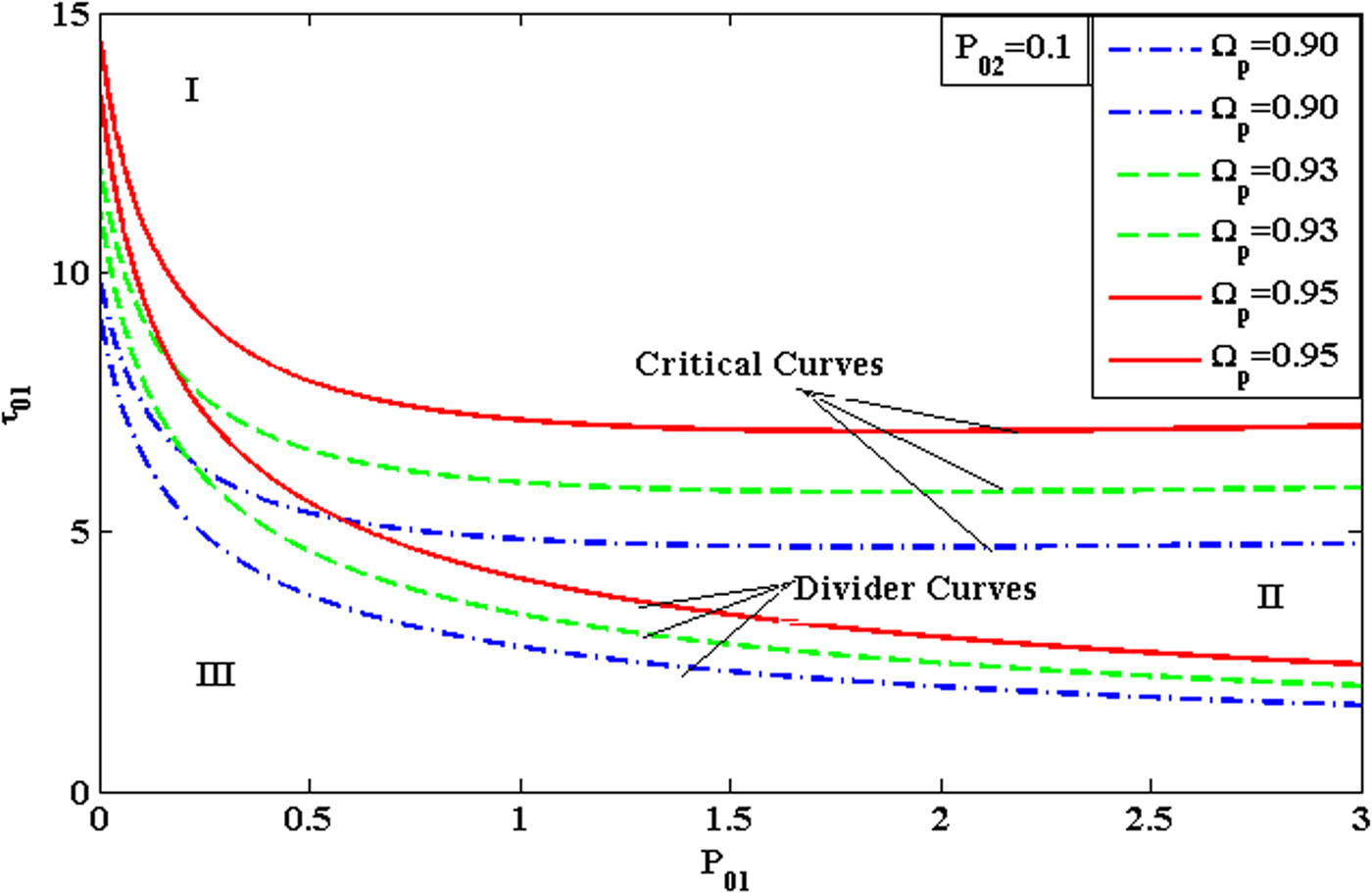
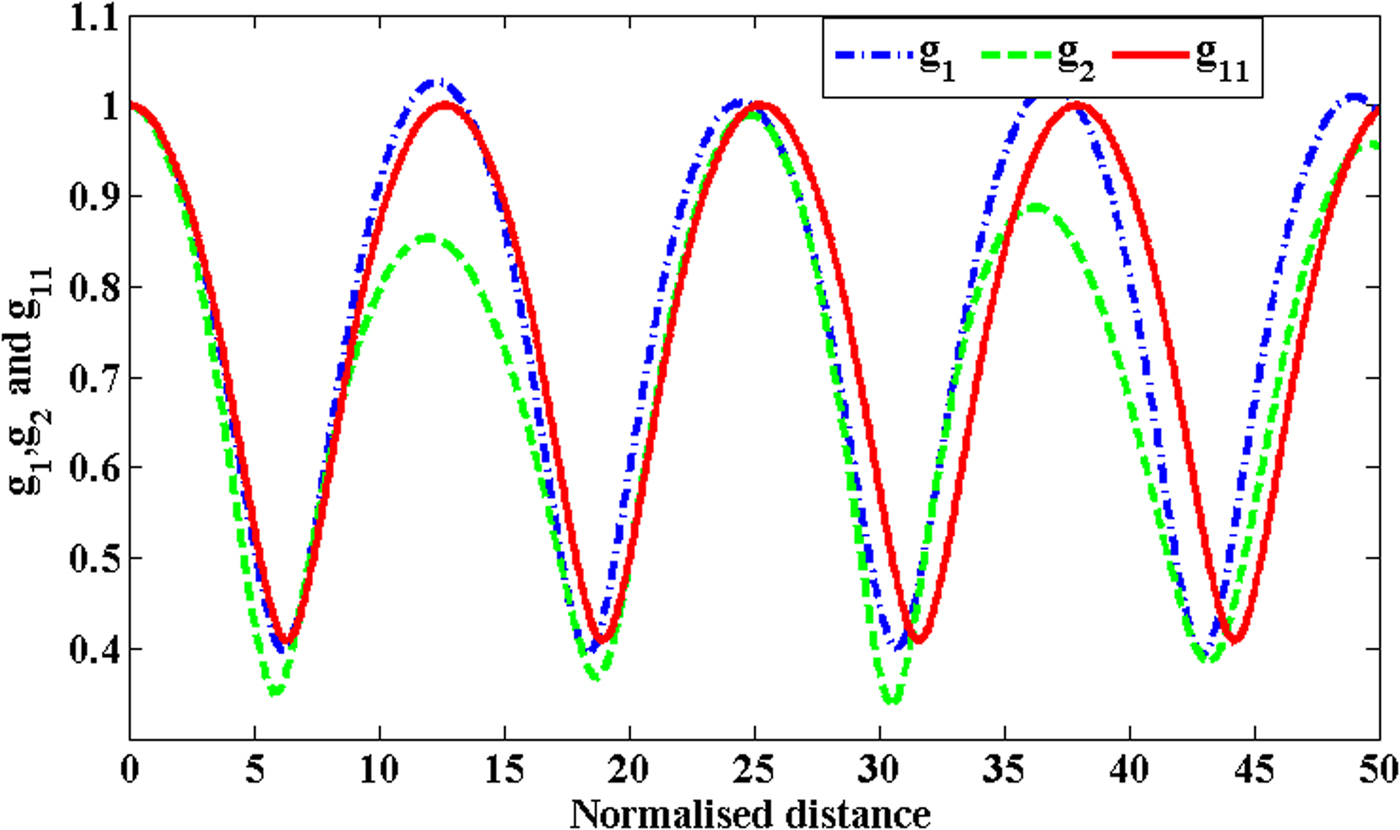
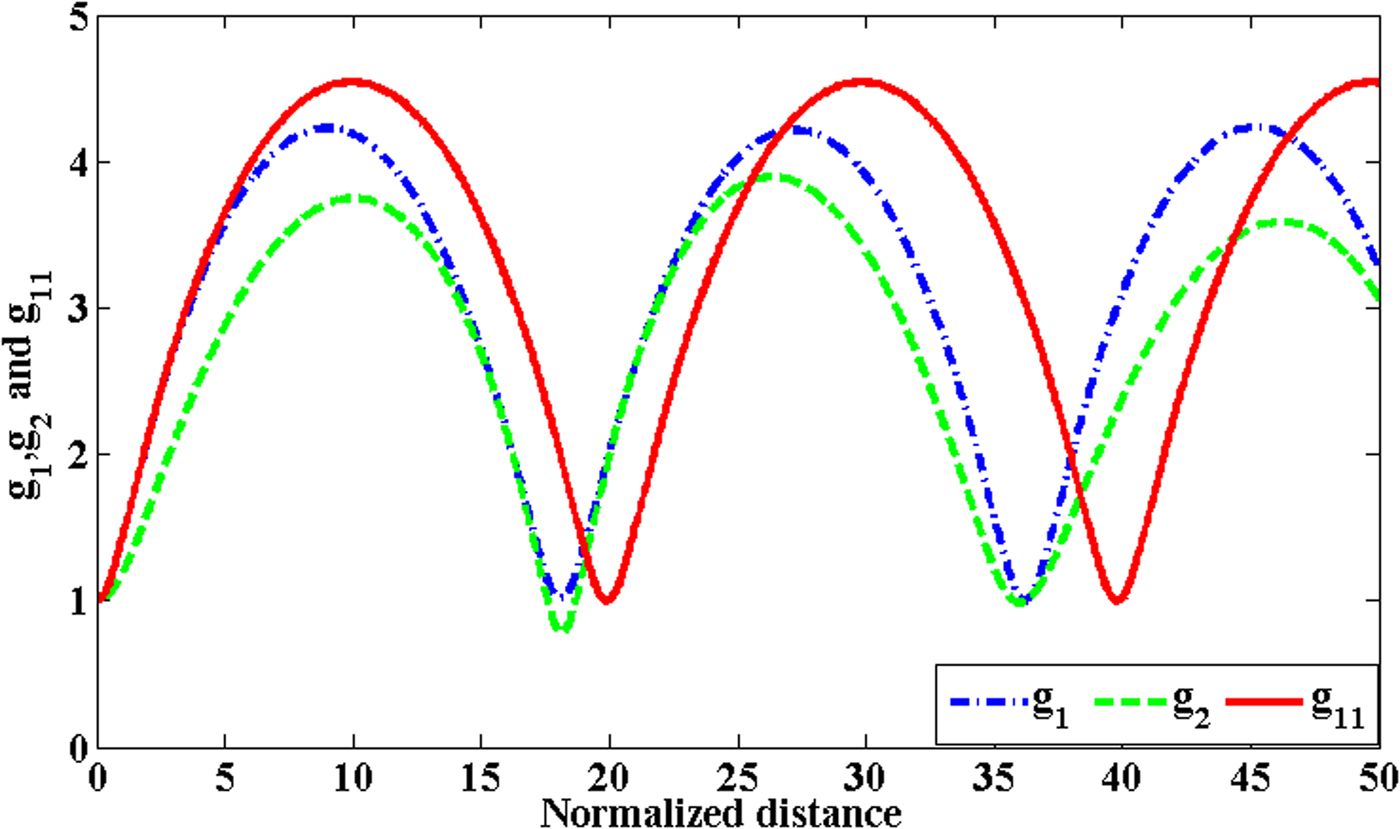
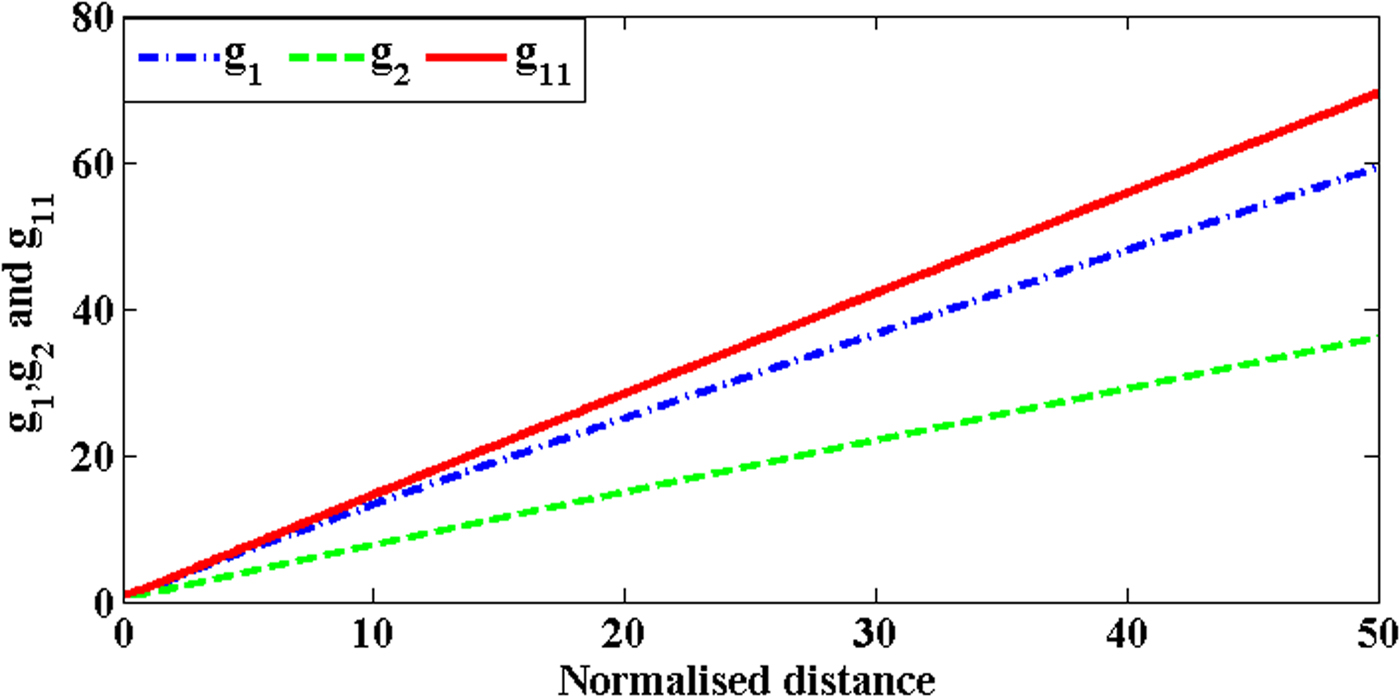
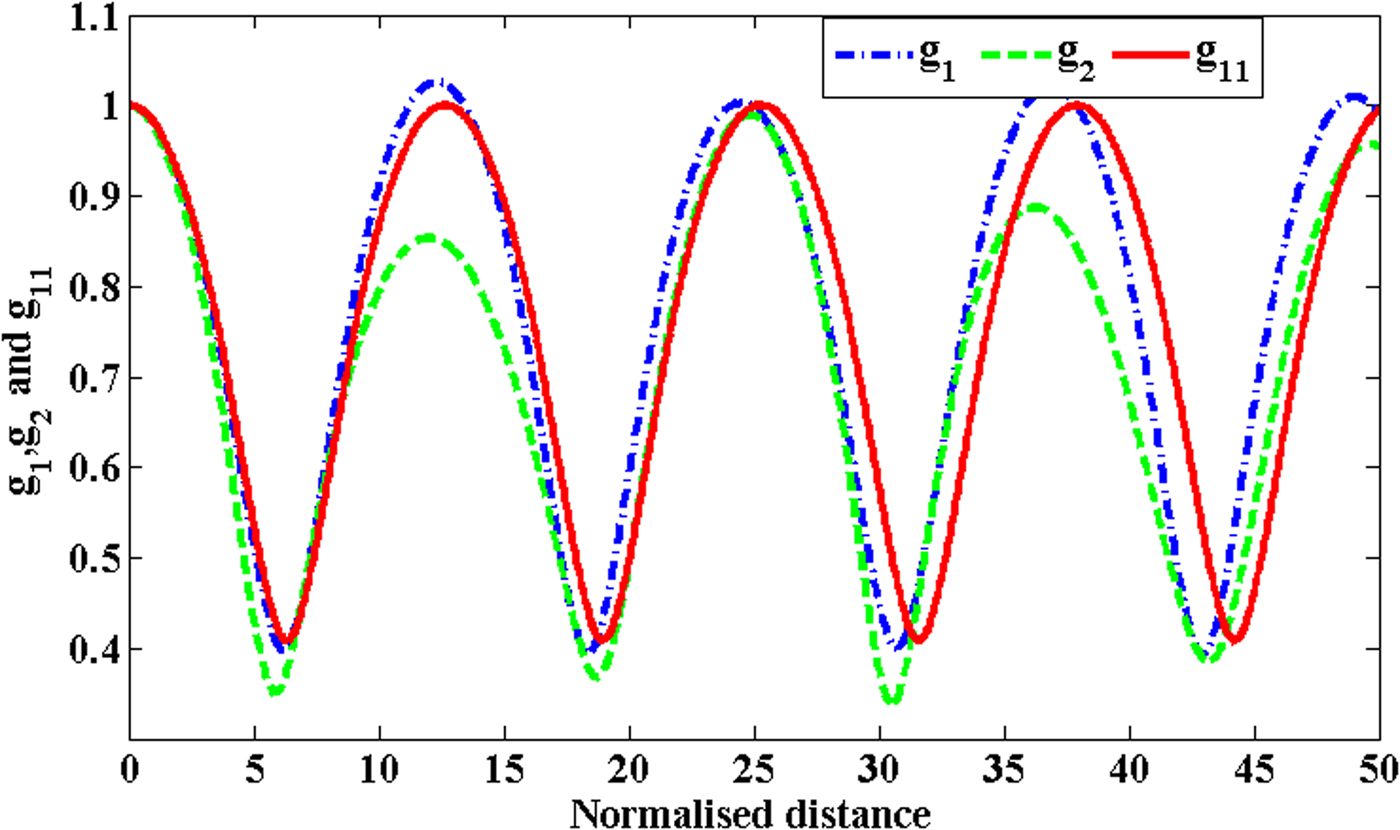
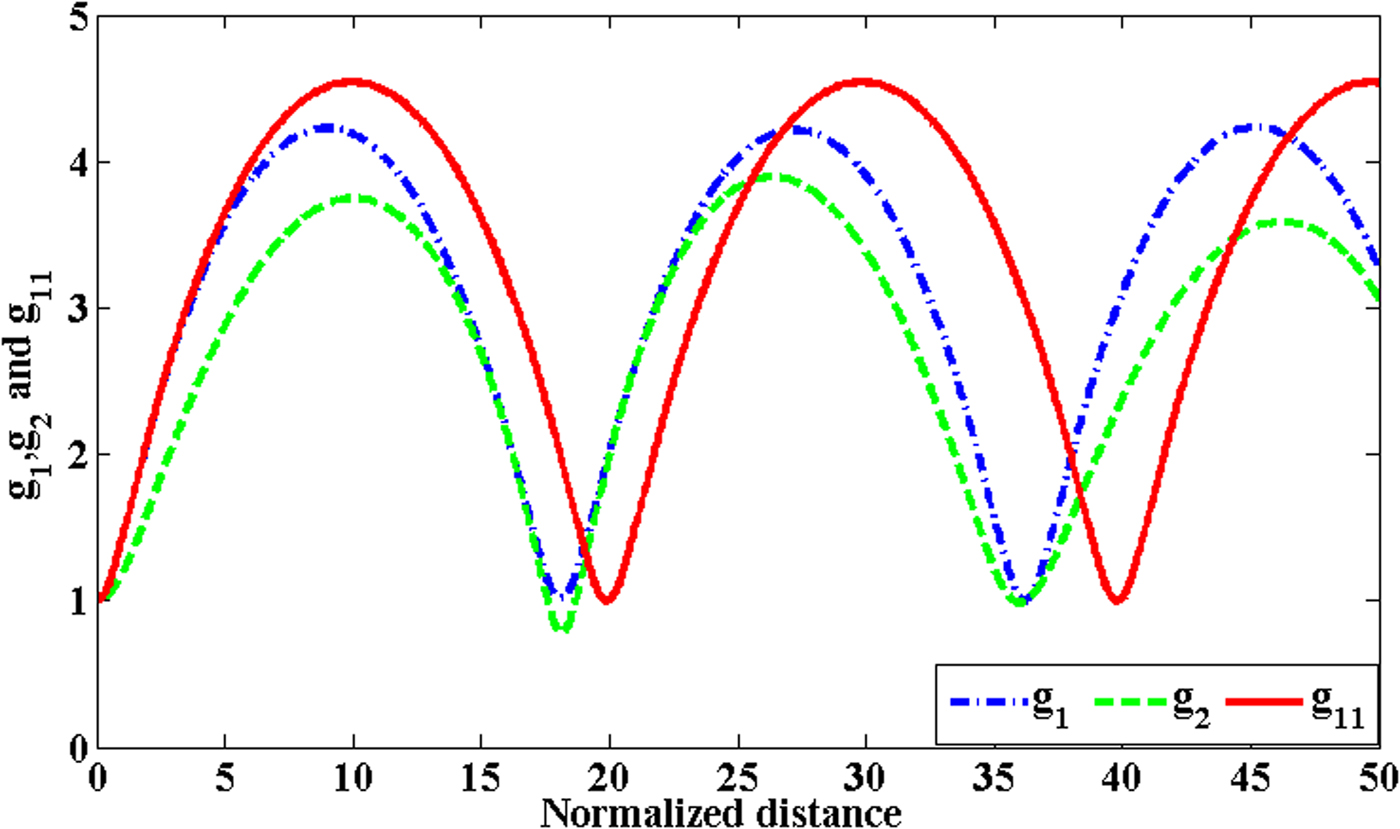
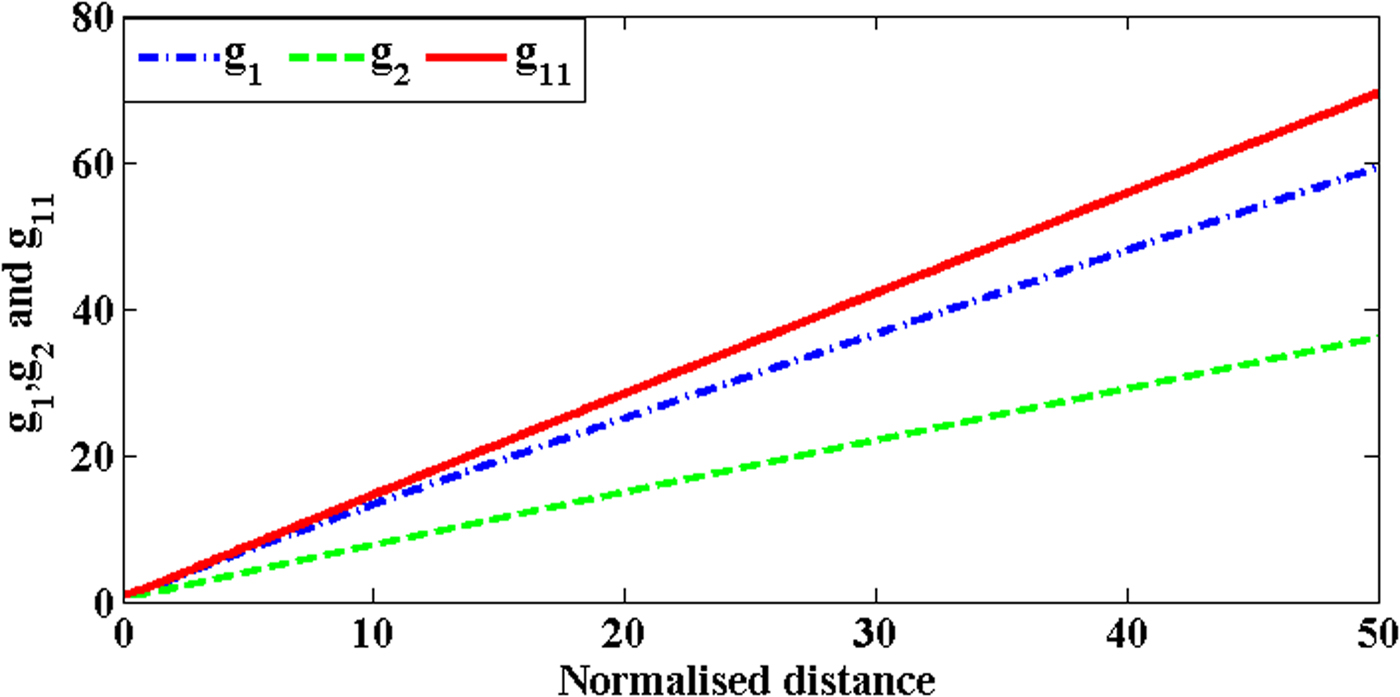
Figure 2 represents the variation of g 1 and g 2(pulse width parameters) with normalized distance of propagation, for initial point P 01, τ01 that is, a(0.7,10) and τ02 = 11 in the region I at Ω1,2 = 0.93. The point a(0.7,10) chosen from critical-divider curve indicates oscillatory compression, in which the pulse width parameters oscillates between initial pulse value and minimum value. We have compared oscillatory compression of both laser beams g 1 and g 2 with single laser beam (g 1,1), shown in Figure 2. It was seen that more compression in both the laser beams than single laser beam (g 1,1) was due to the coupled nonlinearity of both laser beam as it is stronger than the nonlinearity of single laser beam g 1,1. Figure 3, illustrates the oscillatory broadening of laser beams, at initial point, P 01, τ01 that is, b(1.8,3.5) and τ02 = 4, lies between critical-divider curve in region II for Ω1,2 = 0.93 . If the initial point P 01, τ01 that is, c(0.4, 2.5) and τ02 = 4, lies below the divider curve in region III, the initial propagating beams steadily broaden as shown in Figure 4. Normalized pulse width parameters (g 1,1) correspond to the case of a single laser beam propagating inside the plasma. Since coupling is not present in case of a single laser beam and that is why nonlinearity in case of a single laser beam is weaker than the nonlinearity involved in case of co-propagating laser beams. That is the reason, why the single laser beam (g 1,1) is shifted to longer normalized distance for oscillatory compression, oscillatory broadening, and steady broadening.
Variation of pulse width parameters g 1 (first laser beam), g 2 (second laser beam) and g 11 (single laser beam for comparisons) with normalized distance of propagation (Z). The oscillatory compression corresponds to initial point P 01, τ01 that is, a(0.7,10) and τ02 = 11 in the region I as clarify in Figure 1 for Ω1,2 = 0.93, P 02 = 0.1, and wavelengths of both laser beams are λ1 and λ2 = 1064 nm is same for all.
Variation of pulse width parameters g 1 (first laser beam), g 2 (second laser beam) and g 11 (single laser beam for comparisons) with normalized distance of propagation (Z). The oscillatory broadening corresponds to initial point P 01, τ01 that is, b(1.8,3.5) and τ02 = 4 in the region II as clarify in Figure 1 for Ω1,2 = 0.93, P 02 = 0.1, and wavelengths of both laser beams are λ1 and λ2 = 1064 nm is same for all.
Variation of pulse width parameters g 1 (first laser beam), g 2 (second laser beam), and g 11 (single laser beam for comparisons) with normalized distance of propagation (Z). The steady broadening corresponds to initial point P 01, τ01 that is, c(0.4, 2.5) and τ02 = 4 in the region III clarify in Figure 1 for Ω1,2 = 0.93, P 02 = 0.1 and wavelengths of both laser beams are λ1 and λ2 = 1064 nm is same for all.
The Eq. (15), governs the variation of pulse width parameters (g 1 and g 2) of both laser beams in plasma, these pulse width parameters depend on combined intensity of both laser beams, wavelength of both laser beams and initial pulse width of both laser beams. If both laser beams propagate with same frequencies inside plasma, the pulse width parameters (g 1 and g 2) of both laser beams will overlap on the each other.
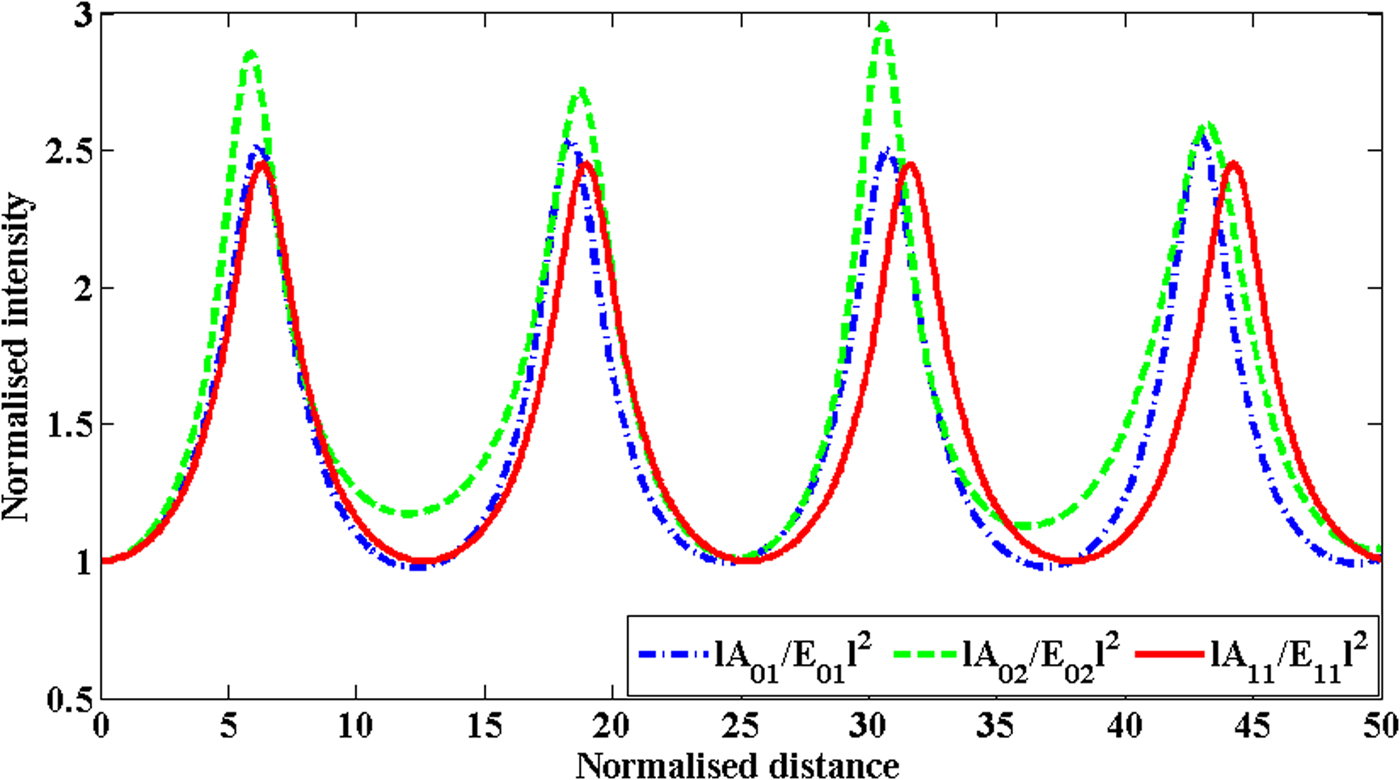
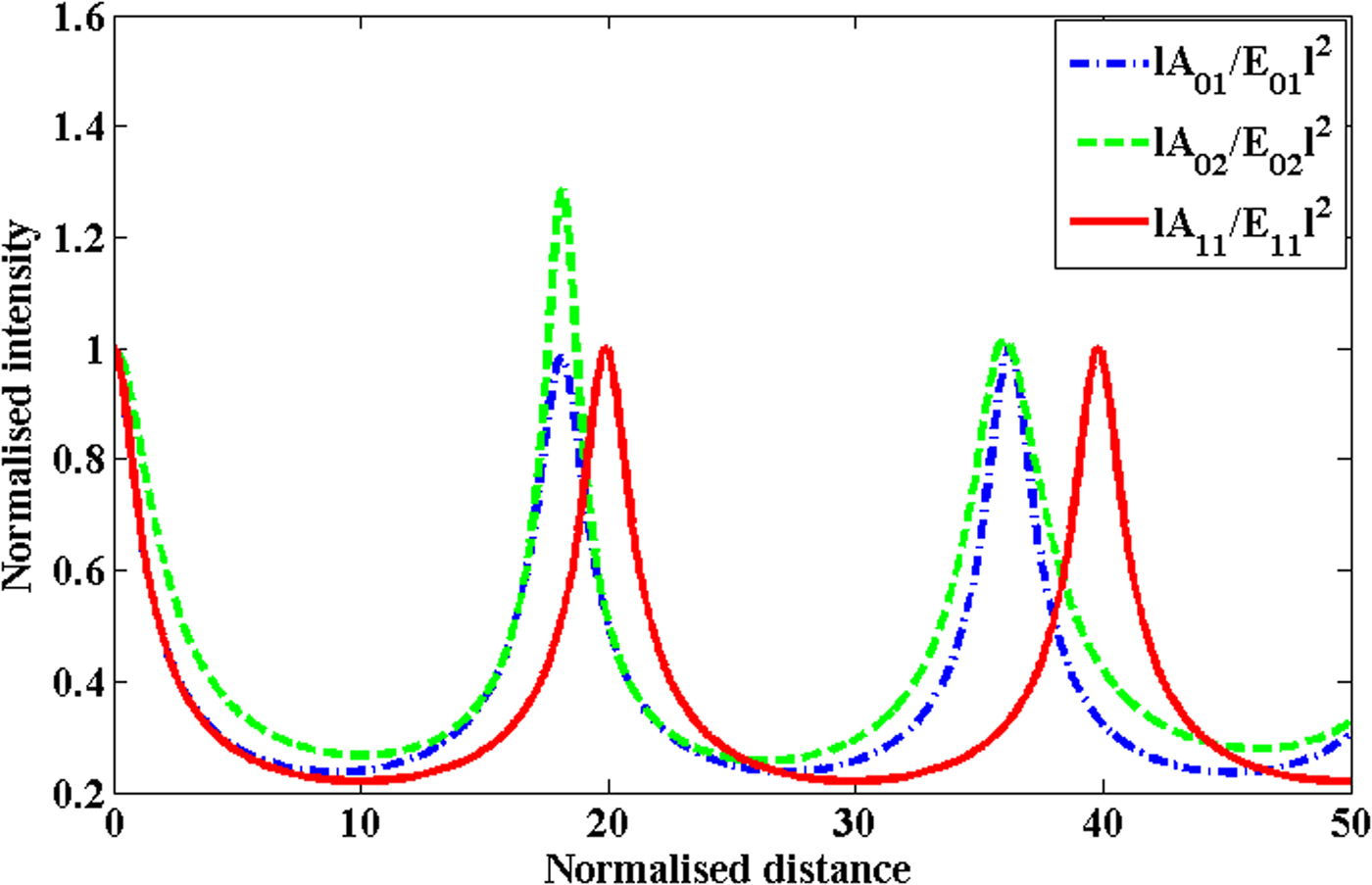
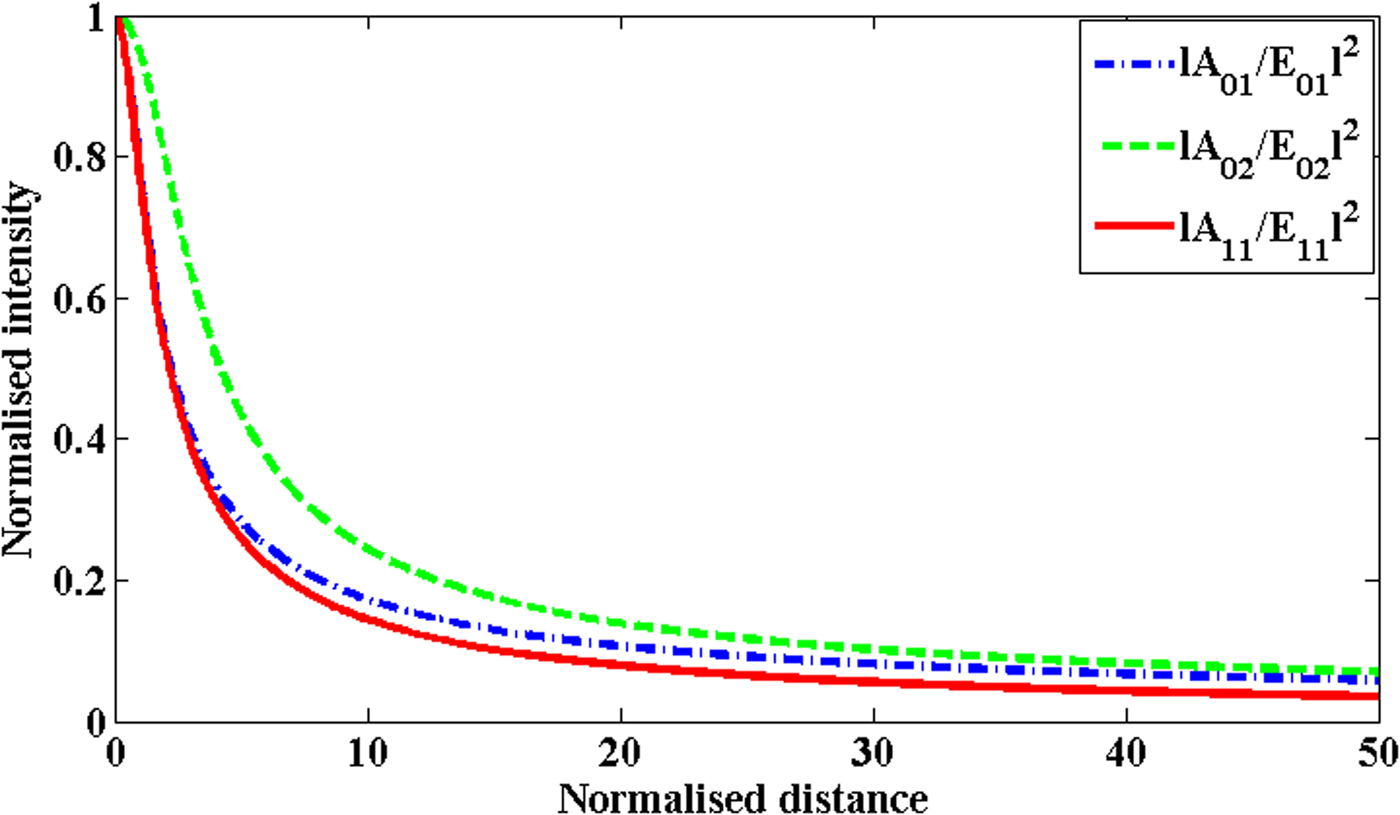
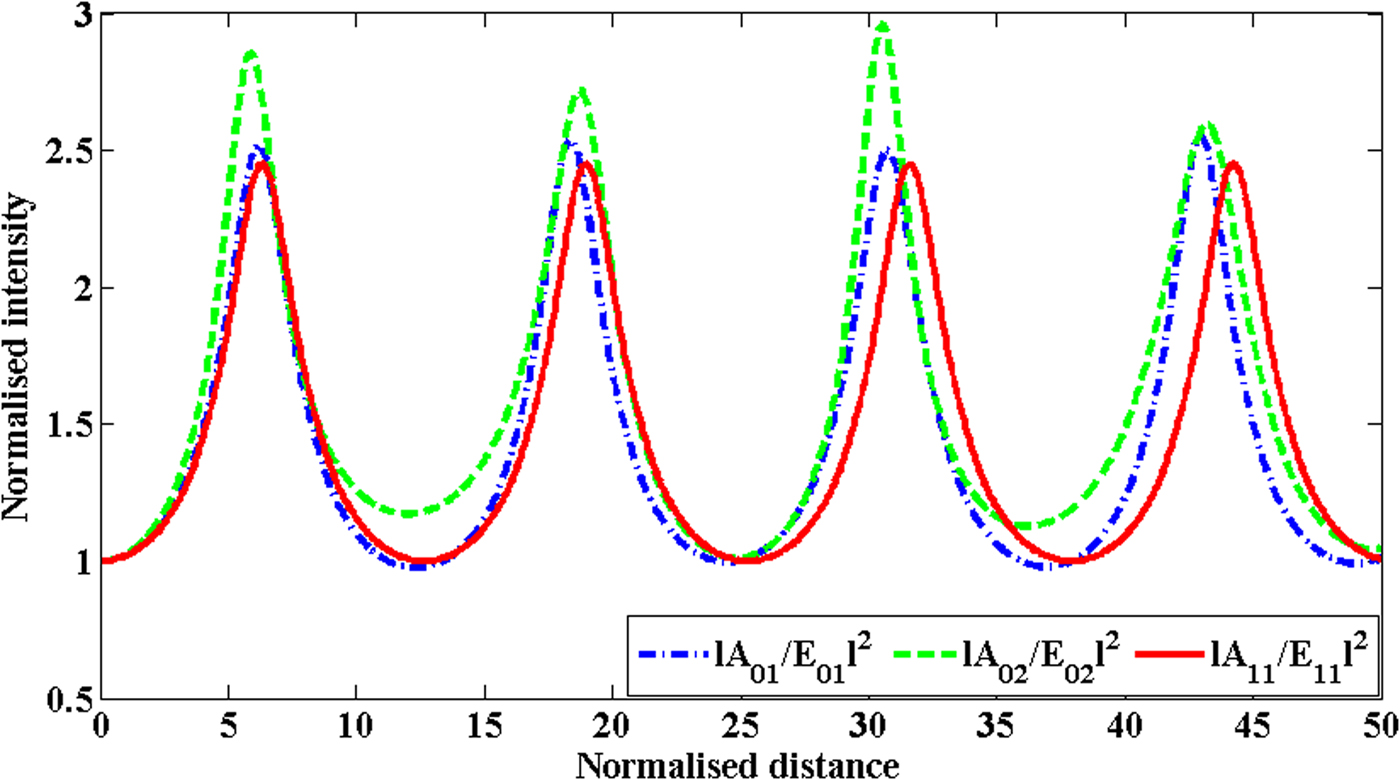
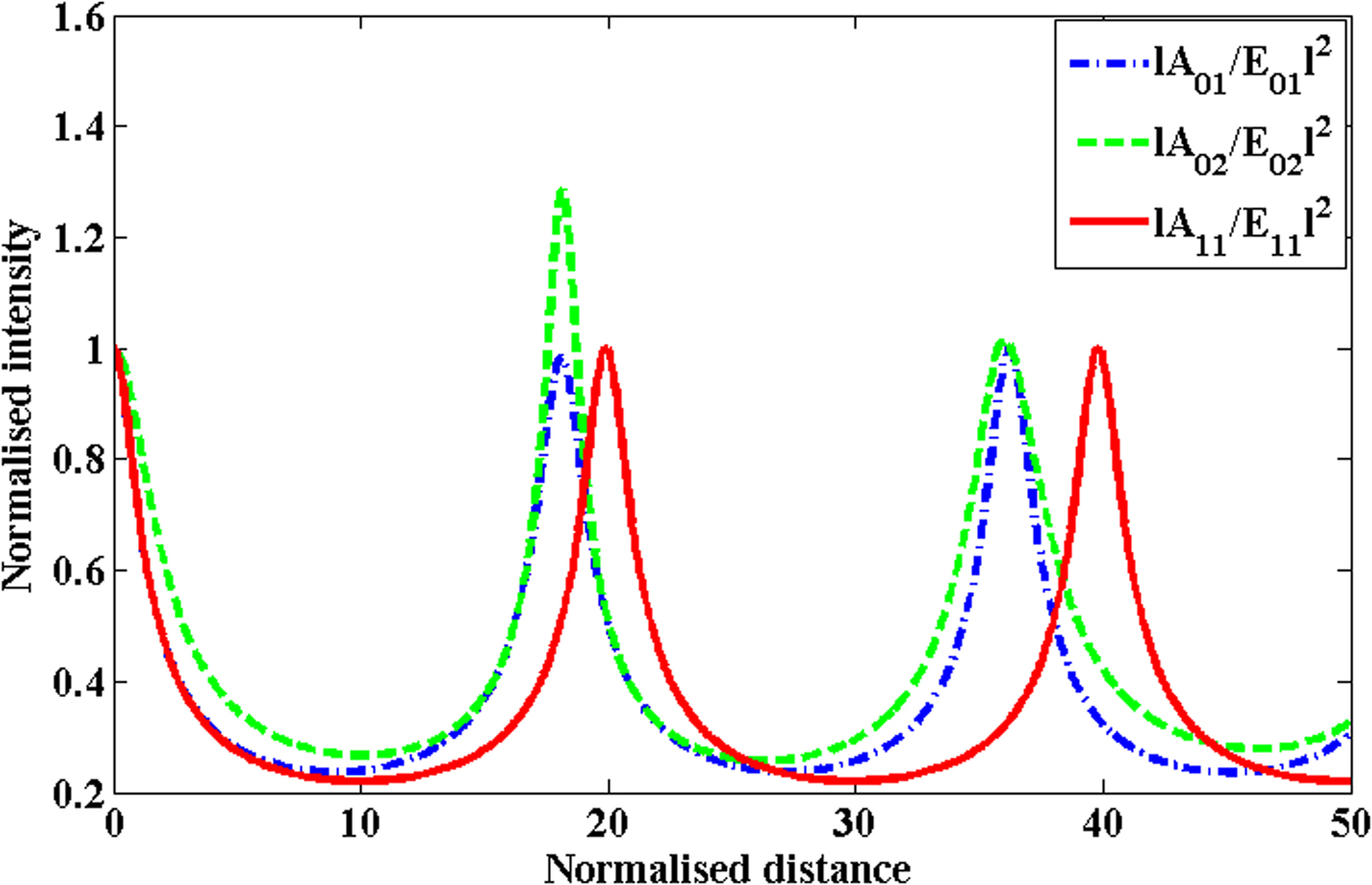
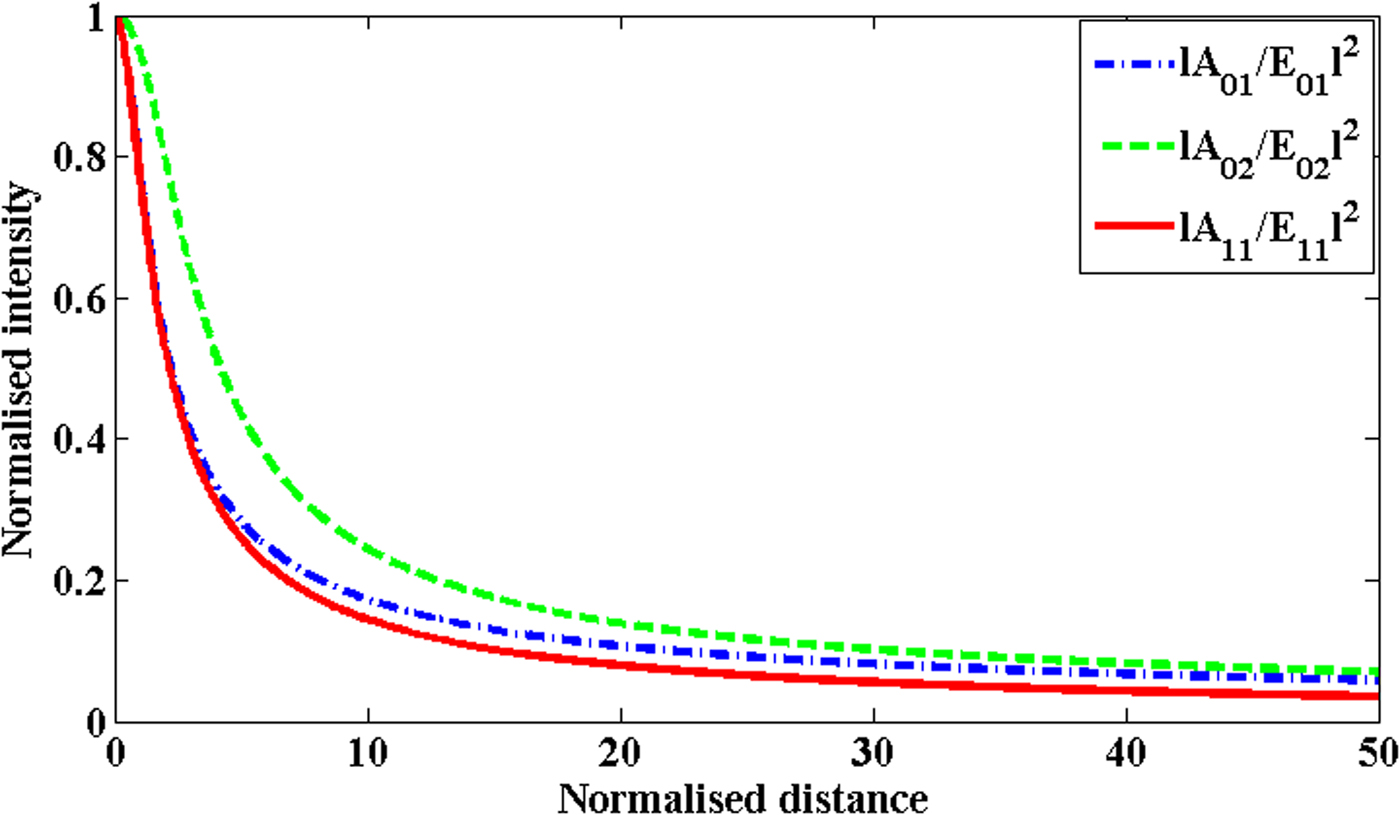
The variation of normalized intensity (|A 01/E 01|2 and |A 02/E 02|2) of both laser beams with normalized distance of propagation is plotted separately for oscillatory compression, oscillatory broadening, and steady broadening at point correspond to Ω1,2 = 0.93 and P 02 = 0.1. Figure 5, depict the plot between normalized intensity of both laser beams with normalized distance for oscillatory compression. Enhancement in peak intensity of high power laser beam is lower than low power laser beam. This behavior in enhancement in peak intensity arises because of the lower effect of coupling in high power laser beam (since P 02 is low) and a higher effect of coupling in low power laser beam (since P 01 is high). Enhancement in peak intensity of single laser beam shows the normal behavior of relativistic self-compression of the laser beam. Figure 6 shows the intensity variation of laser beams with normalized distance for oscillatory broadening. Initially, the intensity decreases and attains minimum value after that, it starts increasing and reaches a maximum peak value. Figure 7, describes the intensity variation with normalized distance for steady broadening.
Dependence of dimensionless normalized intensity with normalized distance of propagation for oscillatory compression of both laser beams corresponds to Ω1,2 = 0.93, P 02 = 0.1, and wavelengths of both laser beams are λ1 and λ2 = 1064 nm is same for all.
Dependence of dimensionless normalized intensity with normalized distance of propagation for an oscillatory broadening of both laser beams corresponds to Ω1,2 = 0.93, P 02 = 0.1, and wavelengths of both laser beams are λ1 and λ2 = 1064 nm is same for all.
Dependence of dimensionless normalized intensity with normalized distance of propagation for a steady broadening of both laser beams corresponds to Ω1,2 = 0.93, P 02 = 0.1, and wavelengths of both laser beams are λ1 and λ2 = 1064 nm is same for all.
5. CONCLUSION
In this paper, the temporal characteristic of co-propagating Gaussian laser beams in relativistic plasma for the laser parameters λ1 = λ2 = 1064 nm and laser frequencies are ω1 = ω2 = 1.77 × 10¹⁵ rad s−1 was investigated and have been solved by the numerical technique with appropriate initial boundary initial condition (g 1 = g 2 = 1 and dg 1,2/dZ = 0, at Z = 0). We have derived the relationship between laser pulse width and critical laser beam power of first laser beam by keeping the power of second laser beam constant, that describe clearly the compression and broadening of both laser beams. To study the physical behavior of laser beams, we have plotted the critical-divider curve between normalized pulse width and normalized laser power for different value of Ω1,2 = 0.90, 0.93 and 0.95 and P 02 (is constant). This is represented in Figure 1, the critical-divider curve goes down as Ω1,2 increases because nonlinearity will be powerful by increasing Ω1,2. The variation of pulse width parameters g 1 and g 2 with normalised distance Z for initial point P 01, τ01 τ02 that is, a(0.7,10) 11, b(1.8,3.5) 4, and c(0.4,2.5) τ02 = 4 in regions I, II, and III have been well-established and depicted in Figures 2–4; oscillatory compression, oscillatory broadening and steady broadening, characteristic in three regions are observed. The dependence of normalized intensity (|A 01/E 01|2 and |A 02/E 02|2) of laser beams with normalized distance Z are plotted in Figures 5–7 for oscillatory compression, oscillatory broadening, and steady broadening, respectively. Due to the coupling of power, two laser beams favor the self-compression of laser beams inside the plasma.
In this paper, we have used the numerical technique for characteristic propagation of two Gaussian laser beams in the time domain via critical-divider curve for the first time. We have also studied the compression and broadening in laser beams at different critical points. Self-compression is a natural phenomenon of the medium to generate short laser pulse and few-cycle laser pulses. Many previous studies have shown the self-focusing and divergence of the laser beam in plasma through the critical-divider curve, self-compression of the laser pulse in plasma. But we have demonstrated the self-compression of the co-propagating laser beam in the time domain. Moreover, we have explored the possibility of generating short laser pulses. Thus our work brings incentive to further progress of 3D simulation of the interaction between laser and plasma. Expressing that, essentially a new physics can be found. The result shows an important resolution above other compression of laser beam. It will be advantageous in many applications in laser–plasma interaction such as laser plasma-based accelerator, particle accelerators, radiation sources, inertial confinement thermonuclear fusion, measuring the electron dynamics in time-domain-spectroscopy, laser physics and plasma-based waveguides.
ACKNOWLEDGMENTS
This work was partially supported by University Grant Commission (UGC), India and Department of Science and Technology (DST), India.