INTRODUCTION
Climate change has been the principal source of fluctuations in global food production in arid and semi-arid regions where extremes of heat and cold, together with drought and floods, have negatively impacted agriculture (Oseni & Masarirambi Reference Oseni and Masarirambi2011). Furthermore, social and political–economic factors have contributed to increased vulnerability, economic loss, hunger and dislocation (Sivakumar et al. Reference Sivakumar, Das, Brunini, Salinger, Sivakumar and Motha2005). Within this context, it is imperative to identify water-use efficient plants that can adapt to climate change and increase the use of rain-fed crops to achieve sustainable agricultural development in areas that are more prone to extreme weather (Lobell et al. Reference Lobell, Burke, Tebaldi, Mastrandrea, Falcon and Naylor2008).
Pearl millet (Pennisetum glaucum (L.) R.) could be a key feed source in agricultural adaptation in dry regions as it is a tropical plant possessing the C4 photosynthetic pathway and tolerance to drought, heat and low soil pH (Maiti & Wesche-Ebeling Reference Maiti and Wesche-Ebeling1997). Because of its adaptability to harsh conditions, millet can be grown in areas that are unfavourable to other crops such as maize (Singh & Singh Reference Singh and Singh1995). Although several studies have evaluated the potential of pearl millet as silage for ruminants in dry regions (Messman et al. Reference Messman, Weiss, Henderlong and Shockey1992; Hill et al. Reference Hill, Utley, Gates, Hanna and Johnson1999), data on its nutritive value are limited.
The Brazilian Agricultural Research Corporation (EMBRAPA) has developed and released new varieties of pearl millet for field testing over the last 10 years, including the varieties BRS 1501, CMS-03 and CMS-01, while the Agronomic Institute of Pernambuco (IPA) and Bonamigo Seeds have released the varieties IPA Bulk1BF and BN-2, respectively. In Brazil, small-scale trials were conducted to evaluate field performance of those five new cultivars, mainly in wet regions (Aguiar et al. Reference Aguiar, Lima, Santos, Carvalho, Guim, Medeiros and Borges2006; Pires et al. Reference Pires, de Assis, Silva, Braz, Santos, Vieira Neto and de Sousa2007; Guimarães Júnior et al. Reference Guimarães Júnior, Gonçalves, Rodrigues, Pires, Jayme, Rodriguez and Saliba2009), and it was found that they could serve as a feed source for livestock during the dry season since they exhibited greater dry matter (DM) yield than members of the African and Indian germplasm banks, which are well adapted to semi-arid conditions (de Rouw Reference de Rouw2004; Yadav & Bidinger Reference Yadav and Bidinger2008; Bashir et al. Reference Bashir, Ali, Ali, Melchinger, Parzies and Haussmann2014). Before recommending these new Brazilian cultivars for commercial use, other experiments should be carried out to investigate their agronomic and ensiling characteristics (i.e. DM partitioning among plant organs, in vitro dry matter digestibility (IVDMD), pH, fermentation end products and chemical composition), as well as intake and in vivo digestibility, so that farmers and policy-makers have sufficient information about these new forages to address the food demands of livestock in semi-arid environments.
As a part of an overall strategy to deal with this issue, the present study evaluated agronomic characteristics of five new Brazilian cultivars of pearl millet (IPA Bulk1BF, BRS 1501, CMS-03, CMS-01 and BN-2) and assessed their potential application in silage production. Finally, the impact of these new forages on intake and digestibility in lambs was quantified.
MATERIALS AND METHODS
Experiments location and general information
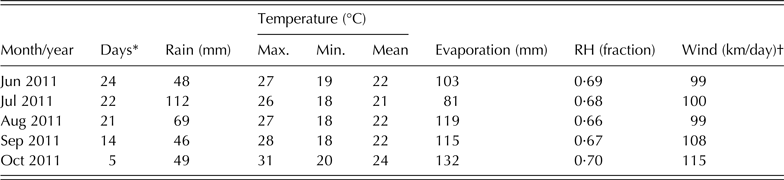
The experiment was conducted from July to October 2011 at the Semi-Arid Experimental Station of the Brazilian Agricultural Research Corporation (EMBRAPA) in the municipality of Nossa Senhora da Glória, Sergipe State, Brazil (10°13′S, 37°25′W, 291 m a.s.l.). The soil type in this region is a eutrophic red–yellow podzol (dos Santos et al. Reference dos Santos, Jacomine, dos Anjos, de Oliveira, Lumbreras, Coelho, Almeida, Cunha and de Oliveira2013), with an average depth of 1·5 m. The climate is typically semi-arid with annual rainfall of 710 mm and average maximum and minimum temperatures of 32 and 20 °C, respectively. Precipitation in the region is low, erratic, and the balance between rainfall and evaporation rate can be negative in some months based on meteorological data from a weather station located about 400 m from the experimental site (Table 1). Seed of the five new pearl millet cultivars (IPA Bulk1BF, BRS 1501, CMS-03, CMS-01 and BN-2) was supplied by the pearl millet breeding programmes of EMBRAPA, IPA and Bonamigo Seeds.
Meteorological data during the experimental period

Source: Agro meteorological station in the Experimental Area of Gloria, Embrapa Semi-Arid – Nossa Senhora da Glória – Sergipe State, Brazil.
RH, relative humidity (fraction).
* Rainfall occurrence in days.
† Wind average speed at 2 m height.
Agronomic characteristics
Treatments were the five cultivars replicated five times in a randomized complete block design (25 plots). Plots measured 10·5 m2 (5 × 2·1 m2), with plants seeded in four rows (0·70 m centres) to a depth of 3 cm. The soil at the site had the following properties: pH (water): 5·8; phosphorus (P): 2·8 mg/dm3; potassium (K): 0·32 cmolc/dm3; aluminium (Al): 0·05; hydrogen (H) + Al (cmolc/dm3): 1·89; calcium (Ca) (cmolc/dm3): 1·4; magnesium (Mg) (cmolc/dm3): 0·74 and organic matter (OM; g/kg): 10·54. All plots were randomly allocated and fertilized prior to planting according to soil test recommendations with 150 kg N/ha, 300 kg P/ha and 250 kg K/ha. Two-side dressing fertilizations were applied, the first on the 25th day and the second on the 40th day after plant emergence, at a rate of 60 kg N/ha in each side dressing. Each treatment comprised c. 32 plants/m2, achieved by thinning plots 20 days after emergence. Five litres/ha of Atrazine [2-chloro-4-ethylamino-6-isopropylamino-s-triazine] (Atanor®, Porto Alegre, Rio Grande do Sul, Brazil) (concentration of active: 500 g/l) was applied on all plot areas for weed control immediately after planting.
Cultivars were harvested when a proportion of at least 0·60 of plants in each plot reached the dough stage of grain maturity (growth stage 86 according to the BBCH scale; BBCH 2001). Plants were harvested manually, cut at 5 cm above ground level. Only the two central rows in each plot were kept, collected into baskets and weighed to estimate wet yield/ha, with the remainder being discarded. After chopping a representative sample from each plot, a 400 g sub-sample was oven-dried at 55 °C for 48 h to estimate DM concentration and yield of the five cultivars. Dry samples were ground through a 1 mm screen using a Wiley Mill (Tecnal Ltd., São Paulo, São Paulo, Brazil) and stored at room temperature.
The agronomic characteristics studied included: plant height, population density, extent of lodging, DM partitioning of plant organs (panicle, stem and leaf), DM yield (DMY) (t/ha) and digestible DM yield (DDMY) (t/ha). The height of ten randomly selected plants within each plot was determined by measuring from ground level to the top of the panicle using a tape measure. Plants were then separated into panicles, stems and leaves, with the mass of each fraction determined after oven-drying at 65 °C for 72 h. Lodging was estimated as the percentage area of plot that was lodged and the angle of stem lodging was estimated. An angle of 10° from perpendicular was scored as 10 and prostrate stems were scored as 90. A lodging score for the plot was then calculated as: (% plot area lodged × angle of lodging from vertical)/90 as described by Bell & Fischer (Reference Bell and Fischer1994). The DDMY was estimated by multiplying the IVDMD (determined as described below) from each repetition by its respective DMY.
The water-use efficiency for DMY and DDMY, expressed in kg/ha/mm, was estimated by dividing the yield by the amount of accumulated rainfall during the crop cycle (229 mm) as described by Devasenapathy et al. (Reference Devasenapathy, Ramesh and Gangwar2008).
Growing degree days (GDD) were used to calculate and express daily heat unit accumulation relative to the pearl millet crop using temperature data as described by Norman et al. (Reference Norman, Pearson, Searle, Norman, Pearson and Searle1995).
Ensiling procedure
At harvest, a silage harvester (Nogueira®, São João da Boa Vista, São Paulo, Brazil) was used to chop plants within each treatment to an average of 1·5 cm long and transferred into 25 × 250-litre plastic barrels.
Representative herbage samples from each plot were packed manually into polyvinyl chloride mini-silos (five mini-silos × five replications for a total of 25 mini-silos; 10·5 cm diameter × 35·5 cm high, capacity of 2·5 kg and average density of 813·7 kg/m3) using a wooden pestle (Sebastian et al. Reference Sebastian, Phillip, Fellner and Idziak1996). The mini-silos were sealed with plastic lids, weighed and stored at room temperature.
Mini-silos were opened following 90 days of ensiling, with forage samples (15 g) from both mini-silos and plastic barrels being homogenized for 1 min in 500 ml of distilled water to measure the pH using a pH meter (TEC-5®, Tecnal Ltd., São Paulo, São Paulo, Brazil). Aqueous extracts (10 ml) were acidified with 50 µl of 9·77 mol/l of sulphuric acid (H2SO4) (Kung & Ranjit Reference Kung and Ranjit2001) and frozen before analysis. Thawed extract samples were centrifuged for 15 min at 10 000 g at 4 °C and analysed for acetic, propionic, lactic and butyric acids using a Varian high-performance liquid chromatography (HPLC) system (Merck Hitachi, Elite Lachrom HTA, Tokyo, Japan) as described by Adams et al. (Reference Adams, Jones and Conway1984). Organic acids were separated using an Aminex HPX-87H column (300 × 7·8 mm2; Bio-Rad, Hercules, CA, USA) with a mobile phase of 0·013 m H2SO4 at a flow rate of 0·5 ml/min. Organic acids were quantified using an ultraviolet detector (Merck Hitachi L-2400) set at 210 nm.
Ammonia was determined using a phenol–hypochlorite reaction, as described by Weatherburn (Reference Weatherburn1967). Finally, silage sub-samples (500 g) were oven-dried at 60 °C for 72 h, ground through a 1 mm screen using a Wiley Mill (Tecnal Ltd., São Paulo, São Paulo, Brazil) and stored at room temperature until further analysis.
Intake and digestibility measurements
All lambs were cared for in accordance with the guidelines of the Brazilian Council on Animal Care (CONCEA 2008). Apparent nutrient digestibility of silages was measured using 25 Santa Inês male lambs (initial body weight (BW): 19 kg ± 1·6 kg) over a 21-day period. Lambs were blocked by weight and assigned randomly to one of the five treatments. The first 17 days were used to adapt lambs to the diets in individual metabolic cages equipped with a poly-ethylene sieve tray to separate faeces from urine. Lambs were fed pearl millet silage only (without concentrate) twice daily at 07·30 and 16·30 h in a manner that assured 0·15 orts at the morning feeding. Water and a trace mineralized salt mixture were available to lambs ad libitum.
Apparent digestibility was determined over 5 days, with lambs being fed pearl millet silage ad libitum as described by da Silva & Leão (Reference da Silva and Leão1979). During these 5 days, total faeces, feed and orts of each lamb were measured and sampled daily. Samples of the 5 days were mixed, sub-sampled (400 g fresh faeces, 400 g fresh feeds and 400 g fresh orts per lamb) and stored at −20 °C until analysed. The total urine output of each animal was collected daily into plastic containers containing 100 ml of hydrochloric acid (HCL) with 2 N concentration to prevent fermentation, degradation and nitrogen (N) losses. During the 5-day collection phase, sub-samples (10% from the total urine volume) were collected in the morning and stored at −20 °C until further analysis.
Chemical analysis
Ground samples were analysed for DM and OM as described by AOAC (2005) (methods 942·05 and 934·01). A Leco combustion N analyser (FP-428N Determinator, Leco Corporation, St Joseph, MI, USA) was used to measure N concentration. Crude protein (CP) was calculated as N × 6·25. Both neutral detergent fibre (NDF), which was determined by using heat stable α-amylase, and sodium sulphite (ash free) and acid detergent fibre (ADF) were quantified using an Ankom Fibre Analyser (Ankom Technology Corporation, Macedon, NY, USA) as described by Van Soest et al. (Reference Van Soest, Robertson and Lewis1991). The concentration of hemicellulose was determined by subtracting ADF from NDF. Ether extract (EE) was determined as described by AOAC (2005) (method 920·39) using an Ankom Fat Extractor (Ankom Technology Corporation, Macedon, NY, USA).
Gross energy was determined using an adiabatic calorimeter (model 1241; Parr, Moline, IL, USA). Non-fibrous (NFC) carbohydrates were calculated as described by Sniffen et al. (Reference Sniffen, O'Connor, Van Soest, Fox and Russell1992): NFCg/kg DM = 100 − (CP + EE + ash + NDF). The concentrations of total digestible nutrients (TDN) were calculated as: TDNg/kg DM = digestible CP + (2·25 × digestible EE) + digestible NDF + digestible NFC (Weiss & Wyatt Reference Weiss and Wyatt2000).
In vitro DMD analysis of fresh forage and silage was conducted in 100 ml serum bottles and examined in a single run for each forage/silage with triplicate bottles being used per treatment. Plant material (0·5 g) was incubated with 10 ml of rumen fluid mixed with 40 ml of McDougall's buffer (McDougall Reference McDougall1948) for 48 h at 39 °C. Samples were subsequently incubated with 0·1 N HCL and 2 g/l pepsin for a further 48 h (Tilley & Terry Reference Tilley and Terry1963). Equal volumes of rumen fluid were collected immediately after feeding from three rumen-fistulated bulls fed a mixture of the five pearl millet cultivars. After stirring the three samples, the combined ruminal fluid was used in the IVDMD assay as described above.
Statistical methods
Experiments were analysed using a mixed model approach with cultivar as a fixed effect, random effects of blocks (agronomic and silage quality trials) and lambs (digestibility study), and random residual error using the MIXED procedure of SAS Version 9.1 statistical program (SAS 2002). When significant, cultivar means were compared using Fisher's protected LSD (i.e., the DIFF option of the LSMEANS statement). Significance was declared at P < 0·05.
RESULTS
Agronomic characteristics
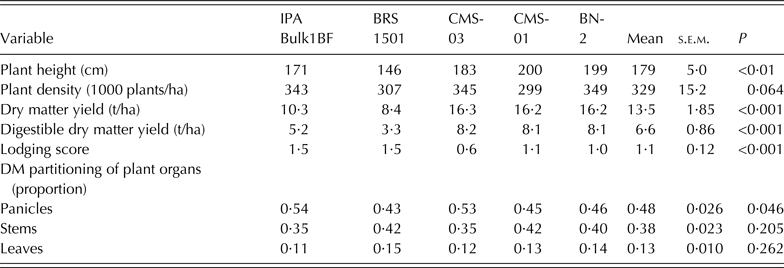
Cultivar height at harvest ranged from 146 to 200 cm, with CMS-01 being 43% taller (P < 0·05) than BRS 1501, although no difference was observed between CMS-01 and BN-2. At the same plant density, BN-2, CMS-01 and CMS-03 yielded more (P < 0·05) DM and digestible DM than BRS 1501, which was similar to IPA Bulk1BF.
The cultivar IPA Bulk1BF exhibited the highest (P < 0·05) proportion of panicles, although there was similarity in DM partitioning of panicles for CMS-03 and BN-2. As for lodging, CMS-03 exhibited more (P < 0·05) resilient stems than BRS 1501 and IPA Bulk1BF, but no difference was observed among CMS-03, CMS-01 and BN-2 (Table 2).
Performance and phenological traits of pearl millet cultivars
DM, dry matter; s.e.m., standard error of mean; P, probability (if treatments differ at P < 0·05); d.f., 16.
Silage quality
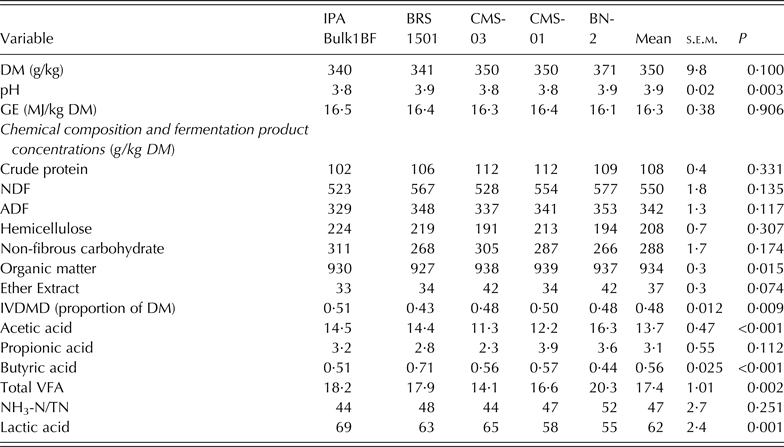
After ensiling, DM concentration of the cultivars ranged from 340 to 371 g/kg and did not differ among treatments. Organic matter concentration ranged from 927 to 939 g/kg and was greater (P < 0·05) in CMS-01 than BRS 1501 silage. Silages produced from IPA Bulk1BF, CMS-01 and CMS-03 had greater (P < 0·05) IVDMD than BRS 1501 silages.
A larger variation in fermentation products was detected among treatments, with CMS-03 and IPA Bulk1BF silages having the lowest (P < 0·05) pH, although they did not differ significantly from CMS-01. Acetic acid concentration was greater (P < 0·05) in silages produced from BN-2 compared with the other cultivars. However, concentrations of total volatile fatty acids (VFA) in ensiled BN-2 were greater (P < 0·05) than those from CMS-03, although there were no differences among BRS 1501, CMS-01 and IPA Bulk1BF. Concentrations of lactic acid in silages produced from IPA Bulk1BF and CMS-03 were greater (P < 0·05) than in BN-2. Finally, concentrations of butyric acid in silages obtained from BRS 1501 were greater (P < 0·05) than those observed for BN-2 (Table 3).
Chemical composition (g/kg DM) and fermentation product concentrations (g/kg DM) of silages produced from pearl millet cultivars
DM, dry matter; NDF, neutral detergent fibre; ADF, acid detergent fibre; IVDMD, in vitro dry matter digestibility; VFA, acetic acid + propionic acid + butyric acid; TN, total nitrogen; GE, gross energy; MJ, Megajoule; s.e.m., standard error of mean; P, probability (if treatments differ at P < 0·05); d.f., 16.
Digestion study
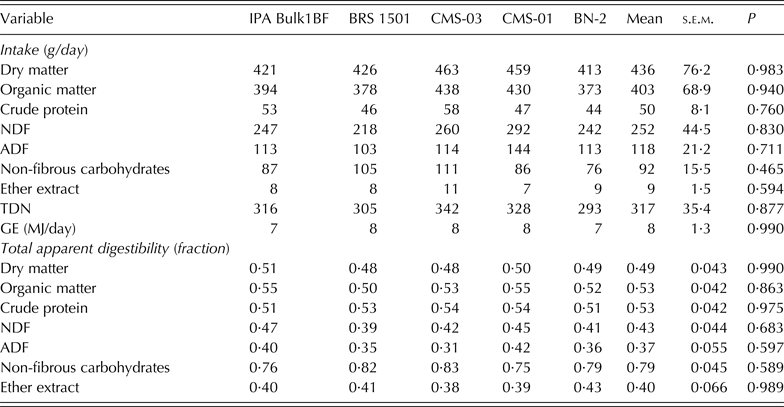
Intake and digestibility were not affected by cultivar (Table 4); however, BRS 1501 resulted in a lower (P < 0·05) urinary N excretion than BN-2 (Table 5).
Dry matter intake (g/kg)and total apparent digestibility (fraction) of dietary components in lambs fed silage produced from five pearl millet cultivars
NDF, neutral detergent fibre; ADF, acid detergent fibre; TDN, total digestible nutrients; GE, gross energy; MJ, Megajoule; s.e.m., standard error of mean; P, probability (if treatments differ at P < 0·05); d.f., 16.
Nitrogen balance in lambs fed silage of five pearl millet cultivars
N, nitrogen; s.e.m., standard error of mean; P, probability (if treatments differ at P < 0·05); d.f., 16.
DISCUSSION
Several studies have indicated that pearl millet is an excellent feed for livestock in arid regions owing to its desirable characteristics for ensiling and potential to yield high biomass in these regions (ICRISAT 2009; Kholova et al. Reference Kholova, Hash, Kumar, Yadav, Kocova and Vadez2010).
The mean (±s.d.) whole-crop DMY of 14 (±3·9) t/ha in the present study was greater than the range of values reported for three African genotypes (7–8 t/ha) and two Brazilian cultivars (7 t/ha) of pearl millet grown in the Brazilian sub-tropical climate (Costa et al. Reference Costa, Geraldo, Pereira and Pimentel2005). It is possible that greater daily heat unit accumulation observed during the growing season in Northeast Brazil (1648 growing degree days (GDD) – °C) compared with those in Southwest Brazil (Costa et al. Reference Costa, Geraldo, Pereira and Pimentel2005) (1204 GDD – °C) may explain the differences in DMY, as the cultivars from both experimental sites were cultivated in a soil with similar characteristics and harvested at almost the same whole plant moisture. Among the cultivars in the present study, CMS-03, CMS-01 and BN-2 had greater DMY than BRS 1501 and IPA Bulk1BF likely because they had greater plant height and were more resistant to lodging (Akromah et al. Reference Akromah, Afribeh and Abdulai2008; Silungwe et al. Reference Silungwe, Millner and McGill2010).
The Brazilian pearl millets evaluated exhibited lower IVDMD than that described for conventional and brown midrib (BMR) pearl millet grown in Canada (Hassanat et al. Reference Hassanat, Mustafa and Seguin2006; Amer et al. Reference Amer, Hassanat, Berthiaume, Seguin and Mustafa2012), possibly because of a greater concentration of ADF exhibited in the Brazilian cultivars.
In general, the fermentation profile observed in Brazilian pearl millet silages was within the limits recommended by McDonald et al. (Reference McDonald, Henderson and Heron1991) and Tomich et al. (Reference Tomich, Pereira, Gonçalves, Tomich and Borges2003). These findings also suggest that enterobacteria and clostridia had little activity in the ensiled material, as these microorganisms have limited growth rate in silage exhibiting >280 g/kg DM and pH < 4 (McDonald et al. Reference McDonald, Henderson and Heron1991). Although butyric acid was detected in silage evaluated in the current work, its concentration was low (0·6 ± 0·13), suggesting that clostridial activity was minimal (Ward et al. Reference Ward, Redfearn, McCormick and Cuomo2001). Lower concentration of lactic acid and higher concentration of acetic acid in BN-2 silage as compared with the other treatments may have resulted from heterolactic and/or enterobacterial fermentation (McDonald et al. Reference McDonald, Henderson and Heron1991), although those concentrations were not sufficient to cause DM and energy losses or to reduce gross energy intake in animals fed BN-2.
Intake of DM, OM and CP were similar to the results obtained by Amodu et al. (Reference Amodu, Kallah, Adeyinka, Alawa and Lakpini2008). They observed intake (±s.e.m.) of 365 (±12·4), 319 (±20·1) and 18 (±5·3) g/day for DM, OM and CP, respectively, for pearl millet fed Yankasa lambs reared in Nigeria.
The similarity in concentrations of fibre fractions in silage generated from the current work as compared with other trials carried out around the world resulted in almost the same consumption of NDF and ADF as described by Khan et al. (Reference Khan, Shahzad, Nisa and Sarwar2011), who reported intake of 586 g (±17·1) NDF/day in animals weighing 30 kg ± 4·45. The average NDF intake as a percentage of BW (2·8%) was higher than that shown by dos Santos et al. (Reference dos Santos, Pereira, Neves, de Araujo, de Aragao and Chizzotti2011), who reported a percentage of 1·5% for Santa Ines lambs reared in the Brazilian semi-arid zone and fed maize silage.
The digestion study revealed that the mean apparent digestibility of DM (0·49 ± 0·089) and NDF (0·43 ± 0·096) of the Brazilian northeastern pearl millets were quite similar to those reported for pearl millet cultivated in temperate climates (for instance, Ward et al. Reference Ward, Redfearn, McCormick and Cuomo2001 obtained values of 0·51 and 0·50 for DM and NDF digestibilities, respectively).
On average, the CP concentration of Brazilian pearl millets (mean ± s.e.m.; 108 ± 0·8 g/kg DM) was similar to other cultivars grown at various locations. For example, Hassanat et al. (Reference Hassanat, Mustafa and Seguin2006) reported conventional pearl millet with a CP concentration of 98 (±0·9) g/kg DM and 107 (±0·9) g/kg DM for BMR pearl millet. The ratio of N intake to N absorbed in the present study was similar to that observed in Sipli lambs (0·51) fed pearl millet cultivars grown in semi-arid zones in Pakistan as evidenced by Khan et al. (Reference Khan, Shahzad, Nisa and Sarwar2011). It should be mentioned that the positive N balance and lack of body reserve mobilization observed in all the lambs fed on the Brazilian pearl millet cultivars suggests an adequate digestibility of dietary protein.
Under the conditions of the present study, the Brazilian pearl millet cultivars could play a strategic role in further intensifying Brazilian grazing livestock systems in a sustainable way, mainly because these forages require less water to yield DM and digestible DM/ha than other feed sources (such as maize or sorghum) that could be planted in these regions. Indeed, the Brazilian pearl millet cultivars were more water-use efficient than sorghum and maize grown in semi-arid regions of Brazil (56 ± 2·8 kg DM/ha/mm water for the Brazilian pearl millet cultivars v. 45 ± 1·9 kg DM/ha/mm water for sorghum; da Silva et al. Reference da Silva, Santos, Azevedo, Edvan, Perazzo, Pinho, Rodrigues and da Silva2011; and 21 ± 2·4 kg DM/ha/mm water for the Brazilian maize cultivars; dos Santos et al. Reference dos Santos, Pereira, Neves, Azevedo, de Moraes and Costa2010). The same response has been reported in temperate climate for maize (11 ± 2·5 kg DM/ha/mm) grown in the USA and sorghum (14 ± 1·4 kg DM/ha/mm) planted in China that exhibited lower water-use efficiency than the Brazilian pearl millet cultivars (Deng et al. Reference Deng, Shan, Zhang and Turner2006; Nielsen et al. Reference Nielsen, Vigil and Benjamin2006).
Therefore, the present study showed that the Brazilian pearl millet cultivars have potential to yield forage with less water and on the same area of land in a Brazilian semi-arid area or in regions where irrigation is not possible and precipitation limits maize silage production. The cultivars CMS-03, CMS-01 and BN-2 exhibited higher DMY per ha as compared with BRS 1501 and IPA Bulk1BF. It should be pointed out that differences in silage chemical composition among cultivars did not influence voluntary feed intake and apparent digestibility of nutrients in lambs. Finally, under the conditions of the present study, the results obtained for production of dry and digestible dry matter, and the ratio of plant fractions indicates the possible use of these cultivars on silage production in semi-arid regions of Brazil.