Key points for a new public health
-
∙ A developmental approach to public health focuses on better nourishing girls and young women, improving maternal nutrition and thereby the health of future generations.
-
∙ Having information and knowing what to do are not sufficient to change behaviour. Both conscious and unconscious drivers of behaviour have to be addressed for interventions to be maximally effective.
-
∙ Young women need to be empowered to make better food choices for themselves and their children, and those choices need to be easier to make.
-
∙ Empowerment needs to underpin the dialogue between people working in public health, politicians and food companies. We need to stop finger wagging.
Introduction
Just before my father, David Barker, died in August 2013, he and I together with Tom Fleming and Michelle Lampl, completed the first draft of a comment piece, which was published in Nature shortly after his death.Reference Barker, Barker, Fleming and Lampl 1 This piece sets out the evidence in support of the case for nourishing mothers and children in order to ensure the future health of nations, and suggests how we might use a focus on the nutrition of young women to secure this ‘New Public Health’, as my father termed it.
‘The New Public Health’ was something he and others of us had been talking about in the months before he died. Whilst clearing out his study after his death, I came across a box file – one of many that lined the walls – labelled ‘The New Public Health’. I was interested to see what this contained and excited at the prospect of discovering where his thinking had been headed. I was disappointed, however, when I opened it to find that a copy of an early draft of our Nature comment was the only paper in that box file. I realize now that this was because my father had left it up to us to explore the implications of his discoveries for improving public health. He gave us his ideas and his science. The challenge for those of us he left behind is to work out how to turn this science into improvements in public health.
In the last decade, there have been significant advances in the behavioural sciences that may allow us to understand and support dietary change in young women and their children, in ways that have not previously been possible. This paper describes some of these advances and aims to show how they inform and support a new approach to public health that emphasizes the role of development in the causation of non-communicable diseases. In pursuit of this aim, I have chosen to showcase the work being done in Southampton, UK.
What is this new public health?
It was my father’s contention that data accumulated over the last 30 years from several hundred thousand people around the world provide sufficient evidence that factors during prenatal and early childhood development predispose to chronic disease. Therefore, instead of focusing exclusively on genetics or on lifestyles of people in middle age, we need a developmental approach to public health. People working in public health must instead focus attention on better nourishing girls and young women, especially those of low socio-economic status, thus improving mothers’ nutrition and thereby the health of future generations.Reference Barker, Barker, Fleming and Lampl 1
Aside from the focus on girls and young women, the other novelty implied by the title ‘the New Public Health’ is in finding new and more effective ways of supporting young women to make better food choices for themselves and their children, and to change structures around them so that those choices are easier for them to make. There is of course a range of ways of improving women and children’s nutritional status. Nutrient supplement interventions, for example, can improve pregnancy outcomes and maternal nutritional status.Reference Haider and Bhutta 2 , Reference Pena-Rosas, De-Regil, Dowswell and Viteri 3 To improve overall dietary quality, however, or to initiate changes in nutritional status that are sustained over time, requires changes in patterns of behaviour and lifestyle. Though there are some notable examples of initiatives that aim to improve maternal nutritional status by giving women supplemental foods,Reference Potdar, Sahariah and Gandhi 4 there have been few attempts to support dietary change in young women through complex interventions, and even fewer that harness recent advances in the behavioural sciences.
Advances in behavioural science
The first of these advances is in the classification of behaviour change techniques and in our understanding of the effectiveness of these in supporting change. Much of our traditional health improvement activity has operated on the basis that if we tell people the negative consequences of eating too much or exercising too little, for example, they will then change their behaviour accordingly. If people do not respond like this, we assume that we have packaged the information in the ‘wrong’ way. This approach is based on the assumption that knowing what you are doing wrong and being told what to do right is enough to change behaviour. This is clearly not true and every clinician and practitioner knows it is not true, which means that this fundamental belief about the role of information and knowledge in determining behaviour is wrong. A recent survey conducted across the United Kingdom by YouGov and reported by Cancer Research UK, found that more people are aware now than ever before of the links between their diet and lifestyle choices, and the risks of disease. 5 At the same time, other data suggest that Britons are still not making the dietary changes that could reduce their disease risk.Reference Bates, Lennox and Prentice 6 Knowing the risks and knowing what to do are clearly not enough to initiate and sustain changes in behaviour.
Working out what is effective in supporting behaviour change has been helped considerably by careful and detailed analysis of techniques that are used by practitioners in interventions.Reference Michie, Ashford and Sniehotta 7 We now have a taxonomy of just short of a hundred documented behaviour change techniques, and a much clearer idea of which of these techniques works best in addressing which issues and in which populations.Reference Michie, Abraham, Whittington, McAteer and Gupta 8 Coherent frameworks now exist within which to design interventions such that they systematically address influences on behaviour at a number of levels.Reference Michie, van Stralen and West 9
Unconscious drivers of dietary behaviour
Another advance worth mentioning is in our understanding of the role that social and physical environments play in shaping our behaviours. In the main, behaviour change interventions address the cognitive drivers of health behaviours, attempting to change the way people think about the choices they make. The effect of these interventions is for the most part small, and this is probably because they address only one source of influence on behaviour. Effect sizes for behaviour change interventions that focus on cognitions are typically very small.Reference Hardeman, Johnston and Johnston 10 As well as these reflective, cognitive processes, behaviour is also heavily influenced by automatic processes – ‘habits’ – and this automatic system responds to environmental and social cues in a way that requires very little conscious engagement. These ‘dual-processing models’ of social behaviour describe behaviour as the product of the interaction of two systems, which can work together synergistically or antagonistically.Reference Strack and Deutsch 11 The first of these is a reflective system in which behaviour is the result of the conscious processing of knowledge and information, and follows a rational decision-making process. The second of these is the impulsive system, where behaviour is elicited through the less conscious processing of associative links and motivations. Traditionally, behaviour change interventions have tended to work on the reflective system, providing information and support that will help people make conscious, rational decisions about behaviours that are better for their health. Understanding and accepting that there is also a profound influence of the unconscious and emotional on health behaviour has led to a new generation of behaviour change interventions, based on a ‘nudge’ approach.Reference Marteau, Hollands and Fletcher 12 The ‘nudge’ in this context refers to small changes in the physical or social environment that make specific behaviours more likely – placing fresh fruit and vegetables at the front of a food display is an obvious example of a nudge making healthier food choices more likely. Data suggest, however, that both conscious and unconscious processes need to be addressed by interventions, if they are to be maximally effective.
Conscious drivers of dietary behaviour
Much more is known about rational, information-driven processes than unconscious emotion or habit-driven processes in determining dietary behaviour. Research in Southampton, UK has focussed on understanding the behaviour that underlies variations in patterns of maternal diet observed primarily in the Southampton Women’s Survey and subsequently replicated in other large surveys of women of child-bearing age.Reference Robinson, Crozier and Borland 13
Through focus group discussions and surveys, a number of key cognitive drivers of the food choices that the women make for themselves and their families have been identified. A woman’s sense of control over life and her sense of personal self-efficacy are strong independent predictors of her food choices, and ultimately of her quality of diet and that of her children.Reference Barker, Lawrence and Crozier 14 , Reference Lawrence, Schlotz and Crozier 15 The construct of self-efficacy describes an individual’s belief that he or she is capable of carrying out a specific behaviour, which implies that he or she also has the knowledge and skills to do so. A sense of control over life and greater self-efficacy have been shown repeatedly to predict better physical health and longevity.Reference Ross and Wu 16 This has been proposed as one mechanism through which disadvantage acts on health outcomes. Focus group discussions with women have established that young women know they and their children should be eating a balanced and varied diet, but that other challenges such as having to balance the cost of fruit and vegetables with the expectation that much of it will be wasted, leave mothers feeling that they lack control and with little energy for the battle involved in establishing good eating habits in their families.Reference Barker, Lawrence and Skinner 17 , Reference Lawrence, Skinner and Haslam 18 In addition to a sense of control and self-efficacy, Southampton research has established that the amount of social support a woman has from friends and family, the priority she is able to give to food and food preparation and the expectations she has of benefits from eating well are also important predictors of her quality of diet.Reference Lawrence, Schlotz and Crozier 15
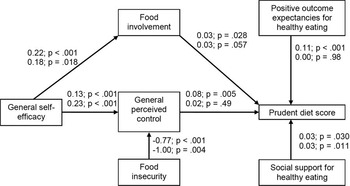
The interaction of these cognitive factors and their ability to predict quality of diet is shown in Fig. 1. This model suggests that a woman’s sense of self-efficacy influences her quality of diet through its effect on her sense of control and via her food involvement, meaning the priority she gives to food. The amount of social support she receives and the expectation she has of benefiting from eating healthily have independent effects on her quality of diet. Somewhat surprisingly, perhaps, a woman’s perception that she lacks money to feed herself and her family a healthy diet has no direct effect on diet in this model, but does affect her perceptions of control over life that in turn is related to her diet. Importantly, however, these data also show that these factors do not exert equal influence over quality of diet for all women.
Results of path models relating self-efficacy to prudent diet score in women of lower and higher educational attainment. Path coefficients for women of lower educational attainment are given above and for women of higher educational attainment are given below. Both models adjusted for age. Reproduced from Lawrence et al.Reference Lawrence, Schlotz and Crozier 15

The strength of the relationship between these cognitive factors and women’s quality of diet varies with educational attainment. Figure 1 presents separate analyses for women of lower as opposed to women of higher educational attainment. For this analysis, women were divided into those who left school at 16 years with up to General Certificate of Secondary Education level qualifications, and who tended to be those who came from more disadvantaged areas, and women who stayed on in education longer and gained more qualifications. What the model suggests is that the cognitive factors we have identified as predictors of quality of diet are more significant predictors in women of lower rather than higher educational attainment. This seems to be particularly true in respect of women’s sense of control over life.
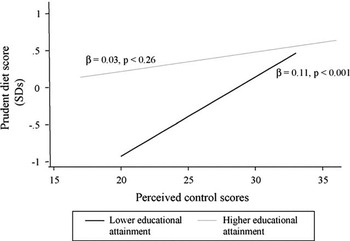
Figure 2 depicts this relationship between educational attainment, sense of control and quality of diet.Reference Barker, Lawrence and Crozier 14 The graph shows women’s diet scores as a marker of quality of diet, separately for women of lower and higher educational attainment based on what would be predicted from their scores on a perceived control scale. The much steeper slope of the line for women of lower educational attainment is an indication of how much more strongly their perceptions of control over life influence their diet. It is not clear why cognitive factors should be more strongly related to quality of diet in women of lower educational attainment. It may be that women of lower educational attainment have to feel more in control and to have greater self-efficacy than women of higher educational attainment in order to ensure a good quality diet, because the environment in which women of lower educational attainment tend to live and to shop is less conducive to making healthier food choices.
Graph showing variation in predicted prudent diet scores by perceived control scores in women of lower and higher educational attainment. Reproduced from Barker et al.Reference Barker, Lawrence and Crozier 14

Later work on a different cohort of young women in Southampton has confirmed and extended these findings. In an analysis of the psychological characteristics and diets of 324 mothers of children aged 2–5 years, women who were identified as more psychologically resilient, a description that encompasses this sense of higher self-efficacy and perceived control, employ more strategic parenting and have children with better quality diets.Reference Jarman, Inskip and Ntani 19 This analysis demonstrated a stronger association between aspects of mother’s psychological resilience and their children’s quality of diet in women who were also of lower educational attainment, suggesting that mothers of lower educational attainment may have to be more resilient than mothers of higher educational attainment if they wish to maintain a good quality of diet for their children. Ongoing work in Southampton has confirmed the idea that more disadvantaged areas of our city where women of lower educational attainment are likely to live have more challenging food environments where there may be less variety and poorer quality of foods available, and where it is therefore more difficult to make healthier food choices.Reference Black, Ntani and Inskip 20 , Reference Black, Ntani and Kenny 21 The implication of these findings is that women of lower educational attainment living in disadvantaged areas need to feel more in control and be more capable of making healthy food choices for themselves and their families than women of higher educational attainment who tend to live in more advantaged areas. This is challenging as it has been suggested that poverty and disadvantage may reduce an individual’s capability to resist environments that tempt, often unconsciously, behaviour that is harmful to health.Reference Marteau and Hall 22
New public health interventions
This body of work at the junction between psychology and public health is beginning to demonstrate that individual, cognitive factors interact with social and environmental factors to determine patterns of diet in young women and their children; which suggests that targeting either the individual to change the reflective processes that generate these cognitions or the environment unconscious, automatic processes that produce habitual behaviour is unlikely to be sufficient. Both need to be addressed. Young women, particularly those of lower educational attainment, need to be supported as individuals to make better food choices, but those choices also need to be easier to make.
There is more than one strategy for supporting behaviour change through addressing unconscious processes. The first is to change the physical or social environment that cues the behaviour using methods epitomized by a nudge approach. Though there are some arena in which the nudge approach has been shown to be very effective in supporting large-scale behaviour change, it is not without challenges particularly with respect to changing complex behaviours like diet.Reference Marteau, Ogilvie, Roland, Suhrcke and Kelly 23 Another strategy is to work with individuals to make unconscious processes conscious. They can be supported to reflect on the factors that lead them to make their food choices and to identify behaviour changes they wish to make.
This is the approach we have taken in the development of Healthy Conversation Skills training. This training is designed for health and social care practitioners to equip them with skills to engage and motivate young women, and to support them to make and sustain changes to their health behaviour.Reference Barker, Baird and Lawrence 24 ‘Healthy Conversation Skills’ are based on a model of empowerment, which rather than giving information or telling women what they should do, allows practitioners to engage with the woman’s own agenda, to support her to think about how she already behaves, what she would like to change and how she feels she can best achieve that change. In this way, the approach aims to promote self-efficacy in both practitioners and patients or clients, and in so doing targets one of the chief cognitive determinants of quality of diet identified in our early work with young women.
The training was developed in partnership with Southampton City PCT and Southampton City Council, and was initially delivered to staff working in Sure Start Children’s Centres. The value of training staff already working in the frontline of health and social care to deliver behaviour change support is that they have the reach into a community that a programmatic intervention could never have. In addition, working with Children’s Centres has enabled us to target women and children from disadvantaged areas, using the relationship of trust that staff already had with women attending centres to implement a behaviour change programme.
The effect of Healthy Conversation Skills training on the way the staff worked in Children Centres, and the impact of this on the diets and lifestyles of young women and their children attending the Centres was tested in a non-randomized controlled trial – the Southampton Initiative for Health. The training produced sustained changes in the way staff interacted with women, and a more empowering style of conversation was apparent in Centres with trained staff a year post-training than it was in Centres where there had been no training.Reference Lawrence, Black and Tinati 25 Evaluation data also suggested that this support seemed to protect women’s sense of self-efficacy against a backdrop of decline in both self-efficacy and diet quality over the period of the intervention.Reference Baird, Jarman and Lawrence 26
Training frontline staff to support health behaviour change seems therefore to hold promise as a method of addressing the needs of the ‘new’ public health, not just because it can deliver individual behaviour change to a large number of women, but also because Healthy Conversation Skills training can change the culture of support for improving diets and lifestyles across organizations. Since the completion of the Southampton Initiative for Health, this approach has been adopted by a number of projects both in the United Kingdom and abroad. The efficacy of Healthy Conversation Skills in improving diet and lifestyle is currently being tested in a trial involving pregnant women in Southampton (Trial registration: ISRCTN 07227232). Health and social care staff in a wide variety of roles have been trained in Healthy Conversation Skills in order to train other frontline practitioners across the Wessex region in the United Kingdom to support the delivery of the U.K. government’s intention to ‘make every contact count’. The New Zealand Ministry of Health have commissioned Gravida at the University of Auckland to train maternal and child health staff across North Island in order to address rising levels of obesity in women and the transgenerational diabetes risk. Other interventions using Healthy Conversation Skills in combination with environmental manipulations are currently being planned in other locations around the world.
Conclusion
Key to the new model of public health that my father proposed is the idea that young women need to be empowered individually and by the environments in which they live to make better food choices for themselves and their children. Choosing to eat a balanced and varied diet needs to be made easier. Small-scale multi-level interventions in towns have shown this to be possible.Reference Mead, Gittlesohn, Roache, Corriveau and Sharma 27 To do this, however, both commercial and political organizations need to be engaged. To date, public health has called for regulation and legislation to curtail the activities of the food industry. The logic of this seems flawed. However, effective it might be in principle, increasing tax on soft drinks, for example, is unlikely to happen as it is not in the interests of either industry or of the politicians. Politicians are sensitive to pressure from industry not to increase tax for fear of reducing sales and profits, and from the public who want cheap soft drinks. This appears to leave the health lobby fighting an isolated and losing battle. There is an alternative. Empowering people to make changes to the way they eat will change consumer demand. An empowered public demand for better access to better food can go a long way towards improving maternal, infant and family nutrition. The secret is to stop wagging fingers and to empower all partners in a dialogue. The methods used by people working in public health to engage politicians and food companies need to undergo a similar transformation to those being used to engage individuals. Empowerment needs to underpin the style in which dialogue is conducted.
In the words of my father, speaking at the centenary event for the UK Medical Research Council in Southampton in June 2013:
The greatest gift we could give to the next generation is to improve the nutrition and growth of girls and young women. The next generation does not have to suffer from heart disease, osteoporosis, breast cancer – they are unnecessary diseases which did not exist a hundred years ago. We could readily prevent them had we the will do so.
Acknowledgements
The author thanks all women who took part in the studies described in this paper, and to author’s colleagues on whose work the author draws heavily. Particular thanks to Janis Baird, Wendy Lawrence and Sian Robinson for their thoughts on early drafts of the presentation on which this paper is based, and to Megan Jarman and Christina Vogel for being so willing to discuss their ideas with the author.
Financial Support
This review received no specific grant from any funding agency, commercial or not-for-profit sectors. The author is supported by the University of Southampton, the Medical Research Council and the NIHR Southampton Biomedical Research Centre.
Conflict of Interest
None.