Johnnie Ray, America in the 1950s, and the maternal signifier
Disability studies, in its contemporary articulation as an interdisciplinary, politically attentive, constructivist analysis of the lived body in society, is very much an emerging field. This rapidly evolving collaboration of academics and activists occupies a position similar to that of postcolonial studies in timing and intent. Both postcolonial studies and disability studies ask: How is the body produced as ‘other’ by given historical circumstances? How does the individual body, with its unique combination of abilities, encounter the world into which – to draw on a phenomenological formulation – it has been ‘thrown’? To what extent does an individual's putative inability to do certain things typical of the majority of human beings (for instance, walking, talking, seeing, hearing, maintaining socially acceptable mental function and emotional balance) result from the cultural shaping of ‘the human’ and enter into complex dialogue with discourses of racism, classism, gender oppression, homophobia, ageism, weightism, and other cultural prejudices? For a scholar of popular music to bring such questions to bear on a particular performer ideally requires access to an unusual depth of information about the individual, the kind of biographical data that is rarely available even for the most cherished and widely written-about musicians of our own era. This essay enters a barely developed discussion about the American singer Johnnie Ray (1927–1990), a singer whose hearing range appears literally to have defined the contour of his performance, the nature of his short-lived popularity, and his enduring iconic status in pre-rock and proto-rock. To attempt a reading of Johnnie Ray means coping with serious limitations of biographical information. My research, supported and enhanced by music librarians at the University of Iowa and the University of Ohio, strongly suggests that no scholarly work has ever been done on Johnnie Ray. This is not to say that brief lateral references to Ray's impact on popular music do not occur in studies of Elvis Presley, Bob Dylan, and other major performers. But apart from reviews contemporary with Ray's performances and the usual fan literature, there are only two sources of semi-reliable biographical information about Ray, somewhat frantic and uneven books written by Tad Mann and Jonny Whiteside. Two further volumes bring Ray into fiction: Bonnie Hearn Hill and Larry Hill's Johnnie Ray and Miss Kilgallen (Reference Hill2002) and Jake Arnott's The Long Firm (Reference Arnott1999); both provide a certain coherence to aspects of Ray's life that biographies and ephemeral reviews have left murky. The hit or miss nature of the record is partly the result of Ray's own persistent spinning of his personal experience. Like many public figures, he was not averse to some fabrication for effect. One crucial example will have to suffice here: in 1953, Ray established a foundation for hearing-impaired children, taking the opportunity of an appearance on The Ed Sullivan Show to talk briefly about hearing impairment and to indicate his foundational donation of $1,500. Many brief biographies of Ray correctly commemorate this important moment of advocacy and generosity. However, I have been unable to discover any longitudinal record of Ray's foundation and whether it continues to exist either as a freestanding enterprise or under the aegis of other deaf advocacy initiatives. Given Johnnie Ray's prominence among hearing-impaired musicians and his status as a sort of roll-over-Beethoven of his time, the scarcity of information about the charity work that he did on behalf of deaf children is extraordinary.
I have also drawn a blank in my effort to discover what brand and kind of hearing aids Ray used throughout his lifetime. Mann and Whiteside both mention that Ray changed over time the devices that he wore, but in the absence of specific information I have been forced to make a rather speculative address to this fundamental issue by studying the generic technology available in Ray's lifetime. One consequence of this occlusion is clear: we have to resort to guesswork when we consider the dialectic between the music that influenced Ray (music that he heard with various degrees of success and failure at different times in his career) and the vocal work that he produced. Further considerations involve the strong possibility that Ray's embodiment can be described under a number of medical rubrics, that he suffered from undiagnosed symptoms that complicated the treatment and management of his aural challenges. More than anything else, interpreting Ray means taking seriously the material and mediated conditions of life in the sectors of America that he experienced during the 1940s and 1950s.
It would be an error to undertake this kind of situated analysis of Ray without speaking to my own investment in understanding his life and music. Much of my desire to interrogate Ray's image and experience has to do with the fact that my mother, Eldean, adored Johnnie Ray. Ray appeared on The Ed Sullivan Show, a Sunday night staple in our household, over half a dozen times between 1953 and 1958. Ray was thus in some sense present in my living room from the time that I was four years old until Elvis definitively propelled me into an early teen-hood. So enthusiastic was Eldean's enjoyment of Johnnie Ray, as opposed to adjacent entertainers such as Ella Fitzgerald, Alma Cogan, Bill Haley, the Everly Brothers, and Louis Armstrong, that in my memory-imaginary Ray is almost always part of Sullivan's variety hour, shining brightly against the classic clowning of Albert Fratellini and the nimble miming of Marcel Marceau, Kate Smith singing ‘America the Beautiful’ and the deft comedy of Imogene Coca.
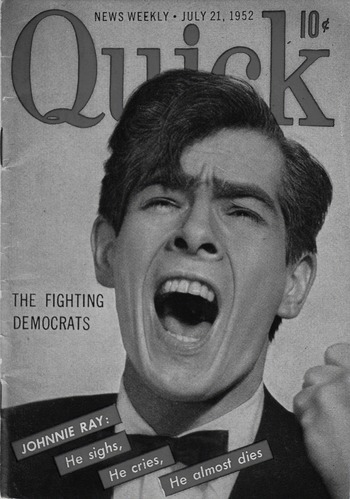
What was it that my mother admired about Ray over any other singer? When Sullivan ushered Ray onto our black-and-white twelve-inch screen, Eldean would always stand up to watch his performance. She was – this is the precise idiom – ‘intent on’ watching him. She trained an unusual alertness toward Ray's every move. And always she would comment, looking at her then only child, ‘He is so great. He's deaf, you know’. At this distance, I believe that she was delighted by the moment when Ray transformed from the simple, semi-motionless crooner, as slim, well-groomed, and controlled as the classy Nat King Cole, into an abruptly volcanic physicality – loose-limbed, urgent – and endearingly clumsy. One of the hallmarks of Johnnie Ray's act was an awkward slapstick, an excess that seemed to be part improvisation, part nervous energy. Reinforcing the tortured affect of his facial expressions (Figure 1), he intermittently raised his arms to the ceiling or fell to the floor, skipped to the left and then Charleston-shimmied to the right, banged his torso on stage equipment and clapped his pockets as though searching for the right way to behave. The singer's vulnerability was signed by his making an unexpected dive towards an activity that he hoped would be entertaining – perhaps kicking the piano – followed by a hopeful look aimed at the audience: Did they like that? Do they still like me? Do they like me?
Although Eldean eagerly attended to Johnnie Ray singing his trademark tune ‘Cry’, (about which more in the next section of this essay), what she loved most was the show-stopping bravura of Ray's rendition of Martha Carson's classic tune, ‘I'm Gonna Walk and Talk with My Lord’. Carson herself occupied an interesting pre-rock position. Before she adopted her stage name, Irene Ambergey was a member of a group called the Sunshine Sisters. One of the sisters became known, albeit briefly, as the Female Elvis Presley. This was Jean Chapel (born Opal Ambergey), whose deep contralto is reminiscent of Helen Shapiro's voice. Chapel's rockabilly repertoire was aired in some of Alan Freedman's early variety shows. In contrast, Martha Carson developed her barn dance métier on the radio and was popular on the gospel circuit. Along with many other performers who are relatively unknown today, Carson appeared on a county fair bill with Elvis Presley. Like Chapel, Carson possessed a deep, rich voice that could easily handle a wide range of pop stylings. Ray surely listened to Carson during his teens, and probably conveniently for Ray, her career petered out as his own took off.
I can readily picture my mother's enthusiastic singing along as Ray joyfully declaimed, ‘He’s a lily of the valley / he's bright as morning star / I'm gonna walk walk and talk with my Lord' (Carson). ‘Walk and Talk’ was not one of Ray's hit singles, but it became a routine part of his stage show. He sang Carson's song at the London Palladium in 1954, a performance re-released in 2005 on the CD, Johnnie Ray On Such a Night. Notably, Ray makes silences as important as sounds in his rendition. Ray's characteristic short bursts of song counterpoint the rhythmic blast of the horn section. Relying on the orchestra to maintain regular tempo, as his diminished hearing increasingly necessitated, Ray concerns himself with bending and extending notes, adding touches of glissando, and staging vocal hesitations in subtle syncopation. As he races to keep up with the fervor he elicits, he sounds breathless; he shouts like a gospel singer; he sometimes laughs for a beat or two as the crowd gratifyingly responds to his well-rehearsed and powerful delivery. To my ears, the fragments of laughter emerge from the same aural space as the slight sob that often breaks his vocalising. Like the best of Ray's songs, the Palladium version of ‘I'm Gonna Walk’ is declamatory, moving from one sonic peak to the next. Even the songs that he opens with light, unemphatic treatment characteristically build intensity to signal a kind of musical spending that for years brought audiences to their feet. The big-finish, gospel-tinged, bump-and-grind rhythm marks all of his hits, but especially ‘I'm Gonna Walk’.
In 1953, Robert W. Dana's ‘Tips on Tables’ column, published in the New York World-Telegram, described the reception of ‘Walk and Talk’ at the Copacabana. The club, Dana says, was turned into a revival meeting:
While cry boy delivers his lachrymose songs, the on-lookers stamp and clap, weep and groan, and by the time Mr. Ray completes his whining, stammering performance an indescribably hypnotic spell seems to have been cast over the entire audience … His interpretation of ‘Walk and Talk With The Lord’ was accompanied by vigorous clapping from the audience, and then, Mr. Ray, his face wet with perspiration, panting from exhaustion, walked off amid a thunderous ovation.
Dana wryly adds, ‘A nice contrast to Mr. Ray's frenetic shenanigans is the likable, vivacious comedy team of Betty and Jane Kean’ (quoted in ‘Craig's Big Bands and Big Names’, [n.d.]).
This evocation of a revival meeting was right on target. The 1958 film Sing Boy Sing (dir. Henry Ephron) opens at a revival meeting where a guitar-playing ten-year-old delivers ‘I'm Gonna Walk’ to a tent full of the born-again as they clap and sing to a hymn rhythm just shy of pressing the backbeat. The camera pans down to the boy's tapping foot, which fades into the white shoe of late 1950s and early 1960s film star and rockabilly singer Tommy Sands. The film makes explicit the precise moment of cultural transition from gospel to rock ‘n’ roll. That is, the preacher's son has grown into a successful, pompadoured, hip-shaking teen idol who shares the stage with four back-up harmonisers and an eight-piece combo as they rock ‘I'm Gonna Walk’. The cinematic context and the social text on which it draws help to explain why there was always something of the televangelist huckster about Johnnie Ray. Like Marjoe Gortner (born 1944), a child who at age four claimed to receive his sermons direct from the divinity, Ray often mimed a tortured inspiration and claimed to capture music from the air. Like a television faith healer, his movements emphasise a sort of spiritual seizure and charismatic inspiration.
Along with Eldean's appreciation of Johnnie Ray, I recall vividly the many times when my parents watched television revival meetings during the 1950s. I am sure that they watched these programmes less for their religious content than because in the three-channel broadcast system that we inhabited at the time, the network that we received most clearly carried programmes about faith-healing. My parents certainly did not believe that faith healing ‘worked’: my father in particular often made withering comments about what he regarded as the transparently deceptive performances of famous televangelist Jack Coe. In what was billed as the largest gospel tent in the world, Coe carried on a ritual of inquiry and raising-up. First he would ascertain that the sufferer believed that God could heal her. Jerking into motion, Coe would pull on frozen limbs, probe blind eyes, clasp deaf ears, place his hand on pain-clenched foreheads to bring down God's power of healing and to extirpate the disease or disability. Across rural America, Coe's tent meetings drew people on crutches, in wheelchairs, on pallets. The frenzies of healing that Coe called ‘casting out the spirit of infirmity’ would be signalled by the abracadabra of ‘All right, here it comes’, and every single time the magic worked. People in the ad hoc congregation looked hypnotised, holy-roller hysterical, telekinetically wrought up. Memorably, the television cameras showed the walls of Coe's tent, where hundreds of putatively cast-off crutches were hanging from the metal framework supporting the canvas as grim confirmation of Coe's spiritual gifts.
The televangelism mise-en-scène provided a crucial context for Johnnie Ray's celebrity. My mother listened to Ray singing about walking and talking with the Lord as if Ray's being able to do these things, and especially his being able to sing despite his deafness, were miraculous. This continuity between the mundane and the divine, between music and miracles, took on a special power within the symbolic economy signified to me by my mother. At the same time, I developed a paradoxical but deeply embedded anxiety about the mechanical apparatus that enabled Ray's apparently quite difficult and painful way of being. It was obvious to me that my mother's joyful reception of Ray's music depended on his wearing a hearing aid, as though this highly visible and celebrated sign of what a televangelist would see as ‘affliction’ resonated with matters in my mother's experience that I did not (and never would) understand fully. Further, my unease hinged on the fact that while assuming the stance of faith healer when he stood before his audiences, the singer clearly always longed to be made whole.
‘Cry’
I hesitated over the wording of the last sentence. Was it that Johnnie Ray wanted to be made whole, or did he want to be made whole again? That is, was his hearing acuity ever 100 per cent? The question foregrounds how Ray has been viewed over the years and gestures toward the background data that we lack. Certainly, a reasonable interpretive move, and one that is implicit in fans' identification with Ray over the years, would be to isolate the song ‘Cry’, his signature hit from 1952, as an expression of Ray's personal tragedy and his lifelong efforts to deploy his musical talent toward an auto-recovery. Just as Jack Coe's faith healing depended on the everyday discomfort of embodiment as experienced by hundreds of thousands of Americans during his ministry, so Johnnie Ray's music, at least the ample percentage of his act that was downbeat, is often viewed as a direct function of his hearing loss. That is, Ray's delivery is seen to be caused by his deafness. Expressing his hearing loss, acting out his aural abandonment as if his ears were lovers who had left him, while being repeatedly outed by press rumours about his bisexuality, Ray appears to be a poster child for the ‘queercrip’ category as developed in Robert McRuer's 2006 book Crip Theory: Cultural Signs of Queerness and Disability. Disabled and different, Ray used ‘Cry’ as both statement and coping mechanism. Many people have told stories of holding Ray as he wept over a failure or a social slight.
Introduced by the Four Lads' cool-toned crooning of ‘doo-waah, doo-waah’, the song's lyrics capture urgent need from the first words: ‘If your sweetheart sends a letter of goodbye / It's no secret you'll feel better if you cry’ (Ray Reference Ray1952). There are only two verses to this number, but as the second verse is repeated, it is rendered more dramatic in intonation and in decibel level. Whatever one may think about other parts of Ray's career, the singer entirely owns this piece. Ray recorded the tune in 1951 under the expert production aegis of Mitch Miller. The story goes that Miller first played a version of the song recorded by Ruth Casey on the Cadillac label and explained that Churchill Kohlman, a night watchman, had written the lyrics. These somewhat obscure beginnings did not hamper Miller and Ray. Rather, Ray's for-the-time unorthodox delivery brought the song alive: his sustained articulation, the emphasis that he gave every syllable, conveyed the pain of living by way of a dramatic change in rhythm. One could go so far as to say that Ray's great talent was less singing than it was emoting. He was skilled at deploying vocal markers of emotion, in particular feelings of acute distress and ebullient joy. These emotional states were very much grounded in the words that he sang: ‘Cry’ offers mildly stated advice to the lovelorn and then escalates the message into an urgent appeal. The message becomes a command: ‘let your hair down and go on and cry’. Ray's repeated injunction to weep actually overshadows the well-tempered sentiment in verse one that sorrow over a broken love affair is no more real than feelings attendant on a bad dream. Crying becomes a crucial exercise in emotional ventilation: in order to feel better, you have to get those bad affects out of your system. At the same time, a blues mentalité prevails in Ray's rendition, which Whiteside sees as ‘an equal product of his native gifts and a then culturally necessary process of survival through identifications with society's untouchables’ (Whiteside Reference Whiteside1994, p. 83). What the biographer means, I think, is that Johnnie Ray learned a great deal from black performers such as LaVern Baker, who helped Ray develop from a raw amateur to a skilled actor. The bump-and-grind rhythm of Detroit's Flame Club, where Ray worked with Baker and with strippers, shaped the catharsis that Ray's performance rendered iconic.
Cover of QUICK magazine, 1952: ‘He almost dies’. Robert Lerner, photographer. LOOK Magazine Collection, Library of Congress, Prints & Photographs Division.

Since the 1950s, ‘Cry’ has become a standard and has been recorded by Elvis Presley, Brenda Lee, Roy Orbison, Ronnie Milsap, Mina Mazzini, Ray Charles and others. Comparison of these performances shows that most singers strongly emulate Ray's pacing and rising urgency. That said, in contrast with Ray's robust and sometimes raw-throated performance of the tune, American country vocalist Crystal Gayle uses the song to showcase the note-perfect purity and impressive range of her voice. When she performed this tune at the Wembley Country Music Festival in 1977, Gayle smoothed the rough edges by taking the tune down-tempo, adding both saxophone and sophistication to the production. Although she followed Ray's lead in making the repeated second verse emotionally emphatic, a strong jazz ambiance was brought forward in an interesting abstraction of sound from meaning: Gayle swallows the consonants and voices the stanza as a series of prolonged vowels. In the television broadcast from Wembley, the BBC announcer, his plummy voice positively Pythonesque, carols, ‘Johnnie Ray, eat your heart out. What a super jazzy version of “Cry” from tonight's star Crystal Gayle’ (quoted in Gayle [n.d.]). Ray's ‘Cry’ remains the classic performance from which others can only conform or diverge; no treatment of the song can shake off this implicit comparison.
Having broached the causal view that in ‘Cry’ Ray basically performed the emotional impact of his disability, I want to return to the question of how Ray dealt with his hearing impairment as well as with his queercrip self-identification. Again, innumerable short accounts of Johnnie Ray's life can be located, but nothing approaching a definitive biography has been written. Fans of the Nabob of Sob have roundly panned the only real contender, Jonny Whiteside's Cry: The Johnnie Ray Story (1994), as a lurid potboiler, cobbled together from mostly undated tabloid articles collected by fans and collapsing under the strain of contradictory accounts and chronological inconsistencies.
To be sure, Whiteside himself signals these problems early on: ‘A biographer is necessarily an interpreter and editorialist. The few presumptions found here are colored primarily by firsthand comments from Johnnie himself. Measuring his statements (from my own tapes and forty years of press interviews) against everything his weird notoriety projected, cross referenced through the inevitable conflicts found in the memories of forty-four different individuals provided my framework of reckoning’ (Whiteside Reference Whiteside1994, pp. 5–6). That said, Whiteside – purportedly targeted by Ray himself in 1989 as a possible ghost-writer for an unwritten autobiography – was fortunate in gaining access to Ray's sister Elma as well as many of Ray's friends and associates. In the midst of Whiteside's inconsistencies and overstatements, Elma Ray's comments always seem judicious and straightforward. The narrative tension between her restrained statements and the poorly controlled speculations of the biographer suggest that there is ample opportunity for another record of Johnnie Ray's life and work to be written, one that is critical and carefully documented.
As the record stands, though, everything turns on an event that occurred during the summer of 1940 when John Ray, aged thirteen, was present at a Boy Scout Jamboree. It is not clear whether the boy was a scout or not, but he was enjoying the large gathering of rambunctious young people. At some point, he was drawn to some kids who were using a canvas tent to set up a blanket toss. Soon chosen to be the object to be thrown into the air and caught on the improvised safety net, Ray was hurled high and wide. Rather than coming down onto the canvas, he landed on hard, dry ground. Another version of this tale suggests that the boys holding one corner of the canvas let go of it on purpose. In any event, Ray is said to have suffered a concussion, but in the absence of bleeding from his head, nothing was done, and the scouts carried on with the jamboree. Whiteside asserts, as the singer often did, that a stiff straw of grass plunged directly into Ray's ear canal and punctured the ear drum, causing the child to lose fifty per cent of his hearing at one blow (Whiteside Reference Whiteside1994, p. 21).
Whiteside says that between summer of 1940 and the fall of 1941, Ray's accidental hearing loss remained undiagnosed, and it is likely that the condition worsened during that year. The story goes that Ray kept the injury to himself, even though he had suffered an ‘inexplicable change in his perception’ (Whiteside Reference Whiteside1994, p. 23). The world around him was suddenly new and strange; his perceptions were altered, but he could not say precisely what was wrong with him. One question that arises immediately is why Ray did not notify a scoutmaster or go home to tell his parents that he had been injured. One can only speculate that the boy felt ashamed of what must have felt like a very public gaffe, one that might actually have been engineered by the other boys. In such a case, a young person might wonder what he had done to deserve this treatment by his peers while remaining uncertain about whether or not he had actually been victimised. Certainly, the possible assault strongly suggests that Ray's physical trauma was matched by emotional injury that never entirely healed.
In later life, Ray told friends that he did not inform his parents that he had been hurt because he did not want them to worry. The family's relative poverty probably made the prospect of medical bills unwelcome. It is also likely that this child was unwilling to confess to the awkward accident, given that it was only one in a string of wild and painful childhood adventures. John Ray was by all accounts a hyperactive boy, reckless to the extent that he often puzzled his schoolmates. He dreaded being the odd kid out, and yet he often seemed to court that moniker. His family and friends recall that even judging by the relatively rough-and-tumble conduct typical of children reared in the Oregon and Texas countryside, Ray raised eyebrows in the community. It is likely that the boy had been chastised many times before for taking part in dangerous activities. A likely scenario, then, is that the boy, characteristically taking part in risky and probably forbidden behaviour (I can recall being told in the 1950s that blanket tosses were strictly off-limits at Girl Scout gatherings and at summer camp), suffered a severe head injury that he construed after the fact as the cause of several coinciding physical and emotional changes. Bill Franklin, Ray's long-time manager and lover, reports that at first Ray himself did not identify his changed perceptions with hearing loss but rather ‘It was just like BONK! And the whole world was different’ (quoted in Whiteside Reference Whiteside1994, p. 24). Ray remembered this time period as the beginning of his tendency to isolate himself. Unable to hear with any clarity either his teachers in the classroom or his friends in the playground, at age thirteen he was also coping with the hormonal explosions of puberty. In every aspect of his development – emotional, physical, sexual – he became aware of ambiguities that drew a line between his childhood and the world after the jamboree.
Whiteside adds the further detail that Ray ‘always lied about his hearing loss in later years’, sometimes attributing the condition to a congenital disorder, exaggerating the time span before he was taken to a physician, and generally confusing the record. The biographer believes that Ray ‘never completely reconciled himself to his misfortune’ (Whiteside Reference Whiteside1994, p. 26). To complement this view, we can draw on information in Johnnie Ray: Beyond the Marquee (2006), a volume written and self-published by Tad Mann, who was Johnnie Ray's road manager for thirty-five years. Mann possesses a steady discursive drive but is not trained as a writer; the information he provides is offered in fragments, recursive, and repetitious. Nonetheless, Mann has the canny intellect of a celebrity handler and the wide experience of the showbiz factotum. He brings forward aspects of Ray's life that are glossed over by Whiteside while doubtless incorporating into his narrative bits of the mythos that Ray developed for himself over the years. This combination of virtues, while not guaranteeing any sort of accuracy, nonetheless offers material not readily available elsewhere.
For what it is worth, Mann is of the opinion that the singer indeed had a congenital hearing defect from birth that gradually worsened over the years. Mann claims that Ray's degenerative hearing loss, actually diagnosed when he was a small child, gradually increased until his early teens when the blanket toss accident occurred. Ray fashioned his life story around this incident as a way of going public with the deafness that he had disavowed. His immediate family appear to have collaborated in this denial until the boy's characteristic wild behaviour and lack of attention in school caused a teacher to recommend that Ray be sent to a school for blind and deaf children. Years later, Ray spoke openly of his unquenched outrage over this suggestion, as though to accept the diagnosis of severe hearing impairment were deeply embarrassing and painfully dishonouring to his family. Throughout his lifetime and in response to a host of different events, Ray experienced persistent shame and feelings of futility. The need to behave with secrecy was probably second-nature to Ray by the time that he failed to notify his parents about his dire accident. In several ways, he warded off feeling like the odd-kid-out by denying that anything was wrong.
The Boy with Green Hair
What cannot be owned outright is often mediated by movie-going. Johnnie Ray saw his first movie at the age of five, and he immediately chose acting as his future career. As it happens, he had only one film role of any substance, playing one of Ethel Merman's sons in the Irving Berlin musical There's No Business Like Show Business (1954). Next to his co-stars – Merman, Donald O'Connor, Dan Dailey, Mitzi Gaynor, Marilyn Monroe (who performs her iconic version of ‘Heat Wave’) – he looks slight, smaller-than-life, almost anaemic. His character's trajectory from born-in-a-trunk vaudevillian to priest, especially considered in the light of increasing public awareness of Ray's bisexuality, speaks to the producers' anxieties over the liminality of the singer and probably to the dilemma posed by his having a soft and somewhat childlike speaking voice. In this cast of bodies and voices, Ray does not really hold his own. But we need not find evidence about Ray only in his own performances; the movies of his era are in fact quite helpful in explaining a child's experience of physical difference and the likely contours of Ray's emotional development.
One film that does a great deal to explain Ray's childhood situation is Joseph Losey's The Boy with Green Hair (1948). Ringo Starr once told Dean Stockwell, who played the titular boy, that this film had deeply affected him. Certainly, the film was widely distributed and had a substantial viewing audience of all ages. Nonetheless, the film is not well known today, so a brief description will help to frame the connections between Ray's life and this film. The story involves a primary-school-age boy named Peter, whose parents had been engaged in charity work in London during the Blitz. For months, possibly years, their death is not revealed to Peter. His inquiries are met with avoidance and heavy silences. In this respect, Losey captures the milieu of 1940s and 1950s America perfectly. Having been bounced from relative to relative, Peter finally comes to live with Gramps (Pat O'Brien), a failed music hall comic. Gramps spends most of the film offering Peter the marshmallow cream of emotional evasion rather than the facts of the boy's reality.
Having established this context of social denial, the movie shows Peter waking up one morning to discover that his hair has turned bright emerald green. The child wrestles with the suddenness and possible meaning of this metamorphosis. A dream-vision convinces him that he is supposed to become an emissary from the orphaned children of World War II to the adult world, reminding society visually and insistently that ‘war is very bad for children’. The strain of this mission shows on Peter almost immediately. He discovers that despite some friendly overtures from neighbourhood children, most people treat him differently because of his hair. Even the ideally supportive Gramps cannot hide his shame over the predicament, first blaming Peter for fooling around with hair dye, then making Peter hide his unruly hair under a hat, and finally taking the boy to a barber where the offending locks are cut off and the shame that they signified moved from the boy to the community of judgmental onlookers.
With this cinematic parable in mind, consider that on one occasion as a teenager Johnnie Ray attended a dance, ‘and he had dyed his hair green – I mean GREEN’, recalls a friend. ‘And everybody there was saying “Jesus Christ, John, what have you done?” It was just a crazy goddamn thing, it wasn't for Christmas or for any reason you could figure. He got an inclination to dye his hair green. As a matter of fact, I believe he used food colouring to do it, because his hair was blond anyway, very light, and it was bright, bright green. Oh, it was crazy, but … he would just do those things. Quirks. Crazy things’ (quoted in Whiteside Reference Whiteside1994, p. 20). The psychological dynamic of The Boy with Green Hair, steeped as it is in American small-town culture in the 1940s, aptly illustrates Ray's situation. From birth, he had been going deaf; neither he nor his family wanted to accept this fact, let alone make it public. The refusal and vilification of difference that strongly marked American life during and after World War II, offered equal-opportunity shame both to children and to adults while also preparing the way for the revolution in values that followed the restrictive 1950s. Just as Ringo Starr admired the transgressive character played by Dean Stockwell, so much later the singer Morrissey would wear a hearing aid while performing to align himself with hearing impaired fans and (apparently) explicitly as an homage to Johnnie Ray.
A second connection between Ray and The Boy with Green Hair pertains to the film's theme song, ‘Nature Boy’. Written by Eden Ahbez, an orphan born in 1908 in Brooklyn who spent the war years homeless in Los Angeles, ‘Nature Boy’ was first recorded in 1947 by Nat King Cole and in the movie was sung behind the film credits by an anonymous chorus. The song tells a simple story about a wandering, shy, and sad child who overcomes his loneliness to offer his listeners some advice: ‘The greatest thing you'll ever learn / Is just to love and be loved in return’ (Cole). Like Ray's little white cloud, the ‘strange enchanted boy’ seeks out the unhappy people and cheers them up, even though the experiences of both speaker and hearer directly contradict the likelihood that happiness will prevail. I bring forward the connections between Ray's artistry and The Boy with Green Hair to emphasise the significant fact that Ray, despite his hearing loss, always claimed to grab messages from the air. The music that Ray himself wrote came to him specifically as auditory inspiration. Insofar as the stories that Ray offered in later life to explain his hearing loss challenged both credulity and chronology, it is perhaps no surprise that there is special confusion regarding the music that he would have heard before the accident in contradistinction to the music that he listened to afterwards. His perception of music itself and of his own inherent musicality and of his auditory inspiration does not change. Consider that in 1955, Phyllis Gray, a writer for TV & Movie Screen, interviewed Johnnie Ray and recounted his narrative of how he wrote one of his 1951 hit tunes.
One day in early 1950, he and Elma were visiting at their parents' Roseburg home. Johnnie was depressed about his career that afternoon, particularly over a Portland booking which had fallen through. While Hazel prepared dinner, he excused himself and wandered outside to amble the countryside. Presently he found himself at the nearby Umpquah River. Johnnie lay down on the riverbank. ‘I just took every idea out of my mind’, he said, ‘and sort of thought “Lord, you'll have to take over from here. I just don't know what to do next. I guess I'm licked”.’ He gazed into the blue expanse of sky and addressed a cloud that drifted overhead. He ‘heard things’. A lyric came into his mind, a melody to his ear and he began scrawling words down even before he got back to the house. ‘It was all there’, he said. ‘The title, the words, the tune’. (quoted in Whiteside Reference Whiteside1994, p. 44)
The song was ‘The Little White Cloud That Cried’. The childlike quality of the lyrics and Ray's sentimental delivery of the tune suggest a grateful regression to a time when he was not regarded as deaf, merely as strange – odd in a way that might actually be a message to the world. The speaker says that he was ‘very sad inside’ when, with the most fundamental of bathetic coincidences, he sees a crying cloud who was also unhappy, lonely, and frightened. Despite the cloud's fears and sorrows, it offers cheering counsel: ‘Have faith in all kinds of weather / For the sun will always shine’ (Ray Reference Ray1952). The song is part of the sizeable genre of songs about sorrow and rain, but ‘The Little White Cloud That Cried’ makes the unusual move of asking us to picture a cloud that is crying but not actually producing rain. In fact, the song is full of contradictions; surely the passing away of dark clouds would also mean the passing away of the crying cloud addressing the singer. Of course, popular song is not meant to be submitted to logical scrutiny in this way. But what this exercise suggests is not only the bathos that Ray himself wrote into his work but also the emotional condensation on which his performances turned. That is, the singer, the song, and the situation are entirely subordinated to a specific organisation of emotions. Extreme sorrow and depression are invoked in order to be dispelled and dispatched by a message delivered with vocal markers of emotion itself. Ray's best and most beloved songs are about being emotional over rejection, loss, and the human condition. The tenor of this song, the healing that it signified for Ray, his insistence that the song came to him from outside or up above, that he heard it – these are critical pieces of information about his framing of his own creativity. Like green-haired Peter, who can accept his own loss and new social status only by way of an encounter with war orphans, Ray's narrative shows the process by which he understands his own sorrow, loss, and need for faith and courage by way of the message given to him by the little cloud. The move here is towards divine intervention – the miracle that follows prayerful surrender to the divine will. Childlike, Ray has returned to his parents' home, a self-confessed failure at the age of twenty-three, unable to come to grips with his hearing, aware of social disapproval of bisexuality, but inhabiting a world charged with spiritual possibilities and perhaps random healings.
Highs, lows and hearing aids
Although Ray's social life often made tabloid headlines, the way that he functioned in society has been under-interpreted. Both as a child and as an adult Ray was fairly insensitive to social decorum: for instance, when he would play the piano at friends' homes, he would frequently overstay his welcome. For some reason, he could not follow road rules well enough to drive a car. Over the course of his lifetime, he acted childishly and recklessly, as though he were bulletproof. Mann emphasises that people who were with the singer on a daily basis often witnessed Ray's irrational anger, the ‘Jekyll and Hyde’ behaviour which ensured that one ‘just never knew what Johnnie Ray you were with’ (Mann Reference Mann2006, p. 20).
The behaviour, rapid changeability, irritable anger, and denial that Mann describes – combined with a lifelong abuse of alcohol and sexual risk-taking, and behaviour on-stage that asks to be interpreted as acting-out – all of these things strongly suggest that the stigma of deafness was compounded multiply by considerable emotional instability and a sometimes dangerous volatility. Mann laments that Johnnie Ray came along too soon to have benefited from Berry Gordy, who maintained strict control over his Motown performers and who insisted that they undergo charm school training, lessons in table manners, speech training, and other behavioural modifications so that they fit the label's image. In contrast, Ray had little guidance and was in any event disinclined to accept advice. The public thrilled to his indecorous and uninhibited performances and then mostly lost interest. Part of the disconnect from reality that marked Ray's experience – a condition that many show business personnel have experienced – is that Ray never stopped trying to engineer a permanent comeback.
In fact, he became increasingly convinced that he taught Elvis the ropes and that his own performances entirely pre-empted the extravagance of rock and roll. It is certainly the case that Ray left his mark on the Beatles and the Stones; Ringo Starr attended the London Palladium concerts as did Andrew Loog Oldham. Bob Dylan, like many others inspired by Ray, has testified to Ray's powerful vocal presence. Ray's physicality and musical style entered directly into the rock environment and became inseparable from the late 1950s and early 1960s popular music mise-en-scène. But the performer whose music influenced so many of those who came after him has to be distinguished from the erratic, volatile, and secretive physical body that suffered not just from deafness but also from behavioural symptoms that, in severe form, characterise some varieties of bipolar disorder. In the absence of a sustained and informed critical biography, the life of Johnnie Ray – his embodied and largely unknowable experience of the world – presents an interesting challenge to emerging Deaf studies, disability/ableist studies, and crip theorists. It would be useful to compare Ray's life with detailed records of other persons multiply challenged by social expectations and norms.
As his hearing progressively worsened, Ray's emotional frustration increased, as did his addiction to alcohol, a sleeping pill called Halcyon (which in high doses has been linked to erratic and violent behaviour) and other drugs both legal and illegal. Both his family and his community puzzled over the persistent symptoms of what we would probably now call mania that he exhibited from childhood onwards. In those days, so-called manic depression was understood even less well than it is now. And there is every sign that Ray, trying to understand his own physical ups and downs, often found the world around him to be strange, new, different, and either intensely thrilling or unbearably boring. At the same time, he did not have a vocabulary for describing that violently changeable personal world. Without being able to prove the point, I have provisionally concluded that when the concussion at the jamboree occurred, Ray's deep disorientation gave him a hook on which to hang the emotional and physical highs and lows that he experienced. Judging by Mann's recollections in particular, one might conclude that those same mood swings, so much a part of his creative energies, stepped up their pace as Ray moved through adulthood. Ray's saving grace was the innate musicality that enabled him, ironically, to play the piano by ear, and to develop himself as a saleable commodity from the combination of his extremely high energy, his semi-hallucinatory experience of ‘hearing things’, his progressive hearing loss, and even, it would seem, the psychic low points against which he perennially struggled.
Having brought Ray's accident into the picture as well as his embodied experience of musical composition, and his sometimes erratic behaviour, I return to the ambiguity surrounding what Ray could and could not hear. The messy biographical record is not helpful in clarifying Ray's embodied experience or in thinking precisely about the sensory data that he received. For example, I have been unable to locate information about the precise model of hearing device that Ray wore. What was it like for Johnnie Ray to wear a hearing aid? How did the device feel in his ear canal and wrapped behind his outer ear? To what extent was amplification the main event, and to what extent did other auditory phenomena occur in the midst of performances and as a function of his very musicality?
Mann states that by 1953, ‘Everyone near him and the audience itself was familiar with him turning the volume [on his hearing aid] up so loud in order to hear the music it would screech with feedback’ (Mann Reference Mann2006, p. 52). Sarah Laufer, who writes the Whatgirl.net site (The Website for Your Ears), calls this the ‘Jimi Hendrix Effect’. She writes, ‘Just about everyone who wears hearing aids has experienced the Jimi Hendrix Effect … Engage in a meaningful hug with someone and revel in the high-pitched, pulsating “EeeahhrjjjhoooEEEEEzhzhzhzhzhzEEEEE” in the hugged ear. Pull a hat down a little too low and get the same thrill in stereo. Do something really inspired like take your hearing aids out of your ears before turning them off, and be rewarded by an electronic riff playing right from the palms of your hands that would make Jimi proud’. She goes on to discuss the feedback that occurs when a hearing aid and a phone receiver make contact.
Ray experienced a deterioration in his hearing during the early 1950s, and doctors counselled him to have surgery. Ray believed that he would be able to hear without impediment after the operation. At the time of the surgery, 1958, both ears were estimated to have had only 35% function, with the left ear rapidly losing ground. Sadly, the surgery did more harm than good, leaving his left ear completely without hearing. Mann comments, ‘I think Johnnie did die some as a result of that surgery. If you look at videos or listen to recordings there is a definite change in his persona’. Rather than exude the confidence of earlier appearances, Ray was constantly adjusting his hearing aid: ‘He could never get the volume the way he wanted it. He often lost his place and the notes … were off key’ (Mann Reference Mann2006, p. 53). This situation meant that in Europe, where big band backing was the norm for Ray, he could function fairly well, led by the piercing horns, but in small stateside clubs Ray lacked the support he needed to follow his own performance. By the end of the 1950s, his right ear also lost further ground.
Recalling The Ed Sullivan Show, I seem to remember Ray wearing a hearing aid that was abnormally large, even for the 1950s. The device hung heavily on his right lobe, a thick clamp connected to a large pale disk that probed his ear canal. Despite the black and white television technology of the times, and despite the fact that Ray often sported a mauve device, I remember perceiving the apparatus as a yellowish grey, a generic and entirely ineffective replica of Caucasian ‘flesh’ colour. Although only one of Ray's ears held a prosthetic aid, as a child I concluded that he was entirely deaf on both sides. Mann affirms that ‘he had to overcome the dreaded embarrassment of wearing it [the aid] onstage’, and he adds that Ray's hearing aid was powered by six D cell batteries that hung from a pack around his neck (ibid., pp. 9, 7).
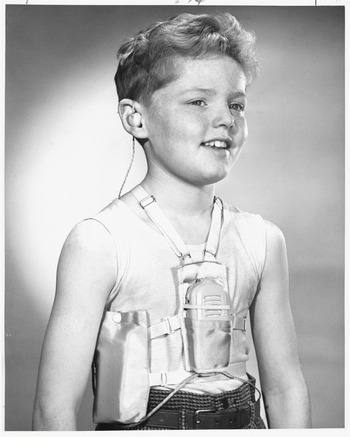
Boy with battery pack on chest. Becker Medical Library, Washington University School of Medicine.

The Bernard Becker Medical Library at Washington University's School of Medicine hosts an invaluable website called ‘Deafness in Disguise: Concealed Hearing Devices of the 19th and 20th Centuries’, which ‘presents images, illustrations, advertising pamphlets, trade catalogs, patents, rare books and other material pertaining to mechanical and electrical hearing devices from the 19th and 20th centuries. Of particular focus in this exhibit are hearing devices that were designed for concealment or camouflage within everyday items’ (‘Deafness in Disguise’). This presentation draws liberally on an archive originally collected by the Central Institute for the Deaf (CID) and included in a project launched in 2002 for the Annual Alexander Graham Bell Association for the Deaf and Hard of Hearing. Early hearing apparatuses were mechanical and were usually so large that many individuals refused to use these emblems of sensory deficiency. The desire to conceal hearing aids – to hide them where hairstyles dictated in the form of acoustic headbands or to disguise them as jewellery or other ornamentation – was inventively met by manufacturers around the world throughout the 1800s. Ear trumpets gathered and enhanced sound waves while ‘dentaphones’ transmitted vibrations into the bones of the head through the teeth. Specially equipped chairs served the needs of the patriarch at work as well as at home. Acoustic devices were concealed in beards, carried in handbags and camera cases, placed in table vases and hollow walking sticks, incorporated into hats and joined to opera glasses. Avoiding the public announcement of one's affliction was as much the aim as improving sonic perception.
The twentieth century brought more powerful electrical amplification of sound, the introduction of vacuum tubes, and the technology for mini- and micro- devices. Johnnie Ray was fitted for his first hearing aid in 1941, an unpropitious era in hearing technology. As the authors of ‘Deafness in Disguise’ state, ‘During the 1930s and 40s, miniaturisation of vacuum tubes allowed manufacturers to develop body-worn designs that housed vacuum tubes and microphones within a single unit, which allowed for portability. However these early body-worn hearing aids were cumbersome and still required use of batteries not housed within the hearing aid. Wires were required to connect the batteries and the earpiece to the microphone/amplifier unit’ (Deafness in Disguise [n.d.]). The word ‘cumbersome’ appears in hearing aid literature almost as often as the descriptor ‘unsightly’. In 1944, a Western Electric hearing aid (model 134) required two batteries, each almost as large as the receiver. These elements amounted to over two pounds of equipment that had to be attached to the user's body – something that continued to be a problem in subsequent years.
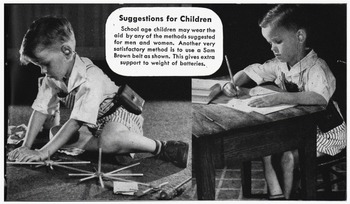
A CID image (Figure 2) shows a boy perhaps six years old wearing a thick plastic ear pod approximately one-half inch in diameter, the pod attached to a wire that wrapped over and behind the ear itself and connecting to equipment strapped on the body. The receiver was held on the chest by six straps that formed a harness, to which the battery pack was attached under one arm like a policeman's gun holster. Men, women and children all wore quite similar devices, except of course that the instrument was relatively more prominent on a child's smaller body. The CID image does not identify the precise maker and model of device pictured. However, a page from the manual for Zenith's 1942 Radionic A2A vacuum tube product (Figure 3) offers suggestions for children wearing this ‘body aid’. Girls could hold the equipment in a special vest for which Zenith would supply the pattern. School-age boys were shown using Sam Browne belts to contain the items. Notably, in both images the boy is shown playing with tinker toys and sitting at his desk alone. From the vantage point of the twenty-first century, all of these photographs carry a strongly prosthetic stigma: even the underwear to which these items often hooked up looks dismally confining. A harness added to a corset could only be uncomfortable. It was not until 1947 that Zenith and other manufacturers had access to batteries small enough that the microphone, amplifier, vacuum tubes, and power supply could be housed in a single unit that could be slipped into a jacket pocket, placed within a good-sized tie clip, or made part of a badge worn for work.
Two boys (Suggestions for Children). Becker Medical Library, Washington University School of Medicine.

To review, the hearing aid developed within a discourse that prized secrecy. The connection between perception and what we might call the personal hygiene of keeping one's sensory capabilities private added a visual element to the hearing circuit: in order to hear, one had to hide. Further, even twenty-first century technology has not entirely excluded equipmental sounds from hearing devices. People using hearing aids receive jolts of noise if the mechanism is tapped during an embrace or loss of balance. A microphone's rubbing on fabric can import extraneous noises. Hearing aids can be difficult to maintain in good working order. These machines are fragile, relatively short-lived (up to five years), and sensitive to moisture, temperature, and rough handling. A hearing aid may be uncomfortable, may be subject to ‘occlusion effect’ (where one's voice sounds too loud), may whistle or squeal from ear canal fluid or perspiration, and may make it highly problematic to distinguish background sound from conversation or media tracks. Additionally, many people who identify as hard of hearing suffer from tinnitus, which can manifest in many different ways, including roaring, whistling, howling, rumbling, and other persistent auditory phenomena.
It is likely that Johnnie Ray disliked dealing with the discomfort of the harness apparatus. Beyond that observation, it is difficult to know what to say. His deafness – its texture, its depth, its effects on his perceptions – remains as much of a mystery, as undescribed, and as unrecoverable as the hearing capacities of the rest of the world's individuals. We have barely begun to find ways of talking about these embodied differences and to develop a vocabulary of inquiry. So it is that the impact of Johnnie Ray's experience on his music remains fundamentally unrecoverable. We can never know very much about the quality and texture of his hearing, amplified as it was by an outmoded and delicate technology. As obvious as this point is, it remains rather startling, especially when we consider that by personal inclination Ray defined himself in large part by his ability to produce sounds, by his musicality. Playing piano, listening to records, singing and performing, making music: these things were his ways of interacting with the everyday world as well as the tokens that he used to fend off an inchoate inner shame and pay for a roller-coaster career.
Another startling point: as far as is known, despite his intensely gestural rendering of songs, Ray never took the precaution to learn to sign. When I consider the dramatic impact of the fluent ASL practitioners that I have seen at concerts large and small, I realise that Ray would have been an extraordinary force for social change had he somehow outrun history to develop a facility with musical signing that is much more a part of my world than of his. Instead, he held to the belief that he could be healed and underwent the disastrous surgery that he hoped would propel him to the top again. All things considered, his choices were quite reasonable. But they were grounded in the belief that the real John Ray, the one who probably had never actually existed, was more whole than the individual who charted in the hit parade. For the record, Johnnie Ray's distinctive sound amplified a broad spectrum of material conditions and contexts in which he was, for a time, a star.
Acknowledgements
Figure 1: Caption: Robert Lerner, photographer. LOOK Magazine Collection, Library of Congress, Prints & Photographs Division. Used with permission.
Figures 2 and 3: Becker Medical Library, Washington University School of Medicine. Used with permission.