In recent years, intensifying global concern over the adverse impacts of climate change has put China’s environmental protection strategy under a spotlight, particularly given the country’s status as the leading emitter of greenhouse gases worldwide.Footnote 1In response, the Chinese government has implemented an extensive array of policy measures aimed at mitigating carbon emissions and advancing sustainable development. Among these measures, the establishment of a national carbon market has emerged as a vital initiative that is expected to play a pivotal role in the realization of China’s climate goals.Footnote 2The governance of China’s carbon market as a policy experiment has, however, become entangled in complex principal-agent issues. At the heart of these issues is the relationship between central and regional power, which is a recurring theme in numerous studies on China’s environmental governance. Under the hierarchical governance system, the Chinese state delegates power to subnational tiers of government and builds strong connections with non-state agents in the enactment of environmental regulations.Footnote 3At the local level, although government officials in the bureaucracies bear responsibility for local government, they come under the control of functional administrative superiors.Footnote 4Benefiting from institutional flexibility, proximity and local knowledge, local governments have the discretion to adapt and implement state-level environmental policies according to regional contexts.Footnote 5As municipalities have gained more regulatory and financial authority since the economic reform, many academics claim that the central state has tried to deputize and designate provincial leaders and regularly negotiates policy issues with provinces.
The carbon market has created a new political arena for a constellation of interests, groups and movements, necessitating the state’s efforts to monitor and regulate the networked agents within the market. The effectiveness of central control mechanisms largely depends on how much information officials in the central state have acquired about the performance of local experimenters,Footnote 6and how the key actors in the policy processes respond to the incentives and sanctions within a given institutional context.Footnote 7In their analysis of China’s carbon market, Bo Chen and colleagues identify various locally guided collaborative processes intended to expand the carbon trading system beyond a top-down fashion in Guangdong province and highlight how these processes align with local political traditions, bureaucratic culture and distinct development needs.Footnote 8In this context, the local state officers bear responsibility for the full process of policy innovation, from designing and developing to implementing and brokering. However, unresolved tensions between the state and market in regulatory practices within China’s carbon market exacerbate the implementation deficits faced by local regulators, who must also address more urgent industrial and environmental regulations.Footnote 9Additionally, mechanisms such as formal institutional arrangements and informal connections among the actors have barely been investigated in studies of China’s carbon market. These mechanisms are at the core of the analysis presented in this paper, which aims to unpack local carbon market governance patterns.
To explore the complex interactions among the various stakeholders involved in carbon market governance and to demonstrate how governance strategies have been employed in a dynamic process to advance the scaling up of the carbon market, we use a principal-agent model within the broader framework of rational choice institutionalism to address the research question of how the Chinese state aligns state and non-state actors to enhance policy implementation in China’s carbon market governance. China’s carbon market system comprises a mandatory emission trading scheme (ETS) that regulates key industrial sectors and a voluntary offset mechanism, the China Certified Emission Reduction (CCER)Footnote 10. The CCER programme was suspended in 2017 and only reactivated in 2023 through regulatory framework restructuring and so this study primarily explores the ETS as the core carbon pricing instrument. Consequently, the term “carbon market” in this paper predominantly refers to the ETS, with limited CCER exemplars incorporated. It should be noted that the selective inclusion of CCER cases here serves as a supplementary contextual element to construct a comprehensive analytical panorama of market governance dynamics. The analysis draws on data gathered from semi-structured interviews conducted with 36 professionals from various fields, including senior policymakers, experts from environmental and energy exchanges, policy researchers in think tanks, executives from third-party regulatory agencies, leaders of NGOs and industrial associations, business practitioners in firms in the covered sectors, experts in carbon consulting firms, and academic scholars. The first round of interviews took place between August and September 2019 and was followed by a second round from March to August 2021 and a third round in February 2022. Throughout the study period, we maintained consistent contact with the study participants and conducted repeated interviews in accordance with longitudinal research design principles.
This article is structured as follows. First, we address the principal-agent challenges in the context of China’s environmental governance practices. We then present an analysis of the monitoring mechanisms employed by the central state to regulate subordinate administrative tiers, followed by an exploration of state efforts to monitor non-state participants in China’s carbon market. Through an analysis that centres on the interactions between state and non-state actors, this paper captures the intricate interplay among regulatory institutions, environmental authorities at various levels and enterprises operating within the carbon market.
The Principal-Agent Dilemma in China’s Environmental Governance
The principal-agent model has been applied to the political world and can also be used to examine the interactions between the vertical and horizontal aspects of carbon market implementation within China’s bureaucracy. Although it is an authoritarian state, China’s vast territory and significant local diversity, combined with its longstanding central–local relations, make the principal-agent approach suitable for exploring how the central state exerts control over subnational provinces in the implementation of its carbon market policies. It should be noted that the carbon market operates on politically determined caps rather than on a trade-based system. The diverse array of stakeholders involved in the market, particularly the covered enterprises that are now asked to pay for their polluting emissions, requires the state to develop robust supervisory mechanisms to monitor market trading.
Environmental governance in China is a multi-tiered issue characterized by a consistent governance pattern of vertical–horizontal relations (also known as the tiao 条 –kuai 块 relationship).Footnote 11This term is commonly used by policymakers and academic researchers to describe the policymaking and implementation process. “Vertical” refers to the hierarchy of the central party-state machinery, which extends from the top down to local governments, while “horizontal” refers to various levels of subnational governments. These vertical and horizontal government apparatuses are cemented by power delegations and a series of control channels. However, the complex intergovernmental relationships within China’s environmental governance, particularly in sectors such as the power industry, often reflect the challenging dynamics between decentralized delegation and centralized control in environmental policy governance.Footnote 12In other words, the central government delegates the power to local governments to handle a wide variety of duties that appear to include all aspects of governance, including the economy, civil affairs and the environment. However, if the central government deems it necessary, it has the authority to revoke the local government’s jurisdiction. Zhou Lian describes China’s intergovernmental relations as a top-down subcontracting practice: “The central government subcontracts virtually all administrative functions and public services to the intermediate subordinate government, and the latter further subcontracts all those functions and services down to the next level of government, all the way down to the bottom-level local governments, such as counties or townships.”Footnote 13
This administrative subcontracting mode of governance saves the central state from the burden of routine micromanagement. Zhou argues that the combination of vertical administrative subcontracting and the horizontal political tournament mechanism reveals unique Chinese characteristics in this mode of governance, which differentiates it from other governance paradigms, such as administrative decentralization, M-form organizations and government outsourcing.Footnote 14Cao Zhenghao extends this argument by suggesting that, in China, the powers of governing officials and civil rights are divided, forming a governing system with upper and lower elements.Footnote 15In his description, the central government mainly wields the power of governance – that is, the power to select, supervise, reward and punish officials – whereas the actual authority to govern the citizens is left to local officials. As long as these local officials do not violate the general policies set by the central government, they can in practice exercise their power of governance in line with local conditions and flexibly manage affairs in the areas under their jurisdiction.
Many academic researchers have argued that the complex interactions among multiple levels of institutions could weaken the state’s decision-making ability and influence policy implementation at the local level.Footnote 16For instance, Benjamin van Rooij maintains that the lack of central recognition of environmental legislation can be attributed to local governments’ inadequate enforcement of environmental regulations.Footnote 17He further demonstrates that conflicts of interest exist between the central state and local authorities, particularly in cases where regulations are lacking or ambiguous. When faced with these conflicts, the provincial-level decision makers, including Party secretaries and governors, may selectively implement the orders from the central government, as they have better access to local information, receive feedback from public participation and enjoy a closer relationship with the people.Footnote 18Elizabeth Economy observes that China’s decentralized administrative structure grants local officials excessive authority, leading to loose enforcement and weak control over policy implementation.Footnote 19Institutional factors have contributed to the persistent gaps in policy implementation and public participation in local environmental politics in China that continue to pose significant challenges to the country’s environmental governance.Footnote 20The deficiencies in policy implementation are conspicuously evident, as regional authorities stand to gain from the institutional malleability, proximity advantages and localized expertise that underpin bottom-up policy innovations.Footnote 21
Zhou Xueguang interrogates China’s environmental governance by positioning the country’s three levels of government (central–provincial–city/county/town) into a three-level bureaucratic model (principal–manager–agent).Footnote 22He contends that the central government (the principal) holds ultimate authority in policy formulation and institutional design, particularly in terms of cadre performance evaluation and supervision. In contrast, grassroots governments (the agents), such as township governments and subdistricts, are responsible for implementing top-down directives and policies. In this structure, the central government delegates partial authority to intermediate governments (the manager), such as provincial governments, to supervise the implementation of policies by subordinate governments. Zhou argues that the incompetence and complicity of local officials in policy implementation stem from a longstanding contradiction within the Chinese regime: the conflict between central authority and local government. The central government tends to concentrate power and resources at the top, which hinders local governments’ abilities to solve problems, while local governments tend to overuse their authority, threatening the central state’s control. It is believed that in an authoritarian system, this contradiction has not been fundamentally resolved.
Although the governance structure leaves bargaining room for local governments to flexibly implement environmental policies, the central government maintains control over local authorities through internal communications, incentives and oversight mechanisms.Footnote 23Instead of trying to address the problems caused by the “wrong” institutional settings, the central government may attempt to align institutional configurations and their development, arrangement and adjustment with environmental issues. As Matthias Finger writes, “Institutions are simply seen as being neutral instruments in the hands of policies, politicians, ideologies, people, organizations, or even technologies. Rarely are institutions considered to be a problem, let alone the problem when it comes to diagnosing or addressing the global environmental crisis.”Footnote 24
Therefore, the ongoing debates surrounding the centralization–decentralization dichotomy may not be particularly relevant to the present research inquiry. Instead, we focus on how the central government exercises its control by supervising and incentivizing local authorities in relation to China’s carbon market governance.
Institutional Configurations for the Supervision of Carbon Markets
From the moment that the state sought to implement such a market-based policy innovation, it became evident that China’s carbon market, in terms of policy implementation, fundamentally distinguishes itself from Western practices. The most conspicuous disparity lies in the role of the state in the market. In the West, carbon market governance tends to be decentralized among the various interest constellations, reflecting the rise of network governance. Instead of the state-led hierarchical institutions, carbon markets in the West operate within a framework where public and private players interact through networks defined by their interdependence, deliberation and reciprocal influence.Footnote 25
In China, however, it is hard to observe networks that align the state and non-state actors in the governance of the carbon market. Rather, the Chinese government has endeavoured to tighten its grip on the carbon market by either exercising its control over the industries that fall under its purview through the prism of state-owned enterprises or deploying a range of regulatory mechanisms to reinforce its dominion over non-state actors. Notably, we identify a passive stance on the part of the central government regarding the oversight of regional administrations in the establishment of the carbon market. This tendency towards passivity may stem from the multifaceted challenges confronting both internal and external central environmental administrative agencies.
The regulatory institutions of China’s carbon market indicate a streamlined oversight structure, extending from the highest levels of government to the lowest level of the state hierarchy. Unlike the robust regulatory institutional settings adopted by the central state in other energy and environment policy governance,Footnote 26the regulatory mechanisms governing China’s local carbon market governance reveal a lax enforcement approach by the central state, particularly by the Ministry of Ecology and Environment, regarding the performance of local officials in carbon market development. This leniency in enforcing carbon market performance underscores the passive stance taken by the central government in supervising local environmental officials.
China’s carbon market governance is overseen by two main top-down mechanisms: the Central Supervision of Ecological and Environmental Protection (Zhongyang shengtai huanjing baohu ducha 中央生态环境保护督察) and the Target Responsibility System (mubiao zerenzhi 目标责任制, TRS hereafter). The central state formed the Environmental Protection Inspection Group of the Central Committee (Zhongyang huanjing baohu duchazu 中央环境保护督察组) as part of China’s Environmental Inspections System. It evaluates, oversees and monitors local officials’ performance in environmental issues. This system is based on an institutional tiao framework designed to collect data and provide key insights to the central government and has been used to address contemporary environmental challenges in China. In China’s multi-level principal-agent relationships, longer information flow pathways tend to exist in more hierarchical systems, leading to a greater degree of information asymmetry between superior and subordinate government levels.Footnote 27The Environmental Protection Inspection Group is designed to overcome this by directly inspecting local officials.
In reality, however, information on local governments’ official websites suggests that the oversight of the supervision groups focuses on obvious and urgent environmental problems; they barely carry out any supervisory work related to the implementation of the emission trading pilot policies. This finding echoes Genia Kostka and Coraline Goron’s argument that the central state’s inspection teams tend to uncover and punish the visible environmental problems.Footnote 28In an interview, an expert working for the Ministry of Ecology and Environment explained that “their [the inspection team members] supervisory period is not long and usually lasts for one month … local officials demonstrate a tendency to prioritize the prevention of significant pollution incidents during the given time frame. It is important to note that the effectiveness of the carbon market cannot be adequately assessed within such a limited time span.”Footnote 29This argument provides a potential rationale for his assertion that local officials prioritize the mitigation of severe environmental pollution over the implementation of an emission trading system.Footnote 30
The central state extensively employs the TRS supervisory mechanism, also known as the Hook Responsibility, in its governance of the carbon market. The notion of the TRS sits at the core of China’s central–local relations.Footnote 31It stipulates that “in the event of any issues arising subsequent to policy implementation, the central government will hold the accountable superior responsible.”Footnote 32The TRS serves as a vital mechanism to prevent ex post opportunism and ensure that local officials effectively implement policies.Footnote 33Through stringent oversight of local governments at all levels, this so-called nomenclature system also enables the central state to influence the individual choices made by leaders of lower levels of government or state-owned businesses.Footnote 34As a result, compliance has increased, to some degree, due to the increased focus on both pre-emptive and post-implementation oversight. This has led to a more consistent adherence to policies at all levels of governance in China’s carbon market.
The TRS is often associated with the cadre evaluation system (ganbu kaohe 干部考核), a key mechanism through which the central state exerts control over local officials by comprehensively evaluating their political performance.Footnote 35In China’s environmental governance, the central state maintains hierarchical control by linking cadre promotions to policy compliance; it has the power to prevent career advancement for officials overseeing jurisdictions with documented deviations in implementation or excessive administrative autonomy.Footnote 36Regional disparities emerge in carbon market governance, as ecologically prioritized provinces establish rigid environment-career contingencies through performance assessment frameworks.Footnote 37Notable cases include Yunnan province, which has integrated carbon market compliance rates into the mandatory auditing criteria for outgoing prefecture leaders. This measure enforces a “one-vote veto” on promotions for non-compliant officials. Qinghai’s Three River Source Region substitutes GDP assessments with Gross Ecosystem Product (GEP) accounting, directly converting ecological restoration outcomes into promotion determinants. Beijing’s institutional reforms, as outlined in Beijing’s “Reform on the vertical management system for monitoring, supervision and enforcement of ecological environment institutions” (Beijingshi shengtai huanjing jigou jiance jiancha zhifa chuizhi guanli zhidu gaige shishi fang’an 北京市生态环境机构监测监察执法垂直管理制度改革实施方案), formally embed environmental quality indicators in municipal leadership evaluations. Guangdong province innovates through multidimensional metrics incorporating carbon market liquidity and CCER project approval efficiency, while strategically leveraging Hong Kong’s Environmental, Social and Governance (ESG) standards to reconfigure industrial financing paradigms. These institutional adaptations demonstrate the central state’s strategic reconfiguration of evaluation frameworks to align carbon market performance with subnational political incentives. However, the effectiveness of such top-down institutional arrangements remains contingent on local implementers’ capacity to reconcile market-based environmental governance with entrenched growth-first governance paradigms.
When it comes to local carbon market governance practice, the evaluation of local cadres’ performance in environmental protection falls significantly short compared to the abundance of GDP-oriented indicators. Local officials are still facing trade-offs between hitting environmental targets, particularly the construction of the carbon market, and other economic targets.Footnote 38This implies that achieving environmental objectives is likely to be perceived as an unlikely and incompatible prospect with the prevailing emphasis on GDP-focused initiatives. Empirical observations from the study period reveal a persistent tension between ecological sustainability targets and developmentalist ideologies institutionalized in municipal governance frameworks, suggesting a seemingly mutually exclusive policy pathway. An expert working for the Ministry of Ecology and Environment pointed out that local officials’ limited involvement in market-based environmental governance might contribute to the central state’s selective oversight. “The Ministry of Ecology and Environment,” he argued, “does not endeavour to supervise the local officials on their performance in carbon market development; the central state only promulgates some general and vague regulations, leaving space for the local officials to achieve more ‘important’ targets.”Footnote 39Zhang Shiyi and colleagues present a similar viewpoint concerning the omission of cadre evaluations for ETS buildings on the ground.Footnote 40The competition among local cadres across different government departments for promotion has often led to the partial fulfilment of duties related to carbon market development. In this context, officials seem to lack the motivation for effective environmental enforcement in promoting a carbon market. This even occurs when a clear delineation of their responsibilities under regulations is missing.Footnote 41They are clearly focused on their own interests, favouring economic development over environment conservation.Footnote 42This divergence contradicts Genia Kostka and Jonas Nahm’s overlapping interests framework, revealing structural barriers to policy coordination, particularly when market instruments conflict with the political economy logic underpinning China’s growth-oriented bureaucracy.Footnote 43The institutional inertia reflects structural constraints embedded within incentive systems: market-based instruments like carbon trading demand long-term capacity building and yield diffuse political returns, contrasting sharply with the immediate visibility of GDP growth metrics. Such path dependency is further compounded by cognitive limitations in local governance networks regarding the operational logic of carbon market mechanisms, coupled with inadequate central regulatory pressure to align subnational political incentives with decarbonization imperatives. The absence of standardized monitoring protocols and weak accountability mechanisms for market infrastructure development entrenches risk-averse bureaucratic behaviour, relegating carbon market governance to performative rather than substantive policy implementation. These systemic deficiencies suggest that the market’s underperformance stems less from its inherent design as a market-based instrument and more from institutionalized cognitive gaps and fragmented hierarchical oversight.
Beyond political incentives, the central state strategically employs financial incentives as a means to achieve behavioural alignment among local governments operating within the established governance framework. Through the implementation of a proactive financial mechanism aimed at mitigating moral hazards, the central government assumes the role of a principal, seeking to harmonize the interests of local governments with its objectives. The central government is legally permitted and able to compel local provinces to pay taxes, which it can then distribute to other levels of government so that they can carry out its directives.Footnote 44However, the financial incentives are insufficient to motivate local governments to effectively implement policies in a carbon market. The “project system” is the main channel through which the central government provides financial incentives to local environmental policy implementers in carbon market governance. The majority of the central state’s budget for environmental protection is allocated and managed by ministries entrusted with projects. The funding for carbon market development is usually provided under the rubric of “technology development” or “energy transition.”Footnote 45As such, the local environmental protection department struggles to obtain information, maintain relationships with other departments and acquire resources. As a result, there are often issues with rent seeking and corruption when running projects. In contrast, the passive implementation of environmental policies may bring more financial benefits to local officials in the forms of (a) the regional economic growth and fiscal revenue obtained with the relaxation of environmental standards, (b) pollutant discharge fees and fines levied on polluting enterprises (for those who break a contract in the carbon market), and (c) government officials’ personal income from environmental corruption.Footnote 46A policymaker in a local environment protection bureau elaborated:
The financial budget for environmental issues comes from two main sources. First, in the name of large projects funded by the state and provincial governments, such as power plants and steel mills, targeting the key industries and enterprises. For example, the province receives around 100 million yuan for a big project, and our city will get a share of around 20 per cent. Second, the funding is in the name of economic development. To some extent, environmental governance is inherently linked to technological improvement. These funds are not meant for environmental protection but for technological input and support to enterprises.Footnote 47
His comments reveal the environmental and economic dilemma that local officials face when implementing policies, particularly in relation to financial support from the state. He further explained: “The central government does not provide any specialized financial support to local governments for environmental protection, especially the carbon market development.”Footnote 48The lack of financial support from the central state for local policy experimentation with the governance of the carbon market exacerbates the incompatibility between environmental protection and economic development during policy implementation.
The literature on the principal-agent model shows that principals can exert control over their agents either with a shared interestFootnote 49or skewed information flows through monitoring mechanisms.Footnote 50In the context of China’s carbon market governance, however, agency loss arises from the inefficiency of the supervisory tools adopted by the central state for overseeing the local environmental protection bureaus. During an interview, a senior project manager at a carbon energy consulting firm in Beijing discussed an instance of agency loss in carbon emission trading:
What I experienced may drive the concern. Around the year 2015, we set up a fund. This was a fund of trust (FOT), which was issued by CIC Trust, a large state-owned company. We signed a CCER purchase agreement with a local company, at a price of 17 yuan. The carbon price at that time was about 22 yuan, which meant that we could earn some profits through replacement and trading. After preparing all the paperwork, the exchange stopped us from continuing because the two local officials at that time ran a private company themselves. They also signed a contract with the company, for the meagre price of seven yuan. They used their position to stop our transaction and gain their own profits.Footnote 51
This case highlights a strong link between state-owned enterprises and local environmental officials in the governance of China’s local carbon market (which we will discuss further below). The institutional arrangements for overseeing the performance of these local officials in the carbon market are inadequate. At first glance, it may seem that local governments are primarily responsible for the agency loss in the market. However, from an institutional perspective, the insufficient oversight by the Ministry of Ecology and Environment may be a key factor driving these instances of opportunism. Throughout the policy implementation process for China’s carbon market, the challenges faced by the Ministry of Ecology and Environment in its role as a principal in monitoring its agents may contribute to the institutional weaknesses that arise from the lack of cohesion within the central administration. Thomas Schillemans and Madalina Busuioc suggest that such a deficiency could explain the principal’s passive attitude, which they describe as “forum paralysis.”Footnote 52That is to say, the passivity of the Ministry of Ecology and Environment in its oversight of local officials can be seen as a form of weakness. This can be recognized as the “abnormal” behaviour patterns of principals whose potential cannot be fully acknowledged and controlled.Footnote 53The interview data revealed that the Ministry of Ecology and Environment is facing internal constraints associated with insufficient financial and personnel resources. One of the interviewees, who chose to remain anonymous, discussed a case involving the shielding of public servants at the local level: “Sometimes, the ‘local government officials’ may go unpaid owing to budget constraints from the Ministry of Ecology and Environment. It is often the case that these ‘government officials,’ who are responsible for overseeing local enterprises, lack permanent employment status (bianzhi 编制Footnote 54 ). That is why they may accept bribes from the enterprises.”Footnote 55
Apart from the institutional constraints inherent in China’s central–local relations, the Ministry of Ecology and Environment’s perceived forum paralysis in carbon market governance may further stem from persistent uncertainties regarding the practical efficacy of financial mechanisms in resolving China’s environment–economy trade-offs. A critical unresolved challenge lies in the central government’s ongoing efforts to reconcile market-based instruments with the broader strategic framework of environmental policy, particularly in defining the precise role of the carbon market within a hybrid governance model that blends state-led regulation and market incentives. In an interview, a vice president of a third-party carbon emission verification institution told us:
Developing and promoting China’s carbon market at the local level under the current governance system incurs high costs for policy coordination. It will be suspended if it fails to achieve a particularly good outcome [for example, carbon emission reduction, local economic growth]. For local officials, it is almost impossible to prioritize the development of a carbon market because it is not as urgent as other social problems. Carbon market development requires the cooperation of high-ranking entities who have the authority to push it forward.Footnote 56
The interviewee’s statement suggests that environmental authorities at the local and central levels are subject to constraints beyond environmental considerations during the policymaking and implementation processes. Local practices in carbon market implementation have, to some extent, indicated that these local experiments are generally incapable of producing satisfying outcomes, primarily due to the central government’s lack of attention and insufficient enforcement. These empirical observations point to a systemic tension: although carbon markets are theoretically positioned to align economic activities with emission reduction goals through price signals, their deployment is challenged by the inherent contradictions within China’s transitional political economy. The contradictions in China’s local carbon market governance stem from misaligned temporal horizons (for example, market mechanisms requiring long-term investment cycles versus short-term political performance metrics) and asymmetrical incentive structures (for example, the carbon market is insufficient to drive technological transitions in heavy industries). Such structural ambiguities have resulted in fragmented policy coordination between market-driven approaches and conventional administrative controls, ultimately undermining the Ministry of Ecology and Environment’s capacity to formulate cohesive regulatory responses. The integration of the carbon market into a regulatory ecosystem dominated by industrial policy priorities has resulted in the subordination of its price discovery mechanisms to the political and economic logic of stability preservation. Instead of serving as a primary driver of decarbonization, the market mechanism has been reconfigured into a policy shock absorber within central–local bargaining dynamics, functioning as a transitional instrument for negotiating growth–environment trade-offs while maintaining strategic ambiguity regarding the state’s ultimate regulatory authority.
Regulating and Monitoring Economic Actors in Carbon Governance
China’s local carbon market governance employs a multilayered regulatory framework for market participants, which institutionalizes hierarchical controls ranging from mandatory inclusion thresholds for SOEs to enhanced monitoring infrastructures. Yet these ostensibly rigorous mechanisms, which include monitoring, reporting and verification (MRV) protocols, allowance trading rules and compliance credit systems, fail to resolve endemic principal-agent dilemmas. The persistence of structural market distortions and regulatory ritualism reveals systemic limitations in reconciling administrative oversight with market autonomy within China’s fragmented authoritarian framework. To mitigate the principal-agent problems in the governance of its relationship with the market, the state has sought to introduce a significant number of SOEs, which are effectively under its control, to the scheme. For instance, in April 2020, the Beijing Municipal Ecology and Environment Bureau and Beijing Municipal Bureau of Statistics issued a list of 843 key carbon emitters and 634 reporting bodies that had joined Beijing’s carbon market in 2019. These enterprises come from various industries, including power and heat generation, petrochemical production, transportation and other energy-intensive industries. Many of them are SOEs (for example, China Telecom Co., Ltd, the Bank of China), government-affiliated institutions (for example, People’s Daily, the National Institute of Metrology, Peking University) or state organs (for example, Haidian District Government Affairs Management Service Centre). These state-supported entities were able to capitalize on the nascent implementation of carbon market governance policies and ensure that they adhered to state mandates. Instead of offering financial incentives, the state can easily align these economic entities’ interests through political consequences, which appears to be the most effective tool in carbon market governance. Due to their government ties and political scrutiny, SOEs are more likely than private enterprises to achieve their carbon emission reduction goals. A vice-general manager of a third-party MRV agency stated that when SOEs engage in carbon markets, they can effectively represent the interests and concerns of businesses to local governments during the process of implementing policies, even though “it is difficult to tell whose interests these enterprises are representing.”Footnote 57
Unlike small enterprises, which are more exposed to external policy shifts, SOEs are more willing to react to policy calls.Footnote 58Instead of profit seeking, they are more inclined to undertake the “political tasks” assigned to them by the government.Footnote 59These SOEs, however, have established discursive hegemony in China’s carbon market, marginalizing the participation and influence of private sector actors.Footnote 60They typically hold greater bargaining power than private enterprises and are more likely to form alliances with local agencies. Such alliances can result in market price distortionsFootnote 61and undermine the ability of the local environmental protection bureau to enforce regulations consistently.Footnote 62One interviewee who used to work in an SOE before moving to an environment and energy consulting enterprise explained that, “although we [SOEs] will take the political responsibilities and follow the mandates given by the central state, in practice we can often negotiate with the local officials if we encounter challenges in fulfilling certain targets, for example carbon emission trading.”Footnote 63
Large SOEs, which are regulated by the central government, pose challenges for local environmental officials trying to enforce regulatory policies in the carbon market.Footnote 64The entrenched presence of centrally administered SOEs highlights a systemic tension inherent in hybrid environmental governance models, where the state’s dual role as both market designer and active participant creates institutional ambiguities that undermine regulatory effectiveness. This duality creates a regulatory paradox: the state’s reliance on SOEs to support carbon pricing mechanisms effectively turns these entities into gatekeepers of market access. This replicates the central planning dynamics that market-based instruments ostensibly seek to transcend. The governance implications can be understood through two main interactions between market and state. On the one hand, the compliance strategies used by SOEs effectively redefine carbon pricing as a politically negotiated cost rather than as an objective signal of scarcity. This results in the subordination of allowance trading to industrial policy imperatives, where emission quotas are used to stabilize SOE balance sheets during energy transitions rather than to promote cross-sectoral efficiency gains. On the other hand, local regulators, influenced by the political-economic weight of SOEs, often tacitly tolerate compliance strategies that prioritize administrative convenience over environmental integrity. The dual roles of SOEs have created systematic barriers that hinder the participation of private enterprises in the carbon market. The owner of a private company elucidated this dilemma:
Our company wants to join the market, even though we are not required to do that, but I do not know what to do. Joining as a trading entity is of little benefit to my company due to the low market prices. However, it is impossible for my firm to undertake the carbon verification as a third party because the local government has already called for bids for the coming three to five years.Footnote 65
His argument indicates that China’s market can be seen as an authoritarian market hybrid, wherein carbon markets function less as neoliberal self-regulating mechanisms and more as controlled environments that ensure corporate behaviour aligns with state developmental priorities. By leveraging SOEs’ dual roles, the state cultivates a controlled experimentation space where market logic is selectively applied to diffuse decarbonization pressures without destabilizing the SOE-centric industrial ecosystems.
In China’s local governance of emission trading, agency loss occurs owing to the persistent issues of scattered trading and opportunistic investors in the market. These issues cannot be eliminated and so must be managed.Footnote 66A robust policy framework, combined with a formal infrastructure, is essential for developing a policy-driven market.Footnote 67It is important to note that the Ministry of Ecology and Environment and local municipal governments have implemented stringent regulatory interventions for non-state actors engaged with managing the carbon market. The formal regulatory and policy portfolio for carbon market governance is referred to as “1 + 1 + N,” and includes legislation enacted by local municipal people’s congresses and more than 20 accompanying policies and technical support documents issued by local municipal ecology and environment bureaus.Footnote 68This approach is designed to establish a strong legal foundation to ensure compliance among market participants.
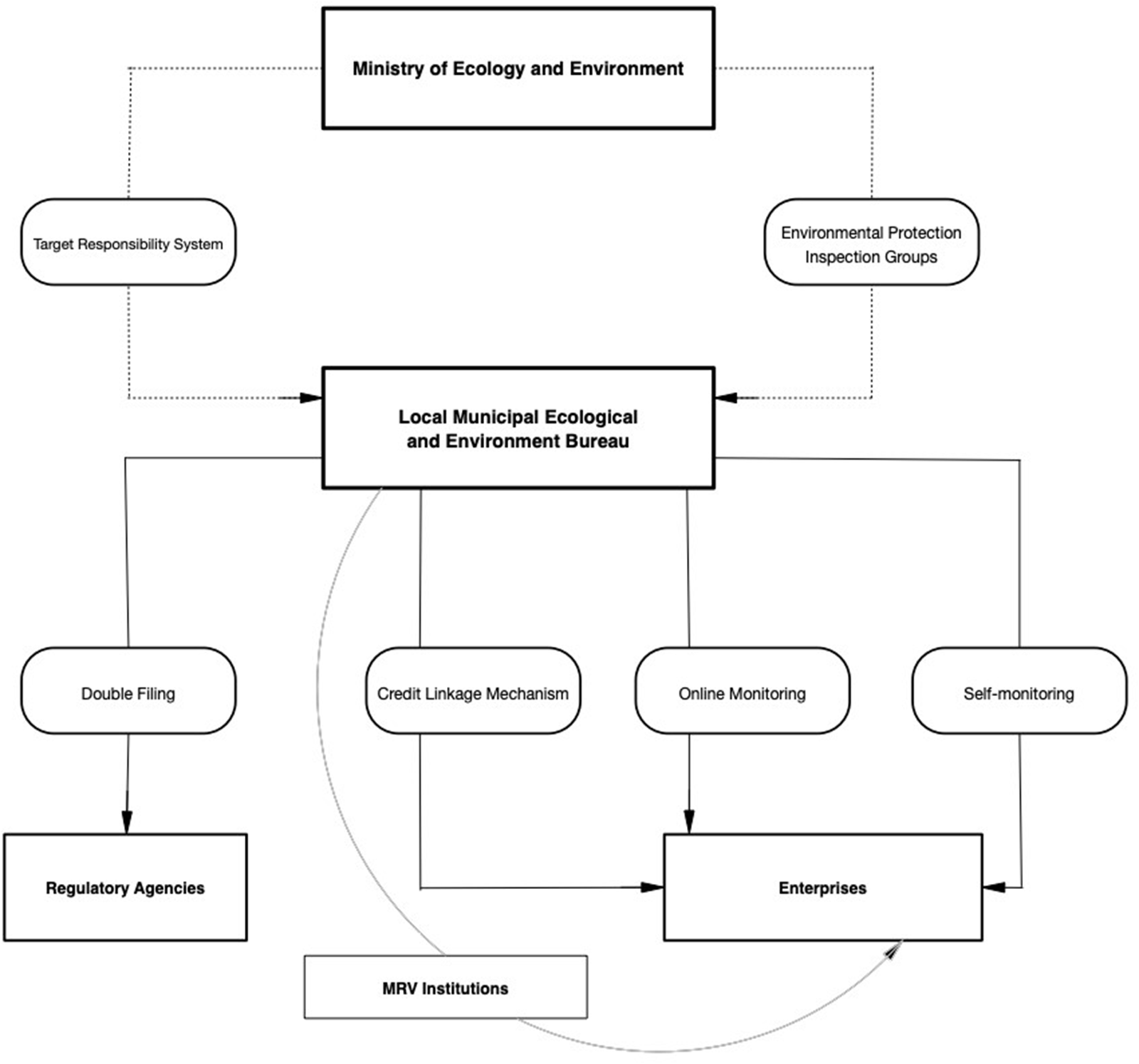
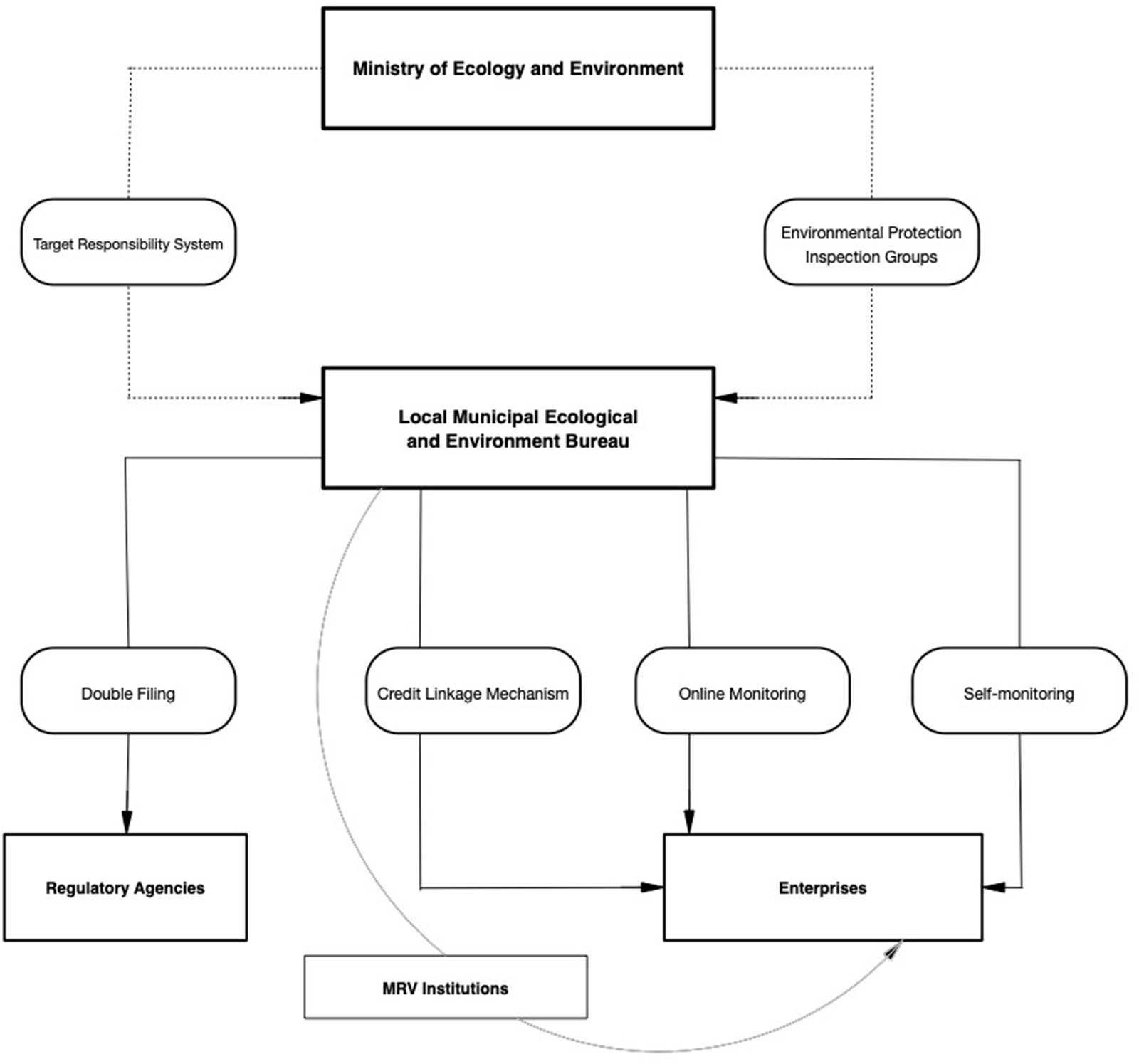
In addition, local government officials have adopted a series of oversight mechanisms to supervise the enterprises as well as the third-party institutions that undertake the MRV duties within the market. An interview with a high-level officer from the Beijing Environment Exchange revealed that there are four main supervisory mechanisms for overseeing the regulatory agencies in the market: (a) a credit linkage mechanism (xinyong liandong jizhi 信用联动机制), (b) online monitoring, (c) self-monitoring and (d) a double filing system (shuangbeian yu jiaocha choucha zhidu 双备案与交叉抽查制度).Footnote 69The following is a detailed discussion of these four mechanisms.
The credit linkage mechanism was initially adopted by the National Development and Reform Commission and State Taxation Administration, who collaborate on producing a list of taxpayers with tax violation cases and associated credit information. This mechanism was then applied to the governance of the carbon market. Some third parties (non-governmental regulatory agencies) and local municipal ecology and environment bureaus share a whitelist and a blacklist. The whitelist serves as a recommendation and filing list: only those enterprises on the whitelist can conduct carbon credit transactions in the future. The blacklist, on the other hand, includes enterprises that have falsified their emission data.Footnote 70
The second supervisory mechanism is online monitoring. Local authorities require emission-intensive enterprises to conduct continuous 24-hour tracking using remote supervisory equipment. Both local governments and enterprises jointly invest in this type of equipment. The online monitoring mechanism aims to ensure compliance by agents in a relatively time-efficient way.
For self-monitoring, enterprises are required to report to the local municipal ecology and environment bureau. The effectiveness of this mechanism relies on firms’ consciousness and their sense of corporate social responsibility.
The double filing system is a supervisory tool used by regulatory agencies. Local municipal governments implement a verification process that involves multiple regulatory parties and expert cross-check reviews of carbon emission reports. This process ensures the quality of carbon emission data and helps to reduce issues arising from asymmetric information from various market agents. This non-governmental verification of institutions and inspectors takes place under the oversight of the local municipal commission of development and reform.
Beyond these four core measures, there are regionally stratified regulatory innovations tailored to monitor the economic actors in China’s carbon market. Local ecological authorities implement dynamic registry management (dongtai minglu guanli 动态名录管理) based on enterprises’ carbon emission levels and sectoral characteristics. For instance, Guangdong province mandates the inclusion of entities with annual emissions exceeding 26,000 tCO₂e and has established a priority–general supervision hierarchy to enforce comprehensive oversight of high-emitting industries such as steel and cement. Shanghai requires third-party verifiers to obtain China National Accreditation Service for Conformity Assessment (CNAS)-accredited qualifications under a filing system that includes negative lists. Hubei province compels coal-fired power plants to install Continuous Emissions Monitoring Systems (CEMS) that directly report data to provincial authorities, while Shenzhen is experimenting with blockchain-based data archiving to enhance traceability. Zhejiang province is trialling integrated carbon-bank account monitoring that tracks allowance-pledged financing flows through the central bank’s credit system to prevent money laundering and market manipulation. Jiangsu province has introduced a five-colour environmental credit rating system (Green/Blue/Yellow/Red/Black) for corporate ecological compliance and is piloting localized carbon performance indicators in selected cities. The Beijing Municipal Ecology and Environment Bureau has developed other channels to gather the relevant market information and ensure compliance among enterprises. These include the front-line supervisory system (yixian jianguan zhidu 一线监管制度), the supervisory risk system (fengxian jianguan zhidu 风险监管制度), the information disclosure system (xinxi pilu zhidu 信息披露制度) and the trade dispute settlement system (jiaoyi jiufen jiejue zhidu 交易纠纷解决制度). All these monitoring arrangements indicate that, in contrast to the central government’s loose oversight of local officials’ carbon market stewardship, market entities, particularly corporate participants, are subjected to a rigorous hierarchical regulatory architecture characterized by compliance obligation stratification, algorithmic surveillance penetration and cross-institutional accountability linkages.
China’s local carbon market governance exemplifies a hybrid regulatory model that integrates police-patrol mechanisms (for example, Guangdong’s dynamic registry management, Hubei’s real-time CEMS monitoring) with market-driven “fire-alarm” systems (for example, Jiangsu’s five-colour credit codes, Zhejiang’s carbon-bank surveillance). This dual-track framework enhances compliance through algorithmic deterrence and reputational constraints yet reveals inherent institutional tensions: over-reliance on algorithmic oversight risks compliance ossification, while fire-alarm tools remain vulnerable to data collusion. Once the Ministry of Ecology and Environment incorporates a series of supervisory mechanisms into this local policy experimentation through the lens of the local environmental authorities, the enterprises may be forced to keep to the agreed-upon deadlines. A vice-general manager of a third party also commented on the compliance situation:
In the first year, I was deeply impressed because 13 enterprises in Beijing were punished. They had to pay a walloping great fine, close to three to five times the price in the market. At the very beginning, in Beijing, the compliance rate was around 98 per cent or 99 per cent; it then became 100 per cent in the following two consecutive years.Footnote 71
However, an expert from a think tank expressed his doubts about Beijing’s 100 per cent compliance rate:
Once, when I conducted on-site supervision of third-party regulatory agencies, it was identified that these non-governmental institutions exhibited a pro-corporate alignment with the enterprises because they could gain a large amount of money for data fabrication. Also, these third-party agencies have no enforcement power. Their supervisory process is based on the concerted actions taken by the enterprises … They cannot break into the firms and conduct the supervision.Footnote 72
He also commented on the online monitoring mechanism:
The government has its policies, and people down below have their own ways of getting around them (shangyou zhengce xiayou duice 上有政策, 下有对策). It is frequently observed that enterprises discharge pollutants without permission or exceed the pollution limit through the corruption of data, such as putting plastic bags on remote supervisory equipment.Footnote 73
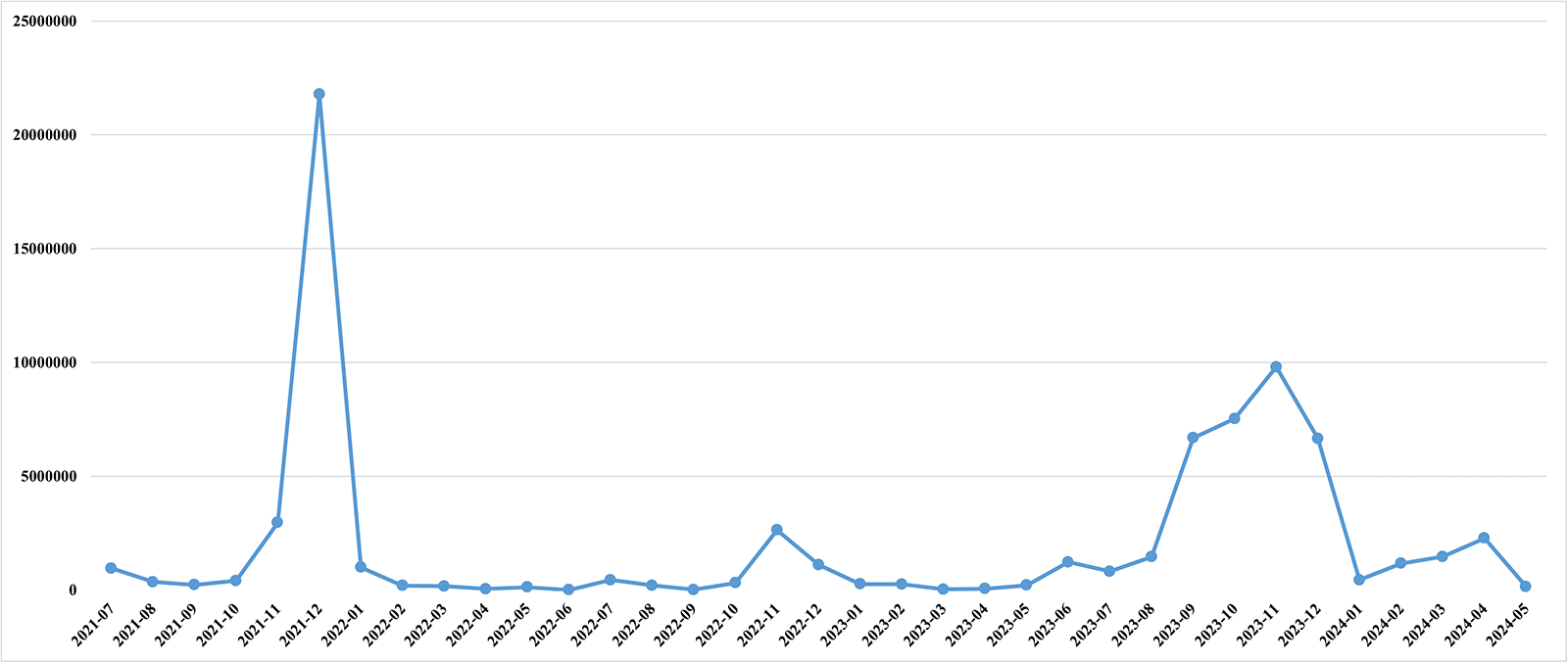
These supervisory mechanisms appear to compel firms to comply with the policies and complete their carbon trading transactions. However, there is little evidence that firms are developing an improved environmental awareness or are better managing their carbon assets through the development of a carbon market.Footnote 74Local environmental authorities verify the contractual entities’ transactions every six months. Notably, the volume of carbon emissions traded shows a significant correlation with the agreed-upon deadlines.Footnote 75The national carbon emissions data provided by the Shanghai Environment and Energy Exchange further support this observation: trading volumes peak at the end of each year (see Figure 1).
China’s National Carbon Market Trading Volume, 2021–2024

Furthermore, the trading volume peaks always occur one or two months before the compliance deadline.Footnote 76A senior manager of the Carbon Trading Centre under the China Beijing Environment Exchange explained:
There were serious complaints among the enterprises. They were unwilling to pay the additional charge for their emissions. At that time, the most punished enterprises were foreign firms, for example Microsoft, Parkson and McDonald’s. We did some training with the staff of these firms, notified them and issued fines, and gave them a few days’ grace, but they failed to honour the agreement on time. Later, our energy conservation monitoring team, along with a [Beijing] TV station, went to their firms directly. They then realized the seriousness and accepted the punishment.Footnote 77
Foreign firms may adopt a passive attitude towards the carbon market if their corporate headquarters are located in areas where environmental supervision is relatively lax. “These foreign enterprises did not pay enough attention to the government regulations at first,” a senior manager told us in an interview. “They thought the government was merely paying lip service and that they would not be punished.”Footnote 78Additionally, the carbon trading systems have undergone further assessment during the compliance process.
Overall, the supervisory mechanisms in China’s market governance allow regulated enterprises to meet the required levels of compliance before the annual trading deadline. Although compliance rates may appear to improve, this procedural adherence often conceals a verification dilemma that undermines meaningful outcomes. This discrepancy is facilitated by collusive principal-agent dynamics. The aligned interests among the non-state agencies (for example, the third-party verifiers and the enterprises) reduce the effectiveness of the seemingly robust supervisory mechanisms. Third-party verifiers, who are legally designated as neutral agents, exploit information asymmetry through double fiduciary gaming. They simultaneously accept local government payments for expedited verification while charging enterprises for “compliance optimization” services.Footnote 79They exacerbate the principal-agent problems with their opportunism. Crucially, China’s local carbon market regulatory experiments offer instructive paradigms for emerging economies grappling with the dual challenges of regulatory capacity constraints and market vitality deficits. At the same time, these cases caution against over-reliance on data-augmented oversight: while algorithmic governance amplifies a state’s surveillance capacities, it may paradoxically incentivize regulated entities to develop adversarial compliance tactics, including collusion with third-party monitors to exploit verification loopholes, thereby eroding the endogenous price discovery mechanisms of carbon markets and progressively hollowing out regulatory authority. Figure 2 summarizes the supervisory and monitoring process of China’s local carbon market governance.
The Institutional Monitoring Configuration of Local Carbon Markets
Conclusion
The analysis of China’s carbon market governance structure using principal-agent theory guides this research inquiry. In terms of the central–local relations, the central state (as principal) employs two main supervisory mechanisms to ensure the compliance of local officials (as agents) in its carbon market initiatives: controlling financial resources and using both proactive (en avance) and reactive (ex post) oversight. These supervisory mechanisms are intended to provide consistency at each level of interest and policy mandate in local carbon market governance. However, it is evident that these measures alone are insufficient to guarantee local officials’ commitment to carbon market development, and indeed can lead them to other, competing objectives. Interestingly, we find that the central state’s weak intention undermines these mechanisms. The principal-agent analysis of China’s carbon market governance reveals systemic tensions that go beyond conventional frameworks. Rather than being neutral policy tools, carbon market institutions become contested terrain for renegotiating bureaucratic power. The principal’s selective supervision, which is characterized by the inconsistent enforcement of allowance compliance and tolerance of GDP-driven metric gaming, reflects an institutional schizophrenia where decarbonization rhetoric coexists with developmentalist incentives. Theoretical implications extend beyond agency loss. When environmental performance metrics lack judicial enforceability and cadre promotions remain anchored to GDP, even advanced monitoring technologies degenerate into legitimacy props for symbolic governance. This explains why local vertical management reforms, despite embedding environmental indicators in cadre evaluations, fail to counteract local agents’ risk aversion. As interview data reveal, the Ministry of Ecology and Environment’s supervisory retreat stems not only from resource constraints but also from systemic institutional contradictions, and its decarbonization mandate clashes with the State Council’s growth-oriented departments’ regulatory turf.
The institutional marginalization of environmental governance persists across China’s local carbon market governance, manifesting as systemic decoupling between political rhetoric and implementation priorities. While environmental protection occupies symbolic prominence in official discourse, the development of carbon markets consistently ranks below growth imperatives at the local level. This structural exclusion does not occur through overt policy discrimination but rather through the strategic re-ordering of bureaucratic attention. When facing developmental trade-offs, municipal actors systematically allocate political capital and administrative resources to GDP-oriented projects, relegating carbon market infrastructure to the periphery. This finding may indicate a possible delay in political will moving from the central state to the lower levels of the bureaucracy, or, more likely, it can be seen as a pragmatic concession by local officials to the interests of industry. The local environmental officers’ turning a blind eye to data fraud and the central state’s stability maintenance, as described by one of the experts, serve as suitable illustrations of this concession.
Contrary to conventional regulatory approaches, China’s local carbon market governance disciplines economic actors directly through hybridized control mechanisms. This is illustrated by the strategic incorporation of SOEs into carbon markets as de facto regulatory proxies. Bound by political mandates that align corporate behaviour with national carbon market development imperatives, SOEs function as institutionalized compliance anchors, with their participation enforced through administrative penalties that activate fire-alarm oversight. Local environmental bureaus operationalize this logic through a layered surveillance architecture, including dual filing systems, credit linkage protocols and real-time emissions monitoring platforms, which collectively constitute a regulatory patchwork aimed at minimizing agency drift. However, these monitoring tools appear to be an ineffective solution to the long-standing principal-agent problems. Agency losses arise from the alliances formed between the supervisory agencies and enterprises, as the state fails to steer the market using financial incentives in trading.
Acknowledgements
We extend our sincere gratitude to the policymakers, experts and scholars who took part in the interviews for sharing their valuable insights. This work was supported by the China Postdoctoral Science Foundation under Grant 2024M752844, the National Natural Science Foundation of China under Grant 22376179, and Science and Technology Fundamental Resources Investigation Programme Grant 2023FY100100.
Competing interests
None.
Xin XU is a postdoctoral research fellow at Zhejiang Ecological Civilization Academy and Zhejiang University. She is interested in China’s carbon market governance, with a particular focus on operational mechanisms, institutional architectures and multi-stakeholder engagement.
Jinsong DENG is professor and doctoral supervisor at the College of Environmental and Resource Sciences of Zhejiang University. His research focuses on environmental remote sensing, ecological assessment and sustainability science, with particular expertise in carbon emission evaluations, ecological economics and climate change adaptation. He has led multiple national research projects funded by the Ministry of Science and Technology, National Natural Science Foundation of China, and other governmental agencies. Professor Deng has published over 150 peer-reviewed papers and three academic monographs, while contributing to the development of national technical guidelines and policy recommendations in environmental governance.
Geoffrey C. CHEN is associate professor in the department of China studies at Xi’an Jiaotong-Liverpool University and co-leads the Urban and Culture Research Group at the University Center for Culture, Communication and Society. His research focuses on environmental governance, public sector reform and the politics of climate and energy in China. He is the author of Governing Sustainable Energies in China (Palgrave, 2016) and co-author of Nuclear Power in Stagnation (Routledge, 2021). His work has appeared in New Political Economy, Third World Quarterly, Europe-Asia Studies and The Pacific Review, among others.