Introduction
The challenges of treating malignant disease in the elderly population have gained greater prominence over the last 5–10 years. Developed nations all have ageing populations, and cancer in older people is an increasing physical and financial burden on these populations. A new learned society, The International Society of Geriatric Oncology, has been formed with an accompanying journal focusing on the management of cancer in older people, the Journal of Geriatric Oncology (http://geriatriconcology.net). The journal was launched in June 2010.
For most tumour types the incidence of new cases increases with age. Exceptions to this are bone, soft tissue and germ cell tumours. So, for the majority of tumour types, the majority of patients will be older. This is borne out in the SEER (Surveillance Epidemiology and End Results) Cancer Statistics ReviewReference Ries, Melbert, Krapcho, Stinchcomb, Howlader and Horner1 from the National Cancer Institute in the USA. Thirty-five per cent of all cancers occur in men over 75 years of age, and 46% of cancers in women occur in the over-75 population. Common cancers commonly affect older patients; the three most commonly fatal cancers in European countries (lung cancer: 19.9% of cancer deaths; colorectal cancer: 12.3%; and breast cancer: 7.5%; 2008 data) predominantly affect patients aged over 70 years.Reference Ferlay, Parkin and Steliarova-Foucher2
Mortality rates from other diseases such as cardiovascular disease and in particular myocardial infarction are reducing, particularly in patients in their 40s, 50s and 60s. In essence, the success of preventative health measures and effective treatment against infectious diseases and cardiovascular disease in men and women in their middle age and early retirement has had the ‘knock-on’ effect of them going on to develop malignant disease with increasing frequency in their older age.
For most tumour types, the all-age mortality figures for the majority of western populations have been falling for up to two decades. Between 1988 and 1997 total cancer mortality rates in the European Union fell by 9%.Reference Levi, Lucchini, Negri and La Vecchia3 However, the major areas for improvements in cancer survival rates had previously been restricted to younger patients. Over the last decade or so these improvements have started to filter through to the older population in the European Union and USA.Reference Levi, Lucchini, Negri, Boyle and La Vecchia4 Unfortunately mortality rates in Eastern Europe and Japan continue to rise in the older population.
Despite these general trends, looking carefully at the statistics reveals some interesting anomalies. All-age prostate cancer mortality figures for white and black American males have fallen year-on-year since 1990; however, in males over 85 years the mortality has shown a significant increase.Reference Chu, Tarone and Freeman5 This may be due to older men receiving substandard treatment, with treatment modalities available to younger compatriots being denied to them; or it may be as a result of the effective treatment of prostate cancer in these men in their 60s and 70s leading to their survival into their 80s. Breast cancer is perhaps the prime example of this phenomenon with the life expectancy of a patient with oestrogen receptor positive bony metastatic disease being up to 5 years. As a result, there is an ever-increasing cancer-related healthcare burden on services for older people.
Assessment
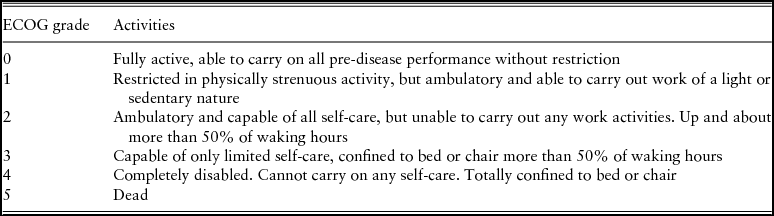
When assessing a patient for consideration of a systemic therapy, oncologists have traditionally used either the Eastern Cooperative Oncology Group (ECOG) performance statusReference Oken, Creech, Tormey, Horton, Davis and McFadden6 or the Karnofsky performance status (first described by D. Karnofsky and J. Burchenal in 1949). Strict age cut-offs are not usually used except in some trials. The ECOG performance status places patients into five categories (see Table 1).
Eastern Cooperative Oncology Group (ECOG) performance status

The original study by the ECOG was designed to examine how well patients tolerated treatment rather than predicting the outcome of treatment. The use of performance status rather than age has been well validated. The ELVIS (Elderly Lung Cancer Vinorelbine Study)Reference Gridelli, Perrone, Gallo, De Marinis, Ianniello and Cigolari7 and MILES (Multi-agent Italian Lung Elderly Trial)Reference Maione, Perrone, Gallo, Manzione, Piantedosi and Barbera8 demonstrated that performance status was a better predictor of side-effects than age. In particular, older patients with a good performance status do better than younger patients with a poorer performance status. Other studies have looked at performance status as a predictor of outcome. Yamazaki and colleagues compared age with performance status as a predictor of completing courses of radical radiotherapy.Reference Yamazaki, Inoue, Yoshida, Imai, Yoshioka and Tanaka9 Again patients with a good performance status were more likely to complete a course of radical radiotherapy irrespective of their age. Performance status has also been looked at as a prognostic factor. Lim and colleagues looked at lymphoma patients over the age of 75 and showed that performance status was a better predictor of outcome than age, histology, extra-nodal involvement or low albumin.Reference Lim, Hee, Quek and Tao10
Much of the published work on cancer in older people has focused on a comprehensive geriatric assessment (CGA) and whether it is a better tool for assessing a patient's fitness for treatment than the ECOG performance status. Repetto and colleagues looked at whether a CGA in addition to the ECOG performance status helped with treatment decisions in a population of patients over 65 years with haematological and solid malignancies.Reference Repetto, Fratino, Audisio, Venturino, Gianni and Vercelli11 Two scores assessing function – activities of daily living (ADL) and instrumental activities of daily living (IADL) – were used in addition to a scoring system for co-morbidities. The study concluded that performance status sometimes did not detect potential problems in older patients. Thirteen per cent of patients with a good performance status (PS ≤ 2) had two or more significant co-morbidities and 9.3% had limitations in their ADLs. The feasibility of implementing a comprehensive geriatric assessment has been examined in a number of studies. A self-administered questionnaire that used validated assessment tools to look at functional status, co-morbidity, cognition, psychological status, social functioning, support and nutritional status was piloted at the Memorial Sloan Kettering Cancer Centre in New York.Reference Hurria, Gupta, Zauderer, Zuckerman, Cohen and Muss12
A more complex geriatric assessment that combined assessments by an elderly care physician, medical oncologist, social worker, dietician, physiotherapist, pharmacist and research nurse has been shown to highlight previously unrecorded problems in cancer patients.Reference Terret, Albrand and Droz13 A comparison with questionnaire-based geriatric assessments that demand far less resources has not been made. Many comprehensive geriatric assessment tools have not been specifically validated in patients with cancer.Reference Gosney14 It is questionable whether it would be feasible to implement a system widely that requires the cancer patient to have face-to-face contact with so many different people.
In the UK, there has been a move in some cancer types, for specialist nurses to complete a ‘holistic needs assessment’.Reference Richardson, Sitzia, Brown and Medina15 This assessment, though less detailed than a CGA, does potentially identify some of the potential social, psychological and spiritual needs of patients and is simpler to implement than a CGA.
Referral patterns
A potential difficulty is that, however good surgical, clinical and medical oncologists are at adapting their services to the needs of older patients, there is little value if older patients are inappropriately referred by either primary care or the secondary care physician to whom they present. A concern that patients are filtered prior to being discussed at an oncology multi-disciplinary team meeting (MDT) or being seen by an oncologist is raised by the data from Repetto et al. Reference Repetto, Venturino, Vercelli, Gianni, Biancardi and Casella16 A study looking at two groups of oncology patients, one group with patients under 70 and the other with patients over 70, demonstrated that older cancer patients appeared to be in better health than age-matched controls without cancer. This raises the possibility that primary care physicians and acute care physicians are reluctant to refer patients with proven or suspected cancer who may be in poor general health. There is evidence that primary care physicians are more negative than oncologists when considering whether treatment is indicated in older patients. Hurria and colleagues compared the views of primary care physicians and oncologists as to whether they would recommend adjuvant treatment to breast cancer patients over the age of 75 years.Reference Hurria, Wong, Villaluna, Bhatia, Chung and Mortimer17 Oncologists would recommend the adjuvant treatment of a statistically significantly larger group of patients than the primary care physicians, again raising concerns over whether older patients’ access to specialist care is limited by primary care providers.
Surgical options for elderly patients
The ageing population plus the increasing detection of cancer is a growing problem for surgeons, as surgery forms the basis of most curative treatment options. Elderly people have more peri-operative risk factors including multiple co-morbidities, poly-pharmacy, malnutrition, frailty and cognitive dysfunction. Furthermore, their perceived anaesthetic risk is the largest obstacle to curative surgery. The older patient metabolizes anaesthetic drugs differently due to a lower glomerular filtration rate and reduced hepatic function. Post-operative complications are more frequent, including aspiration pneumonia due to a weaker airway reflex, post-operative delirium and reduced function. One study involving 8781 patients who underwent major cancer surgery showed that those over 75 years had a higher mortality (4.83 vs 1.09%), longer hospital stays and more major complications. Yet this study also found that age was similar to the effects of other peri-operative risk factors and agreed that peri-operative risk assessment was vital to surgical decision making.Reference Al-Refaie, Parsons, Henderson, Jensen and Tuttle18 Other studies have shown that using peri-operative management and risk assessment means morbidity and mortality following cancer surgery is similar to that in the younger population.Reference Korc-Grodzicki, Downey, Shahrokni, Kingham and Patel19 Age should no longer be a discriminating factor for surgery.
Changes in practice may be due to advances in surgical techniques such as laparoscopic surgery for older, higher risk patients. One study of elderly patients between 1964–89 and 1990–2011 having oesophageal surgery, showed that in those aged 75–79 years the mortality had decreased from 18.2 to 5.1%, and in those over 80 years, from 28.6 to 6.3%.Reference Morita, Otsu, Kawano, Kumashiro and Taketani20 There is also evidence showing little difference in the recurrence rates with laparoscopic surgery. A study done from 2004 to 2012 in patients with colorectal cancer showed improved short-term outcomes and no difference in 5-year survival with the laparoscopic technique over open surgery.Reference Biondi, Grosso, Misretta, Marventano and Toscano21 A further advantage both to the patient and the hospital in economic terms is a reduced length of patient stay.
Systemic anti-cancer treatment for elderly patients
Systemic anti-cancer therapies including hormones, chemotherapy and biological agents form the basis of adjuvant and palliative treatment options for all patients. Hormone-based treatments are very important in the management of breast and prostate cancer. They must not be overlooked as treatment modalities. Tamoxifen (a selective oestrogen receptor modulator) has been established as effective treatment for oestrogen-receptor positive early and metastatic breast cancers for more than 25 years. It is very well tolerated. Tamoxifen is being replaced as the first-choice endocrine therapy in post-menopausal women by the aromatase inhibitors on the basis of the ATAC (Arimidex™, Tamoxifen, Alone or in Combination Trial)Reference Forbes, Cuzick, Buzdar, Howell, Tobias and Baum22 and BIG-1 98 trials.Reference Mouridsen, Giobbie-Hurder, Mauriac, Paridaens, Colleoni and Thuerlimann23
Prostate cancer is the commonest cancer to affect men over the age of 80 years. The mainstay of the treatment of metastatic disease is hormone therapy. Surgical castration was the only option until the advent of luteinizing hormone-releasing hormone (LHRH) analogues such as goserelin (Zoladex™). Patients can remain stable on hormone treatment for prostate cancer for a number of years and only require consideration on chemotherapy should their metastatic disease become refractory to hormone therapy and symptomatic.
Concern has been expressed by some commentators, that treating older patients with systemic cytotoxic therapy relies on extrapolating the evidence from younger patients. Phase 1 trials are carried out to find the maximum tolerated dose of drug and the dose limiting toxicities. These studies are often carried out in a much younger patient population. In previous decades, the majority of trials had upper age limits of 65 or 70 years; this precluded a large burden of patients who are seen by clinicians on a regular basis. Large reviews have been performed to examine if the elderly suffer from an excess burden of side-effects compared with younger patients.Reference Begg, Cohen and Ellerton24 For most types of chemotherapy the side-effect profiles were similar irrespective of age. Peripheral neuropathy associated with vinca-alkaloids and cisplatin was increased in the elderly. Of particular interest is the fact that the response rates to chemotherapy were very similar in all age groups.
As some cancers such as prostate cancer predominantly affect older patients, it is sensible that trials examining new treatments include older patients. Docetaxel is used for symptomatic metastatic prostate cancer in patients refractory to hormone manipulation. The landmark trial in this area by Tannock et al. Reference Tannock, de Wit, Berry, Horti, Pluzanska and Chi25 did not set an upper age limit for inclusion within the trial – included in the trial were patients ranging from 45 to 92 years. Over half the patients in this trial were over the age of 70 years. This demonstrated that not only was docetaxel an effective treatment in this elderly population, but remarkably well-tolerated. Some trials have been specifically designed to look at the effectiveness and side-effect profile of cytotoxic treatments in the elderly. Two such trials in non-small cell lung cancer, ELVIS (Elderly Lung Cancer Vinorelbine Study)Reference Gridelli26 and MILES (Multi-agent Italian Lung Elderly Trial)Reference Gridelli, Cigolari, Gallo, Manzione, Ianniello and Frontini27 showed that treatment regimens that had been thought to be potentially too toxic for older patients were well-tolerated if the patient population was carefully chosen.
Radiotherapy
Most cancer physicians expect older patients to have similar outcomes to younger patients from radiotherapy. Palliative radiotherapy may be delivered in a single fraction. However, most radical or adjuvant courses of radiotherapy require daily visits to hospital over a number of weeks. Wasil et al. looked at a group of patients over 80 years receiving both curative and palliative fractionated radiotherapy to a single site of disease; 77% of patients completed the whole course of treatment and only 31% required any breaks in treatment.Reference Wasil, Lichtman, Gupta and Rush28
Radiotherapy may be chosen as a potentially curative option in patients who have a potentially operable tumour, but are not fit for surgery due to co-morbidities. Continuous Hyperfractionated Radiotherapy (CHART) is an established treatment for patients with early-stage non-small cell lung cancer who are not fit for surgical resection.Reference Jeremic and Milicic29 This is a frequent scenario as lung cancer patients may have co-existent chronic obstructive pulmonary disease that would leave them with insufficient lung reserve if they were to proceed with a resection. The 5-year survival rates of between 32 and 45% are lower than those found in patients with a similar stage of disease who proceed to surgical resection.
Oncologists should not underestimate the burden that multiple frequent visits to hospital places on patients and their carers. A patient's mobility may be restricted by a co-morbidity, travelling may be difficult if they require a patient ambulance or they may be a carer for someone else at home. These are obviously factors that may influence a patient's discussion with the oncologist when choosing to opt for radiotherapy in the management of their tumour.
Stereotactic ablative radiotherapy offers a new treatment option for non-small cell lung cancer (NSCLC) patients with early stage tumours who are unfit for surgery or who decline surgery. The equipment and skills are not available in all cancer centres at present; but it appears to offer improved outcomes with a median overall survival of 34 months and disease-free survival rates of 68% at 2 years in patients of all ages.Reference Lagerwaard, Haasbeek, Smit, Slotman and Senan30 In a study in The Netherlands of patients over the age of 75 with Stage I NSCLC, the introduction of stereotactic radiotherapy led to a 16% decrease in patients receiving no treatment at all and a significant increase in overall survival in those patients treated with stereotactic radiotherapy.Reference Palma, Visser, Lagerwaard, Belderbos, Slotman and Senan31 A significant advantage is that patients have far fewer visits to hospital as treatment is commonly delivered in three to five fractions.
Supportive care
Anaemia is common in both cancer and the elderly (due to an ageing bone marrow). Treating these patients with cytotoxic chemotherapy can further exacerbate this.Reference Spivak, Gascón and Ludwig32 Anaemia affects the quality of life and long-term survival. Radiotherapy depends on tumour tissue oxygenation for its action and therefore there is a risk of treatment failure if patients are anaemic.Reference Calabrich and Katz33 Consideration needs to be given as to how best support elderly patients through these treatments.
The EORTC (European Organisation for Research and Treatment of Cancer) guidelines were revised in 2007; these suggest using blood transfusions and recombinant erythropoietin (EPO) to treat anaemia in cancer patients. EPO has been shown to improve quality of life and reduce the number of transfusions needed – sustaining the target haemoglobin, in chemotherapy and radiation-induced anaemia. However, it is not approved for use in radiation-related anaemia alone.Reference Aapro and Link34 There is evidence that with age the haemopoietic stem cell develops resistance to erythropoietin and this is associated with production of pro-inflammatory cytokines, which inhibit erythropoietin activity.Reference Vanasse and Berliner35 Nevertheless it is suggested that elderly patients receive the same benefit from EPO treatment as younger patients.
Oncology patients have a higher risk of morbidity and mortality secondary to infections, either caused by underlying disease, radiation or chemotherapy induced neutropenia. Neutropenic sepsis requires hospital admission for intravenous antibiotics, which has a further impact on their treatment with delays to future cycles of chemotherapy and subsequent dose reductions.Reference Aapro, Bohlius, Cameron, Dal Lago and Donnelly36 The prophylactic use of recombinant human granulocyte colony stimulating factor (GCSF) following chemotherapy can reduce the duration of neutropenia and hence the frequency of hospital admissions with neutropenic sepsis. The use of GCSF in neutropenic sepsis has been shown to reduce the duration of the neutropenia and reduce the hospital stay, but does not impact on overall survival. The 2010 EORTC update recommends the use of GCSF in subsequent cycles if a patient had an episode of neutropenic sepsis, and in those receiving chemotherapy that have a high risk for developing neutropenia. Age and co-morbidities are significant risk factors for developing neutropenia. GCSF is also advised if the dose of chemotherapy is needed to be maintained as a reduction may be associated with a poorer prognosis.
In the unfit or frail elderly patient with cancer, pegylated-filgrastim given once per cycle may be easier for these patients and help maintain their quality of life without multiple hospital visits.Reference Rupolo, Lleshi, Cacopardo, Michieli and Berretta37 However, pegylated-filgrastim is significantly more expensive than daily filgrastim and may not be funded by all healthcare providers.
Side-effects of treatment
All the treatments offered by oncologists to patients of all ages have both acute and long-term side-effects. One aspect of malignant disease of relevance to elderly care physicians is the detection and management of the long-term side-effects of treatment. This may include patients who have received surgery, chemotherapy, radiotherapy or hormone therapy as part of the curative treatment regimens for their tumours many years previously.
The most obvious problem occurs where a patient has had a kidney or lung surgically resected for malignancy. Some patients following such surgery have a life expectancy similar to age-matched controls. Other patients, however, may develop or have at the time of surgery, co-existent chronic obstructive pulmonary disease. Their reduced lung capacity following surgery becomes critical with the progression of their non-malignant disease. As patients get older their glomerular filtration rate drops by between 0.5 and 1 ml/min each year.Reference Glassock and Winearls38 Even with only a single kidney following a nephrectomy, most patients will not reach the point of end-stage renal failure requiring dialysis, but should they develop diabetes or hypertensive nephropathy their renal function may deteriorate to a critical level. Such dilemmas must have an influence on the choice of surgery that the patient is offered. Up to 44% of patients are at risk of developing chronic kidney insufficiency following a radical nephrectomy compared with only 16% of patients who undergo nephron-sparing surgery.Reference Malcolm, Bagrodia, Derweesh, Mehrazin, Diblasio and Wake39
Lung parenchyma is very sensitive to radiotherapy. Normal lung tissue may be within a treatment field either when a lung primary tumour is receiving radical radiotherapy, or when the mediastinum or another adjacent structure such as the chest wall is treated. Bleomycin, a glycopeptide antibiotic used to treat germ cell tumours, may cause a dose-dependent progressive pulmonary fibrosis in around 5% of patients treated for germ cell tumours.Reference Efstathiou and Logothetis40 Although acute pulmonary fibrosis is more common, a chronic phenomena has been described.
Perhaps of greatest interest are the potential long-term effects of treatment on cardiac function. The largest patient group of concern is patients who have received neo-adjuvant or adjuvant treatment for breast cancer. The risks to breast cancer patients can be threefold: radiotherapy-related accelerated atherosclerosis in patients receiving radiotherapy to the left breast; anthracycline-related cardiomyopathy; and Trastuzumab (Herceptin™)-related cardiomyopathy in patients receiving adjuvant trastuzumab for HER-2 positive tumours. Unfortunately, the combined risk of developing a cardiomyopathy appears to be higher than that of the individual risk. The risk of developing cardiomycopathy with an anthracycline alone is 4%, but rises to up to 27% when both an anthracycline and trastuzumab are used together.Reference Keefe41 Most patients developing a cardiomyopathy are symptomatic (75%) and 79% improve with standard treatment for congestive cardiac failure.Reference Keefe42 Trastuzumab-related cardiomyopathy is normally reversible and responds to treatment with ACE inhibitors and beta-blockade. Chen et al. examined the incidence of heart failure in older patients (mean age 76.2 years) receiving adjuvant trastuzumab and found the incidence to be significantly higher than that reported in the clinical trials.Reference Chen, Long, Hurria, Owusu and Steingart43
On the other hand, there are areas of cancer treatment for patients of all ages where oncologists need to learn from their colleagues specializing in the treatment of elderly patients. One such area is bone health. Here, elderly care physicians and metabolic medicine experts have greater experience than oncologists. A number of oncological treatments adversely affect bone mineral density, leading to an increased risk of osteoporotic fractures. Potential causative factors include specific drugs such as the aromatase inhibitors used in oestrogen-receptor positive breast cancers. Radiotherapy can cause local loss of bone mineral density, whilst chemotherapy may precipitate or bring forward the menopause, increasing the risk of osteoporosis later in life.
Conclusion
There has been and will continue to be an increasing burden of cancer within the elderly. This will affect both oncology services and geriatric services. Cancer may be seen less and less as an acute illness where patients are either cured of or die from it, but more as a chronic disease requiring a long-term management strategy. This will mean services will have to adapt. The data do not exist to prove or disprove whether ageism exists in terms of referral patterns to oncology teams, and it is clear that further data collection and research is required to explore this phenomenon.
New and improved treatments must be adequately evaluated in the elderly population and if they can be shown to be both safe and effective, then they should be made available to older people. Clinical trials design has evolved and far fewer clinical trials have upper age limits than in previous decades. Most clinical trials allow the participation of older people as long as they remain fit and without significant co-morbidity.
There will be many heated debates, both within professional circles and the media, as the cost utility of new expensive treatments is evaluated. Lack of effectiveness may be confused with ageism. All physicians, and elderly care physicians in particular, must be alert to the long-term side-effects of chemotherapy and other treatments. We may well experience an unexpected increase in the burden of health problems related to treatment as we use more new agents with relatively little long-term side-effect data available to us. Oncologists have a vital educational role to play with respect to the management of side-effects, as much of this follow-up may be performed by primary care or elderly care physicians.
Conflicts of interest
Emma Kelly: None.
Peter Stephens has received research support from Vernalis and travel expenses from Eisai and GSK.