INTRODUCTION – DESCRIPTION OF THE VASE
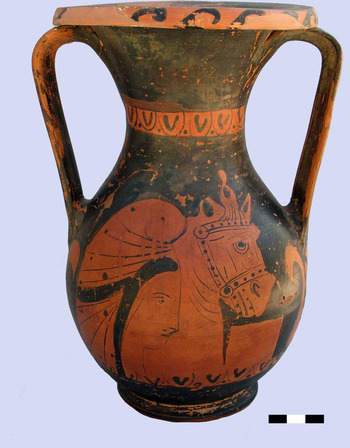
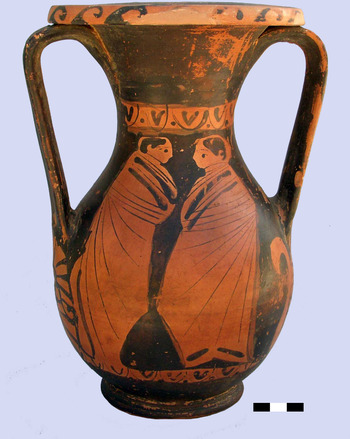
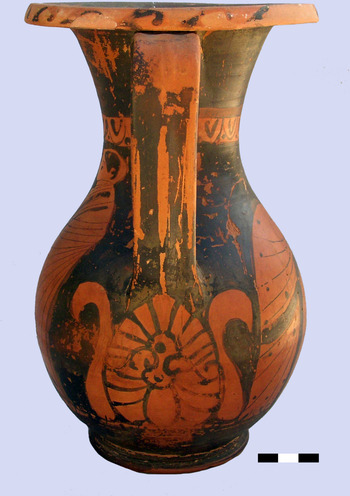
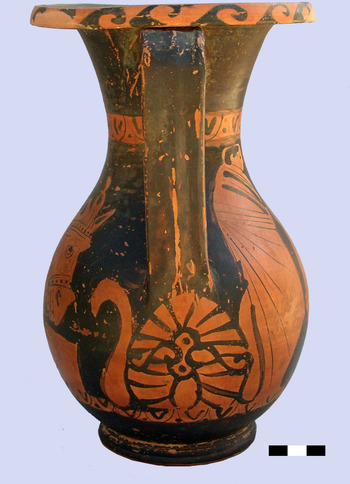
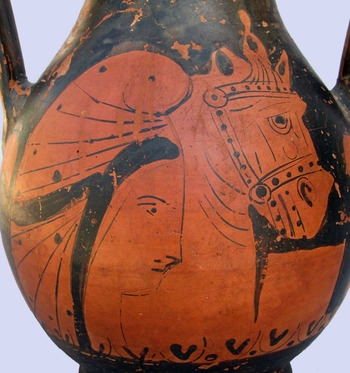
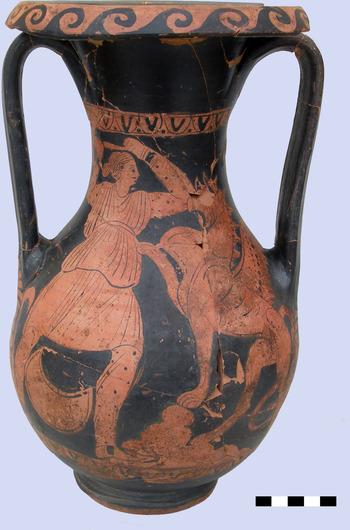
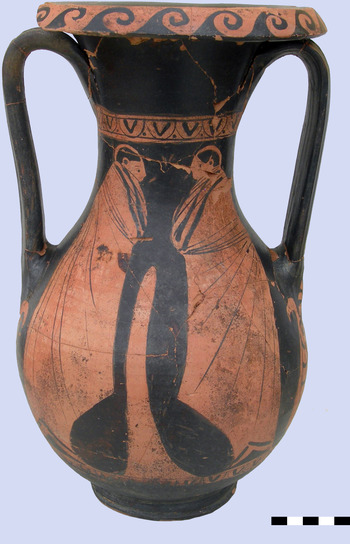
This study deals with a red-figure pelike stored in the repository of the Archaeological Museum of Thessaloniki (Figs. 1, 2, 3, 4).Footnote 1 There is no record of the provenance of the vessel, and thus we do not know where or in what circumstances it was found.Footnote 2 Despite this lack of information, however, it remains an interesting find, as the product of a local Macedonian workshop. The colour and consistency of the clay and the glaze, the shape of the vessel and the manner in which it is decorated all point to a pottery workshop in the capital of the Macedonian kingdom, Pella. Certain stylistic features of the scenes, which will be discussed later, suggest that it was the work of the Pella B Painter, that centre's most prolific vase-painter.Footnote 3
Red-figure pelike. Thessaloniki Museum ΑΜΘ 23926. Photo: the author.

Red-figure pelike. Thessaloniki Museum ΑΜΘ 23926. Photo: the author.

Red-figure pelike. Thessaloniki Museum ΑΜΘ 23926. Photo: the author.

Red-figure pelike. Thessaloniki Museum ΑΜΘ 23926. Photo: the author.

The red-figure pelike presented here is almost intact, missing only parts of the rim that have been restored in plaster and painted.Footnote 4 The surface is extensively encrusted with sediment, and displays some chipping, flaking and cracking. The glaze is black and generally dull, with some lustrous areas on the exterior surface. The interior is unglazed except for the rim and the upper part of the neck.
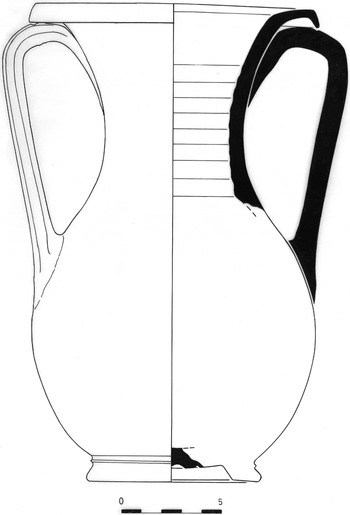
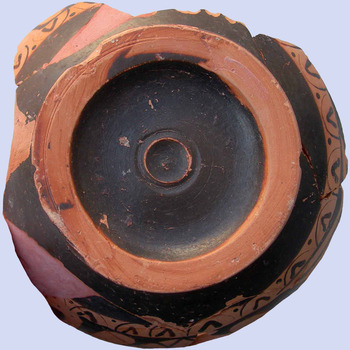
The vessel has a narrow, double torus foot. The resting surface is reserved, and on the black-glazed underside there is a circular depression ringed by a plastic annulus. The body of the pelike is round and the neck doubly curved. The overhanging rim is sharply flared, and the out-curving vertical handles have a central rib. Traces of the potter's wheel are visible in many places on the inner and outer surfaces of the vessel.
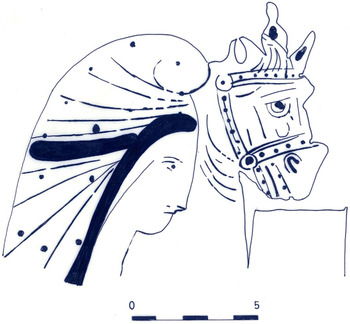
Two busts are depicted on side A, one a figure wearing a Phrygian cap and the other a horse (Figs. 1, 5, 6); both are turned towards the right. In front of them is a rectangular object, probably an altar. The Phrygian cap is decorated with broad black bands, one horizontal and one vertical, and with dots; its folds are rendered by curving lines. The horse is wearing a halter, also decorated with dots.
Red-figure pelike. Thessaloniki Museum ΑΜΘ 23926. Detail. Photo: the author.

Red-figure pelike. Thessaloniki Museum ΑΜΘ 23926. Side A. Drawing: Z. Al Saayah.

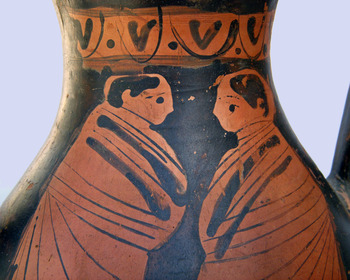
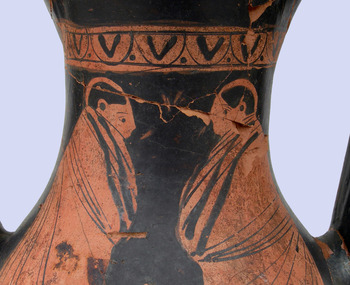
On side B of the pelike are two mantled youths in conversation (Figs. 2, 7). They are depicted in profile, standing face to face, and holding no object. They have short hair, and their mantles cover the whole body except for the head. One knee projects beneath the folds of their garment, which they appear to be holding with their right hand.
Red-figure pelike. Thessaloniki Museum ΑΜΘ 23926. Detail. Photo: the author.

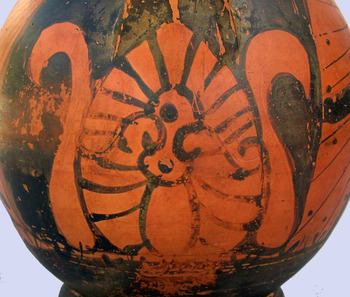
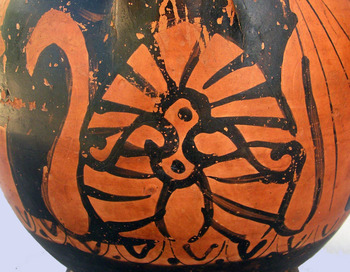
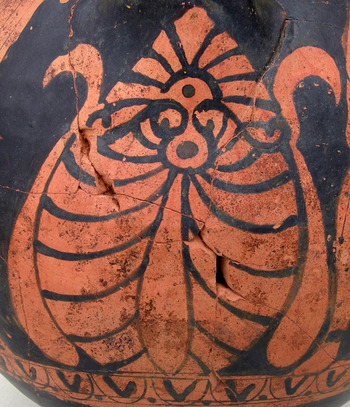
A pair of anthemia occupy the space beneath the handles of the pelike, one facing up and one facing down (Figs. 3–4, 8, 9). The latter has nine petals, the middle one larger than the rest and pear shaped; the other has ten petals on one side and eight on the other, the middle one with a pointed tip. Both these ornaments have a stippled centre and are encircled by stylised scrolling tendrils. The upper and lower borders of the scenes are defined by egg patterns with dots, and a wavy line decorates the rim.
Red-figure pelike. Thessaloniki Museum ΑΜΘ 23926. Detail. Photo: the author.

Red-figure pelike. Thessaloniki Museum ΑΜΘ 23926. Detail. Photo: the author.

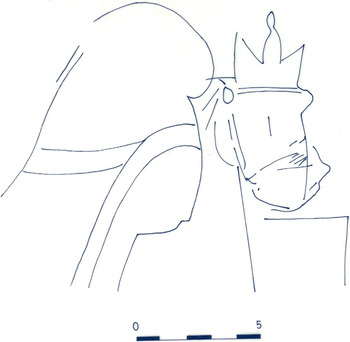
As is frequently the case with red-figure vessels, here too the scene was painted following a preliminary sketch (Fig. 10). The horse's mouth, pupil and nostril, some of the folds of the himatia, the wavy line of the rim and some details of the egg patterns were painted with dilute glaze. The eye of the figure wearing the Phrygian cap, on the other hand, as well as some of the folds of the cap and the contour of the horse's halter, are drawn with a relief line.
Red-figure pelike. Thessaloniki Museum ΑΜΘ 23926. Side A. Preliminary sketch lines. Drawing: Z. Al Saayah.

CLAY AND GLAZE OF THE PELIKE
The colour and consistency of the clay and the glaze are particularly helpful in assigning the pelike to the local Pella workshop, and in distinguishing the vessel from those made in Attica in the second half of the fourth century bc, which served as models for local potters as regards shape and decoration. The clay from which the red-figure pelike in the Archaeological Museum in Thessaloniki is made is fine grained and hard, and contains relatively little mica. The presence of numerous admixtures, which in many cases have caused surface cracking, is a characteristic feature of red-figure vases from Pella, which is not found in Attic ware. In colour, the clay is pink (Munsell 7.5YR 7/4) to reddish yellow (5YR 7/6), thus placing the vessel in the first and commonest category of red-figure pottery from the Pella workshop, in which the clay resembles the orange-red Attic clay but is generally paler and pinker (Akamatis Reference Akamatis2013, 13–14).Footnote 5
The dull black glaze is also typical of the local Pella workshop, and quite different from the more lustrous glaze of Attic red-figure vases (Akamatis Reference Akamatis2013, 14). In addition, the glaze is severely cracked at the points where the foot and the handles meet the body of the vessel, which is frequently the case with products of this local workshop.
SHAPE
On current data, pelikai were the third-commonest shape made in the local Pella workshop, after lekanides and askoi (Akamatis Reference Akamatis2013, 25–9). Few local pelikai have survived, not more than 20 intact or partially preserved vessels. Based on the shape of the foot and handles, the round body, doubly curved neck and bevelled rim, the vase in question may be assigned to the second type of pelikai from the local Pella workshop, which is associated with the Pella B Painter (Fig. 11).
Red-figure pelike. Thessaloniki Museum ΑΜΘ 23926. Profile. Drawing: Z. Al Saayah.

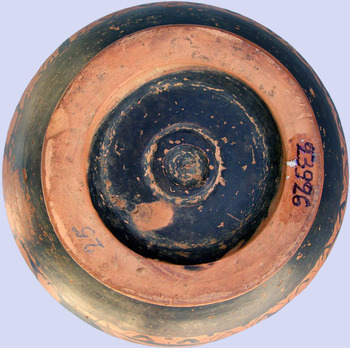
Particular reference must be made to the foot of the vessel, which is markedly different from the foot of an Attic pelike (Fig. 12). This foot is double torus, with torus and groove of 0.002–0.003 m and a total height of 0.01 m, and is relatively narrow for the diameter of the body.Footnote 6 The resting surface is reserved, while the underside is black-glazed. In the centre of the underside is a circular depression measuring 0.024 m across, with a nipple-like nub and a plastic ring enclosed by a shallow groove. The foot was made separately from the body, as is clear from the point of junction, where there is significant cracking of both clay and glaze. Feet of similar shape are found on several pelikai from the Pella workshop (Fig. 13; Akamatis Reference Akamatis2013, pls. 42 fig 3e, 44 fig. 8c). The underside of the foot of an Attic pelike, by contrast, is reserved and has a wider circular depression than is found in local vessels.
Red-figure pelike. Thessaloniki Museum ΑΜΘ 23926. Foot underside. Photo: the author.

Red-figure pelike foot underside. Pella 03.3380 (Akamatis Reference Akamatis2013, pl. 42 fig. 5).

Several features of the shape of this vessel are shared by another well-preserved product of the local Pella workshop, pelike no. 1577 in the Archaeological Museum of Kilkis (Figs. 14, 15; Akamatis Reference Akamatis2013, 158–9): namely the round body, the profile of the neck, and the handles, which are attached to the body just above its widest point, are slightly flared, and have a central rib between shallow grooves on both sides. Apart from these similarities there are also certain differences between the two, such as the slenderer neck and rounder body of the pelike in the Archaeological Museum of Kilkis, which may indicate that it is of later date than the one in the Archaeological Museum of Thessaloniki.
Red-figure pelike. Kilkis Museum 1577. Side A (Akamatis Reference Akamatis2013, pl. 40 fig. 1).

Red-figure pelike. Kilkis Museum 1577. Side B (Akamatis Reference Akamatis2013, pl. 40 fig. 2).

In shape, the second type of Pellan pelike recalls Attic pelikai of the second half of the fourth century, and particularly the middle part of that period. More specifically, the shape of the vessel in the Archaeological Museum of Thessaloniki is comparable to that of two examples in the Pushkin Museum in Moscow, pelikai ΙΙ 1b 1089 and ΙΙ 1b dep. 44 (Tugusheva Reference Tugusheva2003, 23–5 II 1b 1089, dep. 44, pls. 13 figs. 1–2 [dated c.340–320 bc], 15 figs. 1–2 [dated to the second half of the fourth century bc]) and pelike 32619 from pyre P59 of the cemetery of Akraiphia in Boeotia (Sampetai Reference Sampetai2004, 462–3, pl. 209b [dated to the last quarter of the fourth century, probably c.320 bc]). The neck and the rim of our vessel are similar in shape to pelikai of K. Schefold's Group IV and other Attic examples, although these differ in the width of the body and the slope of the handles (Schefold Reference Schefold1934, 142, pls. 23 fig. 2, 24 fig. 3, 25 fig. 2 [all three pelikai are dated c.330–320 bc]; see also Skordou Reference Skordou and Kypraiou1997, 43, fig. 5 [dated c.320 bc]; Tugusheva Reference Tugusheva2003, 20–1, pl. 10 figs. 1–2 [dated to the third quarter of the fourth century bc]).
ICONOGRAPHICAL INTERPRETATION
Scenes with busts wearing Phrygian caps were particularly popular in the workshops of Attica in the fourth century bc, appearing not only on pelikai but also on various other vases, including lekanis lids, askoi, squat lekythoi, oinochoai and craters.Footnote 7 The scene on the pelike in the Archaeological Museum of Thessaloniki was obviously inspired by comparable Attic red-figure pelikai of the fourth century bc with depictions of a bust with Phrygian cap and a bust of a horse. Variations on the same subject are found on Attic pelikai decorated with a bust with Phrygian cap, a bust of a horse and a griffin or a bust of a human figure with one or more busts of griffins. According to R. Margos, who studied this imagery, scenes with busts of human figures accompanied by either a horse or griffins appear more frequently than those depicting a horse and griffin together (Margos Reference Margos1980, 47), an observation which does not seem to be borne out by the evidence from Macedonia (see Appendix).
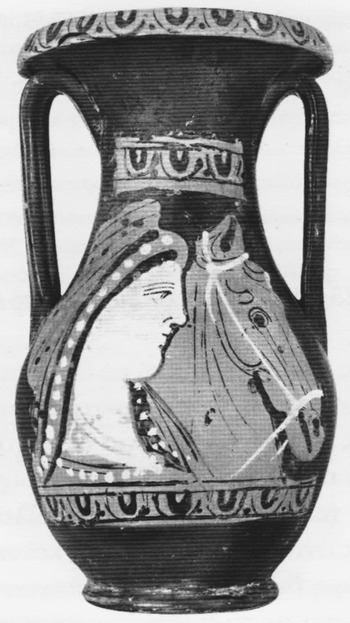
Pelikai decorated with a bust wearing a Phrygian cap and a bust of a horse were produced mainly in the Attic workshops of Group G and the Amazon Painter. According to Margos' study, the subject on the front of the pelike in the Archaeological Museum of Thessaloniki recalls Group G types D and E and Amazon Painter types H and K (Margos Reference Margos1980, 36–7, 39–40).Footnote 8 In these scenes the figures are turned towards the right and the bust with Phrygian cap is depicted behind that of the horse. Unlike the vessel from the Pella workshop, Attic pelikai often have touches of white paint on the face and neck of the human figures, and sometimes on the horse's bridle as well (Fig. 16).Footnote 9 Moreover, the corresponding scenes on Attic pelikai do not include an altar in front of the horse, as is the case with the vessel under consideration here.Footnote 10
Red-figure pelike. Museum of the Royal Tombs at Vergina-Aegae Π 451 (Drougou Reference Drougou2005, 134 fig. 164).

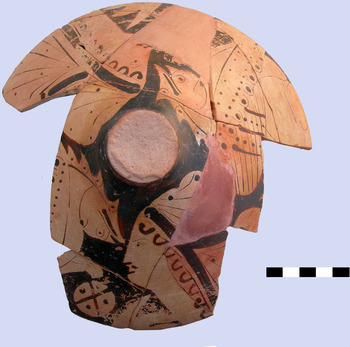
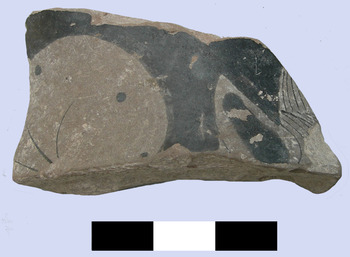
Busts with Phrygian cap constitute one of the favourite subjects of the Pella workshop, and were often used on lekanis lids and askoi (Akamatis Reference Akamatis2013, 31–4) (Fig. 17).Footnote 11 The pelike from the Archaeological Museum of Thessaloniki is the first certainly attested example of a bust with Phrygian cap together with a bust of a horse occurring on a vessel produced in the Macedonian capital. The same subject may have been depicted on another pelike from Pella, of which only a small fragment has been found (Fig. 18).
Red-figure lekanis lid. Pella A 1364. (Akamatis Reference Akamatis2013, pl. 11 fig. 1).

Red-figure pelike sherd. Pella 07.4892 (Akamatis Reference Akamatis2013, pl. 43 fig. 7).

The interpretation of the subject depicted on the pelike under consideration here presents considerable difficulties. Most of those who have studied the red-figure vase-painting of the fourth century bc identify the figures wearing Phrygian caps on pelikai with Amazons, Arimasps or gods. On other vase shapes, for example lekanis lids or askoi, such figures are generally referred to as ‘heads in Phrygian cap’ (Talcott and Philippaki Reference Talcott, Philippaki and Talcott1956, 43 no. 179, 44 nos. 182–3), heads of ‘Orientals’ (Robinson Reference Robinson1950, 119 no. 63; ΜcPhee Reference McPhee1981, 304 nos. 35 and 39, 305 nos. 1–2) or heads of ‘Phrygians’ (Moore Reference Μoore1997, 280 no. 1062).
The identification of these figures with Amazons, which has been adopted by most scholars (Schefold Reference Schefold1934, 147–8; Beazley Reference Beazley1942, 1467–8 nos. 109–113 and 116–26, 1480 nos. 1–4; Margos Reference Margos1980; Moore Reference Μoore1997, 143 nos. 64, 65; Sidorova and Tugusheva Reference Sidorova and Tugusheva2000, 42 no. 1, 43 no. 3; Tugusheva Reference Tugusheva2003, 73 nos. 3–4), is indeed the most likely, particularly when there are no griffins. Supporting evidence includes the head covering,Footnote 12 the horseFootnote 13 and the sex of the figures. That the figures are female is made clear in several scenes by the use of white paint for the bare fleshFootnote 14 and by the depiction of items of jewellery, such as earrings and necklaces (Schefold Reference Schefold1934, pl. 25 figs. 2, 4; Margos Reference Margos1980, 41 figs. 13–15; Tzanakaki Reference Tzanakaki and Kypraiou1997, 26 fig. 5). Busts of Amazons appear sporadically in Attic vase-painting from the end of the fifth century bc (Devambez and Kauffmann-Samaras Reference Devambez and Kauffmann-Samaras1981, 626 nos. 611–12; Bažant et al. Reference Bažant, Bouzek, Dufková and Ondřenová1978, pl. 41 fig. 3), and scenes of Amazonomachies are common on vessels from the second half of the fourth century bc, the period to which most of the red-figure pelikai of interest to us here belong.Footnote 15 The association with griffins is a problematical factor in this identification, since there is no episode involving these creatures with Amazons in the written sources. Many scholars, however, are of the opinion that in order to depict Grypomachies the vase-painters borrowed elements from the imagery of the Amazonomachy, which had a long tradition in Attic decoration, including details such as the Amazons' dress, facial features, weapons and postures (Μetzger Reference Μetzger1951, 331; Gorbounova, Reference Gorbounova1997, 534).
When they are associated with griffins and their bare flesh has not been coloured white, these busts may equally well be identified as Arimasps (Beazley Reference Beazley1942, 1467 nos. 114–15; Schauenburg Reference Schauenburg1982; Moore Reference Μoore1997, 286 nos. 1120, 1123). The busts of griffins depicted on certain pelikai recall the myth of the battle between the Arimasps and the griffins, a very popular subject with Attic vase-painters, particularly in the second half of the fourth century bc.Footnote 16 In these Grypomachies the Arimasps wear the Phrygian cap and oriental dress of the Amazons, and carry similar weapons. In some cases female figures also take part in the Grypomachy, while in others the Arimasps are depicted as beardless figures with long hair, thus differing very little from Amazons (Gorbounova Reference Gorbounova1997, 533 nos. 54, 57).Footnote 17 These things make it very difficult to distinguish between Arimasps and Amazons in many scenes on Attic vases of the fourth century bc.
Another theory is that the busts with Phrygian cap could be gods, given the size of the figures and their prominent position in the centre of the scene on many pelikai. The Phrygian cap, the accompanying horses and griffins, and the fact that such a quantity of these pelikai were exported to the Black Sea region has led many scholars to associate these figures with some oriental divinity, possibly the Great Goddess, who in the Greek world was identified with Aphrodite, Artemis or Pandora (Schefold Reference Schefold1934, 146–7; Metzger Reference Μetzger1951, 85–9; Wiesner Reference Wiesner1963, 211; Christou Reference Christou1968, 59–60; Gajdukevič Reference Gajdukevič1971, 227; Flagge Reference Flagge1975, 101–5; Stähler Reference Stähler1978, 191; Margos Reference Margos1980, 30–2; Paul-Zinserling Reference Paul-Zinserling1994, 106–12; Themelis and Touratsoglou Reference Themelis and Touratsoglou1997, 165; Sgouropoulou Reference Sgouropoulou2000, 229–34; Drougou Reference Drougou2005, 143–4; Jaeggi Reference Jaeggi, Schmidt and Stähli2012, 168–9; Devambez and Kauffmann-Samaras Reference Devambez and Kauffmann-Samaras1981, 647; Leventopoulou Reference Leventopoulou1997, 610). It has also been suggested that the figure with Phrygian cap could portray some other deity worshipped by local populations in the Black Sea region, such as the Argimbasa or Artimbasa of the Scythians, who, according to ancient authors, was similar to Aphrodite Urania (Herodotus 4.59; Hesychius, Lexicon, s.v. Artimbasa). The correlation of the figure wearing Phrygian cap in these busts with one of the above gods is not easy to confirm, given our limited knowledge of the gods of the Black Sea region, whether derived from art or from literature.Footnote 18 A further problem arises from the fact that the pelikai with busts wearing Phrygian cap were not exported exclusively to the Black Sea region, for they have also been found in Greece,Footnote 19 in North Africa (Beazley Reference Beazley1942, 1467–8 nos. 108–110, 112, 116, 121, 124, 126, 129–131, 133–134, 136; Elrashedy Reference Elrashedy2002, pls. 53 figs. 1 and 3, 54 fig. 1, 55 fig. 1), and even on the coast of Spain (Trias de Arribas Reference Trias de Arribas1968, pls. 105a, 214a).
In places that belonged to the Greek world the busts with Phrygian cap may more easily be associated with the Artemis cycle, and particularly with the figure of Bendis, whose cult was introduced into Athens from Thrace towards the end of the fifth century bc. Artemis Bendis, although depicted for certain in only a few scenes in Attic vase-painting, wears a Phrygian cap, just like the busts on the red-figure pelikai.Footnote 20 Artemis is also indirectly associated with griffins, mainly through Apollo and his connection with the land of the Hyperboreans (Lambrinoudakis et al. Reference Lambrinoudakis, Bruneau, Palagia, Daumas, Kokkorou-Alewras and Mathiopoulou-Tornaritou1986, 229–30 nos. 363–9; Paul-Zinserling Reference Paul-Zinserling1994, 80–4), while on a fragment of a red-figure kylix the goddess herself is portrayed mounted on a griffin (Paul-Zinserling Reference Paul-Zinserling1994, pl. 45 fig. 1). Furthermore, Artemis is also associated with the Amazons, who many ancient writers say founded her famous temple at Ephesus (Stephanus Byzantinus, Ethnica s.v. Έφεσος; Pausanias, Messeniaca 4.31.8; Fleischer Reference Fleischer1984, 756–7). One problem with this identification is the fact that as a rule Artemis wears a diadem, a wreath or a sakkos, not a Phrygian cap. Moreover, the goddess is not depicted with horses, as is usually the case in the scenes in question, and finally, scenes on the red-figure pelikai contain none of the goddess's particular attributes, such as the bow, the quiver or the torches that are standard features of her depictions.
The association of these busts with Aphrodite also seems to me to be unlikely. In Attic vase-painting the goddess's customary headgear is a sakkos, a wreath or taenia, not a Phrygian cap. Also, busts of her are not accompanied by horses or griffins but, for example, by Erotes, swans, mirrors and hanging fabrics.Footnote 21
Another possibility that has been suggested is that the busts wearing Phrygian caps may have been associated with the netherworld (Sgouropoulou Reference Sgouropoulou2000, 233–4; Jaeggi Reference Jaeggi, Schmidt and Stähli2012, 169), based on the fact that the pelikai with this subject have been found almost exclusively in cemeteries.Footnote 22 As far as I know, in excavation contexts other than tombs very few pelikai have come to light in the Athenian Agora (Thompson Reference Τhompson, Thompson, Thompson and Rotroff1987, 33–4; Moore Reference Μoore1997, 143 nos. 64–5)Footnote 23 and in the area of the agora in Pella (Appendix, nos. 10, 23).Footnote 24 The association of these busts with chthonic powers is strengthened by their depiction with horses and griffins, beings with funerary symbolism.Footnote 25 According to N. Jijina, horses and griffins may be seen as mystagogues, participants in mysteries connected with the going of souls to the Underworld (Jijina in Trofimova Reference Trofimova2007, 162–4 no. 66). The probability of these figures being Amazons is also strengthened by the fact that there are several instances of Amazons depicted on white lekythoi of the fifth century bc, these being of course pre-eminently funerary vessels (Bothmer Reference Bothmer1957, 182 no. 69, 195 no. 113, 199 nos. 143–5, 204 no. 171; Devambez and Kauffmann-Samaras Reference Devambez and Kauffmann-Samaras1981, 628 nos. 660–1, 663), and by the funerary character that some scholars attribute to the subject of the Amazonomachy (Bakalakis Reference Bakalakis1971, 81–2). One must remember, however, that both Artemis, who is sometimes associated with Hecate (Kahil and Icard Reference Kahil and Icard1984, 749; Vikela Reference Vikela, Kaltsas and Shapiro2008, 80–2), and Aphrodite, whose imagery often decorated censers, altars and xoana (Sgouropoulou Reference Sgouropoulou2000, 224–7), also had chthonic aspects.
The question of the identification of the bust figures with Phrygian caps, already rendered particularly difficult by the above problems, is further complicated by the absence of inscriptions. The fact that these vessels were intended for a broad clientele in Greece and the Black Sea region, and that the figures on them are subject to multiple interpretations, makes it quite likely that, as several scholars have suggested, their Athenian vase-painters did not intend them to have the characteristics of a single mythical figure, thereby allowing the subject to appeal to a wider potential market (Fless Reference Fless2002, 90–3; Langner Reference Langner, Fless and Treister2005, 62–6; Kotitsa Reference Kotitsa2006, 76; Langner Reference Langner, Schmidt and Stähli2012a, 45; Jaeggi Reference Jaeggi, Schmidt and Stähli2012, 169–70).
In Pella, where this particular red-figure pelike was probably made, the bust with Phrygian cap is quite likely to have had a chthonic character, given the presence of the altar in front of the horseFootnote 26 and the probable provenance of the vessel from a tomb. The most likely identification for the figure is that of an Amazon. In Pella Amazons and Amazonomachies are also found in other forms of art, with and without a funerary context. The east graveyard has yielded gilded clay tablets with depictions of Amazons and combats between griffins and oriental figures, as well as an Attic red-figure pelike with an Amazonomachy (Papakonstantinou-Diamantourou Reference Papakonstantinou-Diamantourou1971, pl. 17 fig. 1),Footnote 27 while an Amazonomachy is depicted in a floor mosaic from the ‘Abduction of Helen’ house (Makaronas and Yiouri Reference Makaronas and Yiouri1989, pl. 23). Finally, an imperfectly preserved funerary monument in Macedonian Tomb VI in Pella had a relief scene of a battle between a horseman and barbarians from the east (Chrysostomou Reference Chrysostomou1999, 290–1 and 302 figs. 16, 17).
The bust on the red-figure vessel in question seems less likely to represent a chthonic deity, although this cannot be excluded. Clay busts of female chthonic deities dating from roughly the same time as the red-figure pelike have been found in many tombs in Macedonia, but all wear either a polos or a wreath, none a Phrygian cap.Footnote 28
The scene of mantled youths on side B of the pelike was a very common subject for pelikai from the local Pella workshop (Figs. 2, 7). Sometimes such figures are depicted on both sides of the vessel, which is not the case with Attic pelikai, where they usually appear on side B (Akamatis Reference Akamatis2013, 17). In almost all the examples of local red-figure pelikai the scene is composed of two confronted male figures, identifiable as youths by their short hair and beardless chins. The youths are depicted standing, holding nothing, their entire body covered by their garment except for the head. As in the scenes on Attic vessels there is often some square or oblong object between them, which is interpreted as an altar, stele or pillar (Fig. 15), an element that is not found on the pelike from the Archaeological Museum of Thessaloniki.Footnote 29
Scenes of mantled youths were among the most popular in Attic vase-painting from the second half of the sixth century bc on (Tiverios Reference Tiverios1976, 79; Reference Tiverios1988, 39–50). In the fourth century bc they are found as the main decorative subject on the body of skyphoi, kylikes, oinochoai and pelikai and on side B of craters and pelikai, whereas in Pella they were used only on pelikai. In most instances, on Attic pelikai these scenes contain two figures, often with no rectangular object between them, evidence that here again Attic pottery served as a model for local products. In addition, scenes of youths in similar stance to those on our pelike are found on many Attic vessels, at least from the fifth century bc on (especially Lullies Reference Lullies1952, pl. 83 fig. 2; Kunze–Götte Reference Kunze-Götte1965, pl. 34 fig. 5; for the Pella workshop see also Akamatis Reference Akamatis2013, pls. 41 fig. 2a, 44 fig. 8a, 45 fig. 8a).
In the fourth century bc these compositions become, on Attic vessels, highly standardised and very similar, but the figures of the youths still remain more diversified in stance and gesture than those painted by the local workshop. In most cases, the youths on Attic vases can be identified as athletes by the objects they hold, which include discuses, halteres, strigils and aryballoi, although there are also scenes in which the figures are empty handed, just as with the local red-figure pelikai. The oblong objects between these figures are usually identified as altars, boundary stones or more generally stelai, which is why most scholars associate these scenes with palaestras or gymnasia (Schefold Reference Schefold1934, 146; Chamoux Reference Chamoux1957, 148–59; Karouzou Reference Κarouzou1962, 446–51; Drougou Reference Drougou2005, 144–5). Given the absence of articles associated with athletics on the vessel under consideration here, the scene is interpreted rather as a conversation between the youths, which could be taking place anywhere and not necessarily in a gymnasium or palaestra. According to M. Langner (Reference Langner, Schierup and Bundgaard Rasmussen2012b, 20), scenes with mantled youths symbolised the notional image of the citizen of the ancient city-state in his private and personal life, which is why they occur so frequently, not only in Attic vase-painting but also in the work of many local workshops of the fifth and fourth centuries bc.
THE VASE-PAINTER
The pelike from the Archaeological Museum of Thessaloniki may be ascribed to the Pella B Painter, the most prolific vase-painter of the local Pella workshop, who decorated chiefly lekanides, askoi and, on current evidence, a few pelikai. His iconographic repertory includes busts with Phrygian cap and griffins or felines, busts with sakkos, scenes from the world of women, Grypomachies, scenes with mantled youths, and various floral motifs (Akamatis Reference Akamatis2013, 76–82).
Many details of our red-figure pelike associate it with the Pella B Painter. One characteristic feature of his work is the use of a preliminary sketch, which is found on most vessels apart from the lekanides and askoi that are decorated with floral motifs. As is commonly the case with his work, the lines of the preliminary sketch for the composition are deeply incised and thus easy to see on the surface of the vessel. The preliminary sketch, which was not faithfully followed, traces the outline of the figures and a few interior details (Figs. 6 and 10).Footnote 30
The Pella B Painter renders the contours of the figures with a fine line of thin brown paint and then fills in the details before applying the glaze to the undecorated surface of the vases. This is seen in the lower band of egg pattern with dots on side B of the pelike, the outline of which was painted on first with a thin brown wash. Subsequently the horizontal bands defining the area of decoration were drawn, followed by the eggs and dots of the border, and only then was the glaze that covered part of the scene applied. In the work of the Pella B Painter the details are rendered as a rule with a fine relief black line. More rarely, as is the case here with the eggs of the border, the eye and mouth of the horse and some folds of the drapery, dilute glaze is used.
Busts are the vase-painter's favourite decorative motif and are used mainly on lekanis lids and askoi. As is generally the case with the work of the Pella B Painter, the bust on this red-figure pelike has a single, gently curving line that starts from the brow and ends at the nose, creating a relatively narrow forehead (Fig. 5). The nose has a triangular tip and the mouth is made to project from the line of the face by means of three small hollows, one below the nose, one between the lips and one above the chin. The line of the mouth is a diagonal, and does not touch the lips. The contour of the eye is triangular, the iris indicated by a dot at the front edge, and the brow is a long arc capping the whole eye (Akamatis Reference Akamatis2013, 78).
Also characteristic of the Pella B Painter is the Phrygian cap worn by the figure, which covers the back and top of the head. The two broad intersecting bands are typical of his work, as are the scattered dots completing the decoration and the curved lines rendering the folds of the fabric (Figs. 5, 17; Akamatis Reference Akamatis2013, pls. 12 fig. 51, 13 figs. 57, 60).Footnote 31 Missing from this particular pelike, however, is the customary row of semicircles at the edge of the Phrygian cap, representing locks of curly hair (Fig. 17). This feature is also absent from those of his busts that are depicted with a sakkos (Akamatis Reference Akamatis2013, 79).
The way in which the mantled youths on side B of the pelike are depicted is also characteristic of the Pella B Painter (Figs. 2, 7). The profile of the face and body, the absence of detail, the method of rendering the eye and ear, and the outline of the short hair in the natural colour of the clay, all match the corresponding features of the mantled youths on pelike no. 1577 in the Archaeological Museum of Kilkis (Figs. 15, 19).Footnote 32 Other details typical of this vase-painter's style are the fall of the drapery, rendered by curving lines running from the back of the garment down the front of the body, the two parallel black bands on the front of the garment, and the triangular tips rendered by opposite slashes at the hem of the garment of one of the youths on the pelike under consideration here.
Red-figure pelike. Kilkis Museum 1577. Side B detail. Photo: the author.

Another feature pointing to the Pella B Painter is the shape of the anthemia beneath the handles. As is the case in several of his pelikai, the two anthemia are linked by a thin common bar, which ends in a stippled heart from which spring triangular or trapezoid petals with a strongly curving profile, the centre ones longer than the others and having a pointed tip in the upright anthemia and a pear-shaped curve in the reversed ones (Figs. 8–9, 20).Footnote 33
Red-figure pelike. Kilkis Museum 1577. Decoration under the handle (Akamatis Reference Akamatis2013, pl. 57 fig. 1).

Finally, the pelike in the Archaeological Museum of Thessaloniki displays two of the motifs most favoured by the Pella B Painter in his secondary decoration: the egg pattern with dots and the wavy line (Figs. 1–4).Footnote 34 The heavy triangular eggs framed by large curving bands are typical of his hand, as is the wavy line, which is rendered with large curving hooks.Footnote 35 These decorative motifs appear in the same position on pelike no. 1577 in the Archaeological Museum of Kilkis (Figs. 14–15).
DATING THE PELIKE
The absence of excavation data makes it necessary to date the pelike on the basis of the shape and chronology of the Attic vases that served as models for local products, in conjunction with the activity of the Pella B Painter to whom it is attributed. The shape of the vessel, as has been said, places it in the second half of the fourth century bc, and more precisely in the middle of that period.
The chronology of the Attic pelikai that influenced the pelike in the Archaeological Museum of Thessaloniki, and particularly the dates of Group G and the Amazon Painter, is particularly useful and can serve as a terminus post quem for the vessel in question. Pelikai with busts wearing Phrygian caps appear around the middle of the fourth century bc (Trias de Arribas Reference Trias de Arribas1968, pl. 214a; Vokotopoulou Reference Vokotopoulou1990, pl. 55 figs. 1–2), but most of the vessels of the Attic workshops that we are concerned with date from the second half of that century. This dating is based on a considerable amount of data, furnished mainly by sets of grave goods from, primarily, MacedoniaFootnote 36 and the Black Sea region,Footnote 37 but also from refuse pit H 16:3 in the Athenian Agora.Footnote 38 Most scholars therefore conclude that Group G began producing vases shortly before the middle of the fourth century bc and place its peak period in the third quarter of that century, while the activity of the Amazon Painter is placed somewhat later, around 340–320 bc (Bairami Reference Bairami2000, 207–8; Sampetai Reference Sampetai2004, 463; Kogioumtzi Reference Kogioumtzi2006, 120, 123). There are, however, some who think that both workshops continued producing until the end of the fourth century (Schefold Reference Schefold1934, 141–2; Tzanakaki Reference Tzanakaki and Kypraiou1997, 27; Skordou Reference Skordou and Kypraiou1997, 42–3, 49, 52–3, 55).
Another factor in dating the pelike is the activity of the Pella B Painter. Vessels decorated by that vase-painter have been found in wells in the agora in Pella (Akamatis Reference Akamatis2013, 55–60), and were used in a ceremony of enagismos for the dead of the cist-grave in Toumba Paionia in Kilkis (Savvopoulou Reference Savvopoulou1992, 427–8). Taken together with the period of activity of the Attic workshops that influenced the Pella B Painter, these excavation data suggest that he was active in the latter part of the third and the fourth quarter of the fourth century bc, while some of his wares may still have been in use in the first quarter of the third century bc.
One final factor that enters indirectly into the dating of the red-figure pelike relates to a decorative detail, and more specifically the dressing of the horse's mane, which is drawn up and bound above the animal's forehead. This detail suggests a possible eastern influence, and points specifically to the Persian empire (Amandry Reference Amandry1959, pl. 22, figs. 1–2, 4; Roaf Reference Roaf1983, pl. 12a–e; Cohen Reference Cohen1997, pls. IVa, Vb, VIa). The Macedonians probably became aware of this characteristic appearance of eastern horses after Alexander the Great had launched the expedition that brought them into closer contact with the Persian world and during which they encountered the Persian cavalry in numerous battles. This means that the year 334 bc, when Alexander III set off on his expedition, can be taken as a terminus post quem for the manufacture of the red-figure pelike. Taking into account all the above factors, however, we conclude that the vessel was probably made somewhat later, around 320 bc.
CONCLUSION
One of the most important problems associated with the pelike we are looking at is where it was found. The shape and decoration of the vessel and its good state of preservation point to a grave find, although it is impossible, based on current knowledge, to identify the cemetery from which it might have come. The only information concerning the vessel, a reference to the 13th Archaeological District of Central Macedonia, concurs with the existing data pointing to a restricted distribution of the products of the workshop in question. To date, apart from Pella, isolated examples have been found only in Edessa and Toumba Paionia, that is, in places within a short distance of the Macedonian capital. Vessels from the local Pella workshop seem not to have reached other parts of ancient Macedonia, such as Emathia, Pieria, Upper Macedonia, Chalcidice, and eastern and western Macedonia (Akamatis Reference Akamatis2013, 105). This being the case, it seems likely that our red-figure pelike came from a tomb in the general region of ancient Bottiaia, or possibly some other area around the Thermaic Gulf.
To sum up, the red-figure pelike from the Archaeological Museum of Thessaloniki confirms the strong influence of Attic pottery that may be observed both on the shapes and on the decoration of the output of the local Pella workshop.Footnote 39 Among the features the local pelike in question shares with its Attic counterparts are the existence of black-glazed or reserved shallow grooves where the foot meets the body, the shape of the torus foot, the round body, the flared rim and the central rib on the back of the handles. An Attic influence is also at work in the scenes on sides A and B of the vessel, and in the shape of the anthemia beneath the handles, which are reminiscent of Group G and the Amazon Painter's workshops. Other vase shapes from the Pella workshop, such as lekanides and askoi, clearly show the influence of other Attic workshops, including the Group of the Vienna Lekanis, the Group of Nuptial Lekanides, the Otchët Group, the Painter of Agora Ρ 17562, the Painter of the Reading Lekanis, the Painter of Ferrara T.408, and other vase-painters (Akamatis Reference Akamatis2013, 85–7).Footnote 40
The marked influence of Attic vase-painting on the production of the local workshop makes it likely that local vase-painters learned their craft in Attic workshops or that Attic potters had moved to Pella and were plying their trade there.Footnote 41 This, although difficult to prove, cannot be excluded, especially in the case of the Pella A Painter, who seems to have been the founder of the local workshop.Footnote 42 On the other hand, both the manner of rendering the figures and the shapes of the vessels created by the Pella B Painter, who decorated the pelike under consideration here, show a more evolved stage of work compared to the output of the first vase-painter.Footnote 43 As far as we know, however, none of the vase-painters from the Pella workshop seems to have decorated vessels made with Attic clay, which would have supported the case for a relocation from Attica.Footnote 44
One factor that may have encouraged local potters to copy the shapes and decorative subject matter of Attic vases seems to have been an increased demand for these products in the Macedonian capital. Significant quantities of Attic red-figure pottery from all the workshops that influenced local production have been found in Pella (Akamatis Reference Akamatis2008, 15–18 nos. 6–9 and 12–16, 21 nos. 5–6; Akamatis Reference Akamatis2013, pls. 79–84). The local potters and vase-painters, aware of consumer preferences, may well have decided to decorate their own red-figure vessels with scenes inspired by the Attic vases they saw in the Macedonian capital, especially since scenes of busts with Phrygian cap and accompanying horse were very popular all through Macedonia, as indicated by the discovery of so many Attic pelikai decorated with that subject, and copies of it painted on pelikai from the local workshop in Chalcidice.Footnote 45
The influence of Attic red-figure pottery, particularly during the later stage of its production in Attica, is also seen in other parts of the ancient Greek world. Local imitations of pelikai with busts with Phrygian cap accompanied by busts of horses or griffins were made by other workshops as well, including those in Chalcidice, the Black Sea regionFootnote 46 and possibly Crete.Footnote 47 Here, too, as in Pella, imports of Attic red-figure pottery had increased considerably in the fourth century bc.Footnote 48 The Attic influence on pottery shapes and decoration is also seen in other workshops producing red-figure pottery that were active a little earlier than the Pella workshop, that is, in the late fifth and first half of the fourth century bc, such as those of Laconia (ΜcPhee Reference McPhee1986, 158), Corinth (Herbert Reference Herbert1977, 2–4; Pemberton Reference Pemberton, Williams and Bookidis2003), Boeotia (Avronidaki Reference Avronidaki2007, 31–2; Schöne-Denkinger Reference Schöne-Denkinger, Schmidt and Stähli2012) Euboea (Gex and McPhee Reference Gex and McPhee1995, 9) and Chalcidice (ΜcPhee Reference McPhee1981, 298).
The appearance of local workshops across Macedonia is not a phenomenon of the Late Classical period, to which the red-figure pelike from the Archaeological Museum of Thessaloniki belongs, but is evident from as early as the Iron Age. In a fair number of cases the influence of the most important workshops of the age is pronounced, as with the Pella workshop, while others display different types of decoration that do not imitate imported vases.Footnote 49 Contemporary with the appearance of red-figure vases from the Pella workshop are other vessels from Macedonian workshops, such as the hydriae with polychrome decoration at Vergina-Aegae (Kyriakou Reference Kyriakou2008, 169–96) and vessels decorated with tin-plating (Kotitsa Reference Kotitsa2002; Reference Κotitsa, Schmaltz and Sӧldner2003).
The strong Attic influence on local red-figure pottery in Pella and the great quantity of Attic red-figure ware that flowed into the Macedonian capital are connected with the particular economic and political contacts between Athens and the Macedonian kingdom from the end of the sixth and throughout the fifth century bc.Footnote 50 The re-establishment of Athenian power in the first half of the fourth century bc and the constitution of the Second Athenian League were achieved to a considerable extent with the aid of the Macedonians and the help of the timber they supplied to Athens (Xenophon, Hellenika 6.1.11). Relations between the two states were particularly friendly during the reign of Amyntas III, as the treaty of alliance between them and the accounts of ancient writers make clear (Kirchner Reference Kirchner1913–16, no. 102; Aeschines, De falsa legatione 2.26–8; Ηammond and Griffith Reference Hammond and Griffith1979, 172–180). It was not by chance that the second quarter of that century saw a rapid increase in imports of Attic red-figure pottery into Pella (Akamatis Reference Akamatis2008, 69).
During the reign of Philip II, which is probably when Pella's own red-figure workshop was established, relations between Macedonia and Athens seem to have gradually worsened, culminating in the Battle of Chaeronia in 338 bc. A strong pro-Macedonian party, led by Aeschines, continued nonetheless to exist in Athens, and Athenian ambassadors frequently visited Pella (Hammond and Griffith Reference Hammond and Griffith1979, 203–698; Errington Reference Errington1986, 44–97; Lane Fox Reference Lane Fox and Lane Fox2011, 352–5). In the early years of the reign of Alexander III Athens was not punished for its revolt against Macedonia, as was its ally, Thebes. On the contrary, the city signed a treaty of alliance with Alexander and sent troops to join him on his Persian campaign (Hammond and Walbank Reference Hammond and Walbank1988, 56–83). Alexander's respect for Athens is further indicated by the fact that after the Battle of the Granicus he sent three hundred Persian shields to Athens to be set up in the Acropolis (Plutarch, Alexander 16.18–19). The great quantity of Attic pottery in the eastern graveyard, the agora and other excavation areas of Pella, which dates from the third quarter of the fourth century bc, also confirms the city's close commercial ties with Attica in that era.Footnote 51
The increase in the number of red-figure vases produced by the Pella workshop during the period of activity of the Pella B Painter, which coincides with the reigns of Alexander III and Cassander, may perhaps be considered as not entirely accidental. At that time the manufacture of red-figure lekanides in Attica had almost ceased, and that of askoi was considerably reduced, in contrast to the Pella workshop, which was producing increased quantities of these vessels (Akamatis Reference Akamatis2013, 61–70). The growth of the local workshop seems not to have been unconnected with the new political and economic conditions developing in the Macedonian kingdom at that time, which shaped the framework for the period of great strength, vigour and prosperity that Pella and the Macedonian kingdom enjoyed from the final quarter of the fourth century bc onwards.Footnote 52
Given the general economic prosperity and the existence of a sizeable population of affluent citizens in the Macedonian capital, it is very likely that the demand for Attic red-figure pottery remained high, which may have led to the creation of the local workshop to meet local requirements. This hypothesis is supported by the very minor differences in shape and decoration between the local red-figure vases and their Attic models and by the fact that these vessels continued, to a lesser extent, to be used in the first half of the third century bc, that is, after red-figure pottery had stopped being produced in Athens (Akamatis Reference Akamatis2013, 70). It is a telling fact that in well shafts and refuse pits containing material from the third century bc the quantity of local red-figure pottery is equal to, or greater than, that of Attic ware, a state of affairs which is just the reverse of the situation in the fourth century bc.Footnote 53
Appendix: List of attic pelikai with busts wearing Phrygian cap, busts of horses and busts of griffins found in Macedonia
A) Bust of figure with Phrygian cap and bust of horse
-
1) Museum of the Royal Tombs at Vergina-Aegae Π 451. From Tomb Α of tumulus LXXIII (Fig. 16). Petsas Reference Petsas1963, pl. 262d; Drougou Reference Drougou2005, 134 fig. 164 (Amazon Painter [S. Drougou]).
-
2) Archaeological Museum of Thessaloniki ΜΘ 22531. From Tomb Κ15 on the Chatzialexandrou property in Lete. Tzanavari and Philis Reference Tzanavari and Philis2002, 173 fig. 35 (Amazon Painter [K. Tzanavari and K. Philis]).
-
3) Archaeological Museum of Aiane. From the cemetery of Aiane. Karamitrou–Mentesidi Reference Karamitrou-Mentesidi2008, 136 fig. 227.
-
4) 16th Ephorate of Thessaloniki. From Tomb 6 on the Grammenou property in Drymos. Keramaris Reference Keramaris2009, 232 fig. 10.
B) Bust of figure with Phrygian cap, bust of horse and griffin
-
5) Archaeological Museum of Thessaloniki. From Tomb C at Derveni. Themelis and Touratsoglou Reference Themelis and Touratsoglou1997, pl. 106 fig. Γ1 (Group G [P. Themelis and I. Touratsoglou]).
-
6) Museum of the Royal Tombs at Vergina-Aegae ΒΝΠ 55. From Tomb 1979 Ι. Drougou Reference Drougou2005, 78 fig. 68 (Group G [S. Drougou]).
-
7) Museum of the Royal Tombs at Vergina-Aegae ΒΝΠ 61. From Tomb 1979 ΙI. Drougou Reference Drougou2005, 83 fig. 78; Kotitsa Reference Kotitsa2006, 75 (Group G [S. Drougou]; near the Painter of Mytilene 590 [Z. Kotitsa]).
-
8) Archaeological Museum of Pella 80/462. From the eastern cemetery of Pella. Tomb 97. Siganidou Reference Siganidou1981, pl. 60c; Kotitsa Reference Kotitsa2006, 75 (near the Painter of Mytilene 590 [Z. Kotitsa]).
-
9) Archaeological Museum of Pella 99/1943. From the eastern cemetery of Pella. Trench Ι. Lilimpaki-Akamati and Akamatis Reference Lilimpaki-Akamati and Akamatis2014, fig. 605 no. 617 (Near Group G [N. Akamatis]).
-
10) Archaeological site of Pella 85/7. From the north wing of the agora. Unpublished (Group G [N. Akamatis]).
-
11) Archaeological Museum of Veria Π 2013. From Tomb 23 from the widening of the road from the railway station to the city. Touratsoglou Reference Touratsoglou1973–4, pl. 515b.
-
12) Archaeological Museum of Veria Π 2559. From Trench 4 on the Iordanidis-Georgiadis property. Stratou Street, sector 286. Unpublished.
-
13) Archaeological Museum of Pella. From Tomb 332 of the western cemetery of Archontiko. Unpublished.
-
14) Ephorate of Pieria Πυ 1517. From Tomb 90 of the Melissia cemetery at Aiginio, Pieria. Kotitsa Reference Kotitsa2006, pl. 33 (near the Painter of Mytilene 590 [Z. Kotitsa]).
-
15) Archaeological Museum of Thessaloniki. From a tomb in the vicinity of Thessaloniki. Robinson Reference Robinson1950, pl. 60.
-
16) Aristotle University Cast Museum, Thessaloniki 133. Unknown provenance. Beazley Reference Beazley1942, 1479 no. 22; Saripanidi Reference Saripanidi2012, pl. 35 figs. 3–4 (Amazon Painter [J. Beazley]).
C) Bust of figure with Phrygian cap and bust of griffin
-
17) Archaeological Museum of Veria Π 1997. From Tomb 23 from the widening of the road from the railway station to the city. Unpublished.
-
18) Archaeological Museum of Amphipolis, No. 443. From Tomb 70 of the cemetery of Amphipolis. Romiopoulou Reference Romiopoulou1964, pl. 21a.
-
19) Archaeological Museum of Aiane. ΕΟΡΔ. 30. From the Macedonian tomb at Pyrgoi Eordaia. Karamitrou-Mentesidi Reference Karamitrou-Mentesidi1995, 38 fig. 6 (Amazon Painter [N. Akamatis]).
-
20) Archaeological Site of Longos, Edessa. From a tomb in the cemetery of Edessa. Unpublished (Amazon Painter [N. Akamatis]).
-
21) Aristotle University Cast Museum, Thessaloniki. Unknown provenance. Unpublished.
D) Bust of figure with Phrygian cap and busts of two griffins
-
22) Archaeological Museum of Thessaloniki ΑΜΘ 9208. From Tomb 1 of Tumulus ‘C’ of Aineia. Vokotopoulou Reference Vokotopoulou1990, pl. 55a.
-
23) Archaeological Museum of Pella Α2219. Sector Ι. Makaronas Reference Makaronas1960, pl. 75; Daux Reference Daux1960, 785 fig. 2; Beazley Reference Beazley1942, 1467 no. 115; Margos Reference Margos1980, 38 no. 5 (Group G [J. Beazley]).