Introduction
Dysaphis plantaginea (Passerini, 1860) (Hemiptera: Aphididae) is recognised as a major pest in apple orchards across Europe and northern Africa, where it poses significant challenges to commercial production (Denoirjean et al., Reference Denoirjean, Doury, Cornille, Chen, Hance and Ameline2021; Benzina et al., Reference Benzina, Harizia, Elouissi, Canelo and Bonal2023). This aphid preferentially colonises annual terminal shoots, inhibiting their growth, while typically leaving lateral shoots unaffected. Such specificity is largely attributed to the superior phloem nutritional quality and enhanced developmental suitability offered by the young leaves of terminal shoots (Rousselin et al., Reference Rousselin, Bevacqua, Vercambre, Sauge, Lescourret and Jordan2018). By feeding on the phloem of young leaves and shoots, D. plantaginea induces characteristic symptoms such as leaf rolling, stunted shoot development, and fruit deformation (Denoirjean et al., Reference Denoirjean, Doury, Cornille, Chen, Hance and Ameline2021). Early leafing cultivars – notably Gala, the focus of this study – are particularly vulnerable, suffering greater infestation intensity and damage compared to later-leafing varieties (Miñarro and Dapena, Reference Miñarro and Dapena2007). As a holocyclic and dioecious species, D. plantaginea infestations can persist on apple trees for up to 6 weeks during the active growing season (late spring–early summer) (Benzina et al., Reference Benzina, Harizia, Elouissi, Canelo and Bonal2023). Throughout this period, the species primarily reproduces via parthenogenesis, resulting in populations largely composed of wingless individuals that rapidly expand colonies on susceptible hosts (Guerrieri and Digilio, Reference Guerrieri and Digilio2008). This extended period of aphid pressure underscores the critical importance of timely monitoring and the implementation of targeted management strategies to mitigate economic losses in susceptible apple cultivars. Although chemical pesticides are commonly used for control, their effectiveness can be limited and may pose environmental risks. Consequently, optimising cultural practices remains essential for effective and sustainable aphid management of this pest in apple production.
Cultural practices, notably pruning and fertilisation, have a pronounced impact on aphid population dynamics. Intensive pruning stimulates shoot growth in peach (Grechi et al., Reference Grechi, Sauge, Sauphanor, Hilgert, Senouci and Lescourret2008) and apple trees (Benzina et al., Reference Benzina, Harizia, Elouissi, Canelo and Bonal2023), potentially favouring aphid proliferation, while also enhancing reproductive development specifically in pear trees (Harizia et al., Reference Harizia, Benguerai, Boukhari, Makhloufi, Yerrou and Benzina2025). Additionally, studies on peach trees have demonstrated that aphid population peak under optimal levels of nitrogen and water supply (Rousselin et al., Reference Rousselin, Sauge, Jordan, Vercambre, Lescourret and Bevacqua2016).
Nitrogen fertilisation is a common agricultural practice that is also considered a potential method for managing pests. Collectively, these findings highlight how cultural interventions can alter plant chemistry, growth patterns, and biomass allocation, ultimately influencing both pest performance and overall fruit tree productivity (Hoffland et al., Reference Hoffland, Dicke, Van Tintelen, Dijkman and Van Beusichem2000). Nitrogen is a vital nutrient for plant growth and development, playing a key role in the synthesis of amino acids, proteins, and chlorophyll, as well as supporting essential metabolic processes such as photosynthesis and respiration (Rattan and Goswami, Reference Rattan, Goswami, Rattan and Goswami2015).
Changes in nitrogen availability can therefore have substantial effects on plant vigour and the population dynamics of phytophagous insects. However, the relationship between nitrogen fertilisation and insect populations is complex. Increased nitrogen levels often lead to higher aphid densities, likely due to enhanced plant growth and reduced chemical defences (Dong et al., Reference Dong, Han, Niu, Zappalà, Amiens-Desneux, Bearez, Lavoir, Biondi and Desneux2018; Braham et al., Reference Braham, Boulahia-Kheder, Kahia and Nouira2023), while low nitrogen availability can limit aphid population growth by restricting nutritional resources. Optimising nitrogen supply during critical periods, such as spring, when both tree growth and aphid activity are at their peak, is crucial for promoting healthy tree development while limiting excessive vegetative growth and environmental impacts. Nevertheless, the specific effects of varying nitrogen levels on apple tree growth and rosy apple aphid dynamics remain insufficiently understood. This study investigates the effects of different nitrogen supplementation levels on the vegetative growth of 1-year-old ‘Gala’ apple trees and on the population dynamics and infestation rates of D. plantaginea under controlled conditions. By clarifying the relationship between nitrogen supply and aphid population dynamics, this research aims to inform improved management strategies for sustainable apple production.
Materials and methods
Experimental design
The experiment was conducted during the spring and summer 2020 in a climate-controlled greenhouse at the Faculty of Natural and Life Sciences, University of Mascara, Algeria (58°46′01″ N, 26°24′27″ E; elevation 74 m). Non-fruiting, 1-year-old ‘Gala’ apple trees (Malus × domestica Borkh.), grafted onto M-111 rootstock and known for their susceptibility to D. plantaginea, were selected. At the start of the study, trees averaged 160 ± 5 cm in height and 17 ± 4 mm in trunk diameter. Each tree was cultivated in a 5-L plastic container filled with a standardised peat-based substrate (pH 5.6; 180 mg/L N; 100 mg/L P₂O₅; 230 mg/L K₂O; salinity 1 g/L). Prior to treatment application, all trees were irrigated with deionised water to ensure uniform starting conditions. The experiment was conducted in a greenhouse maintained at 24 ± 2°C, with relative humidity at 65 ± 5%, and an L:D 16:8 h photoperiod throughout the study. A randomised experimental design was implemented using a total of 24 trees. Of the 24 trees, 16 were allocated to aphid-infested (AI) treatments, with 4 replicates at each nitrogen level. The remaining eight trees served as non-infested (NAI) controls, with two replicates per nitrogen level.
Nitrogen supply and aphid infestation
The commercial nitrogen fertiliser applied in this experiment was N Force 40. This solid fertiliser is a blend of organic and mineral components, containing 30% total nitrogen (comprised of 3% ammoniacal nitrogen, 24% urea, 2% urea form, and 1% organic nitrogen). Additionally, the fertiliser contains 10% soluble sulphur trioxide and 7.5% biological carbon. The amount of N Force 40 fertiliser applied per tree was determined based on the recommended nitrogen requirement for young apple trees, typically 20–30 g of elemental nitrogen per tree per year (Tagliavini and Scandellari, Reference Tagliavini and Scandellari2013).
The corresponding fertiliser quantity was calculated by dividing the target nitrogen dose by the nitrogen content of N Force 40 (30%), resulting in application rates of 66.7–100 g of fertiliser per tree annually. For the experiment, four fertilisation treatments were established: 50 g (100%, high/comfort), 37.5 g (75%, intermediate), 25 g (50%, low), and 0 g (0%, control) of N Force 40 per tree.
The highest rate was selected to reflect local grower practices and served as the reference standard for comparison, while the lower rates allowed for the assessment of reduced nitrogen inputs. This approach aligns with the lower end of the commercial recommendation for N Force 40 in apple orchards (400–600 kg/ha), adapted for apple trees.
Nitrogen treatments were initiated once tree shoots reached an average length of 41.35 ± 6.33 mm and bore 9.21 ± 0.57 leaves. From June 1 to 19, 2020, dissolved nitrogen was applied weekly to each of the 24 trees, with each tree receiving 1 L of nutrient solution (prepared with deionised water) per application, for a total of four applications. The total nitrogen dose for each treatment was equally divided among these four applications, ensuring consistent delivery over the experimental period. Beginning June 1, all trees were watered with 1 L of deionised water every 2 days, for a total of eight applications, regardless of nitrogen treatment. Additional deionised water was supplied as needed to maintain pots at a constant weight. Two 8-day-old wingless adult females were placed on a marked terminal shoot of each tree using a fine brush. The D. plantaginea colony used in this study was originally established from a single female collected in March 2019 from an untreated ‘Gala’ apple orchard. The aphids were maintained and allowed to reproduce parthenogenetically on potted, 1-year-old ‘Gala’ apple trees (Malus domestica cv. Gala) in a climate-controlled greenhouse. The greenhouse conditions were kept at 20 ± 2°C, with a relative humidity of 65 ± 5%, and a photoperiod of 16 h light and 8 h dark (L:D 16:8 h) (Benzina et al., Reference Benzina, Harizia, Elouissi, Canelo and Bonal2023).
Sampling and monitoring
Vegetative growth parameters were systematically monitored on the marked terminal shoot of each tree at weekly intervals from June 1 to 25, 2020, including shoot length, relative growth rate (RGR) calculated according to the modified formula given by Hunt (Reference Hunt1978), trunk diameter, the number of leaves per shoot, and aphid number per shoot. Aphid population abundance was assessed using infestation degrees (IF) (Frechette et al., Reference Frechette, Cormier, Chouinard, Vanoosthuyse and Lucas2008).
To provide a comprehensive overview of aphid population dynamics during the infestation period, an additional sampling focused exclusively on aphid density was conducted on June 28, thereby enabling a detailed analysis of both vegetative development and pest population trends. The calculations for RGR and IF followed the respective published formulas:
 \begin{equation*}{\text{IF}} = \frac{{\mathop \sum \nolimits_{d\, = \,0}^5 { }\left( {{{d}} \times {{fd}}} \right)}}{{5 \times \mathop \sum \nolimits_{d = 0}^5 {{fd}}}}\end{equation*}
where d is the aphid density index (0, 1, 2, 3, 4, 5) and fd is the frequency.
 \begin{equation*}{\text{RGR}} = \frac{{{\text{In L}}2 - {\text{In L}}1}}{{{\text{T}}2 - {\text{T}}1}}\end{equation*}
where ln L1 and ln L2 are the natural logarithms of the mean shoot lengths per tree at time T1 (1 June, start of the experiment) and T2 (25 June, the end of experiment), respectively.
Statistical analysis
All statistical analyses were performed using SPSS software 19.0 (version 27, SPSS Inc., Chicago, IL, USA). Each tree was treated as an independent experimental unit (n = 4 AI, n = 2 NAI per nitrogen level; total n = 24 trees). The original data over time of the vegetative growth and aphid dynamics measurements were examined for compliance with the assumption of sphericity using Mauchly’s test. As this assumption was found to be violated (P > 0.05), the Greenhouse–Geisser correction was applied to adjust the degrees of freedom, thereby ensuring the validity of the F-statistics in all subsequent analyses (Lee and Gilmore, Reference Lee and Gilmore2006). Subsequently, the effects of nitrogen treatment and aphid infestation status (AI vs. NAI) on vegetative growth parameters (shoot length, leaf number per shoot) and aphid temporal dynamics were analysed using Generalized Linear Models (GLM) with repeated measures. Sampling dates was set as the within-subjects factor (repeated measure), while nitrogen levels constituted the between-subjects factor. For significant main effects or interactions identified by GLM, post hoc pairwise comparisons were conducted using Tukey’s HSD test (P = 0.05). Relationships between nitrogen levels, final leaf number, and shoot length, as well as between aphid abundance and leaf number, were initially examined using linear regression analysis and Spearman’s rank correlation. In addition, interactions between nitrogen levels and aphid-induced effects on vegetative growth were analysed using multiple regression modelling. As leaf number did not follow a normal distribution over time, Spearman’s rank correlation coefficient was employed to quantify the strength and direction of associations between variables.
Results
Vegetative growth response to nitrogen
Nitrogen treatment significantly influenced apple tree vegetative growth, with differential effects across growth parameters (table 1). Shoot growth responded strongly to nitrogen: in AI trees, nitrogen levels markedly affected shoot development (GLM, Greenhouse–Geisser: F 8.52, 6.43 = 6.43, P < 0.005). For both AI and NAI trees, daily RGR declined after the third week, with the most pronounced reductions observed under 0% (0 g N tree−1) nitrogen conditions. RGR increased with nitrogen availability, peaking at 0.008 mm day−1 in the 75% N (37.5 g N tree−1) treatment. By the end of the experiment (June 25), NAI trees exhibited consistently higher RGR than AI trees across all nitrogen levels (fig. 1), with maximum values at 75% N (Supplementary table S1, fig. S1). Leaf development in apple trees was significantly influenced by nitrogen availability at the end of the experiment, with a higher mean number of leaves per shoot detected on the final sampling date (June 25) (GLM, Greenhouse–Geisser: F 3.24,14.62 = 3.28, P = 0.05; table 2), suggesting that the influence of nitrogen became more prominent as the season progressed.
Temporal variation in shoot length (mm, mean ± SE) and relative growth rate (RGR) of aphid-infested apple trees (AI) under different nitrogen fertilisation treatments

Notes: Significant differences among treatments are indicated by asterisks at P = 0.05, according to the GLM and Tukey’s test.
Effects of nitrogen treatment (% N; 100% = 50 g N tree−1, 75% = 37.5 g N tree−1, 50% = 25 g N tree−1, and 0% = 0 g N tree−1) on the relative growth rate (RGR ln, mean ± SE) in aphid-infested (AI) apple trees at the end of the experiment (25 June).

Temporal evolution of leaf number per shoot (mean ± SE) in aphid-infested apple trees (AI) under different nitrogen fertilisation treatments

Table 2 Long description
Leaf number per shoot (mean with standard error) is reported for aphid-infested apple trees at three June monitoring dates plus a summary row for new leaves, across four nitrogen fertilization levels (100, 75, 50, and 0 percent). On June 1, means ranged from 8.25 at 0 percent nitrogen to 11.00 at 100 percent, and the regression test indicates no significant differences among treatments. On June 13, values were similar across treatments (about 9.75 to 11.75), again without a significant treatment effect. On June 25, leaf number increased in all treatments and separation among treatments was largest: 75 percent nitrogen had the highest mean (14.25), followed by 100 percent (12.50), 50 percent (11.50), and 0 percent (10.25), and the treatment effect was significant. For new leaves, the highest mean was at 75 percent (4.00) while the other treatments were lower (about 1.50 to 2.00), but the overall comparison was not significant. Results summarize group means and statistical tests at each date; they do not indicate which specific pairs of treatments differ.
Notes: P-values (≤0.05) indicate significance of F-statistics from linear regressions analysing the relationship between leaf number per shoot and nitrogen treatment levels at each monitoring date across all experimental trees. Mean values for new leaves were compared using one-way ANOVA.
By this final sampling date, both nitrogen fertilisation and aphid infestation had a marked impact on new leaf production. In AI trees, the greatest leaf initiation was observed under the 75% nitrogen treatment (4.0 new leaves per shoot), while leaf emergence was substantially reduced at 100% (50 g N tree−1) (1.50), 50% (25 g N tree−1) (2.0), and 0% (2 g N tree−1) nitrogen levels. In NAI trees, a similar pattern was observed, with 75% nitrogen yielding the highest number of new leaves (9.0), followed by 100% (7.0), 50% (6.5), and 0% (6.0) (Supplementary table S2). Final total leaf counts at the last sampling point echoed this trend, with 75% nitrogen producing the greatest number of leaves per shoot under both AI (14.25) and NAI (14.50) trees (Supplementary fig. S2). These results demonstrate a synergistic effect of nitrogen supply and aphid presence on shoot vegetative growth.
Regression analysis revealed a strong positive correlation between nitrogen level and final leaf number (AI: r = 0.579, P = 0.002; NAI: r = 0.381, P = 0.016), whereas nitrogen supply had no significant effect on final shoot length (AI: P = 0.315; NAI: P = 0.767). Similarly, trunk diameter was not significantly affected by nitrogen treatment in either group (AI: F = 2.036, P = 0.067; NAI: F = 0.664, P = 0.761) (Supplementary table S3).
These findings indicate that while nitrogen availability can enhance leaf production under certain conditions, it does not necessarily translate to increased shoot elongation or stem thickening within the experimental timeframe.
Aphid response to nitrogen
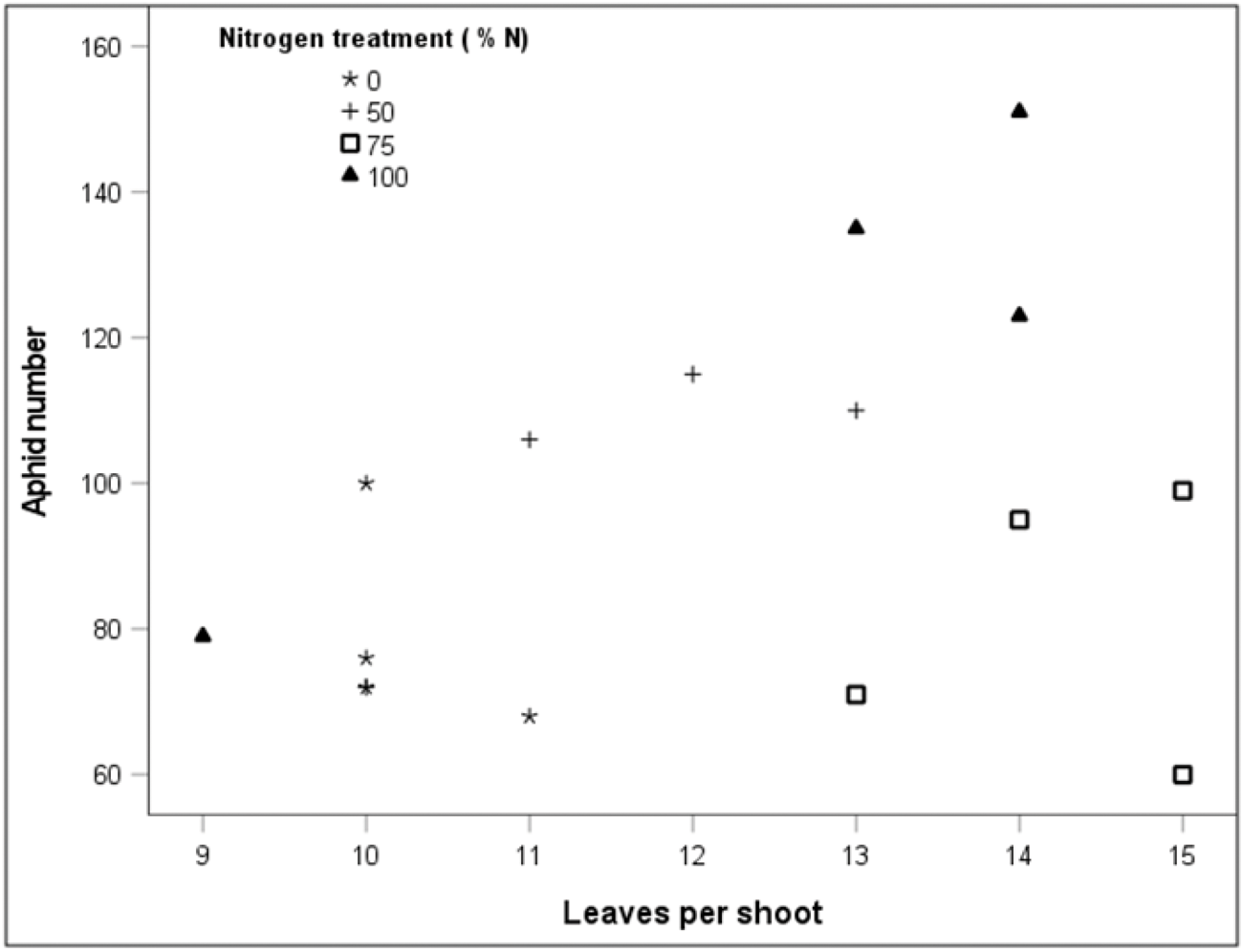
Nitrogen treatment had a significant impact on aphid population dynamics, as indicated by a strong effect in the overall model (GLM, Greenhouse–Geisser: F 7,51, 30,03 = 4.59, P = 0.001) (table 3). The highest aphid densities were observed in the 100% and 75% nitrogen treatments, averaging 62.04 and 54.21 aphids per leaf, respectively, while the 50% and 0% N treatments supported lower populations (48.92 and 35.67 aphids per leaf). Aphid abundance was positively correlated with the number of leaves per shoot (r = 0.269, P < 0.05).
Temporal variation in Dysaphis plantaginea density per shoot (mean ± SE) in aphid-infested apple trees (AI) under different nitrogen fertilisation treatments

Table 3 Long description
Mean aphid density per shoot (with standard error) is reported for six June monitoring dates across four nitrogen fertilization levels: 100%, 75%, 50%, and 0%. On June 1, all treatments were identical at 2.00 per shoot. Densities rose by June 7, reaching 9.00 at 0% nitrogen versus about 4.00 to 4.50 in the fertilized treatments, and the regression test was not significant. Counts increased sharply by June 13 and peaked on June 19, when 100% nitrogen had the highest mean (154.75) and 0% nitrogen the lowest (63.50); this date shows a statistically significant relationship between density and nitrogen level. After the peak, means declined by June 25 (122.00 at 100% versus 79.00 at 0%) and dropped further by June 28 (about 24.75 to 28.25 across treatments), with no significant treatment effect on June 28 and a near-threshold result on June 25. Degrees of freedom were 3 for each date, and F and P values summarize the strength of the nitrogen effect at each monitoring date.
Notes: P-values (≤0.05) indicate significance of F-statistics from linear regressions analysing the relationship between D. plantaginea density per shoot and nitrogen treatment levels at each monitoring date across all experimental trees.
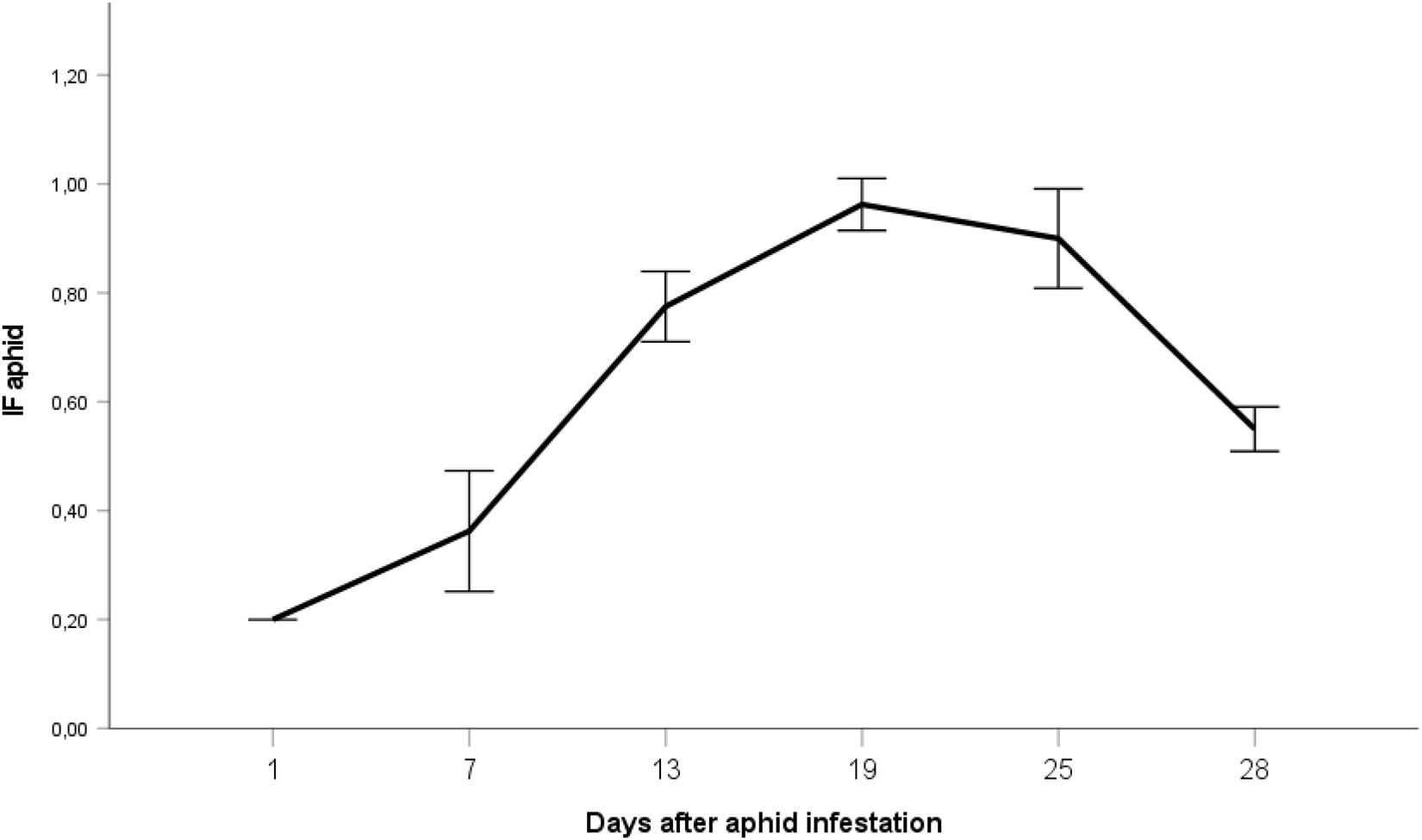
The infestation index (IF) showed a biphasic trend: it increased steadily from the onset of infestation to reach maximum values (0.80–0.95, depending on nitrogen level) by day 19, after which a marked decline occurred, with IF dropping to 0.55 for the highest nitrogen treatments and 0.50 for the lower ones, ultimately leading to the disappearance of aphids (fig. 2, Supplementary fig. S3). These results demonstrate that higher nitrogen supply enhances aphid population growth and prolongs the period of high infestation before a rapid population collapse.
Temporal variation in Dysaphis plantaginea infestation index (IF aphid; mean ± SE) in aphid-infested apple trees (AI).

Aphid–apple interactions under nitrogen supply
Multiple regression analysis showed a significant dependent relationship between leaf production and the combined effects of nitrogen dose and aphid infestation (expressed as IF), with the model explaining a substantial proportion of the variance in leaf number per shoot (F 2,13 = 5.57, R = 0.68, P = 0.02) (fig. 3). In contrast, shoot length exhibited no significant dependence on these factors (F 2,13 = 1.23, R = 0.40, P = 0.32) (Supplementary fig. S4), indicating that shoot elongation was comparatively insensitive to variations in nitrogen availability and aphid pressure under the conditions tested. Correlation analysis corroborated these findings: leaf number was moderately and significantly correlated with nitrogen level (r = 0.53, P = 0.03), whereas its association with aphid abundance was weak and not statistically significant (r = 0.21, P = 0.44). Similarly, shoot length showed no significant correlations with either nitrogen dose (r = 0.34, P = 0.20) or aphid number (r = 0.35, P = 0.18). Furthermore, neither nitrogen application rate (P = 0.502) nor aphid abundance (P = 0.486) exhibited a statistically significant relationship with final trunk diameter (Supplementary table S4).
Relationship between aphid number and number of leaves per shoot across varying nitrogen supply levels (% N; 100% = 50 g N tree−1, 75% = 37.5 g N tree−1, 50% = 25 g N tree−1, and 0% = 0 g N tree−1).

Collectively, these results highlight nitrogen supply as a principal determinant of leaf production in apple shoots, while suggesting that shoot elongation is governed by additional or alternative factors beyond nitrogen and aphid infestation in this experimental context.
Discussion
Effect of nitrogen on vegetative growth
Nitrogen fertilisation markedly promoted vegetative growth in young apple trees, enhancing both shoot elongation and leaf production by the end of the growing season. However, trunk diameter remained unaffected. At the final sampling date, NAI trees displayed consistently higher RGRs across all nitrogen treatments compared to AI trees, with maximal RGR and leaf initiation observed at the 75% nitrogen level. Both insufficient (0%, 50%) and excessive (100%) nitrogen applications resulted in reduced growth. Notably, NAI trees produced up to nine new leaves per shoot at the optimal nitrogen dose. This pattern aligns with previous work indicating that nitrogen primarily stimulates canopy development rather than structural thickening (Sauge et al., Reference Sauge, Grechi and Poëssel2010; Rousselin et al., Reference Rousselin, Bevacqua, Sauge, Lescourret, Mody and Jordan2017; Braham et al., Reference Braham, Boulahia-Kheder, Kahia and Nouira2023) and is consistent with typical spring leaf emergence rates in apple (Mehri and Crabbé, Reference Mehri and Crabbé2002).
In contrast, AI trees exhibited diminished leaf initiation (2–4 new leaves per shoot) across all nitrogen levels, highlighting the suppressive impact of D. plantaginea, particularly on terminal shoots (Varn and Pfeiffer, Reference Varn and Pfeiffer1989; Benzina et al., Reference Benzina, Harizia, Elouissi, Canelo and Bonal2023). Comparable inhibitory effects of aphid herbivory have also been reported in Mysus persicae (Sulzer, 1776) (Hemiptera: Aphididae), peach (Grechi et al., Reference Grechi, Sauge, Sauphanor, Hilgert, Senouci and Lescourret2008) and Aphis spiraecola (Patch, 1914) (Hemiptera: Aphididae), citrus systems (Braham and Amor, Reference Braham and Amor2018).
The lack of significant trunk response further indicates that nitrogen allocation in young apple trees favours ephemeral organs, such as shoots and leaves, over perennial tissues during early development.
Interestingly, even trees without external nitrogen supply maintained shoot growth, likely by remobilising stored nitrogen reserves. This strategy is well documented in deciduous fruit trees (Neilsen and Neilsen, Reference Neilsen and Neilsen2002).
These results underscore the importance of optimising nitrogen inputs. Our findings suggest that a 25% reduction from conventional fertilisation rates (to 75% N), when applied during the active spring growth period, can maximise vegetative growth efficiency in young ‘Gala’ apple trees, aligning with recent recommendations for precision nutrient management (Wang et al., Reference Wang, Hussain, Sun, Zhang, Javed, Dessoky, Ren and Chen2022). The timing of nitrogen application is a critical factor. Recent research demonstrates that administering nitrogen in spring aligns with the periods of maximum root absorption and heightened vegetative growth, thereby improving nitrogen use efficiency and supporting optimal canopy development (Neilsen and Neilsen, Reference Neilsen and Neilsen2002; Mészáros et al., Reference Mészáros, Hnátková, Čonka, Lošák and Náměstek2023; Li et al., Reference Li, Li, Qiang, Yu, Sun, Wang and Li2024a).
Additionally, recent work in apple orchards demonstrates that reducing nitrogen rates by 25–50%, especially when combined with compost and microbial inoculants, can improve vegetative growth, yield, and fruit quality compared to full-rate mineral fertilisation alone (Okba et al., Reference Okba, Abo Ogiela, Mehesen, Mikhael, Alam-eldein and Tubeileh2025). This supports the broader trend towards more sustainable and efficient nitrogen management in fruit tree production.
Effect of nitrogen on aphid infestation
The marked increase in aphid densities under regimes with higher nitrogen levels (75% and 100%) reflects a bottom-up enhancement of host nutritional quality. An elevated nitrogen level elevates both the concentration and the spectrum of free amino acids in phloem sap. In alfalfa, Xu et al. (Reference Xu, Li, Mao, Arthurs, Ye, Yan and Gao2024) demonstrated that nitrogen fertilisation boosted total essential and non-essential amino acids, particularly leucine and methionine, which directly correlated with increased aphid growth rates and fecundity.
Concomitantly, elevated nitrogen supply reprogrammes plant metabolism towards primary growth at the expense of secondary defence compound biosynthesis, thereby compromising innate resistance to sap-feeding insect pests (Li et al., Reference Li, Tan, Yao and Xie2024b).
A similar repression of salicylic acid (SA) defences has been implicated in cotton, where high nitrogen rates attenuated pathogenis-related protein induction, thus facilitating aphid colonisation (Xu et al., Reference Xu, Li, Mao, Arthurs, Ye, Yan and Gao2024). Beyond biochemical effects, elevated N levels drive vigorous vegetative growth, yielding tender flushes that are inherently preferred by aphids. Rousselin et al. (Reference Rousselin, Sauge, Vercambre, Bevacqua, Lescourret and Jordan2016a) found on peach that although N enrichment increased leaf N content, its primary influence on aphid dynamics was mediated by enhanced shoot proliferation rather than direct chemical changes. These rapidly expanding tissues provide both a physical niche and fresh nutrient sinks, aligning with the plant vigour hypothesis. Notably, nitrogen-driven changes also influence tritrophic interactions by modifying volatile organic compound (VOC) emissions. For example, in maize, plants receiving high nitrogen and infested by the aphid Rhopalosiphum padi (L.) (Hemiptera: Aphididae) emitted increased levels of 1-nonene, a key attractant for the predatory coccinellid Harmonia axyridis (Pallas, 1773) (Coleoptera: Coccinellidae), thereby enhancing the recruitment of natural enemies to infested sites (Zhao et al., Reference Zhao, Pan, Wang, Wang, Wang and Xi2024). This VOC-mediated feedback highlights the potential for nitrogen management strategies to strengthen biological control; however, their success will ultimately depend on the compatibility of VOC signals with the local community of natural enemies.
The decline in aphid densities observed at the end of the experiment may be explained by the combined effects of increasing population pressure, changes in host suitability, and plant-mediated responses. Although these mechanisms were not directly evaluated in our study, increasing aphid densities may have intensified intraspecific competition and contributed to population regulation, as density-dependent processes are recognised as important drivers of aphid population dynamics (Valpine and Rosenheim, Reference Valpine and Rosenheim2008).
Furthermore, prolonged aphid infestation may induce plant defence responses mediated by SA and jasmonic acid pathways, which can negatively influence aphid reproduction and development (Kersch-Becker and Thaler, Reference Kersch-Becker and Thaler2019).
Changes in host quality during infestation may also reduce aphid performance and promote the production of winged individuals, facilitating dispersal towards more favourable hosts (Ríos Martínez, Reference Ríos Martínez2018). Therefore, while high nitrogen availability initially enhanced aphid establishment and population growth, the subsequent effects of crowding, declining host suitability, and induced plant defences may have contributed to the reduction in aphid densities observed at the end of the experiment.
Balancing nitrogen inputs for growth and aphid control
Nitrogen fertilisation strongly influences both Gala apple tree growth and rosy apple aphid infestations. Our results confirm that higher nitrogen levels (100% of the conventional dose) not only stimulate vigorous shoot and leaf growth but also significantly increase aphid populations, supporting the plant vigour hypothesis (Price, Reference Price1991). This is likely due to enhanced nutritional quality of plant tissues, particularly increased amino acid concentrations in phloem sap (Zehnder and Hunter, Reference Zehnder and Hunter2008). Althoug the plant vigour hypothesis best explains our observations, other factors, such as cultural practices and environmental conditions, also influence plant–aphid interactions, as suggested by the pulsed stress and plant stress hypotheses (Huberty and Denno, Reference Huberty and Denno2004; Tariq et al., Reference Tariq, Wright, Rossiter and Staley2012).
Our results are in concordance with previous research, showing that increased nitrogen availability not only boosts plant biomass and foliar nitrogen concentrations but also facilitates greater aphid proliferation. The effect of nitrogen on aphids is largely mediated through its stimulation of shoot growth (Zehnder and Hunter, Reference Zehnder and Hunter2008; Rousselin et al., Reference Rousselin, Sauge, Jordan, Vercambre, Lescourret and Bevacqua2016). Furthermore, while restricting both water and nitrogen can limit aphid infestations, it does not fully control them, as aphids preferentially colonise the most vigorous shoots regardless of treatment (Rousselin et al., Reference Rousselin, Bevacqua, Vercambre, Sauge, Lescourret and Jordan2018; Jordan et al., Reference Jordan, Hucbourg and Drevet2021). Excessive nitrogen may also suppress defensive compounds like phenolics, further facilitating aphid success (Cao et al., Reference Cao, Liu, Zhang and Liu2016).
Therefore, nitrogen availability may influence aphid population dynamics through a combination of enhanced plant growth, improved nutritional quality and shifts in resource allocation that favour primary metabolism over defensive investment.
A limitation of the present study is the relatively small number of biological replicates, particularly for the NAI trees. This limited replication may have reduced the statistical power to detect subtle treatment effects, especially where responses were weak or highly variable. Nevertheless, the consistency of the observed patterns across nitrogen treatments and aphid infestation levels supports the overall interpretation of the results. Future studies including a larger number of biological replicates would help to further confirm the robustness and generality of these findings.
Finally, although our study provides insights into the relationship between nitrogen availability and aphid infestation, the applicability of these findings under field conditions should be considered. Greenhouse experiments provide valuable information on plant–aphid interactions. However, aphid population dynamics in the field are also influenced by climatic variability, natural enemy activity, and other ecological interactions. Predators and parasitoids can regulate aphid populations and may modify the effects of nitrogen availability on aphid abundance. Therefore, while our results highlight the importance of nitrogen management in shaping aphid infestations, further field studies are needed to assess how these processes operate under more complex environmental conditions.
Conclusion
These results highlight the complex interplay between nutrient management, plant vigour, and aphid population dynamics, underscoring the need for a nuanced approach to fertilisation. Maintaining moderate nitrogen application rates, around 75% of the conventional dose, optimises vegetative performance without excessively promoting aphid populations. Integrating precision fertigation, systematic monitoring, and biological control can further balance orchard productivity and pest resilience. Ultimately, our findings emphasise the importance of defining optimal nitrogen thresholds and adopting integrated management strategies to maximise yield and fruit quality while minimising pest risks in apple orchards.
Supplementary material
The supplementary material for this article can be found at https://doi.org/10.1017/S0007485326101242.
Acknowledgements
We gratefully acknowledge PGP Society for generously providing the plant material free of charge. We also thank the greenhouse staff of the Faculty of Natural and Life Sciences, Mascara University (Algeria), for their valuable assistance.
Author contributions
All authors have read and approved the final manuscript. Abdelkader Harizia was responsible for project supervision, preparation of the original draft, and review and editing of the manuscript. Elouissi Abdelkader was responsible for statistical analysis and manuscript review. Souad Makhloufi was responsible for preparation of the original draft and review and editing of the manuscript. Sabrina Benzina conducted the experiments and performed the data analysis. All authors reviewed and approved the final version of the manuscript.
Competing interests
The authors declare none.