Implications
Enteric problems are the main cause for mortality in growing rabbits. Some authors have observed that rabbits under restricted feeding had lower mortality rates than those fed ad libitum (AD). Therefore, restricted feeding is being utilised more frequently. The present study shows the consequences of a restricted feeding regimen on social competition and various behavioural elements of rabbits. Data regarding the use of space and performance of agonistic behaviours, as well as mortality rates, confirm that strategies other than those commercially used should be explored to improve both the health status of the animals and their welfare, as well as to reduce the economical impact that enteric problems could have on rabbit production.
Introduction
The Standing Committee of the European Convention for the Protection of Animals Kept for Farming Purposes proposed recommendations concerning domestic rabbits (EFSA, 2005). These guidelines state that fattening rabbits have to be kept in groups, and that the stability of the group should be maintained to minimise aggression and stress. The groups should be formed at an early age, and the group size should be adequate by using related animals or animals that are uniform in size (Postollec et al., Reference Postollec, Boilletot, Maurice and Michel2006). Rabbits are mainly fed AD with a fibrous diet (15% to 18% crude fibre), because they regulate their intake according to the energy content of the diet in order to achieve a constant daily energy intake. However, AD feeding may overload the gut, leading to enteric diseases (Larour et al., Reference Larour, Jobert, Balaine, Eono, Klein, Ledein, Le Bouqin and Guittet2002).
Rabbit disease is important as it not only affects the welfare and productivity of the rabbits and the financial status of the farmers, but also the quantity and quality of rabbit meat produced for food. During the growing period (when rabbits are between 32 and 60 to 73 days old), losses can vary and can also be particularly severe (6% to 8%), as a consequence of the occurrence of several viral infections (rota-, corona-, entero- and parvo-virus) and of the ‘enteritis complex or post-weaning enteritis’, which is a typical multifactorial disease that comprises several factors related to management, housing and environment (Gidenne et al., Reference Gidenne, Garcia, Lebas and Licois2010). It is often associated with a series of aetiological agents that often have low virulence and are opportunistic pathogens.
Mortality rates have not substantially decreased over the last 25 years, despite the use of modern rearing techniques, high hygiene levels, improved bio-security and environmental improvement. In the most successful intensive closed cycle farms, parturition-to-sale losses are around 10% to 15%, and mortality levels can be as high as 25% to 30% (EFSA, 2005). In fact, gastroenteric diseases have significantly increased in the last 15 years, becoming the most common cause of mortality (Marlier et al., Reference Marlier, Dewrée, Delleur, Licois, Lassence, Poulipoulis and Vindevogel2003). However, some feeding management practices can be adopted to reduce their incidence (Larour et al., Reference Larour, Jobert, Balaine, Eono, Klein, Ledein, Le Bouqin and Guittet2002). For instance, Boisot et al. (Reference Boisot, Licois and Gidenne2003) observed that a restriction of at least 20% of the AD consumption reduced the morbidity and mortality caused by epizootic rabbit enteropathy. Similarly, Gidenne et al. (Reference Gidenne, Combes, Feugier, Jehl, Arveux, Boisot, Briens, Corrent, Fortune, Montessuy and Verdelhan2009b) demonstrated a reduction in mortality and morbidity when a restricted diet of 60% to 80% of the ad libitum feed was applied. However, according to the same authors, feed restriction reduced the growth rate proportionally. Di Meo et al. (Reference Di Meo, Bovera, Marono, Vella and Nizza2007) observed that a moderate feed restriction (90% of AD feed) during the growing period did not affect slaughter weight, but reduced the mortality rate. Bovera et al. (Reference Bovera, Lestingi, Piccolo, Iannaccone, Attia and Tateo2013) observed that a feed restriction of around 20% (obtained via water restriction) during the hot season halved the mortality rate. Owing to lower mortality rates associated with restricted feeding, >80% of the farms in France use a restricted feeding diet (Tudela, Reference Tudela2008). When animals are restricted to a limited amount of food (i.e. 75% of the amount consumed AD), their behaviour could be different depending on the type of feed – that is, it varies if the whole ration is provided at the beginning of the day or in several batches throughout the day. A rabbit’s stomach is relatively small, and, as consequence, it cannot eat much in a single meal. Therefore, rabbits typically feed 20 to 30 times a day, usually spending 3 to 4 h/day feeding. The large number of meals reduces competition among animals at feeders and drinkers, and, consequently, under AD feeding conditions a ratio of rabbits to feeding places of 3 to 4 : 1 is sufficient (Maertens, Reference Maertens2001). However, providing restricted feeding in several meals throughout the day with a limited number of feeders could favour the dominant animals, leading to an inverse relationship of social rank to feed restriction. Therefore, authors such as Tudela and Lebas (Reference Tudela and Lebas2006) suggest that when feed is restricted, rabbits should be fed once a day, ensuring that BW homogeneity is not affected. Under these conditions, however, social competition for feed and water is not avoided. It is anticipated that there will be a high level of agonistic interactions between animals when this regimen is applied in comparison with an AD regimen. Therefore, the objective of the present study was to ascertain whether rabbits fed a restricted regimen (75%) with only one provision of feed per day showed significant higher competition for feeding, drinking and being in specific areas in the cage by studying the position of the rabbits and their display of agonistic behaviour in comparison with animals fed AD. In addition, performance variables such as daily gain and feed conversion ratio (FCR), as well as general health status and mortality rate, were assessed.
Material and methods
Animals and housing conditions
The present study was performed with a genetic line of rabbits named Caldes of IRTA (Gómez et al., Reference Gómez, Rafel and Ramon2002) selected for growth rate. In total, 504 rabbits between 31 and 66 days of age (growing period) were used. The study was carried out between October and November 2013 in a commercial farm in Spain. Kits were assigned to two different groups based on their weight: heavy animals (weight above 700 g after weaning, n=408) and light animals (weight under or equal to 700 g after weaning, n=96 animals). A maximum of two kits per litter were allocated in the same cage with the intention of minimising the maternal and pre-weaning environmental and social effects on behaviour and growth performance. A total of 200 heavy-weight rabbits (937±142.1 g) and 56 light-weight ones (626±81.5 g) were allocated in 32 cages, each cage containing eight rabbits: 25 cages housing heavy rabbits and seven cages housing the light-weight ones. They were all fed AD. In addition, a total of 208 heavy-weight rabbits (938±140.8 g) and 40 light-weight ones (635±68.6 g) were placed in 31 cages, each of them containing eight rabbits: 26 cages housing heavy-weight rabbits and five cages housing the light-weight ones. They were all fed a restricted diet (R). The restriction was calculated as 85% of the daily intake of animals fed AD during the previous week. For instance, the restriction in week 3 was calculated according to the consumption of AD -fed rabbits during week 2. As the consumption of the animals increased week by week, the real restriction was higher when rabbits under restricted and AD feeding regimens were compared in the same week. In fact, at the end of the study, the restriction was 75.3% for heavy rabbits and 74.1% for light rabbits when compared with the feed intake of AD -fed rabbits in the same week. Food was in the form of commercial pellets for the rabbits. From day 0 to 28, the nutrient content consisted of 18.7% crude fibre, 15.02% CP, 8.97% ash, 3.28% fat content of the pellets, 1.0% calcium, 0.62% phosphorum and 0.51% sodium, with coccidiostats. From day 28 until sacrifice, the nutrient content consisted of 15.98% crude fibre, 15.90% CP, 8.80% ash, 3.30% fat content, 1.0% calcium, 0.68% phosphorum and 0.35% sodium. The feed was offered each morning at 0900 h from Wednesday to Sunday and at 1100 h on Mondays and Tuesdays. In these latter cases, feed was distributed after rabbits were weighed. Water was available ad libitum (one nipple drinker per cage). The cages had two feeders, but only the one located in the frontal area was used during the study (Supplementary Figure S1). The total space in the cage was 3252 cm2 with a stocking density of 24.6 animals/m2 for both heavy and light rabbits.
Daily temperature and humidity were automatically recorded every 30 min using a data logger (Tinytag; Gemini Data Loggers, Chichester, UK), located in a central area of the building and at the level and in close proximity to the animals. The daily mean temperature ranged from 9.6°C to 22.1°C, and mean humidity ranged from 49.5% to 90.5%. Using these values, the average daily temperature and humidity index (De Lima et al., Reference De Lima, Piles, Rafel, López-Béjar, Ramón, Velarde and Dalmau2013) was calculated and it ranged from 11.4 to 22.9. From week 1 (when rabbits were 32-days old) to week 4 (60-days old), animals were observed once or twice per day from Monday to Friday by means of scan and focal sampling (Altmann, Reference Altmann1974) during two different observational periods, always by one single observer. The first observational period was in the morning, after the animals had been fed, from 0900 to 1100 h on Wednesdays, Thursdays and Fridays and from 1100 to 1300 h on Mondays and Tuesdays. The other observational period was in the afternoon, fixed in all cases from 1400 to 1600 h, and monitored from Mondays to Thursdays. In the 2nd week, the observation on Friday morning was not carried out. In total, 35 observational periods of 2 h each were carried out (19 in the morning and 16 in the afternoon). During each observational period, a total of 20 cages were observed, five cages containing light rabbits AD, five cages containing light rabbits R, five cages containing heavy rabbits AD and five cages containing heavy rabbits R. In the case of feed-restricted light rabbits, there were only five cages available; therefore, those five cages were assessed during all the observational periods (35 assessments). In the case of light rabbits fed AD, the seven cages were assessed in a random order (with a maximum of 26 assessments/cage). In the case of the heavy rabbits, a total of 13 cages of those under restricted feeding and 12 cages of those fed AD were assessed at random (with a maximum of 17 assessments/cage). When an animal died in a cage, observation was carried out in another cage containing eight animals. This occurred twice in this study, both cases during the 3rd week of the study. The only exception was in the case of light rabbits. Due to the low number of cages available, cages with seven animals could not be substituted. In that case, the size of the cage was considered as a factor during statistical analysis.
To carry out the observations, each cage was divided into three areas. The feeder area was considered Area A (472 cm2; Supplementary Figure S1). The central part of the cage was Area B (2000 cm2). Finally, the back area of the cage where the drinker was located was Area C (780 cm2). Each cage was assessed for 5 min to take into account different variables. By means of five consecutive scan samplings, with an interval of 1 min, the position of all the animals was recorded in relation to Areas A, B and C of the cage. In addition, during the 5 min, by means of focal samplings, Areas A and C were examined to assess the number of animals using the drinkers (Area C) and performing agonistic behaviour (Area A). The following three types of agonistic behaviours were assessed: (1) displacements: one animal displacing another at the feeders or drinkers (Welfare Quality, 2009); (2) biting: one animal biting another; and (3) jumping: one animal jumping on top of another. During each observational period, the assessment of the different cages was carried out in a randomly selected order, but always alternating AD and restricted feeding treatments and cages with heavy and light rabbits.
Statistical analysis
When data were normally distributed, the option Proc Mixed of Statistical Analysis System (SAS 9.2; software SAS Institute Inc. 2002 to 2008) was used. When data were not normally distributed, generalised models were applied with the same statistical package. Normal distribution was found only for the variable used to assess the homogeneity of the animals at the beginning and at the end of the study, calculated as follows: (mean standard deviation of the BW per cage/mean BW per cage)×100. The statistical model included the following as fixed effects: the feeding regimen, the size of the rabbit, the first or last week of the study and the interaction week×feeding regimen.
The occurrence of animals biting or not and of mortality were analysed assuming a binomial distribution. The number of animals jumping, drinking and performing displacement was transformed to a categorical variable by considering the following four categories: (a) no animals jumping, drinking or performing displacement; (b) one to three animals jumping, drinking or performing displacements; (c) four to five animals jumping, drinking or performing displacement; and (d) >5 animals jumping, drinking or performing displacement during the 5 min of observation by means of focal sampling. In this case, data were analysed assuming a multinomial distribution. Finally, the percentage of animals in Areas A, B and C, as well as BW, daily gain and FCR were analysed by means of a negative binomial distribution according to the deviance (Cameron and Trivedi, Reference Cameron and Trivedi1998).
In the case of behavioural models, data from heavy and light rabbits were analysed separately to better ascertain the effect of the number of animals in a cage (seven or eight) in the case of lighter ones. The statistical model used to analyse behavioural traits included as independent variables the feeding regimen (AD v. restricted feeding), the week of assessment (from one to four) and the period of the day (morning or afternoon) as main effects, in addition to the interactions of feeding regimen×week and feeding regimen×period of the day. In the case of the group of light rabbits, the number of animals in the cage (seven or eight) was also fitted as a covariant in the model. For mortality, BW, daily gain and FCR, the statistical model included the main effects on the feeding regimen, week and size of the rabbit, as well as the two-way interactions between feeding regimen and week and between feeding regimen and size. Cage was considered in all cases as a random factor. Estimation of model parameters was carried out following a residual maximum likelihood procedure. In all the tests of hypothesis conducted (ANOVA and contrasts between levels of a factor or interaction), the significant level was set at P<0.05.
Ethical approval
The experiment was approved by the Institutional Animal Care and Use Committee of IRTA.
Results
Growth performance
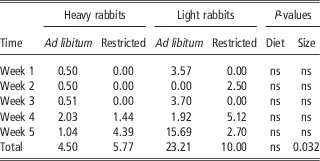
A total of 47 rabbits were excluded from the study; 38 died (mortality rate of 7.5%). However, necropsies were not performed on those 26 or on the other 12 dead animals that did not show clinical signs to confirm the causes of death. In addition, nine rabbits were euthanised due to health problems (six of them were heavy rabbits AD, two of them were heavy rabbits R and one of them was a light rabbit AD). Mortality rates by treatment and week are shown in Table 1. In the heavy rabbits, 43% of the deaths occurred in the group offered ad libitum diet and 57% with the restricted diet, but in the light rabbits 76% of the deaths occurred in the group offered an AD diet and only 24% with the restricted diet. Feed restriction did not significantly affect mortality rate, but the mortality rate was greater (P=0.0324) in the light rabbit group than in the heavy rabbit group.
Effect of feeding regimen (restricted or ad libitum) on percentage mortality in heavy and light rabbits

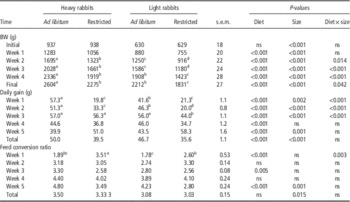
An overall effect of diet (P<0.05) on BW was observed. However, at early ages, the value of the contrast between animals under different diets was not significantly different from zero (P=0.8635; Table 2). In addition, the significant difference between light and heavy rabbits under both treatments at the beginning of the study (P<0.001) was maintained during the following weeks of the experiment. A significant effect of the feeding regimen (P<0.001) was found on daily gain during the complete study period and for each one of the weeks studied separately (P<0.0001). At the same time, the size of the rabbits had a significant effect on daily gain when assessed over the entire 5 weeks of the study (P<0.0001) and at the end of the 1st, 2nd, 3rd, 4th and 5th weeks (P<0.001; Table 2). The interaction between diet and size on daily gain was not statistically significant when assessed over the entire 5 weeks of the study (P=0.2887), but during the first 3 weeks (when rabbits were between 38 and 52 days old) the heavy rabbits had higher (P<0.05) daily gains than the lighter ones. During week 4 (59 day old rabbits), no differences were found (P=0.5334), and in week 5 (66 days old) light rabbits had higher (P<0.05) daily gain values than the heavy ones. The percentage that represented the standard deviation of BW in relation to the mean BW of the group was not different between treatments or size of rabbits, but it was higher (P=0.0013) at the beginning (11.8%) than at the end (8.8%) of the study.
Effect of the feeding regimen (restricted or ad libitum) on BW, daily gain and feed conversion ratio in heavy and light rabbits

Different superscripts indicates significant differences in the interaction diet × size at P<0.05.
The FCR was not influenced by the feeding regimen when estimated over the entire study period (P=0.8733), but significant differences were found when considered by week. In week 1, the FCR was lower (P<0.001) for rabbits fed AD than for those under restricted feeding, but in weeks 3 and 5 it was lower (P=0.005, and P<0.001, respectively) for rabbits under restricted feeding compared with the AD -fed ones (Table 2). There was an effect of the size on the FCR calculated over the entire study period (P=0.0152), although when assessed by week, only in the last week was the FCR lower in the light rabbits compared with the heavy rabbits (P=0.001). Finally, an interaction between size and diet was found in the first week (P=0.0029), with the heavy R rabbits having higher FCR than the light R rabbits and the heavy AD ones.
Behavioural observations
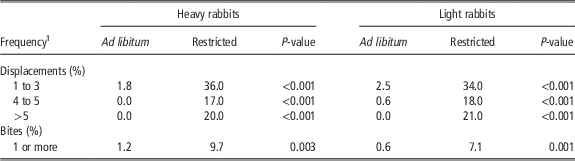
The presence of displacement was affected by the feeding regimen in heavy rabbits (P=0.0026) and light rabbits (P=0.0011), but no effect on week or observational period (morning/afternoon) or interactions of feeding regimen with size, week and observational period were found (P>0.05 in all cases). In general, animals under restricted feeding showed around 20 times more displacement than animals fed AD (Table 3). The display of animals biting was also affected by the feeding regimen both in heavy and light rabbits (P<0.01 in both cases), but no effect on week or observational period (morning/afternoon) or interactions of feeding regimen with size, week and observational period were found (P>0.05 in all cases). Although the percentage of animals biting was lower than the animals performing displacement (i.e. rarely more than one animal per cage bit another during the 5 min of the focal sampling), rabbits under restricted feeding performed this behaviour around eight times more than animals fed AD (Table 3).
Effect of the feeding regimen (restricted or ad libitum) on the percentage of displacements and bites seen in the feeding area of cages within the groups of heavy and light rabbits

1 Percentage of the total observational periods when one to three, four to five or more than five animals were observed performing displacement, and when one or more than one animal was observed biting another.
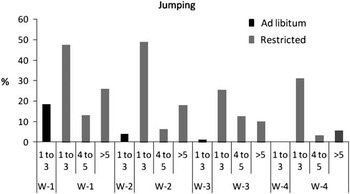
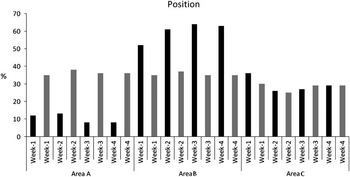
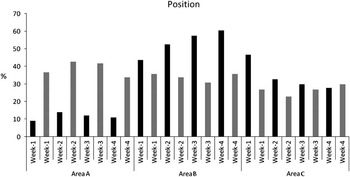
The incidence of animals jumping on the top of each other was affected by the feeding regimen and week in both light and heavy rabbits (P<0.05). However, no effect on the observational period or interactions of feeding regimen with size, week and observational period were found (P>0.05). As it can be observed in Figure 1, this behaviour was more frequently seen in rabbits under restricted feeding and with higher rates during the 1st week when compared with the last ones. When the presence of the animals in the different areas was assessed, the presence of heavy rabbits in Area A showed an effect of feeding regimen (P<0.001), period of the day (P<0.0001), week (P=0.0108) and an interaction between feeding regimen and period of the day (P<0.0001), whereas in light rabbits in the same area an effect on the feeding regimen, period of the day and interaction between feeding regimen and period was found (P<0.0001 in all cases; Figures 2 and 3 and Table 4).
Percentage of times observed when one to three animals, four to five animals or more than five animals were jumping on each other in relation to an ad libitum or restricted feeding regimen from week 1 (W-1) to week 4 (W-4).

Percentage of times when a heavy rabbit was found in Areas A, B or C from week 1 to week 4 in relation to ad libitum or restricted feeding regimens.

Percentage of times when a light rabbit was found in Areas A, B or C from week 1 to week 4 in relation to ad libitum or restricted feeding regimens.

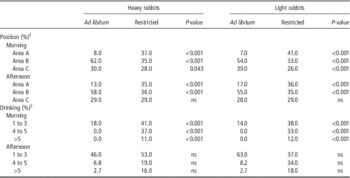
Effect of the feeding regimen (restricted or ad libitum) on the presence of rabbits (heavy and light) in Areas A, B or C of the cages, and drinking behaviour during the morning and afternoon observational periods

1 Mean percentage of animals seen by scan sampling in each area of the cage. Area A was the feeder area and comprised 475 cm2, Area B was in a central position of the cage and comprised 2000 cm2 and Area C was at the back, comprising 780 cm2.
2 Mean percentage of times during the observational periods in which up to three animals (one to three), up to five animals (four to five) or more than five animals (>5) were seen drinking.
When the behaviour of heavy rabbits was analysed in Area B, an effect on the feeding regimen (P<0.0001), week (P=0.0011) and an interaction between feeding regimen and period of the day (P=0.0123) was found. When the behaviour of light rabbits was analysed in Area B, an effect on the feeding regimen (P<0.0001), an interaction between feeding regimen and week (P<0.0001) and between feeding regimen and number of rabbits in the cage (P=0.0003) was found. In this case, Area B was clearly more occupied by rabbits subjected to the AD regimen than those subjected to a restricted regimen (Table 4 and Figures 2 and 3).
When the behaviour of heavy rabbits was analysed in Area C, only an effect of week (P<0.0001) was found (Figure 2), but without a clear pattern. In fact, the presence of rabbits in Area C was higher in week 1 than in weeks 2, 3 and 4 (P<0.0001 in all cases), but it was also higher during weeks 3 and 4 than during week 2 (P<0.0001). In the case of light rabbits, an effect on the feeding regimen (P<0.0001), week (P=0.0040), period of the day (P=0.0484), interaction between week and feeding regimen (P<0.0001), between feeding regimen and period of the day (P<0.0001) and between feeding regimen and number of rabbits in the cage (P=0.0015) was found (Figure 3 and Table 4). The drinker was located in Area C. When the use of the drinker by both heavy and the light rabbits was analysed, there was an effect on the feeding regimen (P<0.0001 in both cases), time of the day (P=0.0016 and P<0.0001, respectively) and interaction between feeding regimen and time of the day (P<0.0001 in both cases). The use of the drinker in the observed periods was higher in animals under restricted feeding when compared with the AD regimen (Table 4).
Discussion
Previous studies performed with the Caldes genetic line of IRTA showed a mean daily gain and an FCR of 53.4 g/day and 2.85, respectively, when animals were fed AD in individual cages (Piles et al., Reference Piles, Gomez, Rafel, Ramon and Blasco2004). In all cases, the daily gain values were lower and the FCR higher in the present study (Table 2) than those found for the same line in previous studies. On the other hand, under these conditions, the FCR was better when animals were under restricted feeding than when they were fed AD, with this effect clearly marked in weeks 3 and 5 (at the second half of the growing period). Other authors reported similar results with better FCR when rabbits were fed a restricted diet than when they were fed AD (Szendro et al., Reference Szendro, Szabo and Hullar1988; Gidenne and Feugier, Reference Gidenne and Feugier2009), although Perrier (Reference Perrier1998) and Tumova et al. (Reference Tumova, Skrivan, Skrivanova and Kacerovska2002) imposing similar levels of feed restriction did not find any difference between regimens. The final BW of rabbits was lower in restricted than in AD-fed rabbits. However, both heavy and light rabbits were within standard ranges for being accepted by Spanish slaughterhouses. Other authors also found this reduction in final weight when animals were fed under a restricted diet in comparison with AD-fed ones (Gidenne et al., Reference Gidenne, Combes, Feugier, Jehl, Arveux, Boisot, Briens, Corrent, Fortune, Montessuy and Verdelhan2009a and Reference Gidenne, Combes, Feugier, Jehl, Arveux, Boisot, Briens, Corrent, Fortune, Montessuy and Verdelhan2009b; Romero et al., Reference Romero, Cuesta, Astillero, Nicodemus and De Blas2010). It is important to state that in the present study the restricted regimen was maintained during the entire growing period, whereas in the case of Romero et al. (Reference Romero, Cuesta, Astillero, Nicodemus and De Blas2010) the restriction was applied only during 2 weeks just after weaning. In commercial conditions, in some cases, the feed-restricted animals are fed AD during the last week of the fattening period to take advantage of some compensatory growth under these conditions. Compensatory growth after a period of feed restriction has been described by Ledin (Reference Ledin1984), Maertens and Peeters (Reference Maertens and Peeters1988) and Romero et al. (Reference Romero, Cuesta, Astillero, Nicodemus and De Blas2010). On the other hand, in France >80% of farmers apply a restricted feeding regimen for rabbits (Tudela, Reference Tudela2008), due to a reduction in the mortality rates (Gidenne et al., Reference Gidenne, Garcia, Lebas and Licois2010). Although there is a large apparent difference in mortality rate in light rabbits offered ad libitum feed compared with those offered restricted feed, no significant interaction between feeding regimen and size was found; thus, the effect of diet on mortality rates was not confirmed in the present study. In any case, taking into account all variables, it seems that a restricted regimen could be beneficial for both rabbits and the producer (i.e. in terms of FCR), especially during the last few weeks of the growing period.
According to Tudela and Lebas (Reference Tudela and Lebas2006), when rabbits are group-housed under a restricted feeding regime, aggressive behaviour and social interactions could be more prominent than when rabbits are fed AD. Our findings reinforce this idea, as rabbits under restricted feeding conditions showed a higher frequency of displacement, biting and jumping on each other compared with the AD-fed ones. In addition, the use of the different areas of the cage, especially Areas A (area of the feeder) and C (area of the drinker) showed signs of increased competition. When high competition for feeding is observed in a group of animals, it is expected to lead to significant variability in the final weight of the animals due to hierarchy, with the most dominant animals feeding more than the subordinates. This is true for cattle (Grant and Albright, Reference Grant and Albright1995) and pigs (Korthals, Reference Korthals2000), where a direct effect on increased competition will show a higher variability in the final weight. However, as the physiology of the gastrointestinal tract of rabbits prevents them from eating a large quantity of food in one meal and causes them to distribute the feeding into 20/30 meals/day (Maertens, Reference Maertens2001), this effect was not seen in the present study. In fact, the standard deviation (s.d.) represented a higher percentage in relation to the BW at the beginning of the study than at the end; therefore, there was more homogeneity at the end than at the beginning of the growing period for both feeding regimens and sizes of rabbits (data not shown). Although compared with AD feeding, restricted feeding reduced the final weight of the rabbits at the end of the growing period. Within each cage, there was a relatively homogeneous distribution of weights in terms of competition, which means that subordinate rabbits, with a ratio of four animals per feeding place (eight animals per two feeding places in a cage), were able to access sufficient amounts of food to gain similar weight to more dominant rabbits. This number was also suggested by Maertens (Reference Maertens2001) to avoid competition when rabbits are fed AD. However, this also reflects that the period of competition for feeding can be longer than in other species where the feed is consumed in shorter periods of time. In the present study, two observational periods were used – one just after feeding and another one finishing between 5 and 8 h after feeding. The signs of social competition such as displacement, bitting and jumping on each other did not show in either case a difference in these two periods, confirming this long period of competition for feeding in the cage. The use of space also confirms the same statement, because no differences were found for restricted-fed rabbits in the use of space between the morning and afternoon observational periods. In fact, Area A represented 15% of the total area, Area B 61% and Area C 24%. This was approximately the distribution of rabbits fed AD, especially in the afternoon (Table 4). However, restricted-fed rabbits showed a clear priorisation of use of Area A, underuse of Area B and similar percentages as AD-fed rabbits for Area C. Another interesting point to highlight is the underuse of Area A among rabbits fed AD during the morning and a slight prioritisation of the use of Area C. A possible explanation could be the necessity of rabbits to use the drinker, which was located in Area C. However, this one can be discarded, as the use of drinkers was lower among AD-fed rabbits during the morning than during the afternoon. An alternative explanation could be the preference of rabbits fed AD to rest during a period of lower activity in the deeper area of the cage, the furthest point from the corridor and human disturbances. In this context, it would be interesting to consider whether Area C is the best area to place the drinker in a cage, as animals that want to drink can show reluctance to approach the water and animals that want to rest could be disturbed when others need water. In any case, in the end, two very active areas can be observed, the front and the back sides of the cage. This is also confirmed by the results obtained observing restricted-fed rabbits when the use of the drinker was assessed, showing a great activity in the morning and in the afternoon, while the animals were feeding. In this case, it would be interesting to study whether one drinker is enough under a restricted regimen, although the homogeneity in the final weight of the animals under restricted feeding seems to show that one drinker per eight rabbits works sufficiently. Only the presence of animals jumping on each other showed a reduction of frequency during the study, this behaviour being more difficult to observe during the last few weeks when compared with the first one. This is probably due to the increase in size of the animals and the physical difficulties of jumping in the cage and not to a reduction in the competition for feeding, as other parameters did not show this reduction.
Conclusions
In conclusion, restricted feeding of rabbits showed that competition for feeding and drinking increased with clear signs of agonistic behaviour such as biting, displacement and animals jumping on top of each other. This competition was maintained during the entire growing period; however, although the final weight of animals under restricted feeding was lower than when fed AD, the homogeneity between animals in the same cage was similar in both cases, suggesting that all rabbits within the same cage could consume similar quantities of feed. The possible advantages of a restricted regimen, such as a better FCR, were observed in this study only during the last few weeks of the growing period; thus, further studies testing a mixed system, first half of the growing period feeding rabbits AD and the second half feeding them a restricted diet, would be interesting. On the other hand, with this feeding regimen it is not possible to take advantage of the compensatory growth of rabbits during the last week of the fattening period, and consequently further studies are also needed to compare different kinds of mixed AD/restricted feeding regimens.
Acknowledgements
This work was funded by the Spanish Instituto Nacional de Investigaciones Agrarias (INIA) (RTA2011-00064 ‘Genetic improvement of feed efficiency in prolific species’). In addition, Dr A.M. Abdel-Khalek could participate in the study thanks to an UFAW grant. The help of Debra Hickman in supervising the grammar and spelling of the text is also acknowledged.
Supplementary material
To view supplementary material for this article, please visit http://dx.doi.org/10.1017/S1751731115000270