





Introduction
Multimorbidity is the co-occurrence of two or more chronic diagnoses in the same individual. Still, multimorbidity is not a homogeneous category defined solely by the number of diagnoses (Coventry et al., Reference Coventry, Small, Panagioti, Adeyemi and Bee2015; Ørtenblad and Nissen, Reference Ørtenblad and Nissen2019). This multifaceted nature often arises from the interactions between multiple diagnoses, the specific combinations of physical and mental health conditions, and the patients’ management of diagnoses (Alvarez-Galvez and Vegas-Lozano, Reference Alvarez-Galvez and Vegas-Lozano2022). Though there is no consensus on the definition of complex multimorbidity (Alvarez-Galvez and Vegas-Lozano, Reference Alvarez-Galvez and Vegas-Lozano2022), this subgroup is characterized by multifaceted treatment trajectories and substantial burden of illness compared to those with fewer or less complex conditions (Frølich, Reference Frølich2024).
The treatment of patients with (complex) multimorbidity is recognized as a difficult and critical issue in primary care (Ørtenblad and Nissen, Reference Ørtenblad and Nissen2019; Adan et al., Reference Adan, Gillies, Tyrer and Khunti2020; Aramrat et al., Reference Aramrat, Choksomngam, Jiraporncharoen, Wiwatkunupakarn, Pinyopornpanish, Mallinson, Kinra and Angkurawaranon2022). Patients with multimorbidity have higher consultation rates and place greater demands on general practitioners (GP), e.g. in terms of workload and time (Ørtenblad and Nissen, Reference Ørtenblad and Nissen2019; Alvarez-Galvez and Vegas-Lozano, Reference Alvarez-Galvez and Vegas-Lozano2022). Moreover, GPs frequently encounter systemic barriers to providing adequate treatment in healthcare systems largely structured around single-disease management models and protocols (Ørtenblad and Nissen, Reference Ørtenblad and Nissen2019; Adan et al., Reference Adan, Gillies, Tyrer and Khunti2020; Aramrat et al., Reference Aramrat, Choksomngam, Jiraporncharoen, Wiwatkunupakarn, Pinyopornpanish, Mallinson, Kinra and Angkurawaranon2022). In support of this, studies consistently demonstrate that treating multimorbidity presents significant challenges to conventional healthcare models and may increase the risk of adverse medication interactions and conflicting therapeutic goals, complicating treatment navigation for patients (Søndergaard et al., Reference Søndergaard, Willadsen, Guassora, Vestergaard, Tomasdottir, Borgquist, Holmberg-Marttila, Olivarius Nde and Reventlow2015; Adan et al., Reference Adan, Gillies, Tyrer and Khunti2020).
The ways in which individuals with multimorbidity manage (or do not manage) their conditions and treatments within the context of their everyday lives contribute significantly to treatment complexity (Coventry et al., Reference Coventry, Small, Panagioti, Adeyemi and Bee2015; Ørtenblad and Nissen, Reference Ørtenblad and Nissen2019; Alvarez-Galvez and Vegas-Lozano, Reference Alvarez-Galvez and Vegas-Lozano2022). For many of these patients, challenges such as maintaining everyday routines and treatment regimens or prioritizing conditions due to altering symptoms are central concerns (Morris et al., Reference Morris, Sanders, Kennedy and Rogers2011; Ørtenblad et al., Reference Ørtenblad, Meillier and Jønsson2018). Patients have reported living with multimorbidity as ‘a juggle’ with appointments and consultations disrupting daily life and complicating self-care routines (Coventry et al., Reference Coventry, Small, Panagioti, Adeyemi and Bee2015; Ørtenblad and Nissen, Reference Ørtenblad and Nissen2019). Furthermore, navigating fragmented healthcare systems based on single diseases exacerbates these challenges (Mason et al., Reference Mason, Nanton, Epiphaniou, Murray, Donaldson, Shipman, Daveson, Harding, Higginson, Munday, Barclay, Dale, Kendall, Worth and Boyd2016), especially when managing multiple medications and coordinating care (Mason et al., Reference Mason, Nanton, Epiphaniou, Murray, Donaldson, Shipman, Daveson, Harding, Higginson, Munday, Barclay, Dale, Kendall, Worth and Boyd2016; Verhoeff et al., Reference Verhoeff, van der Zaag, Vermeeren and van Munster2018).
Although previous studies have described the clinical challenges of multimorbidity in primary care, there is limited insight into how this minor group of patients with complex multimorbidity experience and manage these challenges in daily life. Addressing this gap is essential for designing care that is clinically appropriate and practically feasible from the patient’s perspective.
Consequently, this study aimed to explore how individuals with complex multimorbidity perceive and experience the management of their health in the context of everyday life and healthcare encounters.
Methods
Study design
This study employed a qualitative approach based on individual, semi-structured interviews.
Study setting
A key feature of the Danish healthcare system is the GP, the primary point of contact. Every citizen is assigned a GP, who provides general medical care, preventive services, and health counselling. The GP also acts as a gatekeeper, referring patients to secondary specialized care, and further medical examinations when necessary. The Danish healthcare system is tax-funded, and most services are free at the point of use. However, healthcare activities not covered by the tax-funded system include psychological counselling and physical training beyond the time-limited and referral-dependent treatment/rehabilitation offers. Also, prescription medicine is only partially reimbursed, and the individual citizen pays the remaining expenses.
Some hospitals have specialized units offering interdisciplinary and individualized assessment and treatment of patients with multimorbidity (Bell et al., Reference Bell, Vedsted, Kraus, Fredberg, Jeffery, Dahlgaard, Aarhus and Appel2023). However, access to such initiatives is not accessible for all patients with complex multimorbidity; it depends on the region of residence and GP referral.
Participants
The objective inclusion criteria were individuals with two or more chronic diagnoses. As no consensus exists on complex multimorbidity, the assessments of healthcare professionals were included in the recruitment process. This approach acknowledged that the number of diagnoses alone does not necessarily indicate complexity, as many patients with multiple conditions manage their health effectively. Including professional assessments ensured that patients perceived as complex by clinicians were recruited. Consequently, the classification of ‘complex multimorbidity’ was determined by the GP or the hospital unit from which the potential participants were recruited. No exclusions were applied based on age, gender, or socioeconomic status.
Recruitment process
A purposive sampling strategy was used (Patton and Patton, Reference Patton and Patton2002). Initially, four GPs assisted in recruitment from primary care, which resulted in the inclusion of five participants. Ten additional GPs were contacted but declined to assist with further recruitment due to time constraints and workload. A hospital unit specialized in multimorbidity facilitated the inclusion of three participants. In an attempt to supplement recruitment, an internal medicine hospital ward agreed to assist in the recruitment; however, these efforts did not result in any additional inclusions.
Given the chosen characteristics of the population, recruitment was expected to be challenging. However, it proved more difficult than anticipated despite several targeted recruitment strategies. Barriers reported by recruiting health professionals consisted of limited availability of potential participants and reluctance to participate. After 11 months of active recruitment, the inclusion process thus concluded with eight participants. We evaluated the material and assessed that it provided sufficient data for a trustworthy analysis (Malterud et al., Reference Malterud, Siersma and Guassora2016).
Data collection
Individual semi-structured interviews (Brinkmann and Kvale, Reference Brinkmann and Kvale2018) were conducted in person (n = 7) or via video (n = 1) based on participant preference. In-person interviews took place either in participants’ homes (n = 6) or at the researcher’s office (n = 1). The interview guide was developed by the first author, who has experience with primary care research in collaboration with the research team and with input from the recruiting GPs. It focused on managing life with multimorbidity and experiences with the healthcare system, including perceived continuity in treatment across diagnoses. The first and second authors jointly conducted the first interview to ensure consistency in subsequent interviews. Subsequent interviews were conducted individually by the first and second authors, both experienced qualitative interviewers. Each interview lasted approximately 60 minutes. Interviews were audio-recorded and transcribed verbatim and assigned a pseudonym by a research intern.
Ethical considerations
Written informed consent was obtained from all participants before data collection. Participants were assured of confidentiality and their right to withdraw from the study at any time without consequences. The study was registered with the Central Denmark Region Data Protection Agency (J. No. 1-16-02-241-22). According to Danish law, approval by the National Committee on Health Research Ethics was not required as no biomedical intervention was performed (section 14(2) of the Committee Act, https://en.nvk.dk/how-to-notify/what-to-notify).
Data analysis
Interviews were analysed using thematic analysis as outlined by Braun and Clarke (Braun and Clarke, Reference Braun and Clarke2006; Braun et al., Reference Braun, Clarke, Hayfield, Terry and Liamputtong2019; Braun and Clarke, Reference Braun and Clarke2023). NVivo 15 software (Lumivero.com, 2025) supported the coding process. Initially, authors familiarized themselves with the complete dataset by thoroughly reading the interviews. As a pilot, the first, second and last authors individually coded the same interview, guided by themes from the interview guide combined with an inductive approach. Subsequently, the codes were compared and discussed, resulting in a final coding structure. This process ensured consistency in the final coding performed by the first author. Following this coding, all authors actively engaged in discussions of codes, developing potential themes, and assessing coherence within and across codes. This process aimed to ensure that themes represented the richness and depth of the data material. The analytical process resulted in two main themes, ‘Multiple diagnoses -not multimorbidity’ and ‘Managing treatment and illness in everyday life’, which are presented below.
Results
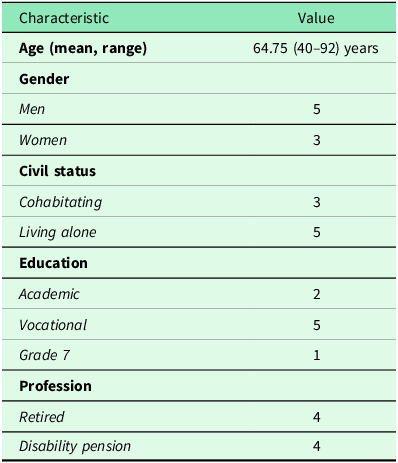
The participants in this study represent a varied sample in terms of age, gender and educational level (see Table 1). Still, the analyses revealed many shared experiences, expectations, and concerns, which are addressed in detail below. A central characteristic across the sample was the difficulty the participants experienced when they were asked to list their diagnoses. Often, the participants would mention a few specific diagnoses and then add other conditions in vague or non-specific terms, such as ‘something with my stomach’. Additional conditions and diagnoses would often be recalled or come forth as part of an answer throughout the interview. This suggests that different illnesses had been at the forefront at different times in their lives and were not equally present at any given point in time. The inability to systematically list all diagnoses automatically did not imply difficulties managing them, rather it reflected a pragmatic focus on the illnesses that were most pressing at a given time.
Participants characteristics

Table 1. Long description
The table presents participant characteristics in a study, focusing on age, gender, civil status, education, and profession. It has two columns: Characteristic and Value. The table includes the following rows: Age (mean, range) with a value of 64.75 (40-92) years. Under Gender, there are 5 Men and 3 Women. For Civil status, 3 participants are Cohabitating and 5 are Living alone. In terms of Education, 2 participants have an Academic background, 5 have Vocational training, and 1 completed Grade 7. Regarding Profession, 4 participants are Retired and 4 are on Disability pension.
Theme 1: multiple diagnoses – not multimorbidity
This theme describes how the participants experience encounters with the healthcare system. The first subtheme, ‘Continuity of care: expectation, experience, and patient strategies’, describes how participants did not expect coherence across medical specialities but actively sought to create continuity within each speciality. The second subtheme, ‘Beyond single diagnoses: recognizing the compounded burden of multimorbidity,’ highlights the participants’ need for recognition from healthcare professionals of the overall burden of their health challenges and their desire to be met with a holistic approach.
Continuity of care: expectation, experience, and patient strategies
When asked about continuity and care integration across their multiple conditions, the participants generally did not expect this. Instead, they expected healthcare professionals to remain focused on their respective specialities rather than attempting to create a unified treatment approach across multiple diagnoses.
Karl: ‘I think the ones I’ve seen have focused on what they’re supposed to do, and on why I’m there. They haven’t really talked about anything else.’
The participants described a preference for continuity of care within each specialty, which henceforth will be named ‘intra-specialty continuity’. Intra-speciality continuity was characterized by health care professionals having prepared themselves by reading the medical journal before consultations or being able to continue where a colleague had left if the consultation was conducted by an unfamiliar professional. Some participants referred to the medical record as having the potential to provide inter-professional information across consultations without requiring any effort from the participants. They simply could not remember all the details. Anna describes meeting a ‘new’ healthcare professional who has not read her file like this:
Anna: ‘Then I’m like, oh my god, because now I have to start explaining my whole medical history all over again. And when you’ve been in the system and had so many illnesses, you just can’t remember it all, you can’t keep it straight — like, when was it that I had that, and when was it the other thing? Just look in my file, because I honestly can’t keep track of it anymore.’
Thus, when intra-specialty-continuity was successful, it relieved the patient of the responsibility of remembering the details from previous consultations, including diagnoses, treatment and prescriptions.
Encounters where continuity was perceived as ‘disrupted’ were described as a waste of time, and many emphasized how those situations were not only ineffective for them as patients but also for the healthcare system in general. Lilly explained:
Lilly: ‘It was a gynecologist who examined me and said, ‘Well, Maria [referring doctor] hasn’t written anything in your record about the fibroid on your uterus.’ What!? And I just said thank you and goodbye — without actually saying anything — and then I got a new appointment with someone who had done their homework and said, ‘Yes, it does say in your record that you have a fibroid.’ So I said, ‘You know what? They weren’t prepared for the examination, and that’s just a waste of time and resources. It costs society too.’
When the system and professionals fail to provide continuity, the responsibility of disease management shifted to the participants, and the above interview excerpt illustrates the efforts that many participants made to ensure intra-specialty continuity. Another strategy was to request the same professional at each consultation:
Karen: ‘And every time, it was a different doctor. So I had to go through everything all over again, every time […] so I said, ‘You know what, wouldn’t it be possible for you to keep track of this —to have just one doctor?’ And ever since I said that, it’s only been him.’
This excerpt illustrates how the participant took the initiative to advocate for continuity, and when succeeding in doing so, she eliminated the need to recount her health repeatedly. Together, these examples point to the efforts and resources that the participants actively engaged in promoting intra-speciality continuity. However, these efforts were not always successful, and Paul described how he felt his GP had left the responsibility for finding a relevant treatment up to him – a responsibility he experienced as an unreasonable burden.
Beyond single diagnoses: recognizing the compounded burden of multimorbidity
Even though the participants did not expect integrated continuity across diagnoses, they did seek recognition for being a person with multiple diagnoses, including the ensuing burden of managing and living with several illnesses. Many participants described situations where the healthcare professionals failed to recognize this compounded burden. Anna articulated this frustration:
Anna: ‘Well, maybe you, [doctor] see the problem as small, but if you add it on top of all my other illnesses, then it’s really starting to become something significant. It’s like — if you’ve already got something huge, and you keep adding more and more onto it, it just gets bigger and bigger, and in the end, you just can’t handle something that big.’
Each diagnosis in itself might be manageable, but the participants appreciated when healthcare professionals acknowledged the compounded burden of illnesses and how it might affect participants’ ability to follow treatment regimens or fit in consultations. Many of the participants highlighted the value of a more holistic approach. Participants described positive experiences from the hospital unit specializing in multimorbidity. Participants who had been in the unit described the value of being met as a whole person and with a holistic approach that considered all their diagnoses simultaneously. Notably, this approach included a complete medication review. Several participants described living with unwanted side effects significantly impacting the daily lives of participants negatively. Peter had experienced pain in his feet for an extended period. These symptoms had earlier been explained as caused by his previous alcohol addiction, and he had accepted this explanation. However, at the inter-disciplinary multimorbidity unit, they identified a specific medication as causing the pain in his feet. He stated the following about his visit to the hospital unit:
Peter: ‘I mean, the way they looked at the whole person and everything going on — that really did help. Some things have been set in motion and figured out. I can only be grateful for that. […] And some new medication that doesn’t affect my feet. Now I can go for walks. I go for a walk every morning.’
The compounded burden of medications for multiple diagnoses, negative side effects, and the possibility of negative interaction between medications was a major issue for several of the participants. The example illustrates how addressing the combined effects of multiple illnesses and their treatment can significantly improve daily functioning. Adjusting the medication not only improved Peter’s physical capacity but also restored meaningful daily activities.
Theme 2: managing treatment and illness in everyday life
This theme describes how participants actively negotiated the balance between managing illness and pursuing a meaningful everyday life. The first subtheme, ‘Personal priorities vs. medical directives: patients’ strategies for quality of life’, illustrates the potential tension between engaging in valued, everyday activities and adhering to strict medical recommendations. The second subtheme, ‘Balancing illness and life: the role of social and professional networks’, describes the perceived value of having accessible social and professional networks to share the everyday burden of illness by providing emotional support alongside medical and practical advice.
Personal priorities vs. medical directives: patients’ strategies for quality of life
The participants described the value of being understood as a person ‘with a life’ and not just someone with multiple diagnoses. They highlighted how the different diagnoses were part of their life but not their entire identity. Thus, the participants described how they prioritized activities that were important for their everyday lives and that enhanced their quality of life, even though some of these activities influenced their health negatively. Anna described:
Anna: ‘[…] if I go on an outing with the kids, then yeah, I might feel unwell for a couple of days afterwards. But the alternative is that I just don’t go out with my kids at all. … And I think that’s a bad alternative — to just not do things with your children. That’s not how it should be. So for me, it’s like: then the outing is worth it, even if I feel bad for a few days.’
These findings illustrated the interplay between patient autonomy and professional authority, and between holistic lived experience and biomedical focus. The participants experienced the established healthcare system as having difficulties acknowledging that they sometimes prioritized quality of life over optimal medical treatment. Some participants had experienced resistance, lack of understanding or even the feelings of being scolded by healthcare professionals.
While some participants chose to ignore such professional recommendations, others ‘gave in’ to the doctor’s orders. For example, Lilly described how side effects caused by her medication changed her physical appearance, making her embarrassed and self-conscious in social situations. She lived alone and appreciated the social life in the local community. Consequently, Lilly decided to discontinue the medication. Subsequently, she was reprimanded by her GP, who asked if she would rather die and reinstated her treatment plan. At the time of the interview, Lilly was still very unhappy with the situation and the social withdrawal it had resulted in.
There were also examples of participants describing positive experiences with psychological or physical therapy beyond the time-limited tax-covered rehabilitation. When encouraged by healthcare professionals to engage in such treatments, they were motivated to do so. However, financial constraints prevented them from accessing these therapies, as they required out-of-pocket payment.
Balancing illness and life: the role of social and professional networks
The participants managed their lives by actively seeking influence and autonomy. For most of them, backup and support were essential to exercise this management. Support came from different sources. Their social and family networks were of significance for most participants. Persons close to them would support the participants in managing appointments, following along, and helping them remember what was said during consultations.
Eric was asked how he experienced the many medical appointments, and he replied:
Eric: ‘Well, I have to say, I get really good support from my wife. She’s great at grounding me, because I can get a bit like, ‘Ugh, here we go again.’’
The network became a ‘cross-setting witness’ for the participants. Witnessing both their lives as patients in the health care system with multiple diagnoses and as persons managing the diagnoses in everyday life. Additionally, social networks and family also provided emotional support, which participants much appreciated.
In addition to social networks and family, the analysis revealed the perceived importance of having a professional lifeline. A known and named person within the healthcare system that could be accessed relatively easily. For several participants, the GP played this role, e.g. by explaining medical information from specialists and supporting participants in decision-making. The GP often became an allied insider, an anchor within the health care system that participants could contact when in doubt about how to interpret symptoms or had questions about medication. The analysis showed that a good relationship between the GP and the participant supported and strengthened participants’ management of their diagnoses and everyday life.
Anna: ‘Well, there’s about a month and a half between my appointments with him, and he really has a handle on everything. He’s the one who makes sure to keep track of what one doctor has done, what another has done, and he takes me completely seriously. I can talk to him about anything — so he actually kind of fills all the roles.’
Other healthcare professionals could also take the role of the lifeline. Karen described her relationship with a nurse at the hospital, which she visited regularly.
Karen: ‘[…] Oh, she’s just amazing, that girl — it doesn’t matter when you call, and I probably called a lot in the beginning. Wow, she’s just, yeah, more than perfect, I think. […] She’s constantly giving good advice and updates on what’s new in her department.’
Participants valued the accessibility of healthcare professionals during periods when illness interfered with their daily lives. They did not necessarily request or need regular monitoring. Rather, the assurance of knowing whom to approach when needed allowed participants to sustain daily activities.
Meanwhile, there were also examples of participants reaching out to professionals, but not feeling supported. Paul described how he had self-initiated treatment for alcohol misuse and informed his GP about this. He expressed an expectation that his GP would follow-up on this treatment, but was met with a complete lack of follow-up. Though Paul was disappointed, he did not pursue the issue further, but he felt neglected and unsupported.
Discussion
This study explored how individuals with complex multimorbidity experience and perceive the management of their health, specifically in relation to navigating healthcare encounters and managing everyday life. While participants did not expect coherence across medical specialities, they sought recognition of the compounded burden of multiple diagnoses. They acted with agency to create coherence and control within the healthcare system and their everyday lives. These findings extend prior research on multimorbidity by foregrounding patients’ efforts to negotiate fragmented care and sustain quality of life through strategic, often agentic and resourceful practices.
In contrast to calls for integrated, interdisciplinary care models (Wilson et al., Reference Wilson, Lavis and Gauvin2016; Dambha-Miller et al., Reference Dambha-Miller, Simpson, Hobson, Roderick, Little, Everitt and Santer2021), our findings show that participants expected and accepted a siloed healthcare system. However, the analysis revealed how this acceptance should not be mistaken for indifference. Participants still highlighted the challenges of managing the cumulative burden of illness when care remained fragmented. Our analysis showed how this was particularly evident in the domain of medication. Participants’ narratives of unaddressed side effects and adverse medical interactions align with research showing that polypharmacy increases the risk of harm when not coordinated (Schiøtz et al., Reference Schiøtz, Høst, Christensen, Domínguez, Hamid, Almind, Sørensen, Saxild, Holm and Frølich2017; Holland et al., Reference Holland, Matthews, Macdonald, Ashworth, Laidlaw, Cheung, Stannard, Francis, Mair, Gooding, Alwan and Fraser2024). Our findings support calls for more consistent medication reviews, particularly in cases where multiple prescribers are involved. Notably, positive experiences emerged when participants encountered healthcare professionals who reviewed medications holistically – as seen at the specialized multimorbidity clinic. The benefits of targeted medication reviews as part of treating multimorbidity are supported by Aramrat et al., and underscore the value of systemic coherence, even when patients themselves have modest expectations of it (Aramrat et al., Reference Aramrat, Choksomngam, Jiraporncharoen, Wiwatkunupakarn, Pinyopornpanish, Mallinson, Kinra and Angkurawaranon2022).
Another key finding was identifying patient agency and the various ways that participants sought to influence and take control over their disease, care trajectories and lives. Much of the literature on complex multimorbidity focuses on the burdens patients face, including difficulties navigating services, low health literacy, and socioeconomic constraints (Ørtenblad and Nissen, Reference Ørtenblad and Nissen2019; Alvarez-Galvez and Vegas-Lozano, Reference Alvarez-Galvez and Vegas-Lozano2022). Our study adds new insights into how patients actively employ strategies to enhance continuity and control. Whereas existing literature often conceptualizes disease management as patients’ responses or adaptations to healthcare demands (e.g. Liddy et al., Reference Liddy, Blazkho and Mill2014; May et al., Reference May, Eton, Boehmer, Gallacher, Hunt, MacDonald, Mair, May, Montori, Richardson, Rogers and Shippee2014; Ridgeway et al., Reference Ridgeway, Egginton, Tiedje, Linzer, Boehm, Poplau, de Oliveira, Odell, Montori and Eton2014; Peeler et al., Reference Peeler, Nelson, Agrawalla, Badawi, Moore, Li, Street, Hager, Dennison Himmelfarb, Davidson and Koirala2024), our findings illustrate that patients not only react but also initiate actions to alter the conditions under which they receive healthcare. Examples include requesting continuity with the same physician, seeking second opinions, or modifying professional advice which are strategies through which patients influence and shape their trajectories. Requesting the same physician can also be interpreted as an attempt to strengthen what Reid (Reid et al., Reference Reid, Haggerty and McKendry2002) describes as relational continuity, which spares patients from repeatedly recounting their clinical histories, a challenge explicitly described by one participant. In this way, our findings both expand on previous research documenting similar strategies (Liddy et al., Reference Liddy, Blazkho and Mill2014; Ridgeway et al., Reference Ridgeway, Egginton, Tiedje, Linzer, Boehm, Poplau, de Oliveira, Odell, Montori and Eton2014) and challenge portrayals of patients with complex needs as passive recipients of care, instead pointing to distributed forms of competence.
Secondly, our analysis shows how participants actively choose to engage in activities that might worsen symptoms in the short term or prognosis in the long term – such as spending time with grandchildren or attending community events – as they contributed to meaning, identity, and joy. This is not new knowledge, but often, such decisions are framed within a discourse of ‘non-adherence‘ where not following medical advice is understood as a result of low health literacy, lack of understanding or poor counselling (Brown et al., Reference Brown, Bussell, Dutta, Davis, Strong and Mathew2016; Foley et al., Reference Foley, Larkin, Lombard-Vance, Murphy, Hynes, Galvin and Molloy2021). We suggest that such decisions may also be understood as intentional actions where patients have carefully considered the pros and cons and are fully aware of the consequences. This is similar to what others have termed a ‘logic of care’ (Mol, Reference Mol2008) or ‘practical reasoning’ (Risør, Reference Risør2003), where patients weigh trade-offs between health and other valued outcomes (Nielsen et al., Reference Nielsen, Jensen, Ryberg, Pedersen, Lund and Lou2025). This insight is consistent with studies arguing that professional and patient priorities may diverge in chronic care (Holland et al., Reference Holland, Matthews, Macdonald, Ashworth, Laidlaw, Cheung, Stannard, Francis, Mair, Gooding, Alwan and Fraser2024; Peeler et al., Reference Peeler, Nelson, Agrawalla, Badawi, Moore, Li, Street, Hager, Dennison Himmelfarb, Davidson and Koirala2024). Reframing patient actions as deliberate, pragmatic reasoning rather than deviance or failure may help practitioners better align care plans with patients’ lived realities.
Finally, our findings confirm the well-documented significance of having a trusted and accessible healthcare professional – a ‘lifeline’ – within a complex system. The GP often filled this role, echoing previous studies that emphasize the value of continuity and relational trust in general practice (Aramrat et al., Reference Aramrat, Choksomngam, Jiraporncharoen, Wiwatkunupakarn, Pinyopornpanish, Mallinson, Kinra and Angkurawaranon2022; Moody et al., Reference Moody, Martin-Misener, Baxter, Boulos, Burge, Christian, Condran, MacKenzie, Michael, Packer, Peacock, Sampalli and Warner2022). However, our study adds nuance by showing that this support was not guaranteed, as some participants described fragmented or unsatisfactory support from their GPs. This highlights both the potential and limitations of general practice as a coordinating node. While GPs are well-placed to serve as anchors in care, their role depends on sustained availability, interpersonal competence, and the ability to respond holistically.
Strengths and limitations
A limitation of this study is the recruitment process, where several issues might have influenced participation. First, while participants were selected based on predefined inclusion criteria, it remains uncertain whether GPs may have excluded potentially relevant patients based on their own assessments. Personal, although professional, assessments of the complexity inevitably involve some degree of interpretation, which might affect who is perceived as a patient with complex multimorbidity. Second, GPs may have been reluctant to risk a positive relationship with patients by categorizing them as ‘complex’ as this label carries a risk of stigmatization. It is also possible that GPs considered certain patients relevant for inclusion but refrained from inviting them because they judged the patients to be too vulnerable from a psychosocial perspective, not wishing to impose an additional burden. Third, the practical realities of general practice may have played a role. In the context of busy clinical routines, recruitment for an interview study might not have been prioritized when patients with multimorbidity attended consultations. It is unclear how many potential participants were invited, whether any declined, and, if so, their reasons for doing so. This selection process could introduce bias.
As noted in the Recruitment section the recruitment period was extensive but concluded with eight participants. We acknowledge that including additional participants might have provided further nuance and potentially yielded additional findings. However, there is a risk of over emphasizing sample size in qualitative research. Following Malterud’s concept of information power (Malterud et al., Reference Malterud, Siersma and Guassora2016) and considering the richness and depth of the data, we consider our sample size of eight participants sufficient to provide meaningful insights into living with multiple diagnoses and navigating the healthcare system.
With its universal tax-funded healthcare system, the Danish context may also influence the findings and limit their transferability to settings with different healthcare structures. Nevertheless, the iterative analytical process ensured reflexivity and a thorough and systematic data analysis, strengthening the credibility of the findings.
Conclusion
This study contributes to understanding how people with complex multimorbidity navigate healthcare systems and everyday life. It highlights the gap between patients’ modest expectations of system continuity and their desire to be recognized as whole persons managing an accumulated heavy burden. It shows that agency is not absent, but enacted through subtle and strategic practices. Recognizing such practices – rather than framing them as deviance or non-adherence – may support more responsive and realistic approaches to care. Additionally, primary health care has a significant role in meeting the need for a trusted lifeline for patients with complex multimorbidity.
Acknowledgements
We thank the participating practices and hospital units for recruitment support. We are very grateful to the participants who took the time to share their experiences with us.
Author contributions
The second, fourth, fifth, and last authors designed the study. The first and second authors conducted all interviews and all authors participated in the initial evaluation and preliminary interpretation of the data. The first, second, third, and last authors conducted the analysis, and all authors were major contributors to the manuscript and participated in the interpretation and analysis of the data. The first and third authors drafted the manuscript with continuous input and critical feedback from all authors. All authors read and approved the final manuscript.
Funding statement
The research was supported by the Central Denmark Region Fund for Strengthening of Health Science [Grant Holder: Camilla Palmhøj Nielsen].
Competing interests
The authors declare none.
Ethical standards
The authors assert that all procedures contributing to this work comply with the ethical standards of the relevant national and institutional guidelines on human experimentation (The Danish Health Research Act) and with the Helsinki Declaration of 1975, as revised in 2008.
Declaration on the use of AI
As part of manuscript preparation, ChatGPT and Grammarly have supported language editing. Responsibility for the analytical findings and the final manuscript rests with the authors.

 Open access

