


Introduction
In a fluid, energy dissipation at the front of a shockwave is provided by binary collisions. As a consequence, the width of the front is a few mean free path thick (Zel'dovich and Raizer, Reference Zel'dovich and Raizer2002). Yet, in a plasma, a shockwave can propagate with a front far smaller than the mean free path. For example, the front of the bow shock of the earth magnetosphere in the solar wind is about 100 km thick, while the mean free path at the same location is of the order of the Sun Earth distance (Bale et al., Reference Bale, Mozer and Horbury2003; Schwartz et al., Reference Schwartz, Henley, Mitchell and Krasnoselskikh2011).
Such shocks have been dubbed “collisionless shocks” and are exclusively mediated by collective plasma effects (Sagdeev, Reference Sagdeev1966). An interesting consequence of the absence of binary collisions is that particles can gather energy without sharing it with the others. Indeed, collisionless shock have been found excellent particle accelerators, which explains in great part the large amount of work that has been dedicated to them is the last decades (Blandford and Eichler, Reference Blandford and Eichler1987; Kirk and Duffy, Reference Kirk and Duffy1999; Dieckmann, Reference Dieckmann2005; Niemiec et al., Reference Niemiec, Pohl, Bret and Wieland2012; Marcowith et al., Reference Marcowith, Bret, Bykov, Dieckman, Drury, Lembège, Lemoine, Morlino, Murphy, Pelletier, Plotnikov, Reville, Riquelme, Sironi and Stockem Novo2016; Ruyer et al., Reference Ruyer, Gremillet, Bonnaud and Riconda2017; Yuan et al., Reference Yuan, Li, Liu, Zhong, Zhu, Li, Wei, Han, Pei, Zhao, Li, Zhang, Liang, Wang, Weng, Li, Jiang, Du, Ding, Zhu, Zhu, Zhao and Zhang2017).
In collisionless shocks, particles are accelerated when going back and forth around the shock front. Because of the difference of bulk velocity on each side of the front, energy is gained at each crossing until the particles escape upstream or downstream. We thus find three implicit assumptions are made at this stage:
(1) The shock must be strong enough. A collisionless shock with a density compression ratio r accelerates particles with a power-law distribution of index q ∝ (r − 1)−1 (Blandford and Ostriker, Reference Blandford and Ostriker1978). Therefore, a weak shock with r = 1 + ε will not be an efficient particle accelerator.
(2) Particles must be able to travel back and forth around the front. This implies that both the upstream and the downstream are collisionless, for if any is collisional, particles will be captured as soon as they enter it, no longer being able to travel across the front.
(3) In order to scatter particles, the vicinity of the front must be electromagnetically turbulent. This turbulence arises in the downstream from the growth of beam–plasma instabilities during the shock formation (Bret et al., Reference Bret, Stockem, Fiuza, Ruyer, Gremillet, Narayan and Silva2013b, Reference Bret, Stockem, Narayan and Silva2014). Once the shock is formed, the upstream turbulence is prompted by the unstable interaction of the upstream plasma with particles reflected at the front, and/or by accelerated particles escaping ahead of the front (Nakar et al., Reference Nakar, Bret and Milosavljević2011; Lemoine et al., Reference Lemoine, Pelletier, Gremillet and Plotnikov2014). At any rate, the shock formation must have been mediated by plasma instabilities instead of binary collisions between particles of the two shells.
This article will explore these three requirements. We will first consider a system consisting in two colliding identical pair plasma shells. Their initial densities (in the laboratory frame), temperatures (comoving), velocities and Lorentz factor are n 0, T 0,  $ \pm {\bf v}_0$ and
 $\gamma _0 = (1-v_0^2 /c^2)^{-1/2}$. At each step, we will study how the three aforementioned criteria translate to the parameters (n 0, T 0, γ 0).
As we will see, the strong shock requirement constraints the range of allowed temperatures. As a result, criteria 2 and 3 can be assessed assuming T 0 = 0. Only criterion 1 can display important temperature effects due to the possible degeneracy of the plasma shells.
Having treated the case of colliding pair plasmas, we will turn to the case of electron/proton plasmas.
We first address in section “Criterion for strong shock” the criterion for strong shock. Then the criterion for collisionless downstream is explained in section “Criterion for collisionless downstream”. Finally, we turn in section “Criterion for collisionless formation” to the criterion for collisionless shock formation necessary to the existence of scattering agents. Section “Merging the three criteria” presents all the criteria together before we explain the case of electron/proton shells in section “Electron/proton shells”, and reach our conclusions.
Criterion for strong shock
The determination of the properties of the shock formed by the collision of two fluids is a typical Riemann problem. The solution of this problem is that a shock is formed regardless of the speed of the collision [see Landau and Lifshitz (Reference Landau and Lifshitz2013b) p. 362, or Zel'dovich and Raizer (Reference Zel'dovich and Raizer2002) p. 89]. Yet, in the limit of small collision speed, that is, small Mach number M 0, the shock density jump reads  $r\sim 1 + M_0$ [this is straightforwardly derived from the expression of the jump in terms of M 0; see, e.g. Thorne and Blandford (Reference Thorne and Blandford2017), p. 905].
We can therefore set the threshold for efficient acceleration at M 0 = 1. The Mach number reads M 0 = v 0/C S where C S is the speed of sound, which is proportional to the thermal spread Δv in the shells. We find therefore that the threshold for particle acceleration naturally limits the range of thermal spreads we need to explore. Such a feature will be important to assess the next two criteria in sections “Criterion for collisionless downstream” and “Criterion for collisionless formation”.
Since v 0 can be relativistic, it is convenient to assess M 0 = 1 in the reference frame of one shell. In this frame, the density is n 0/γ0, and the impact velocity is the relative velocity v r with,
 $$\displaystyle{{v_{\rm r}} \over c} = \displaystyle{{2{\rm \beta} _0} \over {1 + {\rm \beta} _0^2}}, $$
where β0 = v 0/c. Then, the equality M 0 = v 0/C S = 1 reads differently according to the regime considered for the shells. The shells can be relativistic or not, and degenerate or not. Let us start with the case of degenerate shells.
• If the shells are initially degenerate, the speed of sound varies with the density. The condition M 0 = 1 therefore translates to a condition on n 0 and v 0. In the non-relativistic regime, the speed of sound reads (Landau and Lifshitz, Reference Landau and Lifshitz2013a),
 $$C_{\rm S} = \displaystyle{{V_{\rm F}} \over {\sqrt 3}} = \displaystyle{{{(3{\rm \pi} ^2)}^{1/3}} \over {\sqrt 3}} n_0^{1/3} \displaystyle{\hbar \over {m_{\rm e}}},$$
where V F is the Fermi velocity and m e the electron mass. Replacing n 0 by n 0/γ0 and writing v r = C S gives the critical density beyond which no strong shock forms,
 $$n_{0,{\rm c}} = \displaystyle{{8\sqrt 3} \over {{\rm \pi} ^2}}\left( {\displaystyle{{m_{\rm e}c} \over \hbar}} \right)^3\displaystyle{{{\rm \beta} _0^3} \over {{(1 + {\rm \beta} _0^2 )}^3}}{\rm \gamma} _0,$$
where m e is the electron mass. This expression is valid as long as C S ≪ c. When the density tends to infinity, Eq. (2) has to be amended and the asymptotic value of C S is  $c/\sqrt 3 $. In this regime, the equality v r = C S gives therefore a limit value of β0 beyond which any shock is strong. This critical value is,
 $${\rm \beta} _0 = \sqrt 3 -\sqrt 2 \sim 0.32.$$
• As long as the shells are dense enough, they are degenerateFootnote 1 and the strong shock threshold is given by Eqs. (3) and (4). When the density is such that the Fermi temperature becomes lower than the shells temperature, then the speed of sound is given by,
 $$C_{\rm S} = \left\{ \matrix{\sqrt {{ \hat{\rm \gamma}} \displaystyle{{k_{\rm B}T} \over m}} \quad (k_{\rm B}T\ll mc^2), \hfill \cr \displaystyle{c \over {\sqrt 3}} \quad (k_{\rm B}T\gg mc^2), \hfill} \right.$$
where  ${\hat{\rm \gamma}} $ is the adiabatic index of the gas. In this regime, C S = v r yields therefore a maximum velocity β0 beyond which the shock is strong.
The portion of the phase space defined in this section is eventually pictured in Figure 1. For T 0 = 0, there cannot be strong shocks to the left of the blue line defined by Eqs. (3) and (4). At low β0 and for T 0 = 0, the frontier is defined by Eq. (3) all the way to β0 = 0. Then, for finite temperature T 0, the frontier turns vertical at a density n 0 defined by T F(n 0) = T 0. In the limit of infinite T 0, the strong shock threshold is simply a vertical line located at  ${\rm \beta} _0 = \sqrt 3 -\sqrt 2 \;({\rm \beta} _0{\rm \gamma} _0 = 0.32)$. Beyond this initial velocity, the shock formed must be strong because the speed of sound cannot exceed
 $c/\sqrt 3 $.
Strong shock threshold discussed in section “Criterion for strong shock”. For finite comoving temperature T 0, the limit turns vertical at a density n 0 defined by T F(n 0) = T 0 and no strong shock forms to the left of the corresponding vertical line. In the limit of infinite temperature, the speed of sound tends to  $c/\sqrt 3 $ so that all shocks are strong beyond β0γ0 = 0.32.

Criterion for collisionless downstream
A plasma is collisionless, or weakly coupled, if it contains more kinetic energy than Coulomb potential energy. If its temperature T is higher than the Fermi temperature T F (and lower than m ec 2), the weakly coupled regime pertains to,
 $$k_{\rm B}T \gt q^2n^{1/3}.$$
When the plasma becomes degenerate, that is, T <T F, the weakly coupled regime pertains to,
 $$k_{\rm B}T_{\rm F} \gt q^2n^{1/3},$$
where T F is the Fermi temperature, with  $k_{\rm B}T_{\rm F} = (3{\rm \pi} ^2n)^{2/3}\hbar ^2/2m_{\rm e}$. Equation (7) gives,
 $$n \gt 6.3 \times 10^{22}\; {\rm c}{\rm m}^{-3}.$$
The weakly coupled regime is eventually pictured in Figure 2 by the purple area. When T <T F, density plays the role of the temperature.
Plasmas located inside the purple area are strongly coupled, that is, collisional. A shock cannot accelerate particles if either its downstream or its upstream is located within this region.

Assume, for a start, that the two colliding shells are cold. Upon which conditions on (n 0, v 0) will the downstream be strongly coupled? The downstream of the shock formed by their collision will be at density n and temperature T, both functions of (n 0, v 0). The non-relativisticFootnote 2 Rankine–Hugoniot relations allow to determine (n, T) in terms of (n 0, v 0). For a null upstream pressure, they give (Zel'dovich and Raizer, Reference Zel'dovich and Raizer2002),
 $$n = n_0\displaystyle{{{ \hat{\rm \gamma}} + 1} \over {{ \hat{\rm \gamma}} -1}},$$
 $$k_{\rm B}T = m_{\rm e}v_0^2, $$
where  $m_{\rm e}v_0^2 $ could be written
 $2(1/2)m_{\rm e}v_0^2 $, making it clear that the downstream thermal energy comes from the initial kinetic energy of the electrons and the positrons (hence the factor 2). Inverting these relations, we find that if the downstream is degenerate, then it is collisionless for,
 $$n_0 \lt 6.3 \times 10^{22}\left( {\displaystyle{{{ \hat{\rm \gamma}} -1} \over {{\hat{\rm \gamma}} + 1}}} \right)\; \; {\rm c}{\rm m}^{-3}.$$
If the downstream is classical, then it is strongly coupled for,
 $$n_0 \gt N^{^\ast}\left( {\displaystyle{{{\hat{\rm \gamma}} -1} \over {{\hat{\rm \gamma}} + 1}}} \right){\rm \beta} _0^6, $$
where,
 $$N^{^\ast} = \left( {\displaystyle{{m_{\rm e}c^2} \over {q^2}}} \right)^3 = 4.5 \times 10^{37}\; {\rm c}{\rm m}^{-3}.$$
The strongly coupled conditions for the downstream translate to the two conditions above on (n 0, v 0). The corresponding portion of the phase space parameter (n 0, v 0) is pictured in Figure 3 by the green area. Some frontiers derived in the preceding section have been reproduced. We here check that relativistic effects are irrelevant, as the maximum β0 involved is  $\sim 0.004$.
If the colliding shells parameters lie inside the green triangle, the downstream of the shock will be strongly coupled and the shock unable to accelerate particles. This criterion excludes regions which would be allowed by the strong shock requirement.

How can a finite T 0 affect the picture? Weakly, simply because criterion 1 studied in section “Criterion for strong shock” imposes a strong shock. Hence, while the equations above are exact in the T 0 = 0 limit, they remain valid at first order for a strong shock, and Figure 3 with them.
Criterion for collisionless formation
When the two shells approach each other, their interaction can be of two very different kinds. On the one hand, the binary collision frequency νs,s between particles of two different shells sets the time scale for collisional interaction. On the other hand, if the shells start overlapping, the growth rate δ of the fastest growing mode of the resulting unstable counter-streaming system sets the time scale for collisionless interaction.
If δ ≪ νs,s, binary collisions mediate the interaction. The shells encounter is fluid-like, as they do not interpenetrate each other. The outcome of the interaction is also fluid-like, with a shock therefore free of electromagnetic turbulence upstream and downstream.
In the opposite case, when δ ≫ νs,s, the interaction is mediated by counter-streaming instabilities. As a result, the overlapping region is quickly filled with an electromagnetic turbulence which blocks the incoming flow and forms the shock (Bret et al., Reference Bret, Stockem, Fiúza, Pérez Álvaro, Ruyer, Narayan and Silva2013a, Reference Bret, Stockem, Narayan and Silva2014). The same electromagnetic turbulence then provides the scattering agents necessary for particle acceleration.
The condition δ = νs,s is therefore a third criterion for particle acceleration. Let us now compute δ and νs,s, before we compare these two quantities.
Largest growth rate
The strong shock criterion established in section “Criterion for strong shock” imposes an initial thermal spread Δv ≪ v 0. We can therefore work here in the cold limit T 0 = 0.
The growth rate δ we are interested in is the one of the fastest growing mode in the unstable region. Many unstable modes can grow in this region where the two shells overlap. Two-stream modes grow with a wave vector aligned with the flow (Bohm and Gross, Reference Bohm and Gross1949a, Reference Bohm and Gross1949b). Weibel modes grow with a wave vector normal to the flow (Fried, Reference Fried1959), and oblique modes also grow, with a wave vector oblique to the flow (Faĭnberg et al., Reference Faĭnberg, Shapiro and Shevchenko1970; Bret et al., Reference Bret, Firpo and Deutsch2005, Reference Bret, Firpo and Deutsch2006, Reference Bret, Gremillet and Dieckmann2010).
For the present case of two counter-streaming pair beams, the fastest growing modes only depend on γ0. They are two-stream like as long as  ${\rm \gamma} _0 \lt \sqrt {3/2} $ (Bret et al., Reference Bret, Stockem, Fiuza, Ruyer, Gremillet, Narayan and Silva2013b). Beyond this, Weibel modes are the fastest growing ones. The quantity δ is eventually given by,
 $${\rm \delta} = \left\{ {\matrix{ {(1 + {\rm \beta}_0^2 )\sqrt {\displaystyle{{{\rm \gamma}_0} \over 2}} {\rm \omega}_{\rm p},} \hfill & {{\rm \gamma}_0 \lt \sqrt {3/2},} \hfill \cr {\displaystyle{{2{\rm \beta}_0} \over {\sqrt {{\rm \gamma}_0}}} {\rm \omega}_{\rm p},} \hfill & {{\rm \gamma}_0 \gt \sqrt {3/2},} \hfill \cr}} \right.$$
where 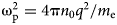 ${\rm \omega} _{\rm p}^{\rm 2} = 4{\rm \pi} n_0q^2/m_{\rm e}$ is the electronic plasma frequency.
Inter-shell binary collision frequency, and comparison with δ
We now compute the binary collision frequency for particles of one shell with particles of the other shell. These particles approach each other at the relative velocity v r given by Eq. (1). The impact parameter b for close collisions, namely, collisions yielding a deviation of π/2, reads (Jackson, Reference Jackson1998),
 $$b = \max \left( {\displaystyle{{q^2} \over {{\rm \gamma}_{\rm r}m_{\rm e}v_{\rm r}^2}}, \displaystyle{\hbar \over {{\rm \gamma}_{\rm r}m_{\rm e}v_{\rm r}}}} \right),$$
with  ${\rm \gamma} _{\rm r} = (1-v_{\rm r}^2 /c^2)^{-1/2}$. The collision frequency νs,s then reads,
 $$\nu _{{\rm s,s}} = n_0v_{\rm r}{\rm \pi} b^2.$$
We need now to compare Eqs. (14) and (16). Due to the various expressions involved in several intervals, the corresponding frontier has several breaks. It is pictured by the orange line in Figure 4, which is further commented in the next section.
Representation of the three criteria on a single plot (pair plasmas). The shock formation is mediated by plasma instabilities only below the orange line. The shock formed is strong only below (or to the right of) the blue line. The downstream is collisional inside the green triangle. Regarding the horizontal gray stripes varying with T 0, see Eqs. (17) and (18) in section “Merging the three criteria”.

Merging the three criteria
Figure 4 gathers all the results obtained for pair plasmas. Plasma shells located above the orange line will form a shock through inter-shells binary collisions. Clearly, our three criteria for no particle acceleration largely overlap. However, the only criterion still discriminating for β0γ0 >0.32 (and T 0 large enough, see Eq. 18) is the collisional/collisionless formation one.
The effects of a finite comoving temperature T 0 are readily accounted for. As noted previously, the strong shock requirement imposes v 0 ≫ Δv so that the growth rate and the inter-shells binary collision frequency used in section “Criterion for collisionless formation”, together with the Rankine–Hugoniot relations used in section “Criterion for strong shock”, remain unchanged. Hence, the green and the blue frontiers are nearly unaffected by T 0 ≠ 0. Only the criteria for strong shock significantly changes since a finite temperature can result in a sound speed varying with the temperature instead of the density.
Section “Criterion for collisionless downstream” assessed the conditions upon which the downstream is collisional. What about the upstream? Indeed, if our colliding shells (which represent the future upstream) are already collisional, acceleration is also suppressed. The shells are collisional if the parameters (T 0, n 0) lie inside the purple triangle in Figure 2. For a given temperature T 0, this translates to a collisional “window” for the density n 0. Therefore, the upstream is collisional if,
 $$\eqalign{& n_0\quad \in \quad [n_-(T_0),n_ + ],\; \; {\rm with} \cr & n_-(T_0) = \left( {\displaystyle{{k_{\rm B}T_0} \over {q^2}}} \right)^3,\; \; {\rm and} \cr & n_ + = 6.3 \times 10^{22}\; {\rm c}{\rm m}^{-3}.} $$
We reach n −(T 0) = n + for,
 $$T_0 = \displaystyle{2 \over {3^{2/3}{\rm \pi} ^{4/3}}}\displaystyle{{mq^4} \over {\hbar ^2k_{\rm B}}} = 6.73 \times 10^4\; K = 5.8\; \,{\rm eV}.$$
Back to Figure 4, this additional criterion defines therefore an horizontal stripe from n 0 = n −(T 0) to n +. The upper limit of the stripe is at n + and does not vary with T 0. The lower limit is at n −(T 0). It reaches the upper limit for T 0 = 5.8 eV so that this criterion for a collisional upstream disappears from the map beyond this temperature. Notably, it turns out that it is perfectly possible to have a collisionless upstream and a collisional downstream, at the same time.
In order to provide a clearer picture of the portion of the (β0γ0, n 0) phase space allowing particle acceleration, Figure 5 represents all the forbidden zones with a unique shading, and for four values of the comoving temperature T 0. At low T 0, the resulting map is highly non-trivial as the three criteria do not fully overlap. At high T 0, only the strong shock criteria (at low densities) and the collisionless formation criteria shape the map.
The shaded area pictures the region of the phase parameter where no particle acceleration can occur for pair plasmas collisions. The four maps are plotted for four different comoving temperatures T 0. The vertical dashed line on the map for T 0 = 50 keV shows the threshold for strong shock in the limit of infinite T 0.

Electron/proton shells
The case of electron/proton (e/p) shells can be nearly straightforwardly adapted from the pair shells treated previously.
The strong shock requirements for e/p shells are derived replacing the electron mass by the proton mass m p in section “Criterion for strong shock”. The reason for this is that the sound speed is formally given by  $C_{\rm S}^2 = \partial P/\partial \rho $, where the density ρ now comes from the protons.
The strongly coupling criteria is also retrieved replacing the electron mass m e by the proton mass m p in section “Criterion for collisionless downstream”.
Regarding the criteria for collisionless formation of section “Criterion for collisionless formation”, we need to now focus on the protons, since they control the dynamics of the shock formation. The inter-shell collision frequency νs,s is obtained replacing the electron mass m e by the proton mass m p in Eqs. (15) and (16). The maximum growth rate needs slightly more adjustments, for two reasons.
(1) In pair plasmas, the dominant instability grows and then, the shock formation starts (Bret et al., Reference Bret, Stockem, Narayan and Silva2014; Dieckmann and Bret, Reference Dieckmann and Bret2017; Dieckmann and Bret, Reference Dieckmann and Bret2018). The process is one stage. In e/p plasmas, the electrons turn unstable first. The related dominant instability grows and saturates. At that stage, owing to the large mass ratio involved, the protons are still counter-streaming over the bath of randomized electrons. Then they turn unstable and form the shock. The process is therefore two stages (Stockem Novo et al., Reference Stockem Novo, Bret, Fonseca and Silva2015).
(2) From the point above, we infer that the growth rate δ we need to compare with the inter-shell collision frequency is the one of the counter streaming protons over the bath of electrons.
Evaluating δ here is both different and simpler. Different because the unstable system under scrutiny is different. Simpler because we only need to focus on the non-relativistic regime. Indeed, as will be checked later, the equality δ = νs,s translates to physically meaningful proton densities (say n 0 <1040 cm−3) only in the non-relativistic regime.
We therefore need to find the maximum growth rate of the unstable system formed by two counter-streaming cold proton beams at  $ \pm {\bf v}_0$, over a bath of electrons. The derivation of the growth rate δ can be performed noting that in the limit of small velocities, the background electrons are cold since their thermal energy comes from their initial kinetic energy. For such a system, the fastest growing instability is the two-stream instability (Bret et al., Reference Bret, Gremillet, Bénisti and Lefebvre2008, Reference Bret, Gremillet and Dieckmann2010), with a dispersion equation given by (Ichimaru, Reference Ichimaru1973),
 $$\displaystyle{2 \over {x^2}} + \displaystyle{R \over {{(Z-x)}^2}} + \displaystyle{R \over {{(x + Z)}^2}} = 1,$$
where x = ω/ωp, Z = kv0/ωp and R = m e/m p. Note that ωp is still the electronic plasma frequency. Since R ≪ 1, the roots of this equation have to be close to  $x = \pm \sqrt 2 $. Hence, in terms of Z, they will be found near
 $Z = \pm \sqrt 2 $, for the denominator of the terms ∝ R has to be small since their numerator is small. Focusing on the solution near
 $Z = + \sqrt 2 $, we can drop the term ∝ (x + Z)−2 and set
 $x = \sqrt 2 + {\rm \varepsilon} $. A Taylor expansion in ε gives,
 $${\rm \delta} = \Im ({\rm \varepsilon} ) = \displaystyle{{\sqrt 3} \over {2^{7/6}}}R^{1/3}{\rm \omega} _{\rm p}.$$
Assessing δ = νs,s is then straightforward from Eqs. (15, 16, 20).
Finally, comoving temperature effects are similar to the pair case. The strong shock limit is obtained from section “Criterion for strong shock” replacing m e by m p, and the upstream is collisional for n 0 ∈ [n −(T 0), n +], where n −(T 0) is given by Eq. (17) and n + = 3.88 × 1032 cm−3. Here, n −(T 0) = n + is reached for T 0 = 10.6 keV. Beyond this temperature, the colliding e/p plasmas are collisionless regardless of their density n 0.
Figure 6 pictures the three criteria for e/p plasmas and four comoving temperatures. The plot for T 0 = 50 keV also features the asymptotic position of the strong shock threshold in the limit T 0 = ∞. It is found equal to the pair case since it is the result of the speed of sound being limited by  $c/\sqrt 3 $ in both settings.
Region of the (β0γ0, n 0) phase space allowing particle acceleration for an e/p shock, for four comoving temperatures T 0. The shaded areas forbid acceleration. The horizontal stripe forbidding acceleration because the upstream would be collisional, vanishes for T 0 >10.6 keV. The vertical dashed line on the map for T 0 = 50 keV shows the threshold for strong shock in the limit of infinite T 0.

Conclusion
We considered the shock formed by the encounter of two identical pair plasma shells characterized by the parameters (n 0, T 0, γ0). We assessed three criteria for particle acceleration, namely (1) that the shock must be strong, (2) that neither the downstream nor the upstream can be collisional, and (3) that the shock formation must have been mediated by plasma instabilities which seed the scattering agents essential for particle acceleration.
Figures 4–6 summarize how these criteria translate to the parameters (n 0, T 0, γ0) for pair and e/p plasmas. The resulting maps are non-trivial as the three criteria do not overlap.
Future works could account for various additional effects. An external magnetic field would modify the Rankine–Hugoniot relations and the growth rate calculations, for example. Also, astrophysical settings often involve radiative shocks (Bouquet et al., Reference Bouquet, Romain and Chieze2000, Reference Bouquet, Stéhlé, Koenig, Chièze, Benuzzi-Mounaix, Batani, Leygnac, Fleury, Merdji, Michaut, Thais, Grandjouan, Hall, Henry, Malka and Lafon2004) in which radiation pressure and energy must be accounted for in the Rankine–Hugoniot budget. As a consequence, the allowed regions for particle acceleration would also be modified.
Author ORCIDs
Antoine Bret 0000-0003-2030-0046.
Acknowledgments
A.B. acknowledges support by grants ENE2016-75703-R from the Spanish Ministerio de Educación and SBPLY/17/180501/000264 from the Junta de Comunidades de Castilla-La Mancha. A.P. acknowledges support by the European Union Seventh Framework Program (FP7/2007-2013) under grant agreement no. 618499, and support from NASA under grant no. NNX12AO83G. A.B. thanks Gustavo Wouchuk, Roberto Piriz for fruitful discussions.



