Implications
Reducing dietary CP level has been intensively studied in farm animals. The learning ability and memory of reward v. no reward discrimination of broiler breeders were not affected by reduced balanced protein (RP) diets feeding. However, RP diets increased the level of fearfulness and enhanced the preference of breeders for meal worms. Appropriate dietary protein reduction is applicable for broiler breeder industry without cognitive impairments. Dietary protein reduction inducing psychological influences should not be neglected.
Introduction
Intensive selection for fast growth rate in broiler chicks has resulted in a remarkable decrease in rearing time from hatch to desired slaughter weight. When fed ad libitum, broiler parent stock (PS) is characterized by a reduced reproductive performance and excessive BW, necessitating restrictive feeding, which in turn cause reduced animal welfare in terms of hunger. This has been named the ‘broiler breeder paradox’, and is a well-documented phenomenon (Decuypere et al., Reference Decuypere, Bruggeman, Everaert, Li, Boonen, De Tavernier, Janssens and Buys2010). Therefore, controlled feed allocation is introduced in the management of broiler breeders to maximize egg and chick production. Alongside the controlled feeding programme, several welfare issues such as chronic hunger, polydipsia, stereotypic pecking and aggression were reported (Savory et al., Reference Savory, Seawright and Watson1992; Mench, Reference Mench2002). In addition to these welfare problems and the behavioural alterations, learning ability and memory retention might also be affected by the physical and psychological stress resulting from controlled feeding. Broiler breeders need to go through several major environmental alterations during their commercial life such as regrouping to different rearing houses from starter, growing period to laying period. During these environmental changes, where and when to eat and drink, social hierarchy and nesting place are all needed to be learned and memorized. Learning and memorizing are important factors in both animal welfare and performance, without which adaptation to environmental changes is compromised (Wechsler and Lea, Reference Wechsler and Lea2007). Lindqvist and Jensen (Reference Lindqvist and Jensen2009) have shown that White Leghorn layers, selected for high egg production, have an impaired spatial learning ability compared with their Red Jungle Fowl ancestors. Early life environment was reported to have long-term effect of short-term memory of laying hens (Tahamtani et al., Reference Tahamtani, Nordgreen, Nordquist and Janczak2015). Developmental stress induced by unpredictable food supplementation was reported to impair performance on association tasks in songbirds (Farrell et al., Reference Farrell, Morgan and MacDougall-Shackleton2016). Marino (Reference Marino2017) suggested that chickens are as cognitively, emotionally and socially complex as most other birds and mammals in many areas. Studies of learning ability of broiler breeders could lead to novel strategies to improve their welfare.
Different levels of dietary protein reduction at different periods in broiler breeder production cycle are increasingly studied, due to potential environmental and economic effects (Spratt and Leeson, Reference Spratt and Leeson1987; Van Emous et al., Reference Van Emous, Kwakkel, Van Krimpen and Hendriks2015). In humans and other mammals, however, nutrition deficiency at early age has been reported to lead to lower cognitive abilities and impaired long-term memory (Kauffman et al., Reference Kauffman, Ashraf, Corces-Zimmerman, Landis and Murphy2010; Laus et al., Reference Laus, Duarte Manhas Ferreira Vales, Braga Costa and Sousa Almeida2011). T-maze tests have been used in numerous ways to assess the cognitive ability of animals such as rodents (Deacon and Rawlins, Reference Deacon and Rawlins2006) and birds (Ueno and Suzuki, Reference Ueno and Suzuki2014). Animals are placed at the base of a maze-shaped like the letter T and by placing a reward at one or both arms of the maze, the animal must choose which path to take. Their choice is highly dependent on the function of the hippocampus and other brain structures (Deacon and Rawlins, Reference Deacon and Rawlins2006). Dietary effects of reduced protein levels on the learning ability and memory retention have not yet been investigated in broiler breeders. In this study, T-maze tests were used to investigate the learning ability of broiler breeders with a reward v. no reward discrimination task. The broiler breeders were fed with either control (C) diets or RP diets during the rearing and laying periods. Feed with or without meal worms were used as reward during the tests and placed in the arms of the T-maze. A tonic immobility (TI) test was also conducted to examine the fearfulness levels of broiler breeders (Gallup, Reference Gallup1979). The aim of this study was to investigate whether a balanced diet with a reduced protein content would differentially affect certain behavioural characteristics of broiler breeders, such as fearfulness, learning abilities and memory retention, and could therefore be used to enhance their welfare.
Material and methods
Breeder husbandry and management
Two animal trials with either PS breeders or pure line A (PL) breeders were performed. Pure line A is a pure broiler breeder male line of an anonymous breeding company at the A position of a four-way cross which makes up a commercial broiler (Paxton et al., Reference Paxton, Anthony, Corr and Hutchinson2010). Both trials had two dietary treatments: a C group provided with standard C diets and a RP group fed with RP diets. For the PS trial, 44 one-day-old PS female broiler breeders were evenly divided into two pens (2.3×1.8 m2) with one pen per dietary treatment (C or RP). For the PL trial, a total of 160 one-day-old PL female breeders were evenly distributed over 10 floor pens (1.5×2 m2) with 16 breeders per pen resulting in five replicates for each treatment (C and RP). The floor of all pens were covered with wood shavings (Aveve, Leuven, Belgium). One bell-shape drinker (diameter 36 cm) was supplied at a corner of each pen. Two metal feeder troughs (1 m) were fixed on the walls of the pen with adjustable height. The feeder length allowed sufficient space for every breeder to access the feed simultaneously.
Light and temperature schedules for both trials from the PS management handbook were followed (Aviagen, 2013). One-day-old chicks were housed at 30°C for the first 2 days. From days 3 to 27, the ambient temperature was gradually reduced to 20°C, and this temperature was maintained for the rest of the rearing and laying periods. The photoperiod of the breeder pullets during the first 2 days was 23L:1D (20 lux) and was gradually reduced to 8L:16D (10 lux) at day 10. The light schedule remained at 8L:16D (10 lux) until photostimulation in week 21 when the light period was increased to 11 h (11L:13D) (45 lux). Starting at week 21, the light period increased with 1 h/week until week 24 (13L:11D, 45 lux). Beak trimming (partial removal of the upper beak) was carried out on day 3 by an experienced veterinarian with a Lyon Debeaker apparatus (Lyon Technologies Inc., Chula Vista, CA, USA). All animals were vaccinated following the standard commercial vaccination programme (Galluvet, Lummen, Belgium).
Dietary treatment
In the RP diets, CP levels and amino acids (AA) were reduced by 25% compared with the C diets. In each feeding phase, both diets contained the same raw materials and were carefully formulated to be isocaloric. Fat percentage remained equal whereas protein was isoenergetically substituted by carbohydrates. The RP fed breeders received on average 10% more feed to reach the same target BW as the C fed breeders. The detailed dietary management (Aviagen, 2013) and the composition of the different diets in the rearing and laying phase can be found in Li et al. (Reference Li, Lesuisse, Schallier, Clímaco, Wang, Bautil, Everaert and Buyse2017).
Measurements
T-maze learning test
Breeders randomly selected for the T-maze test had no access to feed before the start of the test. A detailed overview of the T-maze test can be found in Li et al. (Reference Li, Schallier, Lesuisse, Driessen, Everaert and Buyse2018) and was originally adapted from the approach described by Lindqvist et al. (Reference Lindqvist, Janczak, Nätt, Baranowska, Lindqvist, Wichman, Lundeberg, Lindberg, Torjesen and Jensen2007). The reward v. no reward discrimination learning test was conducted in a T-maze arena. The T-maze, shaped like the letter ‘T,’ consisted of a start box (0.5×0.5 m2) connected to a 2.5-m long start arm and, following with 90° turns, two test arms (1 m each, one to the right and one to the left). Each arm was 0.5 m in width. Removable doors separated the left and right arm from the start arm. During habituation, breeders were placed in the start arm in a group of six or seven for 20 min with doors to the left and right arm closed. This habituation period was followed by a training period of 20 min during which the breeders had access to the left and right arm with feed (with or without meal worms) available in a metal feeder (0.5 m long) at both ends. During the training period, breeders were taken back to the start box after successfully locating the reward and guided to the reward three times in each arm. During the test, a single breeder was placed in the start box with access to the entire arena. The metal feeder with reward was placed at the far end of either the left or right arm, leaving the other arm empty. For each breeder, the location of the reward was fixed for each repeated measurement. The left/right location of the reward was balanced between breeders and the order in which C and RP breeders conducted the tests was maintained during the trials. For each breeder, six repetitions of the test were conducted. Each test lasted for a maximum of 10 min, or until the breeder found the feed and was allowed to eat for 1 min. When a breeder completed the task on at least five out of six test repetitions, it was considered to be successful. The breeders received the respective diet of their experimental group (C or RP) as a reward. If feeding reward was supplemented with meal worms, these were provided during the training period as well.
During the habituation and training periods, one person (being the trainer and tester) remained within sight of the breeders to familiarize them with human presence. The same person performed the six consecutive tests and time recordings. Three time intervals were recorded: (1) the total time used for a breeder to solve the task in each test (Tt), (2) the time from the beginning until entering the reward available arm (Ts) and (3) the time from entering the reward available arm to accessing the reward (Td). It is noted that Tt=Ts+Td. Breeders that failed two out of six times at finding the feed within 10 min were considered unsuccessful.
Learning test schedule
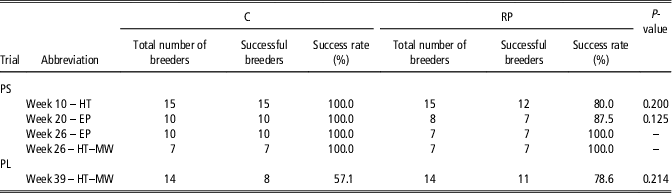
The schedule and detailed information of the learning test for the two trials are listed in Table 1. For the PS trial in week 10, 15 breeders were randomly selected from each dietary treatment and were habituated (20 min) and trained (20 min) in the T-maze construction. During this test, only feed was used as reward. In weeks 20 and 26, the same breeders were tested with the T-maze without the habituation and training periods, to examine their memory retention (animal numbers may vary due to mortality or morbidity). Again, only feed was available as reward. If breeders successfully completed the T-maze test this time around, we considered their memory retention established. In week 26, another seven breeders in each treatment were habituated, trained and tested but this time with feed and meal worms as reward. For the PL trial, 14 breeders of each treatment were chosen randomly at week 39 to perform the T-maze test after the habituation and training period. Feed together with meal worms were provided as reward. For readability reasons, the following abbreviations are used throughout the text: HT=breeders with habituation and training before the tests; EP=same (experienced) breeders used in week 10 and without habituation and training before the tests; HT–MW=breeders with habituation and training before the test and feed with meal worms used as reward.
Schedule and treatments of the T-maze learning test of the two broiler breeder trials

HT=breeders with habituation and training before the tests; PS=parent stock; EP=same (experienced) breeders used in week 10 without habituation and training before the tests; PL=pure line A; HT–MW=breeders with habituation and training before the test and feed with meal worms used as reward.
The success rate of newly habituated and trained breeders from each treatment were recorded at different ages (PS trial: week 10 – HT and week 26 – HT–MW, PL trial: week 39 – HT–MW) to determine the T-maze test learning ability. Memory retention was tested by bringing breeders in contact with the T-maze at an early age, and have them retested at a later age, without any habituation and training (HT) in between. The percentages of breeders that successfully completed the T-maze can be found in Table 2.
Number of broiler breeders used, number of successful broiler breeders and success rates in each group with control (C) or reduced balanced protein (RP) dietary treatment of each T-maze test

PS=parent stock; HT=breeders with habituation and training before the tests; EP=same (experienced) breeders used in week 10 and without habituation and training before the tests; HT–MW=breeders with habituation and training before the test and feed with meal worms used as reward; PL=pure line A.
Successful breeders refer to the breeders that completed the task on at least five out of six test repetitions.
Tonic immobility test
Ten PS breeders were randomly selected from each dietary treatment at the last day of week 26 (3 days after learning test finished) to perform the TI test. The TI test was adapted from the protocol described by Wang et al. (Reference Wang, Ni, Guo, Fu, Grossmann and Zhao2013). In short, a single breeder was taken out of its home pen in an upright position and brought to another room with a large table in it. The breeder was gently placed on its back on the table with one hand on the sternum and the other hand lightly cupping the head of the breeder for 10 s. The observer stood 1 m beside the table and in full view of the breeder. After the handler removed the lateral restraint, time recording started. If a breeder failed to show immobility within 10 s, successive inductions were given up to a maximum of six. If a breeder stayed in a TI state for over 10 min, a maximum of 600 s was recorded. Both the number of attempts to induce TI and the duration of the TI status were recorded.
Statistics
All analyses were performed with JMP Pro.12 software (SAS Institute Inc., Cary, NC, USA). Two-sample t test between proportions was used to determine whether there is a significant difference between treatments with respect to the success rate in the T-maze learning test. The duration of Tt, Ts, Td and TI status were log-transformed to obtain normal distributions. Significant differences between dietary treatment, test repetition and their interactions of Tt, Ts and Td were assessed by a generalized linear mixed effect model (GLME). The six consecutive tests were regarded as repeated measures. Experimental breeders were taken as a random effect and nested in treatments. Breeders that failed in the tests were excluded from GLME analysis. When there was an interaction observed between treatment and repetition, one-way ANOVA was performed to obtain the treatment effect at each test repetition. Chi-square test was used to compare the number of attempts at inducing TI between the two dietary treatments. The TI duration of the two treatments was analyzed by one-way ANOVA. Success rate is presented as a percentage. Data from the learning test and TI test are presented as means. P<0.05 is taken as significantly different. A tendency of difference was defined when 0.05<P<0.01 was observed.
Results
Success rate
The number of breeders used in each trial and success rates are listed in Table 2. No statistical differences in the success rate of the T-maze test were observed between the C and RP group at all ages of the two trials.
T-maze learning performance and memory retention of broiler breeders with feed as sole reward
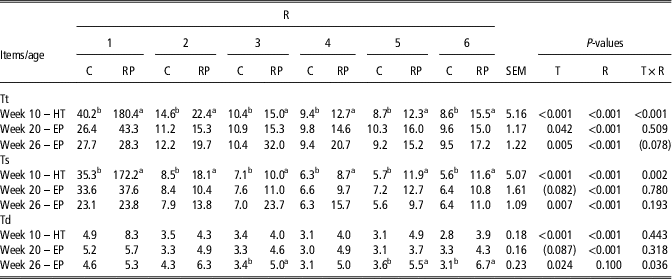
For week 10 – HT, week 20 – EP and week 26 – EP of the PS trial, breeders (feed as sole reward) of the RP group had significantly larger Tt, Ts and Td compared with the C group with a larger tendency of Ts and Td in week 20 (week 10 – HT: Tt F 1,23=17.205, P<0.001; Ts F 1,23=17.490, P<0.001; Td F 1,22=16.957; P<0.001; week20 – EP: Tt F 1,14=4.967, P=0.042; Ts F 1,14=3.488, P=0.082; Td F 1,14=3.366, P=0.087; week 26 – EP: Tt F 1,14=10.848, P=0.005; Ts F 1,14=9.796, P=0.007; Td F 1, 14=6.337, P=0.024; Table 3). Besides the Td of week 26 (F 5,73=2.531 P=0.036), interactions between treatment and repetition were observed for Tt (F 5,117=5.593, P<0.001) and Ts (F 5,117=3.977; P<0.001) in week 10 – HT. Significant repetition effects were observed for all durations of all T-maze tests, except for Td of week 26 – EP breeders (week 10 – HT: Tt F 5,117=63.987, P<0.001; Ts F 5,117=57.083, P<0.001; Td F 5,118=18.030, P<0.001; week 20 – EP: Tt F 5,68=49.606, P<0.001; Ts F 5,70=37.540, P<0.001; Td F 5,70=13.906, P<0.001; week 26 – EP: Tt F 5,70=10.446, P<0.001; Ts F 5,70=12.842, P<0.001; Td F 5,73=1.931, P=0.100; Table 3). It took significantly longer for the breeders to complete the test the first time, but they got increasingly faster during the following five test repetitions.
Effects of reduced balanced protein (RP) diet on the durations (seconds) in completing the T-maze test of the parent stock (PS) broiler breeders in the age of 10, 20 and 26 weeks with feed but without meal worms as reward

C=control group; T=Treatment; R=Repetition; Tt=the total time used for a breeder to solve the task in each repetition; HT=habituation and training; EP=experienced breeders without habituation and training; Ts=the time from the beginning to entering the feed available arm; Td=the time from entering the feed available arm to accessing the feed.
Data are presented as means.
a,bDifferent superscript letters in the same row indicate significant difference between the two treatments.
T-maze learning performance of broiler breeders with feed and meal worms as reward
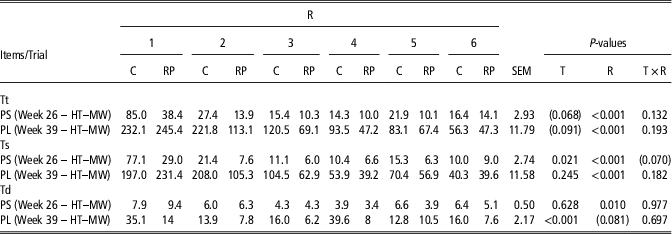
When feed and meal worms were provided as reward during the tests for the HT–MW breeders of the PS trial in week 26, a tendency of short Tt (F 1,12=4.024, P=0.068) and a significantly shorter Ts (F 1,12=7.104, P=0.021) in the RP group were observed compared with the C group, whereas no difference was found in Td (F 1,12=0.248, P=0.628; Table 4). For the PL trial in week 39 (week 39 – HT–MW), the RP breeders tended to be faster in terms of Tt compared with the C group, whereas Td was significantly shorter for the RP breeders (Tt: F 1,16=3.239, P=0.028; Ts: F 1,16=1.451, P=0.245; Td: F 1,15=23.580, P<0.001; Table 4). No interactions between treatment and repetition were observed. Significant repetition effects were observed for all durations of all T-maze tests, except for a tendency of Td of week 39 – HT–MW (PS trial week 26 – HT–MW: Tt F 5,60=24.365, P<0.001; Ts F 5,60=21.791, P<0.001; Td F 5,60=6.792, P<0.001; PL trial week 39 – HT–MW: Tt F 5,80=14.556, P<0.001; Ts F 5,80=14.201, P<0.001; Td F 5,80=2.046, P=0.081; Table 4).
Effects of reduced balanced protein (RP) diet on the durations (seconds) in completing the T-maze test of the parent stock (PS) broiler breeders in week 26 and the pure line (PL) breeders in week 39 with feed and meal worms as reward

R=Repetition; T=Treatment; C=control group; Tt=the total time used for a breeder to solve the task in each repetition; HT–MW=breeders with habituation and training before the test and feed with meal worms used as reward; Ts=the time from the beginning to entering the feed available arm; Td=the time from entering the feed available arm to accessing the feed; T×R=Treatment×Repetition.
Data are presented as means.
Fearfulness of broiler breeders
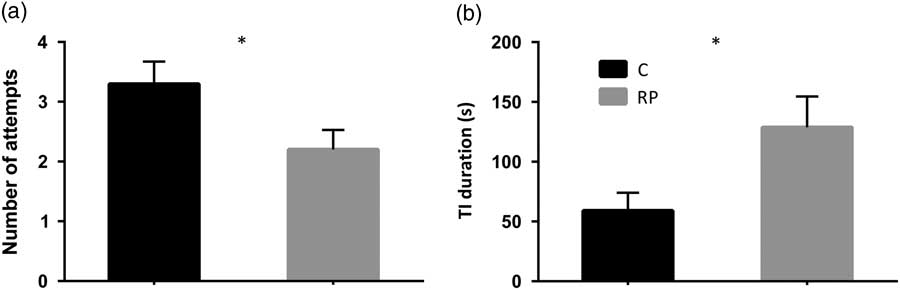
For the PS trial, at the age of week 26, the number of attempts needed to induce TI in the C breeders was significantly greater than that of the RP breeders (χ 2=4.057, P=0.044; Figure 1a). The RP breeders remained longer in a state of TI compared with the C breeders (F 1,18=5.467, P=0.031; Figure 1b).
Effects of reduced balanced protein (RP) diet on the number of attempts needed to induce tonic immobility (TI) (a) and the duration of TI status (b) of the parent stock broiler breeders. C=control group. * indicates significant difference (P<0.05). Data are presented as means±SEM (n=10).

Discussion
The results showed that, under current experimental conditions, both the C and RP groups successfully learned how to complete the reward v. no reward discrimination task in a T-maze. The RP breeders spent more time completing the task than the C breeders with feed as sole reward. In contrast, when feed together with meal worms were provided as reward, the RP breeders completed the test much faster than the C breeders. The RP breeders showed higher levels of fearfulness compared with the C breeders, based on a TI test. Furthermore, breeder from both groups showed a long-term memory retention of the T-maze learning test.
Numerous studies have shown that domestic chicks possess sufficient learning abilities to associate feed with feeder color and position (White Leghorn layers) (Vallortigara and Zanforlin, Reference Vallortigara and Zanforlin1989; Ueda et al., Reference Ueda, Suehiro, Kainou and Bungo2005), or to work for food by solving an operant task (broilers) (Bokkers et al., Reference Bokkers, Koene, Rodenburg, Zimmerman and Spruijt2004). It seems likely that domestic poultry, both layers and broilers, are capable of learning feed-related operant conditioning tasks (Mench, Reference Mench2002). In our study, broiler breeders could easily complete the T-maze learning test with reward, as evidenced by overall high success rate in the PS trial. A lower success rate was observed in the PL trial, which probably due to the age of the breeders (week 39 for PL breeders v. weeks 10 to 26 for PS breeders). In the test, the breeders were expected to find the reward located in one specific arm of the T-maze. Similarly, Buckley et al. (Reference Buckley, McMillan, Sandilands, Tolkamp, Hocking and D’Eath2011) did a feed quantity discrimination test in broiler breeders by using a Y-maze arena. In the Y-maze task, breeders needed to associate black and white arms with large and small quantities of feed. Reaching the feed in the maze was mastered easily by the breeders whereas they failed in the feed quantity discrimination. One explanation might be that the chronic stress induced by controlled feed intake overwhelmed their ability in discriminating the difference between the two arms and thus led them to fail to associate feed amount with corresponding coloured arms. In our study, the breeders were only expected to find the feed located in one specific arm of the T-maze. Both the C and RP groups succeeded in the tests which is in agreement with the aforementioned study (Buckley et al., Reference Buckley, McMillan, Sandilands, Tolkamp, Hocking and D’Eath2011). The controlled feed intake may increase the motivation of breeders in accessing the reward which may explain the relatively high success rates in the T-maze tests. In rodents, feed restriction (70% and 40% of ad libitum feeding amount) was reported to increase learning performance in foot-shock avoidance behaviour in a Y-maze arena with water as reward (Ferreira et al., Reference Ferreira, Spini, Lopes, Lopes, Moreira, Amaral, Cunha, de Souza Borges, Marson and Ribeiro2006). Likewise, the breeders of both groups (C and RP) in both trials were under the controlled feed allocation management with various levels of feed controlling in different stages of their life. Although the RP breeders received on average 10% more feed to maintain similar BW targets, this amount is still considerably less than the feed intake when fed ad libitum.
Interestingly, when their own feed was provided as a sole reward (without meal worms), the RP breeders were much slower in finishing the test compared with the C breeders. Based on the TI test with the breeders of PS trial, the RP breeders maintained a much longer TI duration compared with the C breeders which indicates a higher level of fearfulness (Reese et al., Reference Reese, Angel and Newton1984; Wang et al., Reference Wang, Ni, Guo, Sun, Ahmed and Zhao2014). During the daily managements of the two trials, feather pecking and feather ingestion were intensively monitored in the RP group (unpublished observations). Those feather aimed behaviours can induce pain and an increased sense of threat. An increased level of fearfulness might render the RP breeders more cautious, resulting in more time needed to complete the test compared with the C breeders. In addition, the RP breeders might also have less motivation to reach the reward (RP diet), if the ingestion of feathers are indicative of the RP diet not meeting the nutritional requirements of the breeders. Using the RP diet as a reward may be less attractive to the RP breeders than the C diet to the C breeders.
However, with feed and meal worms provided as reward, the RP breeders turned out to be much faster than the C breeders. A similar result was found by Bokkers and Koene (Reference Bokkers and Koene2002), who performed a walking for feed reward (meal worms) test in fast growing broilers with either a conventional diet or a diet with less energy (5% to 8% reduction) and protein (15% reduction). The fast growing broilers fed with a lower energy and protein diet walked to the meal worms significantly faster compared with the broilers fed with a conventional diet. In present study, the motivation of the RP group to complete the task was probably strengthened by giving meal worms as reward. The RP breeders showed an increased interest in the meal worms compared with the C breeders, which seemed strong enough to diminish their fearfulness in the T-maze test. This indirectly indicates that the RP breeders had a higher preference to the meal worms compared with the C breeders. Meal worms are a protein rich feed with about 57.6% of CP (Ng et al., Reference Ng, Liew, Ang and Wong2001). It might be that the high protein content of meal worms contributed to their high attractiveness to the RP breeders. Birds have been found able to choose between excessive and insufficient protein diets to meet their nutritional requirements (Forbes and Shariatmadari, Reference Forbes and Shariatmadari1994). Methionine-deficient broilers, e.g., had a strong aversion towards a deficient diet and consume more of a methionine-supplemented feed than normal birds (Steinruck et al., Reference Steinruck, Roth and Kirchgessner1990; Forbes and Shariatmadari, Reference Forbes and Shariatmadari1994). It is likely that the reduced protein and AA content of the RP diet enhanced the breeders’ appetite for an alternative feed, so they obtained the meal worms much faster. Furthermore, as the breeders of the two trials had never experienced meal worms before, the meal worms could be considered not only a kind of protein rich feed but also a novel feed in the test. It is possible that, with a short-term taste of the meal worms, the breeders had no indication about the post-ingestive consequences but were just attracted to the taste and tactile characteristics of meal worms (Hogan, Reference Hogan1965). It seems likely the RP breeders have a motivation of obtaining an alternative feed such as meal worms according to their fast performance in reaching the reward during the test.
Based on the success rate of the two groups at various ages, under present experimental conditions, no differences in learning ability and memory retention in the T-maze test was observed. Besides spending longer completing the task with feed as a sole reward, the RP diet had no influence on learning ability and memory retention of the T-maze test in broiler breeders. Learning processes and memory functions highly depend on the brain development. Nutrient deficiency during prenatal period or early in life induces growth deficits and cognitive impairments both in humans and rodents (Laus et al., Reference Laus, Duarte Manhas Ferreira Vales, Braga Costa and Sousa Almeida2011). In humans, the vulnerable period for nutrient deficiency varies from the final third period of gestation to the first 2 years of life, whereas in rats, the critical period is from the 1st week of gestation to the end of the 3rd week of life (Laus et al., Reference Laus, Duarte Manhas Ferreira Vales, Braga Costa and Sousa Almeida2011). In altricial bird species, young birds hatch with small and less developed brains, but with high post-embryonic brain growth (Bennett and Harvey, Reference Bennett and Harvey1985). In contrast, precocial birds hatch with highly developed brains capable of spontaneous cognition and with comparatively less brain development after hatch (Bennett and Harvey, Reference Bennett and Harvey1985). In addition, some synapse development and patterns of neurotransmission continue to mature until ~60 days after hatch (Nicol, Reference Nicol2015). In our trials, the C and RP breeders were hatched from the same parent flock and fed with the same standard starter diet for the first 3 weeks of life. The RP diet was introduced to the RP breeders at the 4th week. Therefore, potential nutrition effects would have the same influence on the brain development of all experimental breeders until 3 weeks of age. Brain development before introduction of the RP diet may be adequate for mastering the T-maze task which explained the similar learning abilities and memory retention between the two groups. It must be noted that the T-maze test used in our experiments is relatively simple, but suitable for the controlled fed breeders as various levels of success rate in different ages were observed.
In conclusion, broiler breeders under controlled feed intake have the learning abilities to complete a reward v. no reward discrimination task in a T-maze. The RP dietary treatment caused the breeders to be more fearful and slowed down their performance in the T-maze test but without learning ability and memory retention impairments. In addition, the RP diet strengthened the motivation of broiler breeders to obtain meal worms as an alternative feed.
Acknowledgements
This work is partially supported by the China Scholarship Council (CSC). The diligent technical assistance of André Respen, Daniel Vermeulen and Bram Vandenbulcke is gratefully acknowledged.
Declaration of interest
The authors declared that there are no conflicts of interest.
Ethics statement
All research was approved by the ethical commission for experimental use of animals of KU Leuven under accession number P187/2013.
Software and data repository resources
None of the data were deposited in an official repository.