LEXICAL SELECTION AND AVOIDANCE: FINDINGS IN BILINGUAL CHILDREN
Stoel-Gammon's first postulate in the early meaningful speech period pertains to findings showing that children's productive phonology influences early lexical development, a phenomenon referred to as lexical selection and avoidance. Two types of lexical selection are discussed: one more idiosyncratic and one more general. First, children's idiosyncratic production tendencies, often based on motor patterns formed in the prelinguistic phase, influence the selection of first words (Ferguson & Farwell, Reference Ferguson and Farwell1975; Stoel-Gammon & Cooper, Reference Stoel-Gammon and Cooper1984) (Postulate II-A). These individual phonological strategies may even take the form of whole-word templates (Vihman & Croft, Reference Vihman and Croft2007) (Postulate II-B). Second, more general tendencies aimed at phonological simplification influence the selection of later words (Stoel-Gammon, Reference Stoel-Gammon and Paul1998) (Postulate II-C).
What do we know about lexical selection in bilingual children? Celce-Murcia (Reference Celce-Murcia and Hatch1978) observed lexical selection and avoidance strategies in an English–French bilingual two-year-old. The child's selection of the English or French equivalent of a word was based on avoidance of phonologically difficult features. Yavas (Reference Yavas1995) provided a more thorough description of the same type of strategy in his analysis of the first fifty words of Deniz, a bilingual Turkish–Portuguese child. The child's selection of words was based on avoidance of phonological features such as front-rounded vowels, initial fricatives and initial laterals, which was applied on a language-independent basis. Thus, avoidance of initial fricatives led to Deniz's selection of Turkish /mum/ not Portuguese /vela/ ‘candle’, but Portuguese /kabelu/ not Turkish /sat∫/ ‘hair’. Vihman (Reference Vihman2002) presents data from three bilingual children which reveal similar whole-word templates and word selection patterns across languages. For example, Raivo, an Estonian–English bilingual child, selected target words with sibilants and matched them to his own production pattern, which consisted of a CVC form with final ‘s’. He did this regardless of whether the source language was Estonian or English (e.g. [dis] this; [kys] küpsis ‘cookie’). Thus, the examples cited here point to a single phonological strategy that influences lexical selection patterns similarly across the two languages.
It is conceivable, however, that bilingual children develop different phonological strategies in each language that in turn influence lexical selection patterns separately across the two languages. For example, a child may develop a penchant for final sibilants in one language but for final velars in the other language. Ingram (1981/Reference Ingram1982) questions the ‘inherent’ nature of phonological strategies (i.e. phonological strategies reflecting individual preferences), arguing that it is possible to observe different phonological strategies very early on depending upon the input language. For example, his Italian–English subject, L, reduplicated in Italian but not in English, a pattern presumably related to the phonological characteristics of her Italian target words. Ingram (1981/Reference Ingram1982) assumes that if phonological strategies are inherent, they should occur in all of the child's languages, which was not the case for his bilingual child. Note that Vihman builds implicit knowledge of the ambient language as well as individual motor preferences into her whole-word template account of first-word production (Vihman, Reference Vihman2002; Vihman & Croft, Reference Vihman and Croft2007). Despite the possibility of differing production strategies in a bilingual child's two languages, which may be the result of either idiosyncratic production patterns or ambient language effects, there are few if any studies documenting separate lexical selection patterns across target languages.
At later stages of phonological development (i.e. beyond the first 50-word period), however, there is clear evidence of ambient language effects. Studies show that the early lexicons of children speaking Romance languages (e.g. Italian or Spanish) contain a higher proportion of multisyllabic words than children speaking Germanic languages (e.g. English or German), mirroring the proportions of multisyllabic words in the ambient language (Lleó & Demuth, Reference Lleó, Demuth, Greenhill, Littlefield and Tano1999; Vihman & Croft, Reference Vihman and Croft2007). There is also evidence to show that bilingual children's early lexicons reflect the language-specific phonological characteristics of their respective languages. Thus, Ingram (1981/Reference Ingram1982) found proportionally more multisyllabic than monosyllabic words in the Italian lexicon of his bilingual Italian–English subject, L, compared to the English lexicon. Similarly, the first words produced in the recording sessions of three German–Spanish bilingual children growing up in Hamburg show the expected patterns of greater numbers of multisyllabic target words in Spanish than in German (see Lleó (Reference Lleó2002) for methodological details of study). On average, the bilingual children produced 49% multisyllabic words in German in comparison with 87% in Spanish (see Table 1).
Table 1.Percentage of word types containing 1, 2 and 3 or more syllables in the first 50-word types produced in the earliest recording sessions of three bilingual German–Spanish children
Given clear phonological differences between the lexicons of children speaking different languages, an interesting question to examine is whether interaction occurs across languages in the lexical selection patterns of bilingual children. Do bilingual German–Spanish children select multisyllabic words earlier in German than monolingual German children due to the influence of Spanish? That is, the high proportion of multisyllabic words in Spanish influences bilingual children to select more multisyllabic words in German. This is plausible since vocal practice producing multisyllabic words in one language may lead to a common production strategy which in turn influences lexical selection in the other language. Unfortunately, I am unaware of evidence bearing on this type of interaction pattern in bilingual children. The German–Spanish bilingual children (mentioned above) displayed quite prominent differences between the percentages of monosyllabic and multisyllabic words selected in each target language, consistent with the percentages reported for monolingual German and Spanish children by Lleó & Demuth (Reference Lleó, Demuth, Greenhill, Littlefield and Tano1999), suggesting that interaction was not occurring; however, studies with greater numbers of bilingual children and monolingual controls would be needed to fully address this question.
LEXICAL AND PHONOLOGICAL DEVELOPMENT TEND TO BE COMMENSURATE: FINDINGS IN BILINGUAL CHILDREN
In the section discussing early meaningful speech, Stoel-Gammon's second postulate is that ‘Lexical development and phonological development tend to be commensurate’ (Postulate III; p. 000). Children with large vocabularies have more advanced phonological systems than children with small vocabularies. Do bilingual children with large vocabularies have more advanced phonological systems than bilingual children with small vocabularies? In addition, what is the nature of phonological and lexical associations in bilingual children? Studies examining the relationship between lexical and grammatical development in bilingual children have found evidence for strong within-language associations but very weak cross-language associations (Conboy & Thal, Reference Conboy and Thal2006; Marchman, Martínez-Sussmann & Dale, Reference Marchman, Martínez-Sussmann and Dale2004). This means that advanced lexical abilities are associated with advanced grammatical abilities in the same language but not necessarily in the other language.
As far as I am aware, associations between phonological and lexical development in bilingual children have not been examined as systematically as they have between lexical and grammatical development. There are, however, findings in the literature which are suggestive of certain conclusions and predictions. In general, the dominant language of a bilingual (typically the language containing the most vocabulary items) is associated with faster phonological acquisition. Law & So (Reference Law and So2006) observed that Cantonese dominant bilinguals had faster Cantonese phonological development than Putonghua dominant bilinguals and vice versa. Similarly, Ingram (1981/Reference Ingram1982) found a higher articulation score in the Italian of his Italian–English subject who was dominant in Italian. Thus, there appears to be strong within-language correlations between phonological and lexical development in bilingual children.Footnote 1
What is less clear is whether cross-language correlations are equally weak in the lexical and phonological domains as they are in the lexical and grammatical domains. The biological component of phonology associated with speech motor skills and articulatory practice may mean that sounds produced in one language are quickly produced in the other language. For example, Kehoe & Lleó (Reference Kehoe and Lleó2006) observed a close timeline between the acquisition of word-medial and word-final codas in the speech of three bilingual German–Spanish children. Codas were acquired in both languages within a one-month period. German seemed to exert a bootstrapping effect on the production of codas in Spanish, resulting in high coda production in both languages even though some of the children were dominant in German and some were not (Lleó, Kuchenbrandt, Kehoe & Trujillo, Reference Lleó, Kuchenbrandt, Kehoe, Trujillo and Müller2003). Thus, it is possible that similar phonological ability across languages may be observed in bilingual children despite disparate differences in lexicon size. In other words, certain cross-language associations may be stronger in the lexical and phonological domains than in the lexical and grammatical domains.
CONCLUSION
There are many ways to look at the relationship between lexical and phonological development in bilingual children. The preceding discussion has put the emphasis on phonological production; other researchers have put more emphasis on phonological representation and memory (Hoff & McKay, Reference Hoff, McKay, Cohen, McAlister, Rolstad and MacSwan2005). Regardless, this commentary makes clear that current research has not addressed the relationship between phonological and lexical development in bilingual children to the same extent as it has in monolingual children, or as in other domains such as lexical and grammatical development. For example, we know little about lexical selection and avoidance in bilingual children. There is evidence that bilingual children may select words in both of their languages based on a common articulatory strategy (Celce-Murcia, Reference Celce-Murcia and Hatch1978; Yavas, Reference Yavas1995; Vihman, Reference Vihman2002), but less evidence that bilingual children select words in different lexicons based on different articulatory strategies. At later stages of phonological development, bilingual children's lexicons reflect ambient language phonological differences, but we do not know whether one language influences another language in terms of lexical selection patterns.
Advanced phonological ability is typically observed in the dominant language of bilingual children, suggesting that phonological development is correlated with lexical development on a language-specific basis. Cross-language correlations between phonological and lexical development may be stronger than in other domains such as the lexicon and grammar due to the speech motor component of phonology; however, this remains to be empirically tested.
Stoel-Gammon makes a plea for more cross-linguistic studies on the interaction between phonology and the lexicon. Research with bilingual children facilitates the study of cross-linguistic effects on the lexical–phonology link since general language-learning ability is kept constant. It provides an additional dimension to the topic since multiple relationships (within-language and cross-language) and interaction are possible. This population has the potential to provide important insights into the interplay between phonological and lexical development.





 You have
Access
LEXICAL SELECTION AND AVOIDANCE: FINDINGS IN BILINGUAL CHILDREN
Stoel-Gammon's first postulate in the early meaningful speech period pertains to findings showing that children's productive phonology influences early lexical development, a phenomenon referred to as lexical selection and avoidance. Two types of lexical selection are discussed: one more idiosyncratic and one more general. First, children's idiosyncratic production tendencies, often based on motor patterns formed in the prelinguistic phase, influence the selection of first words (Ferguson & Farwell, Reference Ferguson and Farwell1975; Stoel-Gammon & Cooper, Reference Stoel-Gammon and Cooper1984) (Postulate II-A). These individual phonological strategies may even take the form of whole-word templates (Vihman & Croft, Reference Vihman and Croft2007) (Postulate II-B). Second, more general tendencies aimed at phonological simplification influence the selection of later words (Stoel-Gammon, Reference Stoel-Gammon and Paul1998) (Postulate II-C).
What do we know about lexical selection in bilingual children? Celce-Murcia (Reference Celce-Murcia and Hatch1978) observed lexical selection and avoidance strategies in an English–French bilingual two-year-old. The child's selection of the English or French equivalent of a word was based on avoidance of phonologically difficult features. Yavas (Reference Yavas1995) provided a more thorough description of the same type of strategy in his analysis of the first fifty words of Deniz, a bilingual Turkish–Portuguese child. The child's selection of words was based on avoidance of phonological features such as front-rounded vowels, initial fricatives and initial laterals, which was applied on a language-independent basis. Thus, avoidance of initial fricatives led to Deniz's selection of Turkish /mum/ not Portuguese /vela/ ‘candle’, but Portuguese /kabelu/ not Turkish /sat∫/ ‘hair’. Vihman (Reference Vihman2002) presents data from three bilingual children which reveal similar whole-word templates and word selection patterns across languages. For example, Raivo, an Estonian–English bilingual child, selected target words with sibilants and matched them to his own production pattern, which consisted of a CVC form with final ‘s’. He did this regardless of whether the source language was Estonian or English (e.g. [dis] this; [kys] küpsis ‘cookie’). Thus, the examples cited here point to a single phonological strategy that influences lexical selection patterns similarly across the two languages.
It is conceivable, however, that bilingual children develop different phonological strategies in each language that in turn influence lexical selection patterns separately across the two languages. For example, a child may develop a penchant for final sibilants in one language but for final velars in the other language. Ingram (1981/Reference Ingram1982) questions the ‘inherent’ nature of phonological strategies (i.e. phonological strategies reflecting individual preferences), arguing that it is possible to observe different phonological strategies very early on depending upon the input language. For example, his Italian–English subject, L, reduplicated in Italian but not in English, a pattern presumably related to the phonological characteristics of her Italian target words. Ingram (1981/Reference Ingram1982) assumes that if phonological strategies are inherent, they should occur in all of the child's languages, which was not the case for his bilingual child. Note that Vihman builds implicit knowledge of the ambient language as well as individual motor preferences into her whole-word template account of first-word production (Vihman, Reference Vihman2002; Vihman & Croft, Reference Vihman and Croft2007). Despite the possibility of differing production strategies in a bilingual child's two languages, which may be the result of either idiosyncratic production patterns or ambient language effects, there are few if any studies documenting separate lexical selection patterns across target languages.
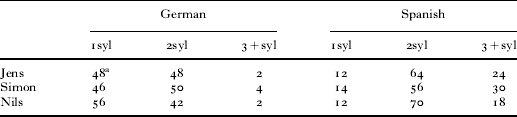
At later stages of phonological development (i.e. beyond the first 50-word period), however, there is clear evidence of ambient language effects. Studies show that the early lexicons of children speaking Romance languages (e.g. Italian or Spanish) contain a higher proportion of multisyllabic words than children speaking Germanic languages (e.g. English or German), mirroring the proportions of multisyllabic words in the ambient language (Lleó & Demuth, Reference Lleó, Demuth, Greenhill, Littlefield and Tano1999; Vihman & Croft, Reference Vihman and Croft2007). There is also evidence to show that bilingual children's early lexicons reflect the language-specific phonological characteristics of their respective languages. Thus, Ingram (1981/Reference Ingram1982) found proportionally more multisyllabic than monosyllabic words in the Italian lexicon of his bilingual Italian–English subject, L, compared to the English lexicon. Similarly, the first words produced in the recording sessions of three German–Spanish bilingual children growing up in Hamburg show the expected patterns of greater numbers of multisyllabic target words in Spanish than in German (see Lleó (Reference Lleó2002) for methodological details of study). On average, the bilingual children produced 49% multisyllabic words in German in comparison with 87% in Spanish (see Table 1).
Percentage of word types containing 1, 2 and 3 or more syllables in the first 50-word types produced in the earliest recording sessions of three bilingual German–Spanish children
a. Results are based on the first 50 word types produced in the earliest recording sessions (typically 1;03–1;08). The only exception is Jens, who produced very few German words at the beginning. His German analysis is based on 25 word types.
Given clear phonological differences between the lexicons of children speaking different languages, an interesting question to examine is whether interaction occurs across languages in the lexical selection patterns of bilingual children. Do bilingual German–Spanish children select multisyllabic words earlier in German than monolingual German children due to the influence of Spanish? That is, the high proportion of multisyllabic words in Spanish influences bilingual children to select more multisyllabic words in German. This is plausible since vocal practice producing multisyllabic words in one language may lead to a common production strategy which in turn influences lexical selection in the other language. Unfortunately, I am unaware of evidence bearing on this type of interaction pattern in bilingual children. The German–Spanish bilingual children (mentioned above) displayed quite prominent differences between the percentages of monosyllabic and multisyllabic words selected in each target language, consistent with the percentages reported for monolingual German and Spanish children by Lleó & Demuth (Reference Lleó, Demuth, Greenhill, Littlefield and Tano1999), suggesting that interaction was not occurring; however, studies with greater numbers of bilingual children and monolingual controls would be needed to fully address this question.
LEXICAL AND PHONOLOGICAL DEVELOPMENT TEND TO BE COMMENSURATE: FINDINGS IN BILINGUAL CHILDREN
In the section discussing early meaningful speech, Stoel-Gammon's second postulate is that ‘Lexical development and phonological development tend to be commensurate’ (Postulate III; p. 000). Children with large vocabularies have more advanced phonological systems than children with small vocabularies. Do bilingual children with large vocabularies have more advanced phonological systems than bilingual children with small vocabularies? In addition, what is the nature of phonological and lexical associations in bilingual children? Studies examining the relationship between lexical and grammatical development in bilingual children have found evidence for strong within-language associations but very weak cross-language associations (Conboy & Thal, Reference Conboy and Thal2006; Marchman, Martínez-Sussmann & Dale, Reference Marchman, Martínez-Sussmann and Dale2004). This means that advanced lexical abilities are associated with advanced grammatical abilities in the same language but not necessarily in the other language.
As far as I am aware, associations between phonological and lexical development in bilingual children have not been examined as systematically as they have between lexical and grammatical development. There are, however, findings in the literature which are suggestive of certain conclusions and predictions. In general, the dominant language of a bilingual (typically the language containing the most vocabulary items) is associated with faster phonological acquisition. Law & So (Reference Law and So2006) observed that Cantonese dominant bilinguals had faster Cantonese phonological development than Putonghua dominant bilinguals and vice versa. Similarly, Ingram (1981/Reference Ingram1982) found a higher articulation score in the Italian of his Italian–English subject who was dominant in Italian. Thus, there appears to be strong within-language correlations between phonological and lexical development in bilingual children.Footnote 1
What is less clear is whether cross-language correlations are equally weak in the lexical and phonological domains as they are in the lexical and grammatical domains. The biological component of phonology associated with speech motor skills and articulatory practice may mean that sounds produced in one language are quickly produced in the other language. For example, Kehoe & Lleó (Reference Kehoe and Lleó2006) observed a close timeline between the acquisition of word-medial and word-final codas in the speech of three bilingual German–Spanish children. Codas were acquired in both languages within a one-month period. German seemed to exert a bootstrapping effect on the production of codas in Spanish, resulting in high coda production in both languages even though some of the children were dominant in German and some were not (Lleó, Kuchenbrandt, Kehoe & Trujillo, Reference Lleó, Kuchenbrandt, Kehoe, Trujillo and Müller2003). Thus, it is possible that similar phonological ability across languages may be observed in bilingual children despite disparate differences in lexicon size. In other words, certain cross-language associations may be stronger in the lexical and phonological domains than in the lexical and grammatical domains.
CONCLUSION
There are many ways to look at the relationship between lexical and phonological development in bilingual children. The preceding discussion has put the emphasis on phonological production; other researchers have put more emphasis on phonological representation and memory (Hoff & McKay, Reference Hoff, McKay, Cohen, McAlister, Rolstad and MacSwan2005). Regardless, this commentary makes clear that current research has not addressed the relationship between phonological and lexical development in bilingual children to the same extent as it has in monolingual children, or as in other domains such as lexical and grammatical development. For example, we know little about lexical selection and avoidance in bilingual children. There is evidence that bilingual children may select words in both of their languages based on a common articulatory strategy (Celce-Murcia, Reference Celce-Murcia and Hatch1978; Yavas, Reference Yavas1995; Vihman, Reference Vihman2002), but less evidence that bilingual children select words in different lexicons based on different articulatory strategies. At later stages of phonological development, bilingual children's lexicons reflect ambient language phonological differences, but we do not know whether one language influences another language in terms of lexical selection patterns.
Advanced phonological ability is typically observed in the dominant language of bilingual children, suggesting that phonological development is correlated with lexical development on a language-specific basis. Cross-language correlations between phonological and lexical development may be stronger than in other domains such as the lexicon and grammar due to the speech motor component of phonology; however, this remains to be empirically tested.
Stoel-Gammon makes a plea for more cross-linguistic studies on the interaction between phonology and the lexicon. Research with bilingual children facilitates the study of cross-linguistic effects on the lexical–phonology link since general language-learning ability is kept constant. It provides an additional dimension to the topic since multiple relationships (within-language and cross-language) and interaction are possible. This population has the potential to provide important insights into the interplay between phonological and lexical development.