

After decades of intensive research, a number of novel techniques have been developed for the large scale production of nanomaterials such as nanoparticles, quantum dots, nanowires, carbon nanotubes, biomolecules, nanofilms, and graphene. It has been shown recently that the unique properties of these nanomaterials can lead to extraordinary new applications and functionalities when combined with organics and polymers, enabled by their deformations and instabilities. Examples include unfolding of proteins and DNA, super-plasticity of carbon nanotubes, strain engineering of graphene, and energy harvesting with nanowires, among others. However, a grand challenge still exists to control these nanomaterials for scaling-up functions and applications that will impact society. An emerging approach is the use of soft materials such as polymers, gels, and biomaterials to assemble large amounts of nanomaterials and to regulate the deformations and instabilities in a designed and controlled manner. Successful examples range from nanostructured tissues, such as bones and cartilage found in nature, to polymer composites with nanowire/nanotube/graphene, flexible electronics, nanogenerators, and nanobatteries. The convergence and interactions of soft materials and nanomaterials have resulted in exciting opportunities for discovery, invention, and commercialization.
This Focus Issue collects papers from leading research groups with diverse backgrounds in soft materials and nanomaterials to discuss scientific and technological frontiers. These papers cover experimental, theoretical, and computational aspects of soft nanomaterials. The issue aims to be of inspiration to the current and next generation of soft nanomaterial scientists.
Dr. Pugno acknowledges support from the European Research Council, ERC Ideas Starting Grant n. 279985 “BIHSNAM”, from ERC Proof of Concept grants n. 619448 “REPLICA2” and n. 632277 “KNOTOUGH”, as well as from the Graphene FET Flagship grant agreement n. 604391, and from the Autonomous Province of Trento grant n. 81017.
ON THE COVER: Predicting fatigue life in vivo
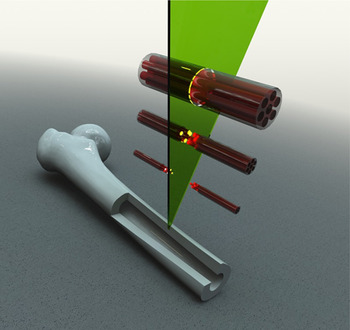
Biomaterials provide striking examples of the extraordinary properties and functionalities of nanostructured soft materials. One of these is the ability to self-heal. The cover image illustrates the healing process occurring at microscopic level inside bone tissue, visualized as an autonomically repairing fiber bundle (cover art by Lucas Brely, University of Torino). Such self-healing mechanisms take place in many living tissues such as bones, tendons or muscles, and are responsible for their ability to withstand cyclic stress while resisting damage progression and fracture propagation. See the dedicated paper by Bosia, Merlino and Pugno, thus presenting an approach for “predicting fatigue life in vivo”, e.g., for better elucidating the risks of fatigue failure in living systems, from tendons in sportsmen to osteoporosis in astronauts and cosmonauts.


