Introduction
Implemented in 1982 on the British Columbia coast, in Canada, the world’s longest running semiochemical-based integrated pest management (IPM) programme is directed against three species of ambrosia beetles: the striped ambrosia beetle, Trypodendron lineatum (Olivier), Gnathotrichus sulcatus (LeConte), and G. retusus (LeConte) (Coleoptera: Curculionidae: Scolytinae) (Borden et al. Reference Borden, Chong, Gries and Pierce2001). Together, the three species were estimated by Lindgren and Fraser (Reference Lindgren and Fraser1994) to cause $95–$189 million in annual losses in degrade of logs and lumber (McLean Reference McLean1985), with additional losses resulting from milling to remove infested sapwood, export restrictions, and imposed alterations in timing of harvesting, storing of logs and freshly sawn lumber, and shipping practices (Gray and Borden Reference Gray and Borden1985; Orbay et al. Reference Orbay, McLean, Sauder and Cottell1994; Borden Reference Borden, Armstrong and Ives1995).
Moreover, shifting log storage and sorting from water to dryland sorts, where logs are sorted by species and grade, in the early 1960s caused the entire circumference of logs to be exposed to beetle infestation. Also, gradual depletion of old-growth timber and conversion to harvesting second-growth trees produced logs with a greater proportion of the diameter consisting of sapwood suitable for infestation, thus intensifying the vulnerability to degrade.
Prerequisites for implementation of semiochemical-based IPM
Four prerequisites had to be met before implementation of a semiochemical-based IPM system became feasible.
Receptive potential clients
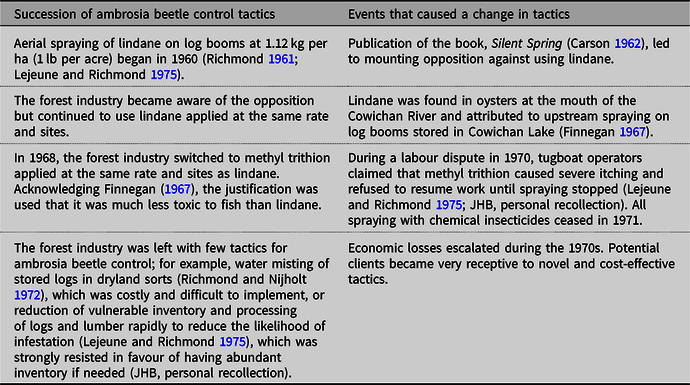
Beginning in the 1940s, enterprising British Columbians began to apply lindane to logs and lumber to prevent attack by ambrosia beetles (Lejeune and Richmond Reference Lejeune, Richmond and Prebble1975). In 1960, most of the spraying shifted to using helicopters to apply lindane at 1.12 kg per ha (1 lb per acre) on log booms in freshwater lakes and saltwater inlets. Subsequent events leading to the eventual cessation of aerial spraying with chemical insecticides resulted in potential clients receptive to alternative tactics (Table 1). In contrast to the frequently used policy of asking users to convey their research needs to applied researchers, the forest industry lacked awareness of semiochemicals and would never have asked for a semiochemical-based solution.
Series of successive insecticidal tactics used to prevent infestation by ambrosia beetles on logs stored in lakes and saltwater inlets in the coastal region of British Columbia, coupled with events that caused changes in the tactics.

Availability of semiochemical lures
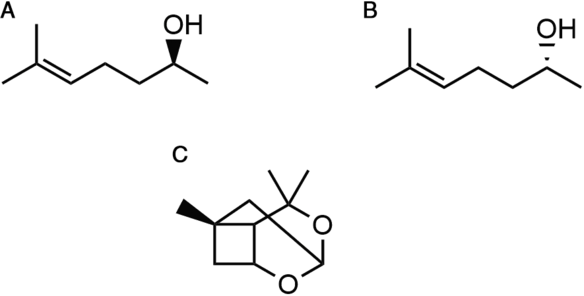
A breakthrough in understanding the chemical ecology of ambrosia beetles came with identification in 1974 of the male-produced aggregation pheromone of G. sulcatus as 6-methyl-5-hepten-2-ol, which was given the trivial name sulcatol (Byrne et al. Reference Byrne, Swigar, Silverstein, Borden and Stokkink1974). Subsequent research demonstrated that both (S)-(+)- and (R)-(−)-sulcatol were required to elicit a positive response (Borden et al. Reference Borden, Chong, McLean, Slessor and Mori1976).
Four years later, the male-produced aggregation pheromone for G. retusus was identified as (S)-(+)-sulcatol; the antipode proved to be repellent, indicating a mechanism for maintaining species specificity (Borden et al. Reference Borden, Handley, McLean, Silverstein, Chong, Slessor, Johnston and Schuler1980a). This discovery also meant that in an operational mass trapping programme, separate traps would be needed for each Gnathotrichus species. In a very creative effort, chemists later employed porcine pancreatic lipase to synthesise pure enantiomers of sulcatol, the first use of an enzyme in the synthesis of an insect pheromone (Stokes and Oehlschlager Reference Stokes and Oehlschlager1987; Figs. 1A–B).
Ambrosia beetle pheromones. A, (S)-(+)-sulcatol; B, (R)-(−)-sulcatol; C, lineatin.

The female-produced aggregation pheromone for T. lineatum was isolated from 450 g of frass produced by 25 000 female beetles and tentatively identified as 3,3,7-trimethyl-2,9-dioxatricyclo[3.3.1.0 4,7]nonane; it was given the trivial name lineatin (MacConnell et al. Reference MacConnell, Borden, Silverstein and Stokkink1977; Fig. 1C).
Two years later, a team of chemists produced 23 µg of synthetic lineatin, which was sufficient to confirm the earlier identification and to demonstrate in a six-replicate field trapping experiment that minute amounts of the synthetic pheromone were highly attractive to both sexes of T. lineatum (Borden et al. Reference Borden, Handley, Johnston, MacConnell, Silverstein, Slessor, Swigar and Wong1979). Facile syntheses developed by Mori and Sasaki (Reference Mori and Sasaki1979) and Johnston et al. (Reference Johnston, Slessor and Oehlschlager1985) made operational use of lineatin feasible.
Phero Tech Inc. (Delta, British Columbia, Canada), an embryonic start-up company, acquired the above mentioned pheromone technology from Simon Fraser University (Burnaby, British Columbia, Canada) in 1981. The young entrepreneurs who founded the company formulated racemic and (S)-(+)-sulcatol in bubble-cap lures, lineatin in a flexlure, and α-pinene and ethanol synergists (Borden et al. Reference Borden, Lindgren and Chong1980b; Shore and Lindgren Reference Shore and Lindgren1996) in sachet lures. This fulfilled the second prerequisite for operational implementation, the availability of effective semiochemical lures.
Invention of an operational trap
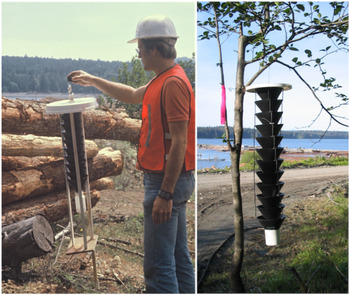
The first type of trap used to capture ambrosia beetles in British Columbia was a glass barrier resting in a collecting trough hung at approximately eye level (Chapman and Kinghorn Reference Chapman and Kinghorn1955) or situated on top of a greenhouse cage baited with attacked or unattacked logs (Chapman Reference Chapman1966). Although effective in trapping small numbers of beetles, these fragile traps were not suitable for operational mass trapping. Trials of a succession of alternative traps, including sticky hardware cloth cylinders (Byrne et al. Reference Byrne, Swigar, Silverstein, Borden and Stokkink1974), perforated drainpipe traps (Bakke and Sæther Reference Bakke and Sæther1978), and sticky window-screen vane traps (McLean and Borden Reference McLean and Borden1979), led eventually to the invention of the multiple-funnel trap (Lindgren Reference Lindgren1983; Fig. 2A–B).
Multiple-funnel trap. A, Early prototype in 1979, with its inventor, Dr. Staffan Lindgren; B, commercial version of the operational trap used for almost three decades before minor modifications were made.

When the four types of traps were compared, vane traps ranked first in numbers of T. lineatum and G. retusus captured, and funnel traps ranked first for G. sulcatus (Lindgren et al. Reference Lindgren1983). Deficiencies in drainpipe and sticky traps eliminated them from further consideration. Beetles that landed on the drainpipe traps tended to resume flight rather than enter the perforations and be trapped in the collecting cup at the bottom (Lindgren Reference Lindgren1983). Both types of sticky traps demanded removal of beetles in solvent for accurate counting or, with vane traps, counting of beetles on a defined area of each vane and inexact extrapolation of what the total catch was (Lindgren Reference Lindgren1983; Lindgren et al. Reference Lindgren1983). The multiple-funnel trap presents an attractive vertical silhouette similar to the drainpipe trap, while incorporating ease of removing and counting beetles captured in detachable cups at the base of each trap. High catch rates can be achieved by optimal positioning of the lure in the funnel column (Lindgren Reference Lindgren1983), accurate placing of traps in the trapping site, and using slightly more traps than required for vane traps.
The multiple-funnel trap was patented (Lindgren Reference Lindgren1984), and the intellectual property was licensed to Phero Tech Inc., which proceeded to manufacture and market it. Availability of this operational trap fulfilled the third prerequisite for implementation of an effective IPM programme.
Proof of concept of mass trapping technology
Because synthetic (±)-sulcatol (Byrne et al. Reference Byrne, Swigar, Silverstein, Borden and Stokkink1974) was available earlier than lineatin, the first series of operational experiments were conducted against G. sulcatus in a commercial sawmill run by MacMillan Bloedel Ltd. in the town of Chemainus, on Vancouver Island, British Columbia, Canada. In 1974, cylindrical hardware cloth sticky traps deployed throughout the site for one week per month captured more than 3000 G. sulcatus, disclosed a pronounced bimodal flight curve with peak flight in late summer, and identified prime problem areas (McLean and Borden Reference McLean and Borden1975a). The following year, trapping was carried out continuously in the most critical location near the planer mill; 4050 G. sulcatus were captured, with an estimated 70 and 87% suppression of attack by males and females, respectively, on vulnerable test loads of freshly sawn lumber placed at the test site (McLean and Borden Reference McLean and Borden1977a). Testing culminated in 1976, with sticky vane traps deployed season-long throughout the mill site, resulting in 42 907 G. sulcatus captured, estimated to be 65% of the available population (McLean and Borden Reference McLean and Borden1979).
In contrast to sawmill sites, dryland sorts can harbour huge populations of ambrosia beetles. Logs with bark and intact sapwood constitute much more favourable breeding sites than freshly sawn lumber, with only small portions of remaining sapwood exposed to the air and prone to drying out. Populations build up through transport of infested logs into a sort, where the beetles emerge. Spring attack flights consist mainly of immigrant and resident beetles that have overwintered in the surrounding forest (T. lineatum) or in logs held on site (Gnathotrichus spp.). At Pacific Forest Products Ltd.’s (Vancouver, British Columbia, Canada) dryland sort near Sooke, on Vancouver Island, British Columbia, Canada, Lindgren and Borden (Reference Lindgren and Borden1983) conducted a season-long mass trapping trial in 1980, employing 40 sticky hardware cloth cylinder traps baited with lineatin, 35 drainpipe traps baited with (±)-sulcatol, and 15 drainpipe traps baited with (S)-(+)-sulcatol. The sticky cylinder traps were used for T. lineatum, because these traps were judged to be most effective and T. lineatum is by far the most abundant and damaging species. The results were encouraging, with captures numbering 458 000 T. lineatum, 219 000 G. sulcatus, and 11 500 G. retusus. In 1981, an intensified programme employed both drainpipe and vane traps and included for the first time 30 multiple-funnel traps as well as the synergists ethanol and α-pinene. Trap catches were impressive, numbering 2 200 000 T. lineatum, 500 000 G. sulcatus, and 15 000 G. retusus. Calculated estimates of overall suppression of all three species ranged from a low of 44% to a high of 77%.
The results of these mass trapping trials at sawmills and dryland sorts indicated strongly that mass trapping could be used as an operational population-suppression tactic for all three species, particularly if trapping continued year after year. Thus, the fourth prerequisite for operational implementation, proof of concept, was fulfilled.
The IPM programme
Beetle life-history considerations
Different life histories of the three ambrosia beetles influence the effective implementation of pest management tactics. Trypodendron lineatum can produce very large populations in log storage areas and is by far the most damaging of the three beetles. Its life history (Borden Reference Borden and Berryman1988) differs markedly from the other two species. It overwinters on the forest floor, in rotting stumps, and under the bark scales of living trees (Kinghorn and Chapman Reference Kinghorn and Chapman1959; Dyer and Kinghorn Reference Dyer and Kinghorn1961). In the spring, the beetles begin to fly when temperatures reach 15–16 °C and, after a brief period of photopositive response, begin searching for host material (Chapman and Kinghorn Reference Chapman and Kinghorn1958; Chapman Reference Chapman1962; Daterman et al. Reference Daterman, Rudinsky and Nagel1965). A sister flight of T. lineatum, consisting of an undetermined number of re-emerged or unsuccessful parent beetles, occurs in early summer, and attacks by this species decline to near zero by late summer (Chapman and Kinghorn Reference Chapman and Kinghorn1958; Shore et al. Reference Shore, McLean and Zanuncio1987). Emerged brood beetles seeking overwintering sites enter a reproductive diapause (Fockler and Borden Reference Fockler and Borden1972) and are no threat to stored logs or lumber.
By the time of spring flight, logs felled before December are most vulnerable to beetle attacks (Dyer and Chapman Reference Dyer and Chapman1965), because they have built up large quantities of the attractive kairomone ethanol as a result of anaerobic metabolism in the still-living sapwood (Graham Reference Graham1968; Moeck Reference Moeck1970, Reference Moeck1971; Kelsey Reference Kelsey1994). Therefore, to reduce vulnerability of logs to attack by T. lineatum, harvesting is best delayed until January and later. Moreover, as long as beetles in the woods are overwintering on the forest floor, freshly felled logs can be transported to dryland sorts and sawmills without fear of also transporting beetles that could contribute to existing populations in sorting and milling sites.
Gnathotrichus sulcatus is the second most important species, not only because it attacks stored logs but because it is the principal species that attacks freshly sawn unseasoned lumber (McLean and Borden Reference McLean and Borden1975b). Gnathotrichus retusus is the least important species. It prefers dry habitats and occurs in relatively low numbers. Unlike T. lineatum, G. sulcatus (and presumably G. retusus) is responsive to low amounts of ethanol produced within two weeks after felling (Cade et al. Reference Cade, Hrutfiord and Gara1970). Emergent brood beetles do not seek external overwintering sites and can attack vulnerable logs and lumber at any time when the weather is favourable (Prebble and Graham Reference Prebble and Graham1957). Therefore, semiochemical-based trapping must extend well into the fall, even though T. lineatum is no longer a threat. Gnathotrichus spp. overwinter in infested logs and thus can be transported to storage and milling sites at any time of the year.
Strategies and tactics
With reference to Borden’s (Reference Borden2020) four broad strategies for IPM, even one ambrosia beetle gallery in a wood product can represent an economic problem. Therefore, Strategy 1 (“prevent a problem from occurring”) and Strategy 4 (“do nothing; let nature take its course”) are unacceptable. The remaining two, “maintain the problem at a tolerable level” and “suppress the problem to a tolerable level,” are the only applicable strategies. Within these two strategies, there are four essential tactics, each with possible subtactics, that must be applied in a successful IPM programme for ambrosia beetles in industrial processing areas:
-
1. inhibit beetle population build-up at all stages of logging;
-
2. limit beetle transportation to new areas;
-
3. remove populations at every storage site;
-
4. compile and use information effectively.
Early management of the IPM programme
Initial implementation of the mass trapping component of the IPM programme by the six entrepreneurs who founded Phero Tech was undertaken partly by their management team and partly by the forest industry, with companies purchasing traps and lures, being given imperfect instruction, and then being left alone. These independent programmes were largely ineffective. Therefore, beginning in the second year, Phero Tech offered the programme under full-service contracts. The companies were thus relieved of the responsibility of solving a poorly understood pest problem using management tactics for which they were untrained. Phero Tech also hired one of the authors (ES), who had knowledge and comprehension accumulated through working on the discovery phases of ambrosia beetle research at Simon Fraser University. The full-service programme at Phero Tech operated effectively for 12 years. In 1995, coastal British Columbia site servicing was transferred to Woodstock Management Inc. (Nanaimo, British Columbia, Canada), a company formed by ES. Lures and traps were manufactured and sold by Phero Tech and, after a merger in 2009, by Contech Enterprises Inc. (Victoria, British Columbia, Canada), which went bankrupt in 2015. Lures and traps are now offered by several other companies.
The early programme found a readymade client base with MacMillan Bloedel Ltd. (Vancouver, British Columbia, Canada (now Weyerhaeuser Company Ltd., Vancouver, British Columbia, Canada)) and Pacific Forest Products Ltd., both of which had participated in the operational research (McLean and Borden Reference McLean and Borden1979; Lindgren and Borden Reference Lindgren and Borden1983). Although neither company exists now, and despite significant downsizing of the industry, four of the original sites remain in the programme today.
Components of the IPM programme
To be as effective as possible, the IPM programme must include all phases of the harvesting and manufacturing process, from the forest to the sawmill gate, including the components noted below.
Preharvest planning
Prioritisation of cutblocks for harvesting can have a significant effect on inhibiting population build-up in felled timber. For example, it is important to ensure that fall-felled timber is not left in the woods over the winter where it will be highly susceptible to attack by T. lineatum in the following spring (Dyer and Chapman Reference Dyer and Chapman1965). This may dictate that fall harvesting be done at low elevation close to town so that beetle-free logs can be transported rapidly away from the logging site without fear of road closure due to snow or landslides.
Management of log inventory on new rights of way
It is often convenient to fell timber along a proposed right of way and to leave it on site while a road is built and stabilised. It can then be conveniently removed with expensive and heavy logging equipment at the same time as timber harvested from the cutblock to which access has been provided. Such right-of-way logs can easily fill up with ambrosia beetles during the delay. This could be avoided by bringing in more portable equipment – for example, small skidders and self-loading logging trucks – to remove the relatively small amount of timber along the right of way.
Management of log inventory in the woods
It is desirable that felled and bucked timber be removed from logging sites before it can be attacked. If attack occurs, for example, by T. lineatum on logs left in the woods over the winter (Dyer and Chapman Reference Dyer and Chapman1965), or by G. sulcatus on logs left for more than two weeks at the peak of the spring flight period (Cade et al. Reference Cade, Hrutfiord and Gara1970; McLean and Borden Reference McLean and Borden1977b), every effort should be made to process the logs through the sorting and milling process before broods emerge.
Management of logs in transport
At the height of flight and attack season, delays in transport should be avoided. The late Hector Richmond, British Columbia’s first consulting forest entomologist, used to delight in recounting his 1950s observations of visible clouds of T. lineatum following odour plumes behind loaded logging trucks heading out of the woods (JHB, personal recollection). While the risk of attack is no longer so extreme, vulnerable logs left on a truck in the woods can be rapidly colonised through pheromone-mediated mass-attack, even if the delay is a few hours. Conversely, delays at the sort or mill can result in large numbers of beetles emerging from infested logs. Traditionally, logs were hauled to a saltwater dump where they were sorted. However, because of increasing recognition in the latter half of the 20th century of pollution from chemicals leached from conifer bark, sorting is now done almost entirely in what are known as dryland sorts. In one dryland sort, Gray and Borden (Reference Gray and Borden1985) demonstrated a significant increase in infestation level on logs being rapidly processed through the sort and being formed into booms (rafts of logs bound together by logs linked by chains) for towing by tugboat to a mill.
Management of log inventory in dryland sorts
Sampling for overwintering T. lineatum in Pacific Forest Products’ Sooke dryland sort began in 1976, the year the sort opened; no beetles were found (Lindgren and Fraser Reference Lindgren and Fraser1994). The next year, populations increased dramatically, possibly the result of a single pile (deck) of infested logs stored in one corner of the sort. Within five years of this dryland sort being established (and others as well), ambrosia beetle frass was so heavy on decked logs in the spring that they gave the appearance of being covered by a light snowfall (JHB, personal recollection). The message is simple and twofold: 1) do not allow infested logs to enter the sort during the period in which brood beetles are emerging, and 2) process all timber in and out of the sort as rapidly as possible.
Mass trapping in dryland sorts
Ideally, effective management of inventory should keep ambrosia beetle populations in dryland sorts at a very low level. Mass trapping would then be a mop-up tactic, implemented when some unforeseen event caused the population to rise (e.g., shutdown of operations in the woods due to machinery breakdown or a labour dispute, or lack of road access to cutblocks due to snow or a landslide). Unfortunately, because inventory management was often less than ideal, removal of ambrosia beetle populations by mass trapping at dryland sorts arguably became the most important tactic in the IPM programme. Reduction of the resident and incoming population achieves much more than reducing the attack level on all logs. Because the attack is mediated by aggregation pheromones, attack progresses from one log to another. Therefore, if the population is reduced, so is the number of logs attacked. Thus, Lindgren and Fraser (Reference Lindgren and Fraser1994) concluded that mass trapping and removal of 14 million T. lineatum and 2.4 million G. sulcatus over a 12-year period at the Sooke dryland sort “was highly successful, yielding an estimated benefit/cost ratio exceeding 5 to 1.”
Management of inventory in sawmills
McLean and Borden (Reference McLean and Borden1979) noted that the ambrosia beetle population at the Chemainus sawmill is “a dynamic population which continually changes with each new load of logs brought from the forest […] and with each new log boom towed in from other regions.” This continual influx of beetles means that every load of freshly sawn lumber is potentially vulnerable to attack. Even the slightest infestation can cause rejection of lumber destined for export offshore. Because of the value added during manufacture of lumber, degrade loss due to ambrosia beetle attack on lumber is proportionally greater than for logs. Thus, rapid processing and minimal storage duration at sawmill sites are imperative.
Mass trapping in sawmills
As in dryland sorts, ambrosia beetles in sawmill sites aggregate on certain loads of lumber before moving to a new load. Therefore, removal of beetles through mass trapping, particularly if 65% or more of the resident population is removed (McLean and Borden Reference McLean and Borden1979), will have the effect of reducing the total number of loads attacked. While not as critical as mass trapping in dryland sorts, trapping in sawmills, combined with inventory management, can be very effective.
Information management
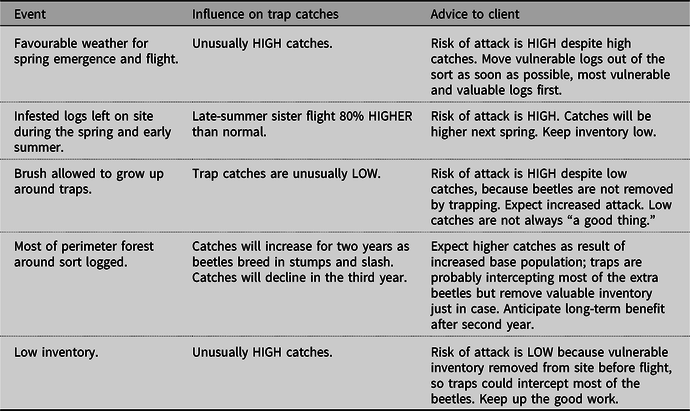
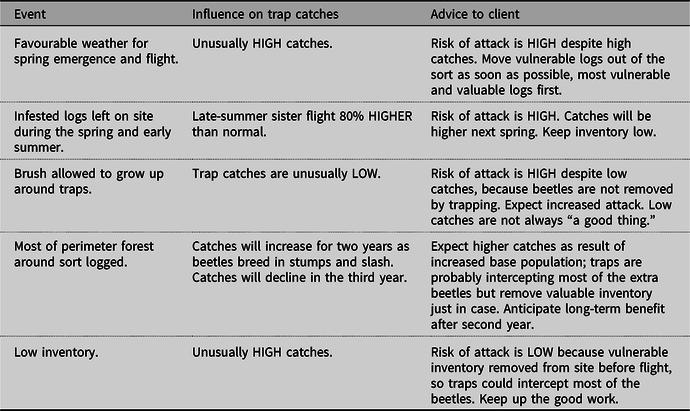
Information management as a component of an ambrosia beetle IPM programme takes place mainly at sorts and sawmills. It takes three forms: (1) informal consultation on site, (2) interim written reports, and (3) comprehensive final reports, with recommendations. An expert consultant may interpret and evaluate events and actions very differently from company personnel who may not be similarly trained, and accordingly, industrial managers may not expect the consultant’s recommendations (Table 2).
Examples of types of events and consequences encountered during the application of a semiochemical-based IPM programme in a dryland sort, with corresponding advice given by a trained consultant to a client, who might not have independently arrived at similar conclusions.
Impediments to success
While highly successful and valued by many measures, including renewed contracts for 36 consecutive years, several factors conspired to erode continued operation of a flourishing IPM programme:
-
1. Ambrosia beetle management was often not the concern of forest companies’ upper management. Because reports and recommendations seldom reached levels above that of managers of dryland sorts and sawmills, those local managers did not have the power to refuse incoming attacked inventory. This resulted in yearly immigration of fresh beetle populations and perpetuation of the problem.
-
2. Large companies have separate profit divisions. Additional costs incurred by a dryland sort by having a trapping programme are not offset by increased revenue. Sorts “sell” their inventory to the sawmill or a log buyer at a set price, and the mill or the buyer reaps the downstream benefit from the service. Thus, there is little financial incentive to continuing the programme.
-
3. When catches are consistently reduced, with a corresponding reduction in attacked inventory, upper management may (and did) decide to discontinue the programme, because it was perceived to no longer be required.
-
4. Industry consolidation eliminated many sites, with the remaining ones operating 365 days a year, often with double shifts. While these sites still had trapping programmes, there were fewer of them. The profitability to the consultant thus diminished, and there was reduced incentive to continue to offer the service.
-
5. In 2008, the economic downturn, coupled with a decline in volume of timber harvested, caused even more clients to discontinue the service.
Because of the above factors, there were only seven sites that contracted for the consulting service in 2009, down from the high of 50 sites in the early years of the IPM programme.
Current situation
By 2015, the coastal British Columbia forest industry had recovered from the economic downturn in the previous decade. This brought a new generation of progressive managers, foresters, and quality-control personnel to the production process. Yet there was still no renewed buy-in of the IPM programme by upper management.
With retirement looming and concern that 36 years of a successful semiochemical-based IPM programme for ambrosia beetles would diminish to nothing, ES singled out her major client and requested a meeting with upper management to address her concerns. They were reluctant to change the way they were operating until she suggested they determine their real losses. Using degrade and monetary information from the 1992 Ambrosia Beetle Task Force run by Dr. John McLean of the University of British Columbia (Vancouver, British Columbia, Canada) (Orbay et al. Reference Orbay, McLean, Sauder and Cottell1994), and substituting 2015 values, the company was made aware of their yearly losses and became an enthusiastic participant in creating a Standard of Practice, using all components of a successful IPM programme, namely:
-
1. inhibit beetle population build-up at all stages of logging;
-
2. limit beetle transportation to new areas;
-
3. remove populations at every storage site;
-
4. compile and use information effectively.
The protocol will be reviewed and signed by all managers annually.
At the time of writing, a similar re-evaluation and restructuring process was underway with other major timber companies on the British Columbia coast. While companies are taking greater responsibility towards managing their inventories, the deployment of traps and interpretation of trap catches require entomological expertise using information gleaned from multiple sites. Weather conditions and market fluctuations affect all sites, while individual dryland sort operations (and their supply chains) can influence local populations. To provide continuing service, ES is now training a new generation of ambrosia beetle management specialists.
Acknowledgements
The endeavours described in this paper represent a body of work in which basic studies on pheromone identification and chemical ecology led to an enduring integrated pest management programme. We feel that it is a fitting tribute to Steve Seybold, a truly remarkable entomologist, forester and chemical ecologist, who carried on this tradition in fine fashion. His seminal work on the walnut twig beetle stands out as a prime and equally enduring example.