Introduction
In the case of the status of English in Hong Kong, most ‘new Englishes’ classification schemes have been either controversial or inconclusive. Dynamic models seem to be more promising, and these predict two things. First, a trend of ‘linguistic schizophrenia’, where people are exonormative in ideal – holding to the ideals of native speaker English – but endonormative in practice – in actual fact, speaking their own local variety. Second, the future ongoing development and eventual acceptance of the new variety. This article aims to shed more light on some of the complexities surrounding the issue of the status of English in Hong Kong. It undertakes an analysis of the attitudes of local English speakers towards the existence and nature of their own variety, perceptions of their own linguistic behaviour, and attitudes towards norms. The significance of the findings is evaluated in the light of dynamic models postulated by Kachru (Reference Kachru, Bolton and Kachru1983) and Schneider (Reference Schneider, Bolton and Kachru2003, Reference Schneider2007). The Hong Kong data present a classic case of Kachru's ‘linguistic schizophrenia’, and confirm the placement of Hong Kong English at the beginning of Schneider's Phase 3 of nativization. The future possibilities for the variety are also discussed.
The debate about Hong Kong English
Is there such a thing as ‘Hong Kong English’ (HKE), or is there simply an ‘English used in Hong Kong’? The issue of the status and even the very existence of an entity called ‘Hong Kong English’ has been a subject of ongoing debate in the literature over the past twenty to thirty years. Some earlier scholars, for instance, Luke and Richards (Reference Luke and Richards1982), Platt (Reference Platt, Bailey and Görlach1982), Tay (Reference Tay and Cheshire1991), Johnson (1994)Footnote 1 and Li (2000),Footnote 2 have tended not to consider the English of Hong Kongers much more than a developmental continuum, or a learner's interlanguage developing along a cline of proficiency. Luke and Richards (Reference Luke and Richards1982: 55) stated outright that ‘there is no such thing as “Hong Kong English”’. Calling attention to the lack of intranational English communication and the non-existence of a basilectal (colloquial) style, they claimed that ‘there is no societal basis for the “indigenization” or “nativization” of English in Hong Kong’. Along the same lines, Pang (Reference Pang2003) considers English in Hong Kong has been localized but not indigenized and therefore calls it a ‘stillborn variety’. He also points out that, in addition to lack of reference works and native speakers, the dearth of a literature written in the local variety of English could be a stumbling block.
More recently, Schneider (Reference Schneider, Bolton and Kachru2003) has suggested that the variety is now on its way to structural nativization. Joseph (Reference Joseph, Wright and Kelly-Holmes1997), Bolton (Reference Bolton and Bolton2002, Reference Bolton2003),Footnote 3 Deterding et al. (Reference Deterding, Wong and Kirkpatrick2008) and Gisborne (Reference Gisborne2009) have all argued for its recognition as an autonomous variety on linguistic and/or societal bases, including a significant and increasing proportion of English users.Footnote 4 However, other researchers undertaking work on its specific language features have been more ambivalent. For instance, both Hung (Reference Hung and Bolton2002) and Pemberton (Reference Pemberton, Pemberton and Tsang1993) note that some of its language features are both systematic and idiosyncratic, yet they avoid committing themselves to a definite position regarding its status. At the other extreme, Stibbard (Reference Stibbard2004) rejects previous claims of (phonological) systematicity.
The introduction of dynamic models
This quick overview of various stances taken in the literature is enough to show that in the case of English in Hong Kong, most ‘new Englishes’ classification schemes proposed to date have been either controversial or, at the least, inconclusive. Why is it that the status of English in Hong Kong continues to defy clear classification? It may be that the answer can be found in considering the evolving nature of language over time, rather than trying to take a ‘snapshot’ view of the variety at one point of time. In this regard, several scholars have noted that the process of the formation of new English varieties around the world has entailed several successive stages, with similarities between locations despite different sociocultural settings. Subsequently, several overarching dynamic models have been posited to account for the phenomenon of the ‘new Englishes’, in place of the static models which sometimes seem to raise more questions than they answer. In the case of the English spoken in Hong Kong, these dynamic models are particularly illuminating, especially those by Kachru and Schneider, which will be introduced below. In this way, this paper aims to shed more light on some of the complexities surrounding this issue of the status of English in Hong Kong. It undertakes a study of the attitudes of local Hong Kongers, and evaluates the significance of the findings in the light of the phenomenon of ‘linguistic schizophrenia’ (competing norm orientations, Kachru Reference Kachru, Bolton and Kachru1983), which these dynamic models necessarily predict. It also discusses what consequences this might have for the future of HKE.
Kachru's three stages
Kachru (Reference Kachru, Bolton and Kachru1983: 115) noted that in reality ‘a variety may exist but unless it is recognized and accepted as a model it does not acquire a status’. Subsequently he proposed three stages in the emergence of new English varieties. The first phase is characterized by non-recognition of the local variety. Local speakers consciously try to imitate native speakers, and look down on speakers of the local variety. In the second stage, there is extensive spread of bilingualism in English. The local model begins to be used widely, although it is still ranked low by its users. During this time, a variety of competing norm orientations co-exist, including prestigious ‘overt’ (native speaker) norms and ‘covert’ (local) solidarity norms. Kachru terms this ‘linguistic schizophrenia’, a time when linguistic attitudes (being exonormative in orientation – holding to the external ideals of native speaker English) do not match up with linguistic behaviour (being endonormative in practice – holding to local norms in actual speech). During the last stage, the local variety becomes accepted as the norm and becomes a badge of identity. The variety gains important intranational functions and the teaching materials become contextualized in the native sociocultural context. Kachru notes that several of the Outer CircleFootnote 5 institutionalized varieties of English in Africa, South Asia, Southeast Asia or the Philippines have already gone some way through these stages. According to observations recorded in the literature, Hong Kong would be somewhere in the first or second stage of Kachru's model.
Schneider's framework
The most recent and comprehensive dynamic model to date is Schneider's (2003, 2007) framework, which posits five stages in accounting for the emergence and development of ‘Post-Colonial Englishes’ (‘PCEs’) specifically. His first four phases roughly align with Kachru's three stages (with Schneider's first two phases covering Kachru's first stage). The most important stages concerning English in Hong Kong are his three middle phases: exonormative stabilization (Phase 2), nativization (Phase 3), and endonormative stabilization (Phase 4). In Phase 2, exonormative stabilization, English is formally established at least in some spheres of society, e.g. administration, education and the legal system. Thus an ‘indigenous elite’ develops, largely attempting to follow the norms of the imported standard English, although at the same time some ‘structural nativization’ begins almost unnoticeably to occur, resulting from phonological and syntactic transfer. These linguistic changes lead directly into the central phase of nativization. The local residents now begin to undergo large-scale second language acquisition of English. Some form of mixed-code becomes an identity carrier, and their usage develops noticeable local ‘linguistic idiosyncrasies’, leading to the rise of a ‘complaint tradition’ about falling standards. In Phase 4, endonormative stabilization, the ‘idiosyncrasies’ now lose their stigma, and local norms are accepted and adopted, including in formal usage. The new language norms become a means of expression of a new identity which is also displayed in the emergence of literature in the new English variety. Characteristically, this is the stage where codification can begin. It is also where formal recognition is given to the new variety, and so the phrase ‘the English spoken in X-place’ becomes ‘X-an English’. Singapore, South Africa and Jamaica are current examples.
According to Schneider, Hong Kong English was in Phase 2, exonormative stabilization, through much of the 20th century. It is now largely in Phase 3, of nativization, with some traces of Phase 2 – a strong exonormative orientation – still being observed. The two important processes taking place in Phase 3 are identity reconstruction and linguistic innovations, both of which can be observed in Hong Kong. Preparation for the Handover in 1997 had a major impact on both language use and identity. Locals were developing a stronger ‘Hong Konger’ identity nested within a broader ‘Chinese’ identity. Attitudes towards the use of English changed positively, with the new Hong Konger identity incorporating a mixed-code of English and Chinese. By this time, ‘elite bilingualism’ had been replaced by a move toward ‘mass bilingualism’.Footnote 6 As the language base broadened, Hong Kongers' English developed its own distinctive phonological, lexical and grammatical features, causing complaints about falling standards. Thus Schneider's framework classifies the English of Hong Kongers as an ‘emergent variety’, and explains the reluctance of many people to use the more definitive term ‘Hong Kong English’.
The implications of the dynamic model for English in Hong Kong
Kachru's and Schneider's models essentially make two predictions for the development of new English varieties. The most pertinent aspect is that they foretell a period of time of ‘linguistic schizophrenia’, of competing exonormative versus endonormative orientations. Based on the statements in the literature, this seems to be generally descriptive of the current state of English in Hong Kong, a state which is welcomed by some linguists such as Joseph (Reference Joseph, Wright and Kelly-Holmes1997). He views this development in a positive light, maintaining that this ‘decline’ in imported standards is a necessary and vital phase for Hong Kong to go through in order for English to adapt to and survive in its post-colonial setting. This leads on to the second facet of relevance, which is that these models also predict that non-native Englishes will in time, barring unexpected events or policy changes, progress through a cycle and eventually become nativized and accepted as varieties in their own right – it's just a matter of time. Schneider himself singles out Hong Kong as potentially being an interesting test case for the predictive implications of his Dynamic Model.
Previous attitude studies
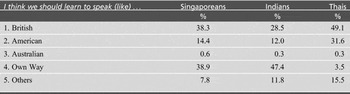
Before discussing the attitude data for this study, let's turn to previous attitudes research conducted relevant to issues raised by these models. Shaw (Reference Shaw and Smith1981, quoted in Kachru, Reference Kachru and Greenbaum1985) conducted some research in 1978 in Singapore, India and Thailand, into the attitudes of a total of 825 final year undergraduate students from 12 universities and colleges. Students were asked to complete the statement, I think we should learn to speak English (like) … Several options were given: three choices of native speaker varieties, plus their own way of speaking English. As seen in Table 1, it seems that the Indians were edging closer to being endonormative, with nearly half (47.4%) choosing their own standards for a model and only two-fifths (40.8% in total) desiring native speaker standards. In contrast, the Thais were the most exonormative, with over 80% in total choosing British or American norms. The Singaporeans were split more half and half. This research was completed over 30 years ago, and so it's no surprise that today both Indian and Singaporean English are relatively well-recognized to some degree.
Preference for models of English in 1978 (Shaw, Reference Shaw and Smith1981, quoted in Kachru, Reference Kachru and Greenbaum1985)

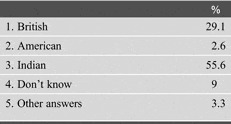
In a separate but informative study conducted two years earlier, 700 Indian university students were asked to self-label their own variety of English (see Table 2). Just over half (nearly 56%) self-identified as speaking their own variety of English, while only just under a third (32.7%) believed they were speaking a form of British or American English. These percentages for self-identification of linguistic conduct very roughly match the percentages from Shaw's study above regarding preferences for an English model among Indians. Kachru (Reference Kachru and Greenbaum1985: 217) comments that this shows ‘the attitudinal conflict between indigenous and external norms is slowly being resolved in favour of localized educated norms’. He noted that only a generation before this study the gap in India between actual linguistic behaviour and idealized norms was much wider. These data imply that, at that time, Indian English was progressing steadily through Schneider's Phase 3, nativization, heading towards endonormative stabilization.
Indian students' self-labelling of their own English in 1976 (Kachru, Reference Kachru and Greenbaum1985)

China and Hong Kong
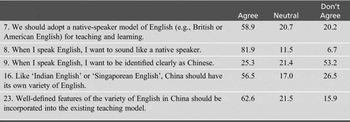
A recent study by He and Li (Reference He and Li2009; see Table 3) into the attitudes of nearly 1,000 non-English-major university students in China produced seemingly incongruous results. The statistics most relevant to the current topic are reproduced in Table 3 below. The majority of students (over four-fifths, 81.9%) wanted to sound like native speakers, with only 6.7% not desiring this identification. In addition, nearly three-fifths (58.9%) directly preferred a native-speaker model of English. However, on the whole, the students were not opposed to the development of a China variety of English either. Just over half (53.2%) also wanted to be identified as Chinese by their speech, while approximately three-fifths believed that China should have its own variety of English (56.5%), and that well-defined features of China English should be incorporated into the teaching model (62.6%). Overall, although it seems there is a fairly strong endonormative orientation, the level of acceptance of Chinese models in addition to native standards, and the resultant ‘linguistic schizophrenia’, is an indication that China English is taking its first steps towards developing as a new variety. This would support Kirkpatrick's (2007) argument that it is currently somewhere in between Schneider's Phases 2 (of exonormative stabilization) and 3 (of nativization).
Attitudes toward China English in 2009 (He & Li, Reference He and Li2009: 81)*

* This has been collapsed from the original 5-point scale to 3 points for ease of comparison (Agree = 1 & 2; Neutral = 3; Don't agree = 4 & 5).
One thing writers are generally agreed upon is that the notion of ‘Hong Kong English’ is not supported by Hong Kong society itself. It has also been stated that Hong Kongers do not believe they are speaking a local variety (e.g. Pang, Reference Pang2003). Although these beliefs do not directly seem to have been investigated, several attitudes studies into preferences for models of English in Hong Kong appear to point in this direction. Luk (Reference Luk1998) discovered an overwhelming preference among local students for an RP accent. In this study, only 21.4% of the subjects desired a Hong Kong accent as a teaching model, and just 26% wanted to speak that way. In another study by Bolton and Luke (Reference Bolton and Luke1999), 43% of male university students, but only 20% of females, showed a preference for local educated models of spoken English. Attitudes among teachers are even more pronounced. Tsui and Bunton (Reference Tsui and Bunton2000) report on a large-scale study of the attitudes of Hong Kong teachers, of which one-third were locals, who strongly preferred (British) native speaker norms. In their analysis of 1,234 forum postings, not once were deviations from native-speaker norms referred to favourably. These kinds of results confirm the strong exonormative orientation remaining in Hong Kong society, thus indicating that HKE still has a long way to go before it can be considered a legitimate variety by its users.
Current trends in Hong Kong society
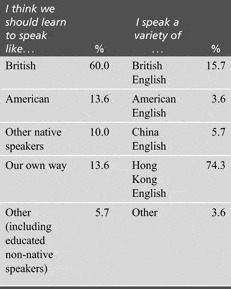
For the current study, 140 undergraduate students of various (non-English) Arts and Science majors were surveyed. They were given a questionnaire to complete in class time, comprising five questions with multichoice answers. (The questionnaire is reproduced at the end of this article.) The main purpose was to investigate to what extent objective research into the attitudes of educated speakers would support this notion of ‘linguistic schizophrenia’ in Hong Kong, and what this might reveal about the possible future for the variety. The first question was self-identification of their own language behaviour (see Table 4). As in the Shaw study, students were asked to complete a sentence, in this case, I speak a variety of […] Five possible answers were given: British, American, Hong Kong or China English, or other. A comparison with Shaw's study is enlightening. Just over half of the Indians surveyed in his study (55.6%) had recognized that they spoke their own kind of English. Surprisingly, even more – three-quarters – of the Hong Kongers (74.3%) self-labelled their English as basically being a kind of Hong Kong English. This suggests that Hong Kongers may be more aware of their own linguistic behaviour than previously thought, and also indicates that Hong Kong has taken its first step out of Kachru's first stage of total non-recognition of the local variety.
Attitudes towards English in Hong Kong in 2009

The second sentence for completion was worded the same as in Shaw's questionnaire: I think we should learn to speak English … Several options were given. The result was as expected (see Table 4) – a large majority (83.6% in total) chose native speaker norms, with British English being the most popular preference (60%). Only 13.6% would choose their own variety as a standard.Footnote 7 Comparison of the two sets of data seems to present a classic case of Kachru's ‘linguistic schizophrenia’, where people are exonormative in ideal – holding to the ideals of native speaker English – but endonormative in practice – in actual fact, speaking their own variety. The stark existence of these competing norm orientations suggests that HKE is near the beginning of its nativization, not yet as far along the developmental cycle as both Singaporean and Indian English were 30 years ago.
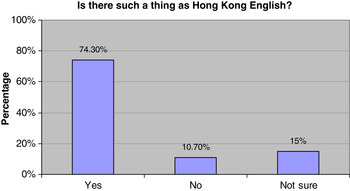
The students were also questioned directly about whether or not they believed HKE existed. Contrary to statements in the literature, around three-quarters (74.3%) of the subjects in our study answered in the affirmative, and only around one-tenth (10.7%) believed there was no such thing (see Figure 1).
Respondents' opinions on the existence of HKE

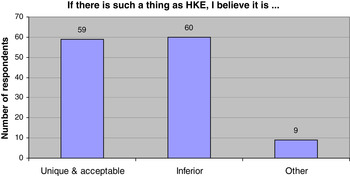
Those who answered ‘yes’ were asked a further question about the nature of Hong Kong English.Footnote 8 As can be seen in Figure 2, they were split roughly half-and-half over whether Hong Kong English was an acceptable variety or an inferior variety.Footnote 9
The opinions on HKE for respondents who believe it is a separate variety

There are two important points to note here. Firstly, in all, 59 out of 140 students stated they believed that HKE is an acceptable, valid variety of English. This represents around 42.1%, or just over two-fifths of the total number of students surveyed, a similar percentage to the figures for males in Bolton and Luke's (1999) survey who showed a preference for local norms. Although these are not majority figures, neither do they represent an insignificant minority, especially in the light of some of the claims in the literature. Secondly, comparing this result with the answers to the first question, we find that as many as 83.6% of the subjects believe they should imitate native speaker norms, yet 42.1% also believe HKE is a valid (and presumably, alternative) variety of English. What does this apparent contradiction tell us? As with the mainland Chinese (where similar proportions of ‘linguistic schizophrenia’ were uncovered), Hong Kongers are still largely exonormative, but there are definite signs beginning to appear of the awareness of a distinct variety of Hong Kong English. This would confirm Schneider's placement of HKE between Phases 2 and 3 (heading from exonormative stabilization into nativization), and would put HKE in a similar position to China English.
Future possibilities for Hong Kong and Hong Kong English
Assuming the long-term predictive power of Schneider's and Kachru's models, the above data enable us to make some tentative forecasts about the possible future of HKE. From tacit awareness of locally-grown norms, it is only one step towards acknowledgement and then overt acceptance of those norms. However, we need to remember that it took imported native speaker varieties such as American, Australian and New Zealand English up to two centuries to pass through this phase of ‘linguistic schizophrenia’, and for their own norms to gain overt prestige. And even for those Outer Circle regions that have moved into the stage of endonormative stabilization, and have begun to use their own norms in their education system, the process has not been without controversy, generally taking generations or even centuries (Schneider, Reference Schneider2007; Kirkpatrick et al., Reference Kirkpatrick, Deterding and Wong2008). Therefore, given that the nativization of HKE is apparently still at a relatively early stage according to the attitudes data, it would probably be unrealistic to expect HKE to emerge as a fully autonomous variety in the near future.
On the other hand, Kirkpatrick (Reference Kirkpatrick2007) has noted that because English is in huge demand at present, non-native English varieties are likely to develop and become recognized much more quickly than their Inner Circle counterparts were. An added influence in the case of Hong Kong is the example of rapidly-developing China English just across the border. If, just across the border, this becomes recognized as quickly as some linguists are predicting, this would almost certainly impact on the development and acceptance of a variety of HKE.
Political developments can also impact on linguistic developments. It is interesting to observe that the current semi-autonomous political situation in Hong Kong is reflected in the semi-autonomous state of both Cantonese and English; both varieties are in a kind of ‘no-man's land’. Discussing English in Hong Kong, Pang (Reference Pang2003) explains that there is a ‘linguistic purism’ perpetuated by the ongoing triglossic situation, due to the desire to keep standards high, and reverence for native speaker varieties, which seems to have fostered the continuing low status of a locally-grown variety, and therefore the contradictory norm orientations. The same would seem to hold true of attitudes towards Cantonese. The status of Cantonese – full language or ‘mere’ dialect? – has been a bone of contention in a very similar way to the status of English, and recent scholarship has postulated a new mid-zone classification.Footnote 10 Attitude studies have also uncovered a kind of Chinese ‘linguistic schizophrenia’ – the same tendency to be exonormative in ideal (valuing spoken Putonghua and Standard Written Chinese above spoken and written Cantonese) but endonormative in practice (spoken and written Cantonese being the everyday language of solidarity). It will be interesting to see what kind of reciprocal effect any future transformations in either Cantonese or English may have on the identity and linguistic values of Hong Kongers.
Joseph (Reference Joseph, Wright and Kelly-Holmes1997) links the two languages by remarking on the possible effects of future policy decisions regarding the use and development specifically of written colloquial Cantonese, which, like English, is not officially recognized. This, he believes, could force a cultural identity crisis, thereby having a spin-off effect on the functions and attitudes towards English usage in Hong Kong. In fact, many parallels exist between the development and current status of written Cantonese and that of English in Hong Kong. Both have been developing and expanding at roughly the same time and pace, with an initial history of a few centuries followed by a spontaneous rapid development and expansion beginning in the last few decades of the twentieth century.Footnote 11 As in the case of HKE, written Cantonese has already developed some of the features of a standard language (Snow, Reference Snow2008). Norms are slowly crystallizing simply through popular consensus, which is also happening (perhaps more unconsciously) in Hong Kong English. And as with an English-Chinese mixed-code, written Cantonese has become a symbol of identity, particularly among youth, although societal attitudes in both cases are ambivalent. Similar to how local features of English usage are decried, there is concern that written Cantonese is undermining students' ability to write Standard Written Chinese.
One factor that does favour the ongoing development of written Cantonese, however, is the fact that it is a youth phenomenon. This is also the case with English; it is worth noting that the results that are most positive towards acknowledging a variety of HKE have been gained from studies of the attitudes of students, whereas teachers seem to have been less open to accepting local norms. Also, today's young Hong Kongers are using a more basilectal, local-feature-laden style of English in their electronic communications (Pang, Reference Pang2003), which may also eventually aid in the indigenization of English. Presumably this could lead to the next generation developing ‘functional’ (as opposed to ‘genetic’) nativeness (Kachru & Nelson, Reference Kachru and Nelson2006), and this would give the variety more ability to expand its functions and social depth, thus advancing its nativization.
Conclusion
Going back to the question asked at the beginning of this article, as to whether Hong Kong English should be considered a variety in its own right, the answer could be: perhaps not yet – but wait and see! Both linguistically and attitudinally speaking, it seems to be already present in Hong Kong society in embryonic form. As Bolton (Reference Bolton2003: 116) believes, the data in this study indicate and Schneider's model predicts, ‘the essential conditions necessary for the emergence of such a variety may be already present in the community’, and so the real question relates not to its present status, but to its future possibilities – will it continue to nativize, developing more functions and social depth, and thus become more than a ‘still-born’ variety? And if so, how long will that process take? This may hinge partly on political or policy decisions, developments in neighbouring varieties such as China English, and on developments among local youth, who seem to be already innovating in both Chinese and English with colloquial styles of writing.
The linguistic situation seems to be highly flexible at present; therefore it awaits to be seen when (or even whether) English in Hong Kong will move into the next stage of formation, Schneider's Phase 4 of endonormative stabilization. While it seems to be a worldwide trend that the attitudinal conflict involving competing norms be resolved in favour of localized norms, on the basis of the data in this study this is unlikely to happen in the short-term future in Hong Kong. For instance, decisions that have been made in the education systems of other countries to enable them to be endonormative cannot yet be made in Hong Kong. In the meantime, there exists the peculiarity of ‘Hong Kongisms’ being produced in everyday English utterances of Hong Kongers, some of whom even deny the very existence of the variety. This in itself is a sign of a new variety in the formative stages. Thus the signs of ‘linguistic schizophrenia’ in Hong Kong seem to be a promising development in terms of the possible long-term autonomy of the variety.
Acknowledgement
I would like to thank my colleague Chan Hei Tao for her suggestions, help with the data collection and overall assistance with this project, and to Mari Uno for her timely practical help.
Appendix: Questionnaire about English in Hong Kong
Year ____________________ Major ________________________
Please circle the best answer, according to your own opinion.
1. I speak a variety of:
a) British English
b) American English
c) Hong Kong English
d) China English
e) Other (please specify) _________________________________________
2. I think that we should learn to speak English:
a) like the British
b) like the Americans
c) like other native speakers (e.g. the Australians)
d) in our own way
e) like educated non-native speakers from other countries
f) Other (please specify) _________________________________________
3. Do you think there is such a thing as ‘Hong Kong English?’
a) Yes → Go to Q. 4
b) No → Go straight to Q. 5
c) Not sure → Go to Q. 4
4. If yes, there is such a thing as Hong Kong English, then I believe it is:
a) A unique, acceptable variety of English spoken by educated Hong Kongers.
b) A variety of English but which is inferior to other varieties (e.g. British English, Australian English, etc)
c) Other (please specify) _________________________________________
5. If no, then what would you call the kind of English that Hong Kongers speak? (explain if necessary)
____________________________________________________
____________________________________________________
 JULIE GROVES first taught music, then worked as an administrator in New Zealand before retraining as a teacher of ESOL. Since then, she has taught English to Asians in New Zealand for two years, and in mainland China and Hong Kong for around eight years, and has also been involved with teacher training in mainland China. She completed her MA in Linguistics at Chinese University of Hong Kong, with her thesis topic being attitudes towards the status of Cantonese in Hong Kong. Her current research interests are self-access language learning, Hong Kong English, language attitudes and language planning. Until recently she was a Lecturer in English at the HKBU Language Centre. Email: jgrovesnz@yahoo.com