In many high yielding dairy herds it is today common practice to milk cows more than 2 times per day throughout the lactation, either by use of automatic milking systems (AMS) or 3 times milking in traditional systems (Lehmann et al., Reference Lehmann, Mogensen and Kristensen2018). However, increasing the milking frequency in early lactation might worsen energy status with a greater body fat mobilization whereas decreasing milking frequency has been shown to improve energy status (Phyn et al., Reference Phyn, Kay, Rius, Morgan, Roach, Grala and Roche2014). Increased fat mobilization with a greater loss of body condition score (BCS) is a risk factor for reproductive problems and health issues in early lactation (Barletta et al., Reference Barletta, Maturana, Carvalho, Del Valle, Netto, Rennó, Mingoti, Gandra, Mourão, Fricke, Sartori, Madureira and Wiltbank2017; Bedere et al., Reference Bedere, Cutullic, Delaby, Garcia-Launay and Disenhaus2018), which already is a general high-risk period (Erb et al., Reference Erb, Smith, Hillman, Powers, Smith, White and Pearson1984; Ingvartsen et al., Reference Ingvartsen, Dewhurst and Friggens2003).
Previous research has shown that milking cows once per day for the first 3–6 weeks post-partum followed by milking twice per day for the remaining lactation improved metabolic status and reduced bodyweight loss in early lactation (Remond et al., Reference Remond, Coulon, Nicloux and Levieux1999; McNamara et al., Reference McNamara, Murphy, O'Mara, Rath and Mee2008; Phyn et al., Reference Phyn, Kay, Rius, Morgan, Roach, Grala and Roche2014) and helped to maintain a functioning immune system and thus improved cow welfare (O'Driscoll et al., Reference O'Driscoll, Olmos, Moya, Mee, Earley, Gleeson, O'Brien and Boyle2012). However, reducing early lactation milking frequency to once daily milking also reduced milk production throughout the whole lactation. The effect of increased milking frequency through the whole lactation was larger from 1 to 2 milking per day compared with from 2 to 3 milking per day (Erdman and Varner, Reference Erdman and Varner1995; Stockdale, Reference Stockdale2006), and even up to 4 times per day increased daily milk production from dairy cows (Erdman and Varner, Reference Erdman and Varner1995; Stockdale, Reference Stockdale2006).
The smaller effect on daily milk yield between 2 and 3 milking per day compared with 1 and 2 milking per day, in combination with a negative correlation between peak milk yield and milk yield persistency (Chen et al., Reference Chen, Kok, Remmelink, Gross, Bruckmaier, Kemp and van Knegsel2016) could make up for a reduced daily milk production in early lactation on total lactation yield. The question driving this experiment was, therefore, if reducing milking frequency from 3 to 2 times per day in early lactation in high yielding dairy herds could reduce the risk of disease related to early lactation due to the unbalance between energy intake and milk yield, without a negative effect on milk production through the total lactation.
Hence, the objective of this experiment was to investigate the effect of reduced early lactation milking frequency on milk yield and persistency through lactation and early lactation fat mobilization, indicated by BCS and BHB in milk.
Material and methods
Experimental herds
Two commercial dairy farms were recruited for this experiment among the 157 herds (6% of total number of dairy herds) in Denmark that milked lactating cows three times per day in a traditional milking system (Lehmann et al., Reference Lehmann, Mogensen and Kristensen2018). To be able to enter the experiment, farms were required to base feeding of all lactating cows on one common TMR, and have the practical possibility for separate grouping of the early lactation cows from the remaining lactating cows as well as different milking frequencies of the early and later lactation groups of cows.
Herd I had 310 Holstein cows (26% first parity) that on average produced 12 500 kg ECM per cow per year, and herd II had 175 Holstein cows (47% first parity) that on average produced 12 300 kg ECM per cow per year. In herd I TMR consisted of, on dry matter basis, 46% roughage of which 79% was maize silage whereas the TMR in the second herd consisted of 58% roughage of which 92% was maize silage. In herd I, the average daily intake was 24.8 kg DM with 17.0% crude protein, 4.3% crude fat, 24.0% starch and 7.7 MJ NE per kg DM. In herd II, the average intake was 20.9 kg DM daily with 17.6% crude protein, 4.3% crude fat, 23.7% starch and 7.6 MJ NE per kg DM.
Both farms used manual visual observation of cows to detect heat. Insemination was either done by the farmer or an employee of the breeding company supplying semen.
Experimental setup and animals
Both farms used a standard herringbone-milking parlor and carried out 3 times daily milking. Herd I started milking at 5 am, 1 pm and 9 pm with a total duration per milking of 4 h 30 min, and the second herd started milking at 6 am, 1 pm and 9 pm with a total duration per milking of 1 h 30 min. The 3 experimental groups of early lactating cows were milked first at the morning milking, last at the afternoon milking and skipped the evening milking so as to achieve as even milking intervals as practically possible. The milking interval for cows milked twice daily was, therefore, 11 h 30 min and 12 h 30 min in herd I and in herd II 8 h 30 min and 15 h 30 min, respectively.
All treatments included a period after calving with 2 milkings per day followed by 3 milkings per day for the remaining lactation. The period with 2 milkings per day was planned to 1 week, 4 week and 7 week after calving respectively in each of the three treatments, with weekly movement of cows from the treatment group to the larger group of lactating cows milked 3 times per day.
All cows at dry off (n = 239) over a period of 10 months were assigned to blocks of 3 cows within farm depending on expected calving date and, within block, cows were randomly allocated to one of the three treatments.
At calving, the farmer and a research technician assessed the ability of each cow to survive and avoid culling within the first 100 d of lactation based on clinical diseases or calving difficulty. This removed 31 cows, and of the remaining 208 cows, five were removed because of lack of space in the experimental group. As part of the data handling 10 cows were removed because of wrong treatment allocation, and 9 were removed because of culling before 100 DIM. Hence, in total 184 cows, of which 81 in 2nd lactation and 103 in 3rd or greater lactations were included in the analysis of which 58 were on treatment 1, 61 on treatment 2 and 65 on treatment 3. Furthermore, 31 of the 184 cows did not complete minimum 305 d of lactation within the time of data collection or due to culling, leaving 153 cows for estimation of full 305 d lactation effect.
Data recording
Both farms were visited once per month by the same trained research technician, who scored all dry cows before entering the experiment and cows that had calved since the previous visit based on a protocol by Thomsen (Reference Thomsen2005). For that protocol, body condition (BCS) was scored from 1 (very lean) over 3 (average) to 5 (very fat) with increments of 0.25 (Ferguson et al., Reference Ferguson, Galligan and Thomsen1994), and lameness was scored on a scale from 1 (normal) to 5 (severely lame) with increments of 1 (Sprecher et al., Reference Sprecher, Hostetler and Kaneene1997). Furthermore, milk yield, fat- and protein content, somatic cell count (SCC) and beta-hydroxybutyrate content (BHB) in milk were recorded individually one day every second week (ICAR, 2022).
Data handling
A threshold of 0.14 mmol/l milk was used for BHB as an indicator of hyperketonemia (Santschi et al., Reference Santschi, Lacroix, Durocher, Duplessis, Moore and Lefebvre2016; Renaud et al., Reference Renaud, Kelton and Duffield2019). Energy-corrected milk (ECM) was calculated based on Sjaunja et al. (Reference Sjaunja, Bævre, Junkkarinen, Pedersen, Setälä, Gaillon and Chabert1991), which adjusts milk to a standard of 3.14 MJ per kg.
Individual lactation curves were fitted for milk yield, ECM yield and log SCC based on Wilmink (Reference Wilmink1987) using the nlme-package for R (Pinheiro et al., Reference Pinheiro, Bates, DebRoy and Sarkar2019). Hence, the curves were fitted as
 $$y_{{\rm ijk}} = a_{{\rm jk}} + b \times {\rm ex}{\rm p}^{{-}0.05\ast {\rm DI}{\rm M}_{\rm i}} + d_{{\rm jk}} \times {\rm DI}{\rm M}_{\rm i} + e_{{\rm ijk}}$$
Where yijk is the observation at DIM i from cow j in herd k, ajk and djk are curve parameters for cow j in herd k, b is the overall curve parameter for the exponential component, and e ijk is the error component.
Curves were first fitted with equation (1) to data from all cows for the first 100 d after calving and afterwards to data from calving to 305 d for those cows that completed 305 d. These curves were used to estimate individual daily milk yield, daily log SCC, peak milk yield, time of peak milk yield and milk yield persistency, where the latter was defined as the slope-parameter (d) from the equation of Wilmink (Reference Wilmink1987). Furthermore, curves were fitted to observations from the first 305 DIM of the previous lactation in order to estimate covariates. Hence, the first 100 DIM, the first 305 DIM and the previous 305 DIM in combination with kg milk, kg ECM and log SCC resulted in nine lactation curve models. Observations were removed as outliers if the residual was greater than 50% of the fitted value before the final model was fitted to data.
Statistical analysis
All response variables were analyzed with the following generalized linear model:
 $$y_{ijkm} = {\rm \mu } + TREATMENT_j + HERD_k + PARITY_m + e_{ijkm}$$
Where yijkm is the response variable at observation i in treatment j in herd k in parity m, μ is the least square mean, TREATMENT is the fixed effect of treatment (3 levels), HERD is the fixed effect of herd (2 levels), PARITY is the fixed effect of parity (2 levels, 2nd and 3rd or greater) and eijkm is the error component.
In addition, models for milk production variables and log SCC included the corresponding 305-d variable from the previous lactation as a covariate, and models for BCS and lameness in early lactation included the score from the preceding dry period as a covariate. All covariates were of the same unit as the response variable.
Continuous variables were analyzed with the normal distribution, count variables with the Poisson distribution and logical variables with the binomial distribution. Moreover, all variables were tested for a possible interaction effect between treatment and herd as well as between treatment and parity. The P-values of these interactions are included in Tables 2 and 3, albeit potential significant effects were not included in the reported estimates. Least square means were estimated with the emmeans-package (Lenth, Reference Lenth2022) in R, and all statistical analyses were done with R version 4.4.2 (R Development Core Team, 2022) using R Studio.
Results and discussion
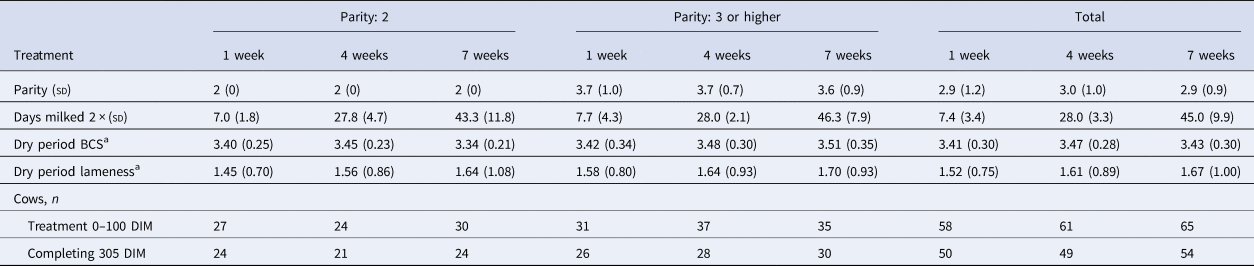
Cows were, in agreement with the planned treatments, on average milked 2 times daily for 7.4, 28.0 and 45.0 d, for the three treatments, respectively, after which they were milked 3 times daily for the remaining part of the lactation (Table 1). In addition, there were no difference across treatments in terms of dry period BCS, dry period lameness, dry period length (data not shown) or mean parity at the start of the experiment.
Treatment is weeks milked 2 × per day, parity, achieved days milked 2 × per day and number of cows on each treatment for 0–100 d in milk (DIM) and for 0–305 DIM, mean and standard deviation (sd)

a Dry period body condition score (BCS) and lameness measured in the dry period prior to treatment lactation.
The 9 lactation curve models described data well with a root mean square prediction error ranging from 9.9 to 19.7% of observed mean with between 95.2 and 99.6% of this error related to random disturbances, where the 3 models for log SCC in all cases resulted in the greatest number of outliers as well as the greatest error.
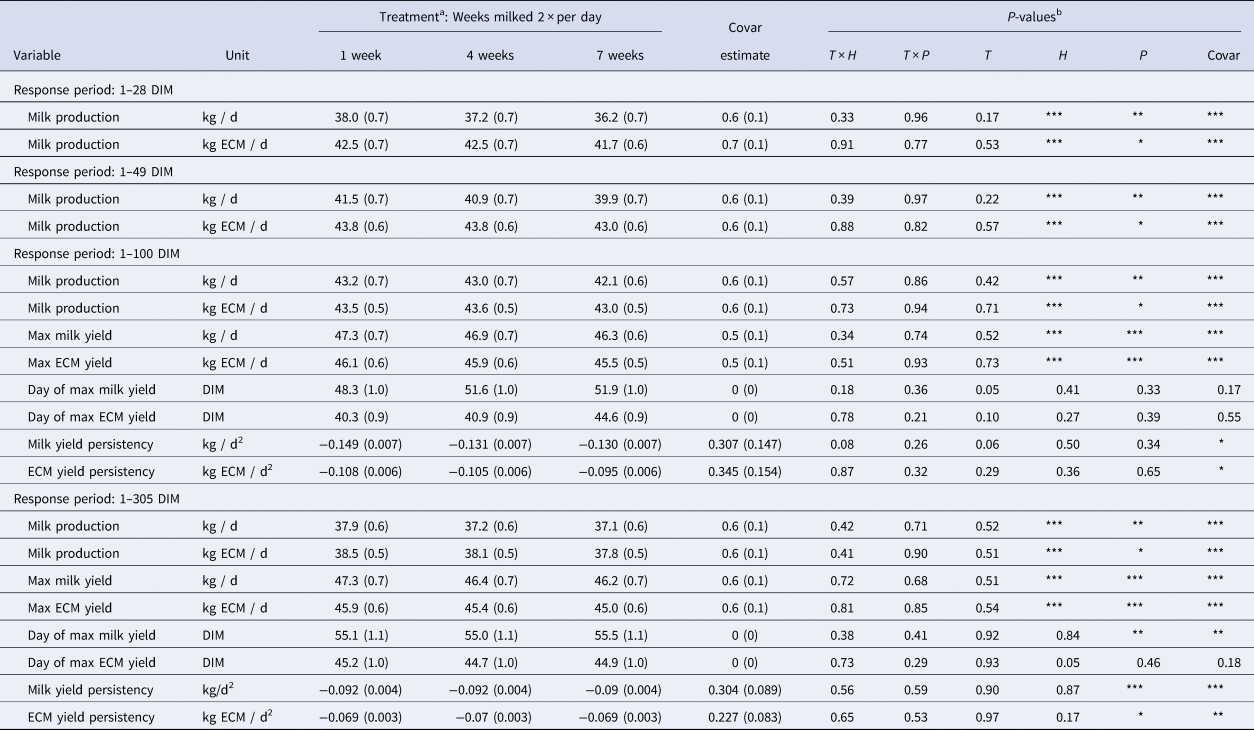
There was no immediate (1–49 DIM) effect of different milking frequency on milk production, either as kg milk or kg ECM (Table 2). This is in line with McNamara et al. (Reference McNamara, Murphy, O'Mara, Rath and Mee2008) comparing 2 times daily milking for 4 weeks with 3 times daily milking with cows at production level identical to this study. Phyn et al. (Reference Phyn, Kay, Rius, Morgan, Roach, Grala and Roche2014), with cows at a lower production level, and Soberon et al. (Reference Soberon, Ryan, Nydam, Galton and Overton2011), with cows at similar production level as in this study, both found a tendency to higher production in kg milk but no effect on kg ECM with 2 times milking compared to 3 times in early lactation. Extending the period to the first 100 DIM showed that cows milked 2 times daily for 7 weeks peaked 3.6 d later (P = 0.05) and persistency was numerically (non-significantly) improved with 19 g milk per day (P = 0.06) compared with treatment 1.
Milk production during the first 28, 49, 100 or 305 DIM in relation to treatment (weeks milked 2 times daily in early lactation, all followed by 3 times daily milking)

a Cows were milked 2 times per day for either the first 1 week, first 4 weeks or first 7 weeks after calving, followed by 3 times per day for the remaining lactation.
b T, Treatment; H, Herd; P, Parity; Covar: Covariate.
P-values: P < 0.05: *; P < 0.01: **; P < 0.001: ***. Estimates are least-square means based on individual effects, hence excluded interaction effects.
There was no significant lactation effect (305 DIM) on average daily milk production or lactation persistency (Table 2). Numerically, lactation yield was decreased by 153 kg ECM by milking cows 2 times daily for 4 weeks and 275 kg by milking cows 2 times daily for 7 weeks compared to 1 week. This is in agreement with Remond et al. (Reference Remond, Coulon, Nicloux and Levieux1999) and Phyn et al. (Reference Phyn, Kay, Rius, Morgan, Roach, Grala and Roche2014), where the shorter period (3 vs. 6 weeks) with changed milking frequency in early lactation reduced the lactation effect.
Milk production was numerically 4.9, 4.0, 2.6 and 2.2% less milk when milked 2 times daily for 7 weeks compared with milking 2 times daily for 1 week in the first 28, 49, 100 and 305 d after calving. In addition, persistency during 1–100 DIM in treatment 3 was higher compared to treatment 1, hence the difference between treatments appeared to diminish as the lactation progressed, which is in line with both Phyn et al. (Reference Phyn, Kay, Rius, Morgan, Roach, Grala and Roche2014) and McNamara et al. (Reference McNamara, Murphy, O'Mara, Rath and Mee2008). This supports the positive combination of reduced milking frequency in early lactation followed by more frequent milking to extend lactation (Sorensen et al., Reference Sorensen, Muir and Knight2008).
For the majority of production variables (Table 2), there was a significant herd effect, while there was no significant interaction between herd and treatment, nor between parity and treatment. The general effect across farms and parity is line with Soberon et al. (Reference Soberon, Ryan, Nydam, Galton and Overton2011) based on 4 farms with 4 times daily milking in early lactation followed by 2 times. The number of farms is too limited to actually analyze for specific management practice, but Soberon et al. (Reference Soberon, Ryan, Nydam, Galton and Overton2011) list management practices including nutrition, genetics and housing system, which in our study was identical at the two farms.
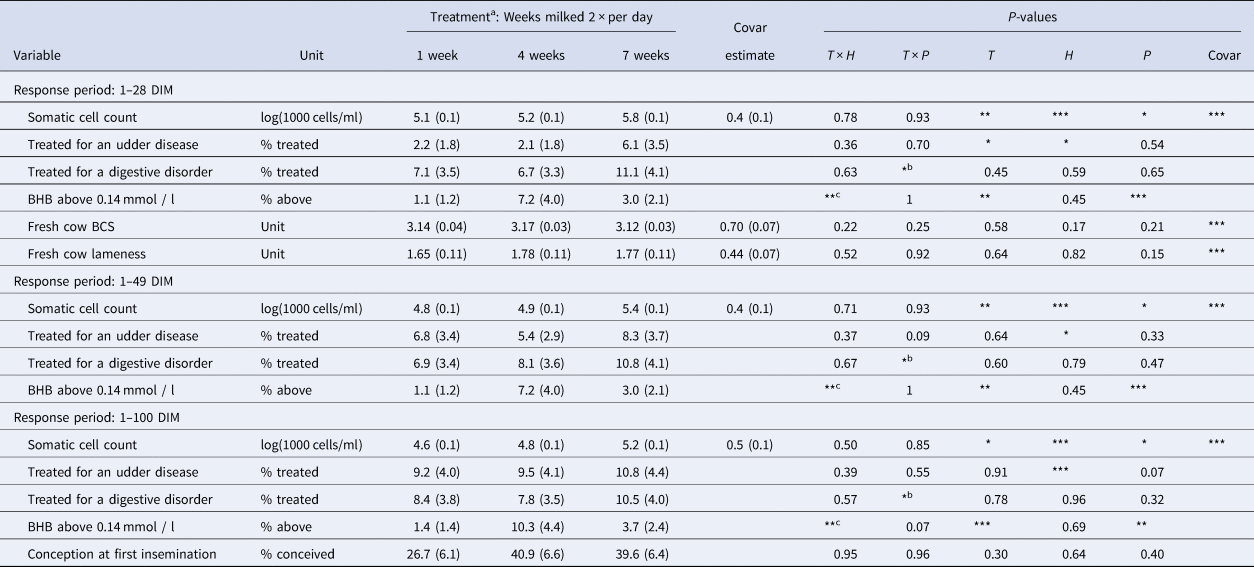
The effect of increased milk frequency on elevated BHB level found by others (Remond et al., Reference Remond, Coulon, Nicloux and Levieux1999; McNamara et al., Reference McNamara, Murphy, O'Mara, Rath and Mee2008) could not be confirmed although the treatment effect was significant (Table 3) as the highest proportion of cows with BHB above threshold was in treatment 2 (Table 3). A reduction in BCS in early lactation could also be used as an indicator of mobilization and, here, we found no effect of milking frequency in early lactation on fresh cow BCS (Table 3), which is in line with McNamara et al. (Reference McNamara, Murphy, O'Mara, Rath and Mee2008) and Soberon et al. (Reference Soberon, Ryan, Nydam, Galton and Overton2011), while Remond et al. (Reference Remond, Coulon, Nicloux and Levieux1999) and Andersen et al. (Reference Andersen, Friggins, Larsen, Vestergaard and Ingvartsen2004) showed a reduction in BCS and energy balance by increasing milking frequency in early lactation. Hence, both milk BHB and BCS indicate that body weight loss was not different across treatments in our study, which is supported by the identical prevalence of treatments for digestive disorders. The missing effect could be a consequence of a high management level in the two herds, based on a low frequency of cows treated for digestive disorder compared to average of 20% in Denmark as well as a low level of BHB, where herds with less than 15% of cows with BHB above 15 mmol/l is defined as not critical (SEGES, 2022).
Health, welfare and reproduction during the first 28, 49, 100 or 305 DIM in relation to treatment (weeks milked 2 times daily in early lactation followed by 3 times daily milking)

a Cows were milked 2 times per day for either the first 1 week, first 4 weeks or first 7 weeks after calving, followed by 3 times per day for the remaining lactation.
b The interaction effect between treatment and parity reflects that no second parity cows in treatment 2 were treated for a digestive disorder.
c BHB, the interaction reflects that herd I only had cows above threshold in treatment 2.
P-values: P < 0.05: *; P < 0.01: **; P < 0.001: ***. Estimates are least-square means based on individual effects, hence excluded interaction effects.
Average SCC increased by length of period with only 2 daily milking (Table 3). This corresponded with a greater prevalence of an udder disease treatment during the first 28 DIM (P < 0.05) and a numerically greater prevalence during the first 49 and 100 DIM, respectively. However, the difference between treatments 2 and 3 for average SCC and proportion of cows treated for an udder disease was also present during the first 28 DIM, which was while cows in both groups were milked 2 times per day. Hence, the difference in average SCC or udder disease prevalence may not be related with the experimental treatment. Despite this, our results are in line with Remond et al. (Reference Remond, Coulon, Nicloux and Levieux1999), who showed a higher SCC for cows milked fewer times per day in early lactation where the difference with control increased with increasing period with reduced milking frequency. In contrast, Phyn et al. (Reference Phyn, Kay, Rius, Morgan, Roach, Grala and Roche2014) did not show an effect on SCC, but their experiment included cows with lower levels of milk production and lower levels of SCC compared with our results.
Finally, treatment did not affect conception rate at first insemination, albeit it was numerically lower in treatment 1 compared with treatments 2 and 3. Herd I inseminated 48 and 66% of cows for the first time within the first 100 DIM in treatments 1 and 3, respectively, whereas herd II inseminated 75 and 72%, respectively (data not shown). Previous studies (McNamara et al., Reference McNamara, Murphy, O'Mara, Rath and Mee2008; Phyn et al., Reference Phyn, Kay, Rius, Morgan, Roach, Grala and Roche2014) has also shown identical conception rates across milking frequency.
In conclusion, we could not confirm our hypothesis that milking cows 2 times per day compared to 3 times in early lactation would reduce fat mobilization (BCS) and reduce peak yield. However, we found that milking cows 2 times per day for 4 or 7 weeks compared with 1 week after calving improved milk yield persistency during 1–100 DIM, which partially offset a numerical reduction in peak yield, and hence there was no significant effect of reducing early lactation milking frequency from 3 to 2 times daily up to 7 weeks after calving on lactation yield. In addition we found that SCC and frequency of treatment for udder diseases in the period 1–28 DIM increased when milking 2 times daily for 7 weeks compared to 1 or 4 weeks.
Acknowledgment
We wish to thank the two farmers for participating in the experiment, the local milk-recording agency for timely recording of milk yield and our research technician for accurate recording every month during the experiment. This study was funded by the Danish milk levy foundation.