I. INTRODUCTION
Titanium dioxide has been used as catalyst in photocatalytic reactions because of its high catalytic activity and stability.Reference Fujishima and Honda1 In particular, it has been accepted that titania with a large surface area and small particle size is desirable for photocatalytic reaction. The photocatalytic activity was dependent on the surface area of the catalysts with the higher the surface area and the higher the photocatalytic activity.Reference Deng, Yue and Gao2 So far, many efforts have been concentrated on the synthesis of photocatalysts in a high surface area form like aerogels.
As well known, aerogels are a class of nanostructured materials with high porosity, low density, and high surface area and have only recently begun to be studied for structural applications such as very efficient catalysts and catalytic supports,Reference Aravind, Shajesh, Mukundan, Krishna Pillai and Warrier3 nuclear waste treatment,Reference Kistler, Fischer and Freeman4 and adsorption materials.Reference Standeker, Veronovski, Novak and Knez5 In the present study, aerogels were prepared by sol–gel method combined with supercritical drying to avoid collapse of the original gel structure due to surface tension. However, it is still a challenge of preparing aerogels on a large scale at low cost. Many researchers have devoted themselves to reduce the cost of aerogel synthesis. In brief, there are two strategies. Schwertfeger et al.Reference Schwertfeger, Frank and Schmidt6 and Shen et al.Reference Zhou, Shen, Wu, Wu and Ni7 first concerned the cheap precursors such as sodium silicate, polyethoxydisiloxane (E-40), rice hull, oil ash. Meanwhile, Prakash et al.Reference Prakash, Brinker and Hurd8 and Rao et al.Reference Rao, Nilsen and Einarsrud9 involved a novel drying techniques at ambient pressure instead of supercritical drying. This process may replace the more costly and dangerous operation of supercritical drying.
The objective of the research was to find low-cost synthesis conditions to obtain the titania aerogels of better photocatalytic. In this paper, the titania aerogels were obtained by nonalkoxide sol–gel routes and drying under ambient pressure conditions. We also studied the photocatalytic degradation of dye over titania aerogels under light irradiation and applied to the different systems, which consists of photodegradation and adsorption. Furthermore, the as-prepared titania aerogels exhibited excellent hydrophobicity and durability under ultraviolet (UV) light irradiation.
II. EXPERIMENTS
A. Preparation of the titania aerogels
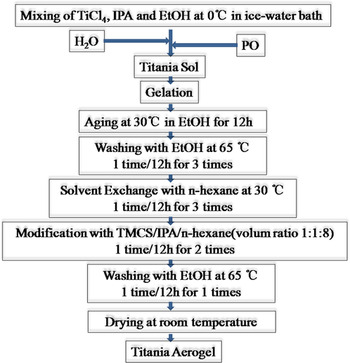
All chemicals used were analytical grade and used without further purification. TiCl4 as a nonalkoxide precursor and propylene oxide (PO) as a gelation agent were used for nonalkoxide sol–gel route. The titania aerogels were synthesized as the following procedure; the procedure can be divided into three general steps: (i) gel preparation, (ii) aging of the gel, and (iii) drying of the gel. The detailed procedure is shown in Fig. 1.
Process flowchart for titania aerogel preparation.

1. Gel preparation
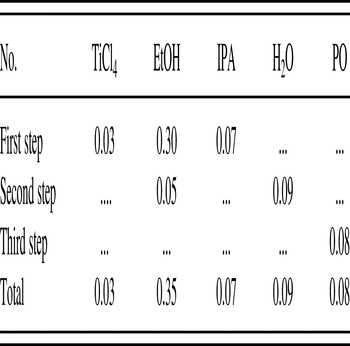
First, titanium tetrachloride (TiCl4) was mixed with ethanol (EtOH) and isopropanol (IPA) solution at 0 °C in ice water bath. After 30 min of stirring at 0 °C, H2O/EtOH solution and PO were added and stirred for 10 more minutes in ice water bath, respectively. The more numbers of the chemicals used are listed in Table I.
Numbers of moles of participating reactants for titania aerogel preparation.

2. Aging of the gel
The sol was stirred for 10 min and then was poured into container to gel and age at room temperature for 12 h. After gelation, the water in the hydrogels was exchanged with EtOH for three times in 36 h and then with n-hexane for three times in 36 h.
3. Drying of the gel
After aging process, the surface characteristics of the hydrogels were modified, by using trimethylchlorosilane (TMCS) agent in the IPA/n-hexane mixed solution (TMCS/IPA/n-hexane volume ratio: 1:1:8), from hydrophilic to hydrophobic. The unreacted TMCS was washed with hexane in 12 h. Then, the solvent was decanted and the gels were covered with an aluminum foil and dried at 60 °C/4 h, 80 °C/2 h, 120 °C/2 h, 200 °C/1 h, respectively. Finally, when the sample was cooled down to room temperature, we obtained the titania aerogels.
B. Characterizations of titania aerogels
The samples were characterized by powder x-ray diffraction (XRD) on a D/Max-γA x-ray diffractometer (Rigaku, Tokyo, Japan) at 40 kV and 100 mA with monochromatic Cu [divergence slit (DS) = scattering slit (SS) = 1°, receiving slit (RS) = 0.15 mm, scan 15–75°, the scope of scanning velocity 10°/min]; the Brunauer–Emmett–Teller (BET) specific surface area was obtained from N2 adsorption/desorption analyses at 77 K (NOVA 2000; Quantachrome, Boynton Beach, FL); the contact angle (θ) was measured by a contact angle meter (OCA20 contact angle analyzer; Data Physics, San Jose, CA). Transmission electron microscopy (TEM) images were taken on a TECNAI12 TEM instrument (Philips, Eindhoven, Netherlands). Scanning electron microscope (SEM) was used to investigate the microstructures of prepared aerogels. Ultraviolet–visible (UV–vis) diffuse reflectance spectra of the samples were measured by using a UV-2450 (Shimadzu, Kyoto, Japan) UV–vis spectrophotometer.
C. Photocatalytic activity of titania aerogels
The photocatalytic efficiency of titania aerogels were investigated by the extent of photodecolorization of Rhodamine B (Rh B) under visible irradiation by a self-ballasted 100 W xenon lamp (λ ≥ 410 nm, luminous flux = 15 lm/W). The titania aerogels (100 mg) were added to 100 mL of Rh B (10 mg/L) solution. At given time intervals, a little amount of reaction solution for UV spectroscopy analysis was taken from the photoreactor every 30 min. And the samples were also investigated by dye without visible irradiation. In line with the absorbance, the degradation (D e) was estimated as follows:
 $$D_{\rm{e}} \, = \,[(C_0 - C)/C_0 ] \times 100\% \, = \,[(A_0 - A)/A_0 ] \times 100\% \quad,$$
where C 0 and C are the concentrations of Rh B before and after experiment, respectively. A 0 and A are the corresponding absorbance values before and after degradation, respectively.
III. RESULTS AND DISCUSSION
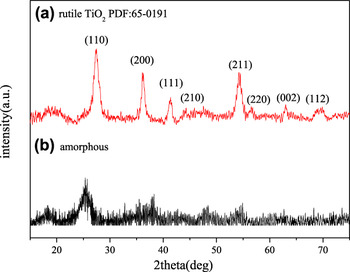
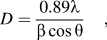
XRD patterns of titania aerogels and samples without modification route in rutile and amorphous phases are shown in Figs. 2(a)–2(b), respectively. In Fig. 2(a), XRD patterns exhibited strong diffraction peaks at 27°, 36°, and 55° indicating TiO2 in the rutile phase. On the other hand, in Fig. 2(b), XRD patterns exhibited strong diffraction peaks at 25°indicating TiO2 in the amorphous phase. All peaks are in good agreement with the standard spectrum (JCPDS No. 65-01915). Therefore, it is obvious that the modification process controlled in sol–gel synthesis determines the crystal type and phase content. The phase transition could happen when the added organic molecules react with the surface of TiO2 nanocrystallites to form covalent or ionic bonds.Reference Murakoshi, Hosokawa, Tanaka, Saito, Wada, Sakata, Mori and Yanagida10 Based on the Scherrer’s equation shown below,Reference Wang, Li, Li, Zuo and Wang11 the average crystalline size for titania aerogels was estimated to be 9 nm:
 $$D = {{0.89{\rm{\lambda }}} \over {{\rm{\beta }}\cos {\rm{\theta }}}}\quad,$$
XRD patterns of titania aerogels.

where D is the average particle size, λ = 0.15406 nm (XRD wave length corresponding to Cu Kα radiation), β is half-height width of the diffraction peak of rutile (110) crystal plane, θ is the corresponding diffraction angle.
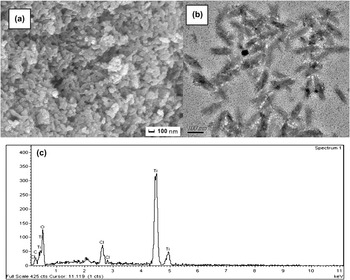
Figures 3(a)–3(b) show the SEM and TEM graphs of titania aerogels, which indicate that the prepared aerogels are porous material with a continuous network structure. The particle distribution of aerogels is uniform. Figure 3(c) is the energy dispersive x-ray (EDX) spectrum obtained from samples. The result from EDX displays that the products are composed of the elements of Ti, C, Cl, and O. The element of C was generated by the hydrophobic groups of the samples. Quantitative EDX analysis shows that the atom ratio of Ti and O is nearly 2:1, indicating that the composition of the products is TiO2.
SEM and TEM images of titania aerogels.

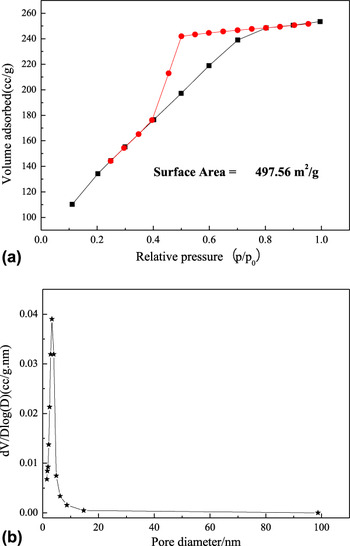
The textural properties of the titania aerogels were also investigated by the N2 adsorption–desorption and pore size distribution analyses. Figure 4(a) shows the N2 adsorption–desorption isotherm. The aerogel exhibits type IV adsorption isotherm, which is recognized to indicate the presence of mesoporous. The pore size distribution showed in Fig. 4(b) was measured by Barret–Joyner–Hatenda model. The BET surface area and average pore size are 497.56 m2/g and 3.2 nm, respectively. This indicates the success of the modification procedure in reducing the relevant surface tension force during the drying process.
Isotherm and pore distribution curves of titania aerogels.

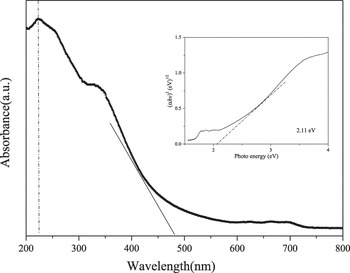
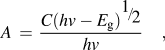
It was reported that the photocatalytic activity was affected by samples’ capability of light absorption and the absorption threshold.Reference Hu, Li, Li, Tang and Sun12 The UV–vis diffusion reflectance spectra of the as-prepared titania aerogels are shown in Fig. 5. A strong absorption due to the interband transition was observed about 400 nm.Reference Hu, Li, Li, Tang and Sun12 Generally, three absorption bands at 220, 260, and 300 nm associated to Ti species are observed in titania-modified samples. The absorption band at 220 nm is attributed to isolated tetrahedral Ti species. This electronic transition is assigned to an O2− → Ti4+ charge transfer transition of tetrahedral Ti species. Meanwhile, the band at 300 nm is assigned to either octahedrally coordinated or polymeric Ti species. Obviously, some of the framework tetrahedral Ti was transformed to extra framework octahedral Ti structure.Reference Lee, Nur and Hamdan13 The band gap, E g, is usually estimated from the absorption edge wave length of the interband transition according to the following formula:
 $$ A\, = \,{{C(hv - E_{\rm{g}} )^{{\raise0.7ex\hbox{$1$} \!\mathord{\left/ {\vphantom {1 2}}\right.\kern-\nulldelimiterspace}\!\lower0.7ex\hbox{$2$}}} } \over {hv}}\quad,$$
UV–vis diffuse reflection spectra of the prepared titania aerogel. The inset is band gap evaluation from the plots of (αhν)2 versus hν.

where A is the absorbency, h is Planck’s constant, and C is the proportional coefficient. The energy of the band gap of the titania aerogels estimated from the absorption edges is 2.11 eV. These results point out that the titania aerogels have a band gap suitable for photocatalytic degradation of organic pollutants under visible light irradiation.
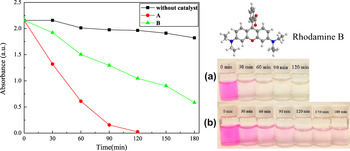
The photocatalytic activities of samples were evaluated by degradation of Rh B aqueous solution as a model reaction under visible light irradiation. As well known, the photocatalytic activity of titania aerogels is strongly dependent on the crystalline structure and the specific surface area.Reference Kim, Suh, Park and Hong14 As shown in Fig. 6, the blank test demonstrates that the degradation of Rh B is extremely slow without any photocatalyst under visible light irradiation. Apparently, it is seen that under the irradiation conditions, samples exhibit much higher activity than under the darkness conditions samples. This is because under the light irradiation, the photochemical reaction plays a dominant role in the process. The decolorization rate is more obviously increased as the times of radiation were extended and finally complete decomposition.
Photocatalytic degradation of Rh B aqueous solution using titania aerogel (A, under irradiation; B, without light irradiation).

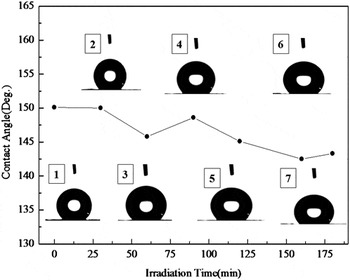
The hydrophobicity of the samples can be directly compared with the contact angles measurements. The contact angles of the aerogels prepared with the modification process to be 145 ± 5°. It is more interesting to uncover the UV-durable hydrophobic property of the titania aerogels. As shown in Fig. 7, the hydrophobic rutile titania aerogels could maintain almost water contact angles after exposure under 50 W Hg lamp (λ ∼ 265 nm) for 180 min. Considering that the intensity of UV irradiation was stronger than that in sunlight, the result clearly demonstrates that the titania aerogels have a rather durable hydrophobicity and may have potential applications in our daily life.
Evolution of water contact angle on titania aerogels under irradiation.

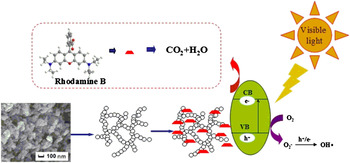
The scheme of photodegradation of Rh B on titania aerogels under irradiation is shown in Fig. 8. The hydrophobic rutile titania aerogels were modified with the organic groups; their surface became hydrophobic but possessed higher adsorption capacity to the organic pollutants. The high adsorption capability is favorable to enrich the organic compounds around the photoactive centers. Hence, the photocatalytic degradation of organics in the aqueous solution is not only influenced by activity of catalysts but also affected by the adsorption property of the material.Reference Zhu, Xie, Chen and Jiang15
Scheme of the photodecolorization of Rh B on titania aerogels under irradiation.

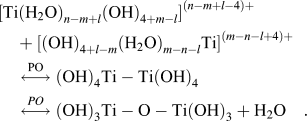
The sol–gel mechanism of the hydrophobic rutile titania aerogels could be divided into four parts to discuss, as shown in below chemical equations.
(i) Hydration:
 $${\rm{Ti}}^{4 + } + n{\rm{H}}_{\rm{2}} {\rm{O}} \to [{\rm{Ti}}({\rm{H}}_{\rm{2}} {\rm{O}})_n ]^{4 + } \quad.$$
(ii) Hydrolysis:
 $$[{\rm{Ti}}({\rm{H}}_{\rm{2}} {\rm{O}})_n ]^{4 + } \lleftrightarrow [{\rm{Ti}}({\rm{H}}_{\rm{2}} {\rm{O}})_{n - 1} ({\rm{OH}})]^{(n - 1) + } + {\rm{H}}^ + \quad,$$
 $$[{\rm{Ti}}({\rm{H}}_{\rm{2}} {\rm{O}})_{n - m} ({\rm{OH}})_m ]^{(n - m) + } \lleftrightarrow [{\rm{Ti}}({\rm{H}}_{\rm{2}} {\rm{O}})_{n - m - 1} ({\rm{OH}})_{m + 1} ]^{(n - m - 1) + } + {\rm{H}}^ + \quad.$$
(iii) Condensation:
 $$[{\rm{PO}}] + [{\rm{Ti}}({\rm{H}}_{\rm{2}} {\rm{O}})_n ]^{4 + } \lleftrightarrow [{\rm{Ti}}({\rm{H}}_{\rm{2}} {\rm{O}})_{n - 1} ({\rm{OH}})]^{(n - 1) + } + [{\rm{PO}}]{\rm{H}}^ +\quad ,$$
 $$[{\rm{PO}}]{\rm{H}}^ + + {\rm{Cl}}^ - \buildrel {{\rm{ring\, opening}}} \over \longrightarrow {\rm{HOCH}}_2 {\rm{CH}}({\rm{Cl}}){\rm{CH}}_3 \quad,$$
 $$\eqalignb{ [{\rm{Ti}}({\rm{H}}_{\rm{2}} {\rm{O}})_{n - m + l} ({\rm{OH}})_{4 + m - l} ]^{(n - m + l - 4) + } + [({\rm{OH}})_{4 + l - m} ({\rm{H}}_{\rm{2}} {\rm{O}})_{m - n - l} {\rm{Ti}}]^{(m - n - l + 4) + } \cr\quad\buildrel {{\rm{PO}}} \over \longleftrightarrow ({\rm{OH}})_4 {\rm{Ti}} - {\rm{Ti}}({\rm{OH}})_4 \cr\quad \buildrel {PO} \over \longleftrightarrow ({\rm{OH}})_3 {\rm{Ti}} - {\rm{O}} - {\rm{Ti}}({\rm{OH}})_3 + {\rm{H}}_2 {\rm{O}}\quad{\rm{.}} \cr} $$
(iv) Modification:
 $$({\rm{CH}}_3 )_3 {\rm{SiCl}} + ({\rm{CH}}_3 )_2 {\rm{CHOH}} \to ({\rm{CH}}_3 )_3 {\rm{Si}} - {\rm{OCH}}({\rm{CH}}{}_3)_2 + {\rm{HCl\quad,}}$$
 $$({\rm{CH}}_3 )_3 {\rm{SiCl}} + {\rm{CH}}_3 {\rm{CH}}_2 {\rm{OH}} \to ({\rm{CH}}_3 )_3 {\rm{Si}} - {\rm{OCH}}_2 {\rm{CH}}{}_3 + {\rm{HCl}}\quad,$$
 $$({\rm{CH}}_3 )_3 {\rm{Si}} - {\rm{OCH}}({\rm{CH}}{}_3)_2 \,+ \,\equiv \,{\rm{Ti}} - {\rm{OH}} \to \equiv \,{\rm{Ti}} - {\rm{O}} - {\rm{CH}}({\rm{CH}}_3 )_2 + ({\rm{CH}}_3 )_3 {\rm{Si}} - {\rm{OH}},$$
 $$({\rm{CH}}_3 )_3 {\rm{Si}} - {\rm{OCH}}_2 {\rm{CH}}{}_3 \,+ \,\equiv \,{\rm{Ti}} - {\rm{OH}} \to \equiv \,{\rm{Ti}} - {\rm{O}} - {\rm{CH}}{}_2{\rm{CH}}_3 + ({\rm{CH}}_3 )_3 {\rm{Si}} - {\rm{OH}}\quad,$$
 $$({\rm{CH}}_3 )_3 {\rm{Si}} - {\rm{OCH}}_2 {\rm{CH}}{}_3 + \equiv \,{\rm{Ti}} - {\rm{OH}} \to \equiv \,{\rm{Ti}} - {\rm{O}} - ({\rm{CH}}_3 )_3 \cr\quad+ {\rm{CH}}_3 {\rm{CH}}_2 {\rm{Si}} - {\rm{OH}}\quad.$$
(i) Hydration: the existing forms of TiCl4(inorganic metal salt) in solution are normally complex ions. Specifically, the metal salt in EtOH–water solution mainly exists in the form of hydrated ion.Reference Gash, Satcher and Simpson16
(ii) Hydrolysis: the reaction produces hydrogen ion and makes the solution partially acidic, as shown in chemical equations.
(iii) Condensation: after adding PO, the balanced reaction of hydrolysis turns right and the neutral matter is produced.Reference Du, Zhou, Shen, Gui, Zhong, Liu, Zhang and Wu17 Mechanistically, the dissolved quotation acts as an acid and protonates the added epoxide, thus activating it toward ring opening by a nucleophile. After that, the colloid particles grow large enough; particles will contact and connect with other particles.Reference Hüsing and Schubert18
(iv) Modification: during the surface modification in the presence of solvent mixtures, TMCS reacted with the protic IPA and EtOH mixture, resulted in isopropoxytrimethylsilane and methoxytrimethylsilane as shown in the reactions [Eqs. (11) and (12)]. The chemical reaction of isopropoxytrimethylsilane and methoxytrimethylsilane reacts with Ti–OH of the internal surface as shown in Eqs. (13) and (14) resulted in hydrophobic pore surface. The obtained EtOH/IPA/TMCS mixture was separated out of the gel pore.Reference Rao, Rao and Bangi19 After modification, the hydroxyl on the surface is replaced by organic groups, which are responsible for hydrophobicity of the aerogel.
IV. CONCLUSIONS
In summary, a nonalkoxide sol–gel route, together with surface modification and ambient pressure drying processes, was developed to prepare the titania aerogels. The results showed that the titania aerogels of rutile crystallized materials have a plenty of hydrophobicmethyl group attaching to their surface; they also exhibited higher photocatalytic activity and were easier to be recycled from the solution, suggesting the potential application in waste water treatment. Furthermore, the sol–gel mechanism of the hydrophobic rutile titania aerogels was divided into four parts for discussion, which are hydration, hydrolysis, condensation, and modification, respectively. Finally, other single metal aerogels may be facility prepared through a chemical way; however, there is dispute on the formation mechanisms of the titania aerogels.
ACKNOWLEDGMENTS
This work was partly supported by the National Natural Science Foundation of China (No. 21003065), Natural Science Foundation of Jiangsu Province (BK2010166), Industry High Technology Foundation of Jiangsu (BE2010144), Scientific Innovation Research of College Graduate in Jiangsu Province (CXZZ12 0682), and Research Foundation for Talented Scholars of Jiangsu University (10JDG133).