Pediatric anxiety disorders are common, with an estimated prevalence rate between 10–20% of school-aged children, and they confer significant impairment in social, familial and academic functioning (Swan & Kendall, Reference Swan and Kendall2016). Avoidance of anxiety-provoking situations is a hallmark of these disorders and is theorised to contribute to functional impairment (Raggi et al., Reference Raggi, Samson, Felton, Loffredo and Berghorst2018). A core goal of cognitive behavioural therapy (CBT), the most empirically supported psychosocial treatment for pediatric anxiety disorders, is to reduce behavioural avoidance by having youth gradually face their fears, also referred to as engaging in ‘exposures’ (Kendall et al., Reference Kendall, Robin, Hedtke, Suveg, Flannery-Schroeder and Gosch2005). Toward that end, an initial step in CBT is to construct a fear or avoidance hierarchy that is comprised of a list of situations that the youth avoids. Each situation is rated in terms of the frequency of avoidance and/or severity of anxiety experienced in the specific situations (McKay, Reference McKay, Storch, McGuire and McKay2018). For instance, an avoidance hierarchy for a child with separation anxiety who avoids separating from their parent might include sleeping alone in their bed, going to a friend’s home without the parent, or being alone in a room in their own home.
When youth avoid anxiety-provoking situations in the classroom, however, identifying these school-based situations for outpatient therapists presents a challenge. One solution is to obtain teachers’ observations of avoided situations, which could be a valuable contribution to the youth’s treatment plan. Unfortunately, outpatient providers rarely get input from teachers regarding school-based avoided situations. In fact, teachers’ reports of avoided situations by students with anxiety is limited. One reason may be due to their engagement in ‘accommodation’ as a way to minimise student anxiety and related disruptions to the class during the school day.
‘Accommodation’ defined from a psychological and treatment perspective refers to allowing (unintentionally or intentionally) a child to avoid what they are afraid of (Lebowitz et al., Reference Lebowitz, Woolston, Bar-Haim, Calvocoressi, Dauser, Warnick, Scahill, Chakir, Shechner, Hermes, Vitulano, King and Leckman2013) and has primarily been studied as a parenting response to child anxiety. For instance, a parent whose child is fearful and avoidant of speaking to adults may speak for them rather than encourage the child to speak for themselves (Thompson-Hollands et al., Reference Thompson-Hollands, Kerns, Pincus and Comer2014). Accommodation is a key factor associated with the maintenance of anxiety and related behavioural avoidance of anxiety-provoking situations (Kagan et al., Reference Kagan, Peterman, Carper and Kendall2016). Accommodation is theorised to reinforce anxiety through negative reinforcement and may also increase the child’s perception of threat, reduce the child’s perceived control over threat, and ultimately increase the child’s anxiety and avoidance (see Iniesta-Sepulvida et al., Reference Iniesta-Sepúlveda, Rodríguez-Jiménez, Lebowitz, Goodman and Storch2021). The relation between child avoidance and adult accommodation is likely reciprocal and is often a response to a child’s direct request and/or because it is an effective way to reduce child distress in the short term (Meyer et al., Reference Meyer, Clapp, Whiteside, Dammann, Kriegshauser, Hale, Jacobi, Riemann and Deacon2018). However, over time, accommodation behaviours maintain anxiety and facilitate further avoidance through both negative reinforcement processes for both child and adult (Ginsburg et al., Reference Ginsburg, Siqueland, Masia-Warner and Hedtke2004; Hudson & Rapee, Reference Hudson, Rapee, Heimberg, Turk and Mennin2004). While a substantive literature documents parents’ perceptions of child avoidance and parental accommodation (Iniesta-Sepulvida et al., Reference Iniesta-Sepúlveda, Rodríguez-Jiménez, Lebowitz, Goodman and Storch2021), little is known about school-based accommodation in general and teachers’ accommodation of student anxiety specifically.
Among the few studies that have examined school-based accommodations for students with anxiety (e.g., Conroy et al., Reference Conroy, Greif Green, Phillips, Poznanski, Coxe, Kendall and Comer2020; Green et al., Reference Green, Comer, Donaldson, Elkins, Nadeau, Reid and Pincus2017), there is some indication that accommodation of avoidance, which is counter to long-term anxiety reduction, may be present. Indeed, ‘accommodation’ defined from an educational perspective involves supports, adjustments and/or resources that enhance a student’s learning. Such accommodations are often intentionally included in 504 Plans or Individualised Education Plans. For youth with anxiety, this may include allowing the student to leave the classroom when anxious or taking an exam in a private room (see Green et al., Reference Green, Comer, Donaldson, Elkins, Nadeau, Reid and Pincus2017; Green et al., Reference Green, Guzmán, Didaskalou, Harbaugh, Segal and LaBillois2018). As noted, some school-based accommodations, while well intended, may enable the student to avoid anxiety-provoking situations but this may inadvertently reinforce and maintain anxiety.
In one of the first studies to examine accommodations for students with anxiety, Green and colleagues (Reference Green, Comer, Donaldson, Elkins, Nadeau, Reid and Pincus2017) gathered data using a measure developed by the research team to assess school-based anxiety experiences, impairments and supports. Participants were 51 youth and their mothers seeking treatment at an outpatient clinic. Relevant findings revealed that more than half of the sample were receiving at least one accommodation or service at school and the most frequently reported accommodation was permission to leave the class. In a more recent study, Conroy and colleagues (Reference Conroy, Greif Green, Phillips, Poznanski, Coxe, Kendall and Comer2020) examined the use of accommodations for students with anxiety by surveying school staff. Specifically, participants were 315 teachers, school nurses and counsellors who completed five questionnaires evaluating their experiences and consciousness of student mental health and use of accommodations. Relevant results indicated that all school staff who identified anxiety as being their top concern also endorsed using at least one type of school-based accommodation. Half of the sample endorsed using counterproductive and potentially problematic accommodations (e.g., letting an anxious student sit and not participate). The researchers concluded that interventions to reduce the use of avoidance-oriented accommodations or supports with anxious students in school settings are warranted. While these studies involved school-aged children, a recent study (Kagan et al., Reference Kagan, Peterman, Carper and Kendall2016) found that age was not significantly associated with levels of accommodation, suggesting accommodation might be prevalent across all developmental stages and worthy of study among older youth as well.
In sum, data is accumulating that documents school-based, anxiety-related avoidance and accommodations. Additional research identifying frequently avoided classroom situations by teachers could increase identification of problematic anxiety and facilitate creating avoidance hierarchies of situations that could be targeted by teachers or treatment providers. In addition, in light of extant research showing the role of parental accommodation of anxiety and the use of accommodation of avoidance by school staff, examining teachers’ level of accommodation is needed to reveal the extent to which teachers are engaging in accommodating behaviours that enable avoidance, and whether these behaviours are associated with higher avoidance or anxiety. Finally, because student gender and type of presenting problem may play a role in avoided situations and teacher accommodation (e.g., Allen & Lerman; Reference Allen and Lerman2018; Green et al., Reference Green, Guzmán, Didaskalou, Harbaugh, Segal and LaBillois2018), additional examination of these factors may be informative. Given that youth spend the majority of their day — for the majority of the calendar year — in school under the supervision of their teachers, these data are critical and have direct applied implications, such as training teachers in the importance of identifying and reducing accommodation to improve outcomes for students with anxiety.
The current study examined: (1) teachers’ reports of avoided situations in the classroom among elementary students with elevated anxiety and whether these situations varied by gender and primary anxiety diagnosis; (2) the frequency of teachers’ use of accommodation; and (3) the association between teacher accommodation behaviours and student avoidance and global anxiety. Based on the parental accommodation literature, we hypothesised that teachers would report engaging in daily accommodation of student anxiety and that higher levels of teachers’ accommodation would be associated with higher levels of student avoidance and overall anxiety.
Methods
Participants
Child participants
Thirty-one students from New England public elementary schools participated. Students’ mean age was 7.7 years (SD = 1.8). Fifty-eight percent of the students were female. In terms of race or ethnicity, the majority of students were White (71%) and non-Hispanic/Latino (84%). Three students (10%) were receiving special education services and six (16%) qualified for free or reduced-price lunch. Students’ diagnostic status and specific anxiety disorders are listed in Table 1.
Student demographic characteristics (N = 31)

Teacher participants
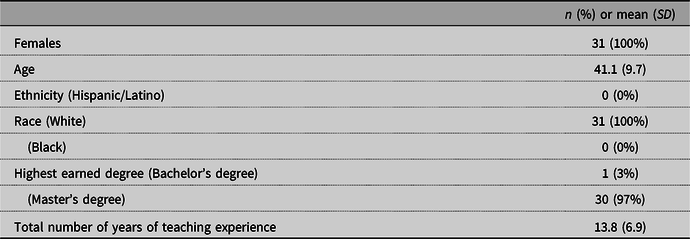
Thirty-one elementary school teachers participated. Demographic and educational backgrounds are presented in Table 2. All teachers were White, non-Hispanic females. Teachers’ mean age was 41 years (SD = 9.7) and had an average of 13.8 (SD = 6.9) years of teaching experience.
Teacher demographics and professional characteristics (N = 31)

Measures
Student Avoidance Hierarchy
This measure, modified by the researchers for the current study, is based on similar measures used in other anxiety treatment studies (Ginsburg et al., Reference Ginsburg, Drake, Muggeo, Stewart, Pikulski, Zheng and Harel2021; Jensen-Doss et al., Reference Jensen-Doss, Ehrenreich-May, Nanda, Maxwell, LoCurto, Shaw, Souer, Rosenfield and Ginsburg2018). It asks teachers to list up to three situations that the identified student with anxiety avoids in the classroom or at school. Each listed situation is then rated by the teacher on a scale of 1 (Never avoid) to 7 (Always avoid). Total avoidance scores on this measure could range from 3 to 21, with a score of 3 indicating no/low avoidance and 21 indicating a high level of avoidance. Each listed situation was categorised into one of six domains by trained coders. Coders were two psychologists and two psychology research assistants with expertise in child anxiety. The domains included: (1) Individual Performance (i.e., an activity or situation in which the student is engaging in academic work that will not be directly evaluated by peers; for example, reading assignment alone, taking a test, completing homework); (2) Group Performance (i.e., an activity or situation in which the student is engaging in academic work that will be directly observed and/or evaluated by peers; for example, answering a question in class, working on a group project, reading aloud); (3) Social Interaction (any nonacademic interaction or situation involving interpersonal interaction with another child and/or an adult; for example, lunchtime, playing at recess, making friends); (4) Separation (a situation, event or activity that requires the student to separate from an attachment figure, typically a parent or teacher, and/or to be alone; for example, being alone in the hallway, leaving parent during drop-off, getting on the bus); (5) Self-regulation (a situation or activity in which a student displays an emotional response disproportionate to the situation and/or has difficulty engaging with or completing a task due to difficulty with emotional control or attention; for example, shutting down, freezing up); (6) Other (any avoidance item that is not accurately described by one of the above categories). Each avoidance situation received only one coded domain. In order to assess the reliability of these domains, interrater reliability was assessed using three coders who rated each item independently. The resulting overall interrater agreement was 0.97. If a coded domain for an avoidance item was not agreed upon independently, the coders discussed the individual item and a coded domain was agreed upon for use in the current analyses.
Teacher Accommodation Scale for Anxiety (TASA)
The TASA is a teacher completed measure reflecting the degree to which they engage in anxiety-related accommodation behaviours of student anxiety. The measure was adapted by the study team from the widely used Family Accommodation Scale, Anxiety (FASA; Lebowitz et al., Reference Lebowitz, Woolston, Bar-Haim, Calvocoressi, Dauser, Warnick, Scahill, Chakir, Shechner, Hermes, Vitulano, King and Leckman2013). Specifically, nine items were used to measure the frequency of teacher participation in anxiety-related behaviours and modification of teacher or classroom functioning (e.g., ‘Have you modified classroom activities because of this student’s anxiety?’) that were rated on a 5-point scale ranging from Never (0) to Daily (4) and provide a Total Accommodation Score. In evaluations of the parent/caregiver version of this measure (FASA), the Total Accommodation scale had high internal consistency (alpha = .90) and displayed evidence of convergent and divergent validity (Lebowitz et al., Reference Lebowitz, Woolston, Bar-Haim, Calvocoressi, Dauser, Warnick, Scahill, Chakir, Shechner, Hermes, Vitulano, King and Leckman2013). In the current version, Cronbach’s alpha for the nine items was also acceptable (alpha = .83).
Anxiety Disorders Interview Schedule for DSM-IV, Child and Parent Versions (ADIS; Silverman & Albano, Reference Silverman and Albano1996)
The ADIS is a semistructured diagnostic interview designed to assess for anxiety disorder diagnoses and severity. Evaluators were psychologists, postdoctoral fellows or graduate students in psychology who met stringent reliability criteria prior to administering the ADIS to study participants. Training criteria included readings, matching a minimum of three gold standard ADIS interviews, and being observed (and approved) by a senior evaluator. Evaluators assign a severity/impairment rating for each disorder using the Clinician Severity Rating (CSR, range 0–8; 4 required to assign a diagnosis). The ADIS has demonstrated good internal consistency and interrater reliability (Silverman et al., Reference Silverman, Saavedra and Pina2001). The ADIS was used in this study at baseline to characterise the student sample and examine classroom avoidance by primary diagnosis.
Clinical Global Impression — Severity (CGI-S) Scale (Guy, Reference Guy1976)
The CGI-S, completed by an independent evaluator, provides a global rating of anxiety severity and impairment on a scale of 1 to 7, with higher numbers reflecting more severe symptoms of anxiety.
Teacher Background Form
This form was developed by the study team and was completed by teachers to collect the demographic information used in the current study.
Procedures
Data for the current study were collected as part of a larger project called the Teacher Anxiety Program for Elementary Students (TAPES; Ginsburg et al., Reference Ginsburg, Pella, Piselli and Chan2019). TAPES was funded by the US Department of Education (R324170071) in order to develop and compare two teacher trainings on student anxiety reduction. Overall, the goal of TAPES is to enhance teachers’ capacity to identify and reduce anxiety symptoms in their students using a teacher-led, school-home initiative. The host university’s Institutional Review Board, school district-level administrators and/or school principals approved the current study. Teachers were recruited via emails and flyers, in-person presentations at teacher staff meetings, and via word of mouth. Teachers contacted study staff to learn more about the study and if interested they consented and were randomised to one of two teacher trainings. Measures used in the current study were completed after teachers had identified a student with anxiety in their classroom and before they received training. Students and their parents completed informed consent and a baseline evaluation in order to confirm their eligibility to participate in TAPES.
Data Analysis Plan
First, all avoidance situations named by teachers were classified into one of the six categories. Second, the prevalence of avoidance for each category and the total avoidance score were calculated for all 91 situations listed by teachers. Third, the prevalence and total scores were compared between genders and the most common primary anxiety disorder using chi-squared or Fishers’ exact tests and t tests respectively. Next, frequencies of teacher accommodations were reported for each of the nine items. Finally, correlation coefficients were used to quantify the relationships of frequency of teacher accommodation behaviours and student avoidance and anxiety scores. All analyses were conducted using SAS 9.4. Due to the small sample size and the descriptive nature of this study, the nominal significance level .05 was used.
Results
Behavioural Avoidance in the Classroom
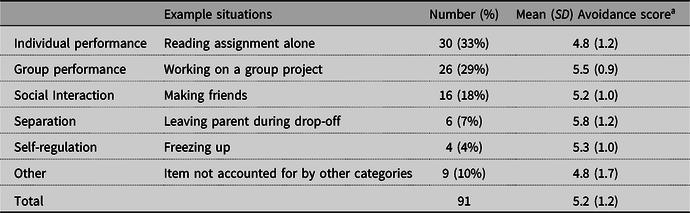
Data from the Student Avoidance Hierarchy revealed that teachers reported 91 avoided situations: 33% individual performance situations, 29% group performance situations, 18% social interaction situations, 7% separation situations, 4% self-regulation situations, and 10% other situations (see Table 3). The mean number of domains per student was 2.29 (SD = .64).
Teacher reported avoidance situations (N = 91)

Note: a1 = Never avoid; 4 = Avoid sometimes; 7 = Avoid every time.
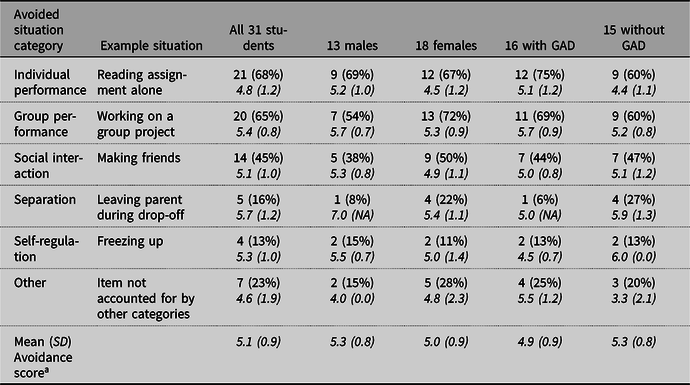
Table 4 presents teachers’ reports of the situations avoided by enrolled students. The most commonly avoided situations were Individual Performance (68%; e.g., taking a test, completing homework) and Group Performance situations (65%; e.g., answering a question in class, working on a group project, reading aloud), followed by nonacademic Social Interactions (45%; e.g., playing at recess, making friends). A relatively smaller percent of situations reflected separation anxiety (16%; e.g., leaving parents at morning drop-off) and self-regulation (13%; e.g., freezing in response to a situation they perceive as difficult). Prevalence of avoided situations across categories did not differ by gender or the most common primary diagnosis (generalised anxiety disorder [GAD] vs. non-GAD; the sample sizes of other primary diagnoses were too small for meaningful statistical comparisons; all p > .157).
Comparisons of avoidance situations across students (N = 31)

Note: n (%) for prevalence, and mean (SD) for average Avoidance scorea shown in italic type; a1 = Never avoid; 4 = Avoid sometimes; 7 = Avoid every time. GAD, generalized anxiety disorder. Sex-prevalence: all Fisher’s exact tests p > .36; sex-score: all Wilcoxon rank sum tests p > .20; GAD prevalence: all Fisher’s Exact tests p > .17; GAD score: all Wilcoxon rank sum tests p > .22
Frequency of Teacher Accommodation
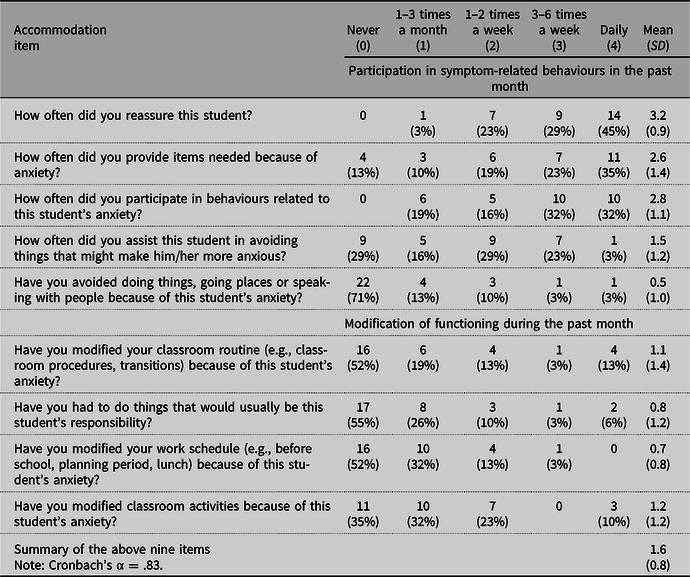
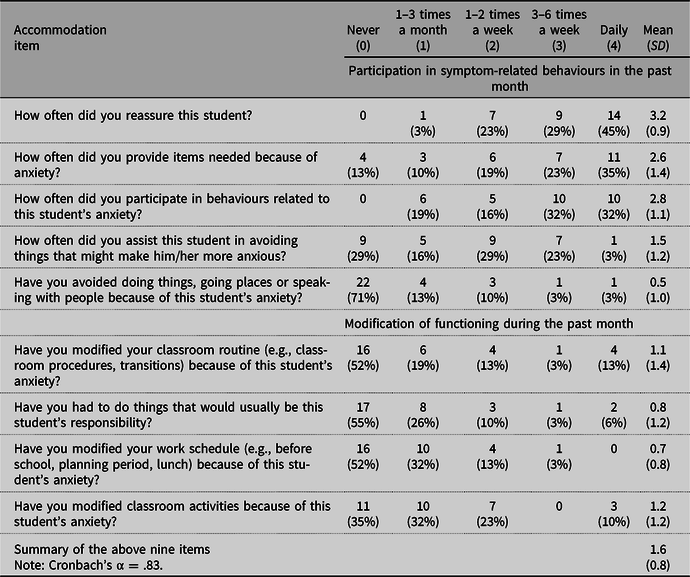
Data on the frequency of teachers’ accommodation of student anxiety appear in Table 5. Specifically, 100% of teachers reported engaging in some form of accommodation of student anxiety weekly. The majority of teachers reported engaging in a variety of accommodation behaviours on a weekly basis, including providing reassurance (97%), providing needed items (77%), participating in behaviours related to anxiety (81%), and assisting students in avoiding anxiety-provoking situations (55%). A smaller but significant percentage of teachers (33%) reported that they modified specific classroom activities due to the students’ anxiety at least weekly.
Frequency of Teacher Accommodation Scale for Anxiety (TASA) raw frequencies (N = 31 teachers)
Teacher Accommodation and Student Severity of Avoidance and Global Anxiety
Pearson correlations revealed positive and statistically significant correlations between teachers’ accommodation behaviours and student avoidance (r = .38; p < .03) and global anxiety severity (r = .34; p < .054). Specifically, teachers who reported engaging more frequently in accommodation behaviours in the classroom (i.e., had higher scores on the TASA) had students with higher levels of anxiety-related avoidance in the classroom and higher global-anxiety severity (i.e., had higher scores on the Student Avoidance Measure and CGI-S).
Discussion
The current study examined: (1) teachers’ reports of anxiety-provoking situations in the classroom or at school among a sample of students with problematic anxiety; (2) the extent to which they engaged in accommodation of avoidance behaviours; and (3) the relation between teacher accommodation of avoidance and students’ avoidance and global anxiety severity. Overall, teachers reported the most commonly avoided situations were performance based (both group and individual). All teachers engaged in some form of accommodation behaviours on at least a weekly basis, and greater teacher accommodation of avoidance was associated with higher levels of students’ behavioural avoidance and anxiety severity.
Avoidance of anxiety-provoking situations is a hallmark feature of problematic anxiety and reducing avoidance via facing one’s feared situations (a strategy called ‘exposure’ in CBT) is considered the curative treatment strategy for anxiety disorders (Raggi et al., Reference Raggi, Samson, Felton, Loffredo and Berghorst2018). An initial step in exposure-based treatment is to develop an avoidance hierarchy or list of situations that are avoided due to anxiety. Data from teachers on avoided situations in the classroom is limited. The current study elicited information from teachers about the school-based situations avoided by their students identified as experiencing problematic anxiety. Not surprisingly, given classroom expectations, approximately two thirds of all avoided situations involved individual and group academic performance situations. This finding is consistent with data from youth perspectives reported by Green et al. (Reference Green, Comer, Donaldson, Elkins, Nadeau, Reid and Pincus2017), which showed youth with anxiety reporting that speaking in front of others (a performance situation) was a top school-based, anxiety-related impairment. Examples of individual performance situations in the current study included completing reading assignment alone, taking a test and completing homework. Examples of group performance situations included answering a question in class, working on a group project and reading aloud. The types of situations avoided in the classroom were similar for boys and girls and did not differ by primary anxiety disorder (i.e., students with vs. without GAD). The least commonly avoided situations were related to separation and self-regulation. Examples of these situations included being alone in the hallway and shutting down in response to a difficult situation. Taken together, these findings highlight teachers’ recognition regarding how anxiety negatively impacts students’ ability to engage in academic performance situations and provides unique data on teachers’ reports of avoided situations in the classroom that can be used by outpatient or school-based clinicians to help construct avoidance hierarchies.
The second aim of this study was to examine the extent to which teachers engaged in accommodating behaviours in relation to their students’ anxiety. As noted above, a robust literature documents the negative impact of parental accommodation of anxious avoidance, but data on teacher accommodation is rare. Findings from the current study revealed that a significant percent of teachers engaged in a variety of accommodating behaviours. Specifically, 97% of teachers reported that they provided weekly reassurance, over 75% of teachers indicated that they provided items to the student weekly because of their students’ anxiety, and 80% reported that they participated in behaviours related to the students’ anxiety weekly. Just over half of teachers (52%) reported assisting their student in avoiding things that make the student anxious — the exact opposite approach recommended for long-term anxiety reduction. Finally, 33% of teachers reported modifying classroom activities or routines (29%) weekly because of their student’s anxiety. These findings parallel patterns found among parents of anxious youth who also report high levels of accommodation (Lebowitz et al., Reference Lebowitz, Woolston, Bar-Haim, Calvocoressi, Dauser, Warnick, Scahill, Chakir, Shechner, Hermes, Vitulano, King and Leckman2013). These findings are also consistent with those of Conroy et al. (Reference Conroy, Greif Green, Phillips, Poznanski, Coxe, Kendall and Comer2020), who found that over 90% of school staff reported using a type of accommodation or support that allowed the student to avoid an anxiety-provoking situation. Similarly, these findings also align with those of Allen and Lerman (Reference Allen and Lerman2018), who surveyed teachers about their responses to student anxiety using hypothetical vignettes as part of a questionnaire development study. Specifically, although teachers endorsed using a broad range of responses when presented with different hypothetical displays of student anxiety in the classroom, many responses were anxiety promoting (i.e., allowing avoidance of anxiety-provoking situations), and the use of these responses was more common for male teachers and those with more teaching experience. Because teachers’ use of accommodating behaviours may unintentionally be maintaining or increasing student anxiety and avoidance, education and training of teachers to identify and reduce their accommodating behaviours appears warranted.
The use of accommodation of anxiety by teachers is likely influenced by several factors. Allen and Lerman (Reference Allen and Lerman2018) found that males and teachers with greater years of experience reported engaging in more anxiety-promoting responses to anxiety. Teachers may also be complying with prescriptions stated in 504 Plans and Individualised Educational Plans. Teachers may also believe that accommodating a student’s avoidance provides the student with the support they need to succeed academically and/or reduces disruption in the classroom overall, which may enhance the learning environment for all students. Personal teacher characteristics may also influence which teachers are more likely to engage in accommodation of student avoidance — such as their own level of job burnout and their own comfort with tolerating student distress. Future research is needed to explore the relation between these factors and engagement in accommodation of avoidance. Such data may be useful in tailoring teacher trainings on student anxiety.
The third aim of this study examined the relation between teacher accommodation and levels of student avoidance and global anxiety. Results indicated that teachers who reported engaging in more accommodating behaviours, such as providing reassurance, doing things for the student or modifying classroom routines or activities to avoid provoking student anxiety, were more likely to have students who showed greater avoidance of anxiety-provoking situations in the classroom and greater overall anxiety. These findings replicate patterns found in research on parental accommodation that document that greater levels of accommodation by parents at home are associated with increased symptomatology and impairment, and poorer treatment response (Caporino et al., Reference Caporino, Morgan, Beckstead, Phares, Murphy and Storch2012; Flessner et al., Reference Flessner, Freeman, Sapyta, Garcia, Franklin, March and Foa2011; Garcia et al., Reference Garcia, Sapyta, Moore, Freeman, Franklin, March and Foa2010; Iniesta-Sepúlveda et al., Reference Iniesta-Sepúlveda, Rodríguez-Jiménez, Lebowitz, Goodman and Storch2021). Given how much time teachers spend with students each day and the documented impact teachers’ behaviour has on students’ social and emotional functioning (Blazar & Kraft, Reference Blazar and Kraft2017), this preliminary study extends our understanding of factors that may contribute to the maintenance of student anxiety at school. We note, however, that the relation between accommodation of avoidance and anxiety, particularly among parent-child dyads, is reciprocal (Iniesta-Sepúlveda et al., Reference Iniesta-Sepúlveda, Rodríguez-Jiménez, Lebowitz, Goodman and Storch2021; Lebowitz et al., Reference Lebowitz, Woolston, Bar-Haim, Calvocoressi, Dauser, Warnick, Scahill, Chakir, Shechner, Hermes, Vitulano, King and Leckman2013). Longitudinal studies are needed to clarify direction of effects and long-term consequences of teacher accommodation of student avoidance.
Findings suggest teacher training in anxiety reduction, and specifically in the importance of reducing accommodating behaviours, may be beneficial. Toward this end, our research team has been examining the impact of the TAPES (Ginsburg et al., Reference Ginsburg, Pella, Piselli and Chan2019), a brief teacher-delivered intervention for anxiety reduction. Results from our open trial found that teachers’ use of accommodation reduced pre- to postintervention, which coincided with reductions in student anxiety and avoidance (Piselli et al., Reference Piselli, Pella, Chan and Ginsburg2021). Although additional research is needed, these results are promising and worthy of replication and extension.
A number of limitations qualify the results and interpretation of this study’s findings. The sample size was small, which may have reduced statistical power or biased results and prevented the incorporation of nesting within youth in data analysis. Thus, a larger sample with a broader range of anxiety disorders would allow future studies to examine avoidance among youth with diverse clinical profiles, ages and comorbidities. In addition, analyses examining whether the relation between student avoidance and teacher accommodation is moderated by student or teacher anxiety severity (among other factors) could be explored. The sample was homogeneous with respect to geography, race, ethnicity and socioeconomic status, which limits generalisability and calls for replication with a larger and more diverse sample of both students and teachers. Measures included in the current study were novel and limited to teachers’ perspectives, which may have inflated associations due to the use of a single informant. Teachers were only reporting on accommodation for one student, which may underestimate the degree of time they spend accommodating anxiety-related avoidance each week and the negative impact on teaching. Future studies should incorporate additional informants (e.g., parents, students and independent evaluators) to further assess relations among teacher accommodation and student avoidance and/or anxiety.
Findings suggest several practical implications for school staff and outpatient clinicians. For instance, inquiry by outpatient therapists into the most commonly avoided school-based situations can facilitate devising avoidance hierarchies used in treatment planning. Related, communication and collaboration between outpatient treatment providers and teachers about the importance of ‘facing fears’ in the classroom and the need for teachers to reduce accommodation of avoidance is warranted (see Conroy et al., Reference Conroy, Hong, Poznanski, Hart, Ginsburg, Fabiano and Comer2021). Finally, teacher training about helpful and unhelpful accommodation and classroom supports to reduce anxiety is needed.
Funding
This research was supported by the Institute of Education Sciences, U.S. Department of Education through Grant # R324A170071 to the University of Connecticut School of Medicine. The opinions expressed are those of the authors and do not represent the views of the Institute or the U.S. Department of Education.
Conflict of interest
None.