To an Englishmen whose interests stretched beyond the tawdry blandishments of the sea front and the worthy seriousness of the college perched alongside the forbidding grey ruins of the castle, Aberystwyth must have seemed a queer little place in the autumn of 1912. Squatting modestly at the end of a railway line with its trim Victorian streets overlooked and often dominated by a series of grandiose chapels in a bewildering variety of architectural styles, it must have appeared, in the eyes of many visitors, to be the very quintessence of nonconformist propriety. For Reginald George Stapledon, scion of Devonshire squires and Tory agnostic, the little market town seemed at first sight a strange and other-worldly place where the natives spoke a language beyond his comprehension and where nothing was ever quite as it seemed.Footnote 1
The train from Shrewsbury had travelled through an October landscape of ravishing if decrepit beauty, and as he got closer to his destination the thirty year old Stapledon reflected upon the studies of grassland ecology which he was to undertake as Adviser in Agricultural Botany at the University College of Wales. He continued his ruminations over a late tea in Owen's Cafe in the company of market day revellers who, it seemed, spoke no language but Welsh. This led him to the rueful conclusion that instilling the basics of agricultural botany at the local university might prove a rather melancholy business. But this was far from the case and during the course of thirty years in the country he grew to develop a profound respect and admiration for Welsh country folk who, in turn, came to regard him with abundant affection and not a little awe. Yet Stapledon never troubled to learn more than a few words of Welsh, a language he regarded as being appropriate for the composition of hymns and prayers, but of little use for creative thought!Footnote 2 In 1930 he advised his students, the bulk of them from Welsh rural backgrounds, to master English and English literature as a means of developing sound judgment and ‘controlled imagination’. Gilbert White, Darwin, Jane Austen and John Clare would, he declared, be of massive benefit as tutors in literary self-discipline. Welsh, on the other hand, he summarily dismissed as ‘not a good language to think and write scientifically’.Footnote 3
This article is not concerned with a deconstruction of Stapledon's stellar career. Suffice it to say that, after a period of time with the Food Production Department in London during the Great War, he was invited in 1919 to become the first Director of the Welsh Plant Breeding Station following its establishment under the generous benefaction of Sir Lawrence Phillips. To the Station he attracted a remarkable group of young colleagues and between 1919 and the outbreak of the Second World War his team established the basic principles underlying the biology of the Graminae. Moreover, they succeeded, often against great odds, in breeding and producing varieties of grasses and legumes which would transform the agriculture not only of Britain but of large swathes of the British Empire and the rest of the world.Footnote 4
Stapledon himself proved rather a shock to the Aberystwyth academic system with its essentially liberal values. His deeply Conservative and Imperialist views, his belief in the virtues of an hereditary aristocracy and his insistence upon the maintenance of tradition as a vehicle for the preservation of national character induced the raising of eyebrows and the elevation of blood pressures in some quarters. If this were not bad enough, he was openly contemptuous of ‘establishments’ too timid to venture beyond the conventional, had a deep distrust of bureaucratic humbug and a loathing of committee work which he regarded as suitable only for the ‘humdrum plodder’. To his immediate colleagues, however, he proved himself a man of limitless and prophetic imagination and unsparing diligence and enthusiasm who promoted a powerful esprit de corps among his team which he described as his ‘dear family’.Footnote 5 Original in thought, sincere in his beliefs and relentless in pursuing them, he was above all a great propagandist who promoted his aims with unceasing zeal.Footnote 6 He was in addition a keen golfer, enthusiastic pipe smoker and lover of the works of Goethe, Keats, Blake and Disraeli. But his first love was the landscape of England and Wales and he soon became a familiar figure in the latter as he strode through hill and valley in his colourful and eccentric clothes, peering at the world through thick-lensed spectacles.Footnote 7 To his colleagues Stapledon constantly emphasised the importance of vision, creative deduction and the avoidance of arbitrary distinctions between disciplines. Compartmentalisation, after all, dulled the imagination.Footnote 8 For applied science to be fruitful, the absurd scientific snobbery so common among pure scientists had to be assiduously avoided. Meanwhile, although free rein was essential for the creative thinker, only carefully coordinated teamwork could put the fruits of applied science to the use of mankind.Footnote 9
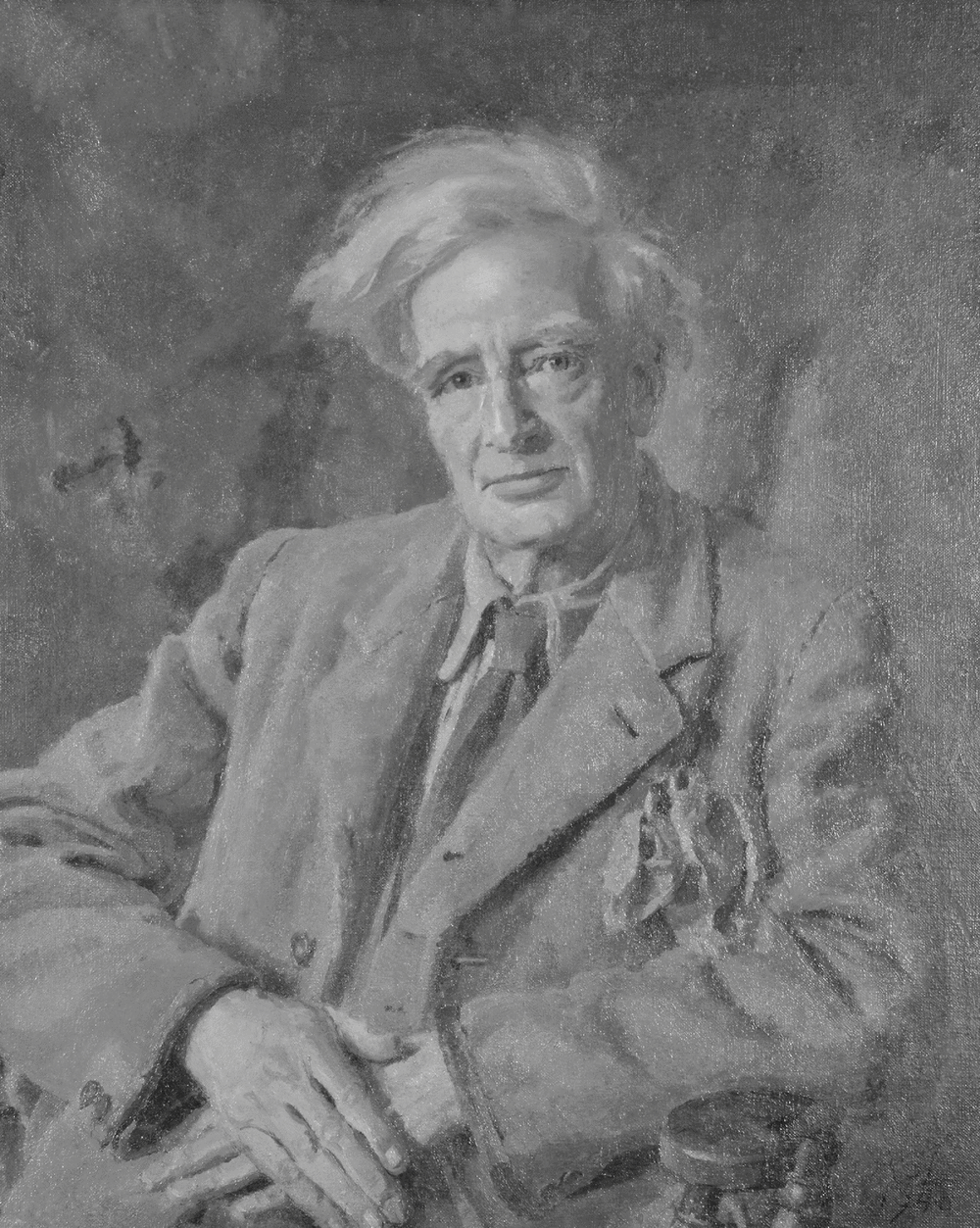
Sir George Stapledon, FRS. Portrait by A. Gwynne-Jones, 1946.

The hills and uplands
As he travelled around Britain, Stapledon became ever more convinced that there was hardly a sheepwalk in the kingdom that might not be radically improved by the judicious use of the plough and the application, with appropriate husbandry methods, of the grass and clover seeds developed at the Welsh Plant Breeding Station and increasingly available on the commercial market.Footnote 10 There were, however, many severe technical and economic obstacles to improvement. In Wales, for example, upland management had for generations been based upon the sale of wether (male) lambs in the autumn months, the remaining flock being sent to lowland farms for the winter. This meant, in effect, that the summer carrying capacity of any given hill was largely determined by the availability of winter keep on farms often many miles away. Also, since the importation of cheap chilled meat from Australasia and South America had slashed the profitability of cattle production, so cattle numbers on the hills had declined with a concurrent deterioration in the botanical quality of upland swards.Footnote 11 The problem was further compounded by a steep decline in public demand for mature mutton relative to young lamb. Four year old wethers, the primary source of mutton, were notably less fastidious grazers than other categories of sheep, and as their numbers declined the coarser and less nutritious grass species were enabled to flourish.
By tradition landowners had taken an interest in the long-term improvement of their properties, but they were less keen to do so during the inter-war period. Burdened by punitive levels of taxation and aware of the availability of remunerative investment opportunities in non-agricultural enterprises, many chose to turn their backs on their land and their tenants. Meanwhile, many of the tenants who had purchased their holdings when local estates had been sold found themselves short of capital. This meant that however much they may have wanted to improve their land against the prospect of future agricultural prosperity, the opportunity to do so was severely limited.Footnote 12 Moreover, many upland holdings in Wales were associated with wide swathes of common land which, by law, could not be divided so that any improvement initiative had to meet with the approval of all commoners. Since this rarely occurred and commoners failed as a rule to act for their future benefit, great stretches of common land succumbed to bush and bracken, heather and gorse.
In association with his colleague William Davies, Stapledon published vegetation maps of Wales in the mid 1930s. These revealed that 1.25 million acres of wet upland was dominated by Nardus (mat grass) and Molinea (purple moor grass) while drier areas included some 132,000 acres of heather and 170,000 acres of gorse and bracken.Footnote 13 It was towards the renovation of some of this land with its steep inclines, acid soils, rocky outcrops and deep beds of blanket peat that Stapledon turned his thoughts. Improvement of these lonely and often very bleak uplands he considered vital, not only on the grounds of agricultural productivity, but in the interests of preserving the very fabric of the human community occupying them. The bald statistics of the social structure of upland Wales reveal a melancholy picture of a unique web of national life beginning to rot at the centre.Footnote 14 As rural population declined, with only Carmarthenshire, Denbighshire and Flintshire returning higher populations in 1931 than 1921, so the proportion of monoglot Welsh speakers began to collapse and Welsh gave way to English as the language of the Breconshire uplands and other parts of central and south Wales. Almost in parallel, the old traditions of craftsmanship and rural industry began to disappear, offering a dispiriting scenario to those for whom the land and the farm were the epicentres of rural life.Footnote 15 How far a sense of the loss of old traditions was deeply felt by country people themselves is a matter for debate. The young probably relished the approach of modernity, while those confronted daily with the grind of rural life in remote and inhospitable locations may have taken a less jaundiced view of change than outside observers cared to admit. Either way, there was the perception among academics and some intellectuals that the closely-knit and cohesive fabric of rural society in the uplands was frayed to the point of destruction.
The 144,000 acre Pumlumon region offered a depressing example of this spreading malaise. With eighty per cent of the area above the seven hundred foot contour, more than ninety farms to the west of Pumlumon itself had been abandoned since the end of the First World War and as houses and buildings steadily crumbled, the paddocks and hillsides succumbed to rushes and bracken.Footnote 16 For Stapledon this situation was intolerable. Rural depopulation was likely to sap the very life blood of the country, and from his standpoint, the only way to stem this haemorrhage was to create a rural environment in which men could live and have their being with some confidence in the future.
He was, of course, not alone in calling for agrarian improvement as a vehicle for maintaining the cohesion and integrity the countryside. The thinking of John Ruskin and the anti-collectivist ideas of Hilaire Belloc, G. K. Chesterton and others with a fascination for self-contained ‘organic’ communities came to influence a number of writers flourishing in the inter-war period. Men like H. J. Massingham, Edmund Blunden and Adrian Bell, along with many of the contributors to Philip Mairet's New English Weekly divined the true and only roots of ‘Englishness’ to be deeply located in the countryside.Footnote 17 In Wales, several prominent figures in the burgeoning Nationalist movement, including Saunders Lewis and Ambrose Bebb, challenged the notion of progress based upon urban capitalism and embraced the idea of a return to rural roots as a keystone of nation building. National culture, they believed, would spring into vigorous rebirth following the deindustrialisation of the depressed valleys of the south and the establishment of agriculture as the country's predominant industry. This reflected the deeply-entrenched view that cultural identity was profoundly rooted in the Welsh countryside, while any philosophy or economic system rejecting mass production and promoting craft skills would be to the advantage of the moral and physical health of the nation.Footnote 18
Stapledon readily agreed with these ruralist perspectives. Yet he was always insistent that land improvement in the hills and uplands and thus the preservation of social fabrics could never be obtained at the expense of the destruction of natural beauty. Any suggestion that ugliness or squalor were a price worth paying for wealth or utility was anathema. Besides, if agreeable rural amenities were to be provided for the expanding army of white-collar workers keen to holiday in the hills, farming had to be sustainable, rural architecture harmonious and land improvement sympathetic with respect to contour, slope and local vegetation. Perhaps a little vaingloriously, Stapledon wrote in 1942 that his hill improvement work merely added a further stanza to Nature's epic:
All. . . .I do in the hills is to add more traits of green to the rather limited range of that beautiful colour normal to hill land, and to render the general scene that much more complete. By a not inartistic touch from the hand of man, Nature merely gains more scope for the display of her infinite glories through my informed, albeit utilitarian cooperation.Footnote 19
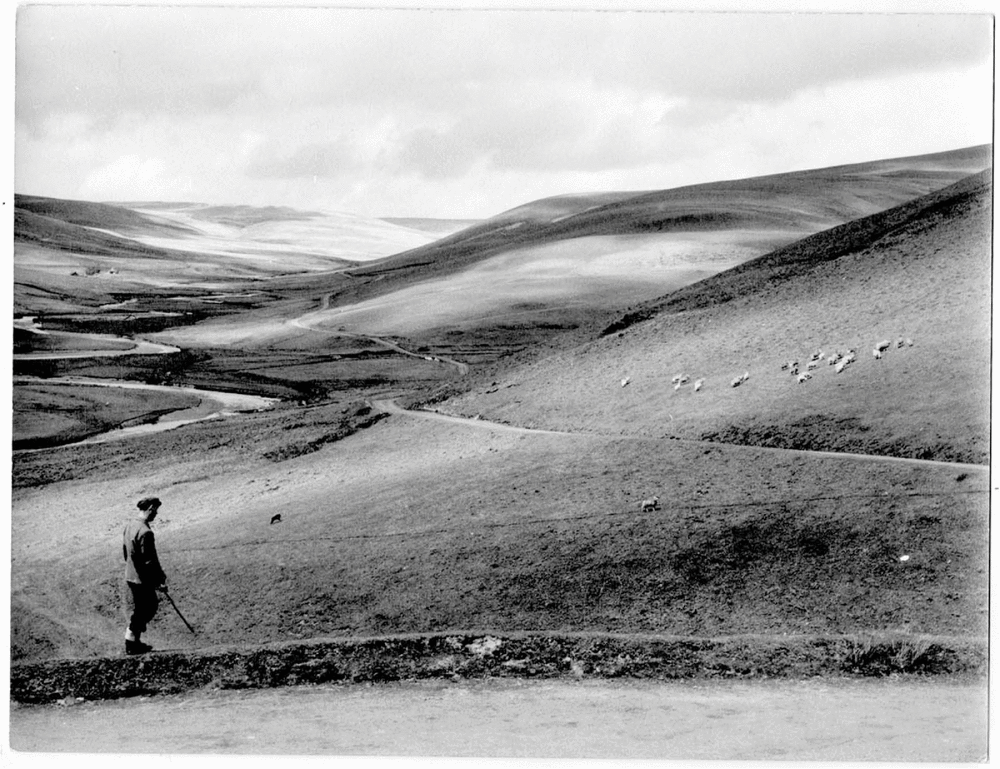
Sheep on unimproved uplands of the Cardiganshire/Brecknockshire border. (Photograph in author's possession)
Limitations and constraints
Although Stapledon may have optimistically believed that the physical and economic constraints to hill land improvement might eventually be overcome, the overall economic position of the 1920s and 1930s was scarcely conducive to exchequer investment in the land. As massive quantities of cheap food found its way to the ports of Britain from the markets of the world, governments were largely unsympathetic to the fortunes of home agriculture. The Ministry of Agriculture inexorably became the grave of ambition and reputation of politician and civil servant alike and farmers were left more or less unaided to face the storm of international competition. A series of marketing boards had been established for a limited range of farm products, yet the overall position was one of apparent official indifference to the plight of most sectors of the agricultural industry.Footnote 20
Despite significant advances in animal and plant breeding and deepening understanding of the chemistry of fertilisers and agro-chemicals, farmers were often reluctant to adopt new technology merely to produce more food for an already flooded market. Under the Land Drainage Act of 1930, the Ministry of Agriculture had undertaken major programmes of arterial drainage works. It was fondly hoped that these projects and the propaganda associated with them would encourage farmers to tile drain their wetter fields in readiness to meet the opportunities offered by a more favourable economic climate at some time in the future. But this met with little success, most farmers having little faith in their future prospects.Footnote 21 In essence then, the overall background, in terms of both finance and morale was less than propitious and to many observers the idea of large scale hill and upland renovation seemed, at the very least, to be eccentric and perverse.Footnote 22
The Cahn Hill Improvement Scheme
It should come as no surprise that R. G. Stapledon, who was not without his own singular eccentricities, should be attracted to and stimulated by, men of independence of spirit and outlook who sometimes courted official and public disapproval. Stanley Morton Bligh (1870–1944), barrister, mystic, writer on psychology, farmer and enthusiastic land improver was just such a man. With his velvet coats, claret-coloured plus-fours, Old Testament beard and self-trimmed hair, Bligh had arrived, via Eton and Trinity, at his family estate of Cilmeri near Builth Wells in Breconshire. Here, in the years preceding the First World War, he ploughed and reseeded much of his demesne, keeping careful records of his activities and procedures.Footnote 23 Befriending Stapledon in 1919, Bligh made the Cilmeri estate freely available for grassland renovation studies and made significant personal contributions to the cost of a great deal of the pioneering work undertaken by Welsh Plant Breeding Station staff. So much was this the case that Cilmeri became, in effect, an outpost of the fledgling Station.
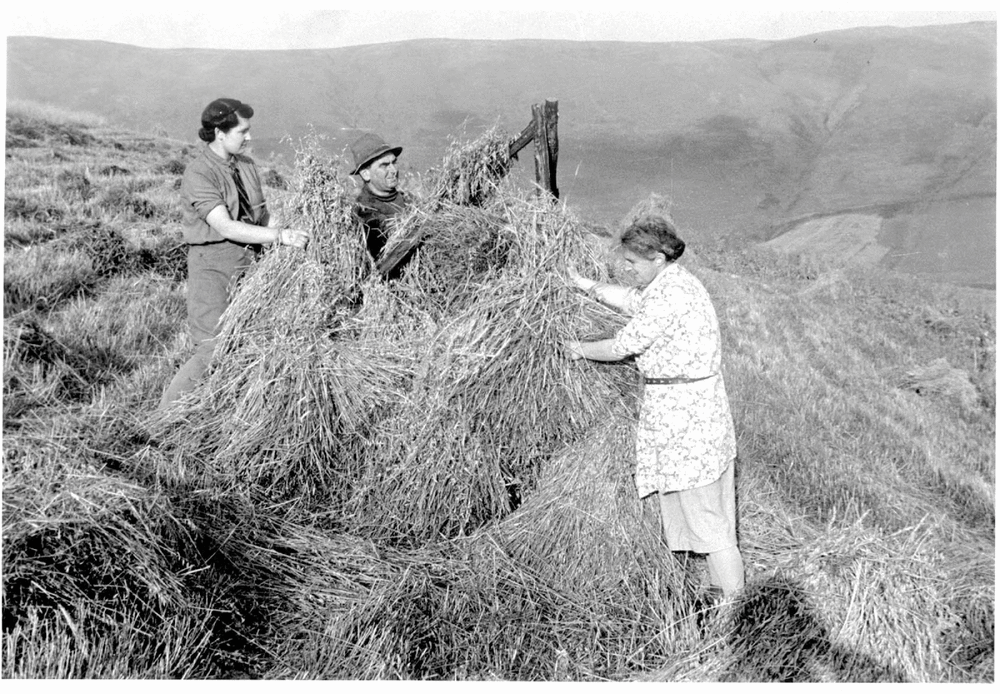
Captain G.L. Bennett-Evans and his wife and daughter stacking oats on a tripod on the slopes of Pumlumon in 1942. (By kind permission of the National Library of Wales)
A man of similar mettle was the war veteran and amateur international footballer, Captain G. L. Bennett-Evans of Peithyll, near Aberystwyth. The owner of extensive sheepwalks in the foothills of Pumlumon, where he spent many happy hours in conflict with the newly-established Forestry Commission, Bennett-Evans had, at considerable personal danger, ploughed and renovated many of his steep and intractable acres. Bennett-Evans was impressed by the startling effects of phosphatic fertilisers on the botanical composition of upland swards that had been demonstrated in small scale experiments by Stapledon and his colleagues, and made his sheepwalks available for further study. Stapledon took full advantage of Bennett-Evans’ generosity and over the course of a decade was able to demonstrate that by combining novel husbandry techniques with judicious sowings of new grasses and clovers, the pasture productivity of hill land could be dramatically increased. Cultivation treatments, fertiliser application, differing grazing regimes and the nitrogen-fixing capacity of wild white clover were just some of the elements under investigation on Bennett-Evans’ remote acres.Footnote 24 Of special significance was the eventual realisation that by carefully controlled and species-balanced grazing, unproductive and unpalatable swards of Nardus/Molinea could be readily converted into productive herbage containing species of higher nutritional value.
But Stapledon's detractors questioned the point of such experiments, asking why landowners, farmers or the Exchequer should pour scarce resources into an enterprise designed to produce more food for a market already subject to the virtually uncontrolled flow of foreign imports. Besides, the traditional home demand for hill-produced mutton was declining in relation to that for fattened lamb from the lowlands, while beef in frozen or chilled form was cheaply available from overseas. Stapledon might well argue that grassland was ‘one of the cornerstones on which the greatness of the British Empire has been built’,Footnote 25 yet such grandiose notions as the wholesale renovation of upland grazing had to be viewed in the light of prevailing economic conditions. Stapledon, however, had scant regard for economists, realising that while an enterprise may appear ‘uneconomic’ today, there was no reason why it should necessarily be so tomorrow. It was, in any case, complete folly to believe that cheap sources of animal feeds and animal products would forever flow unimpeded into British ports. In the event of these supplies being cut off, the improved grasslands of upland Britain would prove of immense value by serving as a reservoir of livestock breeding, allowing lowland pastures to be converted to arable. Besides, the technical improvements would be the mere prelude to a scheme for the wholesale rehabilitation of the upland socio-economic environment, embracing transport systems, housing, forestry, rural crafts and education broadly along the lines set out in his masterly The Land: Now and Tomorrow (1935). This extraordinary tour de force offered a vision of the land as a unifying feature in national life in which farmers would enjoy state aid for agricultural advancement while industrial workers would gain a ‘better’ sense of values through regular contact with rural life and labour.Footnote 26
The point at issue was how to convince the official world of the significance of this vision and show that it was possible to create a great ‘outdoor laboratory’ where the practical feasibility of upland improvement could be demonstrated. As ever, the matter of funding raised seemingly insuperable problems. Between 1929 and 1931 the Welsh Plant Breeding Station confronted serious financial difficulties and although the Ministry of Agriculture had agreed to provide funds, subventions from the Empire Marketing Board and from private individuals had been severely curtailed. The Principal of University College of Wales had failed to obtain further private funding and had it not been for the willingness of staff to accept cuts in wages and stipends, the station's work may have ground to a halt.Footnote 27 It was not, then, the best of times to try to raise the £20000 which Stapledon believed was needed to acquire the land and equipment necessary to meet his grand design. Overworked and under great strain, he fretted and worried, concerned that more than a decade of preliminary work would be of no avail. Now that the Welsh Plant Breeding Station was running efficiently and its new strains of grasses were about to reach the commercial market, Stapledon craved the new challenge offered by a grand upland improvement project. For most of the first week of July 1932 he was closeted with Principal Stuart Jones while the two men wrestled with the issue of finance. Following Jones's earlier unsuccessful attempt to appeal to the Welsh establishment, he and Stapledon penned what was essentially a begging letter. This appeared in the Times on 11th July. Calling for £20000 from a generous benefactor, the authors pointed out the immense benefits to the Empire which might accrue from the extension of earlier experiments. They freely admitted that 1932 was scarcely the ideal year to seek private or state funding. Yet, ‘we are none the less impelled to make our appeal because of the wide implications of the work on which we are engaged and because we stand convinced that it is in the nation's interest that the methods of grassland improvement which we advocate should be brought to the notice of the farmer in a manner that will make the strongest possible appeal to him’.Footnote 28
The following morning Sir Julian Cahn unfolded his Times as he breakfasted in the lavish splendour of his home at Stanford Hall in Nottinghamshire. Entrepreneur, Master of Foxhounds and enthusiastic, if rather ineffective, cricketer, Cahn spent much of his vast fortune on philanthropic projects.Footnote 29 Struck by the grandeur of the Stapledonian vision, he immediately drafted a letter to Principal Jones offering a yearly payment of £3000 for seven years since, ‘the object for which you are appealing is of an importance which it is scarcely possible to exaggerate’.Footnote 30 He noted a little later that the money was to be used specifically for the promotion of Stapledon's scheme and not, as some members of the College Council had hoped, for ‘the general purposes’ of the Welsh Plant Breeding Station.Footnote 31 The Council, along with other members of the College, were initially concerned that the Cahn gift would offer an opportunity for the Ministry of Agriculture to find an excuse to reduce the block grant which it provided to help fund the College's Agricultural Departments.Footnote 32 There was, moreover, general disquiet over the future of the Empire Marketing Board, another important source of agricultural funding.Footnote 33 For some years the Board had helped to fund much of the work of the Plant Breeding Station and Stapledon himself was concerned that the possible demise of the Board would place in jeopardy the future of a significant number of his staff.Footnote 34 But irrespective of these niggling doubts, the College Council was delighted at the prospect of a prestigious project being launched under its auspices. The Principal urged the editor of the Times to ensure that Cahn's munificent benefaction was recognised in the newspaper, adding that, ‘It is well known that so notable an example of the use of wealth for the public good—especially gratifying in these difficult times—should become widely known’.Footnote 35
Stapledon himself was greatly excited. Nevertheless, he confessed to several close friends that with a little more care, subtlety and diplomacy the Principal might have persuaded the admirable Sir Julian to have come up with an even more generous offer. Three years after the scheme had got underway he wrote, rather ruefully, that ‘when I read of Sir Herbert Austin's munificent gift to Cambridge, and that for a destructive science like physics, I nearly die of exasperation and despair. . .we could do a very great deal with a modest £50000’.Footnote 36 But there was little purpose in imagining what may have been and Stapledon put such reflections to the back of his mind as he set about finding a suitable site for his ‘outdoor laboratory’. He was by now thoroughly acquainted with the hinterland of Aberystwyth. On foot, on horseback or by motor car, with his wife at the wheel, he had spent much of the previous decade exploring the high lands of Cardiganshire in all their variety of slope, aspect, microclimate and vegetation. He had been particularly struck by the wild uplands to the east of the celebrated beauty spot at Devil's Bridge where the rivers Ystwyth and Mynach met in romantic confluence. Much of this land lay within the bounds of the Hafod estate, originally the property of the agriculturalist, antiquary, dilettante, scholar and spendthrift, Thomas Johnes (1748–1816). Johnes had managed to liquidate a huge fortune on his house and his various aesthetic pursuits, transforming his estate according to Picturesque principles and adopting fashionable, if inappropriate, techniques on his home farm.Footnote 37 The salutary tale of Johnes’ various misfortunes might have given Stapledon pause for thought, but after surveying the Hafod demesne he conceived the idea of the home farm, Pwllpeiran, as the nucleus of a grand improvement enterprise.
In accordance with his strict principle of directing research towards the solution of general problems rather than the advancement of some particular specialism, Stapledon envisaged Pwllpeiran as the centre of a land unit designed to demonstrate the practicality and potential profitability of land improvement. On the other hand he considered short-term economic considerations to be largely futile, arguing that: ‘The land itself in its response to patient and careful nursing holds rewards and treasures that cannot be purchased with gold, or estimated by the most perfect and elaborate of cost accounts’.Footnote 38 In any event, Pwllpeiran, with its ninety acres of arable/pasture running down to the River Ystwyth, seventy-four acres of woodland and 200 acres of hill grazing lying between 900 and 1200 feet above sea level, would be the keystone of a visionary enterprise.
At the time the Hafod estate was owned by James Waddingham, descendant of a long line of Lincolnshire farmers. A childless widower in advanced old age, he had retired to Aberystwyth, leaving his enormous house in the charge of his former butler and cook.Footnote 39 In the spring of 1933 Stapledon and Principal Stuart Jones visited the old man who, despite severe deafness, had retained his sharp mental faculties. In the claustrophobic presence of a galaxy of nurses and other members of Waddingham's staff, the visitors negotiated with the ninety-three year old over the potential lease of land on the Hafod estate. In due course they secured a fourteen year lease on Pwllpeiran with an option to purchase the holding for £5000 following the lessor's death.Footnote 40 Concurrently, the Plant Breeding Station leased the adjoining 200 acre farm of Prignant and the 2200 acre mountain sheepwalk of Nant Rhys, some five miles away.Footnote 41
In due course a Steering Committee was set up to oversee the project, which would be known as The Cahn Hill Improvement Scheme. Under the watchful chairmanship of Earl de la Warr, Under-Secretary for Agriculture and a personal friend and admirer of Stapledon, the Committee comprised a blend of academics, landed gentlemen and politicians of various guises.Footnote 42 In view of the national and Imperial dimensions of the scheme, the Ministry of Agriculture had insisted that membership of the committee include strong representation from Scotland, Northern Ireland and the Dominions. The assembled body included, for example, Neville Wright, the New Zealand High Commissioner who, in expressing his fulsome thanks to Sir Julian Cahn, observed that farmers in New Zealand and elsewhere in the Dominions would feel gratitude ‘to a special degree’.Footnote 43
One of the Committee's first acts was to appoint Moses Griffith as Lands Director at a yearly salary of £600. Born in 1893, Griffith was a Caernarvonshire farmer's son with a passion for the land who had been serving as Agricultural Organiser for Merioneth since completing his studies at the University College of North Wales, Bangor. A celebrated breeder of Welsh Black cattle, this gentlemanly, charming and humorous man was also a staunch supporter of the concept of political freedom for Wales. A loyal friend of Saunders Lewis, he became a prominent member of the Welsh Nationalist Party after its foundation in 1925 and in keeping with the ruralist perspective of that party may even have come to regard the epic task at Cahn Hill as a metaphor for nation building.Footnote 44 Under Griffith's energetic supervision the buildings and cottages at Pwllpeiran were renovated and a hydro-electric system installed to provide power for house and barn machinery. But before any serious attempt could be made to attack the land itself the problem of access to Pwllpeiran, Prignant and Nant Rhys had to be addressed. This meant that the first three years of the project were entirely absorbed in the construction of roads and trackways and in bridging watercourses, tasks made the more difficult by steepness of gradient, intractable rock outcrops and extensive beds of deep peat. The job would have been virtually impossible without the Caterpillar ‘Twenty’ crawler tractor (purchased for £608) and other equipment loaned to the scheme by the firm of Ransomes, Simms and Jefferies. Even then, wrote Stapledon in his progress report, ‘We are more than hampered by the fact that there is no proper engineering works in Aberystwyth and it is difficult to make experimental models and parts for ourselves’.Footnote 45 Besides, in the early 1930s there were virtually no implements on the market specifically made for the purposes of upland renovation, although the rotary cultivator, produced by Howards of West Horndon, was later to prove valuable for secondary cultivation.Footnote 46
The overriding objective of the Cahn Hill Improvement Scheme was to enhance the productivity of the hills by effecting a general improvement in the total nutritional regime for animals grazed there. To this end, initial improvements would take place at Pwllpeiran and Prignant with the aim of providing forage in various forms thereby to maximize the over-wintering capacity of the unit as a whole. If the 2500 or so sheep summering on the Molinea-clad slopes of Nant Rhys could be wintered at home, the expensive business of sending a high proportion of the flock to be wintered ‘on tack’ at a distant lowland farm could be avoided. By the 1930s ‘tack’ was becoming increasingly difficult to secure as more and more lowland farmers came to realise the benefits of resting pasture land in the winter months, besides which many of them were unwilling to go to the expense of providing the extra fencing needed safely to restrain the venturesome Welsh mountain sheep. Griffith and Stapledon fully realised the potential impact of the measures they were taking. Success would send out a vital and indisputable message to the upland farming community throughout Britain.
There was little time to be lost. Applying what Stapledon described as his ‘infinite resourcefulness’ and his abundant practical knowledge, Griffith set to work.Footnote 47 Earlier plot-based studies had demonstrated the effectiveness of applied lime, basic slag, phosphates and nitrogen in various forms on the botanical composition and nutritional value of swards of different types.Footnote 48 Guided by Stapledon, Griffith set about applying these insights on a large scale at Pwllpeiran and Prignant. Combining nutritional treatments with various modes of cultivation, land was prepared for sowing with pioneer crops and subsequently with the newly-bred rye grasses and clovers from the Welsh Plant Breeding Station. In the first two years large areas of Nardus/Molinea matt were burned and ploughed before being sown with pioneer crops, including turnips and Italian rye grass. After two seasons of winter grazing with sheep had helped improve the structure of the impoverished soils, permanent perennial rye grass/wild white clover swards were sown and a regime of mixed species grazing put in place. These newly created pastures, along with others sown with the recently released ‘S’ strains of grasses and clovers, were so nurtured that by 1946 the livestock carrying capacity of Pwllpeiran and Prignant had quadrupled.Footnote 49 While all this was going on the two lower lying farms played host to a wide variety of pioneering studies of plant/animal/environment interactions, bracken control and seasonal nutritional profiles.Footnote 50
The elevated situation at Nant Rhys presented severe technical problems. Six miles distant from Pwllpeiran, the rain-swept and inaccessible sheepwalk comprised 2000 acres of Nardus/Molinea, bracken and heather. Rocky outcrops and steep slopes interspersed with deep upland peat bog imposed practical difficulties which would have been virtually insurmountable in the absence of a reliable track-laying vehicle. But despite the incredulity of the local wiseacres, who viewed any attempt to improve Nant Rhys as being at best eccentric, Griffith burned the matt of herbage and set his men to work with caterpillar tractor and heavy-duty plough. With the judicious use of rotary cultivators he was eventually able to create a tilth suitable for pioneer crops and ultimately for rye grass/clover swards. As these new plantings were encouraged by carefully balanced applications of lime and basic slag, so their capacity to sustain sheep and cattle over the summer was enhanced. The lower lying pastures at Pwllpeiran were now conserved for hay and silage, the latter being stored in experimental silos provided by Imperial Chemical Industries. Since conserved feed was available from the improved Pwllpeiran acres, a high proportion of the ewes summered on Nant Rhys could now be wintered at home and the costly and inefficient business of ‘tacking’ eventually abandoned.Footnote 51 Throughout the 1930s a good deal of interest had been shown in the potential for feeding dried grass to livestock in the winter months, on the basis that drying the fresh crop was the best means of preserving its nutritional integrity. Stapledon was keen to demonstrate the use of dried grass as a further aid to overwintering and he managed to persuade several commercial companies to provide drying facilities at Pwllpeiran at a subsidised price. The generosity of Kaloroil Limited and R. A. Lister of Dursley enabled valuable data on dried grass feeding to be gathered.
Although Stapledon left the daily management of the scheme entirely in the hands of Moses Griffith, he was a regular visitor, often spending weeks on end in the cottage at Pwllpeiran which he retained for his own use. Here he would ponder and write and ride his shaggy pony across the lonely and windswept uplands of the eastern Cardiganshire border, taking the opportunity to cast a critical eye over the numerous experiments being undertaken by his colleagues as they sought to gain deeper insight into plant/animal relationships at high elevations. For the duration of the scheme Stapledon enjoyed the unswerving support of Earl de la Warr. It was, for example, de la Warr who in 1934 helped to persuade R.A.F. Bomber Command to produce a series of low level aerial photographs of the site so that Stapledon could assess vegetation types and estimate levels of improvability.Footnote 52 Meanwhile de la Warr maintained close contact with Sir Julian Cahn, regularly trying to cajole him into visiting the experimental site. Although cricketing commitments prevented him from joining de la Warr and the Master of Sempill on their 1932 trip, he may have travelled to Pwllpeiran in the spring of 1934 after a visit to the scheme's outpost at Knighton where the local squire, Richard Green Price, was undertaking upland renovation work under Moses Griffith's direction.Footnote 53
In October 1937, de la Warr and Sir Donald Fergusson, Permanent Secretary at the Ministry of Agriculture, travelled to Aberystwyth to spend a long and convivial weekend with Stapledon. The three men, together with various other Ministry officials, visited Pwllpeiran where they discussed the future of the Cahn Hill Scheme and the issue of upland improvement in general. As Chairman of the Steering Committee, de la Warr had been anxious to consolidate the scheme on a permanent footing and to this end he and Fergusson had successfully negotiated with the Agricultural Research Council to secure a £10000 capital grant for the purpose.Footnote 54 Fergusson himself had no doubt as to the national, if not international, significance of the venture and on returning to London met once again with de la Warr to consider the possibility of establishing a series of grassland research stations under Stapledon's direction. Both men were of the view that since he had now established the international importance of the Welsh Plant Breeding Station, Stapledon's dynamism and vision might best be deployed elsewhere. De la Warr pulled no punches when he wrote to Fergusson to declare that ‘it is of national importance that we should get Stapledon out of that hole in Aberystwyth. If he is left there we should run the risk of blunting a very good razor’.Footnote 55 The following day he wrote to Stapledon proposing a meeting in London to ‘have a good talk about your future position and how best you can put across your ideas for the benefit of rural England’.Footnote 56 The ultimate result of these discussions was the establishment of the Grassland Improvement Station on the heavy clays of Drayton near Stratford-upon-Avon and the Grassland Research Station at Hurley, near Reading, the former under Stapledon's direction and the latter in the charge of William Davies, his friend and colleague from Aberystwyth.
Cahn's original endowment terminated in September 1939 and throughout the previous year both Stapledon and Ivor Evans, Principal of the University College, had cast about for some form of replacement funding. Encouraged by de la Warr, they pestered, cajoled and lobbied the Ministry of Agriculture, eventually persuading the Ministry to allot a block grant to support the continuation of work in the hills.Footnote 57 The recurrent grant was given on the strict understanding that the scheme would no longer be administered by the Steering Committee, but by the Council of the University College by way of its Agricultural Committee.Footnote 58 This meant, in effect, that the scheme was no longer an independent entity, but an integral part of the Plant Breeding Station.Footnote 59 Given his distrust of officialdom and his insistence upon allowing free rein to individual creativity, it is hardly surprising that Stapledon was rather equivocal on the issue of funding. Expressing his gratitude to de la Warr early in 1940 he noted:
I am personally sad that it has come within the ambit of State grants, for by that means it loses a certain individuality and freedom of action; however the great point is that it is enabled to carry on for a further seven years, if in somewhat of an undertone.Footnote 60
The modest £1600 per year granted by the Ministry meant that work could only be continued on a reduced scale and although contract work on behalf of local farmers brought in a little extra income, research activity in the round tended to be limited in scale. Nevertheless, the resourcefulness and skill of Stapledon's team ensured that the work undertaken was of major scientific significance.Footnote 61
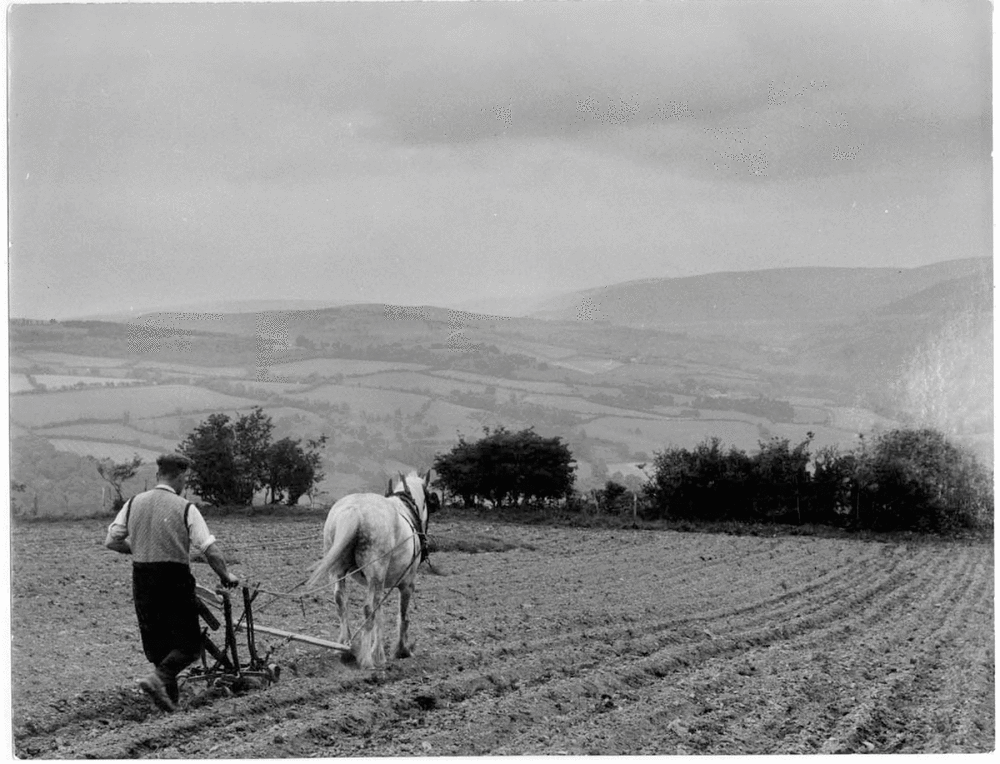
Ridging potatoes on improved land to the east of Aberystwyth, c. 1950. (Photograph in author's possession)
For Stapledon new challenges lay ahead in 1940 once he had resigned his various Aberystwyth posts and headed for the midland clays. By now a Companion of the British Empire, a Knight and Fellow of the Royal Society, he left the Welsh Plant Breeding Station in the capable hands of his protégé, T. J. Jenkin, with whom he had worked closely for twenty five years. Moses Griffith, meanwhile, was appointed Grassland Adviser for Wales, his post being taken by Llewellyn Phillips who became resident manager of the scheme for its final six years.Footnote 62 The Cahn Hill venture, meanwhile, continued to yield a rich harvest of data on a variety of fundamental ecological relationships and to show that under the right economic conditions, land improvement in both hill and lowland was a practical reality. The lessons of Cahn Hill would be repeatedly stressed as Stapledon and hundreds of others involved in the wartime ‘plough up’ campaign struggled to put British farming onto a war footing. Wartime and post-war economic conditions would entirely vindicate Stapledon's view and the cynical critics of the economic feasibility of hill improvement would be routed.
When James Waddingham died in 1938 the University College of Wales exercised its purchase option and with the help of money from the Development Fund was enabled to acquire the freehold of Pwllpeiran.Footnote 63 The leases of Prignant and Nant Rhys, however, ran on for almost a decade and eventually lapsed in September 1947, following the worst winter in living memory. The autumn of 1946 had been wet and cold so that many sheep were in rather poor condition as the appalling winter set in. In the uplands of Cardiganshire the land was covered in snow between January and April with many farms being inaccessible for weeks on end. Despite supplementary feeding hundreds of sheep which had summered at Nant Rhys and Prignant were lost, while of those surviving a significant number, weakened by hunger, succumbed to floods in late March. Overall, half the sheep flock on the Cahn Hill scheme were lost, although all the cattle and horses managed to survive.Footnote 64
On 30th September 1947 all activity associated with the scheme came to an abrupt end.Footnote 65 By way of a series of complex accounting manoeuvres, the financial arrangements between the University College and the Ministry of Agriculture were satisfactorily concluded and the scheme wound up.Footnote 66 To many it seemed unfortunate at the very least that the Cahn Hill Improvement Scheme should draw to a close at a point when it had apparently reached the nadir of its fortunes. Stapledon himself had always argued that land improvement was a progressive, cumulative and long-term exercise and that without constant management effort land that had been subject to costly renovation procedures could soon resort to its original state. So it was with some justifiable misgivings that he and many of his former colleagues at the Welsh Plant Breeding Station witnessed the return of the remaining Cahn Hill lands to their owner. But little could be done once the leases had run their course. With the sale of the live and dead stock, fixtures and fittings, the Cahn Hill Scheme was at an end.
The legacy
The Second World War provided an opportunity for farmers to demonstrate the fundamental importance of the optimal use of land resources within the context of a siege economy. Under the direction of the oft-maligned County War Agricultural Executive Committees and with the help of Exchequer support, the farming industry readily responded to the call for increased output. The ‘plough up’ campaign, so vigorously proselytised by Sir George Stapledon in his barnstorming trips around the country, was ultimately to pay ample dividends and food supplies and civilian morale on the Home Front were maintained.Footnote 67 As farming prosperity advanced during the wartime years increasing attention was given to the improvement of economically marginal land, a process made easier by a variety of developments in agricultural mechanisation. Large scale drainage projects, often carried out by prisoners-of-war, enabled crops to be grown on hitherto intractable land, while in the hills renovation along the lines demonstrated at Cahn Hill were being put into effect.
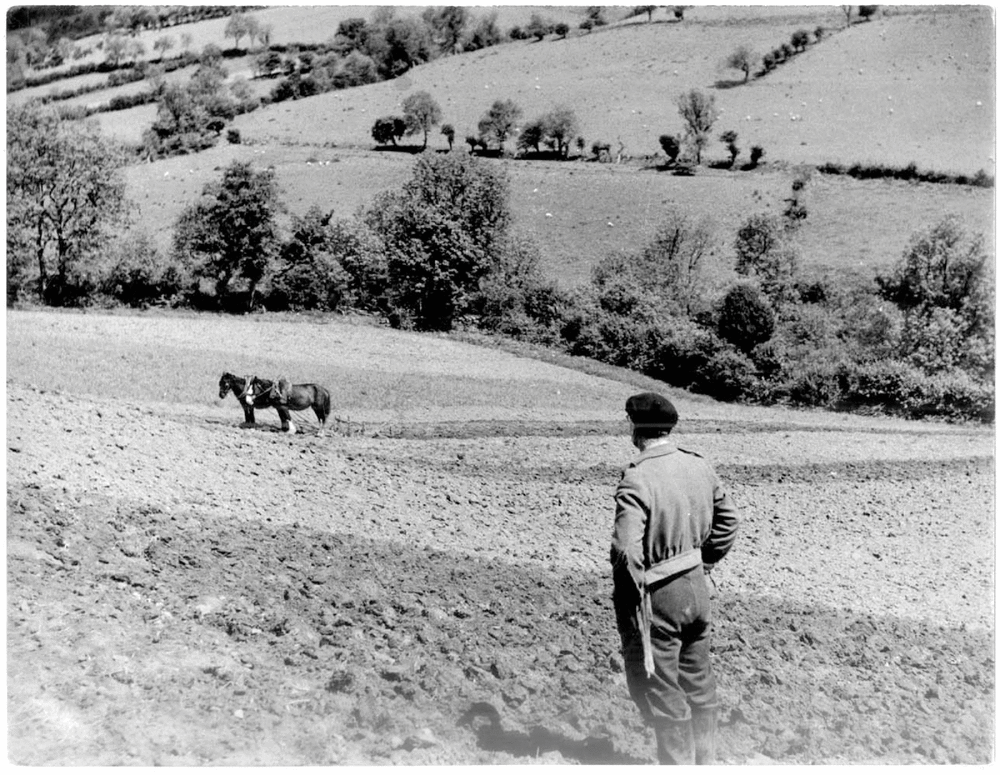
A Brecknockshire farmer contemplates land brought into cultivation from recently-improved upland, ca. 1950. (Photograph in author's possession)
It had long been realised that the hills and uplands of Britain were a fundamental keystone of the livestock economy in the sense of providing a pool of store cattle for the beef industry and, perhaps even more importantly, of raising the foundation stock upon which the stratified British sheep industry was based. Wartime experience merely served to reinforce this realisation and it became clear as the war drew to an end that the economic structure of the fragile and remote upland communities required continued support. The point was powerfully made in 1946 when Earl de la Warr and Lord Balfour of Burleigh reported to the House of Lords on the state of hill farming in England and Wales and Scotland respectively.Footnote 68 In de la Warr and Balfour's findings lay the roots of the Hill Farming Act of 1946 which provided the context for future government support for upland economies and communities.
The Act offered an extension of wartime subsidies by providing a sum of four million pounds in grants to hill farmers. Such was its popularity that by midsummer 1949 more than two thousand schemes covering 800,000 acres of mountain land were being considered or had been accepted for assistance under the Act. Unfortunately, however, large swathes of upland in England and Wales, despite having similar social and economic problems, were excluded from the provisions of the Act. This anomaly was remedied in 1951 by way of the Livestock Rearing Act which extended the original scheme to embrace the uplands and increased to twenty million pounds the amount available in grants and subsidies.Footnote 69 But despite these measures, The Mid-Wales Investigational Report of 1955, along with other local studies, emphasised the continuing problem of economic instability and social fragmentation in the hills and uplands.Footnote 70 The issue was further addressed by the Agriculture Act of 1967 whereby Rural Development Boards were charged with the responsibility for administering grants of fifty per cent, and, three years later, sixty per cent, for the improvement of hill land.Footnote 71 In combination with a variety of subsidy payments for specific categories of hill livestock, improvement grants began to transform the face of the upland environment and by 1970 over thirty thousand applications for assistance under the 1967 provisions had been processed.Footnote 72
As native vegetation was converted to improved pasture by ploughing, drainage, reseeding and the application of dressings of lime and nitrogenous fertilisers, so stock-carrying capacity dramatically improved. In some areas stocking density increased by up to 400 per cent, while the creation and efficient management of improved pasture and temporary grass leys meant that by the early 1980s herbage productivity was five times higher than that of the indigenous grasslands in almost one third of the hills and uplands of England and Wales.Footnote 73 In Wales alone by 1980 over 250,000 acres had been improved, some twenty per cent of that country's total area of hills and uplands.Footnote 74
In effect, government encouragement between 1945 and 1980 had brought about a transformation not only to the appearance of the pastoral uplands, but in the attitudes of those that lived and worked in them. For the time being, it seemed, Stapledon had been vindicated. But even the perceptiveness and foresight of a Stapledon could not have conceived the climate of change generated in the corridors of rural power in the 1980s once the overarching framework of rural policy came to be formulated in Brussels rather than London. The growth of food surpluses, a burgeoning if sometimes misguided concern for environmental and amenity factors and a growing desire by the tax-paying public to have some control over the future fabric of the countryside, led to a sea change in policy. Ministers and officials regularly met in agreeable cities and spa-towns throughout Europe in order to forge agricultural policies which attempted to reconcile the needs of farmers and the rural population with the increasingly vociferous demands of the urban world. In consequence, as strategic reviews succeeded each other with alarming regularity and directives of almost stupefying complexity were elaborated, European agricultural policy moved completely away from the previous mode of giving support as a means of stimulating productivity.Footnote 75 Henceforth productivity would be a matter for the individual farmer and direct support would be provided by a series of procedures designed to promote environmental, conservation and rural amenity measures.
The consequences for the hills and uplands were, and continue to be, of major concern. In many areas formerly improved land was allowed to revert to its earlier state in the hope of creating ‘wetland’ and of promoting the formation of water-retaining peat bog. Drains and watercourses were neglected and rushes spread and bracken flourished as upland cattle numbers declined. With the decoupling of support payments from productivity, the hill sheep population went into decline and the botanical composition of swards deteriorated. Since liming was rarely economically justified, soil acidity increased and indigenous grasses flourished; many hills and uplands were being allowed, and even, in some cases, actively encouraged, to revert to an earlier unproductive state. The effects of these changes on overall wildlife profiles have not been satisfactorily determined, but a walker in the high lands above Devil's Bridge today will see buzzards, kites and carrion crows and perhaps, even, a fox; he will see little more. Future generations will come to their own conclusions as to the wisdom of a policy which encourages the improvement of land and its constant care, only to permit its deterioration under different socio-economic circumstances. The response of Sir George Stapledon and his colleagues would not be difficult to imagine.