Introduction
One of the government's objectives in 2000 was to make cancer and health services more responsive to patients’ needs by enabling staff to renegotiate their roles, ensuring seamless delivery of care.1 The Royal College of Radiologists acknowledged that some tasks could be delegated to competent radiographers.2 A preliminary target, set by the Department of Health (DOH) in 2001, intended to have 250 allied health professional (AHP) consultants in post by 2004.(3) The implementation of consultant posts for AHPs was finally announced in an Advanced Letter in 2001.4 By the end of 2005, there were 15 consultant radiographers in post, however, only 2 were in Radiotherapy. This highlights the need to raise the profile of therapy radiographers within the group of AHPs.
Not all National Health Service trusts consider breast planning a suitable area in which to develop consultant expertise. The author works as a pre-treatment superintendent and extended her role in radiotherapy breast planning. This article discusses the process of role development in breast planning, as well as factors that have hindered the process.
It is hoped that these recommendations will contribute to creating a clear role development strategy in the profession and aid successful implementation of advanced practitioner and consultant roles for those radiographers who aspire to the consultant practitioner role in future.
Background
The AHP's strategy document discusses consultant practice. It is about ensuring that the work these professions do is acknowledged, valued and supported and the innovative practice becomes the norm, to the benefit of the patient.5
In 2003, a national skills mix project introduced and evaluated a new four-tier service delivery model, designed to provide structured career pathways, improve life long learning and address recruitment/retention issues of radiography staff.6 There are four levels of practice in this model: assistant practitioner, practitioner, advanced practitioner and consultant practitioner. The most senior grade, the consultant practitioner, was designed as an alternative to a management role. Common to all non-medical consultants are four core functions: expert clinical practice; professional leadership and consultancy; practice and service development, research and evaluation; and education, training and development. These functions merely provide guidance to the individuals aspiring to consultant status; attainment of these functions does not lead to automatic role progression. That will be dependent on the clinical needs of an organisation.5
The terms role development, role extension, expert practice and advanced practice are used interchangeably in literature and practice. Eddy defines ‘role extension’ to include inclusion of a particular skill or area of practice that was not previously within the remit of a typical therapy radiographer's role. Role expansion incorporates role extension, but includes additional skills and areas of practice that are now set within a specialist role. Accountability and autonomy now extend to encompass a variety of tasks, rather than one single episode, in a patient's journey. This may fit with the definitions of an advanced practitioner. Role development is a completely new practice area, and embraces aspects of both role extension and role expansion. Autonomy is relevant for complete episodes of care, from referral to discharge, and, or ongoing professional relationships with a wider range of healthcare professionals including research, teaching and service development and improvement. The consultant role would fit within this concept and definition.’Reference Eddy7
It is necessary to point out that this is not a systematic review of literature. The aim of this article is to discuss a case study that may be of relevance to other similar cases in the profession and contribute to the limited literature base for radiotherapy. The author used literature pertaining to the nursing profession, radiography and radiotherapy to support discussions and recommendations. Data sources for the search included Cinahl, Elsevier, Pubmed and electronic journal databases.
A case study of the process of role development in breast planning
Initially, the waiting list for patients referred for radiotherapy treatment for breast cancer was 4 months; this patient group represents the largest proportion of the department's workload. The main reason for delay between referral and treatment was the time patients waited for simulation of treatment. Simulator sessions were often overbooked and due to other commitments, clinicians were not always available when needed; this resulted in patients waiting long periods within the department for their appointments. Resources could be used better and patient waiting times improved, by creating additional simulation sessions during which radiographers could simulate treatment in the absence of consultants.
The department sent three radiographers on a breast planning and prescribing course. Planning of patients involves marking up the borders of the tangential, nodal and electron boost fields. One of the criteria for successful completion of the course was the development of a planning portfolio of breast patients under supervision of a mentoring consultant. It is the consultant's responsibility to decide when the radiographer is competent and to delegate the responsibility of planning breast patients. Prescribing treatment and approval of treatment volumes was still the consultant's responsibility.
The department followed delegation guidelines by the professional bodies to implement the change in practice.2, 8, 9 The clinical director of the department, as well as the Trust management, approved the change in practice. New work instructions were introduced to ensure safe practice. According to the Ionising Radiation and Medical Exposure Regulations, the radiographer was now operating as an operator, practitioner and referrer; this is documented in the operational protocols.
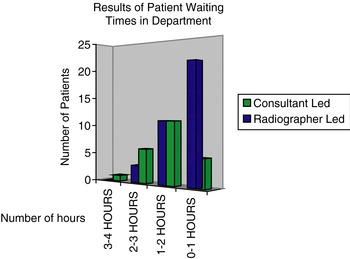
Implementing radiographer-led planning sessions resulted in an increase of 35% in the number of patients seen in any given week. Patients’ waiting time in the department improved as demonstrated in Figure 1 (Appendix 1). The audit compares patient waiting times in the department before and after radiographer-led planning. The majority of radiographer-planned patients waited between 0 and 1 hours and some between 1 and 2 hours. No patients, planned by radiographers, waited 3–4 hours.
Although other factors also contributed, waiting time from referral to treatment is now 4 weeks, a vast improvement on the previous 4 months.
After an annual review the radiographer's role was further extended to include signing off treatment volumes; it reduced delays in processing of paperwork and further streamlined the patient pathway. Treatment prescription remained the consultant's responsibility.
The breast planning radiographer started playing a more important role in the training of junior registrars. She developed a guide, discussing a wide range of issues relating to breast treatment planning, now used in the training of radiographers and clinicians. Knowledge, previously only available to clinicians, cascaded down to radiographers and the team became better informed.
The breast planning radiographer completed a portfolio for pregnancy consent of patients, anticipating a further improvement in patient waiting times by introducing radiographer-led pregnancy consent. Preparation to consent patients with breast cancer for radiotherapy treatment is currently underway. A research proposal is under development for a project that will involve other departments. Discussing the research project is not within the remit of this article; however, it is necessary to mention progress in this area as part of the role-development process.
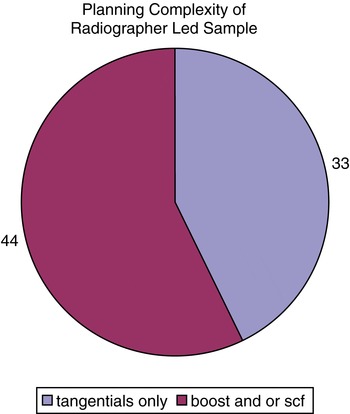
It is not possible to evaluate the effectiveness of all activities undertaken by the radiographer; however, some activities were evaluated in an audit. Seventy-seven patients planned by the radiographer were divided in two groups according to the complexity of the treatment plan. (Figure 2, Appendix 1) Complex planning included tangential fields, nodal fields and electron boosts. Non-complex plans included tangential fields only. Forty-four patients were included in the complex group and 33 patients were for tangential fields only.
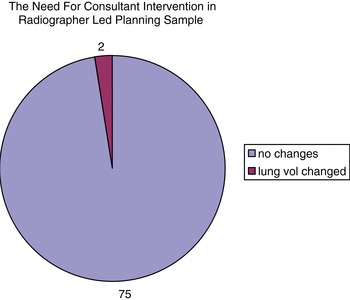
Figure 3 (Appendix 1) demonstrates consultant intervention in radiographer-led planning, measuring radiographer competency. The consultant changed the lung volume in two cases. In one case the lung volume increased from 2 to 2.5 cm and in the other it decreased from 2 to 1.5 cm. It is difficult to determine the clinical significance of these changes as both changes were within departmental tolerance of 2 cm, and it is also known that these changes often depends on personal preference.
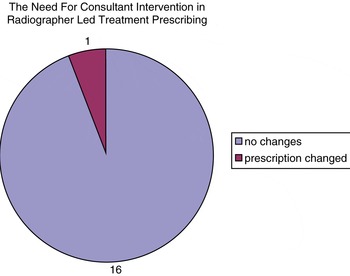
Figure 4 (Appendix 1) demonstrates consultant intervention in radiographer-led treatment prescription. It is hoped that results from this audit will contribute to justifying radiographer-led prescribing of treatment. The consultant intervened in 1 of 17 cases. An electron energy was increased from 12 to 15 Mev. However, it should be mentioned that the radiographer suggested this change and asked for the consultants opinion. 15 Mev is not routinely used for breast boosts.
Discussion
Factors that hindered the process of role development
Career-development plan
Initially, the emphasis was on achieving competence to plan breast patients’ treatment independently and to develop the radiographer's role. It did not seem essential to define and differentiate the advanced practitioner or consultant role. Development was of an opportunistic nature and the next step was always unclear, which ultimately had an impact on decision-making. Two of the three radiographers who completed the initial course decided not to proceed, partly because they lost motivation and owing to their belief that their efforts may ultimately lead to nothing.
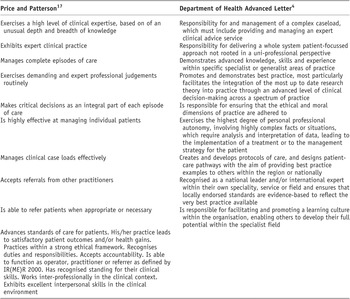
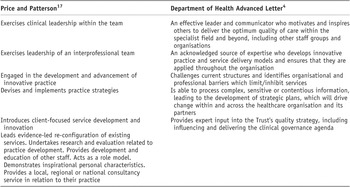
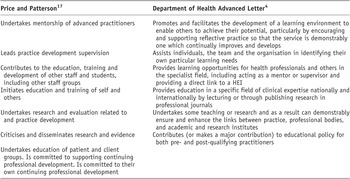
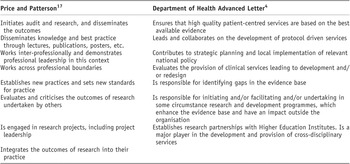
From previous discussion in the case study, it is clear that boundaries of the breast planning radiographer now possibly extend into the role of an advanced practitioner and even consultant practitioner role. The Advanced Letter indicates that consultant practice should show evidence of involvement in the four core functions: expert clinical practice; professional leadership and consultancy; education, training and development and service development; research and evaluation.4 Price and Patterson compare their interpretation of the consultant practice with that of the DOH in Table 1–4 (Appendix 2).Reference Price and Patterson10 The progression from superintendent to advanced practitioner is unclear in the case study, and the career structure does not allow for recognition of responsibilities normally carried out by the medical team.
Hardy identifies that one of the difficulties in defining and recruiting therapy radiographers to consultant practitioner posts could be the lack of national, profession-specific targets and clinical priorities from the DOH to guide their development.Reference Hardy and Snaith11 The lack of a development plan and clear objectives at the outset of this project affected the career opportunities of the individual involved. It is likely to influence recruitment and retention of radiographers who aspire to get involved in role development.
Professional issues
The title ‘consultant practitioner’ will apply to new posts established under this agreement and must not be conferred on individuals in recognition of innovative or excellent practice, or for any other reason, or to be applied simply by re-designing the incumbents of existing posts such as those who occupy posts titled, for example, ‘advanced practitioner’.4 Phrases like these contribute to obstacles in the recognition of radiographers.Reference Eddy7, Reference Price and Patterson10 Although the Society of Radiographers tried to address some of the inconsistencies in recent publications, there still exists great potential for misunderstandings in radiographer development and recognition in some radiotherapy departments.
Compared to nurses, AHPs appear to be disadvantaged because issues concerning their changing forms of practice are less developed.Reference Read, Jones, Doyal and Vaughan12 This had led to inconsistencies in grading and titles.13, 14 The breast planning radiographer should be practicing under a different title, if not that of a consultant radiographer then at least an advanced practitioner. It will be beneficial for the profession to recognise radiographers who have adopted expanded roles to the benefit of patients. Most of these roles require training and education and develop over many years.
Resources
Lack of dedicated time had an effect on the progress of the research project and indirectly on role development that was happening alongside fulfilling existing responsibilities. Academic work is being done at home which has implications on the individual's personal life over a long period; doing an MSc part time takes 5–6 years.
Kelly also refers to the lack of time allocated, particularly to academic work, as a hindering factor in role development.Reference Kelly15 There is more evidence from other research that the main inhibiting factor for nurses developing their role was a requirement to undertake their old job simultaneously.Reference Woods16
Funding for professional training has been made available and is a major factor in role development. However, the case study highlights that support from management and Trusts in creating new positions, is essential, if the profession want to ensure future employment of advanced practitioners and consultant radiographers. It will be extremely difficult for the breast planning radiographer in the case study, to develop further towards the consultant radiographer role, without the provision of protected time.
Organisational characteristics
It requires an organisational and departmental culture that encourages innovative practice and role development, to implement successfully the four-tier model in radiotherapy departments. The author agrees with Price, that it will be more difficult to implement new roles in some departments.Reference Price and Le Masurier17
London has the least number of extended roles, which could account for the higher vacancy rates in the region and the fact that there may be more radiologists in training in London.Reference Read, Jones, Doyal and Vaughan12, 18 However, the author found that getting involved in registrar training helped to work across professional boundaries.
Although clinicians initially expressed fears that radiographer role development in breast planning may adversely influence the training of registrars, there is now more flexibility between the professional groups who provide the service to patients with breast cancer. Clinicians and radiographers exchange knowledge more freely and registrar training has been supplemented with information that was not been easily accessible in the past.
Support from consultants, managers, multi-disciplinary and professional colleagues
Three mentoring consultants were nominated to supervise the breast planning role development. Advanced practice in the case study progressed in an ad hoc fashion, and there was a stage where it was difficult to gain the confidence of one of the mentoring consultants. The first step of handing over breast planning to radiographers took a long time but was made possible by the support of the other two mentors. The subsequent step of delegating approval of lung volumes to radiographers followed shortly afterwards.
Altering established patterns of care is difficultReference Grol and Grimshaw19 and support from managers and consultants is essential. Implementation of radiographer-led planning required approval of all the consultants and as Woods states, its the most important facilitating factor for advanced nurse practitioners.Reference Woods16 To get the support and co-operation of the whole consultant group, the author had to demonstrate maintenance of safe practice and improved patient care. Consultants from other specialities raised concerns, stemming from lack of involvement during the role-development process. Their concerns were put to rest as a result of direct support from the breast consultants working with the radiographer.
Peer resistance
The effect of peer resistance on role development should not be underestimated. An influential member of the team can delay and even avert introduction of changes in work practice. Their lack of support also reflects in the outlook of the team they manage.
Auditing
The author found it particularly difficult to evaluate the impact that radiographer-led planning had on the service. Auditing can be time consuming and the lack of protected time made it very difficult to achieve. Technological changes in record keeping over the last few years complicated and limited the retrieval of information. Lack of evidence on the impact of these new roles seems to be a common occurrence, also established by McPherson et al. in a very thorough systematic review.Reference McPherson, Kersten, George, Lattimer, Breton, Kaur and Frampton20 In hindsight, it would have been beneficial to decide on the data required for comparisons and measuring the impact of the role, before implementation of change in practice.
Recommendations
An inventory of guidelines throughout Europe demonstrates that the UK guideline of 1 consultant per 350 patients is higher than that in any other country.Reference Slotman, Cottier, Bentzen, Heeren, Lievens and van den Bogaert21 Owing to an ageing population and an annual increase in expected cancer cases, future infrastructure changes will be required in radiotherapy departments. Consultant radiographers can play a vital role in taking on duties from the radiation oncologists to redistribute workload and improve services.
The low success rate of consultant appointments indicates a shortage of sufficiently educated radiographers. Taking on the additional responsibility and developing additional skills requires protected study time and highlights the need for support in the form of consultant trainee jobs.
The author appreciates that advanced practitioner and consultant practitioner positions are new to the profession, and lessons are to be learnt from developing these roles. Existing advanced practitioners who already participate in further education and contribute to service improvement do not always benefit from Hospital Trust support and should be identified, supported and guided by the professional bodies; they may be the next generation of consultants. To capitalise on the existing workforce's experience and expertise, better coordination and recognition of advanced practitioners is necessary. It may well mean that a central body should mentor and coordinate the roles while the consultant posts are still under development.
Advanced practitioners, working towards the consultant practitioner role, are specialising in a specific area and developing their skills and services around Trust and departmental needs. This may limit their future career possibilities and employability by other Trusts.
Under a coordinated system, there would be better awareness of Trust and departmental needs nationally; skills of specialising individuals may be better used in departments elsewhere to improve radiotherapy services. It would enable professionals to advertise their skills and apply for positions nationally like our medical colleagues. Perhaps therefore the career-development plan should be generic instead of catered around the needs of one specific Trust.
The author found it difficult to be certain when a radiographer with an extended role became an advanced practitioner and when an advanced practitioner progressed to become a consultant. Although the knowledge and skills framework allows for progression in developing skills, the breast planning radiographer still practices as a pre-treatment superintendent. In a systematic review, McPherson et al. expressed difficulty in interpreting findings on extended scope practice cross-culturally Reference McPherson, Kersten, George, Lattimer, Breton, Kaur and Frampton20 owing to the wide variation of terminology being used in literature. There was uncertainty as to when an extended scope practitioner is no longer an extended scope practitioner. Consistency in the use of terms would be advantageous.
It has become clear from this case study, that there is a need for a framework within the profession that clearly conveys the progression of the radiographer from the practitioner stage through to the consultant practitioner stage. Perhaps this framework should include assistant practitioner, as part of the four-tier model. The author agrees with Eddy that most radiographers want something to aim for and may find an incremental approach to the development of their skills, along a clear competence ladder more helpful than some abstract concepts being used interchangeably.Reference Eddy7
The author strongly recommends that a structured plan be set out before developing the role. It is essential to decide about the objective; expected skill development and responsibilities should be discussed and agreed beforehand. However, some changes around the departmental and inter disciplinary team needs can be anticipated as the process develops.
Summary and conclusion
A precedent has been set for therapy radiographers to develop and extend their roles and improve their status within the AHP team. Role development in breast planning is accepted practice. The role fulfils government recommendations for modernisation, role extension, flexibility, patient-centred treatment and partnership working.
Our profession has come a long way but still has some distance to go if we are to create more consultant practitioner roles. This can be achieved by better coordination of role development by professionals, structured career-development plans and creating new roles to enable individuals to develop new skills.
Although these findings relate to the author, who is involved in role development for breast planning, radiographers as well as other AHPs experience similar difficulties in developing new roles. The author trusts that her experience will contribute to the limited literature base for therapy radiographers and that the process of role development will continue to benefit our patients and the individual, who take up the challenge.
Acknowledgement
The author specially thanks Paul G Chandler BSc. (Hons), MBA for IT support.
APPENDIX 1
Results of patient waiting times in department.

Planning complexity of radiographer-led sample.

The need for consultant intervention in radiographer-led planning sample.

The need for consultant intervention in radiographer-led treatment prescribing.

APPENDIX 2
Expert clinical practice

Professional leadership and consultancy

Education, training and development

Practice and service development, research and evaluation