Introduction
Medicago truncatula, or barrel medic, has been chosen as a genomic and genetic model species for legumes. Legumes account for approximately one-third of the world's primary crop production, human dietary protein and processed vegetable oil, and a world-wide effort has led to the establishment/creation of a wide array of tools and resources, including high-density genetic and physical maps, a variety of different kinds of mutant populations, ‘omics’ dedicated platforms and sequencing of the euchromatic genespace using a BAC-by-BAC strategy (Domoney et al., Reference Domoney, Duc, Ellis, Ferrandiz, Firnhaber, Gallardo, Hofer, Kopka, Kuster, Madueno, Munier-Jolain, Mayer, Thompson, Udvardi and Salon2006). One of the research areas that these novel tools and resources are being applied to study is related to seed development, to improve nutritional value (Gallardo et al., Reference Gallardo, Le Signor, Vandekerckhove, Thompson and Burstin2003, Reference Gallardo, Firnhaber, Zuber, Héricher, Belghazi, Henry, Küster and Thompson2007; Djemel et al., Reference Djemel, Guedon, Lechevalier, Salon, Miquel, Prosperi, Rochat and Boutin2005; Wang and Grusak, Reference Wang and Grusak2005) and to understand seed physiological quality (Buitink et al., Reference Buitink, Ly Vu, Satour and Leprince2003, Reference Buitink, Leger, Guisle, Ly Vu, Wuillème, Lamirault, Le Bars, Le Meur, Becker, Küster and Leprince2006; Glevarec et al., Reference Glevarec, Bouton, Jaspard, Riou, Cliquet, Suzuki and Limami2004; Faria et al., Reference Faria, Buitink, van Lammeren and Hilhorst2005; Boudet et al., Reference Boudet, Buitink, Hoekstra, Rogniaux, Larré, Satour and Leprince2006). In recent years, several studies have been published on the characterization of the factors involved in seed development, using proteomics and transcriptomics or high-throughput quantitative polymerase chain reaction (QPCR) platforms (Gallardo et al., Reference Gallardo, Le Signor, Vandekerckhove, Thompson and Burstin2003, Reference Gallardo, Firnhaber, Zuber, Héricher, Belghazi, Henry, Küster and Thompson2007; Benedito et al., Reference Benedito, Torez-Jerez, Murray, Andriankaja, Allen, Kakar, Wandrey, Verdier, Zuber, Ott, Moreau, Niebel, Frickey, Weiller, He, Dai, Zhao, Tang and Udvardi2008; Verdier et al., Reference Verdier, Kakar, Gallardo, Le Signor, Aubert, Schlereth, Town, Udvardi and Thompson2008). In addition, tissue specificity was studied extensively during seed development, facilitated by the relatively large size of the seeds compared to those of Arabidopsis (Gallardo et al., Reference Gallardo, Firnhaber, Zuber, Héricher, Belghazi, Henry, Küster and Thompson2007; Verdier et al., Reference Verdier, Kakar, Gallardo, Le Signor, Aubert, Schlereth, Town, Udvardi and Thompson2008). Whereas some scattered information exist on how to release dormancy (Faria et al., Reference Faria, Buitink, van Lammeren and Hilhorst2005; Gallardo et al., Reference Gallardo, Lesignor, Darmency, Burstin, Thompson, Rochat, Boutin, Kuester, Buitink, Leprince, Limami and Grusak2006; Garcia et al., Reference Garcia, Barker and Journet2006), there is no in-depth study on the characterization of the dormancy of M. truncatula seeds.
Based on the classification of Baskin and Baskin (Reference Baskin and Baskin2004), M. truncatula seeds fall in the combinational dormancy category and should exhibit both physical (PY) and physiological (PD) dormancy. This type of dormancy is the most phylogenetically restricted dormancy class (for a review see Finch-Savage and Leubner-Metzger, Reference Finch-Savage and Leubner-Metzger2006) and is probably an adaptation to specialized habitats or life strategies. Physical dormancy is characterized by the inability of water to penetrate the surrounding tissues, due to the physical arrangement and the chemical coatings/impregnates of the palisade layer(s), and has been described widely in legume species (Russi et al., Reference Russi, Cocks and Roberts1992). Physiological dormancy in M. truncatula seeds is non-deep, and is removed during afterripening (Gallardo et al., Reference Gallardo, Lesignor, Darmency, Burstin, Thompson, Rochat, Boutin, Kuester, Buitink, Leprince, Limami and Grusak2006). Thus, characterization of the factors influencing dormancy in this species will provide a new framework for comparative molecular analyses of PY+PD dormancy, either between different genotypes or with other model species, such as Arabidopsis, which has been characterized extensively at the physiological and molecular level (Cadman et al., Reference Cadman, Toorop, Hilhorst and Finch-Savage2006; Finch-Savage et al., Reference Finch-Savage, Cadman, Toorop, Lynn and Hilhorst2007; Carrera et al., Reference Carrera, Holman, Medhurst, Dietrich, Footitt, Theodoulou and Holdsworth2008). This study describes the dormancy-related aspects of M. truncatula cv. Jemalong (A17) seeds to better understand factors governing its physical and physiological seed dormancy release. In addition, the genetic diversity of seed dormancy was characterized using an additional two Algerian genotypes (DZA315.16 and DZA45.5). An understanding of the physiology of afterripening will be valuable for studies aimed at investigating seed phenotypes of mutants in relation to germination and seedling emergence. For this reason, the genotype R108 was added to the analysis because of its frequent use for production of transgenic seeds or insertion mutants (Trinh et al., Reference Trinh, Ratet, Kondorosi, Durand, Kamate, Bauer and Kondorosi1998).
Materials and methods
Seeds of genotypes of M. truncatula were obtained from the INRA Medicago truncatula Stock Center, INRA Montpellier, France (DZA315.16, A17 (Jemalong), DZA45.5) and Institut des Sciences Végétales, CNRS, Gif sur Yvette, France (R108). Plants were grown in a sterile mix of vermiculite and soil in a growth chamber at 24°C/21°C, 16 h photoperiod at 200 μmole m− 2 s− 1 and flowers were labelled when pollination had occurred (Rosnoblet et al., Reference Rosnoblet, Aubry, Leprince, Ly Vu, Rogniaux and Buitink2007). Several cultures were launched at monthly intervals to have a continuous supply of seeds for all genotypes. Pods were harvested from 10–12 mother plants at two time points, 28–32 d after pollination (DAP) and when they had fallen off the plants (mature), approximately 40–42 DAP. To obtain mature seeds, these mature pods were collected and pooled on a weekly basis, then left to dry for a further 7 d at 63% relative humidity, after which they were dissected from the pods. Seeds were stored under ambient conditions of 20°C and 60–63% relative humidity (RH) in the dark before use. Water contents were assessed gravimetrically for triplicate samples of four seeds by determination of the fresh weight and subsequent dry weight after 2 d in an oven at 96°C. Water contents are expressed on a dry weight basis.
The effect of drying on the formation of hard seeds of three genotypes (A17, DZA315.16 and DZA45.5) was determined using seeds harvested at 28–32 DAP and drying them for 7 d at different RHs (44, 63, 75, 85%) in small, hermetically closed boxes containing saturated salt solutions of various compositions (K2CO3, NaNO3, NaCl and KCl) at 20°C in the dark. At several time points after imbibition of 50 seeds per genotype and drying condition, the number of unimbibed, hard seeds was counted.
The loss of hardseededness during imbibition was determined using mature seeds of A17 that had been kept for 1 week at 63% RH after harvest. Seeds were then equilibrated for 7 d at different RHs over different saturated salt solutions (KCl, NaCl, CaNO3, MgCl2 and ZnCl2) at 20°C in the dark, and subsequently stored in foil seed pouches (type 321/04, Barrier Foil Products Co., Stockport, Cheshire, UK) at 20°C. At different time points during storage, 60 seeds per storage condition were retrieved from the pouches and imbibed at 20°C ( ± 0.4°C) in a darkroom. The percentage of hard seeds was counted until 58 d of imbibition.
For germination studies, mature seeds were scarified manually by gently rubbing them on fine sandpaper then imbibed on one filter paper (Whatman, no. 1) in distilled water at the indicated light and temperature conditions. Under these conditions, the seed coat was damaged whereas the endosperm remained intact (verified by binocular microscopy). At different time intervals, the percentage of germination was determined by counting the number of individuals that had a protruded radicle of at least 1 mm. When imbibition occurred in dark conditions, seeds were exposed to a green safelight provided by Sylvania F36W/green lamps (500–570 nm) during observations. Germinated seeds were removed from the Petri dishes during the germination time course. To investigate the release of physiological dormancy during storage, mature seeds of A17 that had been kept for 1 week at 63% RH after harvest were equilibrated over MgCl2 (35% RH) and stored in foil seed pouches at 20°C. At different time points during storage, 60 seeds per storage condition were retrieved from the pouches and imbibed at 20°C ( ± 0.4°C) in a darkroom.
To study the effect of genotype, 70 seeds per genotype at 8–15 d post-harvest (DPH) and after 7–12 months post-harvest were imbibed at 20°C in the dark. The effect of temperature on dormancy release was determined on 100 seeds of 19–26 DPH and non-dormant A17 (>6 months DPH) as follows: seeds were first incubated for 4 d at a range of temperatures ( ± 0.5°C) in the dark, then transferred to the darkroom at 20°C. The effect of light was tested by imbibing 100 seeds of A17 and R108 at 19–26 DPH under a photoperiod of 16 h or under continuous white light (200 μmole m− 2 s− 1).
For experiments using hormones and chemicals, seeds at 8–15 DPH (DZA315.16, DZA45.5 and A17) or 14–28 DPH (R108) were scarified as described above. The effect of 1-methyl-3-phenyl-5-(3-trifluoromethyl-(phenyl))-4-(1H)-pyridinone (fluridone) (Duchefa, Haarlem, The Netherlands), paclobutrazol (Riedel-Haen, Hanover, Germany) and gibberellic acid (GA3, Sigma, St. Louis, Missouri, USA) on germination was determined by imbibing 70 mature seeds (DZA315.16, DZA45.5 and A17) or 50 mature seeds (R108) in different concentrations at 20°C in the dark or continuous white light. Fluridone and GA3 were dissolved in ethanol (EtOH) prior to dilution in water. The control treatment of these two compounds consisted of a solution containing the highest concentration of EtOH (i.e. 0.1% v/v). To determine the effect of nitrate, triplicates of 50 seeds were imbibed at 21–28 DPH in different concentrations of KNO3, or KCl as a control, in the dark and in continuous white light at 20°C.
To study the role of the seed coat and endosperm during imbibition, 150 seeds at 5–12 DPH were scarified and imbibed for 6 h in the dark at 20°C, after which they were divided into three pools of 50 seeds. One pool did not receive any treatment. In the second pool, seed layers were carefully removed, after which seeds were placed on a new moist filter paper. In the third pool, seeds were mechanically damaged by a small scalpel incision through the seed coat and the endosperm. Upon subsequent imbibition, seeds of each pool were considered ‘germinated’ when they exhibited an increase in radicle length of more than 2 mm.
Statistical analysis on the germination data was carried out using the χ2-test and differences were regarded as significant at P < 0.05.
Results
Physical dormancy
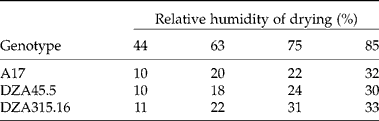
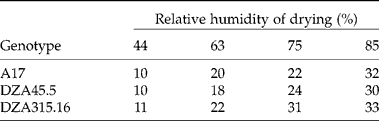
A typical characteristic of numerous legume seeds is their hardseededness (Russi et al., Reference Russi, Cocks and Roberts1992). Seeds of M. truncatula are no exception and a part of the seed population is unable to imbibe when put in water. We found that the percentage of hardseededness of different harvests of several M. truncatula Jemalong cultures varied from 10 to 90% between different harvests. The role of environmental conditions on the development of hard seeds of several genotypes was further investigated in order to better control this characteristic during the production of M. truncatula seeds. Seeds harvested at 28–32 DAP were dried at different RHs (Table 1). The speed of drying during maturation appeared to influence the final percentage of hardseededness; the higher the RH of drying, the slower the drying rate and the higher the percentage of hard seeds (Table 1). Even seeds harvested at 24 DAP could become hardseeded when dried rapidly (data not shown), showing that the factors necessary for this phenomenon are already acquired during the seed-filling phase. The percentage of hard seeds formed during drying was similar for all three genotypes studied (Table 1).
The effect of drying on the formation of hard seeds of three genotypes (A17, DZA315.16 and DZA45.5). Percentage of hard seeds was determined for seeds that were harvested at 28–32 DAP then dried for 7 d at different RHs (44, 63, 75, 85%) in small, hermetically closed boxes containing saturated salt solutions of various compositions (K2CO3, NaNO3, NaCl and KCl) at 20°C in the dark. Then percentage of hard, unimbibed seeds was determined after 6 d of imbibition of 50 seeds in the dark at 20°C
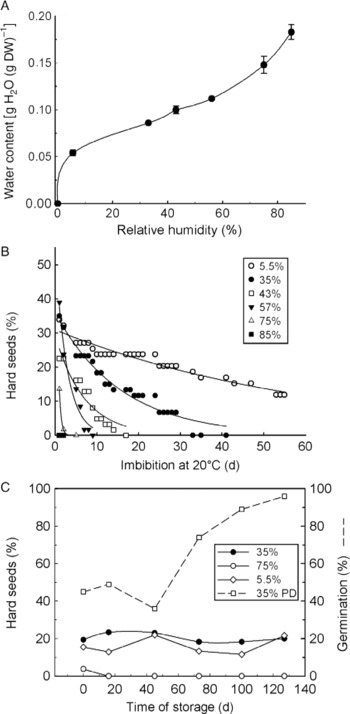
We next assessed whether the RH to which mature seeds are equilibrated influences the level and speed of release of physical dormancy (Fig. 1). A water sorption isotherm of mature seeds is shown in Fig. 1A to relate the actual water content present in the seeds to different RH after equilibration for 7 d. Hardseededness was installed when seeds were dried below 75% RH (Fig. 1B and C). Below this value, the speed of physical dormancy release during imbibition was dependent on the initial water content/RH to which the seeds were dried (Fig. 1B); the drier the seeds, the longer the imbibition time needed to break physical dormancy. For example, to reduce the percentage of hard seeds by half during imbibition, it took c. 5 d and 58 d when seeds were equilibrated at 57% and 5.5% RH, respectively. To reveal physiological dormancy, seeds were scarified before imbibition. We performed a storage experiment to see whether the kinetics of release of physiological dormancy was similar to that of the release of physical dormancy. Storage of mature seeds up to 127 d between 5.5 and 35% RH did not significantly alter the percentage of hard seeds measured after 7 d of subsequent imbibition. In contrast, 73 d of storage at 35% RH were sufficient to induce the release of physiological dormancy, which was completed after 127 d (Fig. 1C). To study the effect of environmental factors on physiological dormancy release, physical dormancy was removed in subsequent experiments through mechanical scarification.
The effect of imbibition and storage on physical and physiological dormancy in mature seeds of M. truncatula cv. Jemalong (A17) after equilibration to relative humidities (RH). (A) Water sorption isotherm of mature seeds at 20°C. Water contents (three replicates ± SE) were determined after equilibration for 7 d over different saturated salt solutions. (B) The effect of imbibition time on the release of physical dormancy of mature seeds equilibrated at the indicated RH. After storage for 9 d at 20°C, seeds were imbibed at 20°C in the dark and percentage of hard, unimbibed seeds was determined. (C) Effect of storage time at 20°C at indicated RH on the release of physical (solid lines) and physiological (dashed lines) dormancy. Data represent percentage of hard seeds or germination after 7 d of imbibition at 20°C in the dark. PD, physiological dormancy. Data are significantly different when they differ by 22% or more (χ2-test, P < 0.05).

Genetic variation of physiological dormancy
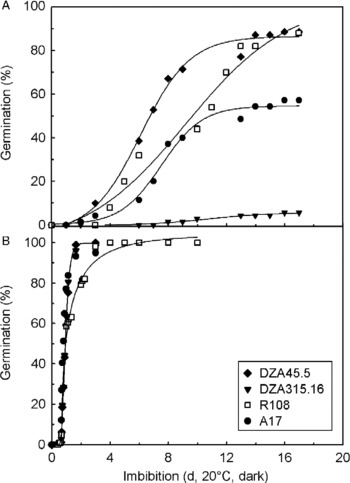
Differences in physiological dormancy between genotypes were studied after removal of physical seed dormancy by scarification. Cultures of the three genotypes were launched over a wide time span to account for differences in flowering times and to be able to harvest seeds at similar maturation stages at the same time. Depending on the genotype, imbibition at 20°C in the dark led to reduced germination in freshly harvested seeds (i.e. 7–18 DPH) compared to seeds kept for more than 7 months post-harvest, corresponding to complete afterripening. Fully afterripened seeds germinated within 1–3 d without significant differences between genotypes (Fig. 2B). Figure 2A indicates that DZA315.16 is the most dormant phenotype. Even after 4 weeks of imbibition, less than 20% of the seed lot had germinated. In contrast, the genotype DZA45.5 showed very little reduction in the percentages of germination: all seeds had germinated within 2 weeks (Fig. 2A). Seeds of the genotype A17 (Jemalong), used for the BAC-to-BAC sequencing (Domoney et al., Reference Domoney, Duc, Ellis, Ferrandiz, Firnhaber, Gallardo, Hofer, Kopka, Kuster, Madueno, Munier-Jolain, Mayer, Thompson, Udvardi and Salon2006), showed intermediate dormancy behaviour compared to the two DZA genotypes, just like seeds from R108, a genotype often used for transformation by Agrobacterium due to its regeneration capacity (Trinh et al., Reference Trinh, Ratet, Kondorosi, Durand, Kamate, Bauer and Kondorosi1998). The difference in dormancy between genotypes appears to be genetically determined, as the order of dormancy depth remained the same (i.e. DZA315.16>A17 (Jemalong)>R108>DZA45.5) for seeds obtained under the same growth conditions, despite the observation that these conditions (growth chamber versus greenhouse, time of sowing of cultures) can influence the dormancy level.
Germination curves of different genotypes of M. truncatula after 8–15 d (A) and 7–12 months (B) of storage at 63% RH and 20°C. Scarified seeds (70) were imbibed at 20°C in the dark. Data are significantly different when they differ by 18% or more (χ2-test, P < 0.05).

Role of seed coat and endosperm in germination of M. truncatula seeds
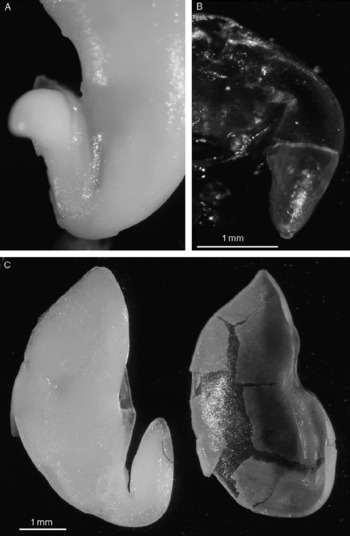
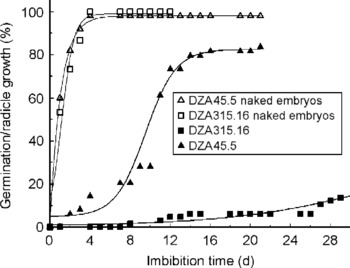
The seed coverings play an important role in germination and dormancy (Bewley and Black, Reference Bewley and Black1994; Nonogaki et al., Reference Nonogaki, Chen, Bradford, Bradford and Nonogaki2007). Seeds of M. truncatula exhibit a transparent endosperm (Fig. 3). This endosperm, which is several cell layers thick, can be observed when punctured by the radicle tip after germination (Fig. 3A). It can be separated from the embryo in imbibed non-germinated seeds (Fig. 3B). Like Arabidopsis and other models, imbibition of non-dormant seeds in a 10 μM solution of abscisic acid (ABA) led to the breaking of the seed testa but not to endosperm rupture (Fig. 3C) (Nonogaki et al., Reference Nonogaki, Chen, Bradford, Bradford and Nonogaki2007). To test the influence of the endosperm on seed dormancy, and to investigate the impact of the endosperm on the difference in dormancy depth between the two most extreme genotypes (DZA45.4 and DZA315.16), radicle growth was assessed during imbibition of naked embryos. Seeds were first incubated for 6 h in the dark at 20°C after which both endosperm and seed coat were carefully removed so as not to damage the embryos. The naked embryos were incubated in water and radicle growth was monitored (Fig. 4). Removing the seed layers allowed rapid radicle elongation regardless of the genotype. Embryos without surrounding layers germinated at almost the same speed as fully afterripened seeds (compare Figs 4 and 2), indicating that the surrounding layers are the main factor in the reduced germination of freshly harvested seeds. Interestingly, when the two genotypes exhibiting a contrasting dormancy are compared, there is no longer any difference in germination. For the seeds that were mechanically damaged by puncturing the endosperm, germination speed increased to between that of intact seeds and naked embryos (data not shown).
Morphology of seed coverings before (B–C) and after germination (A) of a M. truncatula seed. (A) Germinated seed showing radicle emergence through the endosperm. Note that the seed testa has been removed. (B) Dissected endosperm removed from a non-germinated seed that was imbibed for 24 h in 10 μM abscisic acid (ABA). (C) Naked embryo (left) and the corresponding dissected seed coverings (right). Prior to dissection, the seed was imbibed in 10 μM ABA for 24 h. Note that the transparent endosperm, which appears on the left, remained intact during imbibition whereas the testa, which appears on the right, was cracked.

Percentage of germination and radicles exhibiting growth during imbibition of intact seeds (closed symbols) and naked embryos (open symbols). Two batches of 50 scarified seeds of genotypes DZA315.16 (squares) and DZA45.5 (triangles) at 5–12 d post-harvest (DPH) were imbibed for 6 h in the dark at 20°C. Seeds from one batch were dissected to remove the seed coat and endosperm. Both batches were then transferred to a new filter paper in the dark at 20°C. Data are significantly different when they differ by 22% or more (χ2-test, P < 0.05).

External factors influencing seed dormancy in M. truncatula
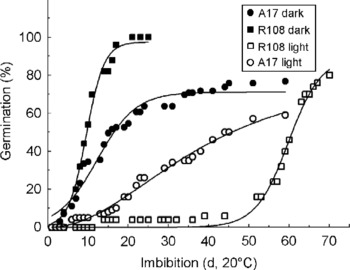
A number of external factors exist that can influence seed dormancy, such as light, temperature or nitrate (for reviews see Finch-Savage and Leubner-Metzger, Reference Finch-Savage and Leubner-Metzger2006; Nonogaki et al., Reference Nonogaki, Chen, Bradford, Bradford and Nonogaki2007). We set out to determine which factors are important in the release of seed dormancy in M. truncatula. In Arabidopsis, light has a promoting effect on dormancy release (Cadman et al., Reference Cadman, Toorop, Hilhorst and Finch-Savage2006). To test whether seeds of M. truncatula behaved similarly, dormant seeds were imbibed in continuous white light or in the dark at 20°C (Fig. 5). Germination speed was reduced in the light compared to the dark, indicating that, unlike most species, light promotes the expression of dormancy in M. truncatula (Fig. 5). For A17, light reduces germination speed, calculated by the T50, roughly threefold, whereas for R108, T50 is sixfold reduced when continuous light is provided during imbibition. The extent of this reduction is either dependent on the genotype, on time of afterripening or on both, as seeds used for the experiment had received different lengths of afterripening: 56 d for A17 and 7–14 d for R108. The effect of light on inhibition of germination was also found to be dependent on the duration of the light treatment. A photoperiod of 16 h light slowed down germination compared to dark controls, but not as much as continuous light (data not shown). Light did not affect germination speed or percentage for any of the fully afterripened genotypes, indicating that it is a dormancy-related trait.
Percentage of germination during imbibition of mature M. truncatula seeds in continuous white light (open symbols) or dark (closed symbols). Scarified seeds (100) of genotypes A17 (circles) and R108 (squares) at 19–26 DPH were used. Data are significantly different when they differ by 15% or more (χ2-test, P < 0.05).

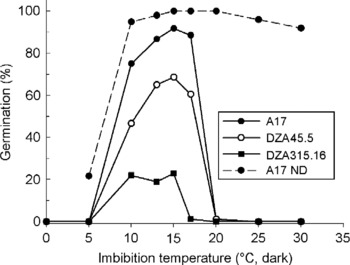
In many species, imbibition of seeds under cold temperatures breaks dormancy, and this has been reported for M. truncatula (Faria et al., Reference Faria, Buitink, van Lammeren and Hilhorst2005; Gallardo et al., Reference Gallardo, Lesignor, Darmency, Burstin, Thompson, Rochat, Boutin, Kuester, Buitink, Leprince, Limami and Grusak2006). To study in more detail the effect of temperature on dormancy release, seeds of A17 and the two DZA genotypes were submitted after 19–26 DPH to different temperatures during imbibition in the dark for 4 d, after which they were transferred to 20°C. The percentage of germinated seeds of the three genotypes was highest at 15°C (Fig. 6). The dormancy release at this temperature was less effective for DZA315.16 than for the other two genotypes, corroborating the more profound dormancy acquired by this genotype. This difference is easily seen at 17°C: seeds of A17 had 88% germination, whereas incubation of the same seed lot only 3°C higher, at 20°C, blocked germination completely (Fig. 6). When this experiment was performed with fully afterripened seeds (over 6 months post-harvest, dashed line in Fig. 6), the inhibiting effect of high temperature was not observed, indicating that afterripening increases the temperature limits for germination.
Effect of imbibition temperature on germination of mature seeds of M. truncatula before (solid lines) or after (dashed line) storage at 20°C. Scarified seeds (100) of genotypes DZA315.16 (closed squares), DZA45.5 (open circles) and A17 (closed circles) at 19–26 DPH and A17 at >6 months post-harvest (non-dormant, ND) were imbibed for 4 d at different temperatures in the dark, after which the percentage of germinated seeds was counted. Data are significantly different when they differ by 15% or more (χ2-test, P < 0.05).

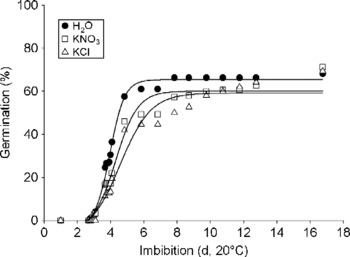
To test the effect of nitrate on dormancy breaking, seeds of the genotype A17 stored for 3 weeks were imbibed in the dark in either a solution of 10 mM KNO3 or 10 mM KCl as a control (Fig. 7). Control seeds germinated only to 60% in water. The final percentage and speed of germination of seeds imbibed in both salt solutions were not significantly affected, indicating that nitrate does not release dormancy of seeds of M. truncatula. Likewise, imbibition of dormant seeds in 5 mM or 20 mM KNO3 in the light did not have an effect (data not shown).
Effect of nitrate on germination percentages of dormant seeds of M. truncatula. Scarified seeds (150) of genotype A17 at 21–28 DPH were imbibed in the dark at 20°C in water (closed circles), a solution of 10 mM KNO3 (open squares) or 10 mM KCl (open triangles). Data are significantly different when they differ by 15% or more (χ2-test, P < 0.05).

ABA and GA dependency
Considering the major roles of ABA and GA in seed dormancy and germination (Bewley and Black., Reference Bewley and Black1994; Nonogaki et al., Reference Nonogaki, Chen, Bradford, Bradford and Nonogaki2007), their specificity in M. truncatula was investigated by incubating the seeds in either a solution of fluridone, an inhibitor of carotenoid synthesis, or gibberellic acid (GA3) (Fig. 8). The addition of fluridone increased the speed of germination in a dose-dependent way. A concentration of 10 μM fluridone was sufficient to remove any dormancy-related differences in germination (Fig. 8A–C), indicating that ABA synthesis plays a key role in maintaining the dormant state. However, the sensitivity to fluridone was dependent on the genotype; a concentration of 0.1 μM fluridone already had a significant effect on the germination of seeds of DZA315.16, increasing germination percentages from 6 to 82% after 17 d of imbibition, whereas this same concentration had little effect on seeds of DZA45.5 and A17. Fluridone at 10 μM was also efficient in breaking dormancy in the light (data not shown).
Percentage of germination of dormant seeds of M. truncatula during imbibition in different concentrations of fluridone (A–C) and gibberellic acid (GA3) (D–E). Scarified seeds (70) at 8–15 DPH were imbibed in the dark at 20°C in the presence of the following concentrations of fluridone or GA3: 0.1 μM (open squares), 1 μM (closed diamonds), 10 μM (open triangles) and 100 μM (closed circles). The control (closed triangles) consisted of a solution 0.1% ethanol (v/v). Genotypes tested were A17 (A+D); DZA315.16 (B+E) and DZA45.5 (C+F). Data are significantly different when they differ by 18% or more (χ2-test, P < 0.05).

Whereas fluridone could efficiently break seed dormancy, the addition of GA3 at concentrations of up to 100 μM had surprisingly little or no effect on germination of any of the three genotypes (Fig. 8D–F). Similar results were obtained for seeds of genotype R108 (Fig. 9A). Nonetheless, the addition of the ent-kaurene oxidase inhibitor paclobutrazol, an inhibitor of GA biosynthesis, at concentrations of 100 μM was capable of reducing germination speed significantly (Fig. 9B), still pointing to a role of GA in germination of M. truncatula seeds.
Percentage of germination of dormant seeds of M. truncatula (genotype R108) during imbibition in different concentrations of gibberellic acid (GA3) (A) and paclobutrazol (PAC) (B). Scarified seeds (50) at 14–28 DPH were imbibed in the dark at 20°C in the presence of 10 μM (open squares) or 100 μM (open circles) of GA3 or PAC. Control (closed triangles) consisted of a solution 0.1% ethanol (v/v). Data are significantly different when they differ by 22% or more (χ2-test, P < 0.05).

Discussion
This paper describes the physiology of dormancy in seeds of several genotypes of M. truncatula. It confirms and extends preliminary data indicating that seeds of M. truncatula exhibit both PY and PD dormancy (Faria et al., Reference Faria, Buitink, van Lammeren and Hilhorst2005; Gallardo et al., Reference Gallardo, Lesignor, Darmency, Burstin, Thompson, Rochat, Boutin, Kuester, Buitink, Leprince, Limami and Grusak2006). Considering that M. truncatula is a winter-annual species, it is essential that the potential timing for seedling emergence is well controlled. Temperature is an important factor in the expression of dormancy of M. truncatula seeds, and the thermodormancy found in M. truncatula is comparable to that of lettuce (Cantliffe et al., Reference Cantliffe, Shuler and Guedes1981). Afterripening increased the temperature range at which seed germination can occur from low to higher temperature (Fig. 6). The depth of dormancy varied between genotypes, being the most prominent in seeds of DZA315.16. This observation warrants further genetic studies that will tap into the genetic diversity using core collections of Medicago to understand dormancy.
The seed coat plays a major role in the inhibition of germination in seeds of M. truncatula, evident from the fast elongation and growth of the embryonic axis when the embryo was removed from the surrounding layers of the most dormant genotype DZA315.16. Indeed, endosperm removal of seeds of two genotypes having very different depths of dormancy led to comparable radicle elongation of both genotypes. It remains to be seen whether the genotypic difference is related to embryo growth potential or differences in endosperm weakening. Further experiments on germination of naked embryos in a solution of slight osmotic pressure, or measurements of the force needed to initiate endosperm rupture, might provide the answer to this question. Both genotypes DZA45.5 and DZA315.16 originate from Algeria, and passport data mention that they were collected from sites at different altitudes (100 m versus 1070 m, respectively) (http://www.montpellier.inra.fr/BRC-MTR/) (Ronfort et al., Reference Ronfort, Bataillon, Santoni, Delalande, David and Prosperi2006). A recombinant inbred line (RIL) population from DZA315.26 × DZA45.6 (LR1) has been used previously to screen for traits involved in flowering date (Pierre et al., Reference Pierre, Huguet, Barré, Huyghe and Julier2008) and aerial morphogenesis (Julier et al., Reference Julier, Huguet, Chardon, Ayadi, Pierre, Prosperi, Barre and Huyghe2007), whereas an RIL population from the cross Jemalong6 × DZA315.16 was used to determine quantitative trait loci (QTL) of seed mineral content (Sankaran et al., Reference Sankaran, Huguet and Grusak2009). These RIL populations will be a useful tool for investigating genetic aspects of seed dormancy in M. truncatula. Furthermore, kinetics of release of physical dormancy appears to be different from that of physiological dormancy. This observation provides interesting cues to test the interactions between endosperm, seed coat and dormancy, a topic that is still a matter of debate for Arabidopsis (Debeaujon et al., Reference Debeaujon, Lepiniec, Pourcel, Routaboul, Bradford and Nonogaki2007).
As for other species, ABA synthesis during imbibition appears to play a prominent role in the maintenance of dormancy, since its inhibition by fluridone resulted in a germination speed comparable to that of fully afterripened seeds. DZA315.16, the most dormant genotype, seemed more sensitive (0.1 μM fluridone) to inhibition of ABA synthesis. The addition of GA3 to the medium did not influence germination speed. It is unclear whether this was a problem of penetration of GA through the surrounding seed layers or a genuine insensitivity. It should be noted that inhibition of GA by the ent-kaurene oxidase inhibitor paclobutrazol reduced the germination speed of dormant seeds considerably, although it cannot be excluded that this is related to side-effects. Possibly, GA is already present in dormant M. truncatula seeds, but the sensitivity to GA is very low. Afterripening would then lead to the increase in this sensitivity, but this remains a hypothesis that needs to be tested. On the other hand, it has been shown that in light-requiring species, Sisymbrium officinale and Arabidopsis, red light (Pfr) plays an important role in the biosynthesis of GAs and also increases the sensitivity of seeds to GAs (Hilhorst and Karssen, Reference Hilhorst and Karssen1988; Yamaguchi and Kamiya, Reference Yamaguchi and Kamiya2002; Seo et al., Reference Seo, Hanada, Kuwahara, Endo, Okamoto, Yamauchi, North, Marion-Poll, Sun, Koshiba, Kamiya, Yamaguchi and Nambara2006). These species germinated in darkness when exogenous GA was applied. In Arabidopsis, a red pulse increases expression of AtGA3ox1 and AtGA3ox2, genes involved in GA biosynthesis (Yamaguchi and Kamiya, Reference Yamaguchi and Kamiya2002), increases ABA catabolism and decreases NCED expression (Seo et al., Reference Seo, Hanada, Kuwahara, Endo, Okamoto, Yamauchi, North, Marion-Poll, Sun, Koshiba, Kamiya, Yamaguchi and Nambara2006). A far-red pulse leads to an increase in AtGA2ox2. In contrast, in this study we demonstrated that white light enhances rather than reduces the expression of dormancy in M. truncatula seeds. This behaviour resembles the response of Bromus sterilis or Hordeum vulgare seeds to light (Corbineau et al., Reference Corbineau, Belaid and Côme1992; Gubler et al., Reference Gubler, Hughes, Waterhouse and Jacobsen2008). Germination of B. sterilis seeds was inhibited by exposure to white or red light for 8 h/d (Hilton, Reference Hilton1982). The effect of red light can be reversed by a single pulse of far-red light, indicating that the photoreversible pigment phytochrome is involved in the response. Continuous white light also markedly inhibits germination of freshly harvested, dormant Bromus rubes seeds, whereas breaking of dormancy during dry storage results in almost complete disappearance of sensitivity of seeds to light (Corbineau et al., Reference Corbineau, Belaid and Côme1992). In barley, Gubler et al. (Reference Gubler, Hughes, Waterhouse and Jacobsen2008) showed that the white light promotion of dormancy is caused by blue light through induction of HvNCED1 expression, a gene encoding 9-cis-epoxycarotenoid dioxygenase, involved in ABA biosynthesis. Afterripening appears to override the blue light promotion of HvNCED1 expression by activating ABA catabolism and GA biosynthesis genes in embryos of imbibing barley seeds. It remains to be investigated whether the different regulation of GA and ABA catabolism and anabolism genes in M. truncatula seeds resembles that of barley. However, a second observation that does not currently fit a phytochrome-regulated dormancy in M. truncatula is that nitrate did not affect the germination response as it does for the Brassicaceae Arabidopsis and Sisymbrium officinale (Hilhorst and Karssen, Reference Hilhorst and Karssen1988; Bethke et al., Reference Bethke, Libourel, Jones, Bradford and Nonogaki2007).
The particular features described for M. truncatula make it a new useful model for genetic and molecular studies that can complement those developed for Arabidopsis. Characterization of factors influencing seed dormancy of different M. truncatula genotypes demonstrated that the response of the seeds to light and nitrate differs from that of the genetic model Arabidopsis. M. truncatula also exhibits physical dormancy leading to seed hardseedness, release of which obeys different kinetics from that of the afterripening process and deserves further attention. DZA315.16, the more dormant genotype, might be particularly suitable in studies aimed at understanding seed dormancy characteristics.
Acknowledgements
This work was supported in part by a grant from the region Pays de la Loire (QUALISEM).