American legislatures differ from those of other advanced democracies in many ways, but perhaps the most important aspect of their distinctiveness lies in their bicameral structure. Unlike nearly all of the world's other federal democracies, the United States employs bicameralism for its national legislature as well as for the vast majority of its subnational (state) legislatures. Moreover, the particular form that bicameralism takes in the United States is quite unusual. In the U.S. Congress and the forty-nine bicameral state legislatures, both chambers have absolute veto power over almost all pieces of legislation and neither chamber enjoys major formal advantages over the other in the lawmaking process.Footnote 1 This form of bicameralism makes the process of bill passage in American legislatures considerably more cumbersome and abstruse than in the legislatures of most other countries.
Since the American Founding in 1787, the bicameral structure of an American state legislature has been eliminated only once. This singular instance occurred in the fall of 1934, when the people of Nebraska, responding to an active campaign spearheaded by progressive Senator George Norris, voted to turn their state legislature into a nonpartisan, unicameral body. With this vote, Nebraska's state government embarked on an unprecedented political experiment with an institution whose long-term fate initially seemed in doubt but which quickly proved durable. Today, the Nebraska unicameral legislature is thoroughly embedded in the Cornhusker State's political system and enjoys widespread support from its residents.Footnote 2 Scholarly evaluations of the Nebraska's unicameral system have been scant but have generally yielded positive assessments.Footnote 3
And yet, despite its longstanding experiment with unicameralism, Nebraska to this day remains the only state in the union with a unicameral legislative body. The fact that Nebraska's adoption of unicameralism did not lead to the adoption of unicameralism in other American states is puzzling given what we know about the diffusion of major institutional innovations in state government during the twentieth century. Since at least the late nineteenth century, state-level institutional innovations have tended to spread across the country once they have been adopted by a single state. For example, significant changes, such as the citizen initiative, the direct primary, judicial retention elections, legislative term limits, and others, all rapidly spread to many states after an initial adoption by a single state.Footnote 4 It is hard to think of a major twentieth-century structural innovation in state government and politics that has been restricted to a single state, aside from the unicameral legislature.
The most obvious potential explanation for why, unlike the citizen initiative or the direct primary, the unicameral legislature did not spread beyond Nebraska is lack of organized support in other states. Nearly all the major institutional reforms that were widely adopted by states throughout the twentieth century were made possible either by the support of grassroots movements involving the general public or by significant backing from organized interests operating across many states. Perhaps an arcane issue like unicameralism simply could not generate as much organized grassroots or progressive backing as did the more successful twentieth-century state government reform efforts.
As this article will show, however, organized movements to establish unicameral legislatures did in fact exist in many states during the early twentieth century, and these movements enjoyed a surge of support in the wake of Nebraska's adoption of unicameralism. Indeed, political scientists writing shortly after the unicameralism initiative passed in Nebraska predicted that at least some of these movements would be successful and thus that other states would soon join Nebraska in abolishing their upper or lower state legislative chambers.Footnote 5 These predictions did not pan out, however. While several of the unicameral movements came quite close to achieving success, all ultimately failed, leaving bicameralism as the legislative structure of every American state except Nebraska.
In this article, I investigate why efforts to bring one-house legislatures to additional states in the wake of the 1934 Nebraska referendum consistently failed. Using detailed case studies, I compare the 1934 Nebraska campaign to subsequent unicameralism efforts in two states where the political and institutional environments of the 1930s–1940s were especially conducive to its passage: Ohio and Missouri. Through examining the successful effort in Nebraska alongside the unsuccessful efforts in Ohio and Missouri, I show that the degree of conflict between urban and rural areas over apportionment of legislative seats was the key factor accounting for the divergent outcomes across these three states. In Nebraska, districting in both chambers of the state's pre-1934 bicameral legislature had roughly adhered to an equal-population standard, so rural communities were not particularly concerned that adopting a single-chambered legislature composed of equal-population districts would cause them to lose influence in state government. In Ohio and Missouri, on the other hand, districting in one chamber of the bicameral legislature was deliberately designed to give rural communities representation disproportionate to population size; not surprisingly, rural leaders strongly opposed efforts to scrap that structure in favor of a unicameral one in which districting would be based on the principle of population equality. Unicameralism advocates in both states responded to rural resistance with a variety of interesting and innovative proposals, but despite their best efforts, they were consistently stymied by their opponents. Over time, the heightened interest in unicameralism that had emerged after the Nebraska breakthrough of 1934 subsided, and unicameralism supporters could not maintain enthusiasm for their cause.
The findings of this article have important implications for several areas of inquiry in the historical study of American politics. First, through demonstrating the role of rural interests in the preservation of bicameral legislatures during the 1930s and 1940s, the article points to an important long-term institutional legacy of the era of rural dominance in American politics that ended with the Supreme Court's early-1960s reapportionment decisions. In doing so, the article also suggests the need to rethink standard accounts of cameral choice in the United States, which have generally emphasized reasons other than apportionment politics in explaining why the vast bulk of American legislatures continue to have two chambers. Finally, through examining the causal processes underlying the failure of a diffusion effort, the article provides an important addition to the literature on policy diffusion, which has focused overwhelmingly on diffusion successes.
The article proceeds as follows: first, I provide a brief history of efforts to establish unicameral state legislatures in the United States, including their origins in the early twentieth century, the successful citizen initiative in Nebraska, and the growth of national interest in unicameralism that followed the Nebraska breakthrough. I then lay out the puzzle of why unicameralism did not spread beyond Nebraska, considering and dismissing a number of potential explanations. From there, I present a political explanation for the failed diffusion of unicameralism, one focusing on opposition from rural leaders who believed that the adoption of unicameral legislatures would lead to the diminished influence of rural areas in state government. I then present case studies of the unicameralism efforts in Nebraska, Ohio, and Missouri, providing clear evidence that the degree of rural opposition accounts for the divergent outcomes across the three states. Following these case studies, I address the question of why unicameralism did not spread to additional states that, like Nebraska, did not have heavily malapportioned legislatures during the 1930s. The article concludes with a consideration of why unicameralism has not taken hold in contemporary American politics, given the absence of significant malapportionment in modern legislatures, and reflections on the theoretical implications of its findings.
THE UNICAMERALISM MOVEMENT IN EARLY TWENTIETH-CENTURY AMERICA
America's distinctive form of bicameralism spread throughout states that joined the union with little dissent for the first 100 years of the country's history.Footnote 6 Toward the end of the nineteenth century, however, some began to question the wisdom of bicameralism at the state level. By the early twentieth century, populist and (later) progressive movements in many states began to champion unicameralism as an important reform to the operation of state government. Support for one-house legislatures was rooted in the progressive conviction that American political institutions needed to be reformed to foster greater democratic accountability and popular power.Footnote 7 As one of the early proponents of unicameralism, Kansas Governor George H. Hodges (1913–1915), put it, “we should now concern ourselves in devising a system for legislating that will give us more efficiency and quicker response to the demands of our economic and social conditions and to the will of the people.”Footnote 8 Unicameralists like Hodges believed that having doubled-chambered assemblies made the legislative process unnecessarily complex and weakened the link between the people and their elected representatives.
No national politician provided a stronger pro-unicameralism voice than Nebraska U.S. Senator George Norris. Over the course of his forty-year career in Congress, Norris established himself as one of the nation's foremost progressive leaders, promoting a wide range of activist policies and institutional reforms (with a mixed record of success). Of the latter, Norris was especially passionate about unicameralism, a cause for which his advocacy spanned decades. Like Hodges and others, Norris's unicameralist views were motivated by the belief that single-chambered legislatures would allow for a more simplified legislative process, thereby giving ordinary citizens the ability to “follow the work of their legislature without being expert parliamentarians.”Footnote 9 In criticizing the bicameral legislative process, Norris focused much of his attention on the conference committee, an institution he decried for its “evils [that] … are inherent and cannot be eliminated.”Footnote 10 Norris saw conference committees as fundamentally undemocratic because they were generally composed of small numbers of legislators chosen by powerful chamber leaders rather than rank-and-file legislators, and because their meetings tended to be held out of public view. Due to their insulation from public pressure, Norris believed that conference committees were especially vulnerable to lobbyist influence and thus that the legislation they ultimately produced tended to be biased in favor of special interests.Footnote 11 For Norris, one of the primary benefits of a one-house legislature was that it would obviate the need for conference committees, since there would be no competing bills emanating from upper and lower chambers in need of being reconciled. Adopting one-house legislatures was thus a key component of Norris's larger progressive vision of a more open, transparent, and democratically responsive government.
Given its ideological roots, it is not surprising that unicameralism enjoyed its greatest support in western states where populism and (later) progressivism were most prominent. Unlike other progressive reform movements, however, the unicameralism movement was initially unsuccessful. Two unusually complex unicameralism initiatives made it to the Oregon ballot in 1912 and 1914 but were voted down overwhelmingly. Four years later, unicameralism initiatives reached the ballot in Arizona and Oklahoma; while unicameralism was defeated in Arizona, a majority of Oklahoma voters supported turning their legislature into a single-chamber body, but the vote failed to reach the supermajority threshold required for passage.Footnote 12 Between 1916 and 1934, unicameralism efforts emerged in a number of states, but these efforts consistently failed to make it to the general election ballot. The tide finally turned in the early 1930s, when Norris decided to make an all-out effort to bring a one-house legislature to his home state of Nebraska. The efforts of Norris and his extensive network of supporters bore fruit on November 6, 1934, when just under 60 percent of Nebraska voters chose to ratify a state constitutional amendment establishing a unicameral legislature in the Cornhusker State.Footnote 13
The national response to the passage of unicameralism in Nebraska was extensive. This fact has been little noticed by scholars and thus merits some attention.Footnote 14 To begin with, many of the country's most prominent newspapers gave the unicameralism initiative considerable coverage, in some cases more than once.Footnote 15 Given that the long-serving Senator Norris was by the 1930s the country's most prominent remaining advocate of progressive institutional reforms, his successful efforts in Nebraska buoyed the spirits of other activists throughout the country who were committed to reforming state government. Editorialists in local newspapers throughout the country penned articles supporting a transition to unicameralism in their states. One indication of the extent to which the issue became a national topic of discussion is that the National Speech and Debate Association chose the topic: “Resolved: That the several states should adopt a unicameral system of legislation” as its official topic for high school debate competitions in the 1937–1938 academic year.Footnote 16 Moreover, throughout the mid-1930s, Senator Norris's offices in Nebraska and Washington, DC, received numerous letters from every state in the union inquiring about unicameralism in Nebraska. The authors of these letters were an extremely diverse lot: Many were interested civic leaders or citizens who wanted to advance the unicameralism cause in their states, others were state legislators who wanted to introduce unicameralism legislation in their chambers, and still others were high school students who wanted information about unicameralism for their debate teams.Footnote 17 Once the new Nebraska unicameral legislature was set up, its clerk quickly became inundated with the task of responding to similar letters from all over the country.
Beyond merely triggering interest among citizens, Nebraska's successful unicameralism initiative led to the development of organized advocacy on behalf of unicameralism in many American states. In some cases, veteran political reform groups such as state chapters of the League of Women Voters decided to make unicameralism a primary objective of theirs; in other cases, new organizations formed with the sole and express purpose of promoting a unicameral legislature in their states. Organized advocacy on behalf of unicameralism was matched with significant and unprecedented legislative action. In 1935, bills establishing unicameral legislatures were introduced in a dozen states; by 1937, this number had risen to twenty-two.Footnote 18 Additionally, in states like Nebraska where the option of a citizen-initiated constitutional amendment existed, petition drives to bring unicameralism referenda to voters commenced. All of these efforts were unsuccessful, however, and by the mid-1940s, unicameralism efforts in the American states began to fade. By the late 1940s, it became clear that the window of opportunity for unicameral reform had closed.
POTENTIAL EXPLANATIONS FOR THE FAILED DIFFUSION OF UNICAMERALISM IN THE 1930S AND 1940S
Why did the passage of unicameralism in Nebraska not lead to the successful passage of unicameralism in other states? As discussed above, the most obvious potential explanation (namely, that unicameralism simply did not capture the attention of would-be reformers elsewhere) is untenable. Unicameralism absolutely did claim the interest of government reform advocates and individual citizens throughout the country, particularly after the Nebraska breakthrough. Indeed, the examples of other successful institutional reform movements (i.e., the citizen initiative and direct primary movements in the early twentieth century) suggest that an initial breakthrough in a single state is precisely the spark that is necessary to generate successful movements on behalf of the same cause in other states. Unicameralism advocates appear to have understood this: In a highly publicized legislative studies textbook published in 1934 (shortly before the Nebraska initiative was passed), the well-known political scientist W. F. Willoughby wrote, “Should one state make the break and go over to the new system of a single chamber, it might easily result that others would speedily follow the example.”Footnote 19
Another possibility is that the failed diffusion of the unicameral legislature can be explained by the timing of its initial adoption. Whereas the other reforms mentioned above enjoyed their breakout moments in the middle of the Progressive Era, when popular interest in institutional reform was at its apogee, the movement to establish unicameral legislatures did not experience success until 1934, by which point national interest in progressive reform had waned and public attention was focused on Depression-era economic challenges. Thus, perhaps the one-house legislature failed to spread beyond Nebraska because its proponents were unable to capitalize on heightened interest in government reform in the 1930s in the way that they could have some three decades earlier.
There is little doubt that efforts to spread unicameralism in the aftermath of the Nebraska breakthrough were made more difficult by the fact that they did not occur in the thick of the Progressive Era. However, not all widely adopted progressive reforms experienced their initial breakthrough when progressivism was at its peak. For example, merit selection of judges followed by retention elections, an idea that originated during the Progressive Era, was first adopted by a state several decades later and then spread to thirty-three additional states.Footnote 20 Other progressive reforms (including the direct primary) continued spreading to additional states well past the end of the Progressive Era.Footnote 21 Thus, the diffusion of progressive reforms was more difficult but far from impossible after the Progressive Era had concluded.
It is also plausible that unicameralism failed to spread beyond Nebraska because of strong resistance on the part of state legislators to an institutional reform clearly contrary to their self-interest. Transforming a state legislature from a bicameral to a unicameral body generally involves downsizing it, meaning that it has the side effect of (in the words of Senator Norris) of “[taking] a great portion of [incumbent state legislators] out of public office.”Footnote 22 In states where constitutional amendments can only be submitted to voters by state legislators, it is therefore hard to see how unicameralism proposals could ever reach voters absent truly massive public pressure. This would not be the case, however, in states like Nebraska where elected officials could be bypassed and proposed constitutional amendments could be brought to the voters via the initiative petition process. By the mid-1930s, there were twelve such states in addition to Nebraska.Footnote 23 Resistance to unicameralism on the part of elected officials cannot explain its failure to spread to these states. Moreover, an examination of letters written by George Norris to unicameralism supporters outside Nebraska in the mid-1930s suggests he recognized that the diffusion of unicameralism could likely only occur among states where citizen-initiated constitutional amendments were possible (at least initially). In his letters, Norris regularly provided encouragement to unicameralism supporters located in states with an initiative process but politely told supporters from states without one not to get their hopes up.Footnote 24
Last, even where organized efforts on behalf of unicameralism emerged and where the citizen initiative existed, unicameralism efforts might have fizzled because of resistance among many in the citizenry to a drastic institutional reform that seemed contrary to core American constitutional principles. As noted at the outset, bicameralism is a fundamental component of the design of the American federal Constitution, one defended by its framers as a key means for ensuring deliberation and stability in republican government.Footnote 25 Perhaps Madisonian-style veneration of the federal constitutional structure led many Americans in the 1930s to ultimately reject state-level unicameralism despite the good arguments made in its favor.
The difficulty with this explanation, once again, lies in the fact that, throughout the late nineteenth and early twentieth century, citizens of many states repeatedly voted to reform state government institutions in ways that flatly contradicted the core principles inherent in the federal constitutional design. In addition to direct democracy, judicial elections and gubernatorial recall were common state-level reforms during the early twentieth century that were justified based on principles with which the American Founders almost certainly would not have agreed. Thus, veneration for principles inherent in the design of the federal Constitution cannot account for the failure of unicameralism to be adopted by states other than Nebraska.
A POLITICAL EXPLANATION FOR THE FAILED DIFFUSION OF UNICAMERALISM
The major claim of this article is that unicameral legislatures failed to spread beyond Nebraska during the 1930s and 1940s chiefly because of opposition from rural communities that believed that they would be politically disadvantaged by a transformation to unicameralism. As alluded to earlier, prior to the one-person, one-vote Supreme Court decisions of the early 1960s, many states based districting plans for their upper and lower legislative chambers on different representational principles. Whereas districting in one chamber (usually the upper) tended to prioritize the principle of equal representation for individuals regardless of geography, districting in the other tended to prioritize the principle of representation for local units of government.Footnote 26 Thus, each town or county was frequently guaranteed at least one legislator regardless of population, leading to situations in which sparsely populated, rural counties or towns enjoyed representation completely disproportionate to their population size in these chambers.Footnote 27
Because adopting a legislature composed of only one chamber would mean that top priority in legislative apportionment could only be given to one representational principle (population equality or representation for local jurisdictions), the unicameralism issue inevitably became entangled with longstanding conflicts over representation between urban and rural areas. For many of the urban reformers who were often the driving forces behind unicameralism efforts, proposing a malapportioned one-house legislature was a nonstarter, since such an arrangement would have been even worse for metropolitan areas than the status quo of a bicameral legislature with one chamber featuring population-based representation. Thus, even though they were primarily motivated to pursue unicameralism for reasons other than ending malapportionment, unicameralism proponents nonetheless routinely championed proposals for one-house legislatures composed of equal-population districts. For rural areas that benefited from malapportioned state legislative chambers, however, the adoption of such proposals would have meant a substantial loss in political power. Having long feared the urban takeover of state politics, rural politicians and voters thus resisted attempts to adopt unicameral legislatures, leading to their ultimate failure.
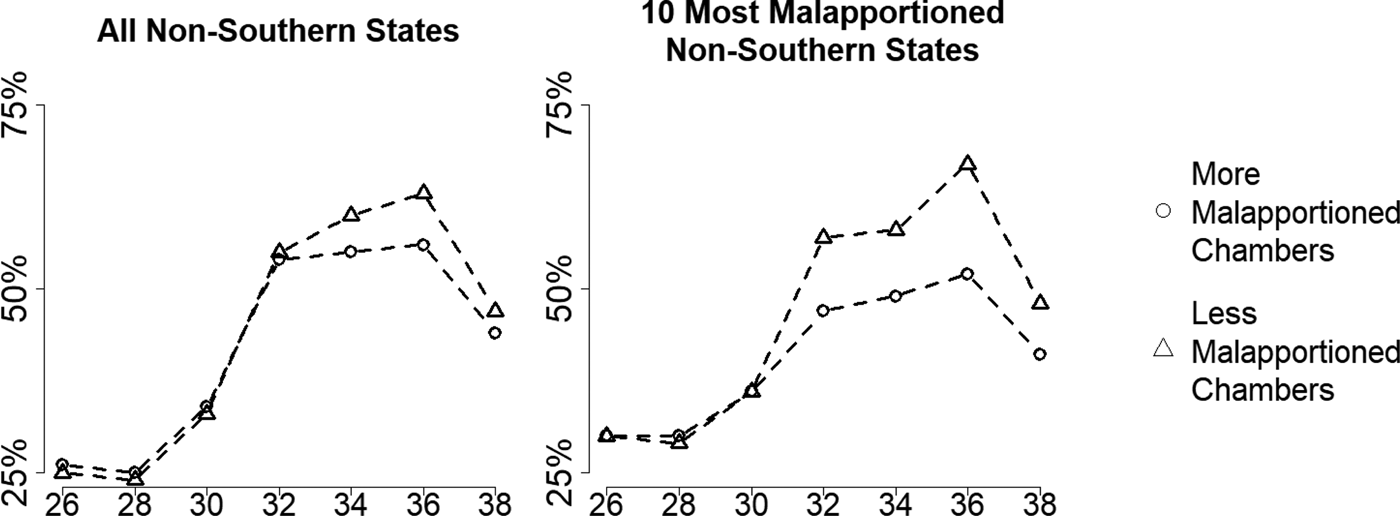
A related though less public factor accounting for opposition to unicameralism in the 1930s and 1940s was its potential consequences for party control of state governments. In the aftermath of the 1928–1936 New Deal realignment, party conflict in numerous American states in the Northeast and industrial Midwest took on a strong urban-rural dimension, with Democratic voters concentrated in large urban centers and Republican voters concentrated in rural areas. Not coincidentally, by the mid-1930s, state legislative chambers in which representation was more equally apportioned tended to have higher proportions of Democratic legislators than those that were highly malapportioned. This is demonstrated in Figure 1, which plots the mean percentage of Democratic legislators across the more malapportioned and less malapportioned chambers within the thirty-seven non-Southern state legislatures between 1926 and 1938. The figure clearly demonstrates the New Deal–era onset of a gap in Democratic representation (especially pronounced in the ten most malapportioned states) between more and less malapportioned legislative chambers. Thus, insofar as adoption of unicameral legislatures would have led to a shift in power from rural to urban areas, it would have almost certainly led to diminished Republican representation in state legislatures as well. Consequently, while urban-rural conflict was the primary source of opposition to unicameralism, partisan concerns among Republicans also played an important (if less visible) role in scuttling unicameralism efforts in many states.
Mean Percentage of Democratic Legislators Among More and Less Malapportioned State Legislative Chambers, 1926–1938.

RESEARCH DESIGN
To investigate the foregoing explanation for the failed diffusion of unicameralism, I utilize a most-similar case study research design examining efforts to establish one-house legislatures in three states: Nebraska, Ohio, and Missouri. A most-similar case study design is one in which the cases are “similar on all the measured independent variables, except the independent variable of interest.”Footnote 28 The three cases in this study are similar with regard to two crucial factors: (1) an organized movement to establish a unicameral legislature in the 1930s–1940s existed within them and (2) as of the 1930s–1940s, all three states gave their voters the ability to amend the state constitution via a citizen-initiated referendum. Uniformity on these two factors effectively eliminates the two most obvious potential explanations for the failed diffusion of unicameralism—lack of organized interest and opposition among self-interested elected officials—from the analysis.
The crucial independent variable on which these states differ is the degree of malapportionment in their bicameral legislatures. In Nebraska, the state constitution of 1919 had established a bicameral legislature in which both chambers would be composed of equal-population districts, and while a delay in reapportioning legislative seats after the 1930 Census led to some inequality in district populations, the Cornhusker State's bicameral legislature was nonetheless among the ten least malapportioned in the country as of the early 1930s.Footnote 29 In Ohio and Missouri, on the other hand, the constitutions in place during the 1930s guaranteed each county at least one legislator in the state House of Representatives regardless of population, causing the legislatures of both states to be among the twenty most malapportioned.Footnote 30 As this study will show, these differences mattered. The fact that both chambers in Nebraska's legislature were apportioned on a population-equality basis meant that its rural communities did not fear that adopting a unicameral legislature composed of equal-population districts would cause them to lose influence in state government; in Ohio and Missouri, on the other hand, rural fears of a loss of influence were pronounced and were, indeed, the ultimate cause of the failure of the unicameralism movement in both states.
THE UNICAMERALISM MOVEMENT IN NEBRASKA, 1919–1934
The unicameralism movement in Nebraska began, as in other Great Plains states where populism and later progressivism was prominent, during the late nineteenth century. Throughout the 1910s, reformers waged unsuccessful efforts to convince the Nebraska legislature to submit a constitutional amendment establishing a unicameral legislature to the state's voters. In 1919, during a state Constitutional Convention, a proposal for a unicameral legislature received a tie vote of 43–43 among delegates, thus narrowly missing passage.Footnote 31 Four years later, tiring of hopeless efforts to convince the state's political class to support their efforts, unicameralism advocates in Nebraska decided to launch a petition drive to bring a citizen-initiated constitutional referendum to the people instead. Efforts to gather a sufficient number of signatures failed, however.Footnote 32
Between the early 1920s and early 1930s, not a single proposal for a unicameral legislature made it to a statewide ballot anywhere in the United States, and Senator George Norris became increasingly frustrated with the lack of progress made by the national movement for unicameralism. In the wake of a particularly unsatisfactory Nebraska state legislative session in 1933, Norris sensed an opening and decided to throw his full weight behind a new effort to bring a unicameralism proposal to Nebraska voters. Norris spent the month of December 1933 writing an initiative proposal and then hashing out a compromise with the Nebraska Model Legislature League concerning its precise provisions and language. The resulting proposal called for a one-house legislature composed of thirty to fifty single-member districts of equal population.Footnote 33
The ensuing campaign surrounding the unicameralism proposal was intense and hard-fought. Most in Nebraska's political establishment (including all but two of the state's newspapers) came out against the proposal, for reasons of both principle and self-interest. Opponents of the proposed one-house legislature made a wide variety of arguments to the public, including that a unicameral legislature was contrary to the American constitutional tradition, that it eliminated necessary checks and balances in government, and that it would lead to irresponsible lawmaking.Footnote 34 But while the unicameralism referendum clearly evoked an intense political fight between Norris's supporters and much of Nebraska's political establishment, the fight did not take on a clear urban-rural dimension. For example, the organization that Norris put together on behalf of the unicameralism proposal included leaders from all parts of the state, while opposition to the proposal was expressed by both urban and rural newspapers.Footnote 35
The fact that the unicameralism proposal did not evoke a strong urban-rural divide is unsurprising given that the proposal was not designed to change the balance of power between urban and rural forces in Nebraska government. The one-house legislature would be apportioned according to population, just as both chambers of the bicameral legislature had been. Opponents of the unicameralism proposal did attempt to provoke rural resistance by pointing out that the proposed unicameral body would be far smaller than the state's 133-member lower chamber, and that its adoption would therefore necessitate the creation of large legislative districts composed of numerous counties in sparsely populated parts of central and western Nebraska, thereby depriving many rural residents of close relationships with their state legislators. But while unicameralism opponents did frequently make this argument, they did not frame it in terms of competition between the state's rural areas and its cities; quite to the contrary, the argument was featured regularly in the editorial pages of the Omaha World Herald, the state's premier urban newspaper.Footnote 36
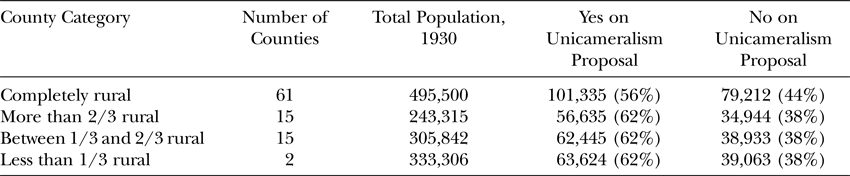
The lack of a strong urban-rural dimension in the 1934 Nebraska unicameralism campaign is further reflected in how ordinary Nebraskans ultimately voted on the proposal. Table 1 classifies Nebraska counties into four categories based on their urban-rural composition as of the 1930 Census and presents the results of the unicameralism referendum among voters in each county category. As can be seen, a majority in all four county categories supported the unicameralism proposal, with almost no difference in degree of support across most of the categories. The level of support for the unicameralism referendum among Nebraskans from the state's sixty-one completely rural counties was, at 56 percent, 6 percentage points lower than the level of support from Nebraskans in the state's other thirty-two counties, suggesting that some rural voters may have been swayed by the argument that they would enjoy less intimate representation in a small unicameral legislature. Still, this difference is minimal, and the overall similarity in voting results across the four county categories is far more striking. Thus it does not appear that most Nebraskans who voted on the unicameralism referendum in 1934 had urban-rural conflict at the forefront of their minds.
Results of 1934 Nebraska Unicameralism Referendum by Urban-Rural County Classification

Sources. U.S. Census Bureau, Urban-Rural Populations, 1930, prepared by Social Explorer (New York: Social Explorer, 2017), accessed November 6, 2017, www.socialexplorer.com; State of Nebraska, Nebraska Blue Book (Lincoln, NE: State Journal, 1935).
THE UNICAMERALISM MOVEMENT IN OHIO, 1935–1939
The unicameralism movement that arose in Ohio after the 1934 Nebraska breakthrough was in large measure a reaction to longstanding institutional dysfunction within the Ohio General Assembly. Throughout the 1930s, Ohio's legislature muddled through an extended deadlock over the issue of funding relief for Ohio's poor and unemployed. The legislature's inability to deal with the poor relief issue was in part a product of the fact that the legislature (particularly the House of Representatives) was heavily malapportioned in favor of rural areas. Rural Republicans holding veto power in the House were strongly resistant to state-level tax increases for poor relief, arguing that localities rather than the state government should be responsible for funding social services.Footnote 37 During the administration of Governor George White (1931–1935), the Ohio legislature thus repeatedly refused White's entreaties that it enact a comprehensive poor relief program managed at the state level. The problem of relief funding was compounded by the 1935 ascendancy to the governorship of conservative Democrat Martin Davey, who resisted using state funds for social services with as much fervor as the legislature's rural Republicans.Footnote 38 Frustration with the legislature's inability to agree enact significant poverty-alleviating measures in the middle of the Great Depression caused Ohioans to actively consider ways of reforming the legislature so as to make it more responsive to the needs of the state's residents.
As frustration with the Ohio legislature grew, interest in transforming it into a unicameral body grew as well. Support for unicameralism experienced a particularly dramatic upturn in early 1937 due to the confluence of several factors. First, national attention on the newly convened unicameral legislature in Nebraska prompted government reform advocates in Ohio (as elsewhere) to make unicameralism a top priority. The Citizen's League of Cleveland, one of the most prominent public interest groups in 1930s Ohio, repeatedly extolled the Nebraska unicameral in its monthly newsletter during the mid-1930s and announced its intention to work toward bringing unicameralism to the Buckeye State.Footnote 39 Additionally, the 1936 Democratic landslide in Ohio resulted in the election of several new reform-minded legislators who promised to become champions of unicameralism in the 1937 state legislative session.
Like George Norris and his collaborators in Nebraska, the core supporters of unicameralism in Ohio were chiefly motivated by a belief in the inherent superiority of single-chambered legislatures over double-chambered ones. In one of their newsletters, the Citizen's League of Cleveland listed what it considered to be the eight chief advantages of unicameralism:
1. The unicameral system has proved satisfactory.…
2. The unicameral system affords a simpler and more direct method of legislating.…
3. The unicameral system fixes responsibility.…
4. The unicameral system invites better candidates.…
5. The unicameral system will develop real leadership.…
6. The unicameral system will prevent stalemates.…
7. The unicameral system will foster citizen interest.…
8. The unicameral system will be less expensive.…Footnote 40
Others actively involved in the unicameralism movement, such as former Governor and then-current U.S. Senator Vic Donahey, made similar statements, emphasizing that a unicameral legislature would be “far more economical … and tremendously more efficient” than the bicameral system in place. State representative Lody Huml of Cleveland, a leader of the pro-unicameralism bloc in the legislature during the late 1930s, argued that a unicameral legislature would “attract better talent” and “be more responsible to the people.”Footnote 41
Given the substantial interest in adopting a one-house legislature that had surfaced in Ohio by early 1937, hopes were high that a proposed constitutional amendment establishing such a legislature would make it out of the 1937 Ohio state legislative session. Within the session's first few months, five different proposals to adopt a unicameral legislature (all sponsored by Democrats) were introduced in the Ohio House of Representatives.Footnote 42 These proposals caught the attention of Ohio's major newspapers, which began to also take an active interest in the unicameralism cause. But while unicameralism's original supporters emphasized benefits such as democratic accountability and efficiency gains, Ohio's big-city newspapers jumped on the unicameralism bandwagon for other reasons. While not denying (and occasionally emphasizing) the inherent benefits of one-house legislatures, the editorials boards of newspapers like the Cleveland Plain Dealer, the Columbus Citizen, and the Toledo Blade made it clear that they favored unicameralism primarily because they saw it as a means of eliminating the malapportioned, rural-dominated state House of Representatives. In an editorial decrying “Ohio's apparent inability to cope with its relief obligations,” which it blamed on rural legislators in the state's lower legislative chamber, the Plain Dealer editorial board stated that “the strong argument for a unicameral assembly … is that it would involve revision of a system which now denies truly representative government.”Footnote 43 In a similar vein, the Columbus Citizen editorial board argued that Ohio's bicameral legislature was “designed to meet the needs of an agricultural state of 50 years ago” and that the Ohio House consistently ignored the state's urban areas: “We would encounter little less comprehension of metropolitan … needs if we were represented by a majority of Hottentots.”Footnote 44
Despite the initial optimism among many unicameralism supporters, efforts to have the Ohio legislature submit a constitutional referendum on unicameralism to the state's voters quickly ran into various roadblocks. To begin with, supporters were internally divided about how the unicameral proposal should address the issue of apportionment. Aware that a proposal for a unicameral legislature composed of equal-population districts would almost certainly draw substantial rural opposition, Representative Huml proposed a one-house legislature with a permanent 50–50 split in representation between urban and rural areas.Footnote 45 Naturally, such a proposal drew the opposition of urban interests, who instead rallied around a competing proposal mandating equal-population districts and the periodic reapportionment of legislative seats to account for population shifts.Footnote 46 Beyond their internal disagreements, however, unicameralism supporters faced a bigger problem: Legislative leaders were indifferent to their cause and pigeonholed all of the unicameralism proposals in the House Committee on Government Operations.Footnote 47
In an effort to overcome their internal differences, unicameralism supporters from across the state organized regular meetings in Columbus starting in the middle of the state legislative session.Footnote 48 Initially these meetings focused on the need to rally behind a single proposal to promote within the Ohio General Assembly, but as the legislative session moved into its final months, advocates began to recognize the unlikelihood that the Assembly would ever propose such a referendum. Thus they decided to turn their attention away from crafting a proposal that could pass both houses of the legislature and toward crafting one that could be brought to the statewide ballot via the initiative petition process. On April 23, 1937, leading representatives of the group filed incorporation papers for a new nonprofit organization called the Ohio Single-House Legislature League (OSHLL). The league, which named U.S. Senator Donahey as its honorary president and Congressman Harold Mosier and Charles P. Taft as honorary vice presidents, announced plans to bypass the legislature and work to bring a citizen-initiated unicameralism referendum to Ohio voters.Footnote 49 The petition that OSHLL settled upon called for a unicameral legislature of 100 members representing single-member districts “containing approximately equal populations.”Footnote 50 Thus, the forces insisting that the proposed unicameral legislature be composed of equal-population districts won out over those who warned that such a provision would likely doom the proposal's chances of gaining passage.
Between 1937 and 1938, OSHLL oversaw a large-scale signature drive to put a unicameralism question on the statewide ballot in the 1938 general election. OSHLL successfully recruited volunteers to canvass neighborhoods in the state's biggest cities, but encountered significant problems with signature collection in the state's rural counties.Footnote 51 The Ohio Constitution specified that, in order to qualify for the statewide ballot, an initiative petition must get the signatures of 10 percent of Ohio's voters in the previous gubernatorial election (slightly less than 300,000 voters in 1938) as well as 5 percent of the voters in forty-four of Ohio's eighty-eight counties. Since only eleven of Ohio's counties were primarily urban, unicameralism advocates could not ignore Ohio's rural areas in their quest to get enough signatures to make it to the November 1938 ballot. Their task was made more difficult by the fact that political leaders from the state's rural areas quickly counter-mobilized against the initiative. John Hodson, chair of the Ohio Farm Bureau, called the unicameral proposal “one of the most dangerous issues we have faced in years” and argued that it would “place [Ohio's farmers] under the complete domination of the strong political forces in the few large urban areas.”Footnote 52 By the early part of 1938, the proposal's backers recognized that opposition in rural areas posed a major challenge to signature-gathering efforts. In a March 1938 letter to George Norris, the OSHLL secretary stated that “we are getting petitions signed although [sp.] not … in the great number that is required” and explained that this was due to the necessity of getting a large number of signatures from forty-four counties: “Our eleven urban counties could provide the number of signatures, but not as required by law.”Footnote 53
Eventually, OSHLL was forced to abandon its efforts as funding dried up, and it became clear that the requisite number of signatures in rural counties could not be obtained. When OSHLL officially abandoned its petition drive in 1938, its volunteers had only managed to reach the 5 percent threshold in two rural counties.Footnote 54 OSHLL's failure appears to have permanently quieted the movement to adopt a unicameral legislature in Ohio; while the issue was occasionally brought up by various interest groups and political gadflies over the next two decades, it does not appear that sustained, organized efforts on behalf of unicameralism were made after 1938.
THE UNICAMERALISM MOVEMENT IN MISSOURI, 1935–1944
Of all the states in which a unicameralism movement emerged after the 1934 Nebraska breakthrough, the state in which unicameralists may have come closest to achieving success was Missouri. Unlike in Ohio, where efforts fizzled after the failure of the 1937–1938 petition drive, supporters of unicameralism in Missouri advanced the cause of a one-house legislature time and time again between 1935 and 1946. Their movement went through many twists and turns, including a notable effort to advance unicameralism within the 1943–1944 Missouri Constitutional Convention as well as a statewide unicameralism referendum in 1944. As will be shown, however, while the unicameralists in Missouri were more tenacious and determined than their counterparts in Ohio, they repeatedly encountered the same, ultimately fatal obstacle: intense opposition from rural communities.
As in Ohio and other states, unicameralism efforts in Missouri were initially launched in 1935 by reform-minded state legislators responding to widespread public interest in the subject following the Nebraska breakthrough.Footnote 55 The efforts of these legislators were met with indifference by legislative leaders and thus failed to advance. The unicameral cause was then picked up by a group of activists calling themselves the Unicameral Legislature Committee of Missouri, who launched an ultimately unsuccessful statewide petition drive in 1938.Footnote 56 A few years later, a group of St. Louis–area businessmen surveyed colleagues throughout the state regarding their views on the state legislature and potential support for reform efforts.Footnote 57 Discovering strong support for unicameralism among the Missouri business community, these leaders created a new organization called the Crusaders of Missouri, whose sole purpose was to work toward the establishment of a unicameral legislature in the state.
Like the core supporters of unicameralism in Nebraska and Ohio, the Crusaders were united by a strong belief that unicameral legislatures were inherently superior to bicameral ones.
Promotional material that the Crusaders sent to businessmen throughout the state read as follows:
Would you have two boards of directors? NO! Then why a two-house legislature [with each house] duplicating the work of the other, with responsibility divided and therefore non-existent?Footnote 58
Similarly, in a generic letter to supporters, the chairman of the organization argued that a bicameral legislative setup “acts to prevent the true expression of the people's will” and that a unicameral setup would facilitate a more “efficient, democratic state government.”Footnote 59
Soon after forming, the Crusaders set to work on designing and then gathering signatures for a new initiative petition to bring the unicameralism issue to Missouri voters in the 1942 general election. In the spring of 1942, the Crusaders publicly announced their petition drive, which called for a legislative body of fifty to seventy-five members, composed of legislators representing single-member districts of equal population.Footnote 60 During the summer of 1942, the organization submitted more than 78,000 signatures from Missourians to the Missouri secretary of state, a number well in excess of what was required. The proposed amendment never reached the ballot, however, because the state attorney general determined that over half of the signatures were not properly notarized.Footnote 61
While the 1942 general election did not provide Missouri voters with the opportunity to establish a unicameral legislature, it did give them the opportunity to call for a state Constitutional Convention, which a majority agreed to do. The focus of the Crusaders and other unicameralism supporters thus shifted, temporarily, to advancing unicameralism within the Missouri Constitutional Convention of 1943–1944. This was despite the fact that, as unicameralists surely recognized, the method of selecting delegates to the convention made the prospect that convention delegates would propose a one-house legislature unlikely. Sixty-eight out of the eighty-three delegates to the convention were to be chosen from Missouri's thirty-four current State Senate districts (with one Democratic and one Republican delegate from each district), but the Missouri State Senate map, though composed of equal-population districts when it was adopted in 1901, had not been redrawn to account for population shifts in the ensuing four decades and was badly malapportioned by 1943. In one particularly egregious example, a St. Louis–based Senate district had come to have eight times the population of the state's least-populous rural district.Footnote 62 The malapportioned nature of the Senate map meant that representation of rural areas in the convention would be substantially in excess of their share of the state population, thus making it less likely that a majority of convention delegates would be amenable to a one-house legislature. Nonetheless, unicameralism supporters held out hope that appealing to the sensibilities of convention delegates in a forum that was at least somewhat removed from ordinary political pressures might bear fruit.
The most prominent advocate for unicameralism among the convention delegates was Stratford Lee Morton, a St. Louis–area businessman with strong ties to national and local organizations advocating progressive reform. Morton served on the council of the National Municipal League, a leading government reform organization whose Model State Constitution handbook had since 1920 endorsed the adoption of unicameral state legislatures. Morton also had close connections with the Crusaders, though he was not a member of the group. During the early months of the Constitutional Convention, Morton began a series of communications with George Norris and John Senning, the University of Nebraska political science professor with whom Norris collaborated on the Nebraska unicameralism initiative. In one letter to Morton, Senning wrote that “you have problems to face that we did not have,” noting that “your state is more politically minded than Nebraska” and thus that a nonpartisan legislature would likely be a nonstarter. Senning also correctly predicted that Morton would “encounter … great, though not insuperable, obstacles in the area of representation,” particularly in terms of conflict between urban and rural areas.Footnote 63
Morton proved to be a tireless fighter for unicameralism, attempting to advance the cause at every stage of the convention's twelve-month duration through a wide variety of means. As a member of the convention's legislative committee, Morton initially proposed that the committee's previously agreed-upon language for the constitution's legislative article be stricken and that new language—establishing a unicameral legislature along the lines of the Crusaders’ proposal—be substituted in its place.Footnote 64 In January 1944, the rural-dominated committee rejected Morton's proposal by an 13–2 vote.Footnote 65 A few months later, Morton introduced a minority report detailing a highly unusual proposal for an eighty-three-member unicameral legislature with a composition nearly mirroring that of the convention: thirty-four equal-population districts would be represented by one Democrat and one Republican, and an additional fifteen legislators would be selected through at-large (statewide) elections. Morton hoped that the selection scheme's similarity to that of the convention would make it seem reasonable in the minds of convention delegates.Footnote 66 Recognizing that the proposal, via the inclusion of fifteen statewide-elected legislators, would raise fears among rural delegates that the state's rapidly growing metropolitan areas would dominate state politics in the long run, Morton proposed to couple the unicameral proposal with a constitutional guarantee of home rule for both urban and rural jurisdictions. As Morton stated in a letter to an ally, “I am hoping that with a strong home rule provision for counties … I can satisfy them that there is no desire to give the control to the cities.”Footnote 67
On July 18, 1944, Morton made his case for his proposal in front of the entire convention. In doing so, he attempted to appeal to conservative delegates from rural areas by arguing that establishing one-house legislatures was a key way of reinvigorating state governments, a topic that interested many who were anxious about the growing dominance of the federal government over the states during the New Deal Era.Footnote 68 Morton's fellow delegates, however, were largely unpersuaded by his pleas and denied him a vote on his minority report.Footnote 69
Members of the Crusaders had been closely watching the convention throughout the fall of 1943, but after Morton's initial proposal was voted down in committee, they concluded that his efforts to advance unicameralism through the convention were a lost cause. Thus, in the early part of 1944, they began circulating another initiative petition to put their original proposal for a unicameral legislature composed entirely of equal-population districts on the November 1944 ballot.Footnote 70 Once again, they exceeded the signature requirements easily, but this time, efforts to challenge their signature-gathering efforts were unsuccessful. In August 1944, as the Constitutional Convention was beginning to wind down, the Missouri secretary of state certified that the Crusaders’ petition had met the legal requirements to appear on the statewide ballot in November.Footnote 71
Naturally, the reactions of Missouri newspapers to the Crusaders’ success tended to vary by geography. The St. Louis Star-Times, one of the state's leading urban newspapers, published numerous columns and editorials praising the Crusaders’ efforts. Interestingly, unlike Ohio's big-city newspapers, the Star-Times emphasized the intrinsic benefits that a one-house legislature would bring to state government rather than the fact that it would be composed of equal-population districts.Footnote 72 Rural newspapers, on the other hand, often voiced strong opposition to the Crusaders’ plan. The local paper in Houston, Missouri, a small town in the Ozarks region, published an article by U.S. Congressman William P. Elmer warning rural voters of the consequences of passage of the unicameral amendment in the strongest possible terms:
The representation in the country areas will be materially reduced, and in the cities it will be increased. This is the real purpose of the plan. The large cities have long been jealous of the power and influence of rural sections in State affairs. They want this power. The Unicameral System will give it to them.Footnote 73
Thus, the stage was set for an acrimonious statewide campaign about the upcoming unicameral referendum. However, just as the campaign commenced, a new twist in the struggle to bring a unicameral legislature to Missouri emerged. In September 1944, the delegates to the Constitutional Convention finally announced that they had completed their work: A new state constitution, setting up a standard bicameral legislature, would be proposed, and a special election in which the people of Missouri would vote on its ratification was announced for February 1945. The timing of this special election posed a massive new difficulty for the Crusaders: If the people approved the unicameralism referendum in November but then approved the proposed state constitution (complete with a bicameral legislature) in February, their earlier vote in favor of a unicameral legislature would be nullified. Scrambling to save their proposal, the Crusaders lobbied several convention delegates to include an item in the official constitutional schedule stating that the Crusaders’ unicameralism proposal would be inserted into the new constitution to be voted on in February should the unicameralism referendum pass in November.Footnote 74
On September 28, 1944, the last full day of the convention, the delegates held a fascinating and acrimonious debate on the Crusaders’ last-ditch effort. Several convention delegates opposed to a unicameral legislature nonetheless rose in support of the Crusaders’ position, arguing that regardless of their personal preferences, to propose a new state constitution setting up a bicameral legislature immediately after voters approved a referendum calling for a unicameral legislature would be an insult to the popular will. Judge Charles Mayer, a delegate from St. Joseph, expressed this sentiment well in his remarks:
I don't think there is any member of this Constitutional Convention who is more completely and absolutely opposed to unicameral legislation than I am. I feel that it would be the greatest mistake Missouri ever made if she … turned the government of this great state over entirely to the cities.… [The unicameral] is alright for a rural agricultural state, maybe like Nebraska, but it ought not to be in Missouri, but the people are going to vote on it in November of this year.… We are submitting this Constitution as a whole and we're saying to the people of Missouri that “Here is an amendment which you adopted in November, but you must throw it away in order to vote for this Constitution. You want a unicameral Legislature; you want the rest of this Constitution, but you can't have it. You can't have both.”Footnote 75
The convention's pro-unicameralism delegates, particularly Stratford Lee Morton, echoed these comments, imploring his fellow delegates to defer to the people on the matter of whether Missouri should have a bicameral or unicameral legislature.Footnote 76 However, those opposed to the Crusaders’ efforts would not budge. They took strong offense at the suggestion that they were thwarting the will of ordinary Missourians, instead contending that they were defending the people against the Crusaders’ efforts to sow confusion by forcing a statewide vote on a proposal that had been roundly rejected by the convention. As one delegate put it, “I have a feeling that a great many people, in voting for this unicameral amendment … will feel that they are voting for something that this [convention] has arranged.”Footnote 77 Furthermore, opponents of the Crusaders rejected the notion that they were denying the people of Missouri from being able to support both the proposed constitution as well as a unicameral legislature. Assuming that the constitution would be ratified, they argued, all the Crusaders needed to do was gather a third set of signatures for another unicameralism referendum after the new constitution was in place.Footnote 78 In a dramatic final vote, the convention delegates indicated their agreement with these arguments by refusing to graft the unicameral proposal onto their proposed constitution if the Crusaders’ referendum passed in November.Footnote 79
Following their loss at the end of the convention, the Crusaders attempted to remove the constitutional referendum they worked so hard to bring to voters from the statewide ballot. Given the likelihood that a pro-unicameralism result in the referendum would soon be nullified, they decided to turn their attention toward a third attempt at a citizen-initiated unicameralism referendum in 1946 and did not want to confuse voters with multiple referenda. However, the secretary of state refused their request, arguing that ballots for the November election (which included the unicameralism referendum) had already been sent out to absentee voters and soldiers overseas.Footnote 80 In response, the Crusaders publicly disavowed their own ballot measure and decided not to waste any time or resources campaigning for it. Leading state newspapers that had previously voiced strong support for the unicameralism cause also called on Missourians to vote no on it.Footnote 81
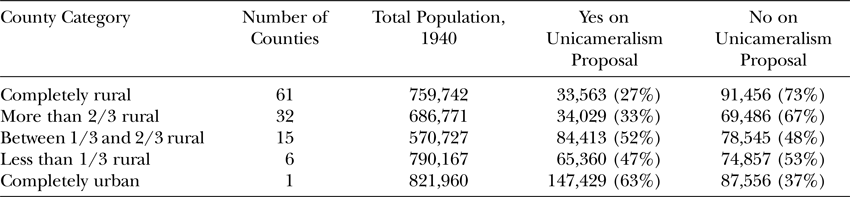
Thus, the unicameralism proposal went to the polls with few prominent endorsements and no campaigning on its behalf. Despite this near-complete lack of organized support, the proposal failed by a quite narrow margin, with 47.5 percent of voters (a total of 364,794 Missourians) voting in its favor. Perhaps more important than the close outcome of the referendum was the sharp urban-rural divide in voting patterns that it provoked. Evidence of this divide is presented in Table 2, which examines electoral support for the unicameralism proposal across Missouri counties with different urban-rural compositions. The table provides a marked contrast to Table 1, which depicts the same relationship for the 1934 Nebraska unicameral referendum. In Nebraska, a majority of voters in every county category supported the unicameralism proposal, with support in the state's completely rural counties only slightly lower than in the other county categories. In Missouri, on the other hand, voters in the state's sixty-three completely rural counties voted overwhelmingly against the unicameralism proposal, voters from counties with a mixture of rural and urban residents voted for it in significantly higher rates, and voters in the state's one completely urban county (St. Louis City) overwhelmingly supported it. Unlike in Nebraska, then, the views of Missouri voters on unicameralism in 1944 appear to have been substantially by their geographical location.
Results of 1944 Missouri Unicameralism Referendum by Urban-Rural County Classification
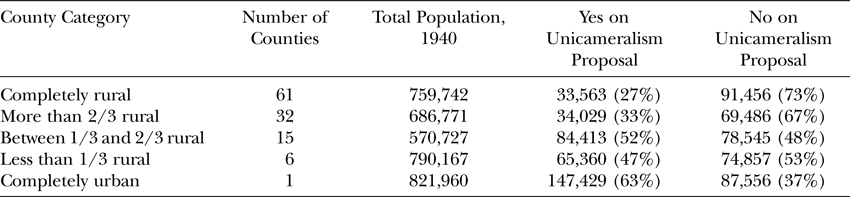
Sources. U.S. Census Bureau, Urban-Rural Populations, 1930; U.S. Census Bureau, Total Populations, 1940, prepared by Social Explorer (New York: Social Explorer, 2017), accessed November 6, 2017, www.socialexplorer.com ; Missouri Secretary of State, Official Manual of the State of Missouri 1945–1946 (Jefferson City, MO, 1945), 408–409, http://cdm.sos.mo.gov/cdm/compoundobject/collection/bluebook/id/24089/rec/35.
A year and a half after the unicameralism vote and the new state constitution's adoption, the Crusaders started yet another petition drive for a citizen-initiated unicameralism referendum. This effort fizzled, however, in part because the state's new constitution placed stricter limits on the amount of time organizers had to gather signatures for the statewide ballot.Footnote 82 Additionally, it is likely that support for the cause had diminished as activists grew tired of repeated failures on the issue. It does not appear that additional organized efforts to bring a unicameral legislature to Missouri occurred after the late 1940s. As in Ohio nine years earlier, the window for unicameral reform in Missouri had closed.
POST-1934 UNICAMERALISM EFFORTS IN STATES WITHOUT SIGNIFICANT MALAPPORTIONMENT
The foregoing case studies have sought to demonstrate that the chief obstacle to the adoption of unicameral legislatures in Ohio and Missouri was opposition from rural areas with a vested interest in maintaining malapportioned legislative chambers. An obvious question thus arises: What about states besides Nebraska in which neither legislative chamber was heavily malapportioned? Because unicameralism proposals in these states would likely not have encountered strong rural opposition, another factor must explain why one-house legislatures did not spread to them.
At the outset, it is worth noting that the number of such states was relatively small. As of the mid-1930s, there were only ten states besides Nebraska in which capturing a majority in both chambers of the legislature necessitated winning seats accounting for at least 40 percent of the state population.Footnote 83 Nearly all of these states did not give their residents the option of amending the state constitution via the initiative petition process, so the spread of unicameralism through them was likely foreclosed by self-interested opposition from incumbent state legislators.
The experience of South Dakota provides an instructive example of how the lack of a citizen-initiated constitutional amendment option prevented the adoption of unicameralism in a state that otherwise seemed like a prime candidate for the reform. A largely rural state neighboring Nebraska with a strong populist tradition but without a highly malapportioned legislature, South Dakota had also been the site of extensive debate on unicameralism in the 1920s, when Governors Peter Norbeck and W. J. Bulow both championed the reform.Footnote 84 Thus, the state would have appeared a very likely adopter of a one-house legislature when the attention of many across the country turned to the subject following the Nebraska referendum of 1934. But because South Dakota voters in the 1930s could not bypass their elected legislators to change the state's constitution, effort to adopt a one-house legislature for the state had to begin with the legislators themselves.Footnote 85 This was a very tall order, given that South Dakota legislators had spent the two previous decades deflecting many potential reforms to legislative structure that bore upon their political futures.Footnote 86 A proposed constitutional amendment, publicly and vocally supported by reform-minded Governor Tom Berry, was indeed introduced in the 1935 South Dakota legislative session.Footnote 87 The proposal generated little enthusiasm from most rank-and-file legislators or their leaders, however, and remained stuck in committee throughout most of the session. Toward the session's end, Gov. Berry decided to spend his limited political capital on pressuring legislators to advance a somewhat less contentious structural change—downsizing both chambers of the legislature while retaining its bicameral form.Footnote 88 Berry apparently reasoned that it would be easier to convince reluctant legislators to modestly shrink both legislative chambers than to eliminate one of them entirely. His gambit was successful: A proposed constitutional amendment downsizing South Dakota's bicameral legislature passed the state House and Senate, made it to the statewide ballot in 1936, and was ratified by the state's voters. The next few years of South Dakota politics were spent debating how to redistrict the state's newly downsized legislative chambers, and the unicameralism option thus faded from public discussion.Footnote 89
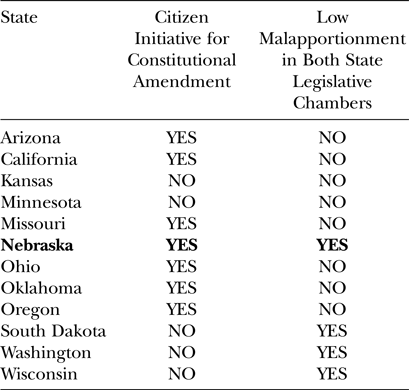
Nebraska's unique adoption of unicameralism was therefore made possible by its unusual status as a state that simultaneously had low malapportionment in its bicameral legislature as well as a citizen initiative option for constitutional change. Table 3 compares Nebraska to other states that were sites of significant unicameralism efforts in the early twentieth century on these two crucial factors.Footnote 90 As can be seen, most of the states with an initiative option for constitutional change suffered from high malapportionment in at least one of their legislative chambers, while most states with low malapportionment in both legislative chambers did not have an initiative option for constitutional change. Nebraska is the only state in the table in which both factors favorable to the adoption of unicameralism were present.
Factors Favorable to Adoption of Unicameral Legislatures in States with Significant Unicameralism Efforts in the Early Twentieth Century

Sources. On malapportionment: Gus Tyler, “The Majority Don't Count.” The New Republic, August 22, 1955, 13–15; on citizen initiative availability as of mid-1930s: New York State Constitutional Convention Committee, Constitutions of the States and United States; on the presence of significant unicameralism efforts: Alvin W. Johnson, The Unicameral Legislature (Minneapolis: University of Minnesota Press, 1938); John W. Senning, The One-House Legislature; John Senning, “Unicameral Movement in the Several States, 1912–1939” (unpublished manuscript), John Senning Papers, State Historical Society of Nebraska; letters to George Norris from unicameralism supporters in various states, George Norris Papers, Library of Congress, file 15. It is possible that I have missed a few states with significant unicameralism efforts that were unrecorded in these sources.
DISCUSSION
This article has told the story of a largely forgotten political reform movement that emerged across numerous states in the 1930s but consistently failed to achieve its goal. During the mid-1930s, unicameralism was not an obscure or quirky idea occasionally trotted out by a handful of delegates in state Constitutional Conventions, as it has become in modern American politics. Rather, in the wake of Nebraska's adoption of the one-house legislature, unicameralism briefly assumed the status of cause celebre among institutional reform advocates in states throughout the country. The problem these reformers ran into, however, was that adopting a unicameral legislature stood to do more than just bring greater efficiency, transparency, or democratic responsiveness to state government, as its advocates passionately argued. Rather, its opponents understood that unicameralism had the potential to fundamentally alter a state's balance of power, advantaging urban interests and Democrats at the expense of rural interests and Republicans.
The failed diffusion of unicameralism can essentially be explained by a basic rule of democratic politics: Institutional reforms are unlikely to occur within fora that are structured to give those benefiting from the status quo a political advantage. Among the thirty-six states in which voters did not have the ability to initiate constitutional referenda as of 1934, prospects for unicameral reform were very slim from the beginning because of self-interested opposition from incumbent state legislators. Even among states where citizen-initiated constitutional amendments were possible, however, structural barriers existed that prevented potential democratic majorities from effectively expressing themselves on the issue. In Ohio, the signature-gathering requirements for bringing initiatives to the ballot box gave the state's rural minority a veto power over such efforts, thereby blocking unicameral reform. The story in Missouri was more complicated, given the simultaneous efforts to adopt a one-house legislature within the state Constitutional Convention and through the initiative petition process. Clearly, the unicameral movement in Missouri made some strategic missteps that may have doomed its efforts (had the Crusaders waited until after the Constitutional Convention concluded to launch their second petition drive, they might well have been successful, though this is by no means certain). But in Missouri, too, various structural barriers existed (most notably, the disproportionately rural composition of the Constitutional Convention) that limited the potential for a coherent democratic expression in favor of unicameralism.
Beyond merely answering a puzzling historical question, this article contributes to broader scholarly debates on a range of important matters. To begin with, the article sheds new light on a once-common topic of inquiry for political scientists: the influence of rural interests on American politics and public policy. Prior to the reapportionment revolution of the early 1960s, much writing on state politics emphasized the dominance of rural interests on policymaking in malapportioned state legislatures, with many going so far as to suggest that state legislative malapportionment was the primary reason behind the lethargy of state governments and the consequent intervention of the national government into many policy areas previously reserved for states.Footnote 91 In later years, scholars demonstrated that, by causing rural areas to lose the disproportionate representation they had enjoyed in many legislative chambers, the reapportionment revolution played a crucial role in shifting state policymaking in a more urban, progressive direction.Footnote 92 This study, however, shows that while most of the policy-based effects of rural overrepresentation in state legislatures may have disappeared, at least one long-term institutional legacy of rural overrepresentation in state government—the bicameral legislature— remains. Had it not been for rural concerns over apportionment in the 1930s and 1940s, the unicameral legislature likely would have spread to Missouri and possibly to Ohio as well as some of the other states in which citizen-initiated constitutional amendments were possible during this period. The adoption of unicameralism by several states in the New Deal Era may well have paved the way for the more widespread adoption of unicameralism in later decades.Footnote 93
Relatedly, this study also suggests the need to revise scholarly understandings of the factors that have affected cameral choice in the American states. Extant scholarship has argued that the original decisions of most states to adopt bicameral legislatures in the late eighteenth and early nineteenth centuries was shaped by a normative belief in the value of bicameralism or fidelity to the federal constitutional structure, not by a desire to protect sparsely populated jurisdictions. To support this claim, scholars have pointed out that most states originally apportioned both of their legislative chambers on the basis of population rather than jurisdictional equality, and that it was only during the late nineteenth century (when cities began to overtake rural areas in terms of state population shares) that many states switched to guaranteeing localities legislative representation regardless of population.Footnote 94 From this perspective, then, state legislative malapportionment was a temporary political reality not fundamentally related to the choice of a bicameral legislature. This study, however, shows that when the issue of cameral choice re-emerged at the forefront of state politics following the Progressive Era and the 1934 Nebraska breakthrough, it was ultimately the desire to protect rural overrepresentation that prevented the spread of one-house legislatures. Thus, the decisions of states to retain the bicameral structure of their legislatures was intimately related to apportionment politics, even if their original decision to adopt it was not.
Next, this article provides an important contribution to the robust political science literature on policy diffusion across jurisdictions.Footnote 95 Recent work has voiced the concern that the diffusion literature suffers from a “pro-innovation bias” in which only diffusion “successes” across numerous jurisdictions are selected for study, thereby leading to inaccurate inferences.Footnote 96 While this critique is primarily focused on studies of substantive policy diffusion (which account for the bulk of the diffusion literature), it can also be applied to the smaller number of studies examining the diffusion of institutional reforms, almost all of which have focused on reforms that were widely adopted. Through examining diffusion efforts on behalf of an institutional reform that were ultimately unsuccessful, this article adds an important corrective to the preexisting bias in the literature. It suggests that structural factors that prevent the coherent expression of democratic majorities may be key to distinguishing between diffusion successes and failures, particularly when the policy or institutional reform at hand is a fairly simple or nontechnical one.
The findings of this study concerning the role of rural communities in scuttling unicameralism efforts in the 1930s and 1940s raise an important question: If fear of losing influence in one-house legislatures composed of equal-population districts was the primary reason why unicameralism efforts encountered significant opposition during these decades, why did the unicameralism cause not advance in the wake of the Supreme Court's reapportionment decisions in the early 1960s? As noted previously, these decisions effectively mandated that population equality be “the highest redistricting priority” in the drawing of district lines for all representative assemblies in the country except the U.S. Senate.Footnote 97 In modern American politics, therefore, those who draw the lines for all state legislative chambers are required to ensure that districts are equal or nearly equal in population, with the representation of local jurisdictions a secondary consideration. Rural areas (and, by extension, Republicans) have thus lost the disproportionate representation they once enjoyed under many bicameral reapportionment arrangements and no longer have cause to fear that a transformation to unicameralism will lead to a further shift in power toward highly Democratic urban areas. One would therefore think that modern-day unicameralism efforts would be much more likely to experience success than those of the 1930s and 1940s. And yet, few significant unicameralism efforts have emerged across the American states since that period.Footnote 98
While providing a thorough explanation for the failure of serious unicameralism movements to materialize after the reapportionment revolution is beyond the scope of this article, it is nonetheless possible to offer several potential reasons for their absence from modern state politics. First, since George Norris's passing in 1944, no national leader of Norris's stature has taken up the cause of unicameralism. As noted earlier, Norris was perhaps the leading progressive in the U.S. Congress during his four decades on Capitol Hill in the early twentieth century. Ideas that he championed immediately became popular among supporters of progressive reform all over the country. Moreover, Nebraska would almost certainly not have adopted the unicameral legislature absent Norris's tireless campaigning on its behalf. Thus, it seems likely that the absence of a Norris-like figure advocating for a one-house legislature in any state is a key factor behind the lack of organized support for unicameralism in the late twentieth and early twenty-first centuries.
Second, it may be that efforts to mobilize large numbers of citizens on behalf of unicameralism in the contemporary U.S. are unlikely to be successful without the sort of highly objectionable inequalities in representation that existed in the early twentieth century. As emphasized throughout this article, the core supporters of unicameralism across the country were consistently motivated by a belief that unicameralism was superior to bicameralism as a mode of legislative organization. In Ohio, however, these true believers gained important backing from interests who supported a one-house legislature chiefly because they saw it as a means of achieving more equitable state legislative representation for the Buckeye State's cities. There is little evidence that ending malapportionment was the primary motive of any of those involved with the unicameralism movement in Missouri (the dark warnings of Congressman Elmer aside), and no evidence whatsoever exists that George Norris and his confreres pursued a one-house legislature out of a desire to eliminate the very minimal amount of malapportionment that had existed in Nebraska. Nonetheless, the Ohio case suggests that urban anger over malapportionment may have been a key factor behind the growth of significant unicameralism movements in other states like California, Oklahoma, and Oregon during the same period.Footnote 99 If this is true, it may well be that, in the absence of malapportionment (and without a nationally recognized political leader like Norris working on its behalf), it is difficult to galvanize large numbers of Americans in the contemporary era around the cause of a one-house legislature (the sensibility of the idea notwithstanding).
At the same time, it is important to reemphasize that, while significant unicameralism efforts occurred in several states during the earliest decades of the twentieth century, widespread enthusiasm for the unicameralism cause did not truly emerge until the Nebraska breakthrough of 1934 directed national attention toward the issue. It therefore stands to reason that the adoption of a one-house legislature in a single state today could generate substantial national interest and spawn significant new unicameralism movements across the country. Moreover, given the absence of malapportionment in modern state legislatures, such efforts would almost certainly not be met with the same level of resistance from rural or sparsely populated communities that the efforts documented in this article encountered. Thus, it is quite possible that a unicameral breakthrough in the early twenty-first century would set in motion a diffusion process with a remarkably different outcome from that which occurred a century earlier.