A substantial body of research has highlighted the importance of examining early behavioral and emotional difficulties in early childhood that precede and predict myriad adverse developmental outcomes (Eisenberg, Spinrad, & Eggum, Reference Eisenberg, Spinrad and Eggum2010; Gilliom & Shaw, Reference Gilliom and Shaw2004; Olson, Choe, & Sameroff, Reference Olson, Choe and Sameroff2017). From a developmental psychopathology perspective, identifying early childhood factors that influence the developmental trajectories of internalizing and externalizing symptoms is essential to elucidating etiological pathways to psychopathology (Gilliom & Shaw, Reference Gilliom and Shaw2004). To achieve this goal, however, we need a conceptual framework that systematically guides the selection of multiple risk factors, from cognitive, affective, and social processes, that may underlie the development of psychopathology across different symptom categories and levels of severity (Cuthbert, Reference Cuthbert2014; Insel, Reference Insel2014).
The Research Domain Criteria (RDoC; www.nimh.nih.gov/research-priorities/rdoc/index.shtml) project launched by the National Institute of Mental Health has been championed as a systematic framework for linking symptoms (e.g., internalizing and externalizing), across the normal to abnormal range, to biological and psychosocial mechanisms underlying psychopathology (Insel et al., Reference Insel, Cuthbert, Garvey, Heinssen, Pine, Quinn and Wang2010). In particular, five major domains of functioning have been proposed as a workable RDoC matrix: negative valence systems (i.e., processes that respond to aversive situations), positive valence systems (i.e., processes that respond to rewards), cognitive systems, systems for social processes, and arousal/regulatory systems (Cuthbert, Reference Cuthbert2014). The RDoC perspective posits that pinpointing associations between symptoms and behavioral and neurobiological constructs across domains will inform future revisions of our diagnostic systems and, more important, inform design of novel strategies to treat and prevent psychopathology (Insel, Reference Insel2014).
Despite almost decade-long efforts since the initiation of the RDoC project (Sanislow et al., 2010), it is still in the initial stage of integrating the critical role of early development and understanding how developmental processes may contribute to psychopathology over time (Franklin, Jamieson, Glenn, & Nock, Reference Franklin, Jamieson, Glenn and Nock2015; Insel, Reference Insel2014). Indeed, a central goal of RDoC is to understand the neurodevelopmental origins of psychopathology (Morris & Cuthbert, Reference Morris and Cuthbert2012). One challenge that impedes this endeavor is the lack of establishment of observable RDoC constructs in early childhood and observes how they relate to the development of psychopathology over time using a prospective longitudinal design. Whereas the RDoC project has been an advocate for using multiple units of analyses (i.e., molecular, genetic, neural circuitry, behavioral) to understand psychopathological processes, in practice, RDoC tends to place a stronger emphasis on neurobiology (Franklin et al., Reference Franklin, Jamieson, Glenn and Nock2015). To develop preventive interventions that can target dysfunctional processes underlying psychopathology, it is essential to first identify and establish behavioral constructs from multiple functional domains. Second, these behavioral constructs need to differentiate typical versus atypical developmental pathways leading to entrenched psychopathology. In this way, we can understand which specific behavioral risk construct(s) to target through early intervention and to examine through multilevel analyses. Accordingly, the central goal of our study was to identify behavioral constructs (described in a subsequent section) in early childhood across different RDoC domains based on existing literatures. We then examined how these constructs predicted typical versus atypical symptom trajectories between ages 3 and 10.
At the same time, developmental psychopathology researchers have pioneered using dimensional and person-centered approaches to examine growth trajectories of symptom development, but most studies have focused on either internalizing or externalizing symptom trajectories (Broeren, Muris, Diamantopoulou, & Baker, Reference Broeren, Muris, Diamantopoulou and Baker2013; Broidy et al., Reference Broidy, Nagin, Tremblay, Bates, Brame, Dodge and Vitaro2003; Feng, Shaw, & Silk, Reference Feng, Shaw and Silk2008; Miner & Clarke-Stewart, Reference Miner and Clarke-Stewart2008; Sterba, Prinstein, & Cox, Reference Sterba, Prinstein and Cox2007); relatively few have simultaneously examined the codevelopment of both trajectories using growth curve analyses, especially beginning in early childhood (see Fanti & Henrich, Reference Fanti and Henrich2010; Wiggins, Mitchell, Hyde, & Monk, Reference Wiggins, Mitchell, Hyde and Monk2015 for exception). Based on these findings, one may assume that internalizing and externalizing pathways are independent developmental pathways, and that it is common for children to develop “pure” internalizing (characterized with high internalizing but low externalizing) or “pure” externalizing (characterized with high externalizing but low internalizing) symptoms across development. Hence, separate efforts have been made to understand risk factors that contribute to internalizing or externalizing trajectories. On the other hand, epidemiological research has shown that the prevalence of co-occurring symptoms is high (Achenbach, Reference Achenbach1991; Angold, Costello, & Erkanli, Reference Angold, Costello and Erkanli1999), even in community samples (Beyers & Loeber, Reference Beyers and Loeber2003). Similarly, attempts to identify children with pure levels of internalizing/externalizing symptom trajectories from early childhood have found that the prevalence rate is low (~2%) relative to children with some levels of co-occurring symptoms (Fanti & Henrich, Reference Fanti and Henrich2010). Driven by the need to better understand the nature of symptom development, we initially examined the prevalence of “pure” and “co-occurring” internalizing and externalizing symptom trajectories. Our first goal was to identify models that best represent the nature of symptom trajectories (i.e., pure vs. co-occurring) from the preschool years through middle childhood.
In what follows, we briefly describe the nature of internalizing and externalizing trajectories based on prior growth curve studies. Next, we describe four behavioral constructs in the context of early childhood across different RDoC domains: regulation of frustration, executive control, delay gratification, and emotion knowledge. Our overarching goal was to determine how these constructs may be related to individual differences in the development of internalizing and externalizing symptom patterns.
Internalizing and externalizing trajectories
Using latent class growth analysis (LCGA; Muthén & Muthén, Reference Muthén and Muthén2012), a person-centered approach, investigators have typically identified three to four externalizing trajectory groups using different samples: a normative group with stable low levels of problems, an intermediate group with either increasing or decreasing problems, and a severe group with stable high problems (Bongers, Koot, Van Der Ende, & Verhulst, Reference Bongers, Koot, Van Der Ende and Verhulst2004; Broidy et al., Reference Broidy, Nagin, Tremblay, Bates, Brame, Dodge and Vitaro2003; Miner & Clarke-Stewart, Reference Miner and Clarke-Stewart2008; Proctor, Skriner, Roesch, & Litrownik, Reference Proctor, Skriner, Roesch and Litrownik2010; Shaw, Hyde, & Brennan, Reference Shaw, Hyde and Brennan2012). Most prior studies have focused on school-age children who have been assessed by single (maternal) informants, with some noteworthy exceptions (e.g., Miner & Clarke-Stewart, Reference Miner and Clarke-Stewart2008; NICHD Early Child Care Research Network, 2004; Shaw et al., Reference Shaw, Hyde and Brennan2012).
To our knowledge, only three studies identified internalizing symptom trajectories using data before school entry (Broeren et al., Reference Broeren, Muris, Diamantopoulou and Baker2013; Feng et al., Reference Feng, Shaw and Silk2008; Sterba et al., Reference Sterba, Prinstein and Cox2007), with inconsistent findings concerning the number and composition of the growth pathways. A large normative group with low-decreasing internalizing symptoms and a small severe group with high-stable or high-increasing symptoms have consistently been identified, but the nature of intermediate trajectories has been mixed (Broeren et al., Reference Broeren, Muris, Diamantopoulou and Baker2013; Feng et al., Reference Feng, Shaw and Silk2008; Sterba et al., Reference Sterba, Prinstein and Cox2007).
Moreover, externalizing and internalizing problems often co-occur (Achenbach, Reference Achenbach1991; Angold et al., Reference Angold, Costello and Erkanli1999) and symptoms from one domain tend to precede and predict symptoms from the other (Capaldi, Reference Capaldi1992; Gilliom & Shaw, Reference Gilliom and Shaw2004; Trim, Meehan, King, & Chassin, Reference Trim, Meehan, King and Chassin2007). This may be due in part to the modest positive associations between internalizing and externalizing trajectories, and that the two domains have shown similar rates of change between early childhood through school entry (Gilliom & Shaw, Reference Gilliom and Shaw2004) and between school entry through early adolescence (Keiley, Bates, Dodge, & Pettit, Reference Keiley, Bates, Dodge and Pettit2000). Delineating classes of individuals based on internalizing and externalizing symptoms independently may therefore create biased estimates because models neglect the covariance with the construct not in the model. Taken together, these findings highlight the desirability of using a person-oriented approach to understand the co-development of symptom trajectories (Fanti & Henrich, Reference Fanti and Henrich2010; Wiggins et al., Reference Wiggins, Mitchell, Hyde and Monk2015).
Co-development of internalizing and externalizing trajectories
To our knowledge, only two prior studies have used person-centered approaches to examine the co-development of internalizing and externalizing symptom trajectories from the preschool years, with different analytical techniques. Fanti and Henrich (Reference Fanti and Henrich2010) identified 11 classes of co-occurring symptom trajectories between ages 2 and 12. Using latent class growth analysis, the authors first identified separate trajectories of internalizing and externalizing symptoms, then calculated the joint probabilities between the two trajectories. This modeling technique permits researchers to identify pure or co-occurring internalizing/externalizing trajectories. As Wiggins et al. (Reference Wiggins, Mitchell, Hyde and Monk2015) have pointed out, however, this approach might run the risk of identifying nonexisting joint classes, or classes with too few subjects, limiting statistical inferences.
Alternatively, parallel-process LCGA modeling (Wiggins et al., Reference Wiggins, Mitchell, Hyde and Monk2015) permits researchers to examine concurrent relationships between change in internalizing and externalizing symptoms by simultaneously estimating two sets of intercepts and slopes (one set for each repeated measure variable), and the covariance among the intercepts and slopes. Using this data-driven approach, Wiggins et al. (Reference Wiggins, Mitchell, Hyde and Monk2015) identified three classes using a male-only sample between ages 3 and 9 years: (a) a normative class with low and declining levels of internalizing and externalizing symptoms; (b) a moderate class with initially medium but decreasing internalizing symptoms and initially high but rapidly decreasing externalizing symptoms; and (c) a severe class with initially moderate but increasing internalizing symptoms and initially high but slightly decreasing externalizing symptoms. Using the same approach, Hinnant & El-Sheikh (Reference Hinnant and El-Sheikh2013) identified three similar symptom classes using both genders between middle and late childhood, supporting the generalizability of Wiggins et al.’s findings.
To our knowledge, no investigators have used this approach to examine both boys’ and girls’ developmental trajectories starting in early childhood. Developmentally, externalizing symptoms typically peak at around age 3 and then steadily decline across the school-age years (Tremblay, Reference Tremblay2010). Boys tend to show higher levels of externalizing problems earlier in childhood, whereas girls tend to develop more internalizing problems in adolescence (e.g., Hankin, Wetter, & Cheely, Reference Hankin, Wetter and Cheely2008; Zahn-Waxler, Shirtcliff, & Marceau, Reference Zahn-Waxler, Shirtcliff and Marceau2008). To fully capture the developmental course of co-occurring behavioral symptoms and the generalizability of these trajectories across genders, we need longitudinal studies that begin in early childhood and include both boys and girls.
Identify behavioral constructs across RDoC domains in the context of early development
To establish the validity of RDoC constructs in early childhood, it is crucial to understand them in the context of development (Franklin, Jamieson, Glenn, & Nock, Reference Franklin, Jamieson, Glenn and Nock2015). Toddlerhood marks a major period of growth in physical, cognitive, and social abilities: instead of solely relying on extrinsic caregivers input or intrinsic reactive control, preschoolers begin to develop reflective self-regulatory skills to modulate their behaviors and emotions in relation to situational demands (Eisenberg et al., Reference Eisenberg, Spinrad, Fabes, Reiser, Cumberland, Shepard and Thompson2004). They also begin to recognize emotional expressions and understand emotional and behavioral cues of others, which may in turn facilitate self-regulation (Denham et al., Reference Denham, Bassett, Way, Mincic, Zinsser and Graling2012). Self-regulation processes play a central role in developmental psychopathology (Nigg, Reference Nigg2017; Posner & Rothbart, Reference Posner and Rothbart2000); therefore, vulnerabilities in self-regulatory skills and emotion knowledge in early childhood may place a child at risk for the onset of internalizing and externalizing pathways. Using the RDoC framework, we propose four constructs across different domains that are central to toddler's self-regulatory and behavioral development.
Negative valence systems: Regulation of frustration
Regulation of frustration refers to the ability to “modulate or adjust the intensity or valence of one's affective responses to [frustration] in situational challenges” (Cole, Martin, & Dennis, Reference Cole, Martin and Dennis2004), and could be classified in the RDoC domain of negative valence systems. Negative emotionality, especially proneness to anger and frustration, has been consistently identified as a major risk factor for the development/co-development of internalizing and externalizing problems (Cole, Zahn-Waxler, Fox, Usher, & Welsh, Reference Cole, Zahn-Waxler, Fox, Usher and Welsh1996; Eisenberg, Fabes, Guthrie, & Reiser, Reference Eisenberg, Fabes, Guthrie and Reiser2000; Gilliom & Shaw, Reference Gilliom and Shaw2004; Rothbart, Posner, & Kieras, Reference Rothbart, Posner, Kieras, McCartney and Phillips2006). Over-and-under modulation of negative emotions in response to situational challenges may foster negative consequences, such as peer rejection and rule violation (Denham et al., Reference Denham, Blair, DeMulder, Levitas, Sawyer, Auerbach-Major and Queenan2003), leading to the development of internalizing and externalizing problems (e.g., Cole, Bruschi, & Tamang, Reference Cole, Bruschi and Tamang2002; Cole et al., Reference Cole, Zahn-Waxler, Fox, Usher and Welsh1996). Indeed, a variety of early childhood internalizing and externalizing disorders may arise, in part from difficulties in the ability to regulate anger and tolerate frustration (Calkins, Reference Calkins2009; Hill, Degnan, Calkins, & Keane, Reference Hill, Degnan, Calkins and Keane2006). For example, regulation of negative emotion resulting from frustration at age 2 differentiated girls with borderline-clinical but declining levels of externalizing behaviors from those who displayed chronic and clinical behavioral problems across the preschool period (Hill et al., Reference Hill, Degnan, Calkins and Keane2006). Similarly, dysregulation of negative emotion among school-aged children was related to concurrent internalizing and externalizing symptoms and indirectly related to later symptoms at 1-yr follow-up (Kim & Cicchetti, Reference Kim and Cicchetti2010).
Cognitive systems: Executive control (“cool” effortful control)
Effortful control (EC), a temperament construct that refers to the child's ability to regulate attention and behavior impulses (Rothbart et al., Reference Rothbart, Posner, Kieras, McCartney and Phillips2006), has consistently been found to be critical to children's long-term behavioral adjustment, especially control of aggressive and disruptive behaviors (Eiden, Colder, Edwards, & Leonard, Reference Eiden, Colder, Edwards and Leonard2009a; Eisenberg et al., Reference Eisenberg, Valiente, Spinrad, Cumberland, Liew, Reiser and Losoya2009, Reference Eisenberg, Spinrad and Eggum2010; Olson, Choe, & Sameroff, Reference Olson, Choe and Sameroff2017). Child EC has also been linked to the development of internalizing problems (Eisenberg et al., Reference Eisenberg, Valiente, Spinrad, Cumberland, Liew, Reiser and Losoya2009; Lengua, Reference Lengua2006; Oldehinkel, Hartman, Ferdinand, Verhulst, & Ormel, Reference Oldehinkel, Hartman, Ferdinand, Verhulst and Ormel2007), albeit with mixed findings. For instance, Dennis, Brotman, Huang, and Gouley (Reference Dennis, Brotman, Huang and Gouley2007) found that EC was negatively associated with children's internalizing problems at age 4 but not at ages 5 or 6. Similarly, Eisenberg et al. (Reference Eisenberg, Sadovsky, Spinrad, Fabes, Losoya, Valiente and Shepard2005) found that children's attentional control (but not inhibitory control) was negatively related to internalizing problems between ages 5 to 7, but not 2 years later.
These inconsistent findings may be in part reflect the way that EC has been defined and measured (Nigg, Reference Nigg2017). A refined model of EC has been proposed to capture two distinct but related processes: executive control (“cool” EC) and delay of gratification (“hot” EC) (Kim, Nordling, Yoon, Boldt, & Kochanska, Reference Kim, Nordling, Yoon, Boldt and Kochanska2013; Sturge-Apple, Davies, Cicchetti, Hentges, & Coe, Reference Sturge-Apple, Davies, Cicchetti, Hentges and Coe2017). For the sake of clarity, we used the term “executive control” instead of “cool” EC to refer to the ability to deploy attention and inhibit responses to stimuli that are “neutral, decontextualized and abstract” (Sturge-Apple et al., Reference Sturge-Apple, Davies, Cicchetti, Hentges and Coe2017). Executive control tasks assess behavioral inhibition (e.g., walking a line slowly) and cognitive inhibition and sustained attention (e.g., Stroop-like tasks), which have no specific extrinsic and proximal rewards associated with performance. Given this conceptualization, executive control could be classified in the RDoC domain of cognitive systems.
Positive valence systems: Delay of gratification (“hot” EC)
In contrast, delay of gratification refers to the ability to delay hedonically attractive rewards (e.g., snack delay; Mischel, Shoda, & Peake, Reference Mischel, Shoda and Peake1988) and is conceptualized as “an affectively charged domain of EC in which tasks elicit approach motivation through the offering of a potential prize or enhanced reward associated with decision making” (Sturge-Apple et al., Reference Sturge-Apple, Davies, Cicchetti, Hentges and Coe2017). Delay of gratification in the preschool years predicted adult's inhibition of positive compelling cues (e.g., happy faces) in both behavioral and neural levels (Casey et al., Reference Casey, Somerville, Gotlib, Ayduk, Franklin, Askren and Shoda2011), suggesting that delay of gratification could be classified in the RDoC domain of positive valence systems.
Supporting the functional utility of differentiating executive control and delay of gratification within the EC construct, Kim et al. (Reference Kim, Nordling, Yoon, Boldt and Kochanska2013) found that preschoolers’ delay gratification and executive control skills were distinctly associated with later behavior problems and academic performance, respectively. Poor delay of gratification in the preschool years was also related to changes in boys’ anxiety symptom trajectories over time (Feng et al., Reference Feng, Shaw and Silk2008).
Systems for social processes: Emotion knowledge
Emotion knowledge (EK) refers to the ability to understand emotion expressions, behavioral cues, and social contexts (Denham et al., Reference Denham, Blair, DeMulder, Levitas, Sawyer, Auerbach-Major and Queenan2003). EK plays a key role in social competence and academic success (Denham et al., Reference Denham, Blair, DeMulder, Levitas, Sawyer, Auerbach-Major and Queenan2003, Reference Denham, Bassett, Way, Mincic, Zinsser and Graling2012; Schultz, Izard, Ackerman, & Youngstrom, Reference Schultz, Izard, Ackerman and Youngstrom2001). For instance, preschoolers with greater EK exhibit more prosocial behaviors toward peers, are rated more likeable among peers and more socially competent by teachers, and improve school readiness (Denham, Bassett, Brown, Way, & Steed, Reference Denham, Bassett, Brown, Way and Steed2015; Denham et al., Reference Denham, Bassett, Way, Mincic, Zinsser and Graling2012). In contrast, the role of EK in the development of children's internalizing and externalizing problems has been unclear and understudied, especially among young children (Trentacosta & Fine, Reference Trentacosta and Fine2010). In community samples, preschoolers with deficits in EK were more aggressive than others in kindergarten (Denham et al., Reference Denham, Caverly, Schmidt, Blair, DeMulder, Caal and Mason2002), yet other studies have failed to find this relation (e.g., Izard et al., Reference Izard, Fine, Schultz, Mostow, Ackerman and Youngstrom2001). In addition, one study showed that children's EK (about situations that elicit happiness, sadness, surprise, and fear) was associated with higher risk of peer victimization (Garner & Lemerise, Reference Garner and Lemerise2007). There are several possible explanations for these inconsistent findings. First, Bassett, Denham, Mincic, & Graling (Reference Casey, Somerville, Gotlib, Ayduk, Franklin, Askren and Shoda2012) suggested that EK is a complex multidimensional construct with distinct subprocesses: emotion recognition of emotion expressions, and situational-based (i.e., stereotypical and non-stereotypical context) emotion understanding (Bassett et al., Reference Bassett, Denham, Mincic and Graling2012). It is therefore possible that distinct EK processes are uniquely related to development of different symptoms (e.g., Heinze, Miller, Seifer, Dickstein, & Locke, Reference Heinze, Miller, Seifer, Dickstein and Locke2015). Second, reciprocal associations were found between children's self-regulation and EK (Denham et al., Reference Denham, Bassett, Way, Mincic, Zinsser and Graling2012; Di Maggio, Zappulla, & Pace, Reference Di Maggio, Zappulla and Pace2016), suggesting the need to examine self-regulation and EK simultaneously to understand their unique contributions on the development (or co-development) of internalizing and externalizing problems.
The current study
Based on developmental psychopathology and transdiagnostic perspectives, self-regulation deficits across multiple domains (i.e., regulation of frustration, executive control, and delay of gratification) and EK (i.e., recognition and understanding) may contribute to the development (or co-development) of internalizing and externalizing symptom trajectories. To our knowledge, however, no previous investigators have simultaneously examined the predictive role of all these constructs on the development (or co-development) of internalizing and externalizing growth trajectories longitudinally.
Aim 1
Our initial objective was to examine the prevalence of pure and co-occurring internalizing and externalizing symptom trajectories using two available analytical techniques: joint-class LCGA (Fanti & Henrich, Reference Fanti and Henrich2010) and parallel-process LCGA models (Wiggins et al., Reference Wiggins, Mitchell, Hyde and Monk2015). The goal was to identify models that best represent the nature of symptom trajectories (i.e., pure vs. co-occurring) in our sample and to identify homogenous groups of children manifesting distinct trajectories of co-occurring internalizing and externalizing symptoms from preschool through middle childhood. Consistent with findings from a recent study (Wiggins et al., Reference Wiggins, Mitchell, Hyde and Monk2015), we hypothesized that at least three trajectories of co-occurring internalizing and externalizing symptoms would be identified: low, moderate, and severe classes (no specific number of trajectories was hypothesized because prior research included boys only).
Aim 2
To corroborate previous findings that self-regulation (Kim et al., Reference Kim, Nordling, Yoon, Boldt and Kochanska2013) and EK (Bassett et al., Reference Bassett, Denham, Mincic and Graling2012) are multifaceted, and to examine whether measures of these constructs can be subdivided into different RDoC domains, we used a data-driven approach to identify distinct self-regulatory and EK constructs. Particularly, principal component analysis (PCA) was used to examine the factor structures child's EC, regulation of frustration, and EK. Assessments of each of these were laboratory-based and parent-reported measures that have been well-validated and widely used in early childhood literatures.
Aim 3
Our primary goal was to identify specific EK and self-regulatory antecedents of children's co-occurring symptom trajectories. In particular, we use multinomial logistic regressions to examine the predictive role of preschool-aged self-regulatory and EK constructs (identified from Aim 2) on class membership (identified from Aim 1). Socioeconomic status (SES) and general intelligence (IQ) at age 3 were controlled as covariates. Given that poor EC has consistently been linked to externalizing problems (Eisenberg et al., Reference Eisenberg, Valiente, Spinrad, Cumberland, Liew, Reiser and Losoya2009; Olson et al., Reference Olson, Choe and Sameroff2017), whereas poor regulation of frustration has been linked to both internalizing and externalizing problems (Cole, Hall, & Hajal, Reference Cole, Hall and Hajal2008; Cole et al., Reference Cole, Zahn-Waxler, Fox, Usher and Welsh1996; Feng et al., Reference Feng, Shaw and Silk2008; Hill et al., Reference Hill, Degnan, Calkins and Keane2006; Kim & Cicchetti, Reference Kim and Cicchetti2010), we hypothesized that young children at greatest risk for persistent co-occurring internalizing and externalizing problems might have deficits in self-regulation processes marked by poor EC and regulation of frustration. No hypothesis was made regarding whether specific subcomponents of EC (i.e., executive control and delay gratification) would predict different symptom trajectories because of insufficient evidence. Given the inconclusive findings regarding EK, we did not have a strong hypothesis but expected that deficits in EK would contribute to atypical symptom development, but no hypothesis was made concerning contributions of specific subcomponents of EK (i.e., emotion recognition and situational-based understanding) to the development of children's behavior problems.
Aim 4
Given that gender differences in levels of early onset externalizing problems have been consistently reported (e.g., Keenan et al., Reference Keenan, Feng, Babinski, Hipwell, Hinze, Loeber, Stouthamer-Loeber, Kerr, Stattin, Engles, Overbeek and Stouhamer-Loeber2011; Zahn-Waxler et al., Reference Zahn-Waxler, Shirtcliff and Marceau2008), we also examined the role of gender in the co-development of internalizing and externalizing symptoms.
Method
Participants
Participants were 238 children (48% girls) and their mothers and a subsample of fathers (63%) who were enrolled in a larger ongoing multiwave study that tracked the development of children's behavioral problems starting at age 3 (Olson, S. L., Sameroff, A. J., Kerr, D. C., Lopez, N. L., & Wellman, H. M., Reference Olson, Sameroff, Kerr, Lopez and Wellman2005). Three children were excluded from the total sample of 241 in the present study because the mothers and fathers of these children did not complete the Child Behavior Checklist for Ages 2-3 (CBCL 2-3; Achenbach, Reference Achenbach1992) at Wave 1. Families were recruited using local and regional newspaper ads, fliers posted at daycare centers and preschools, and referrals by preschool teachers and pediatricians. Because of the initial design of the study, children were recruited to represent the full range of externalizing and internalizing problems scale of the mother-reported CBCL 2-3, with an oversampling of toddlers in the moderate to high range of externalizing problems (T > 50 = 44.5%), whereas internalizing problems were allowed to vary and toddler's internalizing problems varied from the low to high range (T > 50 = 34%).
In the present study, we used data from Waves 1 (n = 238), 2 (n = 228), and 3 (n = 209) in which target children were at ages 2.5–4 (mean [Μ] = 3.14 years, standard deviation [SD] = .23), 5–6 (Μ = 5.28 years, SD = .23), and 8–11 (M = 10.42 years, SD = .63), respectively. Among target children, 86% were non-Hispanic European American and 14% were of other racial–ethnic backgrounds (e.g., African American, biracial). A total of 89% of mothers reported being married, 5% single, 3% living with a partner, and 3% separated or divorced; approximately 6% were in blended or stepfamilies. A total of 92% of households had at least two adults living with the target child, whereas 8% of households had a single, separated, or divorced parent.
During recruitment from 1999 to 2001, 43% of mothers and 32% of fathers reported a bachelor's degree as their highest level of education, and another 39% of mothers and 46% of fathers reported some graduate or professional training. Approximately 14% of mothers and 10% of fathers reported partial college experience or specialized training, and about 4% of mothers and 11% of fathers reported a high school diploma as their highest level of education (one mother and three fathers reported partial high school completion up to tenth or eleventh grade).
Family SES scores ranged from 22 to 66 (M = 54.44, SD = 10.83), representing the top four of five social strata in the Hollingshead system. Most families (87%) resided in the two highest social strata. Average annual family income at recruitment was between $60,000 and $70,000, although incomes ranged from $10,000 to >$100,000. This primarily middle-class sample allowed us to study the predictive role of early self-regulation and EK on school-age internalizing and externalizing problems with minimal confounds of severe environmental adversity. Additionally, children with serious chronic health problems, mental retardation, and/or pervasive developmental disorders were not included in the study. See Olson and colleagues (Reference Olson, Sameroff, Kerr, Lopez and Wellman2005) for more details description of the study sample and study procedure.
Measures
SES
At Wave 1, mothers reported background information about themselves and family members. The Hollingshead (1975) Four-Factor Index of SES was calculated for each family.
Child internalizing and externalizing symptoms
Parents rated children's internalizing (INT) and externalizing behavior(EXT using the CBCL 2-3 at T1 (Achenbach, Reference Achenbach1992) and the CBCL 6-18 at T2 and T3 (Achenbach & Rescorla, Reference Achenbach and Rescorla2001). Because different versions of CBCL (CBCL 2-3/CBCL 6-18) have different items to reflect internalizing and externalizing symptoms at different developmental stages, T scores were used in all waves. Using T scores also enabled us to identify subgroups of children at highest risk based on clinically significant cutoff scores (T score >60). To obtain a more objective measure of symptoms, we averaged across maternal and paternal measures when available. There were no significant differences on child mean CBCL internalizing and externalizing between families that had only maternal data and those had both parents’ reports.
General cognitive functioning (IQ)
Children's general cognitive functioning measured at age 3 was estimated by aggregating scaled scores on the Block Design (α = .84) and Vocabulary (α = .85) subtests of Wechsler's Preschool and Primary Scale of Intelligence-Revised (Wechsler, Reference Wechsler1989).
EC
Individual differences in EC were assessed using behavioral tasks and maternal ratings.
Maternal rating of EC
At Wave 1, the two most theoretically and empirically salient components of EC (Rothbart & Bates, Reference Rothbart, Posner, Kieras, McCartney and Phillips2006) were assessed using the inhibitory control (α = .77) and attentional focusing (α = 0.85) subscales of Rothbart's Child Behavior Questionnaire (CBQ; Ahadi, Rothbart, & Ye, Reference Ahadi, Rothbart and Ye1993), rated by mothers. Higher scores indicated better performances.
Behavioral assessment of EC
At Wave 1, the general construct of EC was tapped with five tasks from Kochanska, Murray, Jacques, Koenig, and Vandegeest (Reference Kochanska, Murray, Jacques, Koenig and Vandegeest1996)’s toddler-age behavioral battery: Snack Delay, Tongue, Tower, Turtle and Rabbit, and Gift Wrap administered in that order. In Snack Delay, the child was instructed to wait while the examiner rang a bell before retrieving a piece of candy from under a glass cup. In the Tongue task, the child was instructed to wait with a piece of candy on his or her tongue until the examiner rang a bell before eating it. In the Tower task, the child was asked to take turns with the examiner while building a block tower using 20 blocks. In the Turtle and Rabbit game, the child was asked to move a same-sex doll (baseline), a fast rabbit, and a slow turtle along a curving path mounted on a piece of poster board. In the Gift Wrap task, the child was asked to sit in a chair facing away from the table where the examiner noisily wrapped a gift for him or her (60 s). The examiner asked the child not to look, so that the examiner could wrap up the “surprise.” Next, the wrapped gift was placed near the child, who was asked to wait while the examiner searched for a bow (120 s). Composite scores of frequencies of peeking and verbal references to the gift were used in the analyses.
We also included Animal Pegs from the Wechsler Preschool and Primary Scale of Intelligence-Revised to measure effortful attention. All tasks were introduced as “games,” and children were reminded of the rules midway through each. Reliability was excellent, κ = .95. Higher scores indicated better performances.
Regulation of frustration
At Wave 1, regulation of frustration was assessed using an adapted version of the disappointment paradigm developed by Cole, Zahn-Waxler, and Smith (1994). We assessed children's regulation of frustration based on both affective codes (i.e., expressed anger and expressed sadness) and behavioral codes (i.e., active regulation and passive regulation). Coding cues for sadness, defined as glumness or tearfulness, included downward lip corners, raised inner brows, and protruding lower lip. Anger was defined as hostility, irritation, annoyance, or harshness, and its coding cues included tightened lips, tightened and narrow eyelids, and clenched teeth. Coding cues for active regulation included playing with the toy, talking about prize in a positive manner, and appropriate eye contact. Passive regulation was coded if minimal regulation and neutral interaction with both the experimenter and toy observed (i.e., a faint “thank you,” asking neutral questions about the toy). Frequencies of affective and behavioral codes were coded every 10 s for each participant (κ for inter-rater reliability ranged from .75 to .84 for all combinations of coders). Affective and behavioral codes in response to receiving a disappointing toy was subtracted from baseline levels (assessed before the toy was presented) to index regulation of these emotions and behaviors. All scores were transformed into z-scores for use in all analyses. Higher values indicated higher levels of expressed emotion (i.e., more expressed sadness and anger) and more behavioral regulation.
EK
At Wave 1, Denham (Reference Denham1986)’s Affect Knowledge Test (AKT) was used to assess children's EK. The measure included two parts: a labeling subtest and a situation knowledge subtest. For the labeling subtest, children were asked to reference and identify four line-drawn faces: “happy,” “sad,” “angry,” and fearful” faces by naming them (expressive knowledge), and then by pointing to them (receptive knowledge). For the situation knowledge subtest, an experimenter performed 10 vignettes with a puppet (gender-matched to the child), while providing vocal and facial cues to indicate the puppet's emotional reaction to each situation. For four of the stereotypical vignettes, the puppet exhibited an emotion typical of how most children would feel in a similar situation (e.g., acting frightened after having a nightmare); for the other six non-stereotypical vignettes, the puppet emoted contrary to the way the child would feel in a similar situation, as reported by the child's mother. Denham (Reference Denham1986) reported that these tasks possess good internal reliability (for labeling subtest: α = .89; for situation knowledge subtest: α = .93). Four separate scores (i.e., expressive knowledge, receptive knowledge, stereotypical situational knowledge, non-stereotypical situational knowledge) were computed and transformed into z-scores. Higher values indicated better performance.
Data analysis plan
Aim 1: To identify pure and co-occurring internalizing and externalizing trajectories across preschool years through pre-adolescence
First, two LCGA models (one for internalizing and one for externalizing symptoms) were conducted with Mplus 7.31 (Muthén & Muthén, Reference Muthén and Muthén2012) to identify internalizing and externalizing trajectories separately. Following established procedures (Jung & Wickrama, Reference Jung and Wickrama2008), we estimated models with one to six classes using LGCA to specify distinct classes in both constructs separately. After that, the joint frequencies of being in both types of classes were calculated based on the identified classes in each construct (Fanti & Henrich, Reference Fanti and Henrich2010). This method of examining trajectories of externalizing symptoms, regardless of internalizing symptoms, and vice versa, then calculating the joint frequencies, allowed us to examine the prevalence of pure internalizing (characterized with high internalizing but low externalizing symptoms) or externalizing (characterized with high internalizing but low externalizing symptoms) trajectories across early childhood and pre-adolescence without the influences of the other symptom domain. This method is limited however because (a) the two symptom domains are highly correlated (Wave 1: r = .71; Wave 2: r = .52; Wave 3: r = .62; all p < .000), hence, the variance (and co-variance) matrix of the growth factors may be biased if the model doesn't estimate one symptom domain in the presence of the other; (b) nonexisting joint classes (or classes with very few cases) may be identified (see Fanti & Henrich, Reference Fanti and Henrich2010); and (c) identified joint classes may encompass more than one homogenous subgroup (Wiggins et al., Reference Wiggins, Mitchell, Hyde and Monk2015). To overcome these shortcomings, we then conducted a parallel-process LCGA model to identify individual's internalizing and externalizing trajectories based on simultaneous consideration of internalizing and externalizing growth factors (Hinnant & El-Sheikh, Reference Hinnant and El-Sheikh2013; Wiggins et al., Reference Wiggins, Mitchell, Hyde and Monk2015). In particular, class memberships are estimated and assigned based on individuals’ initial levels (intercepts) and changes (slopes) in both internalizing and externalizing symptoms concurrently (Wu et al., Reference Wu, Witkiewitz, McMahon and Dodge2010). Parallel-process LCGA models with one to six classes are conducted to specify distinct classes in both constructs concurrently. We chose the best fitting of each of the models based on a comprehensive review of multiple fit indexes: Akaike information criteria, Bayesian Information Criteria (BIC), sample size-adjusted BIC, entropy, Vuong-Lo-Mendell-Ruhin likelihood ratio test, bootstrap likelihood ratio test, a minimum class size of 2%, and theoretical interpretability. To ensure we had a multi-informant measure of child's internalizing and externalizing problems, ratings were averaged across mothers’ and fathers’ reports. T-scores were used for all analyses.
Aim 2: To identify and establish RDoC constructs using early childhood measures
PCA with varimax rotation of the components were conducted to examine whether early childhood measures can be categorized into subconstructs that adhere to the RDoC domains. Specifically, measures included (a) EC: maternal CBQ reports (child's inhibitory control and attentional focusing subscales), Kochanska behavioral battery (Snack Delay, Tongue, Tower, Turtle and Rabbit) and Animal Pegs from Wechsler's Preschool and Primary Scale of Intelligence-Revised; and (b) regulation of frustration assessed using the disappointment paradigm (active and passive regulation, sad and anger expressions); and (c) emotion understanding: receptive and expressive emotion labelling, and stereotypical and non-stereotypical Puppet vignettes from Denham's Emotion Understanding task.
Aims 3 and 4: To examine early childhood precursors (constructs identified in Aim 2 and gender) of the INT and EXT trajectories (identified in Aim 1)
Next, class membership identified using parallel-process LCGA (Aim 1) was analyzed with Mplus using multinomial logistic regression models (using different reference classes) predicting affiliation in co-occurring INT and EXT trajectory classes with child's gender, environmental (i.e., SES), cognitive (i.e., IQ) and constructs identified from PCA (described previously). However, including additional/auxiliary variables in the identified parallel-process LCGA model may affect the latent class information because the probability of an individual entering into a certain latent class may change depending upon the effect of an observed predictor (see Vermunt, Reference Vermunt2010, for more details). Thus, we used a newly developed three-step procedure (R3STEP) for fitting multinomial logistic regression models to latent class outcomes in Mplus to account for the uncertainty of the probability described previously (Asparouhov & Muthen, Reference Asparouhov and Muthen2013; Vermunt, Reference Vermunt2010). Because of missing data, only a subset (n = 186) of participants had all the study variables, multiple imputation was conducted to impute 10 datasets in Mplus to fully use the whole sample and to ensure we have enough power to detect the effects of interest. Pooled estimates from 10 imputed datasets were thus reported for all multinomial logistic regression models.
Results
Preliminary analysis
Missing data and attrition
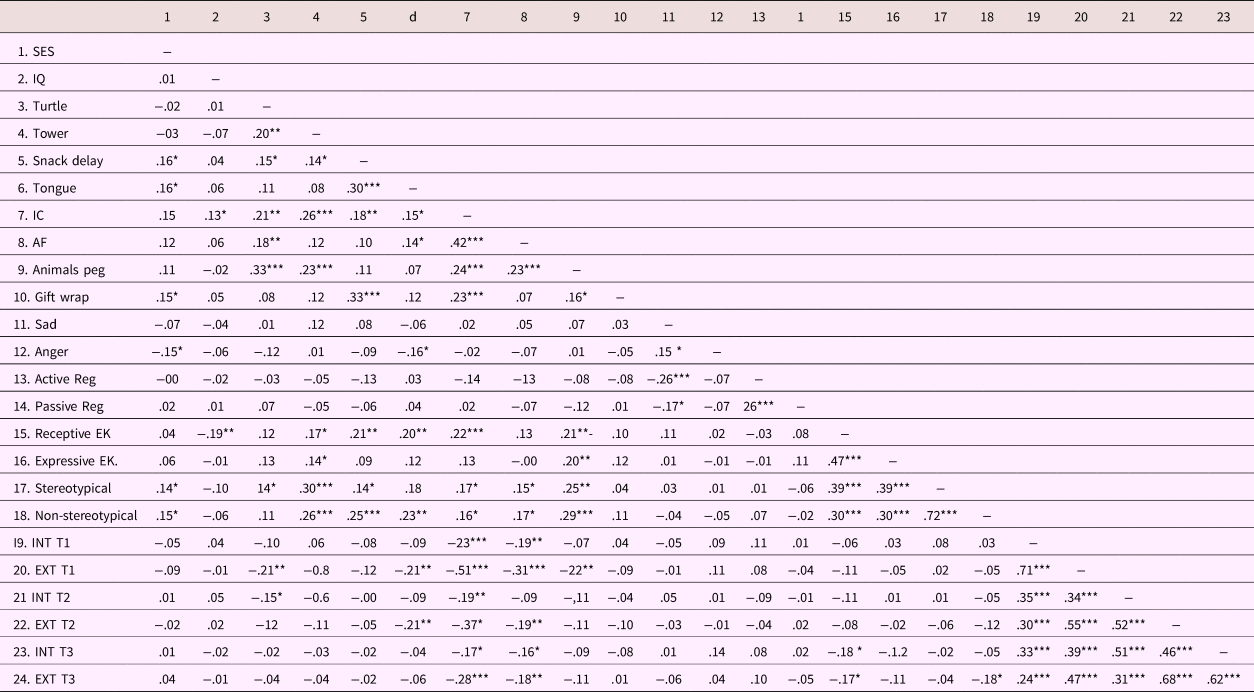
Little's missing completely at random (1988) test was not significant, χ2 (39) = 32.49, p = .760, which suggests that data were missing completely at random and that conditions were sufficient to use full information maximum likelihood to approximate missing data for Aim 1. The percentage of missingness among all variables ranged from 0% to 17%. No correlation was found between missingness of any T1 variables and children's internalizing and externalizing symptoms at any waves. Inter-correlations between all study variables are shown in Table 1.
Intercorrelation of all study variables

Note: *p < .05, **p < .01, ***p < .001. Active reg. = active regulation; AF, attentional focusing; EXT = externalizing problem; IC = inhibitory control; INT = internalizing problem; non-stereotypical = non-stereotypical situation from AKT; passive reg. = passive regulation; stereotypical = stereotypical situation from AKT.
Aim 1: Class membership for pure and co-occurring INT and EXT trajectories
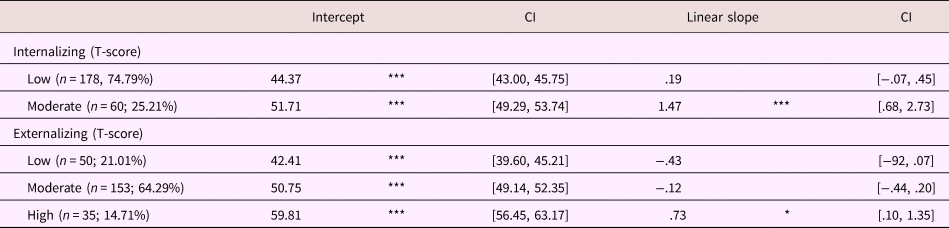
First, separate LCGA models were conducted for internalizing and externalizing symptoms respectively across three waves. Solutions for one to six classes of the LCGA models for both internalizing and externalizing symptoms are presented in Table 2. For internalizing trajectories, the two-class model has overall better fit indexes (lower Akaike information criteria, BIC, sample size-adjusted BIC, higher entropy values, and Vuong-Lo-Mendell-Ruhin likelihood ratio test and bootstrap likelihood ratio test p < .05 indicate the model with a two-class solution is preferred over 1 class; see Table 2). For externalizing trajectories, the three-class model had the best fit indexes (Table 2). Thus, a two-class model of internalizing and a three-class model of externalizing trajectories were identified. Table 3 shows the estimated slopes and intercepts of the identified classes. For internalizing trajectories, the low symptoms (encompassed 75% of the sample) was characterized with initial low and stable levels of internalizing symptoms over time, whereas the moderate symptoms (25%) class was characterized with initial moderate and increasing levels of internalizing symptoms over time. For externalizing trajectories, the low symptoms class (21%) was characterized with initial low and stable externalizing symptoms over time, the moderate symptoms class (64%) was characterized with initial moderate and stable externalizing symptoms over time, and the high symptoms class (15%) characterized with initial high and increasing levels of externalizing symptoms over time.
Comparison of model fit indices and criteria for one through six classes of LCGA of internalizing and externalizing trajectories

Note: The number of classes was chosen based on a comprehensive review of all the fit indicators listed here. The best fitting model is marked in bold font. Lower values of Akaike information criteria (AIC), Bayesian Information Criteria (BIC), and sample size-adjusted Bayesian information criteria (SSABIC) indicate better model fit. Vuong-Lo-Mendell-Ruhin Likelihood Ratio Test (VLMR) and bootstrap likelihood ratio test (BLRT) p < .05 indicate the model with k classes is preferred over k – 1 classes. Entropy values closer to 1 indicate higher classification accuracy. The smallest latent class (sm LC) needs to be >1% of the total sample size to be acceptable. C = latent class; LCGA= latent class growth analysis; NA = not available. aThe best log-likelihood value was not replicated.
Parameter estimates for separate latent class growth analysis models of internalizing and externalizing trajectories

Note: *p < .05, **p < .01, ***p < .001. Parentheses indicate the percentage of participants in the latent classes. All values are based on unstandardized estimates. CI = 95% confidence intervals.
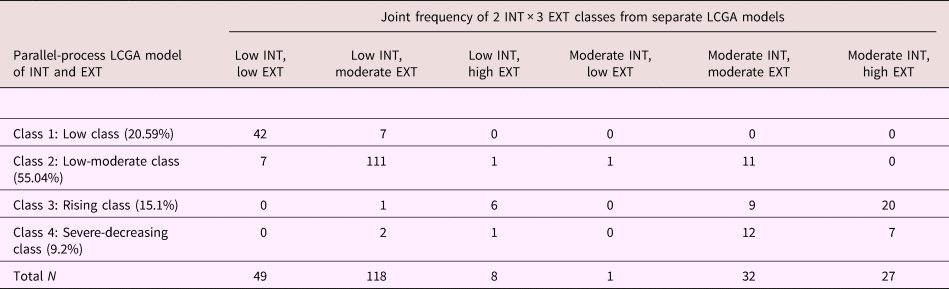
Next, joint frequencies of 2 INT by 3 EXT classes identified from the LCGA models were calculated to examine the prevalence of pure and co-occurring internalizing and externalizing trajectories. As shown in Table 6, very few children were in the pure internalizing (characterized with moderate internalizing and low externalizing symptoms) and pure externalizing (characterized with high externalizing and low internalizing symptoms) classes, which encompassed only 3.4% and 0.4% of the sample, respectively. In contrast, 25% of the sample were in the moderate and high symptoms classes characterized with co-occurring internalizing and externalizing symptom trajectories.
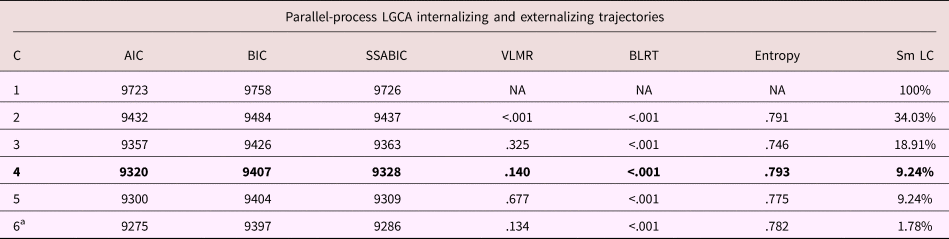
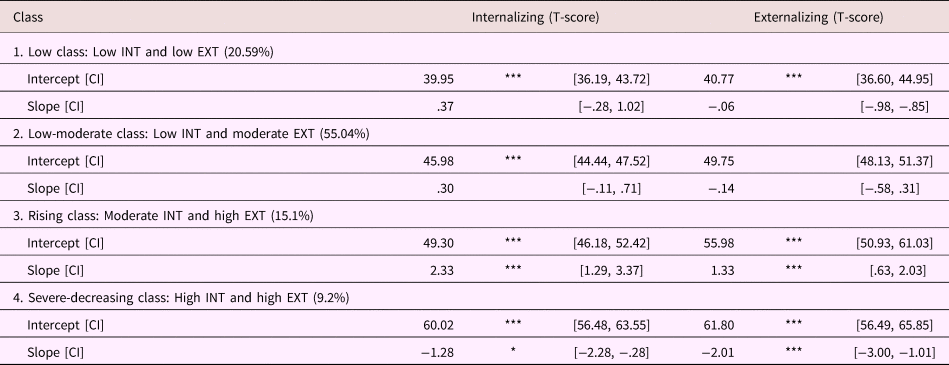
Given the constraints of the joint-class model as described previously and as seen in our sample (identified a class with only 0.4% cases), parallel-process LCGA models were conducted to estimate individual's class membership based on individuals’ initial levels (intercepts) and changes (slopes) in both internalizing and externalizing symptoms concurrently (Hinnant & El-Sheikh, Reference Hinnant and El-Sheikh2013; Wiggins et al., Reference Wiggins, Mitchell, Hyde and Monk2015; Wu et al., Reference Wu, Witkiewitz, McMahon and Dodge2010). Solutions for one to six classes of the parallel-process LCGA models are presented in Table 4. A four-class model has the overall best fit indexes. Table 5 and Figure 1 present the estimated slopes and intercepts of the identified classes. The low class (encompassing 21% of the sample) was characterized with initial low and stable levels of both internalizing and externalizing symptoms over time. The low-moderate class (encompassing 55% of the sample) had initial low and stable levels of internalizing and initial moderate and stable levels of externalizing symptoms over time. The rising class (encompassing 15% of the sample) had initial moderate and increasing levels of internalizing and initial high and increasing levels of externalizing symptoms over time. Last, the severe-decreasing class represented a small subgroup of individuals (9.2%) with very high but decreasing levels of internalizing and externalizing symptoms over time. Table 6 shows the joint frequency distribution of cases based on using the parallel-process LCGA model and the joint class (2 INT 3 × EXT) LCGA model.
Trajectories of co-occurring internalizing (INT) and externalizing (EXT) problems from early preschool years to pre-adolescence. Parallel-process LCGA approximated four discrete developmental trajectories of INT and EXT problems. Data were shown in estimated means. CBCL = Child Behavior Checklist; LCGA = latent class growth analysis.

Comparison of model fit indices and criteria for one through six classes of parallel-process LCGA model of internalizing and externalizing trajectories

Note: The number of classes was chosen based on a comprehensive review of all the fit indicators listed here. The best fitting model is marked in bold font. Lower values of Akaike information criteria (AIC), Bayesian Information Criteria (BIC), and sample size-adjusted Bayesian information criteria (SSABIC) indicate better model fit. Vuong-Lo-Mendell-Ruhin Likelihood Ratio Test (VLMR) and bootstrap likelihood ratio test (BLRT) p < .05 indicate the model with k classes is preferred over k – 1 classes. Entropy values closer to 1 indicate higher classification accuracy. The smallest latent class (sm LC) needs to be >2% of the total sample size to be acceptable. C = latent class; LCGA= latent class growth analysis; NA = not available. aThe best log-likelihood value was not replicated.
Parameter estimates for parallel-process LCGA models of internalizing and externalizing trajectories

Note: *p < .05, **p < .01, ***p < .001. Parentheses indicate the percentage of participants in the latent classes. All values are based on unstandardized T-score estimates. CI = 95% confidence intervals; EXT = externalizing problem; INT = internalizing problem.
Cross-tabs frequency distribution of INT and EXT problems identified from parallel-process LCGA model versus joint frequency of 2 INT × 3 EXT classes from separate LCGA models

Note: EXT = externalizing problem; INT = internalizing problem; LCGA= latent class growth analysis.
Aim 2: To identify and establish RDoC constructs using early childhood measures
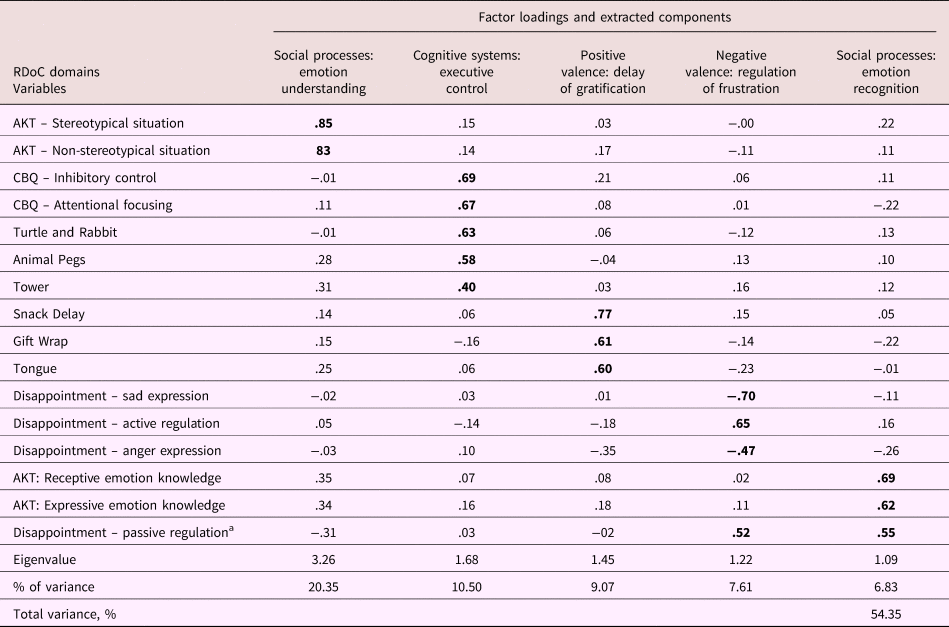
PCA was conducted to examine whether early childhood laboratory-based and parent-reported measures can be categorized into subconstructs based on the RDoC framework. PCA revealed a five-component solution with a total of 54% explained variance (Table 7). The first component, emotion understanding, consisted of the stereotypical and non-stereotypical situational knowledge from the AKT, which pertains to the RDoC domain of systems for social processes (perception and understanding of others). The second component, executive control, consisted of CBQ measures including attentional focusing and inhibitory control, and laboratory measures including Animal Pegs, Tower, and Turtle and Rabbit, which pertains to the RDoC domain of cognitive systems (cognitive control). The third component, delay of gratification, consisted of laboratory measures including Snack Delay, Tongue, and Gift Wrap task, which pertains to the RDoC domain of positive valence systems (action selection/preference-based decision making). The fourth component, regulation of frustration, consists of anger, sadness expression, and active regulation from the disappointment paradigm, which pertains to the RDoC domain of negative valence systems (frustrative non-reward). The fifth component, emotion recognition, consisted of receptive and expressive emotional labelling from the AKT, which pertains to RDoC domain of systems for social processes (reception of facial communication) (Table 7).
Principal component analysis to identify RDoC constructs based on early childhood laboratory-based and parent-reported measures

Note: Factor loadings >.40 are marked in bold font. AKT = Affect Knowledge Test; CBQ = Child Behavioral Questionnaire; disappointment = disappointment paradigm. aPassive regulation was dropped from subsequent analysis because of the nonspecific high factor loading across different domains.
Aims 3 and 4: To examine how early self-regulatory and EK constructs (identified from Aim 2) and gender related to the co-development of INT and EXT trajectories (identified from Aim 1)
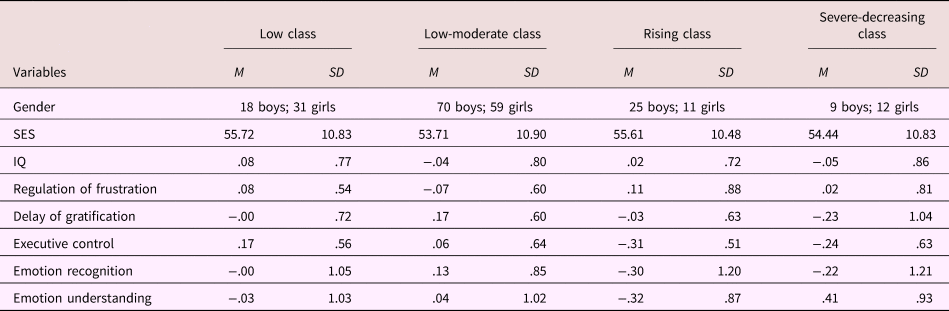
Next, we conducted a series of multinomial logistic regressions to examine how gender, self-regulatory, and EK constructs related to latent class outcomes identified from the parallel-process LCGA models. M and SD of all predictors for each class are presented in Table 8.
M and SD of all predictors for each class

Note: M and SD of all (except gender and SES) variables are reported in z-score. IQ = intelligence quotient; M = mean; SD = standard deviation; SES = socioeconomic status.
Comparison of low versus severe-decreasing class of concurrent INT and EXT symptoms
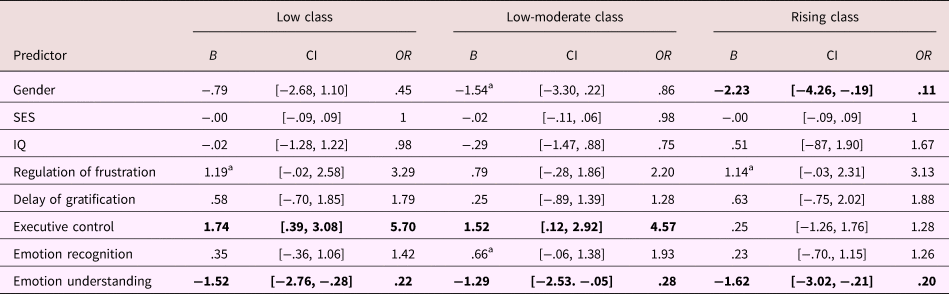
As shown in bold font in Model 1 (Table 9), the odds ratio for a 1-unit increase children's executive control during the preschool years was associated with children's 5.70:1 odds of being in a low versus severe-decreasing class after controlling for other childhood factors. The odds ratio for a 1-unit increase in children's emotion understanding resulted in .22:1 odds for being in a low versus severe-decreasing (or 4.48 odds for being in severe-decreasing versus low) class after controlling for other study variables. A 1-unit increase in children's regulation of frustration resulted in 3.29:1 odds for being in low versus severe-decreasing class, but the result was marginal. Taken together, children low in executive control and regulation of frustration but high in emotion understanding were more likely to be in the severe-decreasing versus low class of co-occurring internalizing and externalizing symptoms.
Model 1: Multinomial logistic regression for preschool-age predictors of parallel-process LCGA internalizing and externalizing trajectories from early preschool years to preadolescence

Note: The severe-decreasing class with high internalizing and externalizing trajectory is the reference category. Pooled unstandardized estimates from 10 imputed data set are reported. Significant estimates (p < .05) at 95% CI are marked in bold font. aMarginal significant estimates (p < .10) at 90% CI. For gender, male is the reference group. CI = confidence interval; IQ = intelligence quotient; OR = odds ratio; SES = socioeconomic status.
Low-moderate versus severe-decreasing class
The odds ratio for being male was marginally associated with .86:1 odds of low-moderate versus severe-decreasing class. A 1-unit increase in children's executive control resulted in 4.53:1 odds for being in low-moderate versus severe-decreasing class, respectively. A 1-unit increase in children's emotion recognition was marginally resulted in 1.93:1 odds for being in low-moderate versus severe-decreasing class. A 1-unit increase in children's emotion understanding resulted in .28:1 for being in low-moderate versus severe-decreasing (or 3.59:1 odds for being in severe-decreasing versus low-moderate) class after controlling for other study variables (Table 9).
Rising versus severe-decreasing class
The odds ratio for being male was associated with .11: 1 odds of rising versus severe-decreasing class. A 1-unit increase in children's regulation of frustration marginally resulted in 3.13:1 odds for being in rising versus severe-decreasing class. A 1-unit increase in children's emotion understanding resulted in .20:1 odds for being in rising versus severe-decreasing (or 5.05:1 odds for being in the severe-decreasing vs. rising) class after controlling for other study variables (Table 9).
Low versus rising class
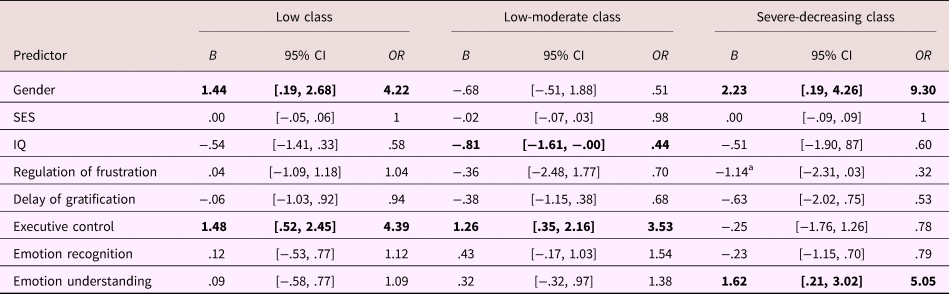
The odds ratio for being female was 4.22:1 odds for being in the low versus rising class. A 1-unit increase in children's executive control resulted in 4.39:1 odds for being in low versus rising class after controlling for other study variables (Table 10).
Model 2: Multinomial logistic regression for preschool-age predictors of parallel-process LCGA internalizing and externalizing trajectories from early preschool years to preadolescence

Note: The rising class with moderate internalizing and high externalizing trajectory is the reference category. Pooled unstandardized estimates from 10 imputed data sets are reported. Significant estimates (p < .05) at 95% CI are marked in bold font. aMarginal significant estimates (p < .10) at 90% CI. For gender, male is the reference group. CI = confidence interval; IQ = intelligence quotient; OR = odds ratio; SES = socioeconomic status.
Low-moderate versus rising class
A 1-unit increase in children's IQ and executive control resulted in .44:1 and 3.53:1 odds for being in low-moderate versus rising class after controlling for other study variables (Table 10).
Discussion
Our study objectives were fourfold. First, we sought to investigate the nature of internalizing and externalizing symptom growth trajectories from early childhood to middle childhood and in both genders. Second, we examined whether different self-regulatory and EK measures at age 3 can be categorized into subconstructs that adhere to the RDoC domains. Third, we examined the predictive role of identified EK and self-regulatory constructs on different internalizing and externalizing symptom trajectories. Finally, we examined the predictive role of child gender on symptom development.
Pure versus co-occurring of internalizing and externalizing trajectories
Our findings revealed that the prevalence of pure internalizing or externalizing trajectories was low from early childhood to middle childhood. Specifically, only 3.4% and 0.4% of the children in our sample developed pure internalizing and externalizing symptoms, respectively, across a 7-yr period spanning the early preschool years through preadolescence. In contrast, most children in our sample were characterized with various levels of co-occurring internalizing and externalizing symptoms across development. Although the initial design of our study aimed to oversample children with elevated externalizing problems (and allowing internalizing symptoms to vary) from the community, we found that in practice most preschoolers with various levels of externalizing symptoms were also characterized with co-occurring internalizing symptoms, and that very few children exhibited pure elevated externalizing symptoms. Although our findings may be sample-specific, they are in line with those based on other community samples (e.g., Beyers & Loeber, Reference Beyers and Loeber2003), person-centered trajectory models (e.g., Fanti & Henrich, Reference Fanti and Henrich2010; Wiggins et al., Reference Wiggins, Mitchell, Hyde and Monk2015), and empirical studies showing that the two domains have similar rates of change (e.g., Gilliom & Shaw, Reference Gilliom and Shaw2004; Keiley, Bates, Dodge, & Pettit, Reference Keiley, Bates, Dodge and Pettit2000). The nature of behavioral symptoms across the early preschool years through preadolescence may therefore be best captured by studying the co-development of internalizing and externalizing symptoms. Indeed, variable-centered models in adults have found that the relations of internalizing and externalizing symptoms are best represented by a bifactor structure model, characterized by a “p” meta-factor: a latent factor underlying shared variance among overall symptomatology, along with sublatent factors of specific symptoms (Beauchaine & McNulty, Reference Beauchaine and McNulty2013). Further study is needed to examine the bifactor model in children using longitudinal designs. Nevertheless, our findings highlight the necessity of simultaneously considering both internalizing and externalizing symptom trajectories to elucidate pathways of psychopathology.
Using parallel-process LCGA model, we identified four (low, low-moderate, rising and severe-decreasing) co-occurring internalizing and externalizing symptom trajectories/classes (Table 5). Because of our initial recruitment design with oversampling of children with externalizing symptoms, the majority of children (~55%) in our sample were in the low-moderate symptom class characterized with low and stable levels of internalizing and moderate and stable levels of externalizing symptoms across time. The second largest subgroup (~21%) was the low symptom class, characterized with low and stable internalizing and externalizing symptom trajectories. In contrast, a third subgroup (rising class, ~15%) of preschoolers manifested moderate levels of internalizing and high levels of externalizing symptoms, then increased levels of both symptoms across the school-age years. In other words, these preschoolers developed into the highest risk group with clinically elevated levels of co-occurring symptoms across time. Finally, a small subgroup (severe-decreasing class, ~9%) of children showed high internalizing and high externalizing levels of symptoms, but decreased levels of both symptoms across time. These children were also at high risk for later maladaptive outcomes due to their initial clinically elevated symptom levels.
In a similar study of the development of co-occurring internalizing and externalizing problems, Wiggins et al. (Reference Wiggins, Mitchell, Hyde and Monk2015) found only three trajectories (low, severe-decreasing, and severe). These partially discrepant findings may reflect differences in sample composition. First, our sample included both boys and girls whereas Wiggins et al. had a male only sample. Second, unlike the previous study that used a high familial risk sample, our study used a moderate- to low-risk community sample; thus, our findings augmented previous work by revealing distinct trajectories of co-occurring internalizing and externalizing symptoms that existed across genders and in a moderate- to low-risk community sample, highlighting the generalizability of this approach.
Establishing RDoC constructs in early childhood
One of the challenges for integrating the critical role of early development into RDoC perspectives is the lack of established early behavioral constructs that can be targeted for multilevel (e.g., genetic, molecular, neural) analyses and intervention. We first selected different measures of self-regulation and EK based on theoretical and empirical relevance to the development of both internalizing and externalizing problems (Denham et al., Reference Denham, Blair, DeMulder, Levitas, Sawyer, Auerbach-Major and Queenan2003; Reference Denham, Bassett, Way, Mincic, Zinsser and Graling2012; Eisenberg et al., Reference Eisenberg, Valiente, Spinrad, Cumberland, Liew, Reiser and Losoya2009; Hill et al., Reference Hill, Degnan, Calkins and Keane2006; Kim & Cicchetti, Reference Kim and Cicchetti2010; Olson et al., Reference Olson, Choe and Sameroff2017). Second, using a data-driven approach with different validated and developmentally appropriated laboratory and parent-reported measures, we identified five distinct EK and self-regulatory constructs across different RDoC domains (Table 7). Specifically, these constructs included: emotion recognition, emotion understanding (both of which are under the RDoC domain of systems for social processes), regulation of frustration (under negative valence systems), delay of gratification (under positive valence systems), and executive control (under cognitive systems). These distinct EK and self-regulatory constructs thus corroborated the multifaceted nature of EK (Bassett et al., Reference Bassett, Denham, Mincic and Graling2012) and self-regulation (Kim et al., Reference Kim, Nordling, Yoon, Boldt and Kochanska2013).
Moreover, both regulation of frustration and delay of gratification may be considered components of emotion regulation, which is supported by executive control (Buhle et al., Reference Buhle, Silvers, Wager, Lopez, Onyemekwu, Kober and Ochsner2014; Kohn et al., Reference Kohn, Eickhoff, Scheller, Laird, Fox and Habel2014; Ochsner, Silvers, & Buhle, Reference Ochsner, Silvers and Buhle2012). Although investigators tend to use only one domain of regulation (e.g., delay of gratification; Feng et al., Reference Feng, Shaw and Silk2008) or combine the two domains (e.g., Hill et al., Reference Hill, Degnan, Calkins and Keane2006) to index children's emotion regulation, our findings suggest that they are indeed distinct constructs. These constructs may involve different brain mechanisms. Executive control may reflect a top-down cognitive control neural circuitry of increased activations in the prefrontal regions. Regulation of frustration may reflect a neutral circuitry of decreased activation in the amygdala, which is associated with processing of negative emotions (Buhle et al., Reference Buhle, Silvers, Wager, Lopez, Onyemekwu, Kober and Ochsner2014; Kohn et al., Reference Kohn, Eickhoff, Scheller, Laird, Fox and Habel2014; Ochsner, Silvers, & Buhle, Reference Ochsner, Silvers and Buhle2012), whereas delay of gratification may reflect a neural circuitry of decreased activation in the ventral striatum, which is associated with processing of reward or compelling cues (Casey et al., Reference Casey, Somerville, Gotlib, Ayduk, Franklin, Askren and Shoda2011). Although it is beyond the scope of our study, examining the neural correlates of these self-regulatory constructs in early childhood is needed to corroborate whether they are distinct or overlapping constructs. Nonetheless, our study highlights the importance of conceptualizing self-regulation as a multidimensional construct and that each construct may have differentiated consequences for children's behavioral development.
Notably, the goal of our study was not to create or invent new constructs. Rather by identifying and establishing RDoC constructs in early childhood based on past literature, we aimed to provide solid behavioral evidence for future researchers to understand the underlying mechanisms supporting the development of these RDoC constructs.
Self-regulatory antecedents of the co-development of internalizing and externalizing trajectories
Our primary aim was to examine early antecedents of the co-development of internalizing and externalizing symptom trajectories. Using multinomial logistic regression, we found that poor executive control at age 3 significantly increased the odds of being in the high risk (both severe-decreasing and rising classes), relative to normative (low and low-moderate) classes of co-occurring internalizing and externalizing problems from early preschool years to pre-adolescence. Our findings are consistent with prior studies suggesting the critical role of EC in adaptive behavioral development (Eiden, Colder, Edwards, & Leonard, Reference Eiden, Colder, Edwards and Leonard2009b; Eisenberg et al., Reference Eisenberg, Valiente, Spinrad, Cumberland, Liew, Reiser and Losoya2009; Olson et al., Reference Olson, Choe and Sameroff2017). Our findings further extend the literature by showing that the “cool” sub-component of EC (i.e., executive control) uniquely predicted the co-occurring of internalizing and externalizing growth trajectories, even after accounting for the effect of IQ, gender, other self-regulatory processes (delay of gratification and regulation of frustration), and EK (emotion recognition and understanding), suggesting the robustness of the finding.
Interestingly, Kim et al. (Reference Kim, Nordling, Yoon, Boldt and Kochanska2013) found that preschoolers’ difficulties with delay of gratification uniquely predicted disruptive behavioral problems in middle childhood (Kim et al., Reference Kim, Nordling, Yoon, Boldt and Kochanska2013); however, we did not find that children's ability to delay immediate gratification predicted the development of co-occurring internalizing and externalizing symptoms after accounting for other self-regulation skills, EK and covariates. Further research is needed to understand how the interplay of different self-regulation skills in young children may be differentially predictive of pure versus co-occurring internalizing and externalizing symptoms.
It is worth noting that we also found some evidence suggesting that poor regulation of frustration increases the odds of being in the severe-decreasing relative to the low class, although the result is marginal and we did not observe the same effect in the rising class. Although our finding converges with prior studies suggesting that deficits in regulating anger and tolerating frustration are linked to early childhood internalizing and externalizing problems (Calkins, Reference Calkins2009; Hill et al., Reference Hill, Degnan, Calkins and Keane2006), emotion regulation (including regulation of frustration) has been proposed to be contextually dependent (Aldao, Reference Aldao2013). Future studies that include combinative measures of frustrative regulation outside the controlled-laboratory setting (such as asessing in school and home environment), and assess specific strategies (e.g., reappraisal vs. suppression; Gross, Reference Gross1998) maybe better able to capture children's variability in regulating negative emotions across different contexts.
In sum, our study pinpoints specific self-regulation deficits in executive control (and potentially regulation of frustration) as risk mechanisms for the long-term co-development of internalizing and externalizing problems.
The role of EK in the co-development of internalizing and externalizing trajectories
Whereas better emotion recognition marginally decreased the odds of being in the severe-decreasing than low-moderate class, better emotion understanding significantly increased the odds of being in the severe-decreasing compared with the normative (low and low-moderate) and rising classes. Although there have been mixed cross-sectional findings on the role of EK and early behavioral problems (see Trentacosta & Fine, Reference Trentacosta and Fine2010, for a review), this was surprising given that prior studies have consistently shown that better EK in general was associated with better social competence during early childhood (Denham et al., Reference Denham, Blair, DeMulder, Levitas, Sawyer, Auerbach-Major and Queenan2003, Reference Denham, Bassett, Way, Mincic, Zinsser and Graling2012; Schultz, Izard, Ackerman, & Youngstrom, Reference Schultz, Izard, Ackerman and Youngstrom2001). Our finding is consistent with a study showing that better EK was associated with higher risk of peer victimization Garner & Lemerise, Reference Garner and Lemerise2007). We speculate that children who develop superior emotion understanding of others in early ages (either because of genetic or environmental impact or both) might be oversensitive to others’ emotions and behaviors (and also possibly threat), which may in turn lead to increased peer victimization (Garner & Lemerise, Reference Garner and Lemerise2007). It is also possible that these children characterized with clinical but decreasing levels of behavioral problems are subjected to early adversity such as maltreatment or neglect; therefore, these children might develop heightened sensitivity to threat and others’ emotions as a compensatory mechanism to adapt to adverse caregiving environments. Future longitudinal studies are needed to replicate this finding. Studies that include measures of parental psychopathology, trauma, and neglect are necessary to dissect the counterintuitive relationship between emotion understanding and later behavioral problems. Moreover, the finding that emotion understanding did not predict the likelihood of being in the rising class suggests that it is not a risk factor, but rather it may serve as a protective or compensatory factor for children who are in the severe-decreasing class. Finally, our finding solidified the importance of differentiating emotion recognition and emotion understanding as two separate processes (Bassett et al., Reference Bassett, Denham, Mincic and Graling2012) because these two processes were distinctly (and even oppositely) related to co-development of internalizing and externalizing problems.
The role of gender on the co-development of internalizing and externalizing trajectories
We found that boys were more likely than girls to be in the rising compared to the low and severe-decreasing class. Although few investigators have studied gender differences in the occurring of internalizing and externalizing problems, gender differences in levels of early onset externalizing problems have been consistently reported (Keenan et al., Reference Keenan, Feng, Babinski, Hipwell, Hinze, Loeber, Stouthamer-Loeber, Kerr, Stattin, Engles, Overbeek and Stouhamer-Loeber2011; Zahn-Waxler et al., Reference Zahn-Waxler, Shirtcliff and Marceau2008). These findings may be attributable to many different factors, such as boys’ relatively slower language development (Keenan & Shaw, Reference Keenan and Shaw1997; Lahey et al., Reference Lahey, Van Hulle, Waldman, Rodgers, D'Onofrio, Pedlow and Keenan2006) and lower levels of inhibitory control (Else-Quest, Hyde, Goldsmith, & Van Hulle, Reference Else-Quest, Hyde, Goldsmith and Van Hulle2006) between early through middle childhood. Else-Quest et al.’s (Reference Else-Quest, Hyde, Goldsmith and Van Hulle2006) meta-analysis of gender differences in temperament revealed that boys showed higher levels of impulsivity, activity, and high-intensity pleasure (i.e., surgency) than girls, whereas girls showed relatively higher levels of EC than boys. Moreover, between infancy through adolescence, girls showed better social sensitivity, empathy, prosociality, and ER than boys (Else-Quest et al., Reference Else-Quest, Hyde, Goldsmith and Van Hulle2006; Zahn-Waxler et al., Reference Zahn-Waxler, Shirtcliff and Marceau2008). These benefits in conjunction with faster cognitive maturation and language development may explain why female gender was a protective factor for behavioral problems across the preschool and school-age years. Because our study did not account for environmental factors such as parenting and parental psychopathology however, these similarities and differences between boys and girls may also be attributed to environmental influences that were beyond the scope of the current report. Therefore, interactions between child gender and environmental factors should be studied to better understand the role of child gender in the co-development of these problems.
Strengths and limitations
Developmental psychopathology as a field has long championed using person-centered approaches to augment variable-centered analyses. To our knowledge, this is the first study to identify specific constructs of early EK and self-regulation that predicted the co-development of internalizing and externalizing symptoms from early preschool years to preadolescence using person-centered analyses. Our study also included both mothers’ and fathers’ reports to represent multi-informant assessments of child's behavioral problems across development. Moreover, we included both parent-report and laboratory-based measures with a data-driven approach to identify different constructs of early EK and self-regulation.
We also wish to acknowledge several limitations of our study. First, our sample contained predominantly European American children and thus the findings may not be generalizable to children from other ethnic or racial groups. Second, our study only included three time points and therefore we were unable to capture more distal outcomes of co-developing behavior problems. Previous studies have shown that the early childhood onset pathways to externalizing problems were associated with worse adaptive outcomes in adulthood (e.g., Fergusson, Horwood, & Ridder, Reference Fergusson, John Horwood and Ridder2005; Moffitt, Reference Moffitt, Lahey, Moffitt and Caspi2003). Thus, young children with co-occurring internalizing and externalizing symptoms may be at even higher risk for later maladaptive outcomes. Third, because of power considerations, we were only able to include SES as an index of environmental influence. Although it is beyond the scope of this paper, other environmental measures (such as parental psychopathology and child adversity) may interact with child self-regulation/EK in relation to later adjustment outcomes. Fourth, because of low prevalence of pure internalizing/externalizing trajectories in our sample, we were unable to examine whether predictors of growth are the same or different across the developmental trajectories of pure and co-occurring symptoms. Fifth, there were relatively small numbers of children in the severe-decreasing and rising classes. Finally, our sample contained predominantly two-parent middle-income families, and therefore our findings are not generalizable to children living in other family constellations or under conditions of extreme economic hardship.
Conclusion
Our study is among the first to integrate RDoC constructs into a developmental psychopathology framework by illuminating potential etiological factors in early childhood that underlie common behavior problems. The applicability of RDoC criteria for developmental psychopathology research has been limited because of a lack of validated, feasible, and standardized assessment batteries to examine RDoC domains in young children. Our findings suggest that measures of self-regulation may serve as transdiagnostic assessment tools for identifying young children at high risk for later maladaptive outcomes. More important, our findings suggest an intervention target for behavioral self-regulation training, particularly children's executive control skills, as preventive efforts to reduce risk for both internalizing and externalizing problems before the onset of clinically significant symptoms in young children.
Financial support
This research was supported by National Institute of Mental Health grant RO1MH057489 awarded to Sheryl L. Olson and Arnold J. Sameroff.
Conflicts of interest
We have no disclosure of any conflicts of interest with regard to the submitted work.
Ethical standards
Our study complied with APA ethical standards in the treatment of our participants and has been continuously approved by the University of Michigan Institutional Review Board since 1999.
Author ORCIDs
Ka I. Ip 0000-0001-7543-3669.