Introduction
In hunter-gatherer societies the pursuit of large animals invariably involves spiritual and ritual aspects. Northern hunting peoples maintain long-term relationships with the animals that surround them, based on respect and mutual obligations. Animals were frequently perceived as other-than-human persons that would allow themselves to be taken by hunters if sufficient respect and ritual had been offered (Brightman Reference Brightman1993; Fienup-Riordan Reference Fienup-Riordan1994; Hill Reference Hill2011; Nadasdy Reference Nadasdy2007; Tanner Reference Tanner1979). This relationship had to be maintained over time, placing on-going obligations on both the hunter and his wife (Bodenhorn Reference Bodenhorn1990; Fienup-Riordan Reference Fienup-Riordan1994; Hill Reference Hill2011). No rigid separation existed between humans and animals; the boundary was permeable and fluid (Fienup-Riordan Reference Fienup-Riordan1994; Hill Reference Hill2011; Reference Hill2013; McNiven Reference McNiven2010). Such beliefs are often referred to as animism, defined by Willerslev (Reference Willerslev2007, 2) as a ‘set of beliefs, whereby nonhuman animals (and even nonanimals such as inanimate objects and spirits) are endowed with intellectual, emotional, and spiritual qualities paralleling those of human persons’. Such concepts have a long history in anthropology, although many researchers now prefer to avoid the term due to its historical baggage (Harvey Reference Harvey2005; Hill Reference Hill2013; Losey Reference Losey2010; Willerslev Reference Willerslev2007). Nevertheless, there is considerable interest in examining Indigenous ontologies to develop archaeological interpretations that attempt to understand how the people who left the archaeological record perceived their world.
Like other hunting-fishing-gathering cultures, the peoples of the Northwest Coast of North America shared their environment with numerous sentient other-than-human persons. The form these beings took was not static; transformation from one state to another is a common theme in the oral histories and the art. Swanton (Reference Swanton1905, 16), for example, recorded the Haida belief that ‘every animal was, or might be, the embodiment of a being who, at his own pleasure, could appear in the human form’. Stories frequently tell of marriages between human persons and animal persons (Boas Reference Boas, Bouchard and Kennedy2002; McIlwraith Reference McIlwraith1948; Swanton Reference Swanton1905). Many groups believed that animals (and other non-human beings, such as prominent rocks) were once people, before they were changed into their present form by the transformers who put the world in its present order (Boas Reference Boas1935; Reference Boas, Bouchard and Kennedy2002; Sapir & Swadesh Reference Sapir and Swadesh1939). In many accounts these beings live in human form, dwelling in houses in human-like social groups and carrying out activities much like humans (Boas Reference Boas1935; Reference Boas, Bouchard and Kennedy2002; Drucker Reference Drucker1951; Swanton Reference Swanton1905). Wolves, for example, live as humans, donning their fur coverings to take wolf shape only when they leave their homes (Curtis Reference Curtis1916, 95; Drucker Reference Drucker1965, 158; Golla Reference Golla and Hoover2000, 146). Similarly, whales, seals, salmon and herring live like people when in their houses under the sea (Drucker Reference Drucker1951, 151; Swanton Reference Swanton1905, 17).
This paper examines the other-than-human beings that prey on whales, the relationship of those beings with human whaling chiefs and their prominent role in the art and ceremonies of these whaling people. It focuses on the closely related Nuu-chah-nulth, Ditidaht and Makah peoples, whose traditional territories encompass the west coast of Vancouver Island in British Columbia, Canada, and the adjacent Olympic Peninsula in Washington state, USA.Footnote 1
The whalers
Few images of ancient people are as compelling as that of hunters in canoes pursuing the large whales well out to sea. Although all the Indigenous groups of the Northwest Coast of North America hunted various marine mammals and would happily harvest blubber and meat from a stranded or drift whale, active whaling at contact was restricted to the Nuu-chah-nulth, Ditidaht and Makah, plus a few southern neighbours of the Makah, such as the Quileute and Quinault, who had adopted the practice from the Makah in relatively late times (Arima & Hoover Reference Arima and Hoover2011; McMillan Reference McMillan1999; Reference McMillan2015). As the traditional beliefs and practices associated with whaling are shared by all three groups, ‘Nuu-chah-nulth’ is occasionally used here as an umbrella term to encompass the wider area.
The abundance of whalebone in almost all excavated archaeological sites along that coastline attests to the importance of whaling to these societies over millennia (Marshall Reference Marshall and Sutton1989; McMillan Reference McMillan1999). Not only did a successful hunt provide a great economic bounty of meat, blubber, and oil (Huelsbeck Reference Huelsbeck1988), but it served to validate chiefly claims to status and power (Harkin Reference Harkin1998, 321; Swan Reference Swan1870, 52). Only a high-ranking whaling chief was entitled to be first to thrust the heavy harpoon into the whale once his well-trained crew had manoeuvred the canoe into position (Drucker Reference Drucker1951, 51–2; Reference Drucker1965, 132–9). Control of supernatural power was also key to success, requiring whalers to undertake lengthy ritual preparation for the hunt. Such ritual preparation, in which the whaler's primary wife played an important role, involved prayers and prolonged bathing in secluded locations while diving and blowing to imitate the whale (Arima & Hoover Reference Arima and Hoover2011, 59–60; Curtis Reference Curtis1916, 20; Drucker Reference Drucker1951, 169–70; Sapir et al. Reference Sapir, Swadesh, Thomas, Thomas, Williams, Arima, Klokeid and Robinson2004, 23). These actions encouraged the whale to swim slowly and allow the whaler's canoe to approach, thus offering itself to the harpooner. Successful whaling, therefore, was a demonstration of the whaling chief's political, physical and spiritual power.
Whaling played a major role in Nuu-chah-nulth identity, running as a central theme through much of their art, stories, songs, ceremonies and chiefly names (Coté Reference Coté2010). Nuu-chah-nulth oral traditions are filled with tales of famed whalers (e.g. Sapir et al. Reference Sapir, Swadesh, Thomas, Thomas, Williams, Arima, Klokeid and Robinson2004). Images related to whaling dominate Nuu-chah-nulth, Ditidaht and Makah art, from archaeological objects to recent works (Coté Reference Coté2010; McMillan Reference McMillan and Hoover2000). Ethnographic accounts tell of great whalers receiving powers from encounters with supernatural beings such as thunderbird (Sapir et al. Reference Sapir, Swadesh, Thomas, Thomas, Williams, Arima, Klokeid and Robinson2000; Reference Sapir, Swadesh, Thomas, Thomas, Williams, Arima, Klokeid and Robinson2004). Such encounters were depicted and publicly displayed to enhance the chief's status, particularly on the large painted plank screens set up in the chief's house during ceremonies.
The chiefly whaler and his crew were not the only beings to pursue these large marine mammals. In Nuu-chah-nulth art and thought, whalers also included non-human beings. Thunderbird, in particular, is pervasive in Nuu-chah-nulth art and chiefly prerogatives. As the great whaler of the supernatural realm, this powerful being was linked symbolically with the human whaling chief. In addition, this article argues that the orca (or ‘killer whale’) was also viewed as a non-human whaler associated with chiefly power and display.
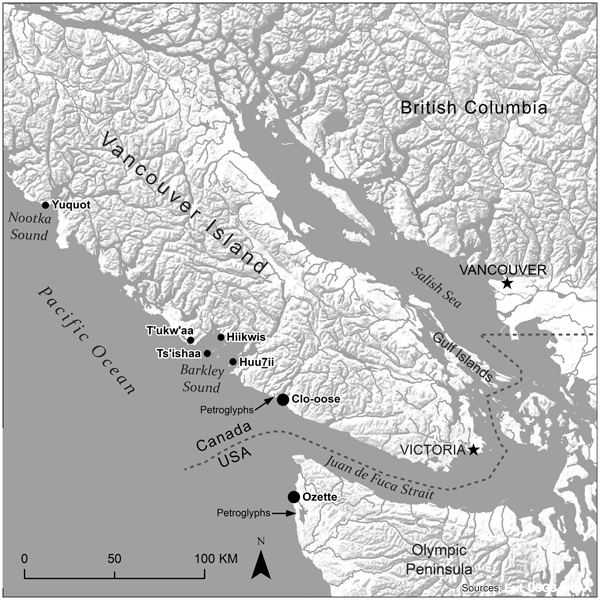
Two major archaeological examples are examined to present interpretations of whaling imagery featuring the orca. The first is the whale fin effigy from Ozette, a former Makah village on the outer coast (Fig. 1), where an ancient mudslide destroyed part of the village, but sealed the house remains and their contents under a thick layer of wet clay. The waterlogged conditions resulted in excellent preservation of wooden and fibre objects, including the whale fin effigy. The second example involves petroglyph sites near both Ozette and the traditional Ditidaht village of Clo-oose (Fig. 1) that feature images related to whaling, including thunderbirds and orcas. The rich and detailed oral histories and ethnographic descriptions available for the Nuu-chah-nulth, Ditidaht and Makah, much of which was supplied by knowledgeable people in those communities over a century ago, provide cultural context to assess these images, particularly in light of the relatively late date of these archaeological examples.
Map showing western Vancouver Island and the Olympic Peninsula, indicating the locations of sites mentioned in the text.

Thunderbird and lightning serpent
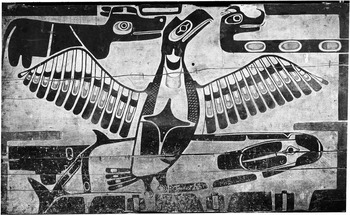
As the great supernatural whaler, thunderbird appears frequently in Nuu-chah-nulth, Ditidaht and Makah art and ceremonies. Thunderbird (tliishin in the Nuu-chah-nulth language) is easily recognized by his heavy downturned beak, a crest or projection on his head and usually outstretched wings, as well as by frequent direct association with a whale. In some accounts this being is described as a large man, who puts on his feathered garb to soar out from his mountain-top home in a hunt for whales (Densmore Reference Densmore1939, 23; Drucker Reference Drucker1951, 153; Swan Reference Swan1870, 7-8). Often depicted with the thunderbird is the lightning serpent (hiy'itl'iik in Nuu-chah-nulth), which the thunderbird wore around its body until a whale was located, then hurled as a harpoon (Densmore Reference Densmore1939, 23; Sapir Reference Sapir and Clews Parsons1922, 314; Swan Reference Swan1870, 8). Thunderbird is associated with stormy weather, as the crashing of his wings is the thunder and the lightning indicates that he has released his harpoon. The large painted plank screens set up in the chiefs’ houses for public events characteristically depict some combination of thunderbird, lightning serpent and whale, often in association with the wolf (Fig. 2).
This Nuu-chah-nulth painted plank screen, adorned with images of thunderbird and whale (at centre) with lightning serpent (upper right) and wolf (upper left), was one of two large screens depicting these beings in a traditional-style chief's house near Port Alberni. (American Museum of Natural History Library, Image #313185.)

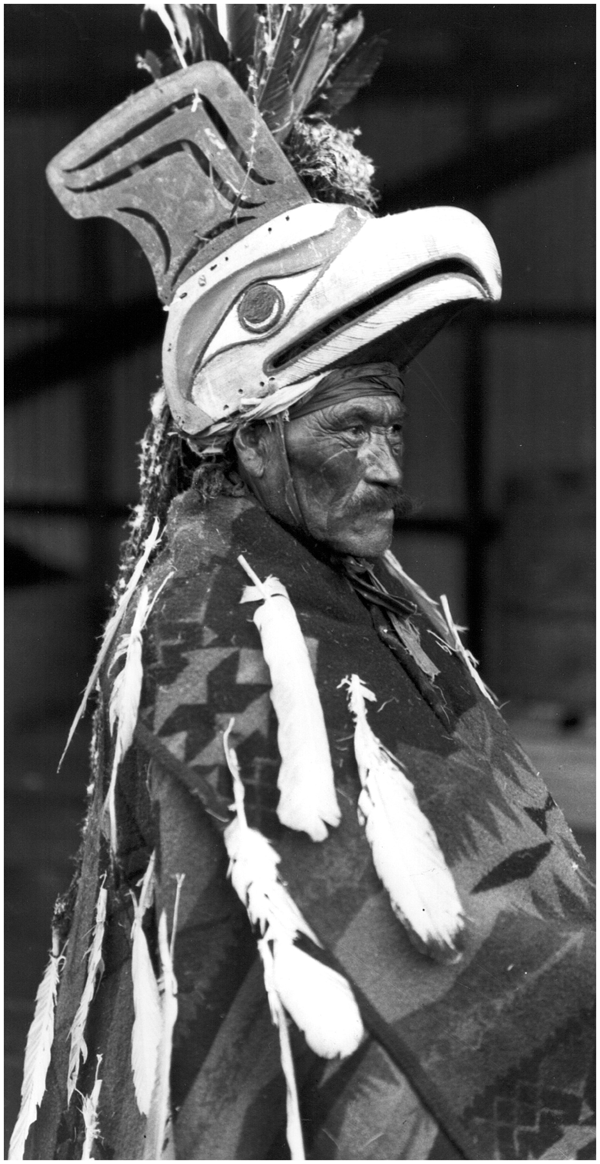
Ethnographic accounts tell of great whalers receiving supernatural powers for whaling through encounters with thunderbird or lightning serpent (Sapir et al. Reference Sapir, Swadesh, Thomas, Thomas, Williams, Arima, Klokeid and Robinson2000, 53–4, 57–61). Some high-status chiefly names refer to the thunderbird, thus directly associating the chief with this powerful supernatural whaler.Footnote 2 Ceremonial performance of the thunderbird dance was a jealously guarded prerogative owned by certain chiefs (Sapir Reference Sapir and Clews Parsons1922, 300, 316; Sapir & Swadesh Reference Sapir and Swadesh1955, 97). Elaborate masks and regalia were part of these performances, along with wooden boxes filled with pebbles that could be rolled to simulate the sound of thunder (Ernst Reference Ernst1952, 40; Sapir & Swadesh Reference Sapir and Swadesh1955, 97). When a chief appeared at such events in his impressive thunderbird headdress, all present were reminded of his association with this powerful supernatural whaler (Fig. 3). Prized inherited rights also included the display of thunderbird images, along with whales and lightning serpents, in prominent contexts such as on painted house fronts (Arima & Hoover Reference Arima and Hoover2011, 212; McMillan & St. Claire Reference McMillan and St. Claire2005, 9-10; Sapir Reference Sapir and Clews Parsons1922, 306, 318-319; Sapir et al. Reference Sapir, Swadesh, Thomas, Thomas, Williams, Arima, Klokeid and Robinson2000, 54, 58).
Chief Joseph John of the Tla-o-qui-aht displays his dance regalia, featuring a thunderbird headdress, in this 1929 photograph. (Photograph: Arthur V. Pollard, Library and Archives Canada, PA140976.)

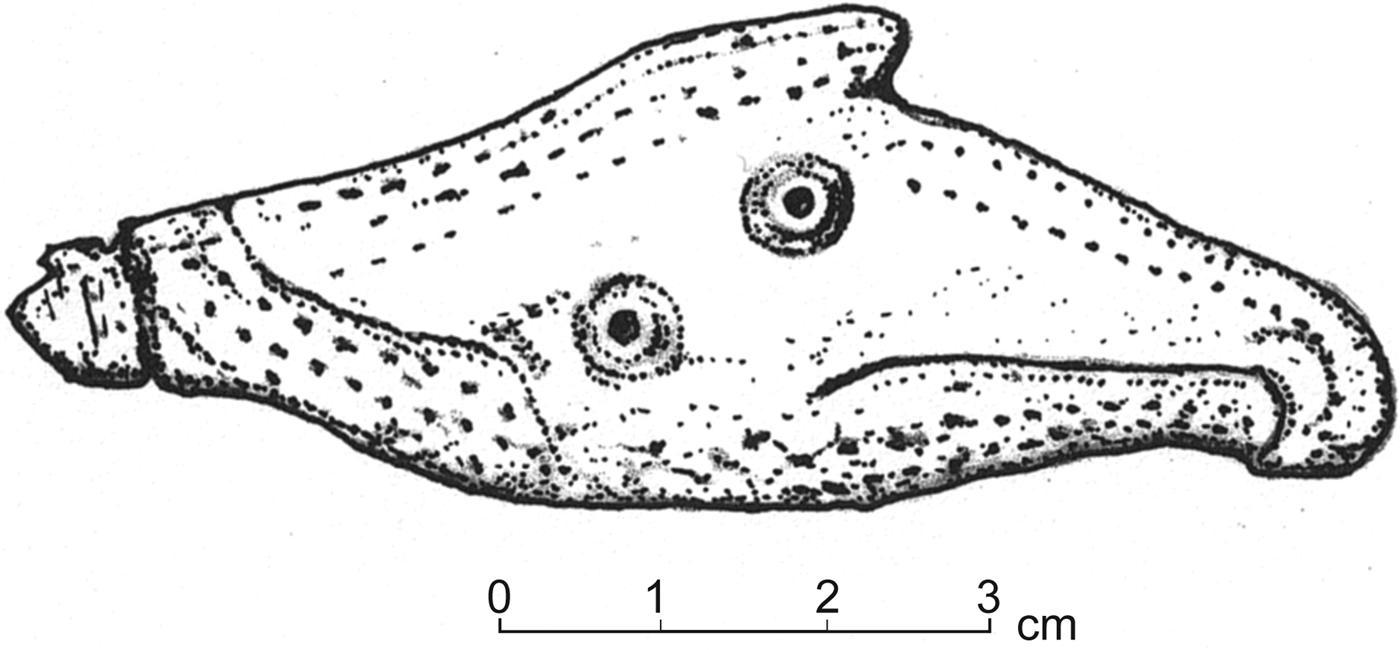
Thunderbirds and whales appear on numerous household objects, including on large wooden panels, preserved in the waterlogged house deposits at Ozette (Daugherty & Friedman Reference Daugherty, Friedman and Carlson1983; Kirk Reference Kirk2015). Paired thunderbirds and wolves face each other on one panel, while another shows a whale in ‘X-ray vision’, with its vertebral column depicted (Kirk Reference Kirk2015, 35). In other archaeological contexts, where wood is not preserved, art objects are much rarer. A small bone carving from Yuquot in Nootka Sound, dating to about 2000 years ago, may be an early stylized image of the thunderbird (McMillan Reference McMillan and Hoover2000, 235–6). Bone valves of whaling harpoon heads were incised with zig-zag designs representing the lightning serpent, thought to add ‘magical virtue’ to the implement (Drucker Reference Drucker1951, 28). Such artefacts appear in the archaeological record at least a thousand years ago (McMillan Reference McMillan and Hoover2000, 237–8). Perhaps the most striking of the small archaeological finds displaying whaling imagery is a bone pendant from the village site of Huu7ii in Barkley Sound (Fig. 1), associated with a house floor dating between approximately ad 1150 and 1550 (McMillan & St. Claire Reference McMillan and St. Claire2012, 79). The object depicts thunderbird and whale through the use of ‘visual punning’. The thunderbird's head, with its characteristic downturned beak and crest on top of the head, faces to the right (Fig. 4). A whale's head, with an incised mouth line, faces in the other direction, with the whale's dorsal fin serving as the thunderbird's crest and the whale's tail doubling as the thunderbird's beak (McMillan Reference McMillan2015, 250–52). The house platform from which this object was excavated, by far the largest evident at the site, has been interpreted as the residence of an ancient whaling chief (McMillan Reference McMillan2015, 249).
This pre-contact bone pendant uses ‘visual punning’ to depict the thunderbird (facing right) and whale (facing left). It was excavated within the floor deposits of a large house, perhaps that of a whaling chief, at the site of Huu7ii in Barkley Sound.

Whale
The thunderbird's prey were the large baleen whales that were also targeted by human hunters. In the ethnographic literature, the California grey whale (Eschrichtius robustus) is frequently presented as the principal species taken (Arima & Hoover Reference Arima and Hoover2011, 58; Curtis Reference Curtis1916, 18; Swan Reference Swan1870, 16; Waterman Reference Waterman1920, 42). Humpbacks (Megaptera novaeangliae), however, were also recognized as important to the Nuu-chah-nulth and their relatives. Kool (Reference Kool1982) strongly questioned the dominance of grey whales in these accounts, arguing that humpbacks played the larger role. In many accounts the whalers took both species, with the emphasis differing according to the time of yearFootnote 3 (Drucker Reference Drucker1951, 48; Sapir et al. Reference Sapir, Swadesh, Thomas, Thomas, Williams, Arima, Klokeid and Robinson2004, 133–5). Although greys and humpbacks were the major species, other whales were occasionally taken. The right whale (Eubalaena japonica), fin whale (Balaenoptera physalus), sperm whale (Physeter microcephalus) and blue (or sulphur-bottom) whale (Balaenoptera musculus) were all known to these outer coast people, although not all were hunted (Drucker Reference Drucker1951, 49; Swan Reference Swan1870, 19; Waterman Reference Waterman1920, 42).
Archaeological evidence provides specific details on which whales were targeted in the past. At Ozette, in a large sample of whalebone identified to species, grey whales accounted for half the total, with humpbacks closely behind; right and fin whales were also present in small numbers (Huelsbeck Reference Huelsbeck1988, 4; Reference Huelsbeck and Samuels1994a, 271). A recent study of whale bones from sites in Clayoquot Sound, using aDNA for species identifications, yielded very similar results (Béland et al. Reference Béland, McLeod, Martin, Martin, Darling and Frasier2018). In Barkley Sound, however, identified whale elements are heavily dominated by humpbacks (Arndt Reference Arndt2011; McMillan Reference McMillan2015; Monks et al. Reference Monks, McMillan and St. Claire2001). In fact, humpback whales account for over 78 per cent of the combined total from all analysed sites, with greys a distant second and right and fin whales occurring in small numbers (McMillan Reference McMillan2015, 243). In addition, the Barkley Sound sites contained a few elements from blue, sperm and minke (Balaenoptera acutorostrata) whales, possibly as a result of harvesting drift or stranded individuals.
In Nuu-chah-nulth art, whales are usually depicted in a rather generic fashion. Unlike the work of modern artists, older pieces rarely display such identifying features as the humpback's long pectoral fins or the grey's row of bumps along the dorsal ridge. A small dorsal fin frequently appears on the animal's back (see, for example, Figure 2). One of the few archaeological examples is a small stone sculpture of a whale with a low dorsal fin from the Barkley Sound site of T'ukw'aa (McMillan Reference McMillan and Hoover2000, 237). Such depictions would appear to rule out the grey whale, which has a series of bumps along the lower back rather than a dorsal fin, and the right whale, which lacks any trace of a dorsal fin (Ford Reference Ford2014, 103, 115). Humpbacks, on the other hand, have a dorsal fin that varies considerably between individuals, from merely a low bump to a more pronounced fin, positioned on a distinctive raised hump (Ford Reference Ford2014, 171; Naughton Reference Naughton2012, 625). Kool (Reference Kool1982) used the frequent presence of a dorsal fin in depictions of the whale to argue that the humpback was the primary whaling target. Images of the whale frequently appear in association with the thunderbird, suggesting that the intent was to portray the whale as the whaler's quarry, so perhaps identifying a particular species would be of little importance. In any case, the prominent dorsal fins on the cetacean images discussed below clearly denote something different from the whale species that were normally hunted.
Wolf
Also common in the art, frequently appearing with thunderbird, lightning serpent and whale on such objects as the painted screens, is the wolf (Fig. 2). This being features prominently in Nuu-chah-nulth ceremonial life. The major winter ceremonial (known as the tlukwana in the Nuu-chah-nulth language), with its array of masked dancers, is generally glossed as the ‘Wolf Ritual’ in English (e.g. Ernst Reference Ernst1952). Extensive ethnographic descriptions document the lengthy series of performances, in which dancers with wolf headdresses were the primary initiating beings (Curtis Reference Curtis1916, 68–91; Drucker Reference Drucker1951, 387–417; Ernst Reference Ernst1952; Sapir & Swadesh Reference Sapir and Swadesh1955, 89–120). Chiefs owned specific hereditary display rights, such as having certain numbers or special varieties of wolves appear (Drucker Reference Drucker1951, 392). In addition to the wolves, the many dancers that performed included thunderbird, lightning serpent and killer whale.
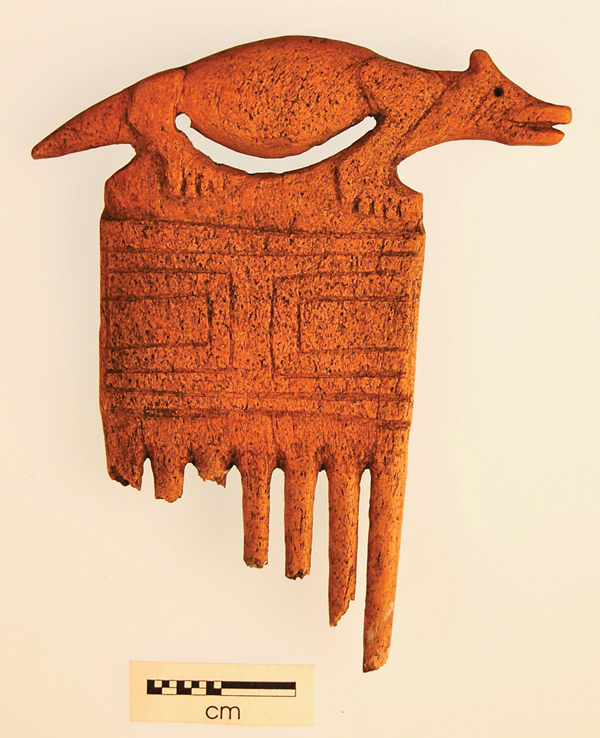
Wolves appear with thunderbirds on a wooden panel from the protohistoric waterlogged house deposits at Ozette. At older village sites, however, factors of preservation have generally removed such objects from the archaeological record. One exception is a finely carved bone comb with the cut-out image of a wolf (Fig. 5) from the former Tseshaht village of Hiikwis in Barkley Sound (Fig. 1). It was excavated from near the base of cultural deposits on the lower (most recent) terrace, immediately above charcoal that yielded a radiocarbon age estimate of cal. ad 1040 to 1240.Footnote 4 Wolf Ritual performances took place at this village in historic times. As Tom Sayach'apis, Edward Sapir's primary Nuu-chah-nulth source of information, recalled early in the twentieth century: ‘I was a boy when I witnessed the wolves creeping out of the woods … It was at Hiikwis that I watched it’ (Sapir & Swadesh Reference Sapir and Swadesh1955, 27).
A carved bone comb, from the Barkley Sound site of Hiikwis, has a geometric design on its body and a cut-out image of a wolf on top. (Photograph: Author.)
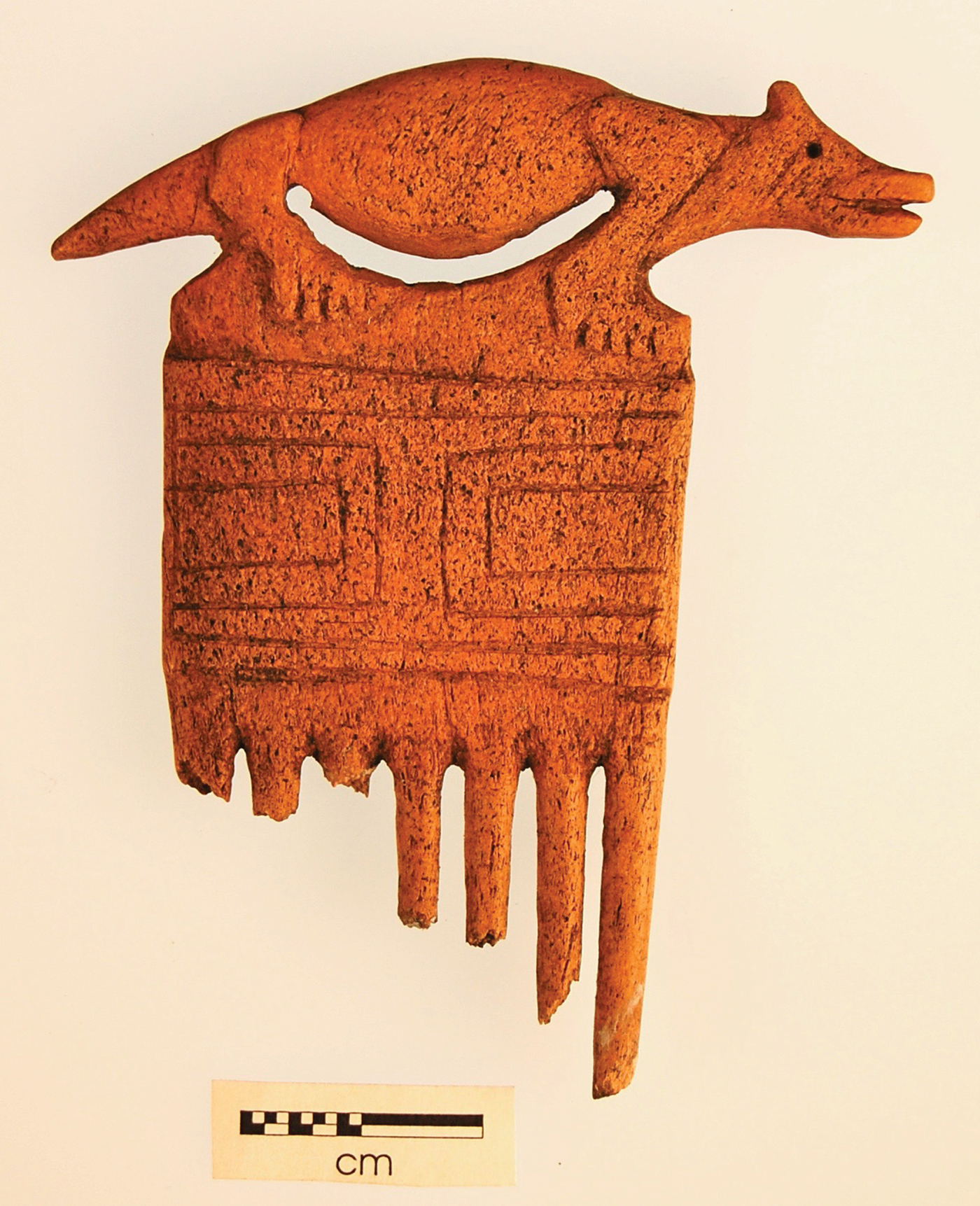
In addition to its ceremonial importance, wolf held an important place in Nuu-chah-nulth traditions due to its supernatural powers, including an ability to transform into killer whale (Densmore Reference Densmore1939, 53; Drucker Reference Drucker1951, 152, 158; Sapir & Swadesh Reference Sapir and Swadesh1955, 92; Sapir et al. Reference Sapir, Swadesh, Thomas, Thomas, Williams, Arima, Klokeid and Robinson2007, 272). In fact, wolf and orca were thought to be the land and sea variants of the same being. Sapir's Nuu-chah-nulth consultants stated: ‘The killer whales are wolves. Wolves sometimes run through caves into the water and turn into killer whales. The tail turns into the big fin on the back’ (Roberts & Swadesh Reference Roberts and Swadesh1955, 318–19). Wolf's appearance in the art may reflect more than its ceremonial importance. Its association with thunderbird, lightning serpent and whale (as in Figure 2) suggests whaling imagery. In a lengthy account of the origin and practice of whaling obtained from a Tla-o-qui-aht whaler early in the twentieth century, the whaler received important private knowledge through a visitor who came to him in a dream (Curtis Reference Curtis1916, 18–37). This visitor eventually identified himself as ‘Wolf, the good friend of hunters and harpooners’ (Curtis Reference Curtis1916, 21). This tie between wolf and whaling likely stems from its identity as killer whale, as is argued below.
Orca (killer whale)
Orcas (Orcinus orca), also commonly known as killer whales, are the largest members of the dolphin family. Nuu-chah-nulth whalers would clearly have viewed them in a different category from the larger whales, particularly those targeted in the hunt. In the Nuu-chah-nulth language, they were known as kaka7wi'n (George Reference George2003, 54). Orcas were not normally hunted by the Nuu-chah-nulth, although occasionally young men took them to demonstrate their bravery and skill (Drucker Reference Drucker1951, 49). Scammon (Reference Scammon1874, 92), however, claimed that the Makah occasionally hunted orcas. They are rare in the archaeological record. Three orca teeth were tentatively identified at Ozette (Huelsbeck Reference Huelsbeck and Samuels1994a, 271), possibly scavenged or traded into the village for their useful ivory. The large sample of Barkley Sound cetacean elements identified through aDNA yielded only one orca result, from the large outer-coast village of Ts'ishaa (McMillan Reference McMillan2015, 246). Nuu-chah-nulth chief Earl Maquinna George (Reference George2003, 54) stated that the reluctance to hunt orcas stemmed from their ‘sacred power’, the ability to change into wolves when on land.
Three distinct orca populations have been identified along the western coastline of North America: transients (or Bigg's), residents and offshores (Ford Reference Ford2014; Ford et al. Reference Ford, Ellis and Balcomb2000; Naughton Reference Naughton2012). Despite their overlapping ranges, these groups rarely if ever interbreed. Genetic separation has led to minor physical variations (Ford Reference Ford2014, 288–90). Their major differences, however, are behavioural and ecological, particularly regarding their diets. The wide-ranging transients are predators of marine mammals, including other cetaceans, whereas residents rely almost totally on fish, particularly salmon; offshore populations are little known, but seem also to subsist primarily on fish, including sharks. For this paper, only the transients are of interest.
In a study of the transient orca population off the British Columbia coast, harbour seals made up over half the observed kills (Ford & Ellis Reference Ford and Ellis1999, 14, 26). Sea lions were also frequently taken, as were the smaller cetaceans: harbour porpoises, Dall's porpoises, Pacific white-sided dolphins and minke whales (Ford & Ellis Reference Ford and Ellis1999; Naughton Reference Naughton2012, 655). Even the large baleen whales, particularly the calves, fall prey to these efficient hunters. Grey whales, in particular, are victims of such attacks, with orcas working together to harry the adults until a calf can be killed (Ford & Ellis Reference Ford and Ellis1999, 69; Naughton Reference Naughton2012, 630; Scammon Reference Scammon1874, 90). Hunting cooperatively, orcas intercept concentrations of whales during their annual migrations. For example, Barrett-Leonard et al. (Reference Barrett-Leonard, Matkin, Durban, Saulitis and Ellifrit2011) have documented orcas in the northern Pacific following migrating grey whales while targeting the calves, subsisting almost entirely on this food source for an extended period. Although young animals most frequently fall victim to such predation, orcas are also known occasionally to attack large adult whales, working together to chase and tire their prey until it bleeds to death from numerous bites or can be held under water to drown (Naughton Reference Naughton2012, 630). Even the large fin whales are occasionally killed by orcas (Naughton Reference Naughton2012, 620). Scars from orca encounters are commonly visible on whales of various species (Naughton Reference Naughton2012, 620, 624, 630). Scammon (Reference Scammon1874, 90), in his nineteenth-century eyewitness account of a group of orcas attacking grey whales, referred to them as ‘wolves of the ocean’, which closely corresponds to Nuu-chah-nulth beliefs concerning this animal.
Nuu-chah-nulth whalers would have been well aware of orca behaviours and very likely witnessed such attacks on the animals they also hunted. Orcas, like thunderbirds, may have been viewed as non-human whalers associated with whaling chiefs and were incorporated into Nuu-chah-nulth ceremonies and ritual privileges. A killer whale dance was one of the owned prerogatives of chiefs (Sapir & Swadesh Reference Sapir and Swadesh1939, 131). Curtis (Reference Curtis1916, 86) provides a lengthy discussion of the dances performed during a ‘Wolf Ritual’ (tlukwana), ending with: ‘Last of all were the killerwhales, and after they one by one had entered the house …, came two men carrying a whale mask, going through the motions of rising, spouting, and diving, while the killerwhales sported about. Then one of them discovered the whale, dashed toward it, and bit at it, and the others joined in the attack and killed the whale.’ This account clearly recognizes the orca as a whaler. Most ritual expressions of orca, however, are linked with the wolf. In a discussion of publicly displayed hereditary privileges (tupaati), Drucker (Reference Drucker1951, 289) states: ‘Some chiefs had Killer Whales which came on the beach and became Wolves.’ Sapir et al. (2007, 154) also note the tupaati of having wolves turn into orcas at the water's edge during the tlukwana performances.
Sapir's early twentieth-century Nuu-chah-nulth colleagues related several versions of the origin of the tlukwana, telling in one how a young man was taken by the wolves. The Wolf Chief told him, ‘You will be my son. You will hunt Hair [harbour] seals and Humpback whales’, apparently referring to his seagoing guise as orca. When he was sent home to teach his people the tlukwana, ‘He put on the Killer Whale clothes … There were lots of Killer Whales down the beach’ (Sapir et al. Reference Sapir, Swadesh, Thomas, Thomas, Williams, Arima, Klokeid and Robinson2007, 50). In another account of the ceremony's origin (Sapir et al. Reference Sapir, Swadesh, Thomas, Thomas, Williams, Arima, Klokeid and Robinson2007, 85–113), a young woman elopes with the chief of the wolves and is taken to his house in the woods. The wolves performed the tlukwana, singing: ‘When I turn into a Killer Whale, I who am Wolf’ (Sapir et al. Reference Sapir, Swadesh, Thomas, Thomas, Williams, Arima, Klokeid and Robinson2007, 87). The wolf people were divided into two bands, the ‘real Wolves’ and the killer whales (Sapir et al. Reference Sapir, Swadesh, Thomas, Thomas, Williams, Arima, Klokeid and Robinson2007, 87). The close association of the two beings is clear in this account: ‘Their hunters went out, all the hunters in the Wolf people band. They say they ate every kind of food, the Wolves did: Sea lion, Hair seals, porpoise. The Killer Whale band also went out. They also killed Humpback whale, which is why they were eating blubber all the time, the Wolf people’ (Sapir et al. Reference Sapir, Swadesh, Thomas, Thomas, Williams, Arima, Klokeid and Robinson2007, 97). Wolf-orca predation on large marine mammals made a powerful image to associate with the human whaling chief, who displayed such prerogatives in art and ritual.
The Ozette whale fin: whale saddle or orca effigy?
In Nuu-chah-nulth beliefs, whales, as well as salmon and seals, live like people in their undersea houses (Drucker Reference Drucker1951, 151). When the whale spirits leave their homes, they get into their canoes, which take the form of whales (Golla Reference Golla and Hoover2000, 146; Sapir & Swadesh Reference Sapir and Swadesh1939, 220; Sapir et al. Reference Sapir, Swadesh, Thomas, Thomas, Williams, Arima, Klokeid and Robinson2004, 244). The human spirit of the whale resides in the area around the dorsal fin (Golla Reference Golla and Hoover2000, 146; Roberts & Swadesh Reference Roberts and Swadesh1955, 318; Sapir et al. Reference Sapir, Swadesh, Thomas, Thomas, Williams, Arima, Klokeid and Robinson2004, 242). Nuu-chah-nulth stories tell of this spirit being emerging from the whale to come on land and interact with humans, returning to his whale canoe when leaving (e.g. Arima & Hoover Reference Arima and Hoover2011, 243–7; Sapir et al. Reference Sapir, Swadesh, Thomas, Thomas, Williams, Arima, Klokeid and Robinson2004, 141–5).
Following a successful hunt, the whale was towed to the front of the village and welcomed with songs (Gunther Reference Gunther1942, 68). The ‘saddle’, the area surrounding the dorsal fin and partially down the sides (known as the tsakwaasi in Nuu-chah-nulth), was removed and taken to the chief's house, where it was adorned with feathers and displayed on a rack (Curtis Reference Curtis1916, 39–40; Densmore Reference Densmore1939, 63–4; Drucker Reference Drucker1951, 178–80; Swan Reference Swan1870, 21–2). For four days, the chief and his wife led singing and prayers to honour the spirit of the whale (Coté Reference Coté2010, 35; Drucker Reference Drucker1951, 179). This respectful treatment encouraged the spirit being that lived in the tsakwaasi to leave it and enter another whale as his canoe (Golla Reference Golla and Hoover2000, 146; Roberts & Swadesh Reference Roberts and Swadesh1955, 318; Sapir et al. Reference Sapir, Swadesh, Thomas, Thomas, Williams, Arima, Klokeid and Robinson2004, 242).
James Swan (Reference Swan1870, 21–2) observed such an object, on a rack and adorned with feathers, among the Makah in the 1860s. His drawing shows little resemblance to the two effigies discussed below, particularly in the lack of a dorsal fin. This may indicate that the saddle depicted was from a grey whale, the most common type taken by the Makah according to Swan (Reference Swan1870, 19), which lacks a dorsal fin. The high pronounced dorsal fins in the two examples below suggest that something different is being displayed.
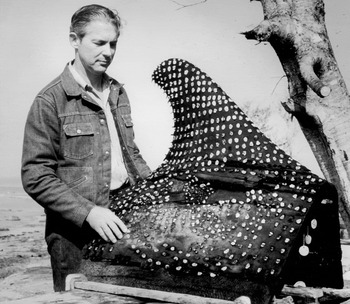
The waterlogged house deposits at the former Makah village of Ozette preserved a wealth of wooden artefacts that have been lost from other sites. One of the most dramatic discoveries during the Ozette excavations was a large carving described as an ‘effigy of a whale fin’ by the excavators (Daugherty & Friedman Reference Daugherty, Friedman and Carlson1983, 184–5). It encompasses the dorsal fin and the adjacent area of the animal's back and side, similar to the ‘whale saddle’ described above (Fig. 6). However, the prominent curving fin does not look like that of any of the whales regularly hunted by the Makah. The Ozette effigy most closely resembles the dorsal fin of an orca, particularly the comparatively lower and more curved fin of a female of that species (Ford Reference Ford2014, 287; Naughton Reference Naughton2012, 654). This remarkable object, formed from several pieces of western red cedar, was inlaid with approximately 700 sea otter teeth, forming decorative rows across the fin and the outline shape of a thunderbird on the body below (Daugherty & Friedman Reference Daugherty, Friedman and Carlson1983, 184; Kirk Reference Kirk2015, 31). A piece of a second dorsal fin effigy, decorated with snail opercula rather than sea otter teeth, was also recovered (Kirk Reference Kirk2015, 31).
Richard Daugherty, director of the Ozette Archaeological Project, poses at Ozette in 1970 with a carved wooden effigy of a whale dorsal fin. The object is inlaid with approximately 700 sea-otter teeth, some of which are arranged to form outline images of the thunderbird and serpent. Thunderbird's upturned head appears roughly in the middle of the object and vertical lines denote the feathers from his outstretched wings. (Courtesy of Makah Cultural and Research Center, Neah Bay.)

Many of the domestic utensils excavated at Ozette were adorned with images of whales and thunderbirds (Daugherty & Friedman Reference Daugherty, Friedman and Carlson1983). Numerous pieces of whaling gear were also recovered. The dorsal fin effigies suggest ritual associations with whaling, perhaps in the context of a whaling chief's residence. None of the available accounts from the Ozette project, however, identify the high dorsal fin as orca, or hint at the symbolism that may have been involved. Nor are there any ethnographic descriptions that document the use of such objects. It is interpreted here as an orca effigy, associating this powerful non-human whaler with the chiefly occupant of the house, rather than being for display after a successful hunt like a whale saddle. The depiction of a thunderbird on its surface enhances this object, bringing together these two powerful non-human whalers.
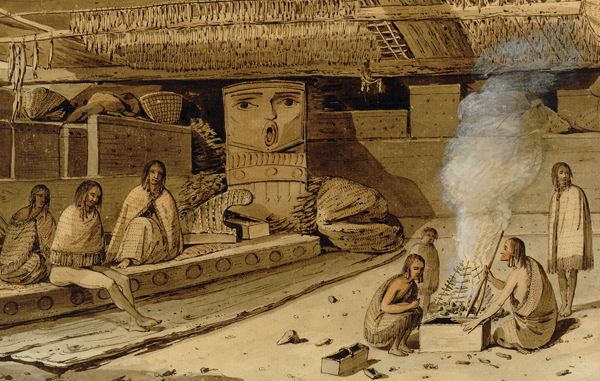
No similar ritual effigies have been found in other archaeological contexts. The only clear parallel is from a historic drawing by John Webber, the artist who accompanied Captain James Cook's third voyage of discovery, which reached the Northwest Coast in 1778. Cook and Webber were guests of Chief Maquinna at his major village of Yuquot in Nootka Sound. Webber's rendering of the inside of this impressive large house, filled with the implements of everyday use, contains important details documenting Nuu-chah-nulth life at this early point of cultural contact. On one side of the house, resting on a wide bench on which several people are sitting, is a large carved effigy very similar to the Ozette example (Fig. 7). Again, the high curved dorsal fin strongly suggests that the image represents an orca. Like the Ozette effigy, it appears to be made from several pieces of wood and is adorned with some form of decorative inlay. Webber has shown the inlay as forming vertical lines, but that may not adequately capture the Nuu-chah-nulth decorative pattern.
Detail of watercolour by John Webber, artist on the Cook expedition, showing the inside of Chief Maquinna's house at Nootka Sound in 1778. Note the carved dorsal fin effigy on the bench beside the people at left. (Gift of the Estate of Belle J. Bushnell, Courtesy of the Peabody Museum of Archaeology and Ethnology, Harvard University, PM#41-72-10/499.)
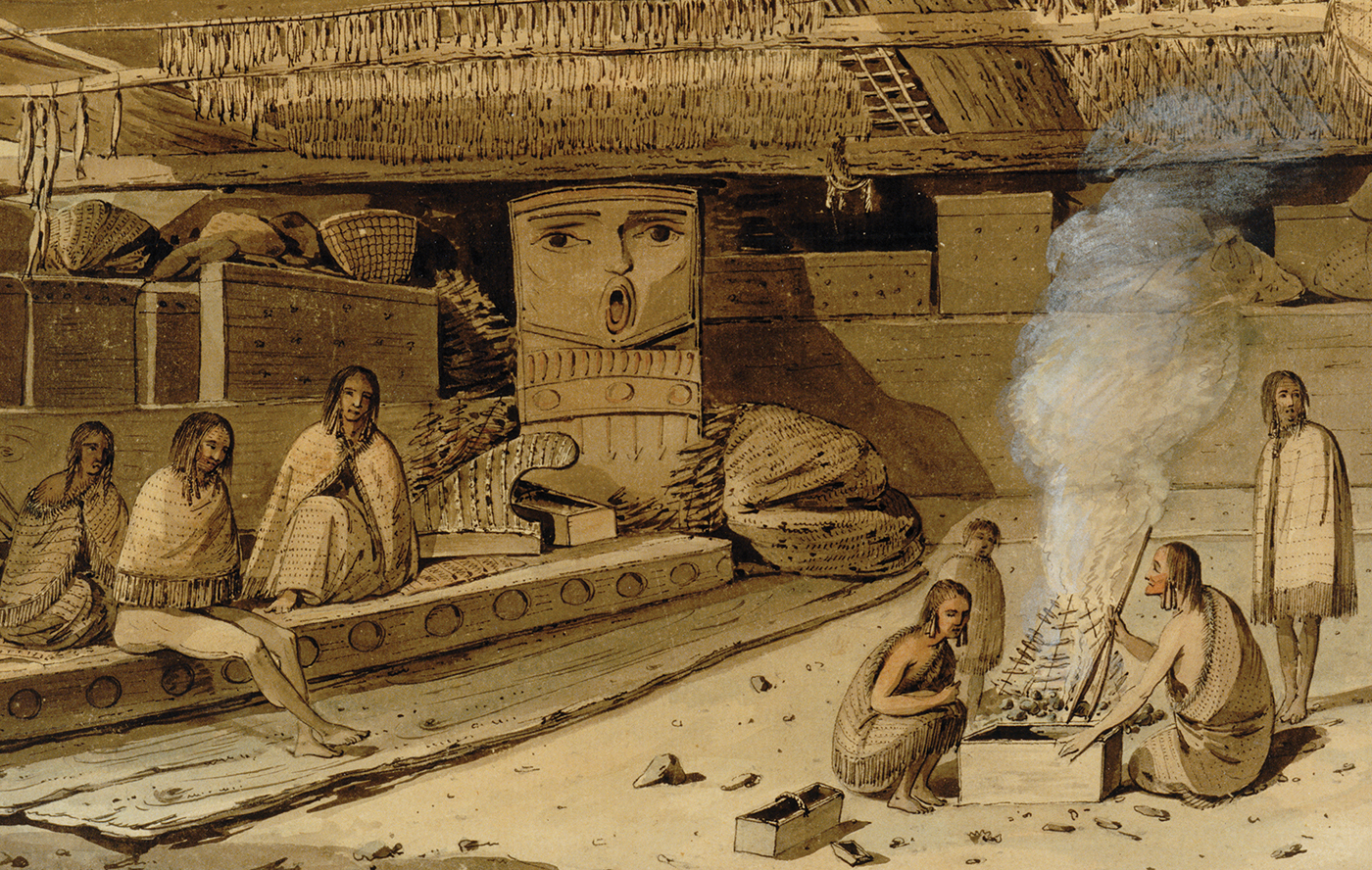
These two orca effigies are reasonably similar in age. The mudslide that crushed the Ozette houses, sealing in and preserving their wooden contents, is thought to have occurred not long before contact with Europeans along the west coast, possibly early in the eighteenth century.Footnote 5 Webber's late eighteenth-century drawing, therefore, would be only decades later. Both effigies likely came from the high-status houses of whaling chiefs (as is known from historic records for Chief Maquinna at Yuquot and inferred from archaeological evidence at Ozette). These effigies are unlikely to represent the whaler's prey, but instead symbolize the orca as a non-human whaler, associated with the house's whaling chief. These large effigies would have been placed in prominent view within the house, displaying chiefly whaling power and status.
The Clo-oose and Ozette petroglyphs
Pictographs and petroglyphs (collectively ‘rock art’) occur in various locations along the west coast of Vancouver Island and the adjacent Makah portion of the Olympic Peninsula. They range from single depictions on prominent rock surfaces to large clusters of images extending over some distance. When their locations are plotted, several distributional patterns are clearly evident (McMillan Reference McMillan1999, 163–4; 2000, 246). Pictographs are found only to the north, in Nuu-chah-nulth territory, and are generally along the protected inlets. They consist of single images or small groupings rendered in red ochre. Petroglyphs, on the other hand, generally occur in exposed outer coast locations. Most are found to the southwest of Barkley Sound, in Ditidaht and Makah territories, where they are the only rock-art type. Significant petroglyph sites, with multiple images, are located near the former major villages of Clo-oose and Ozette, in Ditidaht and Makah territories, respectively (Fig. 1). This section examines imagery at these sites that appears to reflect whaling themes.
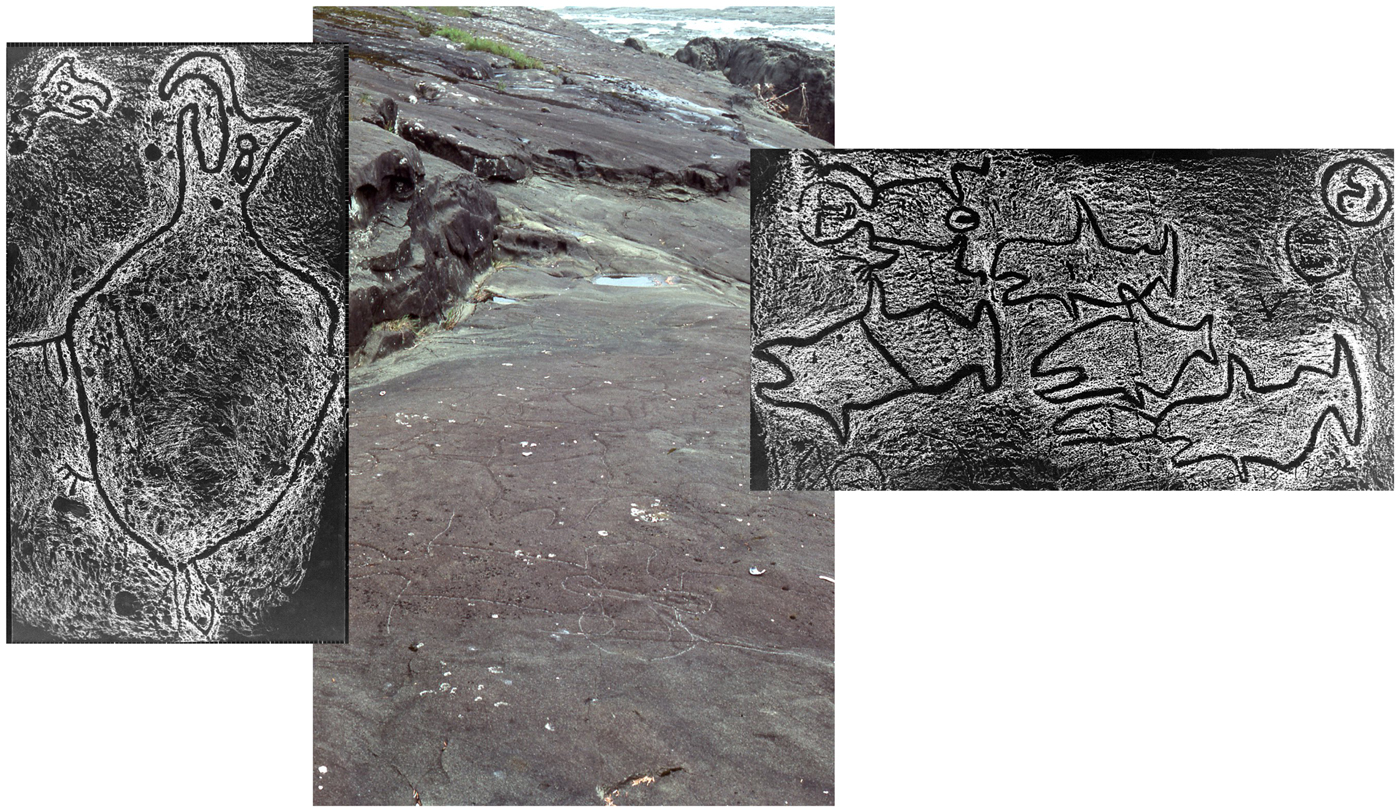
Along the beach to the west of Clo-oose are two large petroglyph locations with multiple images carved into the sloping sandstone shelf above the highest tide line (Fig. 8). The two locations, known as the Clo-oose Blowhole and Clo-oose Hill sites, are about 100 metres apart (Hill & Hill Reference Hill and Hill1974, 71). Together, they contain a minimum of 58 depictions (Haggarty & Inglis Reference Haggarty and Inglis1985, 262). The images to the south of Ozette, on the other hand, are pecked and abraded onto boulders that extend for some distance along the beach. Ellison (Reference Ellison1977) enumerated 43 distinct petroglyph locations. Collectively known as the ‘Wedding Rocks’ petroglyph site, these boulders provided prominent, often vertical, surfaces that would have made the images highly visible to all who passed along the beach.Footnote 6
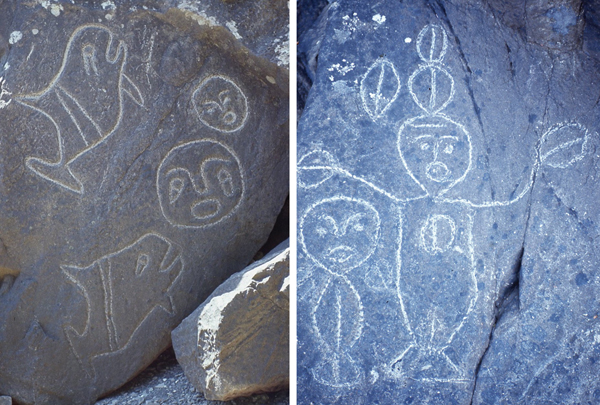
Clo-oose (Hill site) petroglyphs. Images can be seen carved into the sloping sandstone shelf. On the left is a large thunderbird while on the right five orcas swim as a group, with a female anthropomorph and faces. (General photograph: Author; left and right photographs are of rubbings made by Beth Hill, courtesy Royal British Columbia Museum, Victoria.)
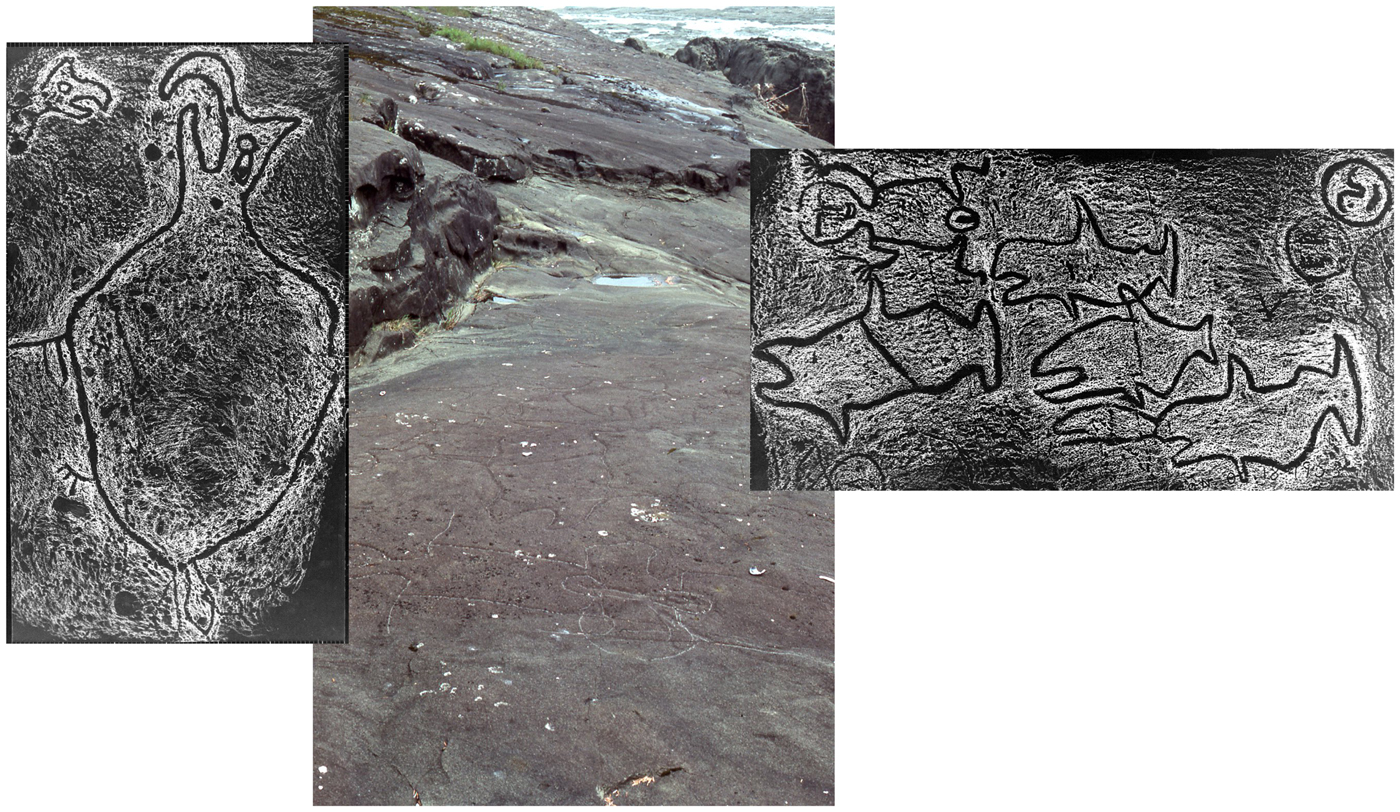
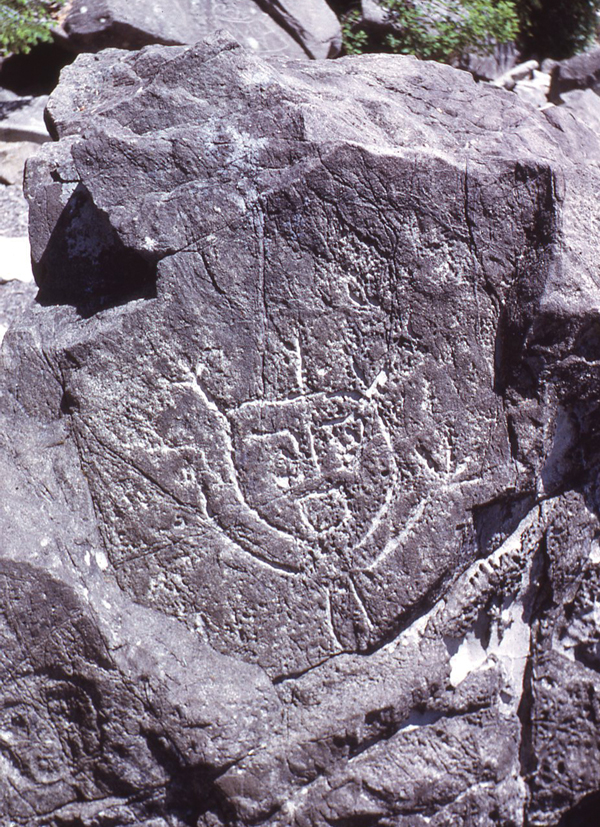
Whaling imagery clearly was a dominant theme at these locations. Both Clo-oose sites feature thunderbirds, the supernatural whalers, that are easily recognizable by their plump bodies, large downturned beaks and a crest or projection on the head. A particularly large thunderbird at Clo-oose Hill has an exaggerated recurved beak (Fig. 8, left; Hill & Hill Reference Hill and Hill1974, 80). Cetaceans appear at all three sites. A whale on a boulder at Wedding Rocks, possibly a humpback due to the presence of a small dorsal fin, is depicted as pregnant, based on the presence of a small, presumably foetal, whale inside the body outline. Orcas, easily identifiable by their high dorsal fins, are also present. At Clo-oose Hill, five orcas, including an apparent juvenile, are swimming together in the same direction, possibly representing a travelling or hunting family group (Fig. 8, right). At Wedding Rocks, two orcas appear to be leaping, the paired diagonal lines across their bodies possibly depicting the orcas’ white patches against their black bodies (Fig. 9, left).
The ‘Wedding Rocks’ site along the beach south of Ozette has numerous images carved into prominent beach boulders: (left) two orcas, along with human faces; (right) two anthropomorphs show vulvic imagery. (Photographs: Author.)
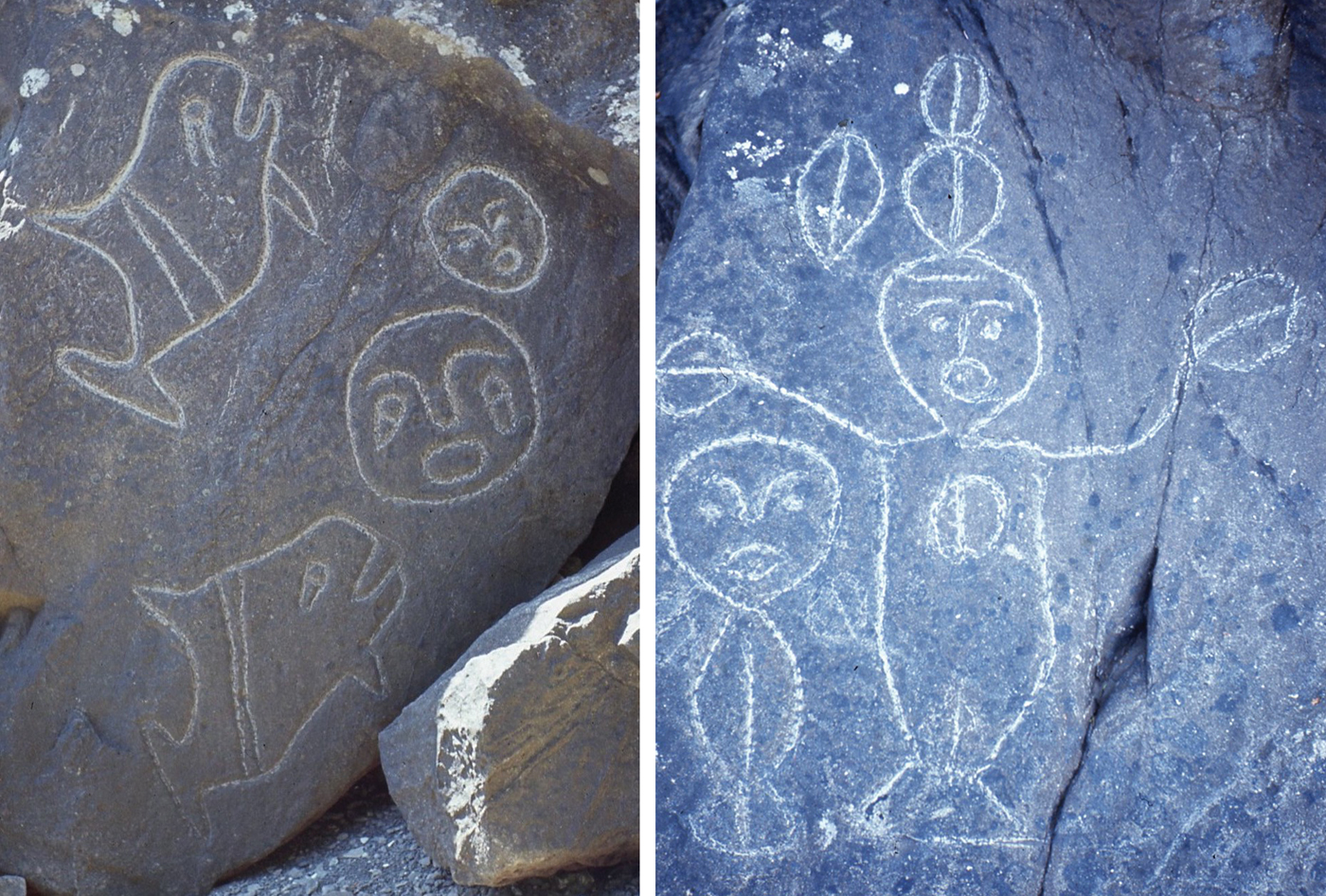
Human figures, often clearly indicated as female, are common. The five swimming orcas at Clo-oose are in apparent association with such a figure, along with two human faces (Fig. 8, right). A bisected oval, interpreted as a vulvaform, is common among the images at Wedding Rocks, either associated with human figures (Fig. 9, right) or in isolation. The clear intent of the ancient artist to have the viewer recognize most human figures as female requires explanation, which may be derived from the rich ethnographic record for this area.
These female images may be interpreted in light of the vital role the chief's wife played in whaling. Some wives participated in all aspects of the ritual preparation, accompanying their husbands in ritual bathing, scrubbing their bodies and diving and blowing in imitation of the whale (Sapir et al. Reference Sapir, Swadesh, Thomas, Thomas, Williams, Arima, Klokeid and Robinson2004, 35–7, 139). In other parts of the ritual, the wife represented the whale. While the whaler was out hunting, she had to remain motionless on her bed, so the whale would be similarly placid and easy to approach (Curtis Reference Curtis1916, 35; Drucker Reference Drucker1951, 177; Reference Drucker1965, 138; Gunther Reference Gunther1942, 67–8). This association of the whaler's wife with the whale is also evident in the names used for the whale during the hunt. Normal terms were taboo; instead the whaling crew talked of the ‘Queen’ or ‘Noble Lady’, referring to the chief's wife (Drucker Reference Drucker1951, 178; Reference Drucker1965, 135). The unusual image of a copulating couple on the rock at the Clo-oose Hill site (Hill & Hill Reference Hill and Hill1974, 79) can also be interpreted in this light. Although sexual abstinence was normally required of a whaling crew prior to the hunt, in some cases whalers and their wives engaged in ritual sexual intercourse as part of their preparation (Drucker Reference Drucker1951, 168; Sapir et al. Reference Sapir, Swadesh, Thomas, Thomas, Williams, Arima, Klokeid and Robinson2007, 37).
The five swimming cetaceans in association with the human figure (Fig. 8, right) are best interpreted through a framework of whaling imagery. The swimming creatures are not whales but orcas, and they were not the targets of human hunters, but were predators themselves, as non-human whalers. The human figure on this panel, shown as female to indicate the whaler's wife, is metaphorically the whale. This interpretation reverses previous ideas of predator and prey at these sites and allows us to see the orca in its active role as whaler.
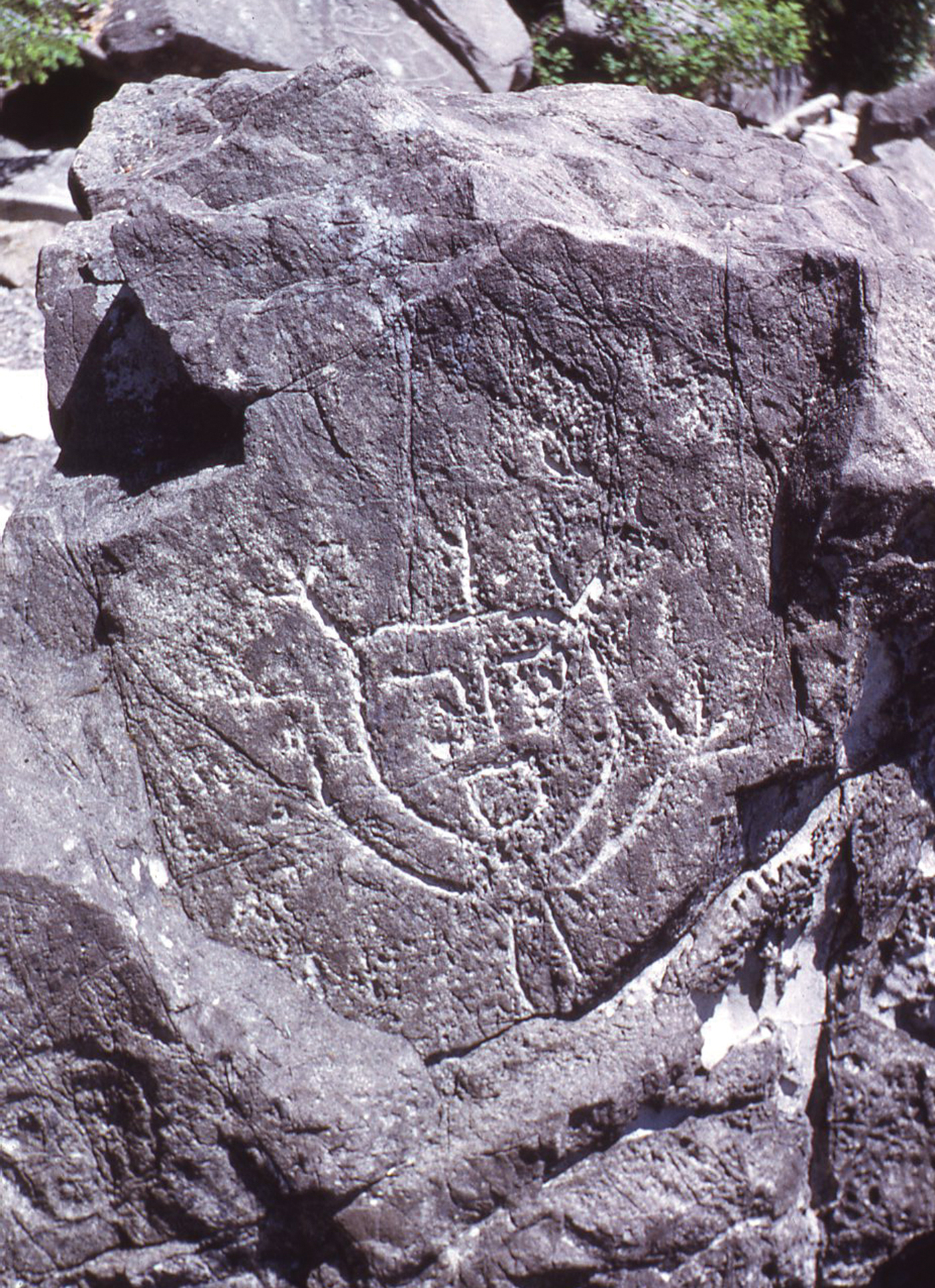
The role of the chief's wife in ritual bathing may be depicted in another image on the boulders at Wedding Rocks. An anthropomorph with outstretched arms and fingers has three branching projections from the head, presumably denoting a headdress (Fig. 10). The identification of this image as female comes from the vulvic depiction on the rudimentary body. Ellison (Reference Ellison1977, 70) associated this image with whaling rituals through comparison with an early photograph by Edward Curtis (Reference Curtis1916) titled ‘The Whaler's Wife’. In Curtis’ portrait, the woman is wearing a headdress with three branching projections, resembling what is shown in the petroglyph. Curtis’ (Reference Curtis1916, 20) description of the headdress worn during ritual bathing specifies hemlock boughs tied with spruce root, whereas Drucker (Reference Drucker1951, 101) describes it as ‘a shredded-cedar-bark head band [with] twigs of hemlock’. Cut feathers are also visible in Curtis’ photograph. Although other explanations are possible for this petroglyph, the strong emphasis on whaling imagery at these sites and the other occurrences interpreted as indicating the role of the chief's wife in whaling rituals add strength to this view.
This boulder petroglyph at Wedding Rocks appears to show a female wearing a headdress similar to those worn by whalers and their wives during ritual bathing in preparation for the hunt. (Photograph: Author.)
These rock carvings cannot be directly dated and no assumption can be made that they were all created around the same time. However, the images are laid out fairly evenly across the available space on the rock surfaces, with no obvious overlapping or crowding for late additions, suggesting that no great time period elapsed during their creation. A number of images are clearly historic, as indicated by their subject matter. Particularly noteworthy are three sailing ships (a fourth is possibly a more recent addition), apparently square-sail schooners (Haggarty & Inglis Reference Haggarty and Inglis1985, 266-–7; Hill & Hill Reference Hill and Hill1974, 72–3), at the Clo-oose Blowhole site, with a very similar example at Wedding Rocks (Hill & Hill Reference Hill and Hill1974, 68). In addition, the detailed rendering of a steamship, with a prominent circular paddlewheel and clouds of smoke trailing from a tall smokestack, is among the images at Clo-oose Blowhole. This depiction is almost certainly of the Beaver, a Hudson's Bay Company trading ship that arrived on this coast in 1836 (Hill & Hill Reference Hill and Hill1974, 77). Although this may have been one of the more recent additions at the site, it shows that the tradition of carving into the rock surface continued into the early nineteenth century and many of the images visible today may not be a great deal older.
Discussion
Northern peoples generally regarded the pursuit of large game as a sacred act, one that involved both the hunter and his wife. Because the women attract the animals through their behaviour, they take on a role seen as equally important to that of the male hunter.Footnote 7 The whaling peoples of northwestern North America and adjacent Siberia offer interesting examples. As Bodenhorn (Reference Bodenhorn1990, 61) notes for the Iñupiat, ‘the whale comes to the whaling captain's wife’. When the whalers were out on the sea, their wives remained in the house, moving slowly and thinking peaceful thoughts (Bodenhorn Reference Bodenhorn1990, 63). Similarly, among the Koniag of southwest Alaska, the wife must lie quietly in bed until the whaler's return (Lantis Reference Lantis1938, 459). Like the Nuu-chah-nulth whaling chief's wife, these women were symbolically linked with the whale and could influence the outcome of the hunt by their behaviour.
The orca, that iconic predator of the northern seas, also features in the oral traditions of northern whalers. The Yup'ik of Nelson Island, whose economy relied heavily on beluga and bowhead whales, had stories of the killer whales that pursued the same species. Orcas would be generous with those who witnessed their hunts, sharing their kill by allowing pieces of blubber to float on the water (Fienup-Riordan Reference Fienup-Riordan2011, 73–5). In one story, when the orcas attacked a bowhead whale the Yup'ik observers dropped beads from their necklaces and other small items into the water in hopes of receiving some blubber. After the bowhead was killed, a young man appeared beside it holding a bead that had been dropped. He was one of the killer whale people, who then left the bowhead carcass behind as a gift for the Yup'ik (Fienup-Riordan Reference Fienup-Riordan2011, 77–9). Such reciprocal relations had to be maintained and could be endangered by human carelessness. When a young orca was accidentally drowned in a Yup'ik net, the killer whales took the life of a human child to restore reciprocity (Fienup-Riordan Reference Fienup-Riordan2011, 77; Hill Reference Hill2013, 126). Similar to Nuu-chah-nulth beliefs, the Bering Sea whalers considered the orca and wolf to be the same animal, capable of transformation between its land and sea manifestations (Fienup-Riordan Reference Fienup-Riordan1994, 74; Nelson Reference Nelson1899, 444).
Non-whaling Northwest Coast societies held similar beliefs regarding orcas. These animals were generally not hunted, due to their supernatural associations (Curtis Reference Curtis1915, 37; Emmons Reference Emmons and de Laguna1991, 122; Swanton Reference Swanton1905, 17). Instead, their assistance in the food quest was sought. At the northern end of the culture area, the Tlingit would beseech the killer whales to drive the seals toward them (Emmons Reference Emmons and de Laguna1991, 122). The Haida viewed the killer whales as the ‘most powerful of the Ocean-People’, living in numerous towns beneath the water (Swanton Reference Swanton1905, 17). Small offerings were made to the killer whales by placing them on a paddle and sliding them into the sea, while requesting food. According to Swanton (Reference Swanton1905, 18): ‘The return expected was generally a black whale, which would be found floating dead at that place soon after.’ The Kwakwaka'wakw, the northern neighbours of the Nuu-chah-nulth, also placed small offerings in the water while requesting the killer whales to provide food such as seals (Boas Reference Boas1930, 188). In addition to these economic exchanges, the Kwakwaka'wakw believed that killer whales could provide humans with supernatural powers, particularly related to healing. As in Nuu-chah-nulth belief, orcas and wolves were the land and sea variants of the same animal and both could bestow curing powers (Curtis Reference Curtis1915, 91). Among groups to the north of the Nuu-chah-nulth, the killer whale was commonly adopted as a crest to denote specific social units. The Nuu-chah-nulth relationship with orcas, it is argued here, differs in that it was primarily to support chiefly rights and prestige related to whaling.
Conclusion
The Indigenous peoples of northwestern North America share similar beliefs about the fluid boundaries between animals and humans, and that the animals will offer themselves to the hunters if sufficient respect has been shown. The hunters’ wives play essential roles in rituals involving the animals, particularly in whaling societies where wives may be linked symbolically with the whale. Similar beliefs regarding orcas were also shared by coastal peoples from Bering Strait south. Even groups that did not practise active whaling, such as along most of the Northwest Coast, regarded the orca as a provider of food such as whales and seals.
None of the Nuu-chah-nulth archaeological examples of whaling symbolism featuring orcas discussed in this paper are of great age. The orca fin effigies from Ozette and Yuquot can be confidently placed in the eighteenth century. Sailing ships and other early historic depictions among the images on the rocks near Clo-oose and Ozette suggest that these are of similar or slightly later age. This late date increases the confidence of interpretations based on the rich ethnographic documentation and the recorded oral traditions. Sapir's voluminous collection of texts, presenting the direct words of knowledgeable Nuu-chah-nulth people, was recorded in the second and third decades of the twentieth century. Curtis’ ethnographic work, particularly focusing on ceremonialism and mythology, took place around the same time as Sapir began his work. Drucker's major ethnographic overview was based on fieldwork conducted only a decade after Sapir. These rich sources of information have been employed in the analyses of recent archaeological work, particularly in Barkley Sound, integrating several data sets for greater confidence in archaeological interpretations and for incorporating Indigenous knowledge, concepts and perceptions (McMillan Reference McMillan, Keelyside and Pilon2009; McMillan & St. Claire Reference McMillan and St. Claire2005).
Ames (Reference Ames and Whelchel2005) has advanced the idea of Ozette as ethnoarchaeology. The wealth of preserved material remains and contextual data, pre-dating contact with Europeans by only a few decades, provides a crucial link between the archaeological and ethnographic records. Interpretations can flow in both directions. Insights into the way of life of the people who occupied the excavated Ozette houses can be derived from the ethnographic descriptions of Makah (and, less directly, Nuu-chah-nulth) culture. Similarly, ethnographic accounts of Nuu-chah-nulth whaling rituals allow us to recognize references to the chief's wife (and her symbolic association with the whale) in the rock art. Ozette also provides an opportunity to work in reverse, using the detailed archaeological information to test the accuracy and completeness of the ethnographic observations. The tumultuous early years of contact, particularly with the introduction of catastrophic epidemic diseases and consequent population loss, meant that some practices that may be archaeologically discernible did not survive long enough to be recorded by outside observers and are no longer held in the cultural memory of the communities. The practice of prominently displaying carved wooden orca fin effigies within chiefs’ houses as indicators of their whaling rights may have had such a fate.
As discussed in this paper, thunderbirds were supernatural whalers associated with human whaling chiefs. Their images, often with lightning serpents and/or whales, featured prominently on house fronts, dance screens, drums and ceremonial regalia. Chiefly names and ceremonial prerogatives were often drawn from associations with these supernatural whalers. Nuu-chah-nulth, Ditidaht and Makah observations of orca behaviour very likely led them to consider the orca as another non-human whaler from which chiefly prerogatives could be derived. Just as images of the thunderbird were prominently displayed in chiefly houses, orca fin effigies could be public reminders of the chief's whaling prowess and supernatural associations. Along with prominent display in the houses, images of thunderbirds and orcas were carved in highly visible locations on the rocks adjacent to at least two major villages. Certain chiefs owned rights to orca performances in the winter dances. In this regard, however, orca is overshadowed by wolf, which is ubiquitous in art and ceremony among these people. Recognition that the wolf and orca are the land and sea variants of the same being allows us to interpret the frequent appearance of wolf with thunderbird, lightning serpent and whale as part of the whaling imagery that was so prominent in the art of these whaling people.
Acknowledgements
The Makah Cultural and Research Center reviewed an earlier draft of this paper and approved use of the photo of the Ozette dorsal fin effigy. The Tseshaht, Toquaht and Huu-ay-aht First Nations supported various phases of the Barkley Sound archaeological research that has shaped my thinking on Nuu-chah-nulth whaling. The Tseshaht also approved use of the wolf comb photograph. Denis St. Claire, co-director of the Barkley Sound projects, shared numerous discussions with me over the years concerning Nuu-chah-nulth archaeology and ethnography.