Introduction
Kraepelin's differentiation of the psychoses into schizophrenia (SCZ) and ‘manic-depressive insanity’ (bipolar disorder, BD) as two distinct neuropsychiatric disorders has been a fundamental nosological distinction for over a century (Kraepelin, Reference Kraepelin1919). However, there is evidence identifying common and also distinctive neurobiological features between the two disorders (Lewandowski et al. Reference Lewandowski, Cohen and Öngur2011). For example, there is now some evidence of shared genetic liability between SCZ and BD (Craddock et al. Reference Craddock, O'Donovan and Owen2006). Regarding pathophysiological similarities and differences, Kraepelin emphasized early cognitive dysfunction in SCZ (i.e. ‘dementia praecox’), also noted by Bleuler (Reference Bleuler1950), whereas these claims were not made about BD. This distinction was highlighted by Murray et al. (Reference Murray, Sham, van Os, Zanelli, Cannon and McDonald2004), who hypothesized that ‘on a background of shared genetic predisposition to psychosis, schizophrenia, but not bipolar disorder, is subject to additional genes or early insults, which impair neurodevelopment’ (p. 405). Studies directly comparing SCZ and BD with psychotic features (bipolar psychoses, BP) provide a strong test of Kraepelin's model because the disorders share psychotic symptoms. The fact that neuropsychological deficits are more severe in individuals with BP compared to BD without psychosis (Glahn et al. Reference Glahn, Bearden, Barguil, Barrett, Reichenberg, Bowden, Soares and Velligan2007; Bora et al. Reference Bora, Yücel and Pantelis2010a) supports the idea that contrasting BP with SCZ provides an informative test of specificity and severity.
There is overwhelming evidence of neuropsychological impairment in SCZ, from the first episode of psychosis onward (Heinrichs & Zakzanis, Reference Heinrichs and Zakzanis1998; Mesholam-Gately et al. Reference Mesholam-Gately, Giuliano, Faraone, Goff and Seidman2009). The evidence for neuropsychological impairment in BD, especially BP, is growing (Bearden et al. Reference Bearden, Hoffman and Cannon2001; Bora et al. Reference Bora, Yücel and Pantelis2010b), but this literature is substantially less comprehensive (Lewandowski et al. Reference Lewandowski, Cohen and Öngur2011). There is also evidence that persons with SCZ have more severe neuropsychological impairment than individuals with BP (Seidman et al. Reference Seidman, Kremen, Koren, Faraone, Goldstein and Tsuang2002; Bora et al. Reference Bora, Yücel and Pantelis2010c; Lewandowski et al. Reference Lewandowski, Cohen and Öngur2011). Characterizing neuropsychological impairments prior to the onset of psychosis could shed light on which specific cognitive functions are shared or distinct apart from the confounds introduced after the disorders manifest, particularly the effects of medications.
Retrospective and prospective studies of individuals with SCZ indicate that pre-morbid neurocognitive deficits can be demonstrated in childhood. This was definitively shown by a meta-analysis of 18 English language studies of pre-morbid IQ demonstrating a consistent IQ decrement of approximately 0.50 standard deviation (s.d.) in children and adolescents who later develop SCZ (Woodberry et al. Reference Woodberry, Giuliano and Seidman2008). IQ (Cannon et al. Reference Cannon, Bearden, Hollister, Rosso, Sanchez and Hadley2000; Seidman et al. Reference Seidman, Buka, Goldstein and Tsuang2006; Woodberry et al. Reference Woodberry, Giuliano and Seidman2008), reasoning (Niendam et al. Reference Niendam, Bearden, Rosso, Sanchez, Hadley, Nuechterlein and Cannon2003; Reichenberg et al. Reference Reichenberg, Caspi, Harrington, Houts, Keefe, Murray, Poulton and Moffitt2010), attention (Cornblatt et al. Reference Cornblatt, Obuchowski, Roberts, Pollack and Erlenmeyer-Kimling1999; Niendam et al. Reference Niendam, Bearden, Rosso, Sanchez, Hadley, Nuechterlein and Cannon2003) and language (Cannon et al. Reference Cannon, Caspi, Moffitt, Harrington, Taylor, Murray and Poulton2002; Niendam et al. Reference Niendam, Bearden, Rosso, Sanchez, Hadley, Nuechterlein and Cannon2003) deficits have been reported as early as age 4 in children who later develop SCZ.
There are fewer studies comparing youth who later go on to develop BD and even fewer examining pre-morbid neurocognition in BP. A prospective investigation using the Wisconsin Card Sorting Test in adolescence found significantly more participants who later developed BD had impairments than those who developed unipolar depression or no mood disorder (Meyer et al. Reference Meyer, Carlson, Wiggs, Martinez, Ronsaville, Klimes-Dougan, Gold and Radke-Yarrow2004). Four conscript studies directly compared pre-morbid intellectual functioning in affective psychosis (AP) or BD versus SCZ (Reichenberg et al. Reference Reichenberg, Weiser, Rabinowitz, Caspi, Schmeidler, Mark, Kaplan and Davidson2002; Zammit et al. Reference Zammit, Allebeck, David, Dalman, Hemmingsson, Lundberg and Lewis2004; Tiihonen et al. Reference Tiihonen, Haukka, Henriksson, Cannon, Kieseppa, Laaksonen, Sinivuo and Lonnqvist2005; Urfer-Parnas et al. Reference Urfer-Parnas, Mortensen, Saebye and Parnas2010), but none specifically distinguished a BP group from BD or from a mixed group of APs. Moreover, conscript studies that recruit adolescents at ages 16–25 probably include some participants with attenuated psychotic (‘prodromal’) symptoms that manifest qualitatively different and more severe neuropsychological impairments than observed pre-morbidly in early childhood (Seidman et al. Reference Seidman, Giuliano, Meyer, Addington, Cadenhead, Cannon, McGlashan, Perkins, Tsuang, Walker, Woods, Bearden, Christensen, Hawkins, Heaton, Keefe, Heinssen and Cornblatt2010).
In general, participants who developed major affective disorders or APs did not differ on neurocognition from unaffected comparisons. An exception was in a Finnish cohort study in which male conscripts had pre-morbid visuospatial deficits that were associated with later development of both BD and SCZ (Tiihonen et al. Reference Tiihonen, Haukka, Henriksson, Cannon, Kieseppa, Laaksonen, Sinivuo and Lonnqvist2005). Because the four conscript studies either excluded individuals with BP or did not distinguish between BP and BD, the association between childhood cognitive impairments and adult BP remains largely unexplored.
It is of interest that none of these studies examined the effect of family history (FH) on neurocognition. This is a key gap because FH is the strongest known susceptibility factor for SCZ and APs. Moreover, there is a large body of literature indicating a significant association between FH of SCZ and neurocognitive impairments in IQ, attention and memory (Johnstone et al. Reference Johnstone, Ebmeier, Owens and Lawrie2005; Keshavan et al. Reference Keshavan, Kulkarni, Bhojraj, Francis, Diwadkar, Montrose, Seidman and Sweeney2010; Agnew-Blais & Seidman, Reference Agnew-Blais and Seidmanin press), brain structure (Boos et al. Reference Boos, Aleman, Cahn, Hulshoff Pol and Kahn2007) and brain function (MacDonald et al. Reference MacDonald, Thermenos, Barch and Seidman2009) in children, adolescents and adults. IQ deficits (Goldstein et al. Reference Goldstein, Seidman, Buka, Horton, Donatelli, Rieder and Tsuang2000) were somewhat greater in children at high risk (HR) for SCZ than for APs, and attention impairments were worse in HR for SCZ than APs (Ott et al. Reference Ott, Spinelli, Rock, Roberts, Amminger and Erlenmeyer-Kimling1998), but neither directly studied BP. Moreover, the presence of FH augmented neuropsychological impairment in those who converted to psychosis among putatively prodromal adolescents (Seidman et al. Reference Seidman, Giuliano, Meyer, Addington, Cadenhead, Cannon, McGlashan, Perkins, Tsuang, Walker, Woods, Bearden, Christensen, Hawkins, Heaton, Keefe, Heinssen and Cornblatt2010). However, to our knowledge, no one has reported whether a FH of psychosis amplifies neuropsychological impairment in non-prodromal younger children assessed decades before they develop SCZ or BP. Finally, it is of potential clinical significance to identify children who are neuropsychologically impaired. If neuropsychological impairments contribute to childhood disability in school or to prediction of later psychosis, then the amelioration of such deficits may be an important early intervention strategy. Thus, use of deviant responder approaches may identify clinically meaningful subgroups of impaired individuals.
In this study, we assessed neuropsychological functioning of pre-teen children who later went on to develop psychosis, using a more extensive battery of neuropsychological tests than used in most prior studies. We also stratified the samples by presence or absence of FH of psychosis. We tested three hypotheses: (1) children who later develop psychoses have neuropsychological impairment compared to controls; (2) children who develop SCZ will show the most impaired neuropsychological functioning compared to children who develop BP and control children, both at the group level and in frequency of individuals identified as impaired; and (3) those with a positive FH of psychosis will be most impaired.
Method
The New England Family Study (NEFS) sample
Participants were selected from the Boston and Providence cohorts of the Collaborative Perinatal Project (CPP), currently known as the NEFS. The CPP was initiated over 50 years ago to investigate prospectively the prenatal and familial antecedents of pediatric, neurological and psychological disorders of childhood (Niswander & Gordon, Reference Niswander and Gordon1972). Details of the CPP and NEFS methodology are reported in previous publications (Myrianthopoulos & French, Reference Myrianthopoulos and French1968; Buka et al. Reference Buka, Goldstein, Seidman, Zornberg, Donatelli, Denny and Tsuang1999; Goldstein et al. Reference Goldstein, Seidman, Buka, Horton, Donatelli, Rieder and Tsuang2000, Reference Goldstein, Buka, Seidman and Tsuang2010; Seidman et al. Reference Seidman, Buka, Goldstein, Horton, Rieder, Donatelli and Tsuang2000, Reference Seidman, Buka, Goldstein and Tsuang2006). Approximately 55 000 pregnancies were followed, including about 17 000 in New England. Many types of assessments, including psychological examinations, were conducted up to 7 years of age when the study officially ended in 1973.
Ascertainment and assessment of the adult psychotic cases in NEFS
Cohort members with psychosis were identified through a systemic follow-up of the entire NEFS cohort of the CPP. NEFS parents and offspring with history of psychiatric hospitalization and/or possible psychotic and bipolar illness were identified from the following sources: (1) record linkages with public hospitals, mental health clinics, and the Massachusetts and Rhode Island Departments of Mental Health; (2) several follow-up and case-control studies nested within the larger NEFS cohort, involving direct interviews with approximately 20% of the cohort; and (3) reports from participants in these interview studies of a family member with a history of psychotic or bipolar symptoms or diagnosis. Adult offspring with major psychoses within NEFS cohorts were identified through a two-stage diagnostic assessment procedure from 1996 to 2007, approximately 30 years after and blind to prior assessments. In the first stage, 249 individuals with possible psychotic illness were identified through record linkages and from personal interviews. This included 109 subjects who reported psychotic symptoms identified through interviews (Robins et al. Reference Robins, Helzer and Cottler1989), and 140 subjects with a history of treatment for psychotic illnesses identified through record linkage.
In the second stage, those who consented to participate in follow-up efforts were interviewed using the SCID (First et al. Reference First, Spitzer, Gibbon and Williams1996). Based on interview data and medical record review, trained PhD- and MD-level diagnosticians then completed best-estimate consensus diagnoses according to DSM-IV criteria (APA, 1994) for lifetime prevalence of psychotic and other psychiatric disorders.
Diagnostic interviews were completed for 173 subjects; medical charts alone were available for the remaining 76 subjects. A total of 114 subjects were determined to have a non-organic psychotic disorder, and 99 of them had been tested at age 7. Nine out of 99 cases were determined to have psychosis from medical charts alone. Those tested are:
(1) Schizophrenia disorders (SD), n = 45 [schizophrenian = 41, schizo-affective, depressed type (SAD) n = 4].
(2) Other non-affective psychoses (NAP), n = 10 (delusional disorder n = 2, brief psychosis n = 1, NAP – type not specified n = 7).
(3) Affective psychoses (AP), n = 44 [schizo-affective bipolar type (SAB) n = 11, bipolar disorder with psychotic features (BP) n = 24, major depressive disorder with psychosis (MDD-P) n = 9].
Ascertainment and assessment of the controls
Controls were selected from families participating in the control arm of a NEFS family HR study in which the control population was a random stratified sample of parents selected from the entire NEFS cohort, with no known history of psychosis or other major Axis I disorders. Furthermore, parents and grandparents, in addition to the parents' siblings, had to be free of any known lifetime history of psychosis, bipolar, schizotypal, recurrent MDD, suicide attempts or psychiatric hospitalizations (described in Goldstein et al. Reference Goldstein, Buka, Seidman and Tsuang2010). Siblings of the controls also had to be free of any lifetime history of psychosis or BD.
Among the 132 control parents included in the NEFS HR study, there were 186 offspring potential controls for this study. Of these offspring, 145 (78%) were interviewed. Of the 145 prospective controls 37 were excluded (25.5%): 15 (9.5%) had a diagnosis of recurrent MDD, eight (4.8%) had personality disorders, 11 (6.8%) had psychosis or BD, one (0.7%) was a sibling of a case, and two (1.4%) had a history of psychosis in a relative. Of the 108 in the final control sample, 101 had been tested at age 7.
Measurement of FH of psychosis
FH of psychiatric disorders was determined from direct interviews of parents and siblings using the Diagnostic Interview Schedule (Robins et al. Reference Robins, Helzer and Cottler1989) and the Family Interview for Genetic Studies (FIGS; Maxwell, Reference Maxwell1996), and interviews of all available adult offspring using the SCID and the FIGS. FH was dichotomized as FH positive (FH + : presence of psychosis in first-degree relatives) and FH negative (FH − : no psychosis in first-degree relatives). Based on these criteria, there were 16 FH+ and 13 FH− individuals in the BP/SAB group and eight FH+ and 28 FH− individuals in the SD group. The remaining subjects did not have FIGS data.
Exclusion criteria
Exclusion criteria for all adult participants were a history of neurological disease, traumatic brain injury, medical illness or alcohol-related disease with documented cognitive sequelae, major sensory impairments (e.g. deafness), IQ <65 in adulthood or inability to understand the procedures, <8 years of formal education and severe substance abuse within the past 6 months. All psychotic cases were living in the community when assessed. Human subjects approval was granted by Institutional Review Boards at Harvard University, Brown University and local psychiatric facilities. Written consent was obtained from all participants interviewed, and subjects were compensated for their participation.
Relationship to prior reports
In a preliminary report (Seidman et al. Reference Seidman, Buka, Goldstein and Tsuang2006), 46% of individuals analyzed for this report (31 SCZ, 61 controls) were studied, focusing only on IQ measures.
Neuropsychological measures at age 7
Neurocognitive data were collected at 7 years of age (1966–1973). The assessment used a battery of 13 psychological tasks including seven subtests from the Wechsler Intelligence Scale for Children (WISC; Wechsler, Reference Wechsler1949), three Wide Range Achievement Test (WRAT) measures of reading, spelling and arithmetic, and three tests of auditory–vocal associations, visual–motor integration and tactile form recognition (Seidman et al. Reference Seidman, Buka, Goldstein, Horton, Rieder, Donatelli and Tsuang2000). The WISC subtests were the scaled scores for Vocabulary, Information, Comprehension, Digit Span, Digit Symbol Coding, Block Design, and Picture Arrangement. Details of the tests and the original principal components analysis (PCA) from data acquired on 11 889 children (Seidman et al. Reference Seidman, Buka, Goldstein, Horton, Rieder, Donatelli and Tsuang2000) are reported in the online Supplementary material, as is our approach to producing four factors for these analyses: ‘Academic Achievement Skills’, ‘Verbal-Conceptual Ability’, ‘Perceptual-Motor Abilities’ and ‘Attention-Working Memory’.
Demographics
An index of socio-economic status (SES), adapted from the Bureau of the Census, derived from the education and occupation of the head of household along with household income, was assigned to each pregnancy (Myrianthopoulos & French, Reference Myrianthopoulos and French1968), along with other demographic variables including child's age at interview, mother's age, mother's education, and ethnicity.
Data analysis
Neuropsychology
The measures of cognitive functioning comprised a full-scale IQ based on seven WISC subtests, four normalized factor scores derived from all 13 tests, and 10 individual scores from the tests of intelligence (n = 7) and achievement (n = 3) used in the profile analysis.
Group contrasts
Hypotheses were described at the end of the Introduction. To test hypothesis 1, we compared psychotic cases with controls on neuropsychological functioning. To test hypothesis 2 regarding specificity of neuropsychological impairment, we compared controls, SD and BP/SAB. BP and SAB groups were combined to increase power. To test hypothesis 3, neuropsychological functioning within psychosis groups stratified by FH were compared, as were stratified FH subgroups within diagnostic groups versus controls.
Statistical approach
Data analyses used mixed linear models in SAS (Reference Robins, Helzer and Cottler2008). Least-squares means and standard errors were adjusted for intra-familial correlation and potential confounders were examined: age at childhood testing, maternal age, SES, maternal education, ethnicity and gender. Covariates that were significantly associated with the outcome in univariate analyses were retained. Given the potential collinearity between SES and maternal education, maternal education was selected for the final model, as it explained a greater amount of variance. The final models controlled for maternal education and race. Subject gender was added to those models in which it was significant. For models that included FH of psychosis, models were adjusted for maternal age as it was found to be a significant predictor.
For profile analyses using the 10 WISC and WRAT subtests, parameters derived from regression equations based on the control sample were used to predict the neuropsychological test scores for all subjects in the study, conditional on maternal education and race. The residuals (predicted minus the observed scores) for the whole study sample were then standardized based on the control distribution for each test such that each had a mean of 0 and an s.d. of 1 in the control group. The average of each cognitive test score in cases, represented as the mean standardized residual, was measured as the number of s.d.s above or below the control mean. When comparing more than two groups (hypothesis 2), analyses of linear trend preceded pair-wise comparisons. For profiles, using generalized linear models, we assessed the magnitude of each group's mean (level) across cognitive domains (group effect). If this was significant, univariate tests followed and also flatness of the groups across domains (domain effect) and profile shape or parallelism of the groups between domains (domain by group interaction). We used p < 0.05 as our significance level for a priori overall tests (i.e. tests for linear trends, overall profile, SD <controls). For subsequent pair-wise comparisons after a significant overall test (i.e. BP/SAB v. SD or controls), we used p < 0.0167 (0.05/3) for significance.
For the deviant responder analyses for the 10 WISC and WRAT variables, we chose two cut-offs commonly used in neuropsychology: <1 s.d. or <the 10th percentile below the control mean. For identifying individuals as impaired, we chose the threshold of ⩾3 of 10 test scores (30%) as abnormal at the above thresholds. Data are presented on analyses below the 10th percentile because the <1 s.d. approach was too liberal, identifying more than 20% of controls as neuropsychologically impaired. Comparisons between case and control groups were made using χ2 tests. Fisher's exact test was used for those comparisons based on one or more cells with five or less subjects.
Results
Demographics
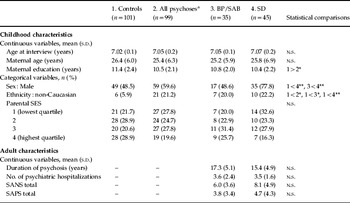
Cases with psychoses and controls were similar on age at testing, maternal age at birth of subject, SES and offspring sex (Table 1). Mothers of cases had fewer years of education and were more often of African-American ethnicity than mothers of controls. There was a higher percentage of males among those with SD than in BP/SAB or controls. As adults, SD and BP/SAB groups were comparable on duration of illness, number of hospitalizations and total positive symptoms, and differed marginally on total negative symptoms (Table 1, p's > 0.05).
Demographic data for cases of psychosis and controls: childhood and adult characteristics

BP/SAB, Bipolar psychosis/schizo-affective disorder, bipolar type; SD, schizophrenia disorders; SES, socio-economic status; SANS, Scale for the Assessment of Negative Symptoms; SAPS, Scale for the Assessment of Positive Symptoms; n.s., not significant; s.d., standard deviation.
* p < 0.05, ** p < 0.01, *** p < 0.001. p values from mixed models adjusted for intra-familial correlation. Variables were log transformed prior to analysis if there was significant skew in the distribution | > 0.8|; these variables were Age at Interview, Maternal Age, Number of psychiatric hospitalizations, and SAPS total.
a All psychoses includes major depressive disorder with psychotic features (MDD-P, n = 9), other psychoses (n = 10) and groups 3 and 4 for total n = 99.
Maternal age, SES and maternal education calculated at study entry.
Sample sizes for adult clinical data on BP/SAB and SD subjects based on available data: duration of psychosis (BP/SAB, n = 17; SD, n = 26); number of hospitalizations (BP/SAB, n = 32; SD, n = 34); SANS total (BP/SAB, n = 24; SD, n = 25); SAPS total (BP/SAB, n = 24; SD, n = 26).
Neuropsychological data
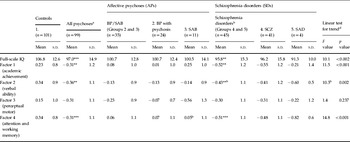
The age 7 IQ scores were significantly lower for children who developed psychoses compared to controls (9.8 points), as were scores on academic achievement, verbal ability and attention/working memory factors (all p < 0.01, Table 2 and Fig. 1). Although cases scored lower than controls on the perceptual-motor factor, the difference was not significant.
Full-scale IQ and standardized measures of neuropsychological functioning at age 7 in adults who developed psychosis including persons with schizophrenia disorders (SD, n = 45), bipolar psychosis and schizo-affective, bipolar type combined (BP/SAB, n = 35) and controls (n = 101): * p < 0.05, ** p < 0.01, *** p < 0.001 compared to controls (least square means). WISC, Wechsler Intelligence Scale for Children; WRAT, Wide Range Achievement Test; ITPA, Illinois Test of Psycholinguistic Abilities.

Prospective age 7 childhood data from adult cases and controls: full-scale IQ and four neuropsychological factor scores

BP/SAB, Bipolar psychosis/schizo-affective disorder, bipolar type; SCZ, schizophrenia; SAD, schizo-affective, depressed type; s.d., standard deviation.
Mixed model adjusted for maternal education, race, and intra-familial correlation. Pair-wise comparisons were performed comparing each diagnostic subgroup (all psychoses, BP/SAB, schizophrenia disorders) to column 1 (controls). Subgroups presented for descriptive purposes.
a All psychoses includes major depressive disorder with psychotic features (MDD-P, n = 9), other psychoses (n = 10) and groups 2, 3, 4 and 5.
b Tests of significance additionally adjusted for child's sex.
c There were no significant pair-wise differences between BP/SAB and schizophrenia disorders groups.
d Linear tests for trend compare controls (n = 101), BP/SAB (n = 35) and schizophrenia disorders (n = 45).
* p < 0.05, ** p < 0.01, *** p < 0.001.
Analyses of a priori predictions of linear trend showed that the SD group was lowest and the BP/SAB group was intermediate. The SD group was significantly lower than controls on IQ, academic achievement, verbal ability and attention/working memory (p < 0.01). None of the comparisons between psychosis subgroups were significant (Table 2 and Fig. 1).
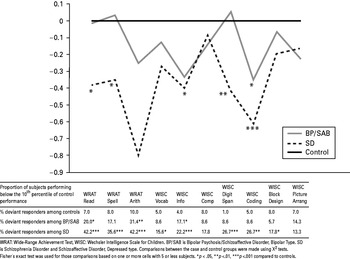
The overall profile of the IQ and achievement test scores (Fig. 2) for the SD group was significantly lower than for those in the control group (overall protected F = 5.38, p = 0.005). Furthermore, the profiles of the BP/SAB and SD groups were not ‘flat’, suggesting significant variation in performance across cognitive domains (F = 2.33, p = 0.017). However, the results did not indicate an interaction between cognitive subtest and diagnostic group (F = 1.22, p = 0.242).
Profile analysis of mean performance and rates of abnormal performance on individual tests (<10th percentile) of the Wide Range Achievement Test (WRAT) and Wechsler Intelligence Scale for Children (WISC) at age 7 for adults who subsequently developed psychosis, including schizophrenia and schizo-affective disorder, depressed type (SD, n = 45), bipolar psychosis and schizo-affective, bipolar type combined (BP/SAB, n = 35), and controls (n = 101).

Visual inspection (see Supplementary Table S1) and exploratory analyses on individual IQ subtests shows that the SD group had non-significantly lower scores than the BP/SAB group on all 10 individual measures. Compared with controls, SD were significantly lower on WRAT Arithmetic and WISC Coding (p < 0.001) and Digit Span (p < 0.01). Raw scores and effect sizes are presented in Supplementary Table S1. There were no significant differences between BP/SABs and controls.
Deviant responder analyses
At the <10th percentile threshold at p ⩽ 0.05, 8/10 tests were abnormal in SD compared to controls, that is all except Comprehension and Picture Arrangement. At that threshold, 3/10 tests were abnormal in BP/SABs compared to controls: Information, Reading and Arithmetic. The children who later developed SD were significantly more likely (p < 0.05) to be impaired than BP/SAB on Digit Span (26.7% >8.6%), Digit Symbol Coding (26.7% >8.6%) and Reading (42.2% >20%). Forty-two percent of SCZ, 22.9% of BP and 7% of controls were neuropsychologically impaired using this threshold.
FH
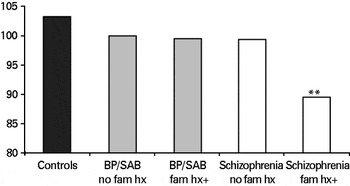
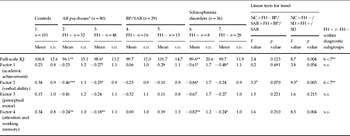
SD FH+ subjects had significant IQ impairment compared to controls (17.2 points lower), whereas the SD FH− was lower by about 0.5 s.d. (7.9 points) but not significantly. The difference in IQ between the SD FH+ and FH− subjects was significant (9.1 points, p = 0.003) (Table 3, Fig. 3). Within SD, there was a significant linear trend (controls > FH− SD > FH+ SD) for verbal ability and attention/working memory factors, yielding a significant pair-wise difference (FH− >FH+) for verbal ability. There were no significant effects of FH on BP/SAB. The majority of the BP/SAB cases with FH+ (87.5%) had a parent with a diagnosis of AP. Among the eight SD cases FH was more mixed: 25% were SD, four had psychosis not otherwise specified (NOS), and two had AP.
Full-scale IQ at 7 years of age for adults, who subsequently developed psychosis, with (FH+) and without (FH) a family history of psychosis in first-degree relatives, ** p < 0.01, compared to controls. Values of IQ given for controls (n = 101), bipolar psychosis and schizo-affective, bipolar type combined (BP/SAB) with no FH (n = 13), BP/SAB with FH+ (n = 16), schizophrenia (SD) with no FH (n = 28) and SD with FH+ of psychosis (n = 8) (least square means).

Prospective age 7 childhood data from adult cases and controls: full-scale IQ and four neuropsychological factor scores, by presence of family history (FH) of psychosis

BP/SAB, Bipolar psychosis/schizo-affective disorder, bipolar type; FH + , a positive family history of psychotic illness in first-degree relatives; FH − , absence of family history of psychotic illness in first-degree relatives; s.d., standard deviation; n.s., not significant.
Mixed model adjusted for maternal education, maternal age, race and intra-familial correlation. Pair-wise comparisons were performed comparing each group in columns 2–7 (all psychoses FH + , all psychoses FH − , BP/SAB FH + , BP/SAB FH − , schizophrenia disorders FH+ and schizophrenia disorders FH−) to column 1 (controls).
a All psychoses includes major depressive disorder with psychotic features (MDD-P, n = 9), other psychoses (n = 10) and groups 4, 5, 6 and 7.
b Tests of significance additionally adjusted for child's sex.
* p < 0.05, ** p < 0.01, *** p < 0.001.
Discussion
This study has demonstrated that SD is associated with significantly lower IQ, academic achievement, verbal ability and attention/working memory in childhood. There was a clear linear trend in performance with controls >BP/SAB >SD. Children who developed BP/SAB were statistically indistinguishable from controls. Pre-morbid neuropsychological deficits in children who later develop SD averaged a moderate effect (Cohen's d ≈ 0.57) whereas the effect in BP/SAB was about half of that (d ≈ 0.30) across 13 tests (Supplementary Table S1). FH of psychosis had a significant influence on cognitive performance for SD but not for BP/SAB. Neurocognitive deficit was particularly pronounced in the SD FH+ subgroup (mean d of the four factors = 1.08).
Analyses of individual IQ subtests were exploratory and should be interpreted with caution given the possibility of Type I error. The greatest impairments on these subtests were on WRAT Arithmetic (d = 0.91), WISC Digit Span (d = 0.70) and WISC Coding (d = 0.64), tests that involve numbers, rapid processing of mental computation, working memory and temporal information. The WRAT Arithmetic is a timed, written task of computations requiring organization and executive functioning skills including working memory. Although we cannot definitively identify the specific cognitive processes impaired in these complex neuropsychological tasks, it is of interest that Digit Symbol Coding is one of the most severely impaired tasks during the prodromal, first-episode and chronic phases of illness (Heinrichs & Zakzanis, Reference Heinrichs and Zakzanis1998; Mesholam-Gately et al. Reference Mesholam-Gately, Giuliano, Faraone, Goff and Seidman2009; Seidman et al. Reference Seidman, Giuliano, Meyer, Addington, Cadenhead, Cannon, McGlashan, Perkins, Tsuang, Walker, Woods, Bearden, Christensen, Hawkins, Heaton, Keefe, Heinssen and Cornblatt2010). Moreover, our findings are consistent with a study from the Philadelphia CPP (Niendam et al. Reference Niendam, Bearden, Rosso, Sanchez, Hadley, Nuechterlein and Cannon2003) showing pre-morbid deficits on Digit Symbol Coding. This suggests that some core neuropsychological deficits found in individuals with SCZ are observed in nascent form many years prior to psychosis, and well before the prodromal phase.
These data indicate that FH of SCZ plays a major role in childhood cognitive vulnerabilities, consistent with the robust demonstration of cognitive impairments in family HR studies of SCZ (Keshavan et al. Reference Keshavan, Kulkarni, Bhojraj, Francis, Diwadkar, Montrose, Seidman and Sweeney2010; Agnew-Blais & Seidman, Reference Agnew-Blais and Seidmanin press). Effect sizes of neuropsychological deficits in offspring or young siblings of persons with SCZ typically range between 0.3 and 0.8 on cognitive measures of IQ, verbal ability, attention and working memory (Agnew-Blais & Seidman, in press). In our study, compared with family HR studies, the effects of FH on cognition are much larger, perhaps because all of the subjects ‘go on’ to develop psychosis compared to about 10% in family HR studies of SCZ.
In general, BP/SAB disorder manifests minor pre-morbid neuropsychological impairment. Although the SD group performance was not significantly lower than that of the BP/SAB group, there was a clear linear trend, and the mean effect size differences across the 10 WISC and WRAT measures for those with BP/SAB was d = 0.28, ranging from clinically meaningful differences of d = 0.51 on Information to trivial differences of d = 0.09 on Digit Span. These small differences are consistent with family HR studies showing modest associations with IQ (Goldstein et al. Reference Goldstein, Seidman, Buka, Horton, Donatelli, Rieder and Tsuang2000) and neuropsychological functioning in BD (Reichenberg et al. Reference Reichenberg, Weiser, Rabinowitz, Caspi, Schmeidler, Mark, Kaplan and Davidson2002; Meyer et al. Reference Meyer, Carlson, Wiggs, Martinez, Ronsaville, Klimes-Dougan, Gold and Radke-Yarrow2004; Zammit et al. Reference Zammit, Allebeck, David, Dalman, Hemmingsson, Lundberg and Lewis2004; Tiihonen et al. Reference Tiihonen, Haukka, Henriksson, Cannon, Kieseppa, Laaksonen, Sinivuo and Lonnqvist2005; Urfer-Parnas et al. Reference Urfer-Parnas, Mortensen, Saebye and Parnas2010).
Limitations and strengths of the study
The main limitations of this study are the relatively modest power to detect differences in individual diagnostic groups and the constraint of using tests that were selected in the 1960s that preclude precise clarification of cognitive mechanisms. Although the clinical tests used are multifactorial and preclude identifying specific neuropsychological processes, the intelligence and achievement tests are commonly used in clinical settings and have utility for clinicians. Moreover, the positive results with the SD group are clear and consistent with prior studies, whereas the marginal results in the BP group are also consistent with a smaller but growing body of work indicating mild pre-morbid deficits. Although the sample size of the BP group is modest, when combined with the SAB group, its size was similar to that for the SD group. The direct comparison of these groups in pre-morbid neuropsychological functioning is novel and consistent with the hypothesis regarding more clear-cut neurodevelopmental impairments in SCZ than BP, proposed by Murray et al. (Reference Murray, Sham, van Os, Zanelli, Cannon and McDonald2004) .
The constraint of a limited sample size is particularly relevant in the comparison of the FH+ and FH− groups, where a relatively small group of FH+ individuals show significantly larger deficits compared to FH− SD individuals. Therefore, although the striking impact of FH+ on pre-morbid neuropsychological functioning was specific to SD, future research on larger samples is needed to confirm these findings. Given that some of the cases were identified through the companion HR study (Goldstein et al. Reference Goldstein, Buka, Seidman and Tsuang2010) from which we ascertained our controls, our rate of FH of psychosis was higher than typical, in part because we identified several of the cases through personal interview of the offspring of parents with psychosis.
Our study also raises some issues regarding ascertainment. We anticipate that our linkage procedures with tertiary public hospitals would tend to identify persons with greater severity and of lower SES, and would under-represent high-functioning cases with no hospitalizations and those receiving treatment exclusively from private hospital settings. However, by contrast, inclusion of persons and family members identified through direct follow-up and interview studies tends to identify participants with greater residential stability, levels of independent functioning and SES. Because of the various methods of case ascertainment used, we anticipate that both poles of the psychosis severity spectrum are likely to be slightly over-represented in the current study, with no extreme bias towards patients of higher or lower severity. Moreover, all of the patients were stable out-patients and their IQ estimates were typical of pre-morbid IQs derived from meta-analysis (Woodberry et al. Reference Woodberry, Giuliano and Seidman2008). Thus, from the point of view of the best-studied pre-morbid neurocognitive measure, they are representative of SCZ. Finally, we considered the possibility that ascertainment of a presumably episodic disorder (BP/SAB) versus a more chronic one (SCZ) might account for the results. We consider this unlikely because the two psychosis groups did not differ on duration of illness, number of hospitalizations or total positive symptoms, although there was a trend for more negative symptoms in the SD group (Table 1).
Clinical implications and future directions
The neuropsychological deficits in pre-SCZ were observed on tests commonly used in schools and clinical settings (e.g. WISC, WRAT). This may be clinically meaningful because deficits were about 1.0 s.d. in the context of a FH+ for SCZ. Moreover, a sizeable proportion of future cases (42.2% SCZ and 22.9% BP/SAB) were considered abnormal. School psychologists need to be aware of the constellation of cognitive impairments and a positive FH of psychosis in a school-age child and not misdiagnose this syndrome as attention-deficit/hyperactivity disorder or other disorder given some cognitive similarities.
The greater severity of cognitive findings for SCZ versus BP suggests that FH for SCZ may implicate genes associated with greater cognitive impairment compared with genes associated with BP. That is, FH for BP did not augment cognitive deficits but it did augment risk for BP diagnosis (Goldstein et al. Reference Goldstein, Buka, Seidman and Tsuang2010) whereas FH for SCZ augmented cognitive impairment in addition to its role in risk for SCZ. Although the FH+ group suggests ‘genetic risk’ and is probably associated with the neural substrates of the illness, it is imperative to study the FH+ factors directly before concluding that they are attributable largely to inherited variations, as other environmental factors (e.g. perinatal complications, environmental stress) may prove to be equally important.
Supplementary material
For supplementary material accompanying this paper, visit http://dx.doi.org/10.1017/S0033291712000773.
Acknowledgments
This research was supported by grants from the Stanley Medical Research Institute (L.J.S. and S.L.B.), the National Association for Research on Schizophrenia and Depression (L.J.S.), the National Institute of Mental Health, MH-63951 (L.J.S.), MH-56956 (J.M.G.), MH-50647 (M.T.T. and J.M.G.), T32 MH-017119 (J.A.B.) and the Commonwealth Research Center (SCDMH82101008006), Massachusetts Department of Mental Health (L.J.S.). We thank the following people for help in carrying out this study: L. Barker, J. Burbridge, M. Cirillo, L. Denny, J.-A. Donatelli, C. Fetterer, J. Koch, W. S. Kremen, E. Olson, C. Provencale, A. Peters Remington and W. S. Stone.
Declaration of Interest
None.