Introduction
Sperm-mediated gene transfer (SMGT) is a simple biotechnological tool that takes advantage of the ability of spermatozoa to bind, internalize, and transport exogenous molecules within the oocyte during fertilization, allowing the generation of embryos and/or transgenic offspring (Lavitrano et al., Reference Lavitrano, Giovannoni and Cerrito2013). However, the efficiency of this technique remains low mainly due to a low level of binding of exogenous DNA in the spermatozoa. Previous studies have confirmed that reduced exogenous DNA uptake in the spermatozoa can be improved by the use of membrane destabilizing agents (Perry et al., Reference Perry, Wakayama, Kishikawa, Kasai, Okabe, Toyoda and Yanagimachi1999; Zhao et al., Reference Zhao, Yu, Wang, Li, Fan, Yang and Jin2012). We have reported previously that sperm pre-treatment with membrane destabilizing agents can improve the efficiency of intracytoplasmic sperm injection (ICSI) in bovine species (Zambrano et al., Reference Zambrano, Aguila, Arias, Sanchez and Felmer2016). In the present study, we evaluated the effects of sperm treatment with membrane destabilizing agents on DNA binding capacity of spermatozoa and the efficiency of exogenous gene expression of bovine embryos generated by ICSI-SMGT.
Materials and methods
Reagents
Unless indicated otherwise, all reagents were purchased from Sigma-Aldrich (St. Louis, MO, USA).
Exogenous DNA and labelling
The plasmid used was pCAG-HcRed (5520 bp), provided by Connie Cepko (Addgeneplasmid #11152). The plasmid was labelled with fluorescein-12-dUTP isothiocyanate (Thermo Fisher Scientific, Inc., MA, USA). The Nick Translation System (Thermo Fisher Scientific, Inc., MA, USA) was used to identify the presence and location of the plasmid in spermatozoa using confocal microscopy and flow cytometry.
Preparation of spermatozoa for incubation with exogenous DNA
Cryopreserved semen from a commercial bull was used for all analyses (Alta Genetics Inc., Alberta, Canada). Spermatozoa were washed and handled in HBSS medium free of Ca2+ and Mg2+ (Invitrogen, Carlsbad, CA, USA).
Selected spermatozoa were subjected to one of four different treatments: (1) incubation in HBSS medium (control); (2) 1 mM NaOH (Arias et al., Reference Arias, Sanchez, Risopatron, Perez and Felmer2014); (3) 0.05% LL (Zambrano et al., Reference Zambrano, Aguila, Arias, Sanchez and Felmer2016); or (4) 0.05% TX-100 (Zambrano et al., Reference Zambrano, Aguila, Arias, Sanchez and Felmer2016). After each treatment, 500 ng of exogenous DNA was added to 1 × 10⁶ spermatozoa and incubated for 30 min at 37°C including the control group (with or without exogenous DNA). For each variable, 10,000 random events were evaluated per treatment with three biological replicates.
Spermatozoa and DNA binding evaluation
The spermatozoa subjected to each treatment were incubated with fluorescein isothiocyanate-labelled DNA (FITC-DNA) and propidium iodide (PI) and examined by flow cytometry to evaluate binding ability and cell viability (FACS CANTO II, Becton Dickinson, Mountain View, USA).
Exogenous DNA binding location
The spermatozoa subjected to each treatment were incubated with FITC-labelled DNA and evaluated by confocal microscopy (Olympus FluoView 1000) using a 488 nm laser excitation spectra and 530 nm emission. Images were taken at ×400 magnification. The image analysis was performed using FV10-ASW software, version 2010.
Sperm quality analysis by flow cytometry
Plasma membrane integrity was evaluated using the spermatozoa viability kit LIVE/DEAD (Molecular Probes, Eugene, OR, USA) treated with 2 μl SYBR-14 (1 nm final concentration) and 2 µl PI (2.4 mM stock solution).
Spermatozoa acrosome integrity was assessed using PNA–FITC and propidum iodide (PI). Spermatozoa were stained with 3 μl PNA–FITC (final concentration 0.3 μg/ml) and 3 μl of PI (final concentration of 18 μM).
DNA integrity after sperm pre-treatments was assessed by terminal deoxynucleotidyl transferase dUTP nick-end labelling assay (TUNEL) using the In Situ Cell Death Detection Kit (Roche Biochemical, Indianapolis, IN, USA), according to the manufacturer's instructions.
ICSI procedure and embryonic development
ICSI was carried out under an inverted microscope with Hoffman objectives using hydraulic micromanipulators (Narishige International, New York, NY, USA) according to the method described previously by our group (Arias et al., Reference Arias, Sanchez, Risopatron, Perez and Felmer2014; Zambrano et al., Reference Zambrano, Aguila, Arias, Sanchez and Felmer2016). Due to the low efficiency in generating transgenic embryos by ICSI-SMGT with the pCAG-HcRed plasmid (unpublished data), oocytes were injected with sperm incubated with pCX-EGFP (kindly provided by Masaru Okabe, Osaka University, Osaka, Japan). After injection, oocytes were activated and cultured as previously described by Arias et al. (Reference Arias, Sanchez, Risopatron, Perez and Felmer2014).
Statistical analysis
The SPSS program (SPSS Inc; Version 20) was used for statistical analysis. Comparisons of variance were performed using analysis of variance (ANOVA) and multiple comparisons were performed according to Scheffe's test. The significance level set for all statistical tests was P < 0.05. Data are presented as mean ± standard deviation.
Results
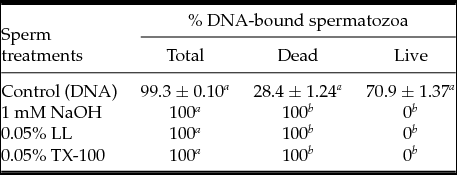
Table 1 shows that 100% of the spermatozoa bound to exogenous DNA in the control as well as in the different membrane destabilizing treatments. As expected, sperm viability was mostly affected with the sperm treatments (100% dead sperm) compared with the control (28.4%).
Sperm viability and DNA binding with different sperm treatments after 30 min of incubation

a,b In the same column indicates significant differences (P < 0.05).
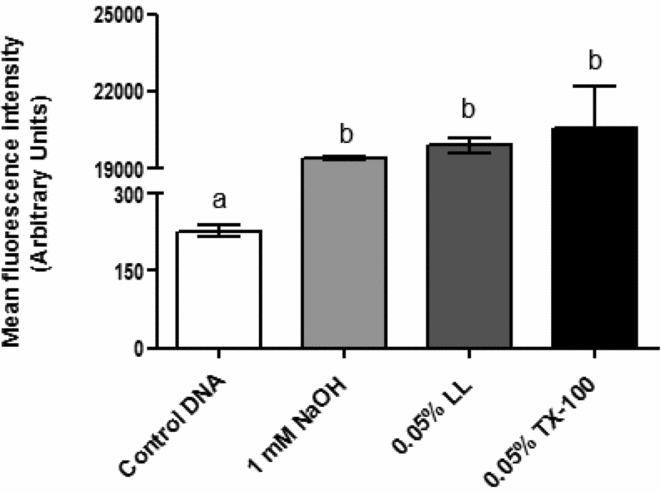
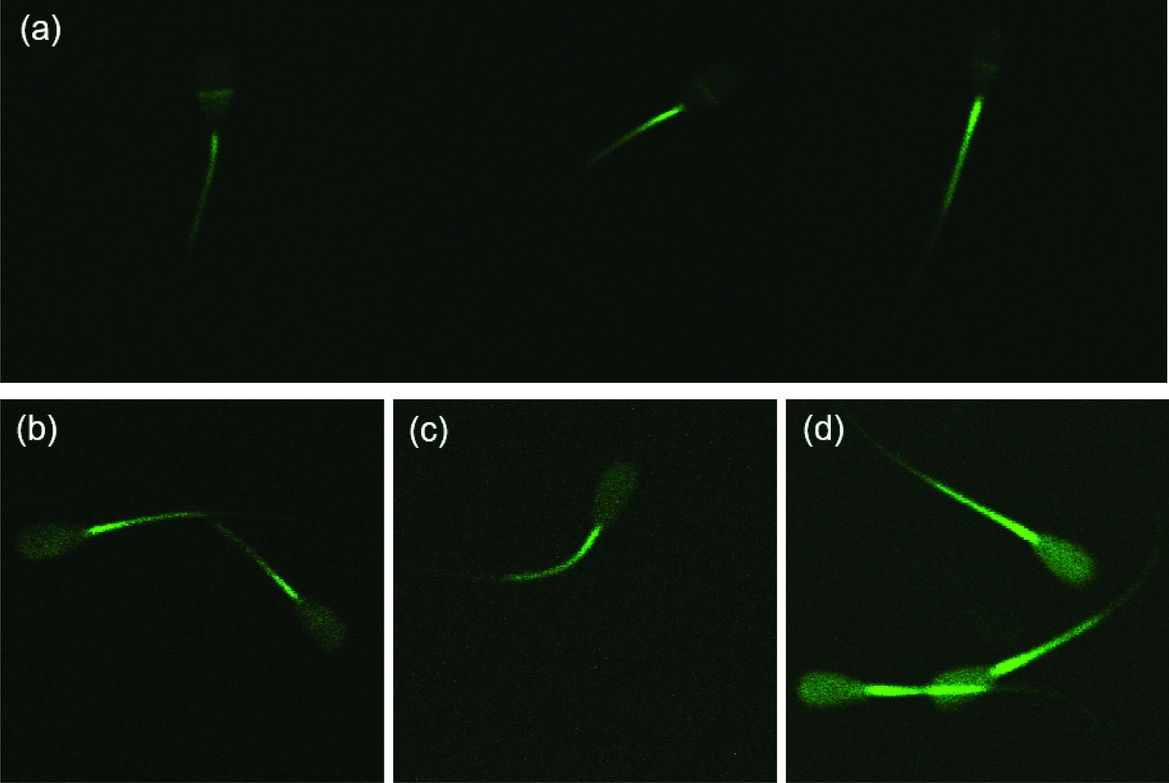
Exogenous DNA was identified throughout the whole head and tail structure of spermatozoa treated with NaOH, LL and TX-100, unlike the control (untreated sperm), in which exogenous DNA binding was observed mostly in the post-acrosomal region and tail (Fig. 1). Exogenous DNA present in bovine spermatozoa increased significantly (P < 0.05; Fig. 2) in spermatozoa treated with membrane destabilizing agents (NaOH: 19403 MFI; LL: 19889 MFI; and TX-100: 20581 MFI), with respect to the control.
Amount of FITC-labelled DNA bound with different sperm treatments and incubated with exogenous DNA for 30 min. Data are shown as mean fluorescence intensity (MFI). a,bDifferent letters on the bars indicate significant differences (P < 0.05).

Location of DNA binding with different sperm treatments. Evaluation by FITC-labelled DNA for 30 min. (a) Control with exogenous DNA; (b) 1 mM NaOH; (c) 0.05% lysolecithin; and (d) 0.05% Triton X-100. Confocal microscopy images, magnification ×400.

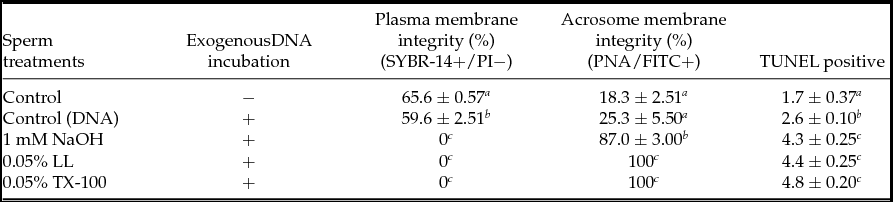
Results recorded by SYBR14/PI staining showed a significant (P < 0.05) decrease in plasma membrane integrity of spermatozoa treated with membrane destabilizing agents (Table 2). In total, 100% of treated spermatozoa showed damage to the plasma membrane compared with the control groups without DNA incubation (34.4%) and incubated with exogenous DNA (40.4%). Likewise, significant differences were observed between both controls (P < 0.05).
Effect of different sperm treatments and incubation with exogenous DNA for 30 min on the plasma and acrosome membrane integrity and DNA damage measured by flow cytometry

a,b,c In the same column indicate significant differences (P < 0.05).
Regarding the integrity of the acrosomal membrane, no differences were observed when incubating the spermatozoa with or without exogenous DNA. However, the percentage of spermatozoa with acrosomal membrane damage increased significantly in all treatments with membrane destabilizing agents compared with both controls (Table 2). Treatments with TX-100 and LL achieved 100% damage in the acrosomal membrane, being significantly higher (P < 0.05) than the treatment with NaOH in which 87% of the spermatozoa showed damage in the acrosomal membrane.
Regarding sperm DNA integrity, the addition of exogenous DNA significantly affected all treatments and the control group DNA with respect to the control without incubation (P < 0.05; Table 2).
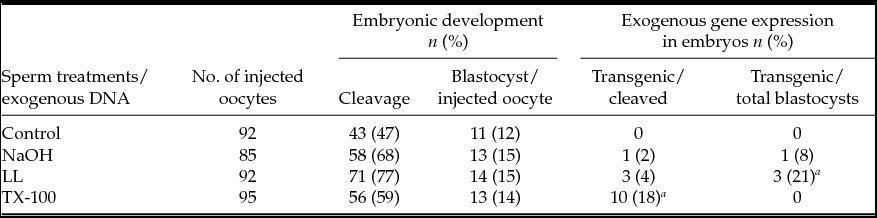
In vitro embryonic development and exogenous gene expression in embryos produced by ICSI-SMGT are shown in Table 3. The results of 364 bovine oocytes injected with sperm treated with membrane destabilizing agents and incubated with exogenous DNA did not show differences in the embryonic development. Significant differences were observed, however, in the exogenous gene expression rates. All sperm treatments generated transgenic embryos compared with the control incubated only with DNA (Table 3); however, a higher gene expression rate was observed in embryos at the cleavage stage with TX-100 and at the blastocyst stage with LL treatments, respectively (Table 3).
In vitro embryonic development and exogenous gene expression in bovine embryos generated by ICSI-SMGT under different sperm treatments

Cleavage and transgenic assessment in embryos was recorded at 72 h of culture and blastocyst and transgenic blastocyst rates were recorded at 192 h. NaOH: sodium hydroxide (1 mM); LL: Lysolecithin (0.05%); TX-100: Triton X-100 (0.05%). a In the same column indicates significant differences (P < 0.05).
Discussion
Previous studies have confirmed that reduced exogenous DNA uptake of mice and goat spermatozoa could be improved by the use of membrane destabilizing agents (Perry et al., Reference Perry, Wakayama, Kishikawa, Kasai, Okabe, Toyoda and Yanagimachi1999; Moreira et al., Reference Moreira, Giraldo, Cozar, Pozueta, Jimenez, Montoliu and Gutierrez-Adan2004; Zhao et al., Reference Zhao, Yu, Wang, Li, Fan, Yang and Jin2012). However, sperm membrane destabilizing agents, specifically in bovine SMGT, were not assessed.
In this study, we confirmed that all spermatozoa under the different sperm membrane destabilizing treatments showed evidence of exogenous DNA binding (Table 1). Additionally, we assessed DNA binding by quantifying fluorescence intensity to establish whether destabilization of the plasma membrane facilitates not only exogenous DNA binding but also the amount of exogenous DNA bound, compared with the control. The results of this assay confirmed that the amount of exogenous DNA bound in bovine spermatozoa treated with membrane destabilizing agents was much higher than that of spermatozoa incubated only with DNA (Fig. 1).
In order to confirm if the greater uptake of exogenous DNA in the sperm group treated with the different membrane destabilizing agents was due to a greater distribution of DNA molecules in the different spermatozoa structures, we carried out a confocal microscopy analysis to identify exogenous DNA binding locations in spermatozoa. Results revealed that sperm membrane destabilizing treatments facilitated exogenous DNA interaction with spermatozoa. Exogenous DNA binding was not limited to the post-acrosomal region, as previously observed by other authors in the control group (Anzar & Buhr, Reference Anzar and Buhr2006; Eghbalsaied et al., Reference Eghbalsaied, Ghaedi, Laible, Hosseini, Forouzanfar, Hajian, Oback, Nasr-Esfahani and Oback2013), but was found throughout the sperm head, the intermediate piece and the tail (Fig. 2), confirming data obtained by flow cytometry that showed higher fluorescence intensity in treated spermatozoa (Fig. 1).
In relation to the integrity of the plasma membrane in spermatozoa treated with membrane destabilizing agents and incubated with exogenous DNA, it was confirmed that these treatments effectively damaged the spermatozoa membrane, as 100% of spermatozoa reacted positively to the PI probe. Interestingly, in the control incubated with exogenous DNA, an increase in plasma membrane damage (~10%) was also evidenced with respect to the control without DNA incubation. This effect can be caused by the presence of exogenous DNA and manipulation of spermatozoa in the laboratory (Lavitrano et al., Reference Lavitrano, Giovannoni and Cerrito2013). In relation to the state of the acrosomal membrane, significant differences were observed between the different treatments and controls, in which treatments with LL and TX-100 showed a greater effect, with 100% of the spermatozoa showing positive reaction to the PNA/FITC probe, unlike the treatment with NaOH, which showed a lower proportion (87%). However, all treatments showed significant differences to both controls.
Due to the possibility that these treatments, together with co-incubation with exogenous DNA, induce the activation of endonucleases capable of degrading both exogenous DNA and nuclear DNA, we studied the effect of these treatments on the DNA integrity of spermatozoa. Results of this experiment showed that DNA damage increased in the DNA incubation control (2.6%) and was higher in spermatozoa treated with membrane destabilizing agents (range 4.3–4.8%), compared with the control without DNA incubation (1.7%). However, it is important to note that these percentages are within normal parameters of sperm quality previously observed in different bovine studies (Feitosa et al., Reference Feitosa, Mendes, Milazzotto, Rocha, Martins, Simoes, Paula-Lopes, Visintin and Assumpcao2010; Arias et al., Reference Arias, Sanchez, Risopatron, Perez and Felmer2014; Goodla et al., Reference Goodla, Morrell, Yusnizar, Stalhammar and Johannisson2014; Zambrano et al., Reference Zambrano, Aguila, Arias, Sanchez and Felmer2016).
We then evaluated the efficiency of these treatments on in vitro embryonic development and assessed exogenous gene expression in bovine embryos generated by ICSI-SMGT. The results of this experiment showed that sperm treatment with membrane destabilizing agents incubated with DNA did not affect embryonic development compared with the control incubated only with exogenous DNA. More interestingly, sperm treatment improved the efficiency of generating transgenic embryos compared with the control (Table 3). However, exogenous gene expression in embryos was affected by sperm treatment. A higher number of embryos expressed the transgene at the cleavage stage when sperm were treated with TX-100 and exogenous DNA compared with all other treatments, although no transgenic blastocysts were later observed with this treatment (Table 3). This could be related to the sperm DNA damage observed after treatment with membrane destabilizing agents, which in this case was higher with TX-100 treatment (Table 2). In fact, it has been suggested that the permeability of sperm membrane to chemical agents increased the level of sperm DNA binding, thus causing a high concentration of the transgene in the oocyte (Szczygiel et al., Reference Szczygiel, Moisyadi and Ward2003; Garcia-Vazquez et al., Reference Garcia-Vazquez, Garcia-Rosello, Gutierrez-Adan and Gadea2009). High concentrations of these chemicals could also become toxic for normal embryonic development (Garcia-Vazquez et al., Reference Garcia-Vazquez, Garcia-Rosello, Gutierrez-Adan and Gadea2009; Li et al., Reference Li, Mizutani, Ono and Wakayama2010).
This result is consistent with previous reports using chemical agents such as TX-100 as sperm treatment. For instance, Garcia-Vazquez et al. (Reference Garcia-Vazquez, Garcia-Rosello, Gutierrez-Adan and Gadea2009) working in pigs also observed transgenic embryos expressing EGFP at the cleavage stage but they did not observe transgenic embryos developing to the blastocyst stage.
Sperm treatment with LL incubated in the presence of exogenous DNA showed a higher percentage of transgenic blastocysts (21%) compared with all other treatments (Table 3). A similar result was observed previously by Moisyadi et al. (Reference Moisyadi, Kaminski and Yanagimachi2009) in mouse. These authors described 11.4% of transgenic oocytes injected and a high efficiency of EGFP transgenic mice (62.5% animals born). No other studies have assessed the effect of this compound on ICSI-SMGT. Meanwhile, bovine sperm treatment with NaOH showed a relatively low efficiency in the generation of transgenic embryos. This finding differed from previous data in mouse in which over 50% of blastocysts expressed EGFP fluorescence and 10% of normal transgenic mice could be generated with this treatment (Li et al., Reference Li, Mizutani, Ono and Wakayama2010).
Different studies have proposed the development of sperm transfection methods with more natural substances that are not harmful to full-term development of transgenic-ICSI embryos (Moisyadi et al., Reference Moisyadi, Kaminski and Yanagimachi2009; Sim et al., Reference Sim, Cha, Song, Kim, Yoon, Choi, Jeong, Kim, Huh, Lee, Kim, Lee, Kim and Chang2013). The use of LL treatment, a natural cellular hydrolysis product of the cell membranes, resulted in better embryonic development of transgenic embryos compared with TX-100 and NaOH treatments, which confirms the importance of selecting an appropriate sperm treatment that does not affect either the embryonic developmental potential or exogenous gene expression (Szczygiel et al., Reference Szczygiel, Moisyadi and Ward2003; Sim et al., Reference Sim, Cha, Song, Kim, Yoon, Choi, Jeong, Kim, Huh, Lee, Kim, Lee, Kim and Chang2013).
In conclusion, the present study confirms the ability of bovine spermatozoa to spontaneously bind exogenous DNA. In addition, we demonstrated that the use of sperm membrane destabilizing agents favours not only exogenous DNA binding but also the amount of exogenous DNA bound, affecting DNA integrity discretely. Lysolecithin treatment improved the efficiency of generating transgenic embryos, and represents a novel and promising approach for ICSI-SMGT in bovine species. Further studies evaluating different concentrations and incubation times with exogenous DNA could improve even further the efficiency of this treatment.
Acknowledgements
This work was supported by FONDECYT No. 11130724, CONICYT of Chile and Directorate of Research DI17-6003, Universidad de La Frontera. Esther Sánchez and Pía Loren were supported by a Doctoral scholarship by CONICYT, Government of Chile.
Conflict of interest
Authors declare that there is no conflict of interest.