There were a limited number of forms of production crucial to state financing in the Inka Empire of precolumbian South America. The various forms have been brought together and characterized under the headings of either staple finance or wealth finance (D'Altroy and Earle Reference D'Altroy, Earle and LeVine1992). In the former case, this refers generally to crops produced by the state, which were stored in warehouses for state purposes; this involved such circumstances as responding to local crises in times of famine or crop loss, feeding the army, or even as largesse directed by the king to potential allies (see below). In terms of the production of such staple crops, subjects of the empire in villages throughout Tawantinsuyu (“the four parts together,” the Inka term for their empire) were obliged to plant, tend, harvest, and store produce as a part of their tribute obligation to the state.
There were two main types, or categories, of land used for the production of these state-owned and state-controlled staple crops. One was state-owned lands, specifically designated as for the support of the Inka, which were worked by subjects of the empire as a part of their rotating labor tribute, or corvée, as an obligation to the state (D'Altroy and Hastorf Reference D'Altroy and Hastorf2001). The labor regimen for the production of such crops, often termed a “labor tax,” or simply a “tax,” was known as the mit'a. The lands on which such crops were produced for the state were distributed across the length and breadth of Tawantinsuyu as a feature of the three-part division of land within the empire; that is, all land (and flocks of camelids) in the empire ultimately belonged to the Inka but was divided in terms of its actual use into three parts, or categories: one each for the state, the gods, and the local ayllus (kin groups; see Cobo Reference Cobo1983 [Reference Cobo1653]:211–214).
The other type of land on which state-owned staple crops were produced were great farms that were set up and managed by the state (D'Altroy Reference D'Altroy2015a:401–405). The best known and documented such farm was in the region of Cochabamba, in present-day central Bolivia. Here, the last Inka, Wayna Kapak, established a farm for the production of corn to feed his army in what were almost continual struggles with recalcitrant populations in what is today central Bolivia, or in responding to incursions of tropical forest tribes (especially the Chirihuano) in eastern Bolivia. The rotating mit'a labor gangs that were sent to work these fields were conscripted from populations in the southern part of present-day Peru and northern Bolivia, each different ethnic group being accommodated within a strip of farm land, known as a suyu (“part”), to grow the Inka's corn. The various mit'a gangs were provided with lands adjacent to the state lands on which they were allowed to grow crops for their own sustenance (Wachtel Reference Wachtel, Collier, Rosaldo and Wirth1982).
Wealth finance, on the other hand, refers to a variety of types of goods that were mined, collected, manufactured, or otherwise produced by mit'a laborers responding to state levies of what were, ultimately, resources belonging to the Inka. This often involved large numbers of people—known as mitimaes—who were uprooted from their home communities and sent to distant production centers for items such as ceramics, textiles, and objects of gold and silver. The goods included within the wealth finance portion of the Inka economy included minerals and mineral ores, obsidian, feathers, honey, shell (esp. Spondylus sp.), coca, psychotropic drugs, and other precious items. It has been suggested by scholars that some portion of the staple goods collected and stored from state-owned lands may have been transformed into what is defined here as wealth finance. This could have been accomplished by such mechanisms as using staple produce to support non-food-producing specialists, or turning staple goods into prestations for local or foreign elites (e.g., D'Altroy and Earle Reference D'Altroy, Earle and LeVine1992; Hastorf Reference Hastorf2017:160–161). Whether such transformations of staple finance into wealth finance were carried out or not is difficult to know for certain, because we have no written records from before the conquest confirming such practices. If confirmed, it would suggest a level of thinking about production in terms of commodities, which could merge with the suggestion here of transforming staple goods into taxable income in late imperial times. In any case, it is probable that wealth finance in its various forms was controlled by the state and given out as gifts to high-ranking lords among local populations, to create alliances that expanded both the territory and the numbers of subjects under Inka state control (D'Altroy Reference D'Altroy and Shimada2015b).
The above were the two primary types of state financing attested to in our colonial Spanish sources. In this article, we present evidence which, we argue, is highly suggestive of the emergence in late preconquest times of what may be characterized as a form of “tax financing,” or taxation. This instrument of appropriation was not included in either of the two categories of financing mentioned above, nor has it heretofore been recognized as having existed in the Inka empire, at least not in the form described below. We would note, however, that to the extent that labor is rightly considered a resource belonging to each household, the taking of a portion of that labor power via a state-mandated corvée is, both technically and metaphorically, a tax. However, we maintain that it is useful to distinguish between a corvée and the taking of an assessed portion of the goods and produce supporting and sustaining a household in the form of a tax. It is the latter which we propose is evidenced—for the first time in Inka studies—in the data presented in this article.
In order to proceed with the description and discussion of the evidence for this proposed incipient form of Inka taxation, we need first to clarify certain terminological matters. The central issue has to do with our use of the terms tax and corvée and with whether or not these terms have been appropriately and consistently used by researchers to refer to the various kinds of demands the Inkas placed on subjects, as described to date.
As noted earlier, the Inka tribute system was one in which subjects of the empire were required to work a certain number of days each month on state projects; this, properly speaking, is what is generally referred to as a system of corvée labor. In Webster's New Twentieth Century Dictionary, corvée is defined as: “1. In feudal law, an obligation on the inhabitants of a district to perform certain services, as the repair of roads, etc., for the sovereign, or the feudal lord. 2. forced labor exacted by a government, as for the construction of public works” (Reference Webster1978:412).
The above definition describes precisely what we read about in our Spanish sources concerning the Inka tributary system, known as the mit'a (Murra Reference Murra, Collier, Rosaldo and Wirth1982). However, Andean scholars (including the authors) have commonly used the phrase “labor tax” in talking about the corvée labor regimen (e.g., see D'Altroy Reference D'Altroy and Shimada2015b:102; D'Altroy and Earle Reference D'Altroy, Earle and LeVine1992:35). Because we are attempting herein to lay out what we believe to be the first evidence for what we think was a system of taxation that was just coming into existence late in the life of the Inka empire, it is important to consider the relationship between a corvée obligation on one hand and a tax on the other. Webster's dictionary defines a tax as:
n. 1. (a) a compulsory payment of a percentage of income, property value, sales price, etc. for the support of a government… v.t. 1. Originally, to determine the value of; to assess; 2. (a) to require (a person) to pay a percentage of his income…for the support of a government; (b) to require (a person) to pay a special assessment, as in a society, labor union, etc. [Webster's New Twentieth Century Dictionary Reference Webster1978:1869].
Thus, a system of taxation is not the same thing as a system of rotating corvée labor. In fact, none of our colonial dictionaries of Quechua or Aymara refers to the Inka mit'a labor system by the Spanish term impuesto (“tax”); rather, the mit'a is consistently characterized as a system of “turn-taking,” or rotating labor (González Holguín Reference González Holguín1952 [Reference González Holguín1608]:243, and Bertonio Reference Bertonio1984 [Reference Bertonio1612]:223, respectively). In sum, the mit'a was corvée labor; it was not, technically speaking, a tax.
We should pause to note that, unlike every other major civilization of the ancient world (e.g., Mesopotamia, Egypt, Shang China), all of which either relied on taxation or a combination of taxation and corvée for state financing (e.g., respectively, Van De Mieroop Reference Van De Mieroop2007:78; Ezzamel Reference Ezzamel2002; Ta-K'un Reference Ta-K'un1952), the Inkas had only a corvée. This was a viable system in the Andean case, given that the Inka owned everything—all land, animals, raw materials, etc.—in the empire. What he required was the labor to transform these resources into consumable or otherwise expendable products, and the mit'a provided that singular need.
So, the questions that arise from the above discussions are, first, did the Inkas ever conceive of instituting what we have defined above as a system of taxation (as opposed to a corvée)? And second, if the practice of taxation did indeed come into existence, what were the circumstances or the conditions that brought about the invention and imposition of such a “compulsory payment of a percentage of income” in the Inka state? The evidence for what we argue herein constituted a form of Inka taxation, which was just beginning to take shape probably only a decade or so prior to the Spanish invasion of the Andes, in 1532, has recently come to light at the site of Inkawasi, on the south coast of Peru. An extraordinary feature of this incipient system of taxation is that the state appears to have devised a mechanism for, in effect, taxing itself; that is, the Inka accountants appear to have imposed an assessment—a tax—on the large quantities of state-owned produce that was stored in the state-run storage facility at Inkawasi.
We would emphasize that the reasons we are able to speak about the possibility of something like a new form of Inka financing coming into being at an Inka storage facility is because of two recent developments in research on the Inka Empire; first, the extraordinary fortune of the excavation of reasonably well-preserved khipus from the Inka storage facility at Inkawasi; and second, a growing awareness of the centrality of khipu accounting in imperial Inka administrative practice. Most notable are recent advances in our understanding of the formatting and structural properties of samples employed in such administrative practices as tribute reckoning (Julien Reference Julien1988; Medrano and Urton Reference Medrano and Urton2018), census taking (Urton Reference Urton2006), and storehouse accounting (Clindaniel and Urton Reference Clindaniel, Urton and Pozzi-Escot2017; Urton Reference Urton2017; Urton and Chu Reference Urton and Chu2015).
What is significant about the latter point is that khipus that were created and used in storehouse accounting (whether at Inkawasi or elsewhere) contain information that is generally not attested to in the Spanish chronicles, which are our only written sources of information about the Inka empire. This is because, although the early colonial chronicles and documents detail a great variety of matters concerning Inka administration, neither the Spanish administrators nor the chroniclers were interested in investigating the finer points of khipu administrative recording; rather, they were interested in the final, gross figures of Inka financing—e.g., with what and how much tribute was levied here or there—but not in the arcane khipu-based accounting practices through which those figures were arrived at by Inka administrators. The information on Inka administration contained in the Spanish chronicles have to do primarily with the outlines of how the system functioned, not with the details – and certainly not with those concerning the recording of information in the knotted-cord records (see Blas Valera's account of the failure of Spaniards ever to penetrate the mysteries of khipu recording, in Garcilaso de la Vega Reference Garcilaso de la Vega and Livermore1966 [Reference Garcilaso de la Vega and Livermore1609]:823–824). Most of the information contained in the earliest Spanish chronicles was obtained from the testimony of noble informants in the imperial capital, Cuzco, not from administrators in far-off provincial accounting centers, such as Inkawasi. Whatever the explanation, nowhere in the Spanish sources do we find descriptions or explanations of what have recently been shown to be highly complex methods of accounting, some even approaching double-entry-like “bookkeeping” methods (Urton Reference Urton2009).
Finally, while there were undoubtedly standard operating procedures for checks-and-balances accounting shared by Inka accountants throughout Tawantinsuyu, nonetheless, there appears to have been something unique going on at Inkawasi. Nowhere else in the preserved khipu archives have we encountered accounting methods as complex as those evidenced at Inkawasi. We propose that the highly complex accounting practices seen in the Inkawasi khipus were the work, and the innovatory behavior, of a cadre of accountants who were trying to make sense of—perhaps to “rationalize”—Inka financing, in what we will see was a new kind of installation that was set up rapidly on the south coast of Peru, far distant from the Inka capital. The major innovation the accountants came up with in state financing—taxation—would have called not only for new accounting procedures to determine the portion of income to be extracted as the tax, but also for procedures for recording the details of the calculation of the extracted sums and the effect of that action on deposits. All of these figures—which were actually represented in bundles of knotted cords—were carefully prepared by the Inkawasi accountants for inspection by imperial accountants in Cusco.
The Site of Inkawasi and Its Storehouse, or “Qolqawasi”
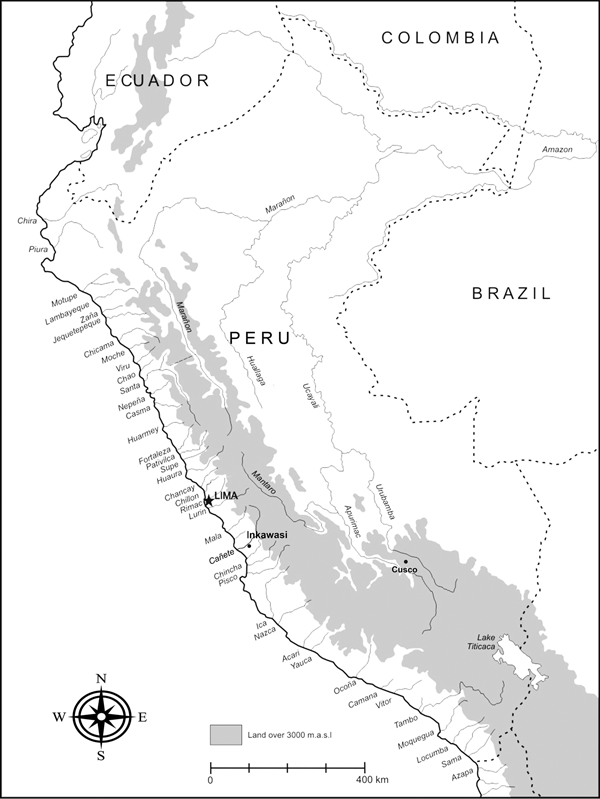
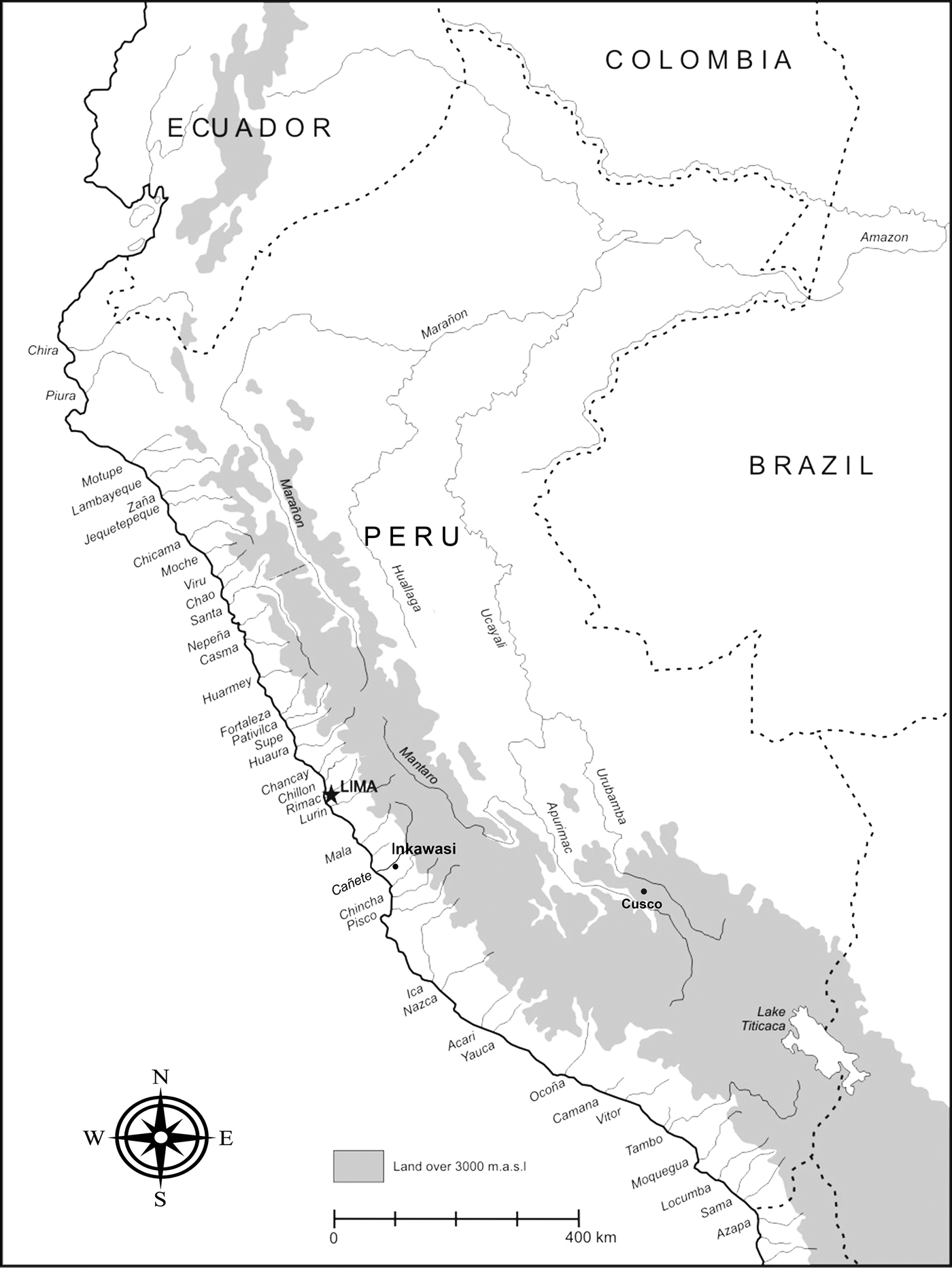
Inkawasi was a large military and storage installation built by the Inkas in the Cañete River Valley, on the south coast of Peru, 27 km upriver from where the river discharges into the Pacific Ocean (Figure 1; Hyslop Reference Hyslop1985). The site, which stretches almost a kilometer along the south (left) bank of the river, was originally built as a military staging facility for the Inka conquest of the Huarco, a bellicose and war-like people who lived near the mouth of the Cañete River (Cieza de León Reference Cieza de León1967 [Reference Cieza de León1553]; Garcilaso de la Vega Reference Garcilaso de la Vega and Livermore1966 [Reference Garcilaso de la Vega and Livermore1609]; see also Marcone Flores and Areche Espinola Reference Marcone Flores and Espinola2015; Marcus Reference Marcus2017). After the conquest of the Huarco, the site was transformed into an administrative and storage complex for state agricultural production. Two large storage facilities, sectors A and E, were built in the second period of occupation.
The location of Inkawasi (Drawing by Alejandro Chu).
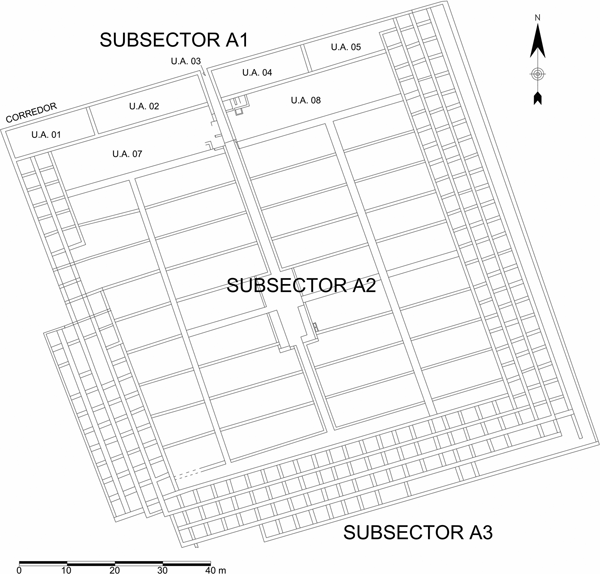
The generally well-preserved ruins of Inkawasi were surveyed and mapped by Hyslop in 1982–1983 as a part of his study of Inka roads and tambos (“way-stations”) along the Qhapaq Ñan (the imperial Inka road system; see Hyslop Reference Hyslop1985; Figure 2). Hyslop divided the site into eight sectors, each related to what he supposed to have been a specific function (e.g., a palace, sun temple, or quarters for workers). At the east end of the site is a collection of buildings (Hyslop's sector B), which Chu has argued was probably the main administrative center for the site (Chu Reference Chu2015). The largest storage facility, located at Hyslop's sector A, which lies across a (usually) dry gulch to the west of the administrative buildings, is referred to by researchers as Qolqawasi (“storehouse;” Figure 3).
The site of Inkawasi (Drawing by Julia Meyerson; after Hyslop Reference Hyslop1985).

Qolqawasi – The “Storehouse” (Drawing by Alejandro Chu).

Qolqawasi is composed of several distinct types of structures, generally paired in different groupings of structures across a pathway that runs generally north/south through the center of the facility. A corridor runs along the northern end of Qolqawasi, separating the storage structure from an adjacent building. Inside Qolqawasi, beginning at the north end, are two rectangular structures, commonly referred to as kallankas, on either side of the central pathway (UA 01, 02, 04, 05); immediately to the south is a large, rectangular open area on either side of the central pathway (UA 07 and 08), which we have argued were probably used for the sorting, drying, and accounting of produce delivered to Qolqawasi for storage; and finally, to the south of the sorting spaces are 36 large rectangular storage bins (18 on either side of the central passageway) surrounded on three sides by some 209 small square storage deposits.
In excavations in the Qolqawasi storage facility, in 2013–2014, Chu and his team found a total of 29 khipus buried just below the surface. What is most remarkable about the recovery of khipus from Qolqawasi is that many of the samples were found covered with staple produce—peanuts, chili peppers, and black beans. The khipus were lying directly on the kallanka floors. This is the first time khipus have been recovered in a storehouse context along with the produce whose accounting—in unit values—they presumably document. It is also important to note that massive quantities of coca—an Inka wealth finance product par excellence—were found at the second largest storage facility at the nearby sector E (earlier erroneously considered to be a palace). No khipus were found associated with the coca.
The khipus at Qolqawasi were found in the following locations: seven khipus were found in the northern corridor; three khipus were found against the southern wall, one against the northern wall, and one against the eastern wall of unit UA02, the kallanka structure on the western side of the central pathway; fourteen khipus were found in a pile, covered by peanuts, in the southwest corner of UA04, the kallanka structure on the eastern side of the central passageway; one khipu was found covered by black beans in the center of the same unit; and two khipus were found tied together, placed in a basket and covered with chili peppers along the western edge of sorting/drying space UA07. We suggested earlier that produce was brought into the site along the northern corridor and off-loaded into the kallankas, where the accounting process would have begun (Urton and Chu Reference Urton and Chu2015).
One issue that arises in regard to the produce stored at Inkawasi is: From where did the produce brought to Qolqawasi derive, and to whom did it belong? The answer to this question relates to the nature of land tenure in the empire. As noted earlier, not only all land but everything—humans, animals, plants, and minerals—in Tawantinsuyu belonged to the Inka. More specifically, as we learn from the mid-seventeenth-century chronicler, Bernabé Cobo:
When the Inca settled a town, or reduced one to obedience, he set up markers on its boundaries and divided the fields and arable land within its territory into three parts, in the following way: One part he assigned to Religion and the cult of his false gods, another he took for himself [i.e., the civil government], and a third he left for the common use of the people. It has not been possible to determine whether these parts were equal in any towns and provinces…In these lands assigned to Religion and to the crown, the Inca kept overseers and administrators who took great care in supervising their cultivation, harvesting the products and putting them in storehouses. The labor of sowing and cultivating these lands and harvesting their products formed a large part of the tribute which the tax-payer [i.e., tribute laborer] paid the king [Cobo Reference Cobo1983 [Reference Cobo1653]:211].
Cobo continues later in the same chapter to note that:
These storehouses were always very well supplied because ordinarily there was food gathered from ten or twelve years back. There were in these storehouses and warehouses inspectors, overseers, and accountants for the administration of the royal goods; these officials kept careful records of all goods received or consumed… [Cobo Reference Cobo1983 [Reference Cobo1653]:221].
From the testimony of Cobo and other chroniclers, we can be fairly certain that the agricultural produce stored in a state storage facility, like Qolqawasi, would have come from fields belonging to the Inka, or the civil government. In the specific case of Inkawasi, the fields would probably have been located within the Cañete Valley, both upstream and downstream from the site, as well as from neighboring valleys to the north and south. There is extensive terracing toward the western edge of the site, as well as along the valley margin, across the river from Inkawasi. Thus, some (even considerable) percentage of the agricultural produce stored at the site could have been produced locally. Unfortunately, we do not have ethnohistorical records to determine more precisely from where the produce stored in Inkawasi actually came. However, what does seem clear from the above general description from the chronicle of Bernabé Cobo is, first, that the produce stored at Inkawasi would almost certainly have come from state (i.e., Inka)-owned fields, and second, that when a portion of the produce from those fields was “set aside,” as we will see from the khipu records, such “siphoned off” quantities constituted taxes assessed on what were, in fact, state-owned staples.
It is important to note that there were many other storage sites throughout the empire where there were high numbers of storage deposits (e.g., Huánuco Pampa and Pumpu; see D'Altroy and Hastorf Reference D'Altroy, Earle and LeVine1992; LeVine Reference LeVine1992; Morris Reference Morris and LeVine1992); however, virtually without exception the storage deposits at these sites were spread out across the hillsides, dissipating the concentration of energy and attention at any one of these other storage settings as compared to Inkawasi. In fact, nowhere else in the empire do we see a storage facility of the size, concentration, and density as that at Inkawasi. We believe that because of the complexity and novel character of this new site, it would have become clear to the Inkawasi administrators soon after the operation was fully underway that they needed new management practices. These would have included some means of feeding and otherwise sustaining workers at the site. Aside from the cadres of administrators and khipukamayuq (“knot maker/animator”) accountants, there would have been many mit'a laborers and/or mitimaes living at the site. How to feed all these workers? The administrators could have given every worker at Inkawasi a bit of land within the Cañete Valley and some time off to go off and till the soil and grow their own crops; however, this would have been quite inefficient, as the demands of managing such a large and bustling site must have been considerable and pressing. What would have become apparent very soon after the operation got underway was that the ideal way to support the facility would have been to siphon off a portion of the produce to feed the workers. Such an assessment (i.e., the siphoning off) for the support of a government facility would constitute a tax. We turn now to the khipu records to see how these “documents” show evidence of this incipient form of tax financing.
Khipu Accounting Methods at Inkawasi and the “Fixed Value” Taxation Units
There now exists a large and readily enough available body of literature detailing how quantitative/numerical values were recorded on Inka khipus, such that it is unnecessary to describe the system in great detail here (Ascher and Ascher Reference Ascher and Ascher1997; Locke Reference Locke1923; Urton Reference Urton2003, Reference Urton2017). Basically, numerical values were recorded in the base-10 (Quechua) system of numeration by tying knots into khipu pendant strings in tiers, with knots in the bottom-most tier recording the units (1s), those in the next highest level recording 10s, and each subsequent higher tier recording successively greater powers of 10 (i.e., 100s, 1000s, etc.). There are many secondary sources that have analyzed different arrangements of numerical data recorded on khipus, from samples recovered at sites at what is now far northern Peru (Urton Reference Urton2001) and, moving southward, along the Pacific coastal desert to southern Peru and northern Chile (Ascher and Ascher Reference Ascher and Ascher1997; Clindaniel and Urton Reference Clindaniel, Urton and Pozzi-Escot2017; Urton Reference Urton2017).
One thing that is unique about the numerical values recorded on the khipus recovered from the Qolqawasi facility at Inkawasi is that many display what may be termed “fixed values” (Urton Reference Urton2017). What this characterization refers to are several variations on an arrangement of pendant cords and knot values in which one finds the following sequence of values: on one cord (a) a large value, followed by an adjacent cord (b) on which a fixed value normally occurs, followed by (c) from one to several additional cords, such that: a = b + c.
We have registered four different fixed values on the Inkawasi khipus: 10, 15, 47, and 208.Footnote 1 Instances of the first two values (10 and 15) are found on the khipus associated with chili peppers (see above), as well as on two of the khipus found in the corridor, while the second two fixed values (47 and 208) are found on two of the khipus covered with peanuts, in Qolqawasi unit UA04. We will return to this point later. For the moment, focusing on the formula outlined above, Table 1 gives one example from each of the four arrangements of fixed values found either on “chili pepper khipus” or “peanut khipus.” Longer representative sequences of registries of one example of each of the four series (10, 15, 47, 208) appear in Table 2 (see Supplemental Table 1 for complete recordings of all data from the four khipus).
Examples of Fixed Values of the Four Different Orders of Magnitude Registered on Inkawasi Khipus.

Sequences of Values on Four Inkawasi Khipus with Fixed Values: 10, 15, 47, 208.
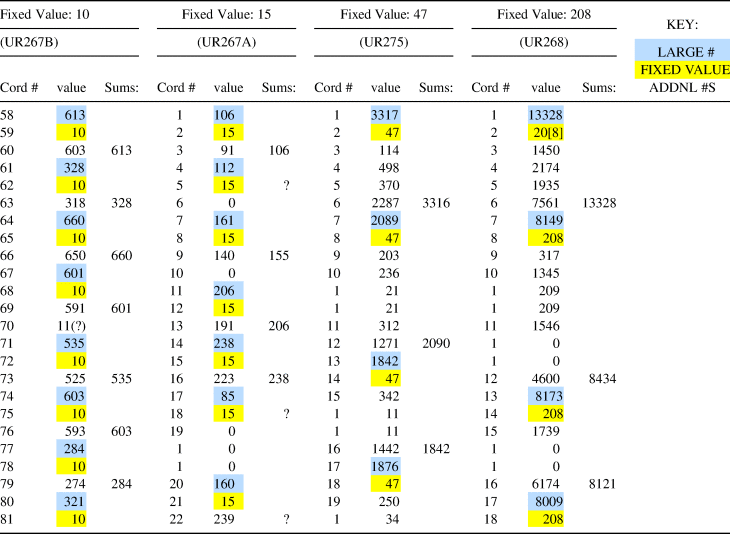
What are we to make of the arrangements of values displayed in Tables 1 and 2? We argue that these data provide evidence that, for the first time in Inka accounting history, accountants were setting aside quantities of produce being stored in an Inka storehouse for the support of that facility itself. In other words, khipukamayuqs were taxing deposits as a form of maintenance fees. We will turn in a moment to the question of how and why the proposed four taxation values may have varied and been fixed as they were.
How would the above hypothetical explanation of the use of the fixed value formula (a = b + c) seen in Table 1 have been put into operation? Let us take the example of fixed value 208, one of the khipus covered with peanuts in unit UA04 (Table 1). Let us suppose that this shipment of 13,328 units of peanuts—i.e., not peanuts, but units of peanutsFootnote 2—arrived from the fields for deposit at Inkawasi. After recording the total number of units included in the shipment, the accountants would have first removed 208 units of peanuts and set them aside for the support of the storage facility staff. Then, the administrators would have apportioned the remainder of the units of peanuts to different storage units within Qolqawasi – that is, 1,450 units would go to one storage unit, 2,174 units would go to another storage unit, 1,935 would go to a third, and the remaining 7,561 units would be stored in a fourth storage deposit. The khipu-keepers would now be able to account for the disposal of all 13,328 units of peanuts that came to the storage facility in that shipment, and a portion of that shipment (i.e., 208 units) would have been extracted for the support of the storage facility personnel. That is, the shipment would have been “taxed,” or assessed a certain amount, for the support of the facility and as a benefit to the state.
While the example discussed above adds up, in that the sum of the fixed value and the additional values is equal to the original deposit amount (13,328), nonetheless, as we see in Table 2, this is not true of some of the registries. For example, as we see in the right-hand set of columns, under “Fixed Value: 208,” one sequence begins with a deposit of 8,149 units and the subsequent values total to 8,434; this example is followed by one in which the sequence begins with 8,173 and the subsequent values sum to 8,121. That said, the calculations are, overall, close enough to leave no doubt that the type of accounting procedure and formula outlined above (i.e., a = b + c) was intended. Perhaps some of the variance was due to fewer items being deposited than were supposed to be (e.g., perhaps some personal siphoning off, on the part of the workers?), or perhaps the variances were due to general accounting “fuzziness,” or “slippage,” in what was, at the point in the development of accounting we are witnessing at Qolqawasi, still a new science.
Considering an Alternative Explanation for the Fixed Values
In the course of writing this article, our attention was drawn by Dr. Sabine Hyland (personal communication 2018) to a possible alternative explanation for the Inkawasi fixed values. In her study of colonial documents pertaining to the hacienda ledgers of Francisco de Maldonado for his maize fields in Guanchac, in the region of Cuzco, Peru, Hyland found that the hacienda administrator recorded the total number of cargas (llama loads) harvested each year over the 10-year period from 1604 to 1613. From those yearly harvest totals, a relatively fixed amount, of between 40–42 cargas of produce, was extracted for seed. While the amount of seed corn extracted from the harvests was relatively consistent, the total amount of cargas harvested varied considerably, from a low of 111 cargas in 1612 to a high of 610 cargas in 1609 (S. Hyland, personal communication 2018). The data from Maldonado's corn fields thus raises the possibility that the Inkawasi fixed values might have been quantities of produce removed from deposits as seeds (i.e., of chili peppers and peanuts) for the next year's planting.
The important point for us in considering the seed hypothesis is the absence of any notion of proportionality in the amount extracted for seed in the Guanchac data. That is, no matter how abundant or slim the harvest—i.e., from 111 cargas to 610 cargas—the administrator extracted virtually the same amount of seed—between 40 to 42 cargas. As we will see in the Inkawasi data (below), while the fixed numbers in these calculations were, indeed, fixed (no waffling, such as between 40–42), nonetheless, the variable sizes of the fixed values (i.e., 10, 15, 47, and 208) appear to reflect an interest in assessing the extraction, or assessment, in proportional terms. Thus, we argue that the Inka data show a concern for proportionality, whereas the colonial data display a fixed and rigid principle governing the extraction (see below). The latter reflects the kind of rigidity that is commonly seen in accounts of colonial tribute reckoning and extraction.
There are two additional considerations that lead us to favor the taxation explanation over the seed explanation. First, there is evidence of khipu accounting in other sites in the Cañete Valley (Larry Coben, personal communication 2014). We think that it would make more sense to extract and account for the removal of seeds locally, rather than to move all the harvest to Inkawasi, extract the seed, account for it, and then send the seed back out to the fields at planting time. And second, if produce was not extracted from deposits made to Inkawasi for the support of the staff, how would the Inka administrators have fed the considerable number of workers employed at the site? For these reasons, we believe that the explanation of the Inkawasi fixed values as amounts assessed as a form of tax to be most probable (although we refrain from being dogmatic on this point and find much of interest and value in Hyland's suggestion).
Why Were There Different Levels of Fixed Values?
The principal, and thorniest, issue to be addressed now is how to account for the different magnitudes, or unit sizes, represented in the different fixed values—i.e., 10, 15, 47, and 208—of our taxation formula. Addressing this issue will lead us to consider certain matters that we have not until now had the data to address with a great deal of specificity in Inka studies. For instance: How was “value” determined in the Inka world? More concretely, how was “equivalency”—the value of one item relative to that of another—arrived at? If all the different types of agricultural produce stored at Inkawasi were considered to be of equal value, we would expect that our fixed value would not vary from product to product, nor within the same product. However, as we have seen, the fixed/taxation values varied between 10 to 15 for chili peppers and between 47 to 208 for peanuts. So, why do we see differences not only between different types of agricultural produce but also within the same kind of produce? In short, how might the various taxation amounts shown in Table 1 have been arrived at?
The principal indicators we have to address these questions are the associations of certain khipus with certain types of agricultural produce. That is: a) khipus with fixed values of 10 and 15 were found covered by chili peppers; b) khipus with a fixed value of 47 were found covered by peanuts; and c) a khipu with a fixed value of 208 was also found under peanuts. Before addressing these associations and differences, it should be stated that we cannot know for certain that just because a given khipu was found associated with (i.e., covered by) a certain kind of produce, that khipu therefore necessarily recorded unit values of that same product. However, since this is the first time in the history of khipu studies that we have had any indication of a possible link between cord accounts and certain resources, it would be shortsighted not to pursue analysis based on these slim (yet admittedly uncertain) associations. Therefore, we accept until proven otherwise that the associations between certain kinds of agricultural produce and certain khipus was significant.
Peanuts or chili peppers, which is most valuable—or, more to the point, which was considered to be most valuable in the eyes of the Inkas? It would appear on the surface that chili peppers were the more valued crop, given that chili peppers were taxed at the rate of 10 or 15 units per deposit, while peanuts were taxed at either 47 or 208 units per deposit. Siphoning off (i.e., taxing), one product at a lower number of units per load than another product would seem to suggest that the former was more highly valued than the latter. Thus, our first assumption is that it took fewer units of a higher valued object to meet the taxation demand than a lower valued object. If this is/was true, we can speculate that, because chili pepper khipus record relatively low fixed values (10 or 15) as compared to peanut khipus (47 or 208), the former was more highly valued than the latter.
But even if the initial assumption stated above is correct, why were some chili peppers worth 10 taxation units per deposit while others were valued at 15? And why were some peanuts taxed at 47 units per deposit while others were taxed at 208 units? We can imagine two possible reasons for these differences. One is that there may have been some principle of quality control in place whereby some chili peppers and some peanuts were considered to be superior (e.g., of higher quality, or more tasty) than others. The other suggestion would be that the differences might reflect a differential valuation based on the origin of the produce. For instance, perhaps the different fields of the Inka from which the produce was harvested had different statuses. Another, similar suggestion would be that perhaps there were different “owners” of the fields from which the produce derived. We have noted above (citing Cobo) that all land was divided into three parts, one each for the Inka, the gods, and commoners. Perhaps in a provincial setting, like the middle Cañete Valley, the state would have drawn on the resources of both the Inka and the gods (it seems unlikely that produce would have been taken from the fields of commoners, as those provided the livelihood of the workers who would be responsible for planting, tending and harvesting the fields of the Inka and the gods). In such a scenario, the accountants might have deemed the chili peppers and peanuts of the gods’ fields more valuable than those belonging to the Inka—or vice versa.
Additional insight on these matters comes from looking more closely at the aggregate data for the total number of deposits registered on the four khipus in question (i.e., two for chili peppers and two for peanuts). From our study of these four khipus, we find that the chili pepper khipu with fixed value 10 (i.e., UR267B) records 12,421 units of chili peppers, while the chili pepper khipu with fixed value 15 (i.e., UR267A) records 3,214 units. The initial deposit sizes in khipu UR267B range between 1,411 and 121, and the average large number value (i.e., the average of the total number [ = 24] of deposits) on this khipu is 517.5. The tax of 10 units/deposit therefore represented 1.9% of the average deposit. The large number values for the 24 identifiable deposits on khipu UR267A range between 238 and 34, with an average of 133.9. The tax of 15 units/deposit represented 11.2% of the average deposit (Table 3).
Deposit Sizes and Taxation Values on Four Inkawasi Khipus.

Initially, the curious thing is that the accountants were taking the smaller tax levy (10 units/deposit) out of the larger quantity of chili peppers (UR267B = 12,421 total units deposited), while they were taking the larger tax levy (15 units/ deposit) out of the smaller quantity of chili peppers (UR267A = 3,214 total units deposited). Were they to have taken the smaller levy (10) out of the smaller number of deposits (3,241), and the larger levy (15) out of the larger number of deposits (12,421), we might argue that they were working on a general principle of proportionality in determining the tax/deposit. However, they did the opposite. Clearly, some principle other than proportionality was at work in these calculations. Perhaps this related to the differential quality, or relative value, of the chili peppers in the two batches of deposits, or it may have related to their different origins.
That there may indeed have been some other principle at work is suggested by the much higher tax as a percentage of the average deposit levied on khipu UR267A (= 11.2%) as opposed to that value for khipu UR267B (= 1.9%; Table 3). Perhaps the shipments of chili peppers registered in khipu UR267A were considered tastier, spicier, or otherwise more desirable than those registered in khipu UR267B, and thus, the higher proportion drawn off for the support of the facility. We cannot know the answer to this quandary with the information available to us at the present time.
Let us look at the calculations for the two peanut khipus, UR275 and UR268. Khipu UR275, which contains the fixed/tax value 47, displays a range of initial (i.e., “large number”) deposits between 1,278 units and 4,272 units. The total number of units of peanuts accounted for on this khipu is 56,446 units. Dividing this total by the number of deposits (i.e., 25), produces an average deposit size of 2,257.8 units/deposit. As for khipu UR268, the account containing the 208 fixed/tax value, the range of deposit sizes is between 7,135 and 15,039, with a total number of deposits of 276,558 units of peanuts in 27 shipments; this produces an average of 10,242.9 units/deposit (Table 3).
Thus, there appears with the peanut khipus to be a very precise principle of proportionality, or percentage assessment, at work in the relationship between the size of the tax and the average deposit size—i.e., the smaller tax value (47) is linked to the smaller average initial deposit size (2,257.8) as compared to the higher tax value (208) linked to the larger average initial deposit size (10,242.9). Here, 47 is 22.6% of 208, while 2,257.8 is 22.0% of 10,242.9. Thus, we can conclude, at least with peanuts, that the accountants were working with a principle of proportionality in determining the size of the fixed/tax value.
Looking again at Table 3, we see that the tax levied as a percentage of the average deposit size was almost exactly the same between peanut khipu UR275 (= 2.1%) and peanut khipu 268 (= 2.0%). This is close to the value for chili pepper khipu UR267B (= 1.9%). Thus, the accountants appear to have been working with a more or less standardized taxation percentage of 2.0%, with the outlier being the 11.2% levied on chili pepper khipu UR267A. Reflecting back on the seed hypothesis (see above), in which no accommodation was made for the proportion or percentage of seed extracted in relation to the size of the harvest, there appears to have been a relatively strong proportionality principle at work in Inkawasi accounting practice.
An additional note of interest concerning the data in Table 3 is that the number of deposit events—i.e., the numbers of initial deposits, or “large number” values—registered on the four khipus, varies narrowly between 24 to 27. We think this indicates that Inkawasi was receiving deposits of chili peppers and peanuts from 24–27 different shipment points within the Cañete and perhaps neighboring valleys. Therefore, this gives us, for the first time in Inka studies, a sense of the “catchment area” of the production of crops destined for deposit in an Inka storage facility.
Conclusions
The new data presented here allow us to see how, as in other ancient societies for which we have evidence for complex accounting regimes (e.g., Mesopotamia), change and innovation were ongoing in the Inka empire. If the Inkawasi accountants were indeed making the kinds of innovations in recordkeeping we argue for herein, this becomes a foil to any notion that knowledge and productive practices were fully constituted and static across the Inka empire at any time in its existence. The Inka khipukamayuq (“knot reader”) accountants were fully engaged and highly creative in conceiving of new, creative ways of managing state resources. As argued by one of us recently (Urton Reference Urton2017:20–23), the cadres of khipukamayuqs who served the Inkas should be understood as a major force for formulating and maintaining state institutions throughout the territory of Tawantinsuyu. From all we can learn about the timing of the Inka conquest of the south coast of Peru (e.g., Marcus Reference Marcus2017), the innovations in accounting we have examined here were occurring probably no more than a generation before the Spanish invasion of Tawantinsuyu, beginning in 1532. Inkawasi was a new kind of facility in the Inka imperial infrastructure, and as such, the management of the site stimulated new accounting procedures.
If the hypotheses and arguments concerning the invention of Inka taxation presented in this paper are convincing, this may open up new fields of contemplation and speculation on how accounting might have evolved in the Andes if Tawantinsuyu had not been invaded by the Spanish. We speculate that central to the forces driving such changes would have been the need to standardize taxation values, as well as to institute adequate and sufficient means for ensuring checks-and-balances accounting. One of us has noted elsewhere (Urton Reference Urton2005, Reference Urton2017) the many different account recording methods and practices that are evidenced in khipus from around the empire. These include arrangements of registries in paired sets that have many of the features of double-entry bookkeeping (Urton Reference Urton2009). Whether or not the Inka accountants invented their own version of what is often considered the crown jewel of Western accounting—i.e., double-entry bookkeeping—is an issue that awaits the closer scrutiny of the corpus of khipus known to date.Footnote 3
Another question that arises from the material presented here is whether or not the new accounting regime emerging at Inkawasi might have become more stabilized or standardized over time. That is, we have noted the different valuations of chili peppers (10 and 15) and peanuts (47 and 208), as well as the somewhat less convincing evidence for other possible fixed values (i.e., 17 and 30; see footnote 3). We can only speculate on whether or not the variability in taxation rates might possibly have become more stable, or fixed, had the accounting activities at the site not been brought to an abrupt end by the Spanish conquest.
And finally, pursuing alternative historical speculation a bit further, had the Spaniards not invaded Tawantinsuyu, we wonder if the general forces and logic of financing that gave rise to the taxation innovation at Inkawasi might have resulted in an expansion of the application of this financial instrument more broadly across Inka society. Specifically, might some form of taxation eventually have been imposed on commoners, the Hatunruna (“the great people”), in addition to their mit'a (corvée) obligation? Becoming accustomed to levying an assessed amount, or tax, on produce coming into a state facility, the Inka khipukamayuq accountants around Tawantinsuyu might well have conceived of the desirability of extending such an assessment on the population at large, resulting in the levying of both corvée and tax liabilities on all subjects of the empire. In short, our discovery of a nascent form of taxation that was beginning to emerge in the late years of Inka prehistory may contain the kernel of a motivation that might have caused this ancient Andean state to have evolved a financing strategy more in line with that of most other empires of the ancient world—the taxing of subject households.
Acknowledgments
On the part of Urton, thanks go out to: Patricia Landa for allowing Urton to study the Inkawasi khipus in her home laboratory, in Miraflores; to Julio Miguel Saldaña Campos, Yazmin Gómez Casaverde, and Julia L. Meyerson for help in studying the Inkawasi khipus; and to Luis Jaime Castillo Butters for facilitating, and accompanying Urton on, two visits to Inkawasi, in January and August, 2014. Special thanks go to Jon Clindaniel and Manuel Medrano for reading and commenting on earlier drafts of the paper and to Sabine Hyland and Terence D'Altroy (two of the readers for Latin American Antiquity) for their extremely helpful and insightful comments on the paper. We are especially grateful to Sabine Hyland for permission to cite her unpublished data from her study of the hacienda accounts of Francisco de Maldonado (1604–1613). Urton expresses his great appreciation to the National Science Foundation (research grant #1111489) for providing the funds that made his research on the Inkawasi khipus possible. Dr. Chu's fieldwork at Incahuasi was made possible with funding from the Gobierno Regional de Lima and Plan COPESCO Nacional; Chu thanks Rosio Gonzales for her neverending and continuous support, and Daniel Davila, Diana Carhuanina, and Manuel Calongos for their support in the fieldwork. Special thanks to Patricia Landa's outstanding help in the subsequent materials conservation and analysis.
Data Availability Statement
All data from the reading of khipus from Inkawasi relevant to the analysis presented in this study appear in Supplemental Table 1. The lead author (Urton) is currently working to revise his khipu database (KDB) website. With that revision, data from the study of all khipus excavated at Inkawasi (including those not discussed herein) will be uploaded to the Data Tables page at the KDB website (http://khipukamayuq.fas.harvard.edu/DataTables.html). Until (and after) that time, any data desired by researchers pertaining to the Inkawasi khipu archive may be obtained by writing to gurton@fas.harvard.edu.
Supplemental Material
For supplementary material accompanying this article, visit https://doi.org/10.1017/laq.2018.64.
Supplemental Table 1. Fixed Values in Four Inkawasi Khipus.